

The DOI matches its Crossref record; 157 of the 157 references it cites were found in a registry or an index.
Advances in understanding and treating persecutory delusions: a review
Open accessAbstract
PURPOSE: Persecutory delusions are a central psychotic experience, at the severe end of a paranoia spectrum in the general population. The aim of the review is to provide an introduction to the understanding of persecutory delusions, highlight key putative causal factors that have the potential to be translated into efficacious treatment, and indicate future research directions. METHODS: A narrative literature review was undertaken to highlight the main recent areas of empirical study concerning non-clinical and clinical paranoia. RESULTS: Six main proximal causal factors are identified: a worry thinking style, negative beliefs about the self, interpersonal sensitivity, sleep disturbance, anomalous internal experience, and reasoning biases. Each has plausible mechanistic links to the occurrence of paranoia. These causal factors may be influenced by a number of social circumstances, including adverse events, illicit drug use, and urban environments. CONCLUSIONS: There have been numerous replicated empirical findings leading to a significant advance in the understanding of persecutory delusions, now beginning to be translated into cognitive treatments. The first trials specifically focussed on patients who have persecutory delusions in the context of psychotic diagnoses are occurring. Initial evidence of efficacy is very promising.
Overview
The claims and statistics of this paper haven’t been checked yet.
Run the check — free, no account needed. It reads the open-access text and checks the sources it cites.
Integrity signals
Registry
Cites
Statistics
Figures
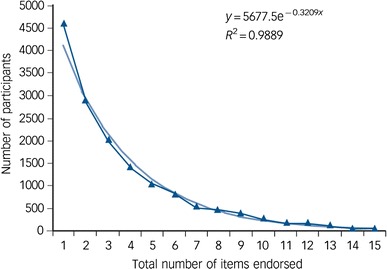
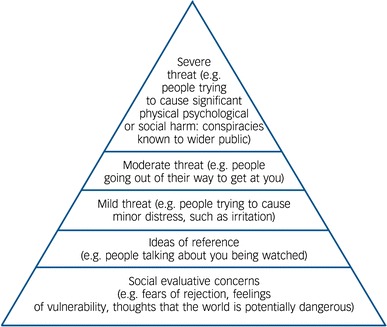
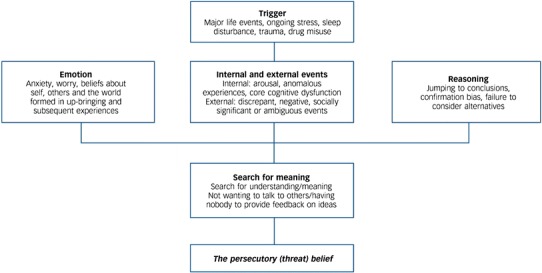
Verification
Claims the paper makes
The claims and statistics of this paper haven’t been checked yet.
Run the check — free, no account needed. It reads the open-access text and checks the sources it cites.
Claims other papers make about this one
Each is checked against this paper’s own text: does it say what the citing paper says it does?
The source backs part of the claim, not all of it — or backs it for a different population, condition or comparison.
In the citing paper
“Likewise, cognitive models of psychosis [23] emphasise the role of emotional processes, particularly anxiety, in the onset and maintenance cycle of psychotic symptoms [5, 24].”
From A brief CBT intervention for depersonalisation/derealisation in psychosis: Study protocol for a feasibility randomised controlled trial (2016) · cites this paper as [5]
Experimental — accuracy not yet measured
Self-check
Percentages, sums and reported differences re-computed from the paper’s own numbers.
The self-check needs the paper’s full text.
Citations
Cites
Confirmation Bias: A Ubiquitous Phenomenon in Many Guises
Nickerson, R. S. (1998) · Review of General Psychology · doi:10.1037/1089-2680.2.2.175 · Cited by 7,267
Frith, C., & Frith, U. (2005) · Current Biology · doi:10.1016/j.cub.2005.08.041 · Cited by 3,561
The Dopamine Hypothesis of Schizophrenia: Version III--The Final Common Pathway
Howes, O. D., & Kapur, S. (2009) · Schizophrenia Bulletin · doi:10.1093/schbul/sbp006 · Cited by 2,693
The cognitive neuropsychology of schizophrenia
(1993) · Choice Reviews Online · doi:10.5860/choice.31-0601 · Cited by 1,901
"Theory of Mind" in Schizophrenia: A Review of the Literature
Brune, M. (2005) · Schizophrenia Bulletin · doi:10.1093/schbul/sbi002 · Cited by 1,044
Comparative Meta-Analysis of Pharmacotherapy and Behavior Therapy for Persistent Insomnia
Smith, M. T., Perlis, M. L., Park, A., Smith, M. S., Pennington, J., Giles, D. E., & Buysse, D. J. (2002) · American Journal of Psychiatry · doi:10.1176/appi.ajp.159.1.5 · Cited by 863
Theory of mind in schizophrenia: Meta-analysis
Sprong, M., Schothorst, P., Vos, E., Hox, J., & Van Engeland, H. (2007) · British Journal of Psychiatry · doi:10.1192/bjp.bp.107.035899 · Cited by 832
Suspicious minds: The psychology of persecutory delusions
Freeman, D. (2007) · Clinical Psychology Review · doi:10.1016/j.cpr.2006.10.004 · Cited by 814
Self-citationCognitive approaches to delusions: a critical review of theories and evidence.
Garety, P. A., & Freeman, D. (1999) · British Journal of Clinical Psychology · doi:10.1348/014466599162700 · Cited by 794 · cited 1×
“ised from an updated search continuing on from our three earlier systematic literature reviews of delusions [24–26].”
BackgroundSelf-citationPsychological investigation of the structure of paranoia in a non-clinical population
Freeman, D., Garety, P. A., Bebbington, P. E., Smith, B., Rollinson, R., Fowler, D., Kuipers, E., Ray, K., & Dunn, G. (2005) · British Journal of Psychiatry · doi:10.1192/bjp.186.5.427 · Cited by 786
Self-citation
Research works printed but not linked: 2
- Tiernan B, Tracey R, Shannon C (2014) Paranoia and self-concepts in psychosis. Psychiatry Res 30:202–313
- Freeman D, Freeman J (2012) You can be happy: the scientifically proven way to change how you feel. Prentice Hall Life, Harlow
Cited by
Sorted by citations
Items 301–348 of 348
Is the paranoia as defence model of persecutory delusions defensible?
Shawyer, F. (2018) · The Lancet Psychiatry · doi:10.1016/s2215-0366(18)30386-9
Kognitiven Verzerrungen und Wahn wirksam begegnen
Mehl, S. (2018) · Zeitschrift für Klinische Psychologie und Psychotherapie · doi:10.1026/1616-3443/a000497
Comment utiliser les thérapies cognitives et comportementales ?
Yazbek, H., Bortolon, C., de Connor, A., & Raffard, S. (2019) · Elsevier eBooks · doi:10.1016/b978-2-294-76179-9.00012-7
Psychotherapeutische und psychosoziale Interventionen (Modul 4b)
Gäebel, W., Hasan, A., & Falkai, P. (2019) · Springer eBooks · doi:10.1007/978-3-662-59380-6_6
Behandlung unter besonderen Bedingungen (Modul 4c)
Gäebel, W., Hasan, A., & Falkai, P. (2019) · Springer eBooks · doi:10.1007/978-3-662-59380-6_7
Allgemeine Grundlagen (Modul 1)
Gäebel, W., Hasan, A., & Falkai, P. (2019) · Springer eBooks · doi:10.1007/978-3-662-59380-6_1
Persecutory delusions and personal goals
Vorontsova, N. (2015)
What Makes a Belief Seem Implausible to Others? A Q Methodology Study of Conspiracy Beliefs
Daniel, L. (2020) · UEL Research Repository (University of East London) · doi:10.15123/uel.88850
Delmastro, M., & Paciello, M. (2022) · Research Square · doi:10.21203/rs.3.rs-1131403/v1
Facteurs psychologiques et neuropsychologiques du processus délirant dans les psychoses de l’adulte
Simon, B., & Tranchard, M. (2022) · Annales Médico-psychologiques revue psychiatrique · doi:10.1016/j.amp.2022.08.003
A Dynamic-Maturational Framework for the Study of Psychosis and Attachment Theory
Jack, A. H., & Wilson, S. A. (2022) · Journal of Experimental Psychopathology · doi:10.1177/20438087221142456 · Cited by 1
Farr, J., Rhodes, J., Baruch, E., & Smith, J. A. (2023) · Psychosis · doi:10.1080/17522439.2022.2163686 · Cited by 1
Martínez, A. P., & Bentall, R. P. (2023) · Elsevier eBooks · doi:10.1016/b978-0-323-91497-0.00247-2
Dernbach, M. R., & Carpenter, J. E. (2024) · Journal of Medical Toxicology · doi:10.1007/s13181-024-00995-1
فسخودی, م. ا., Karsazi, H., Masjedi‐Arani, A., Vand, H. D. A., & Kianimoghadam, A. S. (2024) · Research Square · doi:10.21203/rs.3.rs-4007007/v1
Cognitive Behavioral Management of Delusional Disorder: A Clinical Case Study
Shahid, A., & Ishfaq, K. (2019) · PJPPRP · doi:10.62663/pjpprp.v10i2.64
Navigating the Twisted Path of Delusional Disorder: A Patient Case Study
Waseem, A., & Butt, M. G. (2024) · Pakistan Journal of Medical and Health Sciences · doi:10.53350/pjmhs0202418171
Bridging Perspectives - A Review and Synthesis of 52 Theoretical Models of Delusions (Preprint)Preprint
Denecke, S., Schönig, S. N., Bott, A., Faße, J. L., & Lincoln, T. M. (2024) · doi:10.31234/osf.io/bc6a8
Can neurocognitive performance account for dimensional paranoid ideation?
Wong, A., Baughman, F. D., Mullan, B. A., Heslop, K., Dauer, E., & Haywood, D. (2024) · Cognitive Neuropsychiatry · doi:10.1080/13546805.2024.2425322
Ahmad, A., Malik, I. A., Bakhtawar, S., Ghafoor, A. A., & Mirza, J. (2025) · The Critical Review of Social Sciences Studies · doi:10.59075/q3hhwg72 · Cited by 4
Nonverbal correlates of paranoid ideation – a systematic literature review
Haarms, R., Jongsma, H. E., Geraets, C. N. W., & Veling, W. (2025) · Psychological Medicine · doi:10.1017/s0033291725001230
Social danger and medico-legal risks in paranoia
Iacob, V. T., Chirilă, B. D., Furnică, C., Scripcaru, C., & Scripcaru, A. (2025) · Bulletin of Integrative Psychiatry · doi:10.36219/bpi.2025.3.04
Accounting for Emotion in the Psychopathology of Acute Schizophrenia
Margariti, M. M. (2025) · Journal of Integrative Neuroscience · doi:10.31083/jin45123
Trucharte, A., Peinado, V., Valiente, C., Contreras, A., Espinosa, R., Shevlin, M. E., & Vázquez, C. (2025) · Psychosis · doi:10.1080/17522439.2025.2573476
Assessing measurement invariance of paranoia scales across racial and ethnic groups in the U.S.
Bart, T. A., Hricovec, M. M., Taylor, S., Amlong, W., & Cicero, D. C. (2025) · Schizophrenia Research · doi:10.1016/j.schres.2025.10.026 · Cited by 1
Berkhof, M., van der Stouwe, E. C. D., Lestestuiver, B., van’t Hag, E., van Grunsven, R., de Jager, J., Kooijmans, E., Zandee, C. E. R., Staring, A. B. P., Pot-Kolder, R. M. C. A., et al. (2021) · Figshare · doi:10.6084/m9.figshare.16786866
Vassall, S. G., Kittleson, A. R., Halverson, A. S., Schock, G. V., Leslie, E., Dykens, E., Roof, E., Sheffield, J. M., & Bress, K. S. (2025) · medRxiv · doi:10.64898/2025.12.15.25341842 · Cited by 1
Self-Reflection Protects Behavior from Volatile Beliefs Linked to Paranoia
Suthaharan, P., Castiello, S., Ang, Y., & Corlett, P. (2026) · Computational Psychiatry · doi:10.5334/cpsy.150 · Cited by 1
Garandeau, C. F., Johander, E., Turunen, T., & Salmivalli, C. (2026) · Research on Child and Adolescent Psychopathology · doi:10.1007/s10802-026-01450-1
Hokayem, C., Haddad, G., Fawaz, M. A., Hallit, R. R., Malaeb, D. N., Obeïd, S., Hallit, S. R., & Fekih‐Romdhane, F. (2026) · International Journal of Social Psychiatry · doi:10.1177/00207640261433235
Rossignol, M., Cruz, A. R. D. L., & Lefebvre, L. (2026) · Psychiatry Research Communications · doi:10.1016/j.psycom.2026.100256
A review and integration of models on delusion maintenance
Lincoln, T. M., Romberg, H., Torrents‐Rodas, D., & Bott, A. (2026) · Psychological Medicine · doi:10.1017/s0033291726103705
Niederlohmann, E. (2026) · doi:10.2196/preprints.105731
Fanti, E., Nitti, G., Pisati, E., Sarno, M. D., Felici, C., Pincus, A. L., Madeddu, F., Preti, E., & Pierro, R. D. (2026) · Current Psychology · doi:10.1007/s12144-026-09815-x
Symptom networks of therapy-seeking individuals with comorbid psychosis and PTSD
Frost, R., O’Driscoll, C., PETERS, E. R., Varese, F., Steel, C., Underwood, R., Swan, S., & Hardy, A. (2026) · Psychological Medicine · doi:10.1017/s0033291726104978
A systematic review of the clinical correlates of delusions in Parkinson's disease.
Sharma, T., Lenka, A., McLachlan, E., Foley, J. A., & Reeves, S. (2026) · Clinical Parkinsonism & Related Disorders · doi:10.1016/j.prdoa.2026.100493
Do Psychological Interventions Reduce Paranoia in Adolescents? A Systematic Review
Tierney-Sutton, L., Taylor, C. D. J., Pile, V., Watling, D., Lobo, S., Courten, E., & Kingston, J. L. (2026) · Clinical Child and Family Psychology Review · doi:10.1007/s10567-026-00587-1
Eren, B., & Kumova, F. (2025) · Nesne Psikoloji Dergisi · doi:10.7816/nesne-13-35-04
Widyasari, D. C., Kingston, J., Schlier, B., Clark, T., & Bentall, R. (2026) · Clinical Child Psychology and Psychiatry · doi:10.1177/13591045261494383
Involuntary treatment of delusional disorder, persecutory type
Scott, R. J., & Aboud, A. (2026) · Psychiatry Psychology and Law · doi:10.1080/13218719.2026.2728104
Metadata
- Authors
- Freeman, D., & Garety, P.
- Affiliations
- Warneford Hospital (GB)
- King's College London (GB)
- Corresponding author
- Freeman, Daniel
- Venue
- Social Psychiatry and Psychiatric Epidemiology
- Published
- 2014-07-09
- Volume
- 49
- Issue
- 8
- Pages
- 1179-1189
- ISSN
- 0933-7954 (ISSN-L)
- 1433-9285
- PMC
- PMC4108844
- OpenAlex
- W2013939918
- Cited by
- 348
- References
- 157
- Citations by year
- 2026: 14 · 2025: 23 · 2024: 24 · 2023: 22 · 2022: 18 · 2021: 22 · 2020: 36 · 2019: 41 · 2018: 37 · 2017: 43 · 2016: 35 · 2015: 29 · 2014: 4
- FWCI
- 5.09
- Type
- journal article
- Language
- en
- Open access
- hybrid
- doi.org
- Locations
- Social Psychiatry and Psychiatric Epidemiology (publishedVersion, cc-by)
- Europe PMC (PubMed Central) (publishedVersion, cc-by)
- PubMed Central (publishedVersion, cc-by)
- PubMed (publishedVersion)
- Research Portal (King's College London) (submittedVersion, other-oa)
- Funders
- South London and Maudsley NHS Foundation Trust
- National Institute for Health and Care Research (NF-SI-0510-10121)
- King's College London
- Medical Research Council (G0902308)
- Topics
- Health Sciences › Medicine › Psychiatry and Mental health › Schizophrenia research and treatment
- Social Sciences › Arts and Humanities › Philosophy › Mental Health and Psychiatry
- Life Sciences › Neuroscience › Cognitive Neuroscience › Hallucinations in medical conditions
- Keywords
- persecutory delusions, paranoia, negative self-beliefs, interpersonal sensitivity, sleep disorders, reasoning biases, cognitive intervention, psychosis, illicit drug use, urban environment, life events
- MeSH terms
- Adult, Aged, Anxiety, Culture, Delusions, Female, Humans, Internal-External Control, Male, Middle Aged, Paranoid Disorders, Psychotic Disorders, Risk Factors, Schizophrenia, Paranoid, Severity of Illness Index, Thinking, Cognitive Behavioral Therapy
About these checks
Registry, retraction, Cites and statistics results are computed, not judged, with one exception: a printed reference that no index lists is read once by a model before it counts as a citation error. Claims are extracted by a model and kept only when their quote appears verbatim in the text; each cited source is then checked, with a model’s help, for whether it says what the claim relies on. Those verdicts can be wrong — read the claim’s quote and the cited source before relying on one.
Statistics and arithmetic are recomputed, not judged.
Confidence bands are shown only for fields calibrated on our annotated test set. None is calibrated yet, so no band is shown.
What counts as a claim ›How we measure confidence ›How we check this ›
Are you an author, or do you see a problem with this page? Request a review
