

The DOI matches its Crossref record; 157 of the 157 references it cites were found in a registry or an index.
Advances in understanding and treating persecutory delusions: a review
Open accessAbstract
PURPOSE: Persecutory delusions are a central psychotic experience, at the severe end of a paranoia spectrum in the general population. The aim of the review is to provide an introduction to the understanding of persecutory delusions, highlight key putative causal factors that have the potential to be translated into efficacious treatment, and indicate future research directions. METHODS: A narrative literature review was undertaken to highlight the main recent areas of empirical study concerning non-clinical and clinical paranoia. RESULTS: Six main proximal causal factors are identified: a worry thinking style, negative beliefs about the self, interpersonal sensitivity, sleep disturbance, anomalous internal experience, and reasoning biases. Each has plausible mechanistic links to the occurrence of paranoia. These causal factors may be influenced by a number of social circumstances, including adverse events, illicit drug use, and urban environments. CONCLUSIONS: There have been numerous replicated empirical findings leading to a significant advance in the understanding of persecutory delusions, now beginning to be translated into cognitive treatments. The first trials specifically focussed on patients who have persecutory delusions in the context of psychotic diagnoses are occurring. Initial evidence of efficacy is very promising.
Overview
The claims and statistics of this paper haven’t been checked yet.
Run the check — free, no account needed. It reads the open-access text and checks the sources it cites.
Integrity signals
Registry
Cites
Statistics
Figures
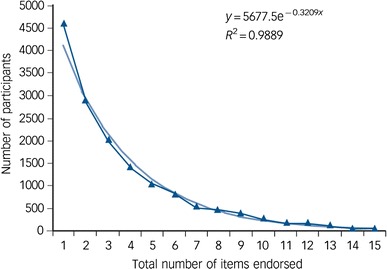
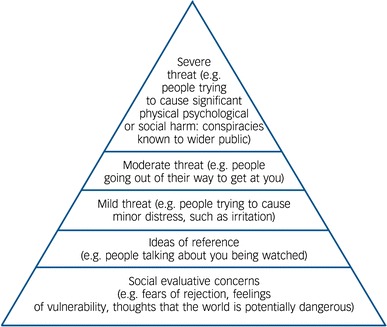
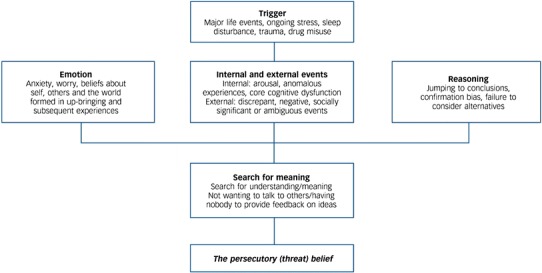
Verification
Claims the paper makes
The claims and statistics of this paper haven’t been checked yet.
Run the check — free, no account needed. It reads the open-access text and checks the sources it cites.
Claims other papers make about this one
Each is checked against this paper’s own text: does it say what the citing paper says it does?
The source backs part of the claim, not all of it — or backs it for a different population, condition or comparison.
In the citing paper
“Likewise, cognitive models of psychosis [23] emphasise the role of emotional processes, particularly anxiety, in the onset and maintenance cycle of psychotic symptoms [5, 24].”
From A brief CBT intervention for depersonalisation/derealisation in psychosis: Study protocol for a feasibility randomised controlled trial (2016) · cites this paper as [5]
Experimental — accuracy not yet measured
Self-check
Percentages, sums and reported differences re-computed from the paper’s own numbers.
The self-check needs the paper’s full text.
Citations
Cites
Confirmation Bias: A Ubiquitous Phenomenon in Many Guises
Nickerson, R. S. (1998) · Review of General Psychology · doi:10.1037/1089-2680.2.2.175 · Cited by 7,267
Frith, C., & Frith, U. (2005) · Current Biology · doi:10.1016/j.cub.2005.08.041 · Cited by 3,561
The Dopamine Hypothesis of Schizophrenia: Version III--The Final Common Pathway
Howes, O. D., & Kapur, S. (2009) · Schizophrenia Bulletin · doi:10.1093/schbul/sbp006 · Cited by 2,693
The cognitive neuropsychology of schizophrenia
(1993) · Choice Reviews Online · doi:10.5860/choice.31-0601 · Cited by 1,901
"Theory of Mind" in Schizophrenia: A Review of the Literature
Brune, M. (2005) · Schizophrenia Bulletin · doi:10.1093/schbul/sbi002 · Cited by 1,044
Comparative Meta-Analysis of Pharmacotherapy and Behavior Therapy for Persistent Insomnia
Smith, M. T., Perlis, M. L., Park, A., Smith, M. S., Pennington, J., Giles, D. E., & Buysse, D. J. (2002) · American Journal of Psychiatry · doi:10.1176/appi.ajp.159.1.5 · Cited by 863
Theory of mind in schizophrenia: Meta-analysis
Sprong, M., Schothorst, P., Vos, E., Hox, J., & Van Engeland, H. (2007) · British Journal of Psychiatry · doi:10.1192/bjp.bp.107.035899 · Cited by 832
Suspicious minds: The psychology of persecutory delusions
Freeman, D. (2007) · Clinical Psychology Review · doi:10.1016/j.cpr.2006.10.004 · Cited by 814
Self-citationCognitive approaches to delusions: a critical review of theories and evidence.
Garety, P. A., & Freeman, D. (1999) · British Journal of Clinical Psychology · doi:10.1348/014466599162700 · Cited by 794 · cited 1×
“ised from an updated search continuing on from our three earlier systematic literature reviews of delusions [24–26].”
BackgroundSelf-citationPsychological investigation of the structure of paranoia in a non-clinical population
Freeman, D., Garety, P. A., Bebbington, P. E., Smith, B., Rollinson, R., Fowler, D., Kuipers, E., Ray, K., & Dunn, G. (2005) · British Journal of Psychiatry · doi:10.1192/bjp.186.5.427 · Cited by 786
Self-citation
Research works printed but not linked: 2
- Tiernan B, Tracey R, Shannon C (2014) Paranoia and self-concepts in psychosis. Psychiatry Res 30:202–313
- Freeman D, Freeman J (2012) You can be happy: the scientifically proven way to change how you feel. Prentice Hall Life, Harlow
Cited by
Sorted by citations
Dudley, R., Taylor, P., Wickham, S., & Hutton, P. (2016) · Schizophrenia Bulletin · doi:10.1093/schbul/sbv150 · Cited by 353
Reininghaus, U., Kempton, M. J., Valmaggia, L., Craig, T. K. J., Garety, P., Onyejiaka, A., Gayer-Anderson, C., So, S. H., Hubbard, K., Beards, S., et al. (2016) · Schizophrenia Bulletin · doi:10.1093/schbul/sbv190 · Cited by 304
Self-citationFreeman, D., Dunn, G., Startup, H., Pugh, K., Cordwell, J., Mander, H., Černis, E., Wingham, G., Shirvell, K., & Kingdon, D. (2015) · The Lancet Psychiatry · doi:10.1016/s2215-0366(15)00039-5 · Cited by 295
Self-citationThe role of sleep dysfunction in the occurrence of delusions and hallucinations: A systematic review
Reeve, S., Sheaves, B., & Freeman, D. (2015) · Clinical Psychology Review · doi:10.1016/j.cpr.2015.09.001 · Cited by 273
“A focus on individual psychotic experiences has allowed development of detailed theoretical models, for example for paranoia (Freeman, Garety, Kuipers, Fowler, & Bebbington, 2002) accompanied by corresponding innovations in treatment (Freeman & Garety, 2014).”
BackgroundSelf-citationChildhood adversities and psychosis: evidence, challenges, implications
Morgan, C., & Gayer-Anderson, C. E. (2016) · World Psychiatry · doi:10.1002/wps.20330 · Cited by 278
Pot-Kolder, R. M. C. A., Geraets, C. N. W., Veling, W., van Beilen, M., Staring, A. B. P., Gijsman, H. J., Delespaul, P. A. E. G., & van der Gaag, M. (2018) · The Lancet Psychiatry · doi:10.1016/s2215-0366(18)30053-1 · Cited by 239
Eichner, C., & Berna, F. (2016) · Schizophrenia Bulletin · doi:10.1093/schbul/sbv225 · Cited by 218
Hardy, A. (2017) · Frontiers in Psychology · doi:10.3389/fpsyg.2017.00697 · Cited by 224
Ross, R. M., McKay, R., Coltheart, M., & Langdon, R. (2015) · Schizophrenia Bulletin · doi:10.1093/schbul/sbu187 · Cited by 198
Koyanagi, A., & Stickley, A. (2015) · Sleep · doi:10.5665/sleep.5232 · Cited by 188
Feyaerts, J., Henriksen, M. G., Vanheule, S., Myin‐Germeys, I., & Sass, L. A. (2021) · The Lancet Psychiatry · doi:10.1016/s2215-0366(20)30460-0 · Cited by 175
Rosser, B. A. (2019) · Cognitive Therapy and Research · doi:10.1007/s10608-018-9964-z · Cited by 157
Moffa, G., Catone, G., Kuipers, J., Kuipers, E., Freeman, D. H., Marwaha, S., Lennox, B., Broome, M. R., & Bebbington, P. (2017) · Schizophrenia Bulletin · doi:10.1093/schbul/sbx013 · Cited by 151
Self-citationMækelæ, M. J., Reggev, N., Dutra, N. B., Tamayo, R. M., Silva-Sobrinho, R. A., Klevjer, K., & Pfuhl, G. (2020) · Royal Society Open Science · doi:10.1098/rsos.200644 · Cited by 149
Ludwig, L., Werner, D., & Lincoln, T. M. (2019) · Clinical Psychology Review · doi:10.1016/j.cpr.2019.101746 · Cited by 147
Mehl, S., Werner, D., & Lincoln, T. M. (2015) · Frontiers in Psychology · doi:10.3389/fpsyg.2015.01450 · Cited by 129
Freeman, D. H., Pugh, K., Dunn, G., Evans, N., Sheaves, B., Waite, F., Černis, E., Lister, R., & Fowler, D. G. (2014) · Schizophrenia Research · doi:10.1016/j.schres.2014.10.038 · Cited by 137
Self-citationWilliams, J., Bucci, S., Berry, K., & Varese, F. (2018) · Clinical Psychology Review · doi:10.1016/j.cpr.2018.05.009 · Cited by 146
A systematic review on mediators between adversity and psychosis: potential targets for treatment
Alameda, L., Rodríguez, V., Carr, E., Aas, M., Trotta, G., Marino, P., Vorontsova, N., Herane-Vives, A., Gadelrab, R., Spinazzola, E., et al. (2020) · Psychological Medicine · doi:10.1017/s0033291720002421 · Cited by 136
Childhood adversity and psychosis: a systematic review of bio-psycho-social mediators and moderators
Sideli, L., Murray, R. M., Schimmenti, A., Corso, M., Barbera, D. L., Trotta, A., & Fisher, H. L. (2020) · Psychological Medicine · doi:10.1017/s0033291720002172 · Cited by 119
Reininghaus, U., Depp, C. A., & Myin‐Germeys, I. (2015) · Schizophrenia Bulletin · doi:10.1093/schbul/sbv193 · Cited by 109
Moritz, S., Pfuhl, G., Lüdtke, T., Menon, M., Balzan, R. P., & Andreou, C. (2016) · Journal of Behavior Therapy and Experimental Psychiatry · doi:10.1016/j.jbtep.2016.07.004 · Cited by 99
Reininghaus, U., Klippel, A., Steinhart, H., Vaessen, T., van Nierop, M. M., Viechtbauer, W., Batink, T., Kasanova, Z., van Aubel, E., van Winkel, R., et al. (2019) · Trials · doi:10.1186/s13063-019-3912-4 · Cited by 106
Klippel, A., Myin‐Germeys, I., Chavez‐Baldini, U., Preacher, K. J., Kempton, M. J., Valmaggia, L., Calem, M., So, S. H., Beards, S., Hubbard, K., et al. (2016) · Schizophrenia Bulletin · doi:10.1093/schbul/sbw185 · Cited by 100
Self-citationThe network structure of paranoia in the general population
Bell, V., & O’Driscoll, C. (2018) · Social Psychiatry and Psychiatric Epidemiology · doi:10.1007/s00127-018-1487-0 · Cited by 83
The paranoia as defence model of persecutory delusions: a systematic review and meta-analysis
Murphy, P., Bentall, R. P., Freeman, D. H., O’Rourke, S. J., & Hutton, P. (2018) · The Lancet Psychiatry · doi:10.1016/s2215-0366(18)30339-0 · Cited by 95
Self-citationFreeman, D. H., Emsley, R., Dunn, G., Fowler, D. G., Bebbington, P., Kuipers, E., Jolley, S., Waller, H., Hardy, A., & Garety, P. A. (2014) · Schizophrenia Bulletin · doi:10.1093/schbul/sbu173 · Cited by 90
Self-citationBell, V., Raihani, N., & Wilkinson, S. (2021) · Clinical Psychological Science · doi:10.1177/2167702620951553 · Cited by 78
Lavin, R., Bucci, S., Varese, F., & Berry, K. (2019) · British Journal of Clinical Psychology · doi:10.1111/bjc.12231 · Cited by 95
Transdiagnostic Extension of Delusions: Schizophrenia and Beyond
Bebbington, P., & Freeman, D. H. (2017) · Schizophrenia Bulletin · doi:10.1093/schbul/sbw191 · Cited by 84
Self-citationWaller, H., Emsley, R., Freeman, D., Bebbington, P., Dunn, G., Fowler, D., Hardy, A., Kuipers, E., & Garety, P. (2015) · Journal of Behavior Therapy and Experimental Psychiatry · doi:10.1016/j.jbtep.2015.02.007 · Cited by 77
Self-citationFurther evidence of a cumulative effect of social disadvantage on risk of psychosis
Stilo, S. A., Gayer-Anderson, C. E., Beards, S., Hubbard, K., Onyejiaka, A. N., Keraite, A., Borges, S., Mondelli, V., Dazzan, P., Pariante, C. M., et al. (2016) · Psychological Medicine · doi:10.1017/s0033291716002993 · Cited by 75
The effects of cannabidiol on persecutory ideation and anxiety in a high trait paranoid group
Hundal, H., Lister, R., Evans, N., Antley, A., Englund, A., Murray, R. M., Freeman, D. H., & Morrison, P. D. (2017) · Journal of Psychopharmacology · doi:10.1177/0269881117737400 · Cited by 70
Self-citationSocial Adversity and Psychosis: The Mediating Role of Cognitive Vulnerability
Jaya, E. S., Ascone, L., & Lincoln, T. M. (2016) · Schizophrenia Bulletin · doi:10.1093/schbul/sbw104 · Cited by 74
Lopes, B., Bortolon, C., & Jaspal, R. (2020) · Psychiatry Research · doi:10.1016/j.psychres.2020.113455 · Cited by 72
The lonely road to paranoia. A path-analytic investigation of loneliness and paranoia
Lamster, F., Lincoln, T. M., Nittel, C. M., Rief, W., & Mehl, S. (2017) · Comprehensive Psychiatry · doi:10.1016/j.comppsych.2016.12.007 · Cited by 75
Garety, P. A., Ward, T., Freeman, D. H., Fowler, D. G., Emsley, R., Dunn, G., Kuipers, E., Bebbington, P., Waller, H., Greenwood, K., et al. (2017) · Trials · doi:10.1186/s13063-017-2242-7 · Cited by 66
Self-citationParanoia and the social representation of others: a large-scale game theory approach
Raihani, N., & Bell, V. (2017) · Scientific Reports · doi:10.1038/s41598-017-04805-3 · Cited by 68
Valmaggia, L., Day, F., & Rus‐Calafell, M. (2016) · Social Psychiatry and Psychiatric Epidemiology · doi:10.1007/s00127-016-1245-0 · Cited by 70
McKetin, R., Baker, A., Dawe, S., Voce, A., & Lubman, D. I. (2017) · Psychiatry Research · doi:10.1016/j.psychres.2017.02.028 · Cited by 59
Nittel, C. M., Lincoln, T. M., Lamster, F., Leube, D., Rief, W., Kircher, T. T. J., & Mehl, S. (2018) · British Journal of Clinical Psychology · doi:10.1111/bjc.12174 · Cited by 62
Peyroux, É., Prost, Z., Danset-Alexandre, C., Brénugat-Herné, L., Carteau‐Martin, I., Gaudelus, B., Mam-Lam-Fook, C., Attali, D., Amado, I., Graux, J., et al. (2018) · Schizophrenia Research Cognition · doi:10.1016/j.scog.2018.10.001 · Cited by 66
A network analysis of post-traumatic stress and psychosis symptoms
Hardy, A., O’Driscoll, C., Steel, C., van der Gaag, M., & van den Berg, D. P. G. (2020) · Psychological Medicine · doi:10.1017/s0033291720001300 · Cited by 69
Subjective versus objective cognition: Evidence for poor metacognitive monitoring in schizophrenia
Moritz, S., Balzan, R. P., Bohn, F., Veckenstedt, R., Kolbeck, K., Bierbrodt, J., & Dietrichkeit, M. (2016) · Schizophrenia Research · doi:10.1016/j.schres.2016.08.021 · Cited by 55
Conflict and cooperation in paranoia: a large-scale behavioural experiment
Raihani, N., & Bell, V. (2017) · Psychological Medicine · doi:10.1017/s0033291717003075 · Cited by 52
A systematic review of self-report measures of paranoia.
Statham, V., Emerson, L., & Rowse, G. (2018) · Psychological Assessment · doi:10.1037/pas0000645 · Cited by 62
Paolini, E., Moretti, P., & Compton, M. T. (2016) · Psychiatry Research · doi:10.1016/j.psychres.2016.06.002 · Cited by 54
Loneliness and Psychotic Symptoms: The Mediating Role of Depression
Jaya, E. S., Hillmann, T. E., Reininger, K. M., Gollwitzer, A., & Lincoln, T. M. (2016) · Cognitive Therapy and Research · doi:10.1007/s10608-016-9799-4 · Cited by 60
Atherton, S., Antley, A., Evans, N., Černis, E., Lister, R., Dunn, G., Slater, M., & Freeman, D. H. (2014) · Behavioural and Cognitive Psychotherapy · doi:10.1017/s1352465814000496 · Cited by 55
Self-citationExperimentally induced social threat increases paranoid thinking
Saalfeld, V., Ramadan, Z., Bell, V., & Raihani, N. J. (2018) · Royal Society Open Science · doi:10.1098/rsos.180569 · Cited by 52
Interpersonal processes in paranoia: a systematic review
Meisel, S. F., Garety, P. A., Stahl, D. R., & Valmaggia, L. (2018) · Psychological Medicine · doi:10.1017/s0033291718000491 · Cited by 56
Self-citationEffects of online intervention for depression on mood and positive symptoms in schizophrenia
Moritz, S., Schröder, J., Klein, J. P., Lincoln, T. M., Andreou, C., Fischer, A., & Arlt, S. (2016) · Schizophrenia Research · doi:10.1016/j.schres.2016.04.033 · Cited by 53
Freeman, D., Bradley, J., Waite, F., Sheaves, B., DeWeever, N., Bourke, E., McInerney, J., Evans, N., Černis, E., Lister, R., et al. (2016) · Behavioural and Cognitive Psychotherapy · doi:10.1017/s1352465816000060 · Cited by 50
“Once developed, the beliefs concerning danger are maintained by a number of key factors (Freeman and Garety, 2014; Freeman, in press): worry brings implausible ideas to mind, keeps them there, and exacerbates the distress; negative self-beliefs lead the person to feel inferior and vulnerable;…”
BackgroundSelf-citationDimensions of Delusions and Attribution Biases along the Continuum of Psychosis
So, S. H., Tang, V. Y. H., & Leung, P. W. L. (2015) · PLoS ONE · doi:10.1371/journal.pone.0144558 · Cited by 55
Reasoning in psychosis: risky but not necessarily hasty
Moritz, S., Scheu, F., Andreou, C., Pfueller, U., Weisbrod, M., & Roesch-Ely, D. (2016) · Cognitive Neuropsychiatry · doi:10.1080/13546805.2015.1136611 · Cited by 46
Eddy, C. M. (2017) · Progress in Neuro-Psychopharmacology and Biological Psychiatry · doi:10.1016/j.pnpbp.2017.11.026 · Cited by 55
Delusional themes across affective and non-affective psychoses
Picardi, A., Fonzi, L., Pallagrosi, M., Gigantesco, A., & Biondi, M. (2018) · Frontiers in Psychiatry · doi:10.3389/fpsyt.2018.00132 · Cited by 50
Buck, B., Browne, J., Gagen, E. C., & Penn, D. L. (2020) · Journal of Mental Health · doi:10.1080/09638237.2020.1739240 · Cited by 49
Smith, L., Johns, L., & Mitchell, R. (2017) · Bipolar Disorders · doi:10.1111/bdi.12520 · Cited by 46
Bell, V., Mills, K. L., Modinos, G., & Wilkinson, S. (2017) · Clinical Psychological Science · doi:10.1177/2167702616677079 · Cited by 44
Stress is a bad advisor. Stress primes poor decision making in deluded psychotic patients
Moritz, S., Köther, U., Hartmann, M. M., & Lincoln, T. M. (2015) · European Archives of Psychiatry and Clinical Neuroscience · doi:10.1007/s00406-015-0585-1 · Cited by 44
Spontaneous future cognitions: an integrative review
Berntsen, D. (2018) · Psychological Research · doi:10.1007/s00426-018-1127-z · Cited by 50
Klippel, A., Schick, A., Myin‐Germeys, I., Rauschenberg, C., Vaessen, T., & Reininghaus, U. (2021) · Psychological Medicine · doi:10.1017/s0033291720004894 · Cited by 47
Visually Perceiving the Intentions of Others
Helton, G. (2017) · The Philosophical Quarterly · doi:10.1093/pq/pqx051 · Cited by 41
Rüegg, N., Moritz, S., Berger, T., Lüdtke, T., & Westermann, S. (2018) · BMC Psychiatry · doi:10.1186/s12888-018-1644-8 · Cited by 40
So, S. H., Chan, A. P., Chong, C. S. Y., Wong, M. H.-M., Lo, W. T.-L., Chung, D. W.-S., & Chan, S. S. M. (2015) · Frontiers in Psychology · doi:10.3389/fpsyg.2015.00730 · Cited by 39
Models of persecutory delusions: a mechanistic insight into the early stages of psychosis
Diaconescu, A. O., Hauke, D. J., & Borgwardt, S. (2019) · Molecular Psychiatry · doi:10.1038/s41380-019-0427-z · Cited by 44
Lüdtke, T., Kriston, L., Schröder, J., Lincoln, T. M., & Moritz, S. (2016) · Journal of Behavior Therapy and Experimental Psychiatry · doi:10.1016/j.jbtep.2016.08.014 · Cited by 39
Investigation of metamemory functioning in the at-risk mental state for psychosis
Eisenacher, S., Rausch, F., Ainser, F., Mier, D., Veckenstedt, R., Schirmbeck, F., Lewien, A., Englisch, S., Andreou, C., Moritz, S., et al. (2015) · Psychological Medicine · doi:10.1017/s0033291715001373 · Cited by 37
Pot-Kolder, R., Veling, W., Counotte, J., & van der Gaag, M. (2017) · Schizophrenia bulletin · doi:10.1093/schbul/sbx119 · Cited by 31
A Temporal Network Approach to Paranoia: A Pilot Study
Contreras, A., Valiente, C., Heeren, A., & Bentall, R. P. (2020) · Frontiers in Psychology · doi:10.3389/fpsyg.2020.544565 · Cited by 38
Unravelling psychosis: psychosocial epidemiology, mechanism, and meaning.
Bebbington, P. (2015) · Europe PMC (PubMed Central) · doi:10.11919/j.issn.1002-0829.215027 · Cited by 38
Gawęda, Ł., & Prochwicz, K. (2015) · European Psychiatry · doi:10.1016/j.eurpsy.2015.08.003 · Cited by 44
Can cognitive insight predict symptom remission in a first episode psychosis cohort?
O’Connor, J. A., Ellett, L., Ajnakina, O., Schoeler, T., Kollliakou, A., Trotta, A., Wiffen, B. D., Falcone, A. M., Di Forti, M., Murray, R. M., et al. (2017) · BMC Psychiatry · doi:10.1186/s12888-017-1210-9 · Cited by 37
Moritz, S., Lüdtke, T., Westermann, S., Hermeneit, J., Watroba, J., & Lincoln, T. M. (2016) · Schizophrenia Research · doi:10.1016/j.schres.2016.04.025 · Cited by 36
Bell, V., Velthorst, E., Almansa, J., Myin‐Germeys, I., Shergill, S. S., & Fett, A.-K. J. (2023) · Schizophrenia Research Cognition · doi:10.1016/j.scog.2023.100282 · Cited by 41
Social cognition and short-term prediction of suicidal ideation in schizophrenia
Depp, C. A., Villa, J., Schembari, B. C., Harvey, P. D., & Pinkham, A. E. (2018) · Psychiatry Research · doi:10.1016/j.psychres.2018.09.005 · Cited by 36
Paranoia and conspiracy: group cohesion increases harmful intent attribution in the Trust Game
Greenburgh, A., Bell, V., & Raihani, N. (2019) · PeerJ · doi:10.7717/peerj.7403 · Cited by 35
The predictive value of early maladaptive schemas in paranoid responses to social stress
Sundag, J., Ascone, L., & Lincoln, T. M. (2017) · Clinical Psychology & Psychotherapy · doi:10.1002/cpp.2128 · Cited by 34
Altered Perception of Environmental Volatility During Social Learning in Emerging Psychosis
Hauke, D. J., Wobmann, M., Andreou, C., Mackintosh, A., de Bock, R., Karvelis, P., Adams, R. A., Sterzer, P., Borgwardt, S., Röth, V., et al. (2024) · Computational Psychiatry · doi:10.5334/cpsy.95 · Cited by 35
Capturing behavioral indicators of persecutory ideation using mobile technology
Buck, B., Hallgren, K. A., Scherer, E. A., Brian, R., Wang, R., Wang, W., Campbell, A. T., Choudhury, T., Hauser, M., Kane, J. M., et al. (2019) · Journal of Psychiatric Research · doi:10.1016/j.jpsychires.2019.06.002 · Cited by 32
Masillo, A., Valmaggia, L., Saba, R., Brandizzi, M., Cascio, N. L., Telesforo, L., Venturini, P., Izzo, A., Mattioli, M. T., D’Alema, M., et al. (2017) · Early Intervention in Psychiatry · doi:10.1111/eip.12447 · Cited by 32
Reininghaus, U., Oorschot, M., Moritz, S., Gayer-Anderson, C. E., Kempton, M. J., Valmaggia, L., McGuire, P. K., Murray, R. M., Garety, P. A., Wykes, T., et al. (2018) · Schizophrenia Bulletin · doi:10.1093/schbul/sby116 · Cited by 34
Self-citationNeural arbitration between social and individual learning systems
Diaconescu, A. O., Stecy, M., Kasper, L., Burke, C. J., Nagy, Z., Mathys, C. D., & Tobler, P. N. (2020) · eLife · doi:10.7554/elife.54051 · Cited by 32
Shore, R., Strauss, C., Cavanagh, K., Hayward, M., & Ellett, L. (2017) · Mindfulness · doi:10.1007/s12671-017-0774-2 · Cited by 31
Worry and metacognitions as predictors of the development of anxiety and paranoia
Sun, X., So, S. H., Chan, R. C. K., Chiu, C., & Leung, P. W. L. (2019) · Scientific Reports · doi:10.1038/s41598-019-51280-z · Cited by 33
Editorial: Trauma, Psychosis and Posttraumatic Stress Disorder
Hardy, K. V., & Mueser, K. T. (2017) · Frontiers in Psychiatry · doi:10.3389/fpsyt.2017.00220 · Cited by 32
Pathological Jealousy: An Interactive Condition
Seeman, M. V. (2016) · Psychiatry · doi:10.1080/00332747.2016.1175838 · Cited by 30
Do depressive symptoms predict paranoia or vice versa?
Moritz, S., Göritz, A. S., McLean, B., Westermann, S., & Brodbeck, J. (2017) · Journal of Behavior Therapy and Experimental Psychiatry · doi:10.1016/j.jbtep.2016.10.002 · Cited by 30
Freeman, D. H., Waite, F., Emsley, R., Kingdon, D., Davies, L. M., Fitzpatrick, R. M., & Dunn, G. (2016) · Trials · doi:10.1186/s13063-016-1245-0 · Cited by 29
Self-citationMonocausal attribution and its relationship with reasoning biases in schizophrenia
Moritz, S., Bentall, R. P., Kolbeck, K., & Roesch-Ely, D. (2017) · Schizophrenia Research · doi:10.1016/j.schres.2017.06.057 · Cited by 28
Ancient Divination and Experience
Driediger-Murphy, L. G., & Eidinow, E. (2019) · doi:10.1093/oso/9780198844549.001.0001 · Cited by 31
Inflexible social inference in individuals with subclinical persecutory delusional tendencies
Wellstein, K. V., Diaconescu, A. O., Bischof, M., Rüesch, A., Paolini, G., Aponte, E. A., Ullrich, J., & Stephan, K. E. (2019) · Schizophrenia Research · doi:10.1016/j.schres.2019.08.031 · Cited by 28
Hesse, K., Kriston, L., Mehl, S., Wittorf, A., Wiedemann, W., Wölwer, W., & Klingberg, S. (2015) · Schizophrenia Bulletin · doi:10.1093/schbul/sbv055 · Cited by 27
Murphy, R., Goodall, K., & Woodrow, A. (2020) · British Journal of Clinical Psychology · doi:10.1111/bjc.12247 · Cited by 31
Jaya, E. S., & Lincoln, T. M. (2016) · Psychiatry Research · doi:10.1016/j.psychres.2016.09.002 · Cited by 29
Sun, X., So, S. H., Chiu, C., Chan, R. C. K., & Leung, P. W. L. (2018) · Schizophrenia Research · doi:10.1016/j.schres.2018.01.024 · Cited by 26
Cognitive Bias Modification for paranoia (CBM-pa): study protocol for a randomised controlled trial
Yiend, J., Trotta, A., Meek, C., Dzafic, I., Baldus, N., Crane, B., Kabir, T., Stahl, D. R., Heslin, M., Shergill, S. S., et al. (2017) · Trials · doi:10.1186/s13063-017-2037-x · Cited by 26
Motive-oriented therapeutic relationship building for patients diagnosed with schizophrenia
Westermann, S., Cavelti, M., Heibach, E., & Caspar, F. (2015) · Frontiers in Psychology · doi:10.3389/fpsyg.2015.01294 · Cited by 26
Childhood Bullying, Paranoid Thinking and the Misappraisal of Social Threat: Trouble at School
Jack, A. H., & Egan, V. (2017) · School Mental Health · doi:10.1007/s12310-017-9238-z · Cited by 29
Metadata
- Authors
- Freeman, D., & Garety, P.
- Affiliations
- Warneford Hospital (GB)
- King's College London (GB)
- Corresponding author
- Freeman, Daniel
- Venue
- Social Psychiatry and Psychiatric Epidemiology
- Published
- 2014-07-09
- Volume
- 49
- Issue
- 8
- Pages
- 1179-1189
- ISSN
- 0933-7954 (ISSN-L)
- 1433-9285
- PMC
- PMC4108844
- OpenAlex
- W2013939918
- Cited by
- 348
- References
- 157
- Citations by year
- 2026: 14 · 2025: 23 · 2024: 24 · 2023: 22 · 2022: 18 · 2021: 22 · 2020: 36 · 2019: 41 · 2018: 37 · 2017: 43 · 2016: 35 · 2015: 29 · 2014: 4
- FWCI
- 5.09
- Type
- journal article
- Language
- en
- Open access
- hybrid
- doi.org
- Locations
- Social Psychiatry and Psychiatric Epidemiology (publishedVersion, cc-by)
- Europe PMC (PubMed Central) (publishedVersion, cc-by)
- PubMed Central (publishedVersion, cc-by)
- PubMed (publishedVersion)
- Research Portal (King's College London) (submittedVersion, other-oa)
- Funders
- South London and Maudsley NHS Foundation Trust
- National Institute for Health and Care Research (NF-SI-0510-10121)
- King's College London
- Medical Research Council (G0902308)
- Topics
- Health Sciences › Medicine › Psychiatry and Mental health › Schizophrenia research and treatment
- Social Sciences › Arts and Humanities › Philosophy › Mental Health and Psychiatry
- Life Sciences › Neuroscience › Cognitive Neuroscience › Hallucinations in medical conditions
- Keywords
- persecutory delusions, paranoia, negative self-beliefs, interpersonal sensitivity, sleep disorders, reasoning biases, cognitive intervention, psychosis, illicit drug use, urban environment, life events
- MeSH terms
- Adult, Aged, Anxiety, Culture, Delusions, Female, Humans, Internal-External Control, Male, Middle Aged, Paranoid Disorders, Psychotic Disorders, Risk Factors, Schizophrenia, Paranoid, Severity of Illness Index, Thinking, Cognitive Behavioral Therapy
About these checks
Registry, retraction, Cites and statistics results are computed, not judged, with one exception: a printed reference that no index lists is read once by a model before it counts as a citation error. Claims are extracted by a model and kept only when their quote appears verbatim in the text; each cited source is then checked, with a model’s help, for whether it says what the claim relies on. Those verdicts can be wrong — read the claim’s quote and the cited source before relying on one.
Statistics and arithmetic are recomputed, not judged.
Confidence bands are shown only for fields calibrated on our annotated test set. None is calibrated yet, so no band is shown.
What counts as a claim ›How we measure confidence ›How we check this ›
Are you an author, or do you see a problem with this page? Request a review
