

A life less lonely: the state of the art in interventions to reduce loneliness in people with mental health problems
Open accessThe DOI matches its Crossref record; 93 of the 93 references it cites were found in a registry or an index.
Abstract
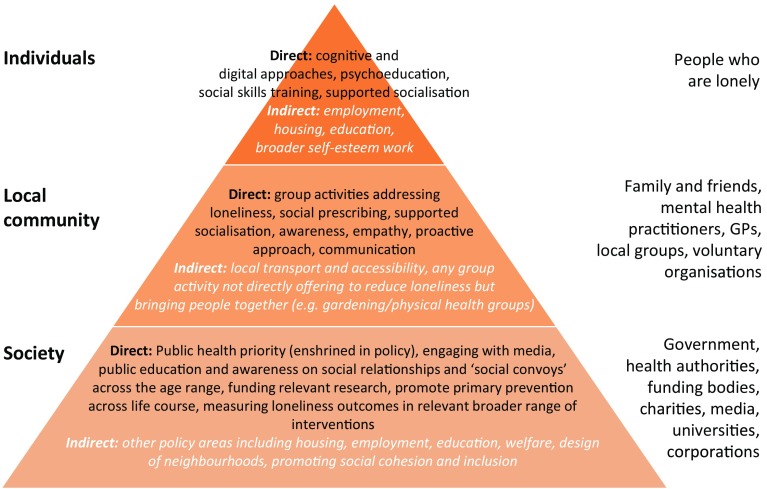
PURPOSE: There is growing evidence of significant harmful effects of loneliness. Relatively little work has focused on how best to reduce loneliness in people with mental health problems. We aim to present an overview of the current state of the art in loneliness interventions in people with mental health problems, identify relevant challenges, and highlight priorities for future research and implementation. METHODS: A scoping review of the published and grey literature was conducted, as well as discussions with relevant experts, to propose a broad classification system for types of interventions targeting loneliness. RESULTS: We categorised interventions as 'direct', targeting loneliness and related concepts in social relationships, and 'indirect' broader approaches to well-being that may impact on loneliness. We describe four broad groups of direct interventions: changing cognitions; social skills training and psychoeducation; supported socialisation or having a 'socially-focused supporter'; and 'wider community approaches'. The most promising emerging evidence appears to be in 'changing cognitions', but, as yet, no approaches have a robust evidence base. Challenges include who is best placed to offer the intervention, how to test such complex interventions, and the stigma surrounding loneliness. CONCLUSIONS: Development of clearly defined loneliness interventions, high-quality trials of effectiveness, and identifying which approaches work best for whom is required. Promising future approaches may include wider community initiatives and social prescribing. It is important to place loneliness and social relationships high on the wider public mental health and research agenda.
Overview
The claims and statistics of this paper haven’t been checked yet.
Free: it reads the open-access text and checks the first 5 claims that cite a source we can check. Create a free account to check every claim.
Integrity signals
Registry
Cites
Statistics
Figures
Verification
Claims the paper makes
The claims and statistics of this paper haven’t been checked yet.
Free: it reads the open-access text and checks the first 5 claims that cite a source we can check. Create a free account to check every claim.
Claims other papers make about this one
Each is checked against this paper’s own text: does it say what the citing paper says it does?
The source backs part of the claim, not all of it — or backs it for a different population, condition or comparison.
In the citing paper
“Effective cognitive behavioural techniques to decrease loneliness include addressing maladaptive cognitive beliefs (e.g., negative evaluations of others, lack of interpersonal trust), training in social skills, encouraging socialization and community involvement (e.g., volunteering), and increasing opportunities for socialization (Mann et al., 2017).”
From Pathways of association between disordered eating in adolescence and mental health outcomes in young adulthood during the COVID-19 pandemic (2023) · cites this paper as Mann et al., 2017
Experimental — accuracy not yet measuredIn the citing paper
“In the UK, a variety of approaches to social relationships and social participation are being developed primarily in the charitable sector and in primary care [74].”
From Associations between loneliness and perceived social support and outcomes of mental health problems: a systematic review (2018) · cites this paper as [74]
Self-check
Percentages, sums and reported differences re-computed from the paper’s own numbers.
The self-check needs the paper’s full text.
Citations
Cites
Bowling alone: the collapse and revival of American community
(2000) · Choice Reviews Online · doi:10.5860/choice.38-2454 · Cited by 28,789
The Ecology of Human Development: Experiments by Nature and Design
Bronfenbrenner, U. (1979) · Harvard University Press eBooks · doi:10.4159/9780674028845 · Cited by 26,084
Social Capital: Its Origins and Applications in Modern Sociology
Portes, A. (1998) · Annual Review of Sociology · doi:10.1146/annurev.soc.24.1.1 · Cited by 12,037
Social Relationships and Mortality Risk: A Meta-analytic Review
Holt-Lunstad, J., Smith, T. B., & Layton, J. B. (2010) · PLoS Medicine · doi:10.1371/journal.pmed.1000316 · Cited by 7,272
Loneliness and Social Isolation as Risk Factors for Mortality: A Meta-Analytic Review
Holt-Lunstad, J., Smith, T. B., Baker, M., Harris, T., & Stephenson, D. (2015) · Perspectives on Psychological Science · doi:10.1177/1745691614568352 · Cited by 6,043
UCLA loneliness scale (version 3): reliability, validity, and factor structure
Russell, D. W. (1996) · Journal of Personality Assessment · doi:10.1207/s15327752jpa6601_2 · Cited by 5,800 · cited 1×
“The two most commonly used loneliness scales are the UCLA Loneliness Scale [81] and the de Jong Gierveld loneliness scale [82].”
MethodLoneliness matters: a theoretical and empirical review of consequences and mechanisms
Hawkley, L. C., & Cacioppo, J. T. (2010) · Annals of Behavioral Medicine · doi:10.1007/s12160-010-9210-8 · Cited by 4,782 · cited 1×
“Loneliness can lead to negative evaluations of other people, for example, and a lack of interpersonal trust [5].”
BackgroundSocial isolation, loneliness, and all-cause mortality in older men and women
Steptoe, A., Shankar, A., Demakakos, P., & Wardle, J. (2013) · Proceedings of the National Academy of Sciences · doi:10.1073/pnas.1219686110 · Cited by 2,503 · cited 1×
“It has been argued that social isolation is of greater relevance in predicting poor physical health [89], while others have argued that loneliness is a stronger predictor [8].”
BackgroundPerceived social isolation and cognition
Cacioppo, J. T., & Hawkley, L. C. (2009) · Trends in Cognitive Sciences · doi:10.1016/j.tics.2009.06.005 · Cited by 2,144 · cited 1×
“This sits well alongside evidence of cognitive changes in people who feel lonely [32], but the small effect sizes and few studies of people with mental health problems included limit generalisation of these findings.”
BackgroundLoneliness: A Source Book of Current Theory, Research and Therapy
Blazer, D. (1983) · Journal of Gerontology · doi:10.1093/geronj/38.4.492 · Cited by 2,120
Research works printed but not linked: 3
- Thomas J Insights in loneliness, older people and well-being 2015 United Kingdom Office for National Statistics
- Pinfold V Sweet D Porter I Quinn C Byng R Griffiths C Improving community health networks for people with severe mental illness: a case study investigation 2015 Southampton Health Services and Delivery Research 25741571
- Centers for Disease Control and Prevention Identifying vulnerable older adults and legal options for increasing their protection during all-hazards emergencies: A cross-sector guide for states and communities 2012 Atlanta, U.S. Department of Health and Human Services
Cited by
Items 201–300 of 345
Ose, S. O., Thaulow, K., Færevik, H., Hoffmann, P. L., Lestander, H., Stiles, T. C., & Lindgren, M. (2023) · Journal of Rehabilitation and Assistive Technologies Engineering · doi:10.1177/20556683231187545 · Cited by 5
“Although social isolation and loneliness are increasingly studied among older adults,(15) few studies have been conducted among people with mental illnesses and suggestions on how to reduce social isolation and loneliness are rare.(16) Comorbid social anxiety disorder is often found among people with severe mental ill…”
BackgroundOe, H., & Yamaoka, Y. (2021) · Health Marketing Quarterly · doi:10.1080/07359683.2021.1986961 · Cited by 4
Liebmann, M., Pitman, A., Hsueh, Y.-C., Bertotti, M., & Pearce, E. (2022) · Research Square · doi:10.21203/rs.3.rs-1757555/v1 · Cited by 4
Indirect Interventions: Lifestyle Options to Treat Mental Disorders
Kazdin, A. E. (2025) · Healthcare · doi:10.3390/healthcare13050505 · Cited by 6
“In 2017, an overview of interventions focused on loneliness and distinguished between direct and indirect interventions [17].”
Smith, G. D., Pau, M. M. L., Lau, C. K. Y., Ho, K. H. M., & Watson, R. A. (2025) · Australian Journal on Ageing · doi:10.1111/ajag.70083 · Cited by 3
Social isolation and anxiety disorders during COVID-19: a systematic review
Alotaibi, F. S., Alotaibi, M. T., Altamimi, N., Abu-Dawas, S., Yaqinuddin, A., & Alkattan, K. (2025) · Frontiers in Public Health · doi:10.3389/fpubh.2025.1688239 · Cited by 5
“Similarly, research among university students identified social isolation as a central stressor linked to anxiety and depression (16, 19).”
Freher, N. K., Bexkens, A., van Bennekom, M. J., Veling, W., & Bockting, C. (2022) · Psychiatry Research Communications · doi:10.1016/j.psycom.2022.100086 · Cited by 3
Should Loneliness Be a Treatment Target?
Krieger, T., & Seewer, N. (2024) · Psychotherapy and Psychosomatics · doi:10.1159/000540988 · Cited by 3
“Hence, when addressing loneliness in the general population, it is essential to consider several levels [83].”
Social network size and endorsement of political violence in the US
Schleimer, J. P., Reeping, P. M., Robinson, S. L., & Wintemute, G. J. (2024) · Injury Epidemiology · doi:10.1186/s40621-024-00540-2 · Cited by 5
“…roots of people’s alienation from government, addressing the crisis of loneliness, making people feel heard, protected, and socially and economically stable are potentially fruitful avenues to decrease such structural alienation (Mann et al. 2017; Stewart et al. 2021; U.S. Surgeon General 2023).”
BackgroundLoneliness in Advanced Life-Threatening Illness: An Integrative Review
Blair, C., McConnell, T., Bradley, N., Finucane, A., Hudson, B. F., McCullagh, A., Orr, A., Paradine, S., Patynowska, K. A., & Reid, J. (2025) · Journal of Pain and Symptom Management · doi:10.1016/j.jpainsymman.2025.04.008 · Cited by 6
Policy Recommendations to Address Loneliness in Later Life
Ghenţa, M., & Matei, A. (2025) · International perspectives on aging · doi:10.1007/978-3-031-94565-6_13 · Cited by 4
Loneliness—the concept and experience
Rokach, A. (2019) · Elsevier eBooks · doi:10.1016/b978-0-12-815618-6.00003-5 · Cited by 4
Badcock, J. C., Christiansen, J. A., Badcock, A. C., & Lasgaard, M. (2023) · Current Research in Behavioral Sciences · doi:10.1016/j.crbeha.2023.100136 · Cited by 3
Social Isolation and Loneliness Among Older Adults
Kumar, A., Petriceks, A. H., & Schwartz, A. W. (2025) · Clinics in Geriatric Medicine · doi:10.1016/j.cger.2025.05.002 · Cited by 3
The issue of loneliness for democracies – alienation, demobilisation, polarisation?
Langenkamp, A. (2022) · Publication Server of Goethe University Frankfurt am Main (Goethe University Frankfurt) · doi:10.21248/gups.71950 · Cited by 3
Neurocomputational mechanisms of maladaptive behaviors in loneliness
Bellucci, G., Imada, H., Fett, A.-K. J., & Ito, A. (2025) · Trends in Cognitive Sciences · doi:10.1016/j.tics.2025.07.007 · Cited by 6
Chen, Z., Zheng, D., Wu, S., Dai, J., Huang, H., & Yu, Y. (2025) · BMC Geriatrics · doi:10.1186/s12877-025-06342-5 · Cited by 5
“Loneliness is an unpleasant feeling caused by differences in individuals’ expected and actual levels of socially meaningful relationships [6].”
Peer support in mental health services to reduce loneliness and emotional symptoms in Latin American
Agudelo‐Hernández, F., Giraldo-Álvarez, A. B., & Guapacha-Montoya, M. (2026) · American Journal of Community Psychology · doi:10.1002/ajcp.70045 · Cited by 2
Xiang, X., Wang, X., Kong, D., & Habash, S. (2026) · Clinical Gerontologist · doi:10.1080/07317115.2026.2613866 · Cited by 2
“Despite growing awareness and efforts to reduce loneliness, current interventions have produced inconsistent effects and modest improvements (Mann et al., 2017; O’Rourke et al., 2018).”
Interventions against loneliness and social isolation in older adults– a systematic review
Bergsträsser, J., Schmahl, T., Steinhäuser, J., & Goetz, K. (2026) · BMC Public Health · doi:10.1186/s12889-026-27683-9 · Cited by 3
“Benefits of community interventions compared to individual interventions have also been reported in earlier studies [18, 23, 112, 113, 117–119].”
Zang, W., Liu, N., Wu, J., Zhang, Q., & Junxiu, W. (2026) · Journal of Affective Disorders · doi:10.1016/j.jad.2026.121987 · Cited by 4
Barmina, P. S., & Нозикова, Н. В. (2023) · Experimental Psychology (Russia) · doi:10.17759/exppsy.2023160110 · Cited by 5
“Содержание психологической помощи и превентивных мер в ситуации одиночества составляют психологическое консультирование с целью улучшить интеграцию в социум и приобрести необходимые навыки общения и реализация социальных мер, направленных на улучшение благосостояния, организацию общественных пространств и мероприятий…”
Olawa, B. D., Idemudia, E. S., Omolayo, B. O., & Azikiwe, J. C. (2023) · Health Psychology Open · doi:10.1177/20551029231206764 · Cited by 3
“…that loneliness has adverse effects on the mental health and wellbeing of vulnerable individuals during “ normal ” times (Kearns et al., 2015; Mann et al., 2017), however, given that the pandemic lockdown is an unusual occurrence shutting down public life across the general population at the…”
BackgroundWirth, M., Motl, R. W., Bombardier, C. H., Bartle, B., Wong, A., Aguina, K., & LaVela, S. L. (2024) · Journal of Spinal Cord Medicine · doi:10.1080/10790268.2023.2299500 · Cited by 5
“Interventions, such as cognitive behavioral therapy, addressing maladaptive ways of thinking been reported to be effective in reducing PSI (41, 42).”
Social isolation: relationship with cardiovascular diseases
Lobov, G. I. (2024) · Успехи физиологических наук · doi:10.31857/s0301179824010045 · Cited by 4
Gerbig, P., Reinhard, M. A., Ababu, H., Rek, S. V., Amann, B. L., Adorjan, K., Abera, M., Padberg, F., & Jobst, A. (2025) · BMJ Open · doi:10.1136/bmjopen-2024-088098 · Cited by 2
“Competing interests FP is a member of the European Scientific Advisory Board of Brainsway Inc., Jerusalem, Israel, and the International Scientific Advisory Board”
Wang, J. (2018) · UCL Discovery (University College London) · doi:10.13140/rg.2.2.22466.61126 · Cited by 4
Self-citationSOLUS-D – Eine Internet-basierte Selbsthilfeintervention bei chronischer Einsamkeit
Seewer, N., Skoko, A., & Krieger, T. (2022) · PiD - Psychotherapie im Dialog · doi:10.1055/a-1711-8377 · Cited by 2
Interventionen gegen Einsamkeit und ihre Wirksamkeit
Seewer, N., & Krieger, T. (2022) · Kulturen der Gesellschaft · doi:10.1515/9783839463505-013 · Cited by 1
Facetten, Quellen und Auswirkungen von Einsamkeit
Landmann, H., & Buecker, S. (2022) · Kulturen der Gesellschaft · doi:10.14361/9783839463505-004 · Cited by 6
Loneliness and the COVID-19 pandemic: implications for practice
Makey, L. M., Lewis, R., Ashmore, R., & Wigfield, A. (2024) · British Journal of Nursing · doi:10.12968/bjon.2024.33.3.110 · Cited by 2
Estimating risk of loneliness in adulthood using survey-based prediction models: A cohort study
Elovainio, M. J., Airaksinen, J., Nyberg, S. T., Pentti, J., Pulkki-Råbäck, L., Cachón-Alonso, L., Suvisaari, J., Jääskeläinen, T., Koskinen, S. V. P., Kivimäki, M., et al. (2024) · Journal of Psychiatric Research · doi:10.1016/j.jpsychires.2024.06.030 · Cited by 4
Goodwill, J. R., & Taylor, H. O. (2025) · Public Health Reports · doi:10.1177/00333549251314665 · Cited by 1
Prerequisites for social prescribing in Swedish primary care – stakeholders’ perspectives
Degerstedt, F., Rapo, E., Viklund, E. W. E., Jönsson, F., Lundgren, A. S., & Nilsson, I. (2025) · Scandinavian Journal of Primary Health Care · doi:10.1080/02813432.2025.2507272 · Cited by 1
“…is associated with a range of health problems such as depression, anxiety, eating disorders, alzheimer’s disease and cognitive impairment [3] as well as with increased mortality [4]. social relationships are known to be a protective factor for good health [4,5], and efforts are being…”
Peris-Ramos, H. C., David-Fernandez, S., Beltrán-Velasco, A. I., Sepulveda, R. A. Y., López‐Gil, J. F., & Clemente‐Suárez, V. J. (2025) · Frontiers in Education · doi:10.3389/feduc.2025.1577481 · Cited by 1
Lee, Y. A., Li, G., Nakamura, J. S., Guo, Y., & Chen, F. S. (2025) · Journal of Personality · doi:10.1111/jopy.70015 · Cited by 1
Li, G., Qin, R., Zhao, X., Junyan, D., & Li, P. (2025) · Supportive Care in Cancer · doi:10.1007/s00520-025-10008-8 · Cited by 4
“Loneliness refers to a subjective negative feeling of a mismatch between the meaningful social connections one desires and those they actually have [1].”
Nagata, S., & Subica, A. M. (2025) · International Journal of Mental Health and Addiction · doi:10.1007/s11469-025-01558-3 · Cited by 2
“…epidemics (Ozawa-de Silva, 2021), targeted research examining loneliness as a potential target for Japanese mental health and suicide prevention efforts remains limited, restricting our ability to design effective mental health and loneliness interventions for Japanese adults (Mann et al., 2017).”
Loneliness Among Adults with Serious Mental Illness
Neumann, T., & McCormick, B. P. (2025) · Springer eBooks · doi:10.1007/978-3-032-02959-1_19 · Cited by 1
Willingness to trust is reduced by loneliness and paranoia
Bellucci, G., Keramati, M., Hanssen, E., & Fett, A.-K. J. (2025) · Communications Psychology · doi:10.1038/s44271-025-00384-6 · Cited by 3
“Preliminary evidence suggests that loneliness is characterized by cognitive biases that lead to overly negative expectations of others 12 .”
Ikesu, R., Wu, Y. Y., Rojas‐Saunero, L. P., Nianogo, R. A., Torres, J. M., Kotwal, A., Ramirez, C. M., Tsugawa, Y., & Mayeda, E. R. (2026) · American Journal of Epidemiology · doi:10.1093/aje/kwag044 · Cited by 1
Köhler, S. (2026) · Nervenheilkunde · doi:10.1055/a-2682-7104 · Cited by 1
Coll‐Planas, L., Masó-Aguado, M., Briones‐Buixassa, L., Morató, A., Méndez, S., Carbó, A., Fuente-Vidal, A., Olivella-Cirici, M., Casajuana, C., Bártová, A., et al. (2026) · The Lancet Regional Health - Europe · doi:10.1016/j.lanepe.2026.101821 · Cited by 1
“33 FiN combines strategies by building groups with peer support, providing social opportunities that are strengthened by experiences in nature, and by developing social skills.”
A Psychosocial Touch on Elderly Individuals: Art Therapy
Düzgün, N., & Demir, S. (2023) · Journal of Gazi University Health Sciences Institute · doi:10.59124/guhes.1254046 · Cited by 1
Salomon-Gimmon, M. (2023) · The Arts in Psychotherapy · doi:10.1016/j.aip.2023.102054 · Cited by 1
Wang, H.-W. (2023) · International Journal of Human Resource Studies · doi:10.5296/ijhrs.v14i1.21564 · Cited by 1
VR and Sensors in Alleviating Loneliness
Davies, S. (2023) · International Conference on Affective Computing and Intelligent Interaction Workshops and Demos (ACIIW) · doi:10.1109/aciiw59127.2023.10388117 · Cited by 1
“However, intervention strategies employed in the treat-ment of chronic loneliness are commonly found to be ineffective [7]–[9], which has particularly been attributed to their lack of focus on detrimental intrinsic cognition, disregard for the diverse structure of loneliness, and the minimal…”
BackgroundConceptual Foundations: Relational Thinking for Mental Health Contexts
Boden, Z., & Larkin, M. (2023) · Springer eBooks · doi:10.1007/978-3-031-50047-3_2 · Cited by 2
Maßnahmen gegen Einsamkeit – Beispiele aus einer international vergleichenden Perspektive
Wendt, C. (2024) · Bundesgesundheitsblatt - Gesundheitsforschung - Gesundheitsschutz · doi:10.1007/s00103-024-03945-y · Cited by 1
Counteracting the Effects of Loneliness: Empirical Research and Policy Interventions
Casabianca, E. J., & Nurminen, M. (2024) · Population economics · doi:10.1007/978-3-031-66582-0_7 · Cited by 1
Groups 4 Health: Managing Loneliness and Social Disconnection, Facilitator Guide
Haslam, C., Cruwys, T., Haslam, S. A., Bentley, S. V., & Jetten, J. (2025) · Oxford University Press eBooks · doi:10.1093/med-psych/9780197776810.001.0001 · Cited by 4
Rodríguez, Y. N. F., & Aragón, R. S. (2021) · Psicología y Salud · doi:10.25009/pys.v32i1.2713
Cameranesi, M., Mollard, R. C., Balshaw, R. F., & MacKay, D. (2023) · Trials · doi:10.1186/s13063-023-07708-z · Cited by 2
Brockman, R. N. (2017) · Research Bank (Australian Catholic University) · doi:10.26199/5b84de1fbcf82 · Cited by 1
Who should be “controls” in studies on the neurobiology of psychiatric disorders?
Boksa, P., & Joober, R. (2018) · Journal of Psychiatry and Neuroscience · doi:10.1503/jpn.180128 · Cited by 2
Pollet, T. V., Thompson, A., Malcolm, C., McCarty, K., Saxton, T. K., & Roberts, S. G. B. (2021) · PsyArXiv (OSF Preprints) · doi:10.31234/osf.io/fpmur · Cited by 2
Duffy, C., & Gaynor, K. (2023) · Preprints.org · doi:10.20944/preprints202310.0624.v1
Willingness to trust is reduced by loneliness and paranoiaPreprint
Bellucci, G., Keramati, M., Hanssen, E., & Fett, A.-K. J. (2024) · doi:10.31234/osf.io/vnqys · Cited by 1
Perfectly Alone (and Anxious): A Test of the Perfectionism Social Disconnection Model in Adolescents
Murphy, E. (2019) · Brock University Digital Repository (Brock University) · Cited by 1
Caring for outpatients during COVID-19: 4 themes
Marcus, P. H., Emmerich, A. D., Koh, K. A., Razafsha, M., Rudolph, M. M., & Hanau, M. S. (2020) · Current Psychiatry · doi:10.12788/cp.0065
Mikkelsen, A. S. B., & Kristiansen, M. (2021) · International Journal of Environmental Research and Public Health · doi:10.3390/ijerph18041808 · Cited by 1
“presents an inspiring approach to categorise social interventions aimed at loneliness or related constructs among people with mental health problems [18].”
BackgroundCadet, T. J., Burke, S. L., Mitchell, J. A., Conner, K. O., & Nedjat‐Haiem, F. R. (2021) · Social Work Research · doi:10.1093/swr/svab002
02 - SELF-EFFICACY AND DIABETES SELF-CARE IN TUNISIAN PATIENTS WITH TYPE 2 DIABETES
Larnaout, A., Abdelghaffar, W., laamiri, H., Larnaout, A., Melki, W., & Mnif, L. (2019) · doi:10.26226/morressier.5d1a038357558b317a140d04
Human responses to nature and culture-based non-clinical interventions: A systematised reviewPreprint
Fairbrass, A. J., Chatterjee, H. J., Jones, K. E., & Osborn, D. (2019) · OSF Preprints (OSF Preprints) · doi:10.31219/osf.io/kcyb9
Ose, S. O., Thaulow, K., Færevik, H., Hoffmann, P. L., Lestander, H., Stiles, T. C., & Lindgren, M. (2022) · Research Square · doi:10.21203/rs.3.rs-1691098/v1
Gazadinda, R., Putri, G. W., & Maulana, H. (2023) · Bulletin of Counseling and Psychotherapy · doi:10.51214/bocp.v5i1.448 · Cited by 1
Lūka, C. T. B., & Barsalou, L. W. (2023) · PsyArXiv (OSF Preprints) · doi:10.31234/osf.io/j7kph · Cited by 1
Psychosocial Impact on Families during the COVID-19 Pandemic: A Scoping Review
Megananda, N. K., Windarwati, H. D., & Zuhriyah, L. (2023) · Jurnal Aisyah Jurnal Ilmu Kesehatan · doi:10.30604/jika.v8i1.1575
Socially Designed: A Prescription for Brain Health
Fridman, D. (2023) · Open Access Victoria University of Wellington | Te Herenga Waka (Figshare) · doi:10.26686/wgtn.23596278
Abrantes, M. L., & Pitman, A. (2023) · Current Research in Behavioral Sciences · doi:10.1016/j.crbeha.2023.100126 · Cited by 1
“In clinical populations the most promising interventions appear to involve addressing maladaptive cognitions (Mann et al., 2017).”
BackgroundGerbig, P., Reinhard, M. A., Ababu, H., Rek, S. V., Amann, B. L., Adorjan, K., Abera, M., Padberg, F., & Jobst, A. (2023) · Research Square · doi:10.21203/rs.3.rs-2972638/v1
Starenje i kvaliteta života umirovljenika
Brajković, L., Korać, D., & Vučenović, D. (2023) · Kroatologija : časopis za hrvatsku kulturu · doi:10.59323/k.14.1.9 · Cited by 2
Einsamkeit, soziale Isolation und psychische Gesundheit
Riedel-Heller, S. G. (2023) · Public Health Forum · doi:10.1515/pubhef-2023-0064 · Cited by 1
Hansen, T., Nes, R. B., Hynek, K. A., Nilsen, T. S., Reneflot, A., Stene‐Larsen, K., Tornes, R. A., & Bidonde, J. (2023) · Research Square · doi:10.21203/rs.3.rs-3351098/v1
ตรีเจริญวิวัฒน์, ณ., & พิสิษฐ์สังฆการ, ก. (2022) · Chula Digiverse · doi:10.58837/chula.the.2022.544
Chen, Y., Xue, H., Ai, S., Liu, Y., Nie, Y., Ai, Q. Y. H., Zhang, J., & Liang, Y. Y. (2023) · Research Square · doi:10.21203/rs.3.rs-3410802/v1
Percepção do Suporte Social de clientes de um Serviço-Escola de Psicologia
Sousa, L. A., Silva, R. S., de Aguiar, K. G. M., & dos Reis, N. K. S. (2023) · PSI UNISC · doi:10.17058/psiunisc.v7i2.18331
Kappal, R., & Mishra, D. K. (2023) · International Conference on Sustainable Islamic Business and Finance (SIBF) · doi:10.1109/sibf60067.2023.10380060
“The studies need to explore the challenges and opportunities that arise from balancing the need for confidentiality with the need for connection-building [13].”
BackgroundManifestation of loneliness in elderly people
VLAICU, C. (2023) · Psihologia Revista științifico-practică = Psychology Scientific-practical journal · doi:10.46728/pspj.2023.v43.i2.p15-31 · Cited by 1
Symonds, A., Bernard, M. M., Fox, A. P., & Larkin, M. (2023) · Springer eBooks · doi:10.1007/978-3-031-50047-3_9
Experiencing loneliness in adolescence depending on interpersonal relationships
Barmina, P. S., & Нозикова, Н. В. (2024) · Perspectives of science and education · doi:10.32744/pse.2024.1.32 · Cited by 1
Erkennen und Bewältigen von Einsamkeit im betrieblichen Kontext
Institut für Arbeit und Gesundheit der Deutschen Gesetzlichen Unfallversicherung, D., & Rahnfeld, M. (2024) · ASU Arbeitsmedizin Sozialmedizin Umweltmedizin · doi:10.17147/asu-1-350383 · Cited by 1
Wang, J., Zhang, W., Wang, T., Yao, Y., Lin, H., Yang, X., Song, P., Chen, X., & Fu, C. (2024) · Research Square · doi:10.21203/rs.3.rs-4210447/v1
Self-citationBecoming Connected - Adolescent Social-Cognitive Development in the Peer Context
Hollarek, M. (2024) · doi:10.5463/thesis.492 · Cited by 1
Rayner, C. L. (2024) · Cronfa (Swansea University) · doi:10.23889/suthesis.66311 · Cited by 1
A Dominance Analysis on the Relationship between Schizotypy and Loneliness TypePreprint
Randell, J., Gray, D., Cleveland, M., & Manning, R. (2024) · SSRN Electronic Journal · doi:10.2139/ssrn.4847327
Disability and Loneliness: A Critical Study of Males under British Social Policies
Guo, S. (2024) · International Journal of Social Sciences and Public Administration · doi:10.62051/ijsspa.v4n1.18
“The discussion of supporting meaningful social interactions should be situated within a wider framework of social policies, including housing, employment, welfare, and infrastructure [1].”
BackgroundInfluentialLoneliness and Psychiatric Disorders in Older Adults
Triolo, F., Sjöberg, L., Calderón‐Larrañaga, A., & Dahlberg, L. (2024) · Practical issues in geriatrics · doi:10.1007/978-3-031-58488-6_6
A dominance analysis on the relationship between schizotypy and loneliness type
Randell, J., Gray, D., Cleveland, M., & Manning, R. (2024) · Schizophrenia Research · doi:10.1016/j.schres.2024.10.002 · Cited by 1
“…anxiety and social withdrawal have been shown to be key factors in predicting clinical psychosis (Eglit et al., 2018; Michalska Da Rocha et al., 2018; Tr ´ emeau et al., 2016) and areas of focus of interventions to improve loneliness (Caple et al., 2023; Mann et al., 2017; Williams et al., 2021).”
Golden, T. L., Sandu, C. C., & Edwards, E. E. (2025) · Health Promotion Practice · doi:10.1177/15248399241311286 · Cited by 3
“In addition, arts-based experiences have been shown to positively impact loneliness and isolation (Mann et al., 2017) and to create ways to articulate complex experiences (Cole et al., 2018; Golden, 2022)—both of which are relevant to stigma-reducing education and contact.”
Social Connection and Engagement
Morgan, T., & Pocock, T. (2024) · Topics in Geriatric Care. · doi:10.1007/978-981-96-0462-3_4
Haslam, C., Cruwys, T., Bentley, S. V., Jetten, J., & Haslam, S. A. (2025) · Oxford University Press eBooks · doi:10.1093/med-psych/9780197776810.005.0001
Haslam, C., Cruwys, T., Bentley, S. V., Jetten, J., & Haslam, S. A. (2025) · Oxford University Press eBooks · doi:10.1093/med-psych/9780197776810.002.0004
Session 5 Sustaining: Maintaining Groups
Haslam, C., Cruwys, T., Bentley, S. V., Jetten, J., & Haslam, S. A. (2025) · Oxford University Press eBooks · doi:10.1093/med-psych/9780197776810.003.0006
Introduction: Program Background and Overview
Haslam, C., Cruwys, T., Bentley, S. V., Jetten, J., & Haslam, S. A. (2025) · Oxford University Press eBooks · doi:10.1093/med-psych/9780197776810.003.0001
Session 1 Setting Up: Appreciating Groups
Haslam, C., Cruwys, T., Bentley, S. V., Jetten, J., & Haslam, S. A. (2025) · Oxford University Press eBooks · doi:10.1093/med-psych/9780197776810.003.0002
Session 4 Scaffolding: Extending Groups
Haslam, C., Cruwys, T., Bentley, S. V., Jetten, J., & Haslam, S. A. (2025) · Oxford University Press eBooks · doi:10.1093/med-psych/9780197776810.003.0005
Session 2 Scoping: Mapping Groups
Haslam, C., Cruwys, T., Bentley, S. V., Jetten, J., & Haslam, S. A. (2025) · Oxford University Press eBooks · doi:10.1093/med-psych/9780197776810.003.0003
Session 3 Sourcing: Strengthening Groups
Haslam, C., Cruwys, T., Bentley, S. V., Jetten, J., & Haslam, S. A. (2025) · Oxford University Press eBooks · doi:10.1093/med-psych/9780197776810.003.0004
Metadata
- Authors
- Mann, F., Bone, J. K., Lloyd-Evans, B., Frerichs, J., Pinfold, V., Ma, R., Wang, J., & Johnson, S.
- Affiliations
- University College London (GB)
- McPin Foundation (GB)
- St Pancras Hospital (GB)
- Corresponding author
- Mann, Farhana
- Venue
- Social Psychiatry and Psychiatric Epidemiology
- Published
- 2017-05-20
- Volume
- 52
- Issue
- 6
- Pages
- 627-638
- ISSN
- 0933-7954 (ISSN-L)
- 1433-9285
- PMC
- PMC5487590
- OpenAlex
- W2615658301
- Cited by
- 346
- References
- 93
- Citations by year
- 2026: 25 · 2025: 51 · 2024: 44 · 2023: 48 · 2022: 67 · 2021: 44 · 2020: 36 · 2019: 16 · 2018: 9 · 2017: 6
- FWCI
- 3.16
- Type
- journal article
- Language
- en
- Open access
- hybrid
- doi.org
- Locations
- Social Psychiatry and Psychiatric Epidemiology (publishedVersion, cc-by)
- Europe PMC (PubMed Central) (publishedVersion, cc-by)
- PubMed Central (publishedVersion, cc-by)
- PubMed (publishedVersion)
- UCL Discovery (University College London) (submittedVersion)
- Funders
- Wellcome Trust (203618/Z/16/Z)
- Topics
- Social Sciences › Health › Health disparities and outcomes
- Social Sciences › Psychology › Experimental and Cognitive Psychology › Anxiety, Depression, Psychometrics, Treatment, Cognitive Processes
- Health Sciences › Medicine › Psychiatry and Mental health › Mental Health Treatment and Access
- Keywords
- loneliness, loneliness interventions, mental illness, interpersonal relationships, social skills training, psychoeducation, social prescribing, community-based approach, public mental health
- MeSH terms
- Mental Disorders, Humans, Loneliness, Social Support, Socialization
About these checks
Registry, retraction, Cites and statistics results are computed, not judged, with one exception: a printed reference that no index lists is read once by a model before it counts as a citation error. Claims are extracted by a model and kept only when their quote appears verbatim in the text; each cited source is then checked, with a model’s help, for whether it says what the claim relies on. Those verdicts can be wrong — read the claim’s quote and the cited source before relying on one.
Statistics and arithmetic are recomputed, not judged.
Confidence bands are shown only for fields calibrated on our annotated test set. None is calibrated yet, so no band is shown.
What counts as a claim ›How we measure confidence ›How we check this ›
Are you an author, or do you see a problem with this page? Request a review
Data sources
Bibliographic data: Semantic Scholar, OpenAlex, Crossref.
Contains information from the Semantic Scholar Academic Graph Datasets, made available under the ODC Attribution License (ODC-BY 1.0).
Semantic Scholar’s data is described in: Kinney, R., et al. (2023). The Semantic Scholar Open Data Platform. arXiv:2301.10140.
