

A life less lonely: the state of the art in interventions to reduce loneliness in people with mental health problems
Open accessThe DOI matches its Crossref record; 91 of the 93 references it cites were found in a registry or an index.
Abstract
PURPOSE: There is growing evidence of significant harmful effects of loneliness. Relatively little work has focused on how best to reduce loneliness in people with mental health problems. We aim to present an overview of the current state of the art in loneliness interventions in people with mental health problems, identify relevant challenges, and highlight priorities for future research and implementation. METHODS: A scoping review of the published and grey literature was conducted, as well as discussions with relevant experts, to propose a broad classification system for types of interventions targeting loneliness. RESULTS: We categorised interventions as 'direct', targeting loneliness and related concepts in social relationships, and 'indirect' broader approaches to well-being that may impact on loneliness. We describe four broad groups of direct interventions: changing cognitions; social skills training and psychoeducation; supported socialisation or having a 'socially-focused supporter'; and 'wider community approaches'. The most promising emerging evidence appears to be in 'changing cognitions', but, as yet, no approaches have a robust evidence base. Challenges include who is best placed to offer the intervention, how to test such complex interventions, and the stigma surrounding loneliness. CONCLUSIONS: Development of clearly defined loneliness interventions, high-quality trials of effectiveness, and identifying which approaches work best for whom is required. Promising future approaches may include wider community initiatives and social prescribing. It is important to place loneliness and social relationships high on the wider public mental health and research agenda.
Overview
The claims and statistics of this paper haven’t been checked yet.
Free: it reads the open-access text and checks the first 5 claims that cite a source we can check. Create a free account to check every claim.
Integrity signals
Registry
Cites
Statistics
Figures
Verification
Claims the paper makes
The claims and statistics of this paper haven’t been checked yet.
Free: it reads the open-access text and checks the first 5 claims that cite a source we can check. Create a free account to check every claim.
Claims other papers make about this one
Each is checked against this paper’s own text: does it say what the citing paper says it does?
The source backs part of the claim, not all of it — or backs it for a different population, condition or comparison.
In the citing paper
“Effective cognitive behavioural techniques to decrease loneliness include addressing maladaptive cognitive beliefs (e.g., negative evaluations of others, lack of interpersonal trust), training in social skills, encouraging socialization and community involvement (e.g., volunteering), and increasing opportunities for socialization (Mann et al., 2017).”
From Pathways of association between disordered eating in adolescence and mental health outcomes in young adulthood during the COVID-19 pandemic (2023) · cites this paper as Mann et al., 2017
Experimental — accuracy not yet measuredIn the citing paper
“In the UK, a variety of approaches to social relationships and social participation are being developed primarily in the charitable sector and in primary care [74].”
From Associations between loneliness and perceived social support and outcomes of mental health problems: a systematic review (2018) · cites this paper as [74]
Self-check
Percentages, sums and reported differences re-computed from the paper’s own numbers.
The self-check needs the paper’s full text.
Citations
Cites
Bowling alone: the collapse and revival of American community
(2000) · Choice Reviews Online · doi:10.5860/choice.38-2454 · Cited by 28,789
The Ecology of Human Development: Experiments by Nature and Design
Bronfenbrenner, U. (1979) · Harvard University Press eBooks · doi:10.4159/9780674028845 · Cited by 26,084
Social Capital: Its Origins and Applications in Modern Sociology
Portes, A. (1998) · Annual Review of Sociology · doi:10.1146/annurev.soc.24.1.1 · Cited by 12,037
Social Relationships and Mortality Risk: A Meta-analytic Review
Holt-Lunstad, J., Smith, T. B., & Layton, J. B. (2010) · PLoS Medicine · doi:10.1371/journal.pmed.1000316 · Cited by 7,272
Loneliness and Social Isolation as Risk Factors for Mortality: A Meta-Analytic Review
Holt-Lunstad, J., Smith, T. B., Baker, M., Harris, T., & Stephenson, D. (2015) · Perspectives on Psychological Science · doi:10.1177/1745691614568352 · Cited by 6,043
UCLA loneliness scale (version 3): reliability, validity, and factor structure
Russell, D. W. (1996) · Journal of Personality Assessment · doi:10.1207/s15327752jpa6601_2 · Cited by 5,800 · cited 1×
“The two most commonly used loneliness scales are the UCLA Loneliness Scale [81] and the de Jong Gierveld loneliness scale [82].”
MethodLoneliness matters: a theoretical and empirical review of consequences and mechanisms
Hawkley, L. C., & Cacioppo, J. T. (2010) · Annals of Behavioral Medicine · doi:10.1007/s12160-010-9210-8 · Cited by 4,782 · cited 1×
“Loneliness can lead to negative evaluations of other people, for example, and a lack of interpersonal trust [5].”
BackgroundSocial isolation, loneliness, and all-cause mortality in older men and women
Steptoe, A., Shankar, A., Demakakos, P., & Wardle, J. (2013) · Proceedings of the National Academy of Sciences · doi:10.1073/pnas.1219686110 · Cited by 2,503 · cited 1×
“It has been argued that social isolation is of greater relevance in predicting poor physical health [89], while others have argued that loneliness is a stronger predictor [8].”
BackgroundPerceived social isolation and cognition
Cacioppo, J. T., & Hawkley, L. C. (2009) · Trends in Cognitive Sciences · doi:10.1016/j.tics.2009.06.005 · Cited by 2,144 · cited 1×
“This sits well alongside evidence of cognitive changes in people who feel lonely [32], but the small effect sizes and few studies of people with mental health problems included limit generalisation of these findings.”
BackgroundLoneliness: A Source Book of Current Theory, Research and Therapy
Blazer, D. (1983) · Journal of Gerontology · doi:10.1093/geronj/38.4.492 · Cited by 2,120
Research works printed but not linked: 3
- Thomas J Insights in loneliness, older people and well-being 2015 United Kingdom Office for National Statistics
- Pinfold V Sweet D Porter I Quinn C Byng R Griffiths C Improving community health networks for people with severe mental illness: a case study investigation 2015 Southampton Health Services and Delivery Research 25741571
- Centers for Disease Control and Prevention Identifying vulnerable older adults and legal options for increasing their protection during all-hazards emergencies: A cross-sector guide for states and communities 2012 Atlanta, U.S. Department of Health and Human Services
Cited by
Items 301–345 of 345
(2025) · Oxford University Press eBooks · doi:10.1093/med-psych/9780197776810.002.0006
Loneliness and Social Isolation in the Care of the Seriously Ill Older Adult
Kotwal, A., & Perissinotto, C. M. (2025) · Clinics in Geriatric Medicine · doi:10.1016/j.cger.2025.04.008
Yüksel, E., & Söner, O. (2025) · Uluslararası Türk Eğitim Bilimleri Dergisi · doi:10.46778/goputeb.1687204
Loneliness, Social Cohesion, and the Role of Art Making
Sagan, O. (2025) · Societies · doi:10.3390/soc15090237 · Cited by 2
Shyanti, R. K., Alagan, R., Aladuwaka, S., Malik, S., & Mishra, M. K. (2025) · Springer eBooks · doi:10.1007/978-981-96-6650-8_8 · Cited by 4
The Importance of Existential Questions in Patients with a Depressive Disorder: A Pilot Study
Mavrogiorgou, P., Paffrath, V. P., & Juckel, G. (2025) · Psychopathology · doi:10.1159/000548702
“Also, it is generally agreed that loneliness leads to mental disorders, but many factors play a role here that are not yet understood in their interaction [25].”
Orden, K. A. V. (2025) · Springer eBooks · doi:10.1007/978-3-032-02959-1_32
Rue, C. J. L., Haslam, C., Cruwys, T., Haslam, S. A., Jetten, J., Wergin, V. V., Steffens, N. K., Hides, L. M., Connelly, L. B., Spinks, J., et al. (2025) · Springer eBooks · doi:10.1007/978-3-032-02959-1_31
Kotwal, A. (2025) · Springer eBooks · doi:10.1007/978-3-032-02959-1_28
Fang, S., & Leung, C. H. (2025) · Aging & Mental Health · doi:10.1080/13607863.2025.2593976
“To date, loneliness has been studied among different populations, such as people with mental health problems (Achterbergh et al., 2020; Mann et al., 2017), disabled people (Gilmore & Cuskelly, 2014; Tarvainen, 2021), widowed people (Davies et al., 2016; Freak-Poli et al., 2025), adolescents…”
Liebmann, M., Alexandra, P., Hsueh, Y.-C., Bertotti, M., & Pearce, E. (2022) · Figshare · doi:10.6084/m9.figshare.21366153
Barnett, P., Steare, T., Dedat, Z., Pilling, S., McCrone, P., Knapp, M. R. J., Cooke, E., Lamirel, D., Dawson, S., Goldblatt, P., et al. (2022) · Figshare · doi:10.6084/m9.figshare.19681799
Self-citationBarnett, P., Steare, T., Dedat, Z., Pilling, S., McCrone, P., Knapp, M. R. J., Cooke, E., Lamirel, D., Dawson, S., Goldblatt, P., et al. (2022) · Figshare · doi:10.6084/m9.figshare.19681790
Self-citationJamalishahni, T., Turrell, G., Foster, S., Davern, M. T., & Villanueva, K. (2024) · Figshare · doi:10.6084/m9.figshare.26579201
Hansen, T., Nes, R. B., Hynek, K. A., Nilsen, T. S., Reneflot, A., Stene‐Larsen, K., Tornes, R. A., & Bidonde, J. (2024) · Figshare · doi:10.6084/m9.figshare.26750372
Ma, R., Wang, J., Lloyd‐Evans, B., Marston, L., & Johnson, S. (2021) · Figshare · doi:10.6084/m9.figshare.16417282
Self-citationBarnett, P., Steare, T., Dedat, Z., Pilling, S., McCrone, P., Knapp, M. R. J., Cooke, E., Lamirel, D., Dawson, S., Goldblatt, P., et al. (2022) · Figshare · doi:10.6084/m9.figshare.19681802
Self-citationStefanidou, T., Wang, J., Morant, N. J., Lloyd‐Evans, B., & Johnson, S. (2021) · Figshare · doi:10.6084/m9.figshare.14175845
Self-citationLiebmann, M., Alexandra, P., Hsueh, Y.-C., Bertotti, M., & Pearce, E. (2022) · Figshare · doi:10.6084/m9.figshare.21366150
Cameranesi, M., Mollard, R. C., Balshaw, R. F., & MacKay, D. (2024) · Figshare · doi:10.6084/m9.figshare.26631478
Stefanidou, T., Wang, J., Morant, N. J., Lloyd‐Evans, B., & Johnson, S. (2021) · Figshare · doi:10.6084/m9.figshare.14175839
Self-citationBarnett, P., Steare, T., Dedat, Z., Pilling, S., McCrone, P., Knapp, M. R. J., Cooke, E., Lamirel, D., Dawson, S., Goldblatt, P., et al. (2022) · Figshare · doi:10.6084/m9.figshare.19681793
Self-citationBarnett, P., Steare, T., Dedat, Z., Pilling, S., McCrone, P., Knapp, M. R. J., Cooke, E., Lamirel, D., Dawson, S., Goldblatt, P., et al. (2022) · Figshare · doi:10.6084/m9.figshare.19681805
Self-citationBarnett, P., Steare, T., Dedat, Z., Pilling, S., McCrone, P., Knapp, M. R. J., Cooke, E., Lamirel, D., Dawson, S., Goldblatt, P., et al. (2022) · Figshare · doi:10.6084/m9.figshare.19681808
Self-citationBarnett, P., Steare, T., Dedat, Z., Pilling, S., McCrone, P., Knapp, M. R. J., Cooke, E., Lamirel, D., Dawson, S., Goldblatt, P., et al. (2022) · Figshare · doi:10.6084/m9.figshare.19681787
Self-citationBarnett, P., Steare, T., Dedat, Z., Pilling, S., McCrone, P., Knapp, M. R. J., Cooke, E., Lamirel, D., Dawson, S., Goldblatt, P., et al. (2022) · Figshare · doi:10.6084/m9.figshare.19681796
Self-citationStefanidou, T., Wang, J., Morant, N. J., Lloyd‐Evans, B., & Johnson, S. (2021) · Figshare · doi:10.6084/m9.figshare.14175842
Self-citationIntroduction: Sick, lonely and left behind
Lewis, S. C., Willis, K. F., Smith, L. D., Moensted, M. L., Franklin, M., Dubbin, L. A., & Rogers, A. E. (2025) · Springer eBooks · doi:10.1007/978-981-96-7909-6_1
Romantik Yalnızlıkla Başa Çıkma: Beliren Yetişkinler İçin Bir Psikoeğitim Programının Etkililiği
Yüksel, E., & Söner, O. (2025) · DergiPark (Istanbul University)
Li, C., Zhong, R., Chen, H., & Liu, Y. (2026) · Frontiers in Psychology · doi:10.3389/fpsyg.2026.1748115 · Cited by 1
Das leise Risiko: Einsamkeit und Gesundheit
Riedel-Heller, S. G., Hajek, A., & König, H. (2026) · Psychiatrische Praxis · doi:10.1055/a-2776-3877 · Cited by 2
Duran, S., ÖZ, Y. C., & İncedere, A. (2026) · Perspectives In Psychiatric Care · doi:10.1155/ppc/2728156
Nadler, S., Laudenbach, L., & Pedersen, A. (2026) · Journal of Behavioral and Cognitive Therapy · doi:10.1016/j.jbct.2026.100593
Vasquez, C., D’souza, A. R., Nowland, R. A., Taylor, B. L., Adlington, K., Pearce, E., & Pitman, A. (2026) · BMC Psychiatry · doi:10.1186/s12888-026-08035-8
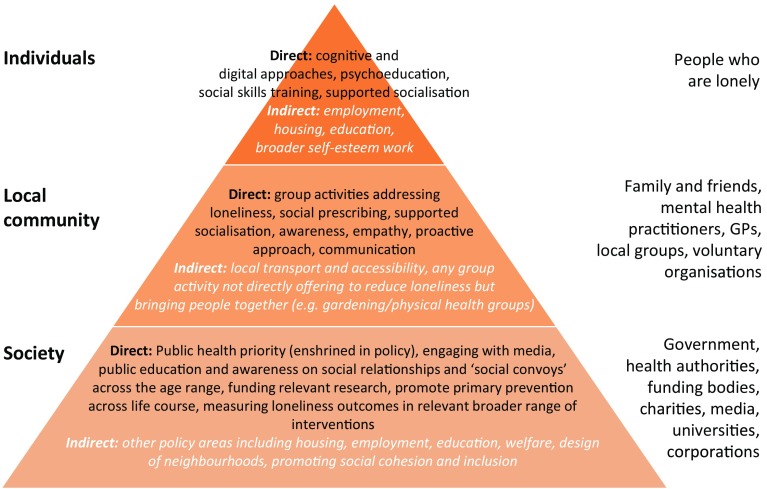
“…with mental health problems, but not specifically in the peri-natal period, are broadly classified into ‘direct interven-tions’ (to reduce loneliness or enhance social support specifically) or ‘indirect interventions’ (addressing broader wellbeing approaches that could impact loneliness) [35].”
InfluentialIkhtabi, S., Morrison, N., Goulder, J., Ma, Z., Jarvis, A., Emptage, I., Gray, H., Pitman, A., Lloyd‐Evans, B., & Johnson, S. (2026) · Research Square · doi:10.21203/rs.3.rs-9576879/v1
Self-citationFunakoshi, A., Yong, R. K. F., & Sekiguchi, E. (2026) · International Journal of Social Psychiatry · doi:10.1177/00207640261446111
“…or depression, among those with hikikomori, psychological interventions must be designed to address cognitive factors linked to loneliness, as changing a person’s mental processes can lead to a change in their social behaviour and contribute to reducing loneliness over time (Mann et al., 2017).”
Wong, T. Y., Wong, T. S., Hou, W. K., Leung, A. N. M., Xiao, J., Yuen, K. S. L., Lui, S. S. Y., Qiu, A., Moore, T. M., & Gur, R. C. (2026) · Journal of Child Psychology and Psychiatry · doi:10.1111/jcpp.70178
“Despite growing attention, research on loneliness in late childhood remains limited, particularly regarding prospective risk and protective factors with longitudinal designs (Binte Mohammad Adib & Sabharwal, 2023; Mann et al., 2017; Marquez et al., 2023).”
Hall, A., Barreto, M., Victor, C., Qualter, P., & Pitman, A. (2026) · Current Research in Behavioral Sciences · doi:10.1016/j.crbeha.2026.100219
Sippel, L. M., Chilton, R., Hoang, A., Rožek, D., Smith, N., Harpaz‐Rotem, I., & Hoff, R. A. (2026) · Psychological Medicine · doi:10.1017/s0033291726105157
“Cognitive – behavioral therapies have been found to produce small-to-moderate reductions in loneliness (Hickin et al., 2021), perhaps due, in part, to targeting of maladaptive social beliefs (Mann et al., 2017).”
Combatting Loneliness for the Older Person in Rural Communities
McDonnell‐Naughton, M. (2026) · Proceedings of the ... International Conference on Business Excellence · doi:10.2478/picbe-2026-0074
“Interventions such as psychoeducation, social skills training, and empowering the older person to engage in social prescribing programs is one positive pathway towards addressing loneliness (Mann et al., 2017, 2021).”
Ikhtabi, S., Morant, N. J., Rushforth, A., Rowe, S. L., Pearce, E., Dale, O., Pitman, A., & Johnson, S. (2026) · PLOS mental health. · doi:10.1371/journal.pmen.0000671
“Our findings suggest that a socially focused intervention could potentially reduce loneliness in this clinical group through developing a sense of social identity and group belonging [55,56].”
Self-citationFu, Y. (2026) · International Journal of Social Psychiatry · doi:10.1177/00207640261487612
“Reviews also show substantial heterogeneity in interventions targeting loneliness and social isolation (Ma et al., 2020; Mann et al., 2017), reinforcing the need to distinguish a low-bur-den benchmark measure from contextual follow-up.”
Dodell‐Feder, D., Gibbs, K., Silverstein, S. M., & Tamir, D. (2026) · Perspectives on Psychological Science · doi:10.1177/17456916261479653
Dehkordi, N. B., Khanjani, M. S., Jafari, P., Foruoghan, M., Shirinbayan, P., & Vahedi, M. (2026) · Topics in Geriatric Rehabilitation · doi:10.1097/tgr.0000000000000524
Sport Is Social Medicine: A Conceptual Review of Loneliness and Social HealthPreprint
Arslan, C. (2026) · Research Square · doi:10.21203/rs.3.rs-11072500/v1
Metadata
- Authors
- Mann, F., Bone, J. K., Lloyd-Evans, B., Frerichs, J., Pinfold, V., Ma, R., Wang, J., & Johnson, S.
- Affiliations
- University College London (GB)
- McPin Foundation (GB)
- St Pancras Hospital (GB)
- Corresponding author
- Mann, Farhana
- Venue
- Social Psychiatry and Psychiatric Epidemiology
- Published
- 2017-05-20
- Volume
- 52
- Issue
- 6
- Pages
- 627-638
- ISSN
- 0933-7954 (ISSN-L)
- 1433-9285
- PMC
- PMC5487590
- OpenAlex
- W2615658301
- Cited by
- 346
- References
- 93
- Citations by year
- 2026: 25 · 2025: 51 · 2024: 44 · 2023: 48 · 2022: 67 · 2021: 44 · 2020: 36 · 2019: 16 · 2018: 9 · 2017: 6
- FWCI
- 3.16
- Type
- journal article
- Language
- en
- Open access
- hybrid
- doi.org
- Locations
- Social Psychiatry and Psychiatric Epidemiology (publishedVersion, cc-by)
- Europe PMC (PubMed Central) (publishedVersion, cc-by)
- PubMed Central (publishedVersion, cc-by)
- PubMed (publishedVersion)
- UCL Discovery (University College London) (submittedVersion)
- Funders
- Wellcome Trust (203618/Z/16/Z)
- Topics
- Social Sciences › Health › Health disparities and outcomes
- Social Sciences › Psychology › Experimental and Cognitive Psychology › Anxiety, Depression, Psychometrics, Treatment, Cognitive Processes
- Health Sciences › Medicine › Psychiatry and Mental health › Mental Health Treatment and Access
- Keywords
- loneliness, loneliness interventions, mental illness, interpersonal relationships, social skills training, psychoeducation, social prescribing, community-based approach, public mental health
- MeSH terms
- Mental Disorders, Humans, Loneliness, Social Support, Socialization
About these checks
Registry, retraction, Cites and statistics results are computed, not judged, with one exception: a printed reference that no index lists is read once by a model before it counts as a citation error. Claims are extracted by a model and kept only when their quote appears verbatim in the text; each cited source is then checked, with a model’s help, for whether it says what the claim relies on. Those verdicts can be wrong — read the claim’s quote and the cited source before relying on one.
Statistics and arithmetic are recomputed, not judged.
Confidence bands are shown only for fields calibrated on our annotated test set. None is calibrated yet, so no band is shown.
What counts as a claim ›How we measure confidence ›How we check this ›
Are you an author, or do you see a problem with this page? Request a review
Data sources
Bibliographic data: Semantic Scholar, OpenAlex, Crossref.
Contains information from the Semantic Scholar Academic Graph Datasets, made available under the ODC Attribution License (ODC-BY 1.0).
Semantic Scholar’s data is described in: Kinney, R., et al. (2023). The Semantic Scholar Open Data Platform. arXiv:2301.10140.
