

Age-dependent effects of low-dose nicotine treatment on cocaine-induced behavioral plasticity in rats
Open accessThe DOI matches its Crossref record; 71 of the 71 references it cites were found in a registry or an index.
Abstract
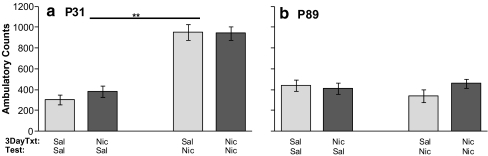
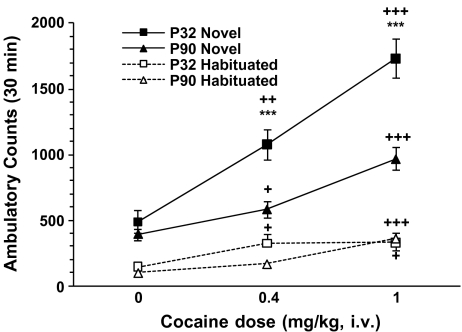
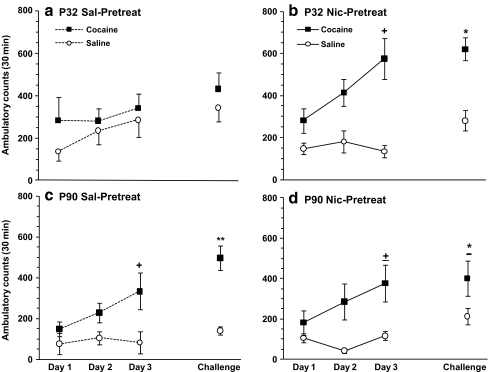
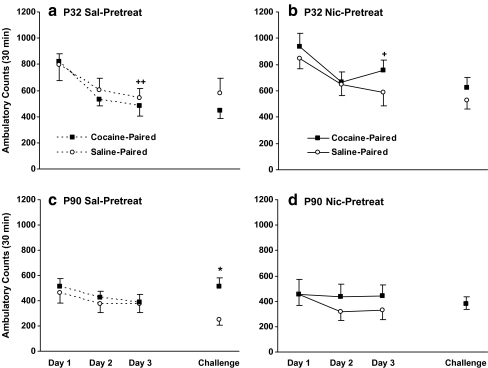
RATIONALE: Epidemiological evidence of early adolescent tobacco use, prior to that of marijuana and other illicit drugs, has led to the hypothesis that nicotine is a "gateway" drug that sensitizes reward pathways to the addictive effects of other psychostimulants. OBJECTIVE: To test this hypothesis, we have compared the effect of a brief, low-dose nicotine pretreatment of adolescent and adult rats on subsequent locomotor response to acute and chronic cocaine. MATERIALS AND METHODS: Adolescents, aged postnatal day (P) 28, and adults, aged P86, were given four daily injections of saline or nicotine (0.06 mg/kg, i.v.). At P32 and P90, rats were given acute injections of cocaine (0, 0.4 or 1.0 mg/kg, i.v.) and monitored for locomotor activity in either a habituated or novel test environment. To examine cocaine sensitization, rats were treated for 3 days with saline or cocaine (0.4 mg/kg, i.v.), and, after 1 day of withdrawal, were given a challenge dose of cocaine (0.4 mg/kg, i.v.). RESULTS: Nicotine pretreatment did not affect acute, drug-induced locomotor activity at either age. However, age differences in cocaine response were observed, with adolescent animals showing enhanced locomotor activity in the novel environment. Adolescent controls did not exhibit cocaine-induced locomotor sensitization, whereas adults did. Nicotine pretreatment during adolescence promoted the development and expression of a sensitized response to repeated cocaine exposure similar to that observed in saline-pretreated adult controls. CONCLUSIONS: These findings show that brief pretreatment with nicotine, in a low dose comparable to that inhaled in 2-4 cigarettes, enhances cocaine-induced behavioral plasticity in adolescent rats.
Overview
The claims and statistics of this paper haven’t been checked yet.
Free: it reads the open-access text and checks the first 5 claims that cite a source we can check. Create a free account to check every claim.
Integrity signals
Registry
Cites
Statistics
Figures
Verification
Claims the paper makes
The claims and statistics of this paper haven’t been checked yet.
Free: it reads the open-access text and checks the first 5 claims that cite a source we can check. Create a free account to check every claim.
Claims other papers make about this one
Each is checked against this paper’s own text: does it say what the citing paper says it does?
The source backs part of the claim, not all of it — or backs it for a different population, condition or comparison.
In the citing paper
“Current data indicate that nicotine disrupts normative limbic development and primes behavioral susceptibility to drugs of abuse (McQuown et al. 2009; Dao et al. 2011).”
From Nicotine and the adolescent brain (2015) · cites this paper as McQuown et al. 2009
Experimental — accuracy not yet measuredThe source backs part of the claim, not all of it — or backs it for a different population, condition or comparison.
In the citing paper
“However, brief treatment of adolescent rats with a low dose of nicotine, equivalent to one to two cigarettes per day for 4 days, enhances acquisition of self-administration for cocaine, methamphetamine and alcohol, induces cocaine locomotor sensitization, and enhances sexual arousal (McQuown et al. 2007; McQuown et al. 2009; Dao et al. 2011; Figs 5 and 6).”
From Nicotine and the adolescent brain (2015) · cites this paper as McQuown et al. 2009
Experimental — accuracy not yet measuredThe cited source says what the claim attributes to it.
In the citing paper
“Nicotine treatment during early adolescence also increases subsequent cocaine-induced locomotor sensitization”
From Unique, long-term effects of nicotine on adolescent brain. (2020) · cites this paper as McQuown et al., 2009
The cited source says what the claim attributes to it.
In the citing paper
“Brief pretreatment of early adolescent rats (postnatal days (P) 28–31) with a low dose of nicotine that models smoking initiation significantly increases self-administration of cocaine, ethanol, fentanyl, and methamphetamine when compared to adults [146–151].”
From Nicotine on the developing brain. (2023) · cites this paper as [148]
The cited source says what the claim attributes to it.
In the citing paper
“However, brief treatment of adolescent rats with a low dose of nicotine, equivalent to one to two cigarettes per day for 4 days, enhances acquisition of self-administration for cocaine, methamphetamine and alcohol, induces cocaine locomotor sensitization, and enhances sexual arousal (McQuown et al. 2007; McQuown et al. 2009; Dao et al. 2011; Figs 5 and 6).”
From Nicotine and the adolescent brain (2015) · cites this paper as McQuown et al. 2009
3 more claims about this paper
Create a free account to see every claim other papers make about this one.
Self-check
Percentages, sums and reported differences re-computed from the paper’s own numbers.
The self-check needs the paper’s full text.
Citations
Cites
The neural basis of drug craving: An incentive-sensitization theory of addiction
Robinson, T. (1993) · Brain Research Reviews · doi:10.1016/0165-0173(93)90013-p · Cited by 7,346 · cited 1×
“Locomotor sensitization, a form of behavioral plasticity induced by repeated exposure to many classes of abused drugs, has been shown in rodents to be associated with augmented drug reward and increased vulnerability to relapse (Robinson and Berridge 1993; De Vries et al. 1998).”
BackgroundThe adolescent brain and age-related behavioral manifestations
Spear, L. P. (2000) · Neuroscience & Biobehavioral Reviews · doi:10.1016/s0149-7634(00)00014-2 · Cited by 5,433
Chambers, R. A., Taylor, J. R., & Potenza, M. N. (2003) · American Journal of Psychiatry · doi:10.1176/appi.ajp.160.6.1041 · Cited by 1,719 · cited 3×
“Corticolimbic systems and their monoamine projections have not yet fully developed by adolescence (Chambers et al. 2003).”
BackgroundRobinson, T. E., & Berridge, K. C. (2003) · Annual Review of Psychology · doi:10.1146/annurev.psych.54.101601.145237 · Cited by 1,509
Vanderschuren, L. J. M. J., & Kalivas, P. W. (2000) · Psychopharmacology · doi:10.1007/s002130000493 · Cited by 1,346
A circuitry model of the expression of behavioral sensitization to amphetamine-like psychostimulants
Pierce, R. C., & Kalivas, P. W. (1997) · Brain Research Reviews · doi:10.1016/s0165-0173(97)00021-0 · Cited by 1,239
Kandel, D. B., Yamaguchi, K., & Chen, K. (1992) · Journal of Studies on Alcohol · doi:10.15288/jsa.1992.53.447 · Cited by 1,039 · cited 2×
“Such findings have led to the hypothesis that early teenage tobacco use may be a “gateway” to later illegal drug use (Kandel et al. 1992).”
BackgroundCarr, D. B., & Sesack, S. R. (2000) · The Journal of Neuroscience · doi:10.1523/jneurosci.20-10-03864.2000 · Cited by 880 · cited 2×
“Projections from the prefrontal cortex regulate activity of the nucleus accumbens and its dopaminergic afferents (Carr and Sesack 1999, 2000), and this circuitry is vital for the development of sensitization to psychostimulants (for review, Pierce and Kalivas 1997).”
BackgroundThe natural history of drug use from adolescence to the mid-thirties in a general population sample
Chen, K., & Kandel, D. B. (1995) · American Journal of Public Health · doi:10.2105/ajph.85.1.41 · Cited by 857 · cited 1×
“Initiation of alcohol and tobacco use often occurs during the early teens, whereas first use of illicit substances arise later (Kandel and Logan 1984; Chen and Kandel 1995).”
BackgroundKandel, D. B., & Logan, J. A. (1984) · American Journal of Public Health · doi:10.2105/ajph.74.7.660 · Cited by 785 · cited 1×
“Initiation of alcohol and tobacco use often occurs during the early teens, whereas first use of illicit substances arise later (Kandel and Logan 1984; Chen and Kandel 1995).”
Background
Cited by
Nicotine and the adolescent brain
Yuan, M., Cross, S. J., Loughlin, S. E., & Leslie, F. M. (2015) · The Journal of Physiology · doi:10.1113/jp270492 · Cited by 623
Self-citationA Molecular Basis for Nicotine as a Gateway Drug
Kandel, E. R., & Kandel, D. B. (2014) · New England Journal of Medicine · doi:10.1056/nejmsa1405092 · Cited by 353
The Gateway Hypothesis of substance abuse: developmental, biological and societal perspectives
Kandel, D., & Kandel, E. (2015) · Acta Paediatrica · doi:10.1111/apa.12851 · Cited by 254
“Indeed, pretreatment with nicotine has been reported to lead to enhanced cocaine-induced locomotor activity and increased initial self-administration of cocaine among adolescent but not adult rats (39,40).”
BackgroundEmergence of sex differences in the development of substance use and abuse during adolescence
Kuhn, C. (2015) · Pharmacology & Therapeutics · doi:10.1016/j.pharmthera.2015.06.003 · Cited by 179
“, 2012), and a third which reported comparable sensitization following adolescent or adult treatment (Adriani, Deroche-Gamonet, Le Moal, Laviola, & Piazza, 2006) Two studies reported increased cross-sensitization to cocaine (Santos, Marin, Cruz, Delucia, & Planeta, 2009) or amphetamine (McQuown et al., 2009) after ado…”
BackgroundUnique, long-term effects of nicotine on adolescent brain.
Leslie, F. M. (2020) · Pharmacology, Biochemistry, and Behavior · doi:10.1016/j.pbb.2020.173010 · Cited by 178
“Nicotine treatment during early adolescence also increases subsequent cocaine-induced locomotor sensitization (Kelley & Rowan, 2004; McQuown et al., 2009; Alajaji et al., 2016; Reed and Izenwasser, 2017).”
BackgroundSelf-citationNicotine Gateway Effects on Adolescent Substance Use
Ren, M., & Lotfipour, S. (2019) · Western Journal of Emergency Medicine · doi:10.5811/westjem.2019.7.41661 · Cited by 166
Nicotine on the developing brain.
Castro, E. M., Lotfipour, S., & Leslie, F. M. (2023) · Pharmacological research · doi:10.1016/j.phrs.2023.106716 · Cited by 157
Self-citationSalmanzadeh, H., Ahmadi‐Soleimani, S. M., Pachenari, N., Azadi, M., Halliwell, R. F., Rubino, T., & Azizi, H. (2020) · Brain Research Bulletin · doi:10.1016/j.brainresbull.2020.01.007 · Cited by 176
The emergence of gonadal hormone influences on dopaminergic function during puberty
Kuhn, C., Johnson, M., Thomae, A., Luo, B., Simon, S. A., Zhou, G., & Walker, Q. D. (2010) · Hormones and Behavior · doi:10.1016/j.yhbeh.2009.10.015 · Cited by 113
“…of adolescent rats is less than that observed after a comparable treatment of adult rats, although cross-sensitization to cocaine and amphetamine were both greater in adolescent males than adult males (Collins and Izenwasser 2004; Collins et al. 2004; Cruz et al. 2005; McQuown et al. 2009).”
BackgroundMechanisms and genetic factors underlying co-use of nicotine and alcohol or other drugs of abuse
Cross, S. J., Lotfipour, S., & Leslie, F. M. (2017) · The American Journal of Drug and Alcohol Abuse · doi:10.1080/00952990.2016.1209512 · Cited by 99
Self-citationNicotine alters limbic function in adolescent rat by a 5-HT1A receptor mechanism
Dao, J. M., McQuown, S. C., Loughlin, S. E., Belluzzi, J. D., & Leslie, F. M. (2011) · Neuropsychopharmacology · doi:10.1038/npp.2011.8 · Cited by 79
“4-Day Pretreatment The same design was used as described in McQuown et al (2007, 2009).”
MethodSelf-citationMicroglial activation increases cocaine self-administration following adolescent nicotine exposure
Linker, K. E., Gad, M., Tawadrous, P., Cano, M., Green, K. N., Wood, M. A., & Leslie, F. M. (2020) · Nature Communications · doi:10.1038/s41467-019-14173-3 · Cited by 77
Self-citationCamarini, R., & Pautassi, R. M. (2016) · Brain Research Bulletin · doi:10.1016/j.brainresbull.2016.04.006 · Cited by 61
“Adolescent rats that were given a very brief exposure to nicotine, but not their counterparts that were given vehicle, subsequently exhibited cocaine-induced behavioral sensitization (McQuown et al., 2009).”
BackgroundHuang, Y.-Y., Levine, A., Kandel, D. B., Yin, D., Colnaghi, L., Drisaldi, B., & Kandel, E. R. (2014) · Learning & Memory · doi:10.1101/lm.032292.113 · Cited by 56
“…to nicotine produces a greater increase in selfadministration, sensitization, and conditioned place preference than the administration of cocaine alone (Klein 2001; Desai and Terry 2003; Collins et al. 2004; McMillen et al. 2005; McQuown et al. 2009; Levine et al. 2011; Mello and Newman 2011).”
BackgroundE-cigarettes may serve as a gateway to conventional cigarettes and other addictive drugs
Chen, G. L., Rahman, S., & Lutfy, K. (2023) · Advances in Drug and Alcohol Research · doi:10.3389/adar.2023.11345 · Cited by 59
Unique effects of nicotine across the lifespan
Ren, M., Lotfipour, S., & Leslie, F. (2022) · Pharmacology Biochemistry and Behavior · doi:10.1016/j.pbb.2022.173343 · Cited by 40
Self-citationAdolescent Maturation of Dopamine D1 and D2 Receptor Function and Interactions in Rodents
Dwyer, J. B., & Leslie, F. M. (2016) · PLOS ONE · doi:10.1371/journal.pone.0146966 · Cited by 41
“While the consensus definition of adolescence in the rodent continues to evolve in light of emerging behavioral, endocrine, and imaging data [10,11], adolescent animals show unique responses to drugs that target the DA system, including blunted cocaine-induced locomotion [12], stereotypy [13], and sensitization [14].”
BackgroundSelf-citationDickson, P. E., Miller, M. M., Rogers, T. D., Blaha, C. D., & Mittleman, G. (2014) · Addiction Biology · doi:10.1111/j.1369-1600.2012.00496.x · Cited by 35
“…that several studies in rats and mice have shown that exposure to nicotine during adolescence affects measures of drug reward and sensitivity (e.g. Kelley & Middaugh 1999; Collins & Izenwasser 2004; Kelley & Rowan 2004; McQuown, Belluzzi & Leslie 2007; McQuown et al. 2009; Anker & Carroll 2011).”
BackgroundThe reinforcement threshold for nicotine as a target for tobacco control
Sofuoglu, M., & LeSage, M. G. (2012) · Drug and Alcohol Dependence · doi:10.1016/j.drugalcdep.2012.04.023 · Cited by 39
Gender differences in risk factors for cigarette smoking initiation in childhood
Sylvestre, M., Wellman, R. J., O’Loughlin, E. K., Dugas, E. N., & O’Loughlin, J. L. (2017) · Addictive Behaviors · doi:10.1016/j.addbeh.2017.04.004 · Cited by 23
Age-dependent alterations in reward-seeking behavior after brief nicotine exposure
Mojica, C. Y., Belluzzi, J. D., & Leslie, F. M. (2014) · Psychopharmacology · doi:10.1007/s00213-013-3266-7 · Cited by 17
Self-citationKaratayev, O., Collier, A. D., Targoff, S. R., & LEIBOWITZ, S. F. (2024) · International Journal of Molecular Sciences · doi:10.3390/ijms25158341 · Cited by 17
“…a gateway to the use of other drugs [106], with nicotine-exposed rodents found to be more sensitive to the locomotor-activating effects of cocaine [107] and more susceptible to the co-use of nicotine and alcohol during adolescence [108] and the self-administration of alcohol and cocaine in adults…”
BackgroundCardenas, A., & Lotfipour, S. (2022) · Nicotine & Tobacco Research · doi:10.1093/ntr/ntab218 · Cited by 16
Khani, F., Pourmotabbed, A., Hosseinmardi, N., Nedaei, S. E., Fathollahi, Y., & Azizi, H. (2022) · Developmental Psychobiology · doi:10.1002/dev.22315 · Cited by 14
Mackenzie, R. (2010) · Neuroethics · doi:10.1007/s12152-010-9074-4 · Cited by 16
“Nicotine appears to act as a gateway drug in adolescence, sensitising reward pathways to the addictive effects of other psychostimulants [ 61 ].”
BackgroundHayase, T. (2017) · Behavioural Pharmacology · doi:10.1097/fbp.0000000000000326 · Cited by 11
“…locomotor sensitization during adolescence, the period showing overt vulnerability to drug addiction, and this was considered to occur through the activation of nAChRs in the brain (Schoffelmeer et al., 2002; Collins and Izenwasser, 2004; McQuown et al., 2009; Reed and Izenwasser, 2017).”
BackgroundNicotine modulation of adolescent dopamine receptor signaling and hypothalamic peptide response
Mojica, C. Y., Dao, J. M., Yuan, M., Loughlin, S. E., & Leslie, F. M. (2014) · Neuropharmacology · doi:10.1016/j.neuropharm.2013.10.012 · Cited by 10
“Nicotine pretreatment also produces an adolescent-specific enhancement of both cocaine-induced locomotor sensitization (McQuown et al., 2009) and acute locomotor activity and penile erection induced by the D2-like agonist, quinpirole (Dao et al., 2011).”
BackgroundSelf-citationCardenas, A. M., Bai, Y., Heydary, Y. H., Li, J., Leslie, F. M., & Lotfipour, S. (2022) · International Journal of Molecular Sciences · doi:10.3390/ijms23063145 · Cited by 16
“Our findings are consistent with adolescent wild-type rat studies, which show low-dose nicotine exposure during early adolescence is sufficient to enhance nicotine-induced locomotion and anxiolytic behavior after nicotine infusion [37,42].”
MethodResultInfluentialSelf-citationNicotine and fluoxetine alter adolescent dopamine-mediated behaviors via 5-HT1A receptor activation
Yuan, M., & Leslie, F. M. (2024) · Frontiers in Psychiatry · doi:10.3389/fpsyt.2024.1380123 · Cited by 9
“Basal [ 35 S]GTP g S binding was determined in the absence of 8-OH-DPAT.”
BackgroundMethodInfluentialSelf-citationNeurotensin Agonist Attenuates Nicotine Potentiation to Cocaine Sensitization
Fredrickson, P. A., Boules, M., Stennett, B., & Richelson, E. (2014) · Behavioral Sciences · doi:10.3390/bs4010042 · Cited by 5
“However, low dose nicotine did enable locomotor sensitization to cocaine that was not seen in control animals [8].”
Singh, P. K., & Lutfy, K. (2017) · Pharmacology Biochemistry and Behavior · doi:10.1016/j.pbb.2017.07.010 · Cited by 5
“Although an earlier study reported that prior nicotine treatment only enhanced the rewarding action of cocaine in adolescents but not adult rats (McQuown et al., 2009; Mojica et al., 2014), limited information is available on the impact of nicotine exposure during adulthood on cocaine reward, extinction and reinstatem…”
BackgroundResultInfluentialExperimental Evidence on Age-related Differential Outcomes Associated With Substance Abuse
Ahmadi‐Soleimani, S. M., Salmanzadeh, H., & Azizi, H. (2023) · Basic and Clinical Neuroscience Journal · doi:10.32598/bcn.2023.587.1 · Cited by 4
Stojakovic, A., Ahmad, S. M., & Lutfy, K. (2021) · Brain Sciences · doi:10.3390/brainsci11040420 · Cited by 5
Chen, G., Ghazal, M., Rahman, S., & Lutfy, K. (2021) · International review of neurobiology · doi:10.1016/bs.irn.2021.07.006
107 Wat Rookt De Nederlandse Jeugd En Waarom?
(2010) · Zorg en Financiering · doi:10.1007/bf03094803
Epidemiology of Substance use Disorders
Kandel, D. B., Hu, M., Griesler, P. C., Kerridge, B. T., & Grant, B. F. (2017) · Oxford University Press eBooks · doi:10.1093/med/9780190681425.003.0041
Maldonado‐Devincci, A. M., Amante, R., Raudales, R., Michael, L. A., Badanich, K. A., & Kirstein, C. L. (2025) · bioRxiv (Cold Spring Harbor Laboratory) · doi:10.1101/2025.07.10.664140
“Nicotine pretreatment during adolescence, but not adulthood, sensitized rats to cocaine-induced elevations in TDM when challenged three days later, an effect that was likely potentiated by novelty (McQuown et al., 2009).”
Impact of E-Cigarettes on the Neurologic System
Hamdan, A. (2025) · Springer eBooks · doi:10.1007/978-3-032-04913-1_11 · Cited by 1
Nicotine enhances the expression of a conditioned place preference in adult male rats
Marfo, N. Y. A. (2013) · D-Scholarship@Pitt (University of Pittsburgh)
Metadata
- Authors
- McQuown, S. C., Dao, J. M., Belluzzi, J. D., & Leslie, F. M.
- Affiliations
- University of California, Irvine (US)
- Corresponding author
- McQuown, Susan C.
- ORCID
- Leslie, Frances M.
- Venue
- Psychopharmacology
- Published
- 2009-09-02
- Volume
- 207
- Issue
- 1
- Pages
- 143-152
- ISSN
- 0033-3158 (ISSN-L)
- 1432-2072
- PMC
- PMC2764852
- OpenAlex
- W2105607151
- Cited by
- 39
- References
- 70
- Citations by year
- 2025: 2 · 2024: 2 · 2023: 3 · 2022: 3 · 2021: 3 · 2020: 3 · 2019: 1 · 2017: 4 · 2016: 3 · 2015: 2 · 2014: 4 · 2013: 3 · 2012: 2
- FWCI
- 0.83
- Type
- journal article
- Language
- en
- Open access
- hybrid
- doi.org
- Licence
- cc-by-nc
- Locations
- Psychopharmacology (publishedVersion, cc-by-nc)
- PubMed Central (publishedVersion, cc-by-nc)
- PubMed (publishedVersion)
- eScholarship (California Digital Library) (submittedVersion)
- Funders
- Tobacco-Related Disease Research Program
- National Institute on Drug Abuse (DA 19138, R01DA019138)
- Topics
- Life Sciences › Neuroscience › Cellular and Molecular Neuroscience › Neurotransmitter Receptor Influence on Behavior
- Health Sciences › Medicine › Public Health, Environmental and Occupational Health › Smoking Behavior and Cessation
- Life Sciences › Biochemistry, Genetics and Molecular Biology › Molecular Biology › Nicotinic Acetylcholine Receptors Study
- Keywords
- nicotine, cocaine, adolescent nicotine exposure, age-dependent effects, locomotor sensitization, cocaine-induced locomotor activity, behavioral plasticity, gateway hypothesis, stimulant use disorder
- MeSH terms
- Adaptation, Physiological, Aging, Analysis of Variance, Animals, Animals, Newborn, Cocaine, Dose-Response Relationship, Drug, Exploratory Behavior, Locomotion, Male, Nicotine, Rats, Sprague-Dawley, Nicotinic Agonists, Dopamine Uptake Inhibitors, Rats
About these checks
Registry, retraction, Cites and statistics results are computed, not judged, with one exception: a printed reference that no index lists is read once by a model before it counts as a citation error. Claims are extracted by a model and kept only when their quote appears verbatim in the text; each cited source is then checked, with a model’s help, for whether it says what the claim relies on. Those verdicts can be wrong — read the claim’s quote and the cited source before relying on one.
Statistics and arithmetic are recomputed, not judged.
Confidence bands are shown only for fields calibrated on our annotated test set. None is calibrated yet, so no band is shown.
What counts as a claim ›How we measure confidence ›How we check this ›
Are you an author, or do you see a problem with this page? Request a review
Data sources
Bibliographic data: Semantic Scholar, OpenAlex, Crossref.
Contains information from the Semantic Scholar Academic Graph Datasets, made available under the ODC Attribution License (ODC-BY 1.0).
Semantic Scholar’s data is described in: Kinney, R., et al. (2023). The Semantic Scholar Open Data Platform. arXiv:2301.10140.
