

Computational modelling reveals contrasting effects on reinforcement learning and cognitive flexibility in stimulant use disorder and obsessive-compulsive disorder: remediating effects of dopaminergic D2/3 receptor agents
Open accessThe DOI matches its Crossref record; 85 of the 85 references it cites were found in a registry or an index.
Abstract
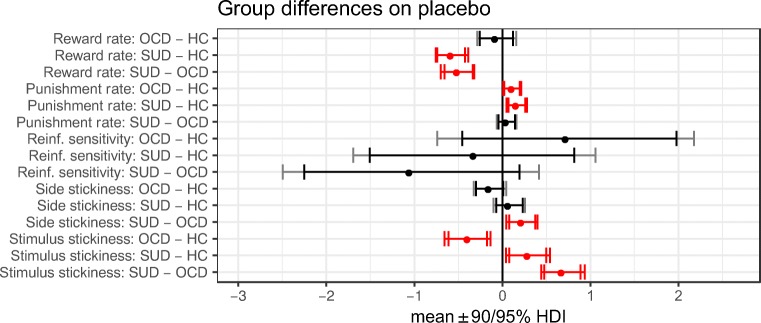
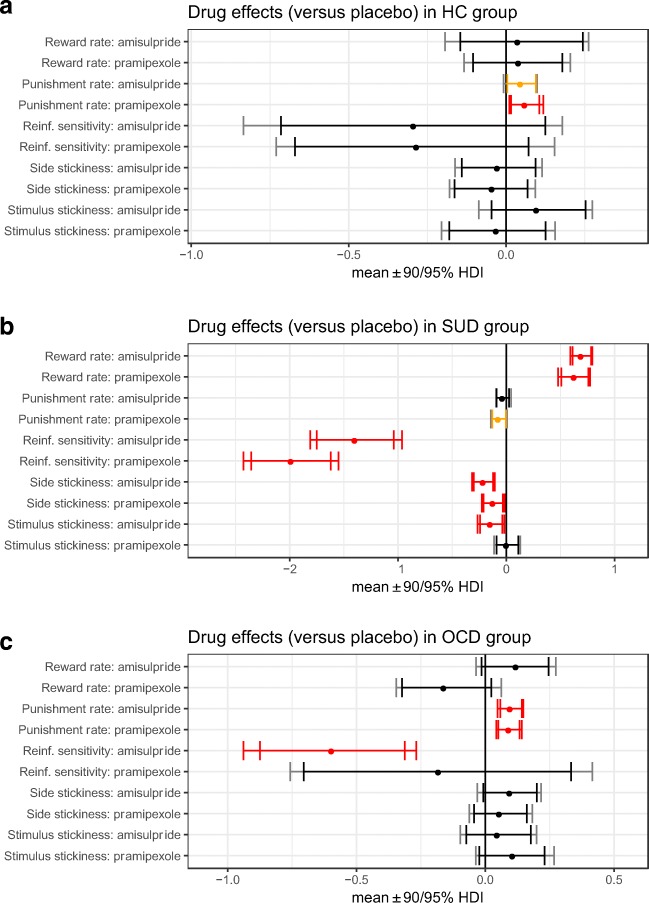
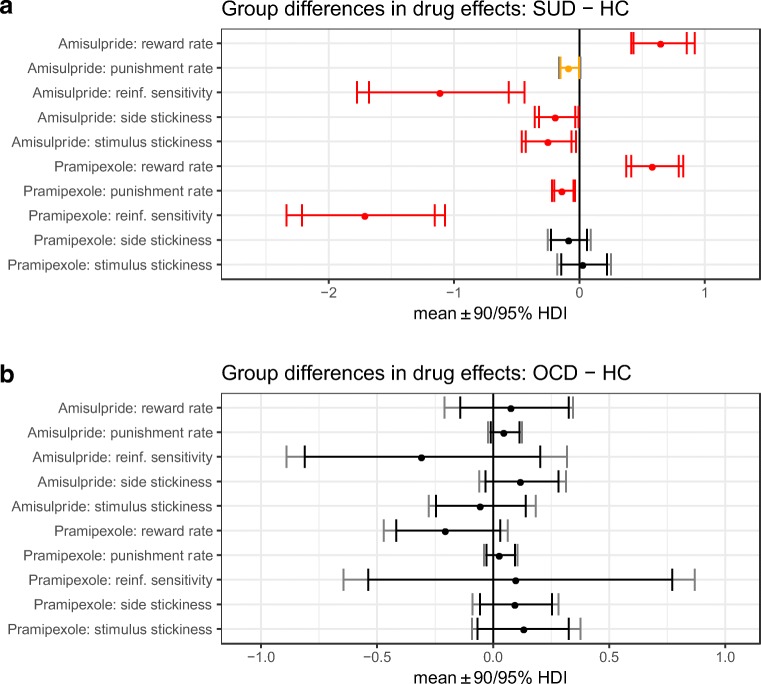
Rationale Disorders of compulsivity such as stimulant use disorder (SUD) and obsessive-compulsive disorder (OCD) are characterised by deficits in behavioural flexibility, some of which have been captured using probabilistic reversal learning (PRL) paradigms. Objectives This study used computational modelling to characterise the reinforcement learning processes underlying patterns of PRL behaviour observed in SUD and OCD and to show how the dopamine D2/3 receptor agonist pramipexole and the D2/3 antagonist amisulpride affected these responses. Methods We applied a hierarchical Bayesian method to PRL data across three groups: individuals with SUD, OCD, and healthy controls. Participants completed three sessions where they received placebo, pramipexole, and amisulpride, in a double-blind placebo-controlled, randomised design. We compared seven models using a bridge sampling estimate of the marginal likelihood. Results Stimulus-bound perseveration, a measure of the degree to which participants responded to the same stimulus as before irrespective of outcome, was significantly increased in SUD, but decreased in OCD, compared to controls (on placebo). Individuals with SUD also exhibited reduced reward-driven learning, whilst both the SUD and OCD groups showed increased learning from punishment (nonreward). Pramipexole and amisulpride had similar effects on the control and OCD groups; both increased punishment-driven learning. These D2/3-modulating drugs affected the SUD group differently, remediating reward-driven learning and reducing aspects of perseverative behaviour, amongst other effects. Conclusions We provide a parsimonious computational account of how perseverative tendencies and reward- and punishment-driven learning differentially contribute to PRL in SUD and OCD. D2/3 agents modulated these processes and remediated deficits in SUD in particular, which may inform therapeutic effects.
Overview
The claims and statistics of this paper haven’t been checked yet.
Free: it reads the open-access text and checks the first 5 claims that cite a source we can check. Create a free account to check every claim.
Integrity signals
Registry
Cites
Statistics
Figures
Verification
Claims the paper makes
The claims and statistics of this paper haven’t been checked yet.
Free: it reads the open-access text and checks the first 5 claims that cite a source we can check. Create a free account to check every claim.
Self-check
Percentages, sums and reported differences re-computed from the paper’s own numbers.
The self-check needs the paper’s full text.
Citations
Cites
Diagnostic and Statistical Manual of Mental Disorders
American Psychiatric Association (2013) · doi:10.1176/appi.books.9780890425596 · Cited by 116,369
Gelman, A., Carlin, J. B., Stern, H. S., & Rubin, D. B. (2003) · doi:10.1201/9780429258480 · Cited by 27,276
Hao (2015) · doi:10.1002/14651858 · Cited by 11,321
A neural substrate of prediction and reward
Schultz, W., Dayan, P., & Montague, P. R. (1997) · Science · doi:10.1126/science.275.5306.1593 · Cited by 9,388 · cited 2×
“When a reward is omitted, there is ordinarily a dip in dopaminergic firing (Schultz et al. 1997), and in the setting of dopamine depletion in Parkinson’s, this mechanism of learning from negative feedback appears to be facilitated, at least when assessed using outcomes of points or money (Frank et…”
BackgroundStan : A Probabilistic Programming Language
Carpenter, B., Gelman, A., Hoffman, M. D., Lee, D., Goodrich, B., Betancourt, M., Brubaker, M., Guo, J., Li, P., & Riddell, A. (2017) · Journal of Statistical Software · doi:10.18637/jss.v076.i01 · Cited by 7,754 · cited 1×
“A single dose of an SSRI, more specifically, has promoted hypersensitivity to negative feedback in rats and healthy humans, and subchronic dosing has improved performance in rats (Bari et al. 2010; Chamberlain et al. 2006; Skandali et al. 2018).”
BackgroundThe Yale-Brown Obsessive Compulsive Scale: I. Development, Use, and Reliability
Goodman, W. K. (1989) · Archives of General Psychiatry · doi:10.1001/archpsyc.1989.01810110048007 · Cited by 7,712
Information theory, inference, and learning algorithms
(2004) · Choice Reviews Online · doi:10.5860/choice.41-5949 · Cited by 6,362
General methods for monitoring convergence of iterative simulations
Brooks, S. P., & Gelman, A. (1998) · Journal of Computational and Graphical Statistics · doi:10.1080/10618600.1998.10474787 · Cited by 6,045
Information Theory, Inference, and Learning Algorithms
(2004) · Kybernetes · doi:10.1108/03684920410534506 · Cited by 4,937
Diagnostic and Statistical Manual of Mental Disorders, 5th Edition
(2013) · American Psychiatric Association Publishing eBooks · doi:10.1176/appi.books.9780890425596.893619 · Cited by 4,383
By Carrot or by Stick: Cognitive Reinforcement Learning in Parkinsonism
Frank, M. J., Seeberger, L. C., & O'Reilly, R. C. (2004) · Science · doi:10.1126/science.1102941 · Cited by 1,964
Uneven Pattern of Dopamine Loss in the Striatum of Patients with Idiopathic Parkinson's Disease
Kish, S. J., Shannak, K., & Hornykiewicz, O. (1988) · New England Journal of Medicine · doi:10.1056/nejm198804073181402 · Cited by 1,953 · cited 1×
“Parkinson’s is characterised by dramatic degeneration of dopaminergic neurons in the substantia nigra (Kish et al. 1988) and has therefore been of great importance for understanding dopamine function.”
BackgroundExperience-weighted Attraction Learning in Normal Form Games
Camerer, C., & Hua Ho, T. (1999) · Econometrica · doi:10.1111/1468-0262.00054 · Cited by 1,487
Why We (Usually) Don't Have to Worry About Multiple Comparisons
Gelman, A., Hill, J., & Yajima, M. (2012) · Journal of Research on Educational Effectiveness · doi:10.1080/19345747.2011.618213 · Cited by 1,274 · cited 1×
“…of estimates drawn from a higher-level distribution (including, at the least, the priors at the top level), leading to an automatic multiple comparisons correction without the reduction in power seen with the classical approach (Gelman and Tuerlinckx 2000; Gelman et al. 2012; Kruschke 2011b).”
BackgroundDrug addiction: updating actions to habits to compulsions ten years on
Everitt, B. J., & Robbins, T. W. (2016) · Annual Review of Psychology · doi:10.1146/annurev-psych-122414-033457 · Cited by 1,225
Self-citationVolkow, N. D., Fowler, J. S., Wang, G., Hitzemann, R., Logan, J., Schlyer, D. J., Dewey, S. L., & Wolf, A. P. (1993) · Synapse · doi:10.1002/syn.890140210 · Cited by 924
Volkow, N. D., Chang, L., Wang, G.-J., Fowler, J. S., Ding, Y.-S., Sedler, M., Logan, J., Franceschi, D., Gatley, J., Hitzemann, R., et al. (2001) · American Journal of Psychiatry · doi:10.1176/appi.ajp.158.12.2015 · Cited by 916 · cited 3×
“…receptor involvement in maladaptive behaviour is particularly important given the evidence of reduced striatal D2 receptor availability in cocaine abuse (Volkow et al. 1993), methamphetamine abuse (Volkow et al. 2001), and OCD (Denys et al. 2004; Perani et al. 2008; but see Schneier et al. 2008).”
BackgroundTen simple rules for the computational modeling of behavioral data
Wilson, R. C., & Collins, A. G. (2019) · eLife · doi:10.7554/elife.49547 · Cited by 710 · cited 1×
“The use of multiple simulation runs with measurement of convergence is an important check for simulation reliability (cf. Wilson and Collins 2019) and is an intrinsic part of Stan.”
BackgroundCognitive Inflexibility After Prefrontal Serotonin Depletion
Clarke, H. F., Dalley, J. W., Crofts, H. S., Robbins, T. W., & Roberts, A. C. (2004) · Science · doi:10.1126/science.1094987 · Cited by 632 · cited 1×
“Indeed, while serotonin depletion of the OFC in marmosets induced perseveration on a deterministic reversal learning paradigm (Clarke et al. 2004), which appears to”
BackgroundSelf-citationDecreases in dopamine receptors but not in dopamine transporters in alcoholics
Volkow, N. D., Wang, G., Fowler, J. S., Logan, J., Hitzemann, R., Ding, Y., Pappas, N., Shea, C., & Piscani, K. (1996) · Alcoholism: Clinical and Experimental Research · doi:10.1111/j.1530-0277.1996.tb05936.x · Cited by 612
Gillan, C. M., Papmeyer, M., Morein-Zamir, S., Sahakian, B. J., Fineberg, N. A., Robbins, T. W., & de Wit, S. (2011) · American Journal of Psychiatry · doi:10.1176/appi.ajp.2011.10071062 · Cited by 609
Self-citationNeurochemical Modulation of Response Inhibition and Probabilistic Learning in Humans
Chamberlain, S. R., Müller, U., Blackwell, A. D., Clark, L., Robbins, T. W., & Sahakian, B. J. (2006) · Science · doi:10.1126/science.1121218 · Cited by 573
Self-citationReduced volume of orbitofrontal cortex in major depression
Bremner, J. D., Vythilingam, M., Vermetten, E., Nazeer, A., Adil, J., Khan, S., Staib, L. H., & Charney, D. S. (2002) · Biological Psychiatry · doi:10.1016/s0006-3223(01)01336-1 · Cited by 537
Bayesian Assessment of Null Values Via Parameter Estimation and Model Comparison
Kruschke, J. K. (2011) · Perspectives on Psychological Science · doi:10.1177/1745691611406925 · Cited by 468 · cited 4×
“…of estimates drawn from a higher-level distribution (including, at the least, the priors at the top level), leading to an automatic multiple comparisons correction without the reduction in power seen with the classical approach (Gelman and Tuerlinckx 2000; Gelman et al. 2012; Kruschke 2011b).”
BackgroundMethodInfluentialTrial-by-trial data analysis using computational models
Daw, N. D. (2011) · Decision Making, Affect, and Learning · doi:10.1093/acprof:oso/9780199600434.003.0001 · Cited by 456
Chamberlain, S. R., Fineberg, N. A., Menzies, L. A., Blackwell, A. D., Bullmore, E. T., Robbins, T. W., & Sahakian, B. J. (2007) · American Journal of Psychiatry · doi:10.1176/ajp.2007.164.2.335 · Cited by 438 · cited 3×
“Prior studies of OCD, however, have not found evidence of perseveration during PRL (Chamberlain et al. 2007a, b; Ersche et al. 2011; Hauser et al. 2017; Remijnse et al. 2006).”
BackgroundSelf-citation(2015) · Elsevier eBooks · doi:10.1016/c2012-0-00477-2 · Cited by 416
Reduced orbitofrontal-striatal activity on a reversal learning task in obsessive-compulsive disorder
Remijnse, P. L., Nielen, M. M. A., van Balkom, A. J. L. M., Cath, D. C., van Oppen, P., Uylings, H. B. M., & Veltman, D. J. (2006) · Archives of General Psychiatry · doi:10.1001/archpsyc.63.11.1225 · Cited by 408
Enhanced avoidance habits in obsessive-compulsive disorder
Gillan, C. M., Morein-Zamir, S., Urcelay, G. P., Sule, A., Voon, V., Apergis-Schoute, A. M., Fineberg, N. A., Sahakian, B. J., & Robbins, T. W. (2014) · Biological Psychiatry · doi:10.1016/j.biopsych.2013.02.002 · Cited by 399
Self-citationType S error rates for classical and Bayesian single and multiple comparison procedures
Gelman, A., & Tuerlinckx, F. (2000) · Computational Statistics · doi:10.1007/s001800000040 · Cited by 380 · cited 3×
“the top level), leading to an automatic multiple comparisons correction without the reduction in power seen with the classical approach (Gelman and Tuerlinckx 2000; Gelman et al. 2012; Kruschke 2011b).”
BackgroundBari, A., Theobald, D. E., Caprioli, D., Mar, A. C., Aidoo-Micah, A., Dalley, J. W., & Robbins, T. W. (2010) · Neuropsychopharmacology · doi:10.1038/npp.2009.233 · Cited by 325
Self-citationPresynaptic Recording of Quanta from Midbrain Dopamine Neurons and Modulation of the Quantal Size
Pothos, E. N., Davila, V., & Sulzer, D. (1998) · The Journal of Neuroscience · doi:10.1523/jneurosci.18-11-04106.1998 · Cited by 320
Initial validation of two opiate craving questionnaires
Franken, I. H. A., Hendriks, V. M., & van den Brink, W. (2002) · Addictive Behaviors · doi:10.1016/s0306-4603(01)00201-5 · Cited by 307
MURPHY, F. C., MICHAEL, A., ROBBINS, T. W., & SAHAKIAN, B. J. (2003) · Psychological Medicine · doi:10.1017/s0033291702007018 · Cited by 298
Self-citationWang, G. (1997) · Neuropsychopharmacology · doi:10.1016/s0893-133x(96)00184-4 · Cited by 285 · cited 1×
“An analogous pattern has been observed in alcohol (Hietala et al. 1994; Volkow et al. 1996) and opiate dependence (Wang et al. 1997).”
BackgroundGronau, Q. F., Sarafoglou, A., Matzke, D., Ly, A., Boehm, U., Marsman, M., Leslie, D. S., Forster, J. J., Wagenmakers, E.-J., & Steingroever, H. (2017) · Journal of Mathematical Psychology · doi:10.1016/j.jmp.2017.09.005 · Cited by 284
Striatal D2 dopamine receptor binding characteristics in vivo in patients with alcohol dependence
Hietala, J., West, C., Syvälahti, E., Någren, K., Lehikoinen, P., Sonninen, P., & Ruotsalainen, U. (1994) · Psychopharmacology · doi:10.1007/bf02245330 · Cited by 269
Dissociable Effects of Dopamine and Serotonin on Reversal Learning
den Ouden, H. E. M., Daw, N. D., Fernandez, G., Elshout, J. A., Rijpkema, M., Hoogman, M., Franke, B., & Cools, R. (2013) · Neuron · doi:10.1016/j.neuron.2013.08.030 · Cited by 255
Rutledge, R. B., Lazzaro, S. C., Lau, B., Myers, C. E., Gluck, M. A., & Glimcher, P. W. (2009) · The Journal of Neuroscience · doi:10.1523/jneurosci.3524-09.2009 · Cited by 255
Ersche, K. D., Roiser, J. P., Robbins, T. W., & Sahakian, B. J. (2008) · Psychopharmacology · doi:10.1007/s00213-007-1051-1 · Cited by 252 · cited 11×
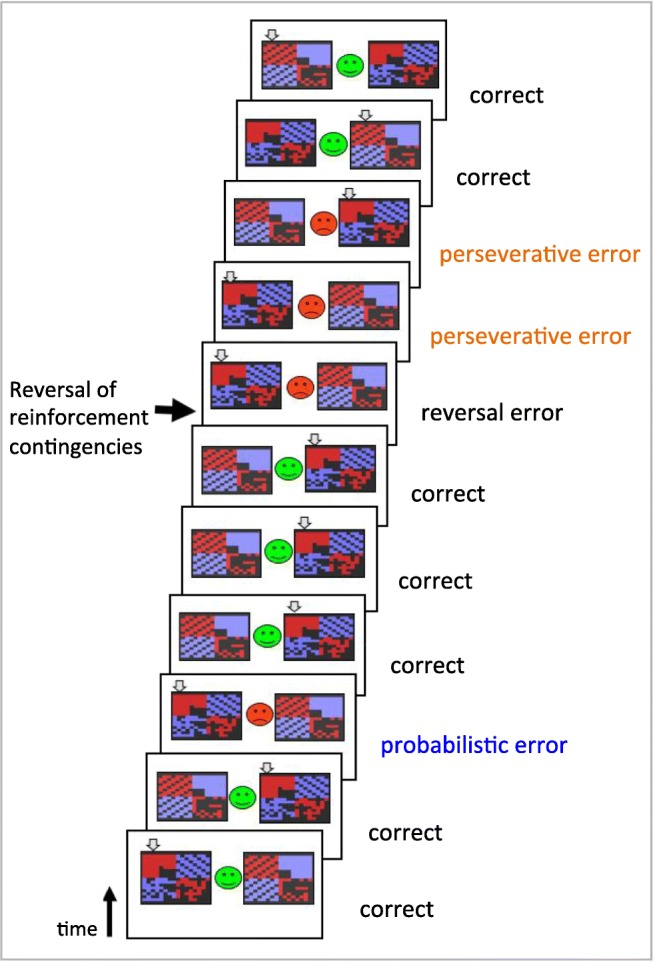
“1 Schematic of the serial probabilistic reversal learning task, used with permission from Ersche et al. (2011). Two abstract stimuli were presented on either side of the screen, the participant selected one using a button press, and feedback was immediately given in the centre of the screen in the form of a green smil…”
BackgroundMethodResultInfluentialSelf-citationSerotonin Selectively Modulates Reward Value in Human Decision-Making
Seymour, B., Daw, N. D., Roiser, J. P., Dayan, P., & Dolan, R. (2012) · The Journal of Neuroscience · doi:10.1523/jneurosci.0053-12.2012 · Cited by 252
Carrots and sticks fail to change behavior in cocaine addiction
Ersche, K. D., Gillan, C. M., Jones, P. S., Williams, G. B., Ward, L. H. E., Luijten, M., de Wit, S., Sahakian, B. J., Bullmore, E. T., & Robbins, T. W. (2016) · Science · doi:10.1126/science.aaf3700 · Cited by 239 · cited 7×
“Experimental data showing abnormalities in processing and flexibility adapting behaviour following rewards and punishments in SUD (e.g. Ersche et al. 2011, 2016) and OCD (e.g. Gillan et al. 2011, 2014) suggest parameters tracking separate reward and punishment learning rates would be of central…”
BackgroundResultInfluentialSelf-citationNeural basis of abnormal response to negative feedback in unmedicated mood disorders
Taylor Tavares, J. V., Clark, L., Furey, M. L., Williams, G. B., Sahakian, B. J., & Drevets, W. C. (2008) · NeuroImage · doi:10.1016/j.neuroimage.2008.05.049 · Cited by 229
Perani, D., Garibotto, V., Gorini, A., Moresco, R. M., Henin, M., Panzacchi, A., Matarrese, M., Carpinelli, A., Bellodi, L., & Fazio, F. (2008) · NeuroImage · doi:10.1016/j.neuroimage.2008.04.233 · Cited by 219 · cited 2×
“…receptor involvement in maladaptive behaviour is particularly important given the evidence of reduced striatal D2 receptor availability in cocaine abuse (Volkow et al. 1993), methamphetamine abuse (Volkow et al. 2001), and OCD (Denys et al. 2004; Perani et al. 2008; but see Schneier et al. 2008).”
BackgroundA neuropsychological comparison of obsessive–compulsive disorder and trichotillomania
Chamberlain, S. R., Fineberg, N. A., Blackwell, A. D., Clark, L., Robbins, T. W., & Sahakian, B. J. (2007) · Neuropsychologia · doi:10.1016/j.neuropsychologia.2006.07.016 · Cited by 212
Self-citationLow level of dopaminergic D2 receptor binding in obsessive-compulsive disorder
Denys, D., van der Wee, N., Janssen, J., De Geus, F., & Westenberg, H. G. M. (2004) · Biological Psychiatry · doi:10.1016/j.biopsych.2004.01.023 · Cited by 195
Dopamine DRD2 Polymorphism Alters Reversal Learning and Associated Neural Activity
Jocham, G., Klein, T. A., Neumann, J., von Cramon, D. Y., Reuter, M., & Ullsperger, M. (2009) · The Journal of Neuroscience · doi:10.1523/jneurosci.5195-08.2009 · Cited by 181 · cited 1×
“At the same time, healthy humans carrying the A1 allele of the dopamine D2 receptor Taq1A polymorphism, which is associated with reduced striatal D2 receptor expression, showed deficits in PRL (Jocham et al. 2009).”
BackgroundEmpirical priors for reinforcement learning models
Gershman, S. J. (2016) · Journal of Mathematical Psychology · doi:10.1016/j.jmp.2016.01.006 · Cited by 167 · cited 4×
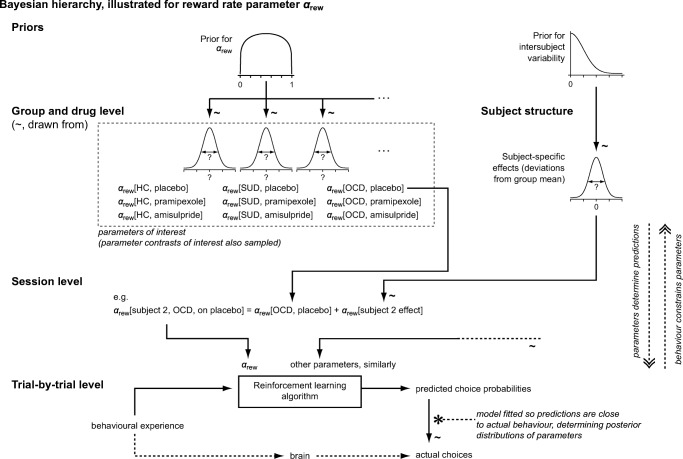
“This procedure directly estimates the marginal likelihood, and thus the posterior probability of eachmodel, given the data, prior model probabilities, and the assumption that the models represent Table 2 Model parameter prior distributions Models using each parameter Prior Reference, if applicable Model parameters Rew…”
BackgroundInfluentialMartinez, D., Greene, K., Broft, A., Kumar, D., Liu, F., Narendran, R., Slifstein, M., Van Heertum, R., & Kleber, H. D. (2009) · American Journal of Psychiatry · doi:10.1176/appi.ajp.2009.08121801 · Cited by 166
Lawrence, A. D., Sahakian, B. J., Rogers, R. D., Hodges, J. R., & Robbins, T. W. (1999) · Neuropsychologia · doi:10.1016/s0028-3932(99)00035-4 · Cited by 160
Self-citationEvenden, J. L., & Robbins, T. W. (1983) · Psychopharmacology · doi:10.1007/bf00427498 · Cited by 151
Self-citationModeling Avoidance in Mood and Anxiety Disorders Using Reinforcement Learning
Mkrtchian, A., Aylward, J., Dayan, P., Roiser, J. P., & Robinson, O. J. (2017) · Biological Psychiatry · doi:10.1016/j.biopsych.2017.01.017 · Cited by 151
Lee, B., Groman, S., London, E. D., & Jentsch, J. D. (2007) · Neuropsychopharmacology · doi:10.1038/sj.npp.1301337 · Cited by 148 · cited 1×
“D2/3 agonism and antagonism, for instance, affected different aspects of reversal learning (Boulougouris et al. 2009; Lee et al. 2007).”
BackgroundRole of Dopamine D2 Receptors in Human Reinforcement Learning
Eisenegger, C., Naef, M., Linssen, A., Clark, L., Gandamaneni, P. K., Müller, U., & Robbins, T. W. (2014) · Neuropsychopharmacology · doi:10.1038/npp.2014.84 · Cited by 134
Self-citationNeural and Psychological Maturation of Decision-making in Adolescence and Young Adulthood
Christakou, A., Gershman, S. J., Niv, Y., Simmons, A., Brammer, M., & Rubia, K. (2013) · Journal of Cognitive Neuroscience · doi:10.1162/jocn_a_00447 · Cited by 133 · cited 1×
“Indeed, while serotonin depletion of the OFC in marmosets induced perseveration on a deterministic reversal learning paradigm (Clarke et al. 2004), which appears to reflect behaviour that has become stimulus-bound (Walker et al. 2009), OFC serotonin depletion also impaired PRL but did not induce…”
BackgroundErsche, K. D., Roiser, J. P., Abbott, S., Craig, K. J., Müller, U., Suckling, J., Ooi, C., Shabbir, S. S., Clark, L., Sahakian, B. J., et al. (2011) · Biological Psychiatry · doi:10.1016/j.biopsych.2011.06.033 · Cited by 128
Self-citationEl Mansari, M. (1995) · Neuropsychopharmacology · doi:10.1016/0893-133x(95)00045-f · Cited by 128
bridgesampling: An R Package for Estimating Normalizing Constants
Gronau, Q. F., Singmann, H., & Wagenmakers, E.-J. (2017) · doi:10.31222/osf.io/v94h6 · Cited by 128 · cited 4×
“…used a bridge sampling estimate of the marginal likelihood to perform model comparison, which has been newly introduced to practical Bayesian inference (Gronau et al. 2017a, b), and is thought to be an improvement upon the Bayesian information criterion (BIC) as used in Hauser et al. (2017).”
BackgroundMethodInfluentialPharmacotherapy of obsessive–compulsive disorder: evidence-based treatment and beyond
Fineberg, N. A., Reghunandanan, S., Brown, A., & Pampaloni, I. (2013) · Australian & New Zealand Journal of Psychiatry · doi:10.1177/0004867412461958 · Cited by 122
Self-citationDopamine agonists for the treatment of cocaine dependence
Minozzi, S., Amato, L., Pani, P. P., Solimini, R., Vecchi, S., De Crescenzo, F., Zuccaro, P., & Davoli, M. (2015) · Cochrane Database of Systematic Reviews · doi:10.1002/14651858.cd003352.pub4 · Cited by 107 · cited 1×
“There have been numerous studies testing dopaminergic agonists for the treatment of SUD; however, evidence for their clinical efficacy is currently lacking (Minozzi et al. 2015).”
BackgroundBoulougouris, V., Castañé, A., & Robbins, T. W. (2009) · Psychopharmacology · doi:10.1007/s00213-008-1341-2 · Cited by 104
Self-citationSchneier, F. R., Martinez, D., Abi-Dargham, A., Zea-Ponce, Y., Simpson, H. B., Liebowitz, M. R., & Laruelle, M. (2008) · Depression and Anxiety · doi:10.1002/da.20268 · Cited by 100 · cited 2×
“…receptor involvement in maladaptive behaviour is particularly important given the evidence of reduced striatal D2 receptor availability in cocaine abuse (Volkow et al. 1993), methamphetamine abuse (Volkow et al. 2001), and OCD (Denys et al. 2004; Perani et al. 2008; but see Schneier et al. 2008).”
BackgroundHarden, D., & Grace, A. (1995) · The Journal of Neuroscience · doi:10.1523/jneurosci.15-09-06157.1995 · Cited by 96
Walker, S. C., Robbins, T. W., & Roberts, A. C. (2009) · Cerebral Cortex · doi:10.1093/cercor/bhn136 · Cited by 96
Self-citationSkandali, N., Rowe, J. B., Voon, V., Deakin, J. B., Cardinal, R. N., Cormack, F., Passamonti, L., Bevan-Jones, W. R., Regenthal, R., Chamberlain, S. R., et al. (2018) · Neuropsychopharmacology · doi:10.1038/s41386-018-0229-z · Cited by 89
Self-citationGroman, S. M., Lee, B., London, E. D., Mandelkern, M. A., James, A. S., Feiler, K., Rivera, R., Dahlbom, M., Sossi, V., Vandervoort, E., et al. (2011) · The Journal of Neuroscience · doi:10.1523/jneurosci.0363-11.2011 · Cited by 87 · cited 1×
“Behaviourally, monkeys with greater D2type availability indeed exhibited better performance on a (deterministic) reversal learning task (Groman et al. 2011).”
BackgroundHauser, T. U., Iannaccone, R., Dolan, R. J., Ball, J., Hättenschwiler, J., Drechsler, R., Rufer, M., Brandeis, D., Walitza, S., & Brem, S. (2017) · Psychological Medicine · doi:10.1017/s0033291716003305 · Cited by 86
Rygula, R., Clarke, H. F., Cardinal, R. N., Cockcroft, G. J., Xia, J., Dalley, J. W., Robbins, T. W., & Roberts, A. C. (2015) · Cerebral Cortex · doi:10.1093/cercor/bhu102 · Cited by 85
Self-citationKosugi, K. E., Maeda, K., & Hirakawa, M. (2017) · The Proceedings of the Annual Convention of the Japanese Psychological Association · doi:10.4992/pacjpa.81.0_tws-011 · Cited by 85
Reiter, A. M. F., Deserno, L., Kallert, T., Heinze, H.-J., Heinz, A., & Schlagenhauf, F. (2016) · The Journal of Neuroscience · doi:10.1523/jneurosci.4322-15.2016 · Cited by 82
Ten simple rules for the computational modeling of behavioral dataPreprint
Wilson, R. C., & Collins, A. G. E. (2019) · doi:10.31234/osf.io/46mbn · Cited by 79
Zhornitsky, S., Rizkallah, É., Pampoulova, T., Chiasson, J., Stip, É., Rompré, P.-P., & Potvin, S. (2010) · Journal of Clinical Psychopharmacology · doi:10.1097/jcp.0b013e3181e7810a · Cited by 77 · cited 1×
“Existing studies testing other D2/3 antagonists have mostly found a lack of clinical benefit for SUD, or even a worsening of symptoms; however, multiple studies have found D2/3 antagonists to reduce cravings in those with comorbid psychosis (Zhornitsky et al. 2010).”
BackgroundMehta, M. A., Montgomery, A. J., Kitamura, Y., & Grasby, P. M. (2007) · Psychopharmacology · doi:10.1007/s00213-007-0947-0 · Cited by 74 · cited 1×
“Indeed, a single 800 mg dose of sulpiride has been reported to occupy ~ 60% of striatal dopamine D2 receptors (Takano et al. 2006), whereas a single 400 mg dose of sulpiride occupies ~ 30% in healthy volunteers (Mehta et al. 2008).”
BackgroundBrain functional connectivity in stimulant drug dependence and obsessive–compulsive disorder
Meunier, D., Ersche, K. D., Craig, K. J., Fornito, A., Merlo-Pich, E., Fineberg, N. A., Shabbir, S. S., Robbins, T. W., & Bullmore, E. T. (2012) · NeuroImage · doi:10.1016/j.neuroimage.2011.08.003 · Cited by 72
Self-citationImpaired cognitive plasticity and goal-directed control in adolescent obsessive–compulsive disorder
Gottwald, J., de Wit, S., Apergis-Schoute, A. M., Morein-Zamir, S., Kaser, M., Cormack, F., Sule, A., Limmer, W., Morris, A. C., Robbins, T. W., et al. (2018) · Psychological Medicine · doi:10.1017/s0033291717003464 · Cited by 64
Self-citationEagle, D. M., Noschang, C., d’Angelo, L.-S. C., Noble, C. A., Day, J. O., Dongelmans, M. L., Theobald, D. E., Mar, A. C., Urcelay, G. P., Morein-Zamir, S., et al. (2014) · Behavioural Brain Research · doi:10.1016/j.bbr.2013.12.040 · Cited by 61
Self-citationClarke, H. F., Cardinal, R. N., Rygula, R., Hong, Y. T., Fryer, T. D., Sawiak, S. J., Ferrari, V., Cockcroft, G., Aigbirhio, F. I., Robbins, T. W., et al. (2014) · The Journal of Neuroscience · doi:10.1523/jneurosci.0718-14.2014 · Cited by 54
Self-citationMurray, G. K., Knolle, F., Ersche, K. D., Craig, K. J., Abbott, S., Shabbir, S. S., Fineberg, N. A., Suckling, J., Sahakian, B. J., Bullmore, E. T., et al. (2019) · Psychopharmacology · doi:10.1007/s00213-019-05292-2 · Cited by 53 · cited 1×
“Murray et al. (2019), compared the same set of OCD and control participants as in our experiment and found that negative prediction errors were enhanced in OCD and that this was normalised by both amisulpride and pramipexole.”
ResultSelf-citationSERT and DAT availabilities under citalopram treatment in obsessive–compulsive disorder (OCD)
Pogarell, O. M., Poepperl, G., Mulert, C., Hamann, C., Sadowsky, N., Riedel, M. J., Moeller, H., Hegerl, U., & Tatsch, K. (2005) · European Neuropsychopharmacology · doi:10.1016/j.euroneuro.2005.01.003 · Cited by 49
Takano, A., Suhara, T., Yasuno, F., Suzuki, K., Takahashi, H., Morimoto, T., Lee, Y.-J., Kusuhara, H., Sugiyama, Y., & Okubo, Y. (2006) · The International Journal of Neuropsychopharmacology · doi:10.1017/s1461145705006103 · Cited by 43
Rat brain binding sites for pramipexole, a clinically useful D3-preferring dopamine agonist
Catnacho-Ochoa, M., Walker, E. L., Evans, D. L., & Piercey, M. F. (1995) · Neuroscience Letters · doi:10.1016/0304-3940(95)11857-s · Cited by 38 · cited 1×
“Although pramipexole may have higher affinity for the D3 receptor (Camacho-Ochoa et al. 1995), the respective contributions of D2 and D3 receptors cannot be dissected using less selective drugs like amisulpride or pramipexole, as in our study.”
BackgroundHorst, N. K., Jupp, B., Roberts, A. C., & Robbins, T. W. (2019) · Neuropsychopharmacology · doi:10.1038/s41386-018-0272-9 · Cited by 38
Self-citationFree operant observing in humans: a translational approach to compulsive certainty seeking
Morein‐Zamir, S., Shahper, S., Fineberg, N. A., Eisele, V., Eagle, D. M., Urcelay, G. P., & Robbins, T. W. (2018) · Quarterly Journal of Experimental Psychology · doi:10.1177/1747021817737727 · Cited by 22
Self-citationbridgesampling: An R Package for Estimating Normalizing ConstantsPreprint
Gronau, Q. F., Singmann, H., & Wagenmakers, E. (2017) · arXiv (Cornell University) · doi:10.48550/arxiv.1710.08162 · Cited by 12 · cited 4×
“…used a bridge sampling estimate of the marginal likelihood to perform model comparison, which has been newly introduced to practical Bayesian inference (Gronau et al. 2017a, b), and is thought to be an improvement upon the Bayesian information criterion (BIC) as used in Hauser et al. (2017).”
BackgroundMethodInfluentialFactor structure of the Barratt impulsiveness scale
Patton, J. H., Stanford, M. S., & Barratt, E. S. (1995) · Journal of Clinical Psychology · doi:10.1002/1097-4679(199511)51:6<768::aid-jclp2270510607>3.0.co;2-1
Research works printed but not linked: 2
- Beck AT Steer RA Brown GK Manual for Beck depression inventory—II 1996 San Antonio Psychological Corporation
- First MB Spitzer RL Gibbon M Williams JBW Structured clinical interview for DSM-IV-TR Axis I disorders, research version, non-patient edition. (SCID-I/NP) 2002 New York Biometrics Research, New York State Psychiatric Institute
Cited by
Does Psychedelic Therapy Have a Transdiagnostic Action and Prophylactic Potential?
Kočárová, R., Horáček, J., & Carhart-Harris, R. (2021) · Frontiers in Psychiatry · doi:10.3389/fpsyt.2021.661233 · Cited by 96
Value-free random exploration is linked to impulsivity
Dubois, M., & Hauser, T. U. (2022) · Nature Communications · doi:10.1038/s41467-022-31918-9 · Cited by 68
“Inaddition,ourdata allowed us to explore how exploration impairments may be linked to other psychiatric domains (e.g., to OCD and other avoidance of uncertainty disorders 44,45 ; to depression, anxiety and anhedonia 46 – 48 ) using data-driven methods.”
MethodSmith, R. S., Schwartenbeck, P., Stewart, J. L., Kuplicki, R., Ekhtiari, H., T Investigators, & Paulus, M. P. (2020) · Drug and Alcohol Dependence · doi:10.1016/j.drugalcdep.2020.108208 · Cited by 85
Modulation of value-based decision making behavior by subregions of the rat prefrontal cortex
Verharen, J. P. H., den Ouden, H. E. M., Adan, R. A. H., & Vanderschuren, L. J. M. J. (2020) · Psychopharmacology · doi:10.1007/s00213-020-05454-7 · Cited by 81
Gueguen, M. C. M., Schweitzer, E. M., & Konova, A. B. (2020) · Current Opinion in Behavioral Sciences · doi:10.1016/j.cobeha.2020.08.007 · Cited by 73
“Further, under certain conditions, some users actually showed increased learning from punishment [32] and punishment prediction errors [34], while drugs with effects on dopamine administered acutely either normalized (rather than exacerbated) deviant learning phenotypes [32] or had no measurable…”
BackgroundResultInfluential
Metadata
- Authors
- Kanen, J. W., Ersche, K. D., Fineberg, N. A., Robbins, T. W., & Cardinal, R. N.
- Affiliations
- University of Cambridge (GB)
- University of Hertfordshire (GB)
- Corresponding author
- Kanen, Jonathan W.
- Venue
- Psychopharmacology
- Published
- 2019-07-20
- Volume
- 236
- Issue
- 8
- Pages
- 2337-2358
- ISSN
- 0033-3158 (ISSN-L)
- 1432-2072
- PMC
- PMC6820481
- OpenAlex
- W2957704534
- Cited by
- 101
- References
- 83
- Citations by year
- 2026: 6 · 2025: 17 · 2024: 17 · 2023: 24 · 2022: 14 · 2021: 13 · 2020: 8 · 2019: 2
- FWCI
- 4.42
- Type
- journal article
- Language
- en
- Open access
- hybrid
- doi.org
- Licence
- cc-by
- creativecommons.org/licenses/by/4.0 (tdm)
- creativecommons.org/licenses/by/4.0 (vor)
- Locations
- Psychopharmacology (publishedVersion, cc-by)
- Europe PMC (PubMed Central) (publishedVersion, cc-by)
- PubMed Central (publishedVersion, cc-by)
- PubMed (publishedVersion)
- University of Hertfordshire Research Archive (University of Hertfordshire) (submittedVersion)
- Apollo (University of Cambridge) (submittedVersion)
- Apollo (University of Cambridge) (submittedVersion, cc-by)
- Apollo
- Apollo (cc-by)
- Funders
- University of Cambridge
- Topics
- Life Sciences › Neuroscience › Cellular and Molecular Neuroscience › Neurotransmitter Receptor Influence on Behavior
- Life Sciences › Neuroscience › Cognitive Neuroscience › Neural and Behavioral Psychology Studies
- Social Sciences › Psychology › Clinical Psychology › Obsessive-Compulsive Spectrum Disorders
- Keywords
- stimulant use disorder, obsessive-compulsive disorder, probabilistic reversal learning, reinforcement learning, cognitive flexibility, dopamine D2/D3 receptors, pramipexole, amisulpride, perseveration, computational modelling, compulsivity
- MeSH terms
- Adult, Central Nervous System Stimulants, Cognition, Double-Blind Method, Female, Humans, Male, Middle Aged, Models, Neurological, Obsessive-Compulsive Disorder, Reinforcement, Psychology, Reversal Learning, Reward, Receptors, Dopamine D2, Dopamine Agonists, Dopamine Antagonists, Substance-Related Disorders, Receptors, Dopamine D3, Young Adult, Dopamine D2 Receptor Antagonists
About these checks
Registry, retraction, Cites and statistics results are computed, not judged, with one exception: a printed reference that no index lists is read once by a model before it counts as a citation error. Claims are extracted by a model and kept only when their quote appears verbatim in the text; each cited source is then checked, with a model’s help, for whether it says what the claim relies on. Those verdicts can be wrong — read the claim’s quote and the cited source before relying on one.
Statistics and arithmetic are recomputed, not judged.
Confidence bands are shown only for fields calibrated on our annotated test set. None is calibrated yet, so no band is shown.
What counts as a claim ›How we measure confidence ›How we check this ›
Are you an author, or do you see a problem with this page? Request a review
Data sources
Bibliographic data: Semantic Scholar, OpenAlex, Crossref.
Contains information from the Semantic Scholar Academic Graph Datasets, made available under the ODC Attribution License (ODC-BY 1.0).
Semantic Scholar’s data is described in: Kinney, R., et al. (2023). The Semantic Scholar Open Data Platform. arXiv:2301.10140.
