

Interference of Aspergillus fumigatus with the immune response
Open accessThe DOI matches its Crossref record; 134 of the 134 references it cites were found in a registry or an index.
Abstract
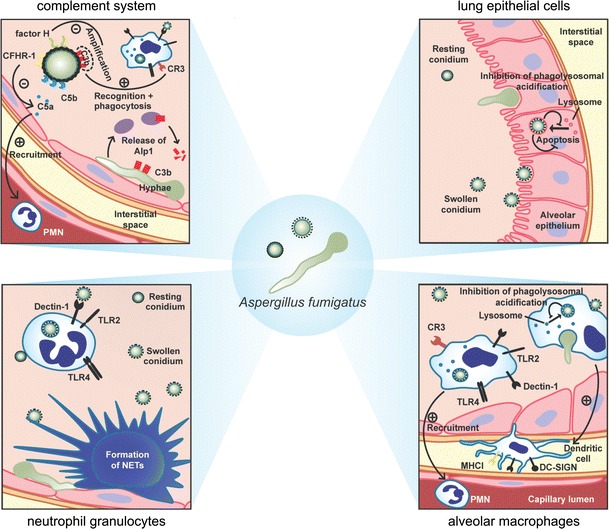
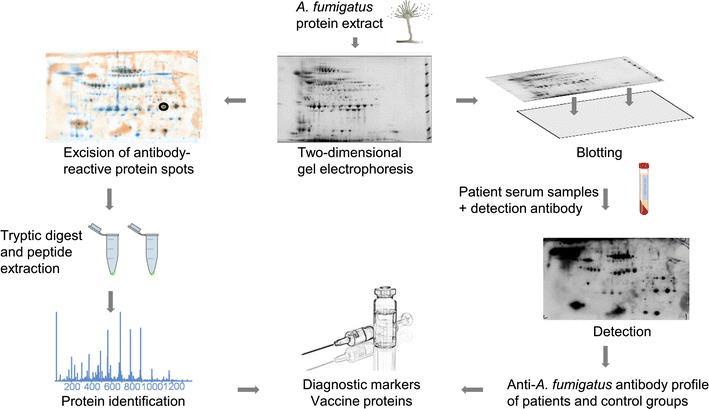
Aspergillus fumigatus is a saprotrophic filamentous fungus and also the most prevalent airborne fungal pathogen of humans. Depending on the host's immune status, the variety of diseases caused by A. fumigatus ranges from allergies in immunocompetent hosts to life-threatening invasive infections in patients with impaired immunity. In contrast to the majority of other Aspergillus species, which are in most cases nonpathogenic, A. fumigatus features an armory of virulence determinants to establish an infection. For example, A. fumigatus is able to evade the human complement system by binding or degrading complement regulators. Furthermore, the fungus interferes with lung epithelial cells, alveolar macrophages, and neutrophil granulocytes to prevent killing by these immune cells. This chapter summarizes the different strategies of A. fumigatus to manipulate the immune response. We also discuss the potential impact of recent advances in immunoproteomics to improve diagnosis and therapy of an A. fumigatus infection.
Overview
The claims and statistics of this paper haven’t been checked yet.
Free: it reads the open-access text and checks the first 5 claims that cite a source we can check. Create a free account to check every claim.
Integrity signals
Registry
Cites
Statistics
Figures
Verification
Claims the paper makes
The claims and statistics of this paper haven’t been checked yet.
Free: it reads the open-access text and checks the first 5 claims that cite a source we can check. Create a free account to check every claim.
Claims other papers make about this one
Each is checked against this paper’s own text: does it say what the citing paper says it does?
The cited source says what the claim attributes to it.
In the citing paper
“Firstly, A. fumigatus can survive within phagocytes [189, 190].”
From Mechanisms of fungal dissemination (2021) · cites this paper as [189]
Self-check
Percentages, sums and reported differences re-computed from the paper’s own numbers.
The self-check needs the paper’s full text.
Citations
Cites
Neutrophil Extracellular Traps Kill Bacteria
Brinkmann, V., Reichard, U., Goosmann, C., Fauler, B., Uhlemann, Y., Weiss, D. S., Weinrauch, Y., & Zychlinsky, A. (2004) · Science · doi:10.1126/science.1092385 · Cited by 10,268
Meijer, L., Nelson, D. J., Riazanski, V., Gabdoulkhakova, A. G., Hery-Arnaud, G., Le Berre, R., Loaëc, N., Oumata, N., Galons, H., Nowak, E., et al. (2016) · Journal of Innate Immunity · doi:10.1159/000444256 · Cited by 4,992
Hidden Killers: Human Fungal Infections
Brown, G. D., Denning, D. W., Gow, N. A. R., Levitz, S. M., Netea, M. G., & White, T. C. (2012) · Science Translational Medicine · doi:10.1126/scitranslmed.3004404 · Cited by 4,284 · cited 1×
“, in chemotherapy and organ or bone marrow transplantation, contributes to the steadily increasing number of patients with impaired immune status [1].”
BackgroundCalamita, E., Schmid, M., Kunz, M., Ndebele-Murisa, M. R., Magadza, C. H. D., Nyambe, I., & Wehrli, B. (2019) · Figshare · doi:10.26181/6153922fe919c · Cited by 4,222
Complement: a key system for immune surveillance and homeostasis
Ricklin, D., Hajishengallis, G., Yang, K., & Lambris, J. D. (2010) · Nature Immunology · doi:10.1038/ni.1923 · Cited by 3,654 · cited 3×
“Moreover, the complement system provides a platform for the cross-talk between innate and humoral circuits via the interaction of complement activation products and surface receptors resulting in governing both T and B cell responses [87].”
BackgroundInfluentialNovel cell death program leads to neutrophil extracellular traps
Fuchs, T. A., Abed, U., Goosmann, C., Hurwitz, R., Schulze, I., Wahn, V., Weinrauch, Y., Brinkmann, V., & Zychlinsky, A. (2007) · The Journal of Cell Biology · doi:10.1083/jcb.200606027 · Cited by 3,197
Aspergillus fumigatus and Aspergillosis
Latgé, J.-P. (1999) · Clinical Microbiology Reviews · doi:10.1128/cmr.12.2.310 · Cited by 2,307 · cited 1×
“Accordingly, neutropenic patients face the highest risk to develop an invasive aspergillosis [50].”
BackgroundNeutrophil elastase and myeloperoxidase regulate the formation of neutrophil extracellular traps
Papayannopoulos, V., Metzler, K. D., Hakkim, A., & Zychlinsky, A. (2010) · Journal of Cell Biology · doi:10.1083/jcb.201006052 · Cited by 2,103 · cited 4×
“Primary or azurophilic granules contain myeloperoxidase (MPO), lysozyme, and antimicrobial proteins like cathepsin G, elastase, and proteinase 3.”
BackgroundInfluentialMedzhitov, R., & Janeway, C. (2000) · New England Journal of Medicine · doi:10.1056/nejm200008033430506 · Cited by 1,825
Segal, A. W. (2005) · Annual Review of Immunology · doi:10.1146/annurev.immunol.23.021704.115653 · Cited by 1,789 · cited 1×
“Tertiary granules contain gelatinase [57, 58].”
Cited by
Complement factor H in host defense and immune evasion
Parente, R., Clark, S. J., Inforzato, A., & Day, A. J. (2017) · Cellular and Molecular Life Sciences · doi:10.1007/s00018-016-2418-4 · Cited by 193
“For example, the opportunistic fungus Aspergillus fumigatus has acquired the ability to recruit both FH and C4BP onto its cell wall [128], however, in this case the microbial ligands are unknown [142].”
BackgroundSantus, W., Devlin, J. R., & Behnsen, J. (2021) · Infection and Immunity · doi:10.1128/iai.00648-20 · Cited by 129
“Inhaled spores of the mold 49 Aspergillus fumigatus can germinate and cause invasive lung disease in immunocompromised 50 patients (18, 19).”
BackgroundFungal iron homeostasis with a focus on Aspergillus fumigatus
Misslinger, M., Hortschansky, P., Brakhage, A. A., & Haas, H. (2020) · Biochimica et Biophysica Acta (BBA) - Molecular Cell Research · doi:10.1016/j.bbamcr.2020.118885 · Cited by 154
Self-citationMechanisms of fungal dissemination
Strickland, A. B., & Shi, M. (2021) · Cellular and Molecular Life Sciences · doi:10.1007/s00018-020-03736-z · Cited by 127
Pathophysiological aspects of Aspergillus colonization in disease
Gago, S., Denning, D. W., & Bowyer, P. (2018) · Medical Mycology · doi:10.1093/mmy/myy076 · Cited by 135
“15,16,107 Immunocompromised patients such as those on acute immunosuppression with neutropenia are at risk of developing invasive fungal disease such as invasive pulmonary aspergillosis.”
Background
Metadata
- Authors
- Heinekamp, T., Schmidt, H., Lapp, K., Pähtz, V., Shopova, I., Köster-Eiserfunke, N., Krüger, T., Kniemeyer, O., & Brakhage, A. A.
- Affiliations
- Leibniz-Institut für Naturstoff-Forschung und Infektionsbiologie e. V. - Hans-Knöll-Institut (HKI) (DE)
- Jena University Hospital (DE)
- Corresponding author
- Heinekamp, Thorsten
- Brakhage, Axel A.
- Venue
- Seminars in Immunopathology
- Published
- 2014-11-18
- Volume
- 37
- Issue
- 2
- Pages
- 141-152
- ISSN
- 1863-2297 (ISSN-L)
- 1863-2300
- PMC
- PMC4326658
- OpenAlex
- W1973988376
- Cited by
- 123
- References
- 133
- Citations by year
- 2026: 6 · 2025: 12 · 2024: 12 · 2023: 7 · 2022: 9 · 2021: 11 · 2020: 8 · 2019: 18 · 2018: 17 · 2017: 10 · 2016: 7 · 2015: 6
- FWCI
- 1.06
- Type
- journal article
- Language
- en
- Open access
- hybrid
- doi.org
- Locations
- Seminars in Immunopathology (publishedVersion, cc-by)
- Europe PMC (PubMed Central) (publishedVersion, cc-by)
- PubMed Central (publishedVersion, cc-by)
- PubMed (publishedVersion)
- Funders
- Deutsche Forschungsgemeinschaft (0315900, CRC/Transregio 124, Transregio 124)
- Bundesministerium für Bildung und Forschung
- Topics
- Health Sciences › Medicine › Infectious Diseases › Antifungal resistance and susceptibility
- Life Sciences › Biochemistry, Genetics and Molecular Biology › Molecular Biology › Fungal and yeast genetics research
- Health Sciences › Medicine › Infectious Diseases › Fungal Infections and Studies
- Keywords
- Aspergillus fumigatus, fungal virulence factors, immune evasion, complement evasion, complement regulatory proteins, lung epithelial cells, alveolar macrophages, neutrophils, invasive aspergillosis, allergic bronchopulmonary aspergillosis, immunoproteomics, fungal pathogenesis
- MeSH terms
- Antigens, Fungal, Aspergillosis, Aspergillus fumigatus, Complement System Proteins, Humans, Neutrophils, Macrophages, Alveolar, Proteomics, Host-Pathogen Interactions, Alveolar Epithelial Cells, Immune Evasion
About these checks
Registry, retraction, Cites and statistics results are computed, not judged, with one exception: a printed reference that no index lists is read once by a model before it counts as a citation error. Claims are extracted by a model and kept only when their quote appears verbatim in the text; each cited source is then checked, with a model’s help, for whether it says what the claim relies on. Those verdicts can be wrong — read the claim’s quote and the cited source before relying on one.
Statistics and arithmetic are recomputed, not judged.
Confidence bands are shown only for fields calibrated on our annotated test set. None is calibrated yet, so no band is shown.
What counts as a claim ›How we measure confidence ›How we check this ›
Are you an author, or do you see a problem with this page? Request a review
Data sources
Bibliographic data: Semantic Scholar, OpenAlex, Crossref.
Contains information from the Semantic Scholar Academic Graph Datasets, made available under the ODC Attribution License (ODC-BY 1.0).
Semantic Scholar’s data is described in: Kinney, R., et al. (2023). The Semantic Scholar Open Data Platform. arXiv:2301.10140.
