

The DOI matches its Crossref record; 176 of the 177 references it cites were found in a registry or an index.
DNA glycosylases: in DNA repair and beyond
Open accessAbstract
The base excision repair machinery protects DNA in cells from the damaging effects of oxidation, alkylation, and deamination; it is specialized to fix single-base damage in the form of small chemical modifications. Base modifications can be mutagenic and/or cytotoxic, depending on how they interfere with the template function of the DNA during replication and transcription. DNA glycosylases play a key role in the elimination of such DNA lesions; they recognize and excise damaged bases, thereby initiating a repair process that restores the regular DNA structure with high accuracy. All glycosylases share a common mode of action for damage recognition; they flip bases out of the DNA helix into a selective active site pocket, the architecture of which permits a sensitive detection of even minor base irregularities. Within the past few years, it has become clear that nature has exploited this ability to read the chemical structure of DNA bases for purposes other than canonical DNA repair. DNA glycosylases have been brought into context with molecular processes relating to innate and adaptive immunity as well as to the control of DNA methylation and epigenetic stability. Here, we summarize the key structural and mechanistic features of DNA glycosylases with a special focus on the mammalian enzymes, and then review the evidence for the newly emerging biological functions beyond the protection of genome integrity.
Overview
The claims and statistics of this paper haven’t been checked yet.
Run the check — free, no account needed. It reads the open-access text and checks the sources it cites.
Integrity signals
Registry
Cites
Statistics
Figures
Verification
Claims the paper makes
The claims and statistics of this paper haven’t been checked yet.
Run the check — free, no account needed. It reads the open-access text and checks the sources it cites.
Claims other papers make about this one
Each is checked against this paper’s own text: does it say what the citing paper says it does?
In the citing paper
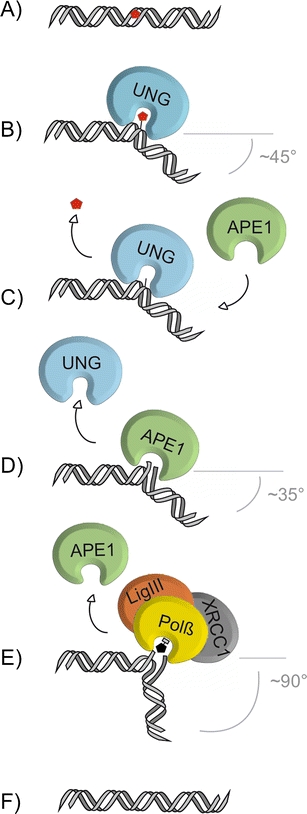
“The ligation process is carried by DNA ligase III working together with its cofactor X-ray repair cross-complementing protein 1(XRCC1) [111,112,113].”
From Focus on UV-Induced DNA Damage and Repair—Disease Relevance and Protective Strategies (2020) · cites this paper as [112]
Self-check
Percentages, sums and reported differences re-computed from the paper’s own numbers.
The self-check needs the paper’s full text.
Citations
Cites
1 retracted
DNA demethylation in hormone-induced transcriptional derepression
Kim, M. S., Kondo, T., Takada, I., Youn, M., Yamamoto, Y., Takahashi, S., Μatsumoto, T., Fujiyama, S., Shirode, Y., Yamaoka, I., et al. (2009) · Nature · doi:10.1038/nature08456 · Cited by 242
RetractedConversion of 5-Methylcytosine to 5-Hydroxymethylcytosine in Mammalian DNA by MLL Partner TET1
Tahiliani, M., Koh, K. P., Shen, Y., Pastor, W. A., Bandukwala, H., Brudno, Y., Agarwal, S., Iyer, L. M., Liu, D. R., Aravind, L., et al. (2009) · Science · doi:10.1126/science.1170116 · Cited by 5,836
Friedberg, E. C., Walker, G. C., Siede, W., Wood, R. D., Schultz, R. A., & Ellenberger, T. (2005) · doi:10.1128/9781555816704 · Cited by 5,683
Muramatsu, M., Kinoshita, K., Fagarasan, S., Yamada, S., Shinkai, Y., & Honjo, T. (2000) · Cell · doi:10.1016/s0092-8674(00)00078-7 · Cited by 3,475
Tet proteins can convert 5-methylcytosine to 5-formylcytosine and 5-carboxylcytosine
Ito, S., Shen, L., Dai, Q., Wu, S. C., Collins, L. B., Swenberg, J. A., He, C., & Zhang, Y. (2011) · Science · doi:10.1126/science.1210597 · Cited by 3,451
Tet-Mediated Formation of 5-Carboxylcytosine and Its Excision by TDG in Mammalian DNA
He, Y., Li, B.-Z., Li, Z., Liu, P., Wang, Y., Tang, Q., Ding, J., Jia, Y., Chen, Z., Li, L., et al. (2011) · Science · doi:10.1126/science.1210944 · Cited by 2,776
Ito, S., D’Alessio, A. C., Taranova, O., Hong, K., Sowers, L. C., & Zhang, Y. (2010) · Nature · doi:10.1038/nature09303 · Cited by 2,628
Highly Integrated Single-Base Resolution Maps of the Epigenome in Arabidopsis
Lister, R., O’Malley, R. C., Tonti‐Filippini, J., Gregory, B. D., Berry, C. C., Millar, A. H., & Ecker, J. R. (2008) · Cell · doi:10.1016/j.cell.2008.03.029 · Cited by 2,424
Lindahl, T. L., & Wood, R. D. (1999) · Science · doi:10.1126/science.286.5446.1897 · Cited by 1,521
Inherited variants of MYH associated with somatic G:C→T:A mutations in colorectal tumors
Tassan, N. A. A., Chmiel, N. H., Maynard, J. H., Fleming, N. I., Livingston, A. L., Williams, G. T., Hodges, A., Davies, D. R., David, S. S., Sampson, J. R., et al. (2002) · Nature Genetics · doi:10.1038/ng828 · Cited by 1,408
Cited by
Sorted by citations
Items 401–410 of 410
Tabassum, R. E., Hirota, K., & Kawasumi, R. (2026) · DNA repair · doi:10.1016/j.dnarep.2026.103952
Gökcan, H., & Isayev, O. (2026) · Journal of Chemical Information and Modeling · doi:10.1021/acs.jcim.6c02468
DNA Proofreading, Damage, and Repair: Implications in Health and Disease
Minden, A. (2026) · Springer eBooks · doi:10.1007/978-3-032-20529-2_23
Praharaj, S., Chakraborty, E., & Mahalingam, G. (2026) · Frontiers in Cellular Neuroscience · doi:10.3389/fncel.2026.1909393
Wang, W., Yan, L., Wu, F., & Zhang-Akiyama, Q.-M. (2026) · Free Radical Research · doi:10.1080/10715762.2026.2716701
Hrovat, A. M., Noreen, F., Schwarz, S. D., Aksu, M. E., Kuśnierczyk, A., Singh, N. K., Sturla, S. J., & Schär, P. (2026) · Nucleic Acids Research · doi:10.1093/nar/gkag921
Self-citationSomatic mutations in human ontogenesis and their impact on health
Sergeyev, O., Ашапкин, В., Korostin, D. O., Bezuglov, V., Suvorov, A., Rebrikov, D., & Chernykh, V. (2026) · Ageing Research Reviews · doi:10.1016/j.arr.2026.103338
Kladova, O. A., Tyugashev, T. E., Miroshnikov, A. A., Bakman, A. S., & Kuznetsova, A. A. (2026) · Biochimica et Biophysica Acta (BBA) - Proteins and Proteomics · doi:10.1016/j.bbapap.2026.141176
Molecular Basis for Uracil‐ DNA ‐Glycosylase to Identify DNA Damage in the Nucleosome
Ghediri, S., Blossey, R., & Cleri, F. (2026) · Proteins Structure Function and Bioinformatics · doi:10.1002/prot.70172
Adenomatous Polyposis Syndromes
Roberts, M. E., Baker, J., & Stanich, P. P. (2026) · Gastroenterology Clinics of North America · doi:10.1016/j.gtc.2026.05.013
Metadata
- Authors
- Jacobs, A. L., & Schär, P.
- Affiliations
- University of Basel (CH)
- Corresponding author
- Schär, Primo
- ORCID
- Schär, Primo
- Venue
- Chromosoma
- Published
- 2011-11-03
- Volume
- 121
- Issue
- 1
- Pages
- 1-20
- ISSN
- 0009-5915 (ISSN-L)
- 1432-0886
- PMC
- PMC3260424
- OpenAlex
- W2052679982
- Cited by
- 407
- References
- 177
- Citations by year
- 2026: 24 · 2025: 30 · 2024: 32 · 2023: 28 · 2022: 35 · 2021: 34 · 2020: 35 · 2019: 28 · 2018: 33 · 2017: 29 · 2016: 29 · 2015: 18 · 2014: 22 · 2013: 14 · 2012: 16
- FWCI
- 1.51
- Type
- journal article
- Language
- en
- Open access
- hybrid
- doi.org
- Licence
- cc-by-nc
- Locations
- Chromosoma (publishedVersion, cc-by-nc)
- PubMed Central (publishedVersion, cc-by-nc)
- PubMed (publishedVersion)
- reroDoc Digital Library (submittedVersion)
- Funders
- National Science Foundation
- Schweizerischer Nationalfonds zur Förderung der Wissenschaftlichen Forschung (122574, 31003A)
- Topics
- Life Sciences › Biochemistry, Genetics and Molecular Biology › Molecular Biology › DNA Repair Mechanisms
- Life Sciences › Biochemistry, Genetics and Molecular Biology › Molecular Biology › DNA and Nucleic Acid Chemistry
- Life Sciences › Biochemistry, Genetics and Molecular Biology › Molecular Biology › Epigenetics and DNA Methylation
- Keywords
- DNA glycosylase, base excision repair, DNA damage recognition, base flipping, DNA oxidation, alkylation, deamination, mutagenesis, innate immunity, adaptive immunity, DNA methylation, epigenetic stability, genome stability
- MeSH terms
- Animals, Base Sequence, DNA Repair, Humans, Models, Biological, Models, Molecular, Molecular Sequence Data, Structure-Activity Relationship, Genomic Instability, DNA Glycosylases
About these checks
Registry, retraction, Cites and statistics results are computed, not judged, with one exception: a printed reference that no index lists is read once by a model before it counts as a citation error. Claims are extracted by a model and kept only when their quote appears verbatim in the text; each cited source is then checked, with a model’s help, for whether it says what the claim relies on. Those verdicts can be wrong — read the claim’s quote and the cited source before relying on one.
Statistics and arithmetic are recomputed, not judged.
Confidence bands are shown only for fields calibrated on our annotated test set. None is calibrated yet, so no band is shown.
What counts as a claim ›How we measure confidence ›How we check this ›
Are you an author, or do you see a problem with this page? Request a review
