

Neurobiology of local and intercellular BDNF signaling
Open accessThe DOI matches its Crossref record; 176 of the 177 references it cites were found in a registry or an index.
Abstract
Brain-derived neurotrophic factor (BDNF) is a member of the neurotrophin family of secreted proteins. Signaling cascades induced by BDNF and its receptor, the receptor tyrosine kinase TrkB, link neuronal growth and differentiation with synaptic plasticity. For this reason, interference with BDNF signaling has emerged as a promising strategy for potential treatments in psychiatric and neurological disorders. In many brain circuits, synaptically released BDNF is essential for structural and functional long-term potentiation, two prototypical cellular models of learning and memory formation. Recent studies have revealed an unexpected complexity in the synaptic communication of mature BDNF and its precursor proBDNF, not only between local pre- and postsynaptic neuronal targets but also with participation of glial cells. Here, we consider recent findings on local actions of the BDNF family of ligands at the synapse and discuss converging lines of evidence which emerge from per se conflicting results.
Overview
The claims and statistics of this paper haven’t been checked yet.
Free: it reads the open-access text and checks the first 5 claims that cite a source we can check. Create a free account to check every claim.
Integrity signals
Registry
Cites
Statistics
Figures
Verification
Claims the paper makes
The claims and statistics of this paper haven’t been checked yet.
Free: it reads the open-access text and checks the first 5 claims that cite a source we can check. Create a free account to check every claim.
Claims other papers make about this one
Each is checked against this paper’s own text: does it say what the citing paper says it does?
The source backs part of the claim, not all of it — or backs it for a different population, condition or comparison.
In the citing paper
“Within microcircuits, TrkB signaling implements a refinement rule in which mature BDNF strengthens coactive synapses while precursor BDNF (proBDNF) weakens poorly correlated inputs, sharpening ensembles that encode shared activity patterns [105,110,111].”
From Synaptic Plasticity—Intrinsic Excitability and Antidepressant Discovery (2026) · cites this paper as [105]
Experimental — accuracy not yet measuredThe source backs part of the claim, not all of it — or backs it for a different population, condition or comparison.
In the citing paper
“The BDNF–TrkB axis functions as a master regulator that converts transient plasticity into stable synaptic reinforcement [105,106].”
From Synaptic Plasticity—Intrinsic Excitability and Antidepressant Discovery (2026) · cites this paper as [105]
Experimental — accuracy not yet measuredThe cited source says what the claim attributes to it.
In the citing paper
“At the level of individual spines, activity-dependent BDNF release activates TrkB in an autocrine loop that is essential for both structural and functional long-term potentiation [105,107,108].”
From Synaptic Plasticity—Intrinsic Excitability and Antidepressant Discovery (2026) · cites this paper as [105]
Self-check
Percentages, sums and reported differences re-computed from the paper’s own numbers.
The self-check needs the paper’s full text.
Citations
Cites
Cell Signaling by Receptor Tyrosine Kinases
Lemmon, M. A., & Schlessinger, J. (2010) · Cell · doi:10.1016/j.cell.2010.06.011 · Cited by 7,929
Domingos da Silveira da Luz, A. C., Pereira Dias, G., do Nascimento Bevilaqua, M. C., Cocks, G., Gardino, P. F., Thuret, S., & Nardi, A. E. (2013) · Neuropsychobiology · doi:10.1159/000353269 · Cited by 3,995
Egan, M. F., Kojima, M., Callicott, J. H., Goldberg, T. E., Kolachana, B. S., Bertolino, A., Zaitsev, E., Gold, B., Goldman, D., Dean, M., et al. (2003) · Cell · doi:10.1016/s0092-8674(03)00035-7 · Cited by 3,888 · cited 2×
“The Val66Met polymorphism does not exist in the mouse or other model organisms, and multiple s tudies are aimed at mimicking the funct ion of BDNF with the help of cellular models, genetic tools, or genetically engineered mouse models [26, 33, 34, 47, 64].”
BackgroundThe size and burden of mental disorders and other disorders of the brain in Europe 2010
Wittchen, H. U., Jacobi, F., Rehm, J., Gustavsson, A., Svensson, M., Jönsson, B., Olesen, J., Allgulander, C., Alonso, J., Faravelli, C., et al. (2011) · European Neuropsychopharmacology · doi:10.1016/j.euroneuro.2011.07.018 · Cited by 3,754
The Nerve Growth Factor 35 Years Later
Levi-Montalcini, R. (1987) · Science · doi:10.1126/science.3306916 · Cited by 3,125
Microglia promote learning-dependent synapse formation through brain-derived neurotrophic factor
Parkhurst, C. N., Yang, G., Ninan, I., Savas, J. N., Yates, J. R., Lafaille, J. J., Hempstead, B. L., Littman, D. R., & Gan, W.-B. (2013) · Cell · doi:10.1016/j.cell.2013.11.030 · Cited by 2,599 · cited 2×
“In line with this, microglial cells have been found to be another physiological source of BDNF [128, 154].”
BackgroundTrk Receptors: Roles in Neuronal Signal Transduction
Huang, E. J., & Reichardt, L. F. (2003) · Annual Review of Biochemistry · doi:10.1146/annurev.biochem.72.121801.161629 · Cited by 2,537 · cited 1×
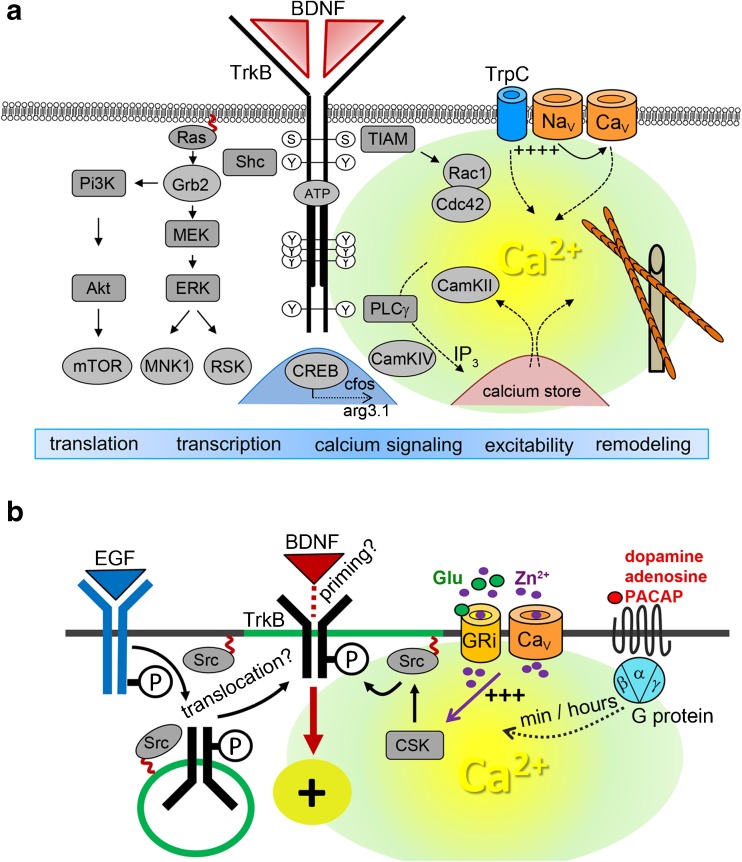
“Upon binding BDNF, TrkB dimerizes, activates an intrinsic kinase activity, undergoes autophosphorylation, and activates a complex set of intracellular signaling cascades [30, 65, 110, 123, 126] (Fig.”
BackgroundNeurotrophins and their receptors: A convergence point for many signalling pathways
Chao, M. V. (2003) · Nature Reviews Neuroscience · doi:10.1038/nrn1078 · Cited by 2,298 · cited 3×
“Upon binding BDNF, TrkB dimerizes, activates an intrinsic kinase activity, undergoes autophosphorylation, and activates a complex set of intracellular signaling cascades [30, 65, 110, 123, 126] (Fig.”
BackgroundNeurotrophin regulation of neural circuit development and function
Park, H., & Poo, M.-M. (2013) · Nature Reviews Neuroscience · doi:10.1038/nrn3379 · Cited by 2,060 · cited 10×
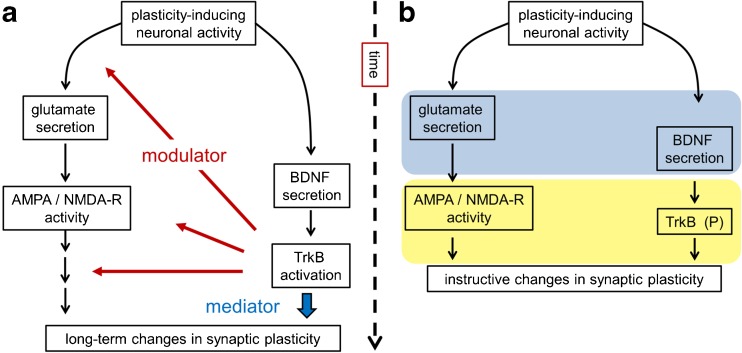
“BDNF as a mediator (according to Park and Poo [126]) can directly influence late effects in synaptic plasticity, for instance, local protein synthesis, spine remodeling, or gene transcription. b BDNF as an instructor of synaptic plasticity.”
BackgroundInfluentialNeurotrophins and Neuronal Plasticity
Thoenen, H. (1995) · Science · doi:10.1126/science.270.5236.593 · Cited by 1,927 · cited 2×
“The neurotrophin brain-derived neurotrophic factor (BDNF) [15, 151] and its signaling partners [21, 30, 110, 126] have emerged as key regulators of synaptic plasticity, a biological process describing the regulation of synaptic strength by neuronal activity.”
Background
Cited by
Items 301–369 of 369
mGluR5 Modulation as a Treatment for Parkinson’s Disease
Farmer, K. (2018) · Carleton University's Institutional Repository (MacOdrum Library, Carleton University) · doi:10.22215/etd/2018-14442
Bothwell, M. (2019) · Faculty Opinions – Post-Publication Peer Review of the Biomedical Literature · doi:10.3410/f.735570010.793564955
Zhang, D., Zhao, S., Zhang, Z., Xu, D., Lian, D., Wu, J., He, D., Sun, K., & Li, L. (2021) · Research Square · doi:10.21203/rs.3.rs-586130/v1
Kalinichenko, S. G., Korobtsov, A. V., & Matveeva, N. Y. (2022) · Cell and Tissue Biology · doi:10.1134/s1990519x2203004x
Port’s, N. M. D. S. (2022) · Digital Library of Theses and Dissertations (Universidade de São Paulo) · doi:10.11606/d.42.2022.tde-27012023-100010
Muresanu, D. F., Sharma, A., Tian, Z. R., Lafuente, J. V., Nozari, A., Feng, L., Buzoianu, A. D., Wiklund, L., & Sharma, H. S. (2023) · Advances in neurobiology · doi:10.1007/978-3-031-32997-5_6
Pérez-Revuelta, L. (2023) · Gredos (University of Salamanca) · doi:10.14201/gredos.153257
Jin, T., Rehani, P. R., Ying, M., Huang, J., Liu, S., Roussos, P., & Wang, D. (2021) · Figshare · doi:10.6084/m9.figshare.14691826
Jin, T., Rehani, P. R., Ying, M., Huang, J., Liu, S., Roussos, P., & Wang, D. (2021) · Figshare · doi:10.6084/m9.figshare.14691838
Jin, T., Rehani, P. R., Ying, M., Huang, J., Liu, S., Roussos, P., & Wang, D. (2021) · Figshare · doi:10.6084/m9.figshare.14691835
Jin, T., Rehani, P. R., Ying, M., Huang, J., Liu, S., Roussos, P., & Wang, D. (2021) · Figshare · doi:10.6084/m9.figshare.14691832
Jin, T., Rehani, P. R., Ying, M., Huang, J., Liu, S., Roussos, P., & Wang, D. (2021) · Figshare · doi:10.6084/m9.figshare.14691823
Détermination du rôle de la plasticité morphologique des astrocytes dans la régulation du sommeil
Walter, A. (2023) · theses.fr (ABES) · doi:10.70675/c0c4b839z1cd6z4d6fz828fzaaee8dc84d8a
Rodrigues, É. F., Fachin, A. L., Marins, M., Letieri, F. B., Stábeli, R. G., & Beleboni, R. O. (2024) · Biotechnology Notes · doi:10.1016/j.biotno.2024.09.001
Wirth, B., & Schweinhardt, P. (2024) · Ból · doi:10.5604/01.3001.0054.8675
Brain-derived neurotrophic factor as a target for the search of anti-addiction drugs
Khalimanov, M. S., Grigorevskikh, E., Zavadich, K. A., Sologov, S. I., Traschenkova, D. A., Александровна, Т. К., Polikarpov, E., Sologova, S. S., Kudlay, D. A., & Smolyarchuk, Е. А. (2025) · Pharmacy & Pharmacology · doi:10.19163/2307-9266-2025-13-1-4-19
Bardella, M. D. C. (2025) · Digital Library of Theses and Dissertations (Universidade de São Paulo) · doi:10.11606/d.109.2025.tde-29072025-153127
Kempermann, G. (2025) · Oxford University Press eBooks · doi:10.1093/med/9780197519233.003.0009
Huang, F., Wang, S., Peng, Z., Huang, X., & Bai, S. (2025) · PubMed Central · doi:10.11817/j.issn.1672-7347.2025.240318
“Binding with BDNF induces TrkB dimerization and autophosphorylation of tyrosine residues within its intracellular domain [33] .”
Wei, X., Wang, L., Hua, J., Jin, X., Ji, F. S., Peng, K., Zhou, B., Yang, J., & Meng, X.-W. (2021) · Figshare · doi:10.6084/m9.figshare.14450779
PHYSICAL ACTIVITY AND COGNITIVE FUNCTIONS: ROLE OF THE BRAIN-DERIVED NEUROTROPHIC FACTOR (BDNF)
Arcone, R., & Masullo, M. (2022) · Giornale Italiano di Educazione alla Salute, Sport e Didattica Inclusiva · doi:10.32043/gsd.v6i1.529
Evidenzbasierte Belastungseinstufung von Epilepsiemodellen
Koska, I. (2019) · Elektronische Hochschulschriften der LMU München (Ludwig-Maximilians-Universität München) · doi:10.5282/edoc.25108
Wille, I. (2022) · Institutional Repository of Leibniz Universität Hannover (Leibniz Universität Hannover) · doi:10.15488/11945
Zhang, D., Zhao, S., Zhang, Z., Xu, D., Lian, D., Wu, J., He, D., Sun, K., & Li, L. (2021) · Figshare · doi:10.6084/m9.figshare.16921892
Zhang, D., Zhao, S., Zhang, Z., Xu, D., Lian, D., Wu, J., He, D., Sun, K., & Li, L. (2021) · Figshare · doi:10.6084/m9.figshare.16921895
Turkmen, B. A., Yazıcı, E., Erdogan, D. G., Suda, M. A., & Yazıcı, A. B. (2021) · Figshare · doi:10.6084/m9.figshare.16994287
Jin, T., Rehani, P., Ying, M., Huang, J., Liu, S., Roussos, P., & Wang, D. (2021) · Figshare · doi:10.6084/m9.figshare.14691829
Hope, R. J. (2020) · NVA (Nasjonalt vitenarkiv)
Faste i et biokjemisk perspektiv
Lien, T. A. (2020) · NVA (Nasjonalt vitenarkiv)
Solés-Tarrés, I. (2023) · Tesis Doctorals en Xarxa (Consorci de Serveis Universitaris de Catalunya)
Contributions of the Thalamus to Striatal Pathology and Motor Dysfunction in Huntington’s Disease
Crevier‐Sorbo, G. (2020) · eScholarship@McGill (McGill) · doi:10.82308/2601
Johansson, Y. (2024) · DiVA (Stockholm University)
Aldhshan, M. S. (2021) · Mspace (University of Manitoba)
Matrix Metalloproteinase 9 in dendritic spine plasticity : PhD thesis
Legutko-Bijoch, D. (2024) · RCIN (Digital Repository of the Scientifics Institutes) (Institute of Archaeology and Ethnology of the Polish Academy of Sciences)
Thorsdottir, D. (2021) · ScholarWorks -A service of University of Vermont Libraries (University of Vermont)
Sá, A. T. C. M. D. (2019) · Portuguese National Funding Agency for Science, Research and Technology (RCAAP Project by FCT)
Influence of nutrition and activity on expression of BDNF to enhance rehabilitation after stroke
Ocvirk, Š. (2019) · Repository of the University of Primorsk (University of Primorska)
Kuruc, T., Kuchárová, K., Kisucká, A., Ileninová, M., Ihnátová, L., Bimbová, K., Magurova, M., Gálik, J., & Lukáčová, N. (2026) · IBRO Neuroscience Reports · doi:10.1016/j.ibneur.2026.01.006
Siddiqui, S. A. (2024) · TSpace (University of Toronto)
The effect of exercise on brain derived neurotrophic factor levels:A meta-analysis study
Süleymanoğulları, M., & Yüksekokulu, B. E. V. S. (2024) · Ağrı İbrahim Çeçen University Institutional Repository
Rochais, C., Lecoutey, C., Culley, G. R., Curel, T., Davis, A., Duval, E., Rouvière, L., Henriques, A., Legrand, R., Claeysen, S., et al. (2026) · Journal of Alzheimer s Disease · doi:10.1177/13872877261424925
“25 To detect an effect of neocopride on BDNF expression, timing was an Figure 6.”
Gill, H. (2025) · TSpace (University of Toronto)
Głowacka, A. (2023) · RCIN (Digital Repository of the Scientifics Institutes) (Institute of Archaeology and Ethnology of the Polish Academy of Sciences)
Mécanisme d’activation neuronale de mTORC1 et de son altération par le peptide amyloïde β
Khamsing, D. (2017) · theses.fr (ABES) · doi:10.70675/8081dbf0zf76bz43bdza502z6c0c6c419856
Pathophysiological role of Pyk2 in the nervous system
de Pins, B. (2019) · theses.fr (ABES) · doi:10.70675/e9fd4e35z9e7ez42d4za65cz5d999e5b2d5e
Dissection de la réponse biologique à la dyspnée expérimentale aigüe
Rolland‐Debord, C. (2020) · theses.fr (ABES) · doi:10.70675/0c8fdb99zee1fz48dfz9216z968c85f622ae
KCC2 into the spotlight : from physiology to pathology
Hamze, M. (2023) · theses.fr (ABES) · doi:10.70675/25267775zf815z4920zb957zd68879fc263e
The Epidermal Growth Factor Receptor (EGFR) as a means of neuro-immune cross-conversation
Gryksa, K., Sibilia, M. C., Rothhammer, V., Liston, A., & Zaiss, D. M. W. (2026) · Journal of Neuroinflammation · doi:10.1186/s12974-026-03873-5
“However, most interestingly, it has also been demonstrated that in the absence of BDNF, TrkB can be transactivated via EGF binding to EGFR, in this way regulating the migration of newborn cortical neurons [81, 82].”
Cortisol awakening response and Val66Met BDNF polymorphism interact to shape verbal fluency in aging
Rivas-Diaz, P., Trillo-Figueroa, D., Peiró, T., David-Lluesma, J., Rivero, O., Miguel, N. S., Hidalgo, V., & Salvador, A. (2026) · Psychoneuroendocrinology · doi:10.1016/j.psyneuen.2026.107956
Gupta, L. R., Ahmad, A., Srivastava, S., & Jafar, D. T. (2026) · Research Square · doi:10.21203/rs.3.rs-10521019/v1
Altérations de la conscience dans les synesthésies induites lors d'états émotionnels
Lebeau, C. (2026) · Archipel (Université du Québec à Montréal)
Microbiome‐Phytochemical Crosstalk Along the Gut‐Brain Axis in Alzheimer and Parkinson's Disease
Emon, M., Rahaman, M. M., Sarder, D., Shadin, M., Neela, S. A., Wangchuk, P., & Sarker, S. (2026) · MicrobiologyOpen · doi:10.1002/mbo3.70374
“BDNF mainly mediates its effects by binding to the TrkB tyrosine kinase receptor, thereby initiating phosphorylation cascades and activating several intracellular signaling pathways (Sasi et al. 2017).”
Voluntary Exercise and Hippocampal Memory Enhancement: Decoding the Molecular Blueprint
Razazpour, F., Golkar, A., Heidari, M., Seyedi, F., Hedayati‐Moghadam, M., & Baghcheghi, Y. (2026) · Journal of Molecular Neuroscience · doi:10.1007/s12031-026-02577-y
Anam, M. K., Tarek, M., Islam, S., Ahmed, A., & Hossain, M. (2026) · Journal of Food and Nutrition Sciences · doi:10.11648/j.jfns.20261404.15
The Influence of BDNF on Cortical Remodeling After Peripheral Nerve Injury
Bo-Yuan, C. H. E. N., Hao-Ran, C. H. E. N., ZHANG, T., & ZHANG, J. (2026) · PROGRESS IN BIOCHEMISTRY AND BIOPHYSICS · doi:10.3724/j.pibb.2026.0110
Campos, N. M. D. S., da Silva, P. A. V., Borçoi, A. R., Moreno, I. A. A., Cunha, E. R., Olinda, A. S., Quaioto, B. R., de Souza, M. L. M., Oliveira, L. H. G. D., Corrêa, C. H. P., et al. (2026) · Journal of Psychiatric Research · doi:10.1016/j.jpsychires.2026.09.006
Demirdaş, A., & Nazıroğlu, M. (2026) · Metabolic Brain Disease · doi:10.1007/s11011-026-01980-z
“BDNF is the most important growth factor in the central nervous system, emitted by neurons throughout the brain (Sasi et al. 2017).”
Alqahtani, S. M. (2026) · Discovery Medicine · doi:10.24976/discov.med.202638212.212
Duha Khalil Ali Khalil Mahmoud, D. I. A.-A., Abd-Alaleem, D. I., Abulfadle, K. A., & Hemead, D. A. R. (2024) · Cuestiones de Fisioterapia · doi:10.48047/tc0gd369
Yang, L., Shang, Y., Liu, X., Wang, J., Zhang, H., & 杨莉 (2026) · Behavioural Brain Research · doi:10.1016/j.bbr.2026.116520
The dual role of BDNF in epilepsy: insights from calpain-mediated TrkB-FL cleavage
Ribeiro‐Rodrigues, L., Griškova-Bulanova, I., Diógenes, M. J., & Xapelli, S. (2026) · Pharmacological Research · doi:10.1016/j.phrs.2026.109702
Szarowicz, C. A., Werp, M. J. V., Stancati, J. A., Sortwell, C. E., Caulfield, M. E., & Steece‐Collier, K. (2026) · npj Parkinson s Disease · doi:10.1038/s41531-026-01605-3
Wang, L., Bian, X., Liu, L., He, Q., Xu, J., Chen, X., Ye, H., Yang, J., & Jiang, L. (2024) · doi:10.3389/fendo.2024.1324867.s001
Wu, Z.-H., Fan, H., Gao, S.-Y., Jin, Y.-F., chen, C., Jiang, B., & Shen, J. (2022) · doi:10.3389/fphar.2022.921553.s001
Metadata
- Authors
- Sasi, M., Vignoli, B., Canossa, M., & Blum, R.
- Affiliations
- University of Würzburg (DE)
- University of Trento (IT)
- Corresponding author
- Blum, Robert
- Venue
- Pflügers Archiv - European Journal of Physiology
- Published
- 2017-03-09
- Volume
- 469
- Issue
- 5-6
- Pages
- 593-610
- ISSN
- 0031-6768 (ISSN-L)
- 1432-2013
- PMC
- PMC5438432
- OpenAlex
- W2591947168
- Cited by
- 324
- References
- 177
- Citations by year
- 2026: 19 · 2025: 22 · 2024: 34 · 2023: 40 · 2022: 47 · 2021: 57 · 2020: 43 · 2019: 33 · 2018: 24 · 2017: 5
- FWCI
- 3.54
- Type
- journal article
- Language
- en
- Update notices
- correction (2017-03-30)
- Open access
- hybrid
- doi.org
- Locations
- Pflügers Archiv - European Journal of Physiology (publishedVersion, cc-by)
- Europe PMC (PubMed Central) (publishedVersion, other-oa)
- PubMed Central (publishedVersion, cc-by)
- PubMed (publishedVersion)
- Institutional Research Information System (Università degli Studi di Trento) (submittedVersion, cc-by)
- Funders
- Deutsche Forschungsgemeinschaft (BL567/3-2, TRR58, A10)
- Graduate School of Life Sciences Würzburg
- MURST (PRIN-2012-2015)
- Italian research council (EBRI-CNR 2015-2017)
- Lazio Innova (FILAS 2015 - 2017)
- Topics
- Life Sciences › Neuroscience › Cellular and Molecular Neuroscience › Nerve injury and regeneration
- Life Sciences › Neuroscience › Cellular and Molecular Neuroscience › Neuroscience and Neuropharmacology Research
- Life Sciences › Neuroscience › Developmental Neuroscience › Neurogenesis and neuroplasticity mechanisms
- Keywords
- brain-derived neurotrophic factor, BDNF signaling, TrkB receptor, proBDNF, synaptic plasticity, long-term potentiation, learning and memory, glial cells, intercellular communication, neurotrophins
- MeSH terms
- Animals, Anxiety Disorders, Humans, Synaptic Transmission, Synapses, Long-Term Potentiation, Brain-Derived Neurotrophic Factor, Receptor, trkB
About these checks
Registry, retraction, Cites and statistics results are computed, not judged, with one exception: a printed reference that no index lists is read once by a model before it counts as a citation error. Claims are extracted by a model and kept only when their quote appears verbatim in the text; each cited source is then checked, with a model’s help, for whether it says what the claim relies on. Those verdicts can be wrong — read the claim’s quote and the cited source before relying on one.
Statistics and arithmetic are recomputed, not judged.
Confidence bands are shown only for fields calibrated on our annotated test set. None is calibrated yet, so no band is shown.
What counts as a claim ›How we measure confidence ›How we check this ›
Are you an author, or do you see a problem with this page? Request a review
Data sources
Bibliographic data: Semantic Scholar, OpenAlex, Crossref.
Contains information from the Semantic Scholar Academic Graph Datasets, made available under the ODC Attribution License (ODC-BY 1.0).
Semantic Scholar’s data is described in: Kinney, R., et al. (2023). The Semantic Scholar Open Data Platform. arXiv:2301.10140.
