

The DOI matches its Crossref record; 103 of the 106 references it cites were found in a registry or an index.
Anxiety and perceptual-motor performance: toward an integrated model of concepts, mechanisms, and processes
Open accessAbstract
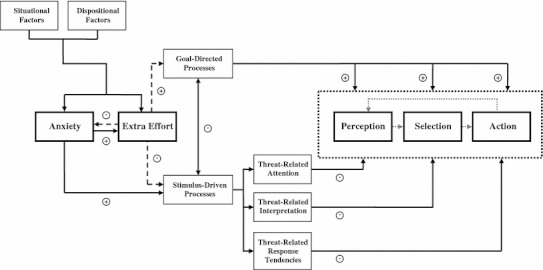
Under anxiety, people sometimes perform poorly. This concerns cognitive performance (e.g., taking an important exam) as well as perceptual-motor performance (e.g., picking up a cup from a table). There is still much debate about how anxiety affects perceptual-motor performance. In the current paper we review the experimental literature on anxiety and perceptual-motor performance, thereby focusing on how anxiety affects the perception, selection, and realization of action possibilities. Based on this review we discuss the merits of two opposing theoretical explanations and build on existing frameworks of anxiety and cognitive performance to develop an integrated model that explains the various ways in which anxiety may specifically affect perceptual-motor performance. This model distinguishes between positive and negative effects of anxiety and, moving beyond previous approaches, recognizes three operational levels (i.e., attentional, interpretational, and behavioral) at which anxiety may affect different aspects of goal-directed action. Finally, predictions are formulated and directions for future research suggested.
Overview
The claims and statistics of this paper haven’t been checked yet.
Run the check — free, no account needed. It reads the open-access text and checks the sources it cites.
Integrity signals
Registry
Cites
Statistics
Figures
Verification
Claims the paper makes
The claims and statistics of this paper haven’t been checked yet.
Run the check — free, no account needed. It reads the open-access text and checks the sources it cites.
Claims other papers make about this one
Each is checked against this paper’s own text: does it say what the citing paper says it does?
The cited source says what the claim attributes to it.
In the citing paper
“Competitive anxiety is a common psychological challenge among athletes and can negatively affect sports performance.”
From The Effect of Different Psychological Interventions on Athletes' Competitive Anxiety: A Systematic Review and Bayesian Network Meta-Analysis. (2026) · cites this paper as [8]
Self-check
Percentages, sums and reported differences re-computed from the paper’s own numbers.
The self-check needs the paper’s full text.
Citations
Cites
The Ecological Approach to Visual Perception
Bornstein, M. H., & Gibson, J. J. (1980) · The Journal of Aesthetics and Art Criticism · doi:10.2307/429816 · Cited by 22,935 · cited 1×
“Our own approach to perceptual-motor behavior can be considered embodied (e.g., Beilock, 2008b; Proffitt, 2006; Wilson, 2002), and ultimately has its origins in ecological psychology (Gibson, 1979).”
BackgroundThe Ecological Approach to Visual Perception: Classic Edition
Gibson, J. J. (2014) · doi:10.4324/9781315740218 · Cited by 12,132
Feeling and thinking: Preferences need no inferences.
Zajonc, R. B. (1980) · American Psychologist · doi:10.1037/0003-066x.35.2.151 · Cited by 8,094 · cited 2×
“…et al., 2007)—but also affects interpretational processes (Bishop, 2007; Blanchette & Richards, 2010) and facilitates emotion-specific behavioral responses (Frijda, 1988; Zajonc, 1980; see also Krieglmeyer et al., 2010, 2011; Lavender & Hommel, 2007; Schutter et al., 2008; Stins et al., 2011).”
BackgroundFodor, J. A. (1983) · doi:10.7551/mitpress/4737.001.0001 · Cited by 7,734
The relation of strength of stimulus to rapidity of habit formation
Yerkes, R. M., & Dodson, J. D. (1908) · Journal of Comparative Neurology and Psychology · doi:10.1002/cne.920180503 · Cited by 6,911
Journal of experimental psychology: Human Perception and performance
Jong, R. D., Coles, M. G. H., Logan, G. D., & Gratton, G. (1987) · Journal of Sound and Vibration · doi:10.1016/0022-460x(87)90423-8 · Cited by 5,411
Anxiety and cognitive performance: Attentional control theory
Eysenck, M. W., Derakshan, N., Santos, R., & Calvo, M. G. (2007) · Emotion · doi:10.1037/1528-3542.7.2.336 · Cited by 5,289
Cummins, R., & Fodor, J. A. (1985) · The Philosophical Review · doi:10.2307/2184717 · Cited by 4,791
Six views of embodied cognition
Wilson, M. (2002) · Psychonomic Bulletin & Review · doi:10.3758/bf03196322 · Cited by 4,782
Threat-related attentional bias in anxious and nonanxious individuals: a meta-analytic study.
Bar-Haim, Y., Lamy, D., Pergamin, L., Bakermans-Kranenburg, M. J., & van IJzendoorn, M. H. (2007) · Psychological Bulletin · doi:10.1037/0033-2909.133.1.1 · Cited by 3,721
Research works printed but not linked: 2
- Frijda, N. H. (1988). The laws of emotions. American Psychologist, 43, 349–358. · DOI
- Nibbeling, N., Daanen, H. A. M., Gerritsma, R. M., Hofland, R. M., & Oudejans, R. R. D. (2011). Effects of anxiety on running. Journal of Sports Sciences (in press).
Cited by
Sorted by citations
van der Riet, P., Levett-Jones, T. L., & Aquino-Russell, C. E. (2018) · Nurse Education Today · doi:10.1016/j.nedt.2018.03.018 · Cited by 298
Levett-Jones, T. L., Pitt, V., Courtney‐Pratt, H., Harbrow, G., & Rossiter, R. C. (2015) · Nurse Education in Practice · doi:10.1016/j.nepr.2015.03.012 · Cited by 160
Choking interventions in sports: A systematic review
Gröpel, P., & Mesagno, C. (2017) · International Review of Sport and Exercise Psychology · doi:10.1080/1750984x.2017.1408134 · Cited by 144
A systematic review and meta-analysis of the relationship between flow states and performance
Harris, D., Allen, K., Vine, S. J., & Wilson, M. (2021) · International Review of Sport and Exercise Psychology · doi:10.1080/1750984x.2021.1929402 · Cited by 129
Anxiety and performance: perceptual-motor behavior in high-pressure contexts
Nieuwenhuys, A., & Oudejans, R. R. D. (2017) · Current Opinion in Psychology · doi:10.1016/j.copsyc.2017.03.019 · Cited by 145
Self-citation
Metadata
- Authors
- Nieuwenhuys, A., & Oudejans, R. R. D.
- Affiliations
- Amsterdam Movement Sciences (NL)
- Vrije Universiteit Amsterdam (NL)
- Corresponding author
- Nieuwenhuys, Arne
- Venue
- Psychological Research
- Published
- 2011-10-29
- Volume
- 76
- Issue
- 6
- Pages
- 747-759
- ISSN
- 0033-3026 (ISSN-L)
- 0340-0727
- 1430-2772
- PMC
- PMC3470682
- OpenAlex
- W2167386533
- Cited by
- 265
- References
- 106
- Citations by year
- 2026: 35 · 2025: 23 · 2024: 24 · 2023: 23 · 2022: 20 · 2021: 20 · 2020: 21 · 2019: 20 · 2018: 18 · 2017: 11 · 2016: 18 · 2015: 16 · 2014: 7 · 2013: 8 · 2012: 1
- FWCI
- 6.60
- Type
- journal article
- Language
- en
- Open access
- hybrid
- doi.org
- Licence
- Locations
- Psychological Research (publishedVersion, cc-by-nc)
- Europe PMC (PubMed Central) (publishedVersion, cc-by-nc)
- PubMed Central (publishedVersion, cc-by-nc)
- PubMed (publishedVersion)
- VU Research Portal (publishedVersion, other-oa)
- Radboud Repository (Radboud University) (submittedVersion)
- Data Archiving and Networked Services (DANS) (submittedVersion, other-oa)
- Topics
- Social Sciences › Psychology › Experimental and Cognitive Psychology › Anxiety, Depression, Psychometrics, Treatment, Cognitive Processes
- Social Sciences › Psychology › Developmental and Educational Psychology › Sport Psychology and Performance
- Life Sciences › Neuroscience › Cognitive Neuroscience › Neural and Behavioral Psychology Studies
- Keywords
- anxiety, perceptual-motor performance, action selection, goal-directed action, cognitive performance
- MeSH terms
- Anxiety, Attention, Humans, Models, Psychological, Psychomotor Performance, Performance Anxiety
About these checks
Registry, retraction, Cites and statistics results are computed, not judged, with one exception: a printed reference that no index lists is read once by a model before it counts as a citation error. Claims are extracted by a model and kept only when their quote appears verbatim in the text; each cited source is then checked, with a model’s help, for whether it says what the claim relies on. Those verdicts can be wrong — read the claim’s quote and the cited source before relying on one.
Statistics and arithmetic are recomputed, not judged.
Confidence bands are shown only for fields calibrated on our annotated test set. None is calibrated yet, so no band is shown.
What counts as a claim ›How we measure confidence ›How we check this ›
Are you an author, or do you see a problem with this page? Request a review
