

The DOI matches its Crossref record; 103 of the 106 references it cites were found in a registry or an index.
Anxiety and perceptual-motor performance: toward an integrated model of concepts, mechanisms, and processes
Open accessAbstract
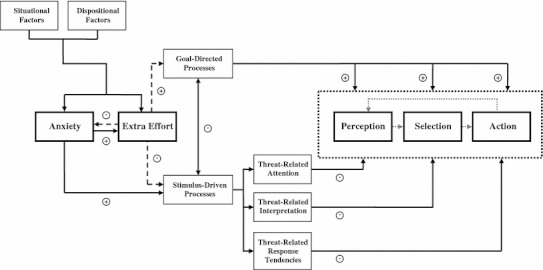
Under anxiety, people sometimes perform poorly. This concerns cognitive performance (e.g., taking an important exam) as well as perceptual-motor performance (e.g., picking up a cup from a table). There is still much debate about how anxiety affects perceptual-motor performance. In the current paper we review the experimental literature on anxiety and perceptual-motor performance, thereby focusing on how anxiety affects the perception, selection, and realization of action possibilities. Based on this review we discuss the merits of two opposing theoretical explanations and build on existing frameworks of anxiety and cognitive performance to develop an integrated model that explains the various ways in which anxiety may specifically affect perceptual-motor performance. This model distinguishes between positive and negative effects of anxiety and, moving beyond previous approaches, recognizes three operational levels (i.e., attentional, interpretational, and behavioral) at which anxiety may affect different aspects of goal-directed action. Finally, predictions are formulated and directions for future research suggested.
Overview
The claims and statistics of this paper haven’t been checked yet.
Run the check — free, no account needed. It reads the open-access text and checks the sources it cites.
Integrity signals
Registry
Cites
Statistics
Figures
Verification
Claims the paper makes
The claims and statistics of this paper haven’t been checked yet.
Run the check — free, no account needed. It reads the open-access text and checks the sources it cites.
Claims other papers make about this one
Each is checked against this paper’s own text: does it say what the citing paper says it does?
The cited source says what the claim attributes to it.
In the citing paper
“Competitive anxiety is a common psychological challenge among athletes and can negatively affect sports performance.”
From The Effect of Different Psychological Interventions on Athletes' Competitive Anxiety: A Systematic Review and Bayesian Network Meta-Analysis. (2026) · cites this paper as [8]
Self-check
Percentages, sums and reported differences re-computed from the paper’s own numbers.
The self-check needs the paper’s full text.
Citations
Cites
The Ecological Approach to Visual Perception
Bornstein, M. H., & Gibson, J. J. (1980) · The Journal of Aesthetics and Art Criticism · doi:10.2307/429816 · Cited by 22,935 · cited 1×
“Our own approach to perceptual-motor behavior can be considered embodied (e.g., Beilock, 2008b; Proffitt, 2006; Wilson, 2002), and ultimately has its origins in ecological psychology (Gibson, 1979).”
BackgroundThe Ecological Approach to Visual Perception: Classic Edition
Gibson, J. J. (2014) · doi:10.4324/9781315740218 · Cited by 12,132
Feeling and thinking: Preferences need no inferences.
Zajonc, R. B. (1980) · American Psychologist · doi:10.1037/0003-066x.35.2.151 · Cited by 8,094 · cited 2×
“…et al., 2007)—but also affects interpretational processes (Bishop, 2007; Blanchette & Richards, 2010) and facilitates emotion-specific behavioral responses (Frijda, 1988; Zajonc, 1980; see also Krieglmeyer et al., 2010, 2011; Lavender & Hommel, 2007; Schutter et al., 2008; Stins et al., 2011).”
BackgroundFodor, J. A. (1983) · doi:10.7551/mitpress/4737.001.0001 · Cited by 7,734
The relation of strength of stimulus to rapidity of habit formation
Yerkes, R. M., & Dodson, J. D. (1908) · Journal of Comparative Neurology and Psychology · doi:10.1002/cne.920180503 · Cited by 6,911
Journal of experimental psychology: Human Perception and performance
Jong, R. D., Coles, M. G. H., Logan, G. D., & Gratton, G. (1987) · Journal of Sound and Vibration · doi:10.1016/0022-460x(87)90423-8 · Cited by 5,411
Anxiety and cognitive performance: Attentional control theory
Eysenck, M. W., Derakshan, N., Santos, R., & Calvo, M. G. (2007) · Emotion · doi:10.1037/1528-3542.7.2.336 · Cited by 5,289
Cummins, R., & Fodor, J. A. (1985) · The Philosophical Review · doi:10.2307/2184717 · Cited by 4,791
Six views of embodied cognition
Wilson, M. (2002) · Psychonomic Bulletin & Review · doi:10.3758/bf03196322 · Cited by 4,782
Threat-related attentional bias in anxious and nonanxious individuals: a meta-analytic study.
Bar-Haim, Y., Lamy, D., Pergamin, L., Bakermans-Kranenburg, M. J., & van IJzendoorn, M. H. (2007) · Psychological Bulletin · doi:10.1037/0033-2909.133.1.1 · Cited by 3,721
Frijda, N. H. (1988) · American Psychologist · doi:10.1037//0003-066x.43.5.349 · Cited by 2,724
Anxiety and Performance: The Processing Efficiency Theory
Eysenck, M. W., & Calvo, M. G. (1992) · Cognition & Emotion · doi:10.1080/02699939208409696 · Cited by 2,661 · cited 3×
“How extra mental effort may help to maintain performance under anxiety Besides affecting performance negatively, anxiety also serves a motivational function that enables people to try and maintain performance through increases in mental effort (Eysenck & Calvo, 1992; Eysenck et al., 2007).”
BackgroundInfluentialIronic processes of mental control.
Wegner, D. M. (1994) · Psychological Review · doi:10.1037//0033-295x.101.1.34 · Cited by 2,609 · cited 2×
“However, although such attempts can be very successful, a potential caveat is that trying hard not to attend (or respond) to something may ironically draw more attention towards it (or make the unwanted response more likely; Wegner, 1994).”
Background(2020) · Wiley eBooks · doi:10.1002/9781119568124 · Cited by 1,498
Do threatening stimuli draw or hold visual attention in subclinical anxiety?
Fox, E., Russo, R., Bowles, R., & Dutton, K. (2001) · Journal of Experimental Psychology: General · doi:10.1037/0096-3445.130.4.681 · Cited by 1,469
Masters, R. S. W. (1992) · British Journal of Psychology · doi:10.1111/j.2044-8295.1992.tb02446.x · Cited by 1,236 · cited 15×
“Although there is no direct evidence yet, execution focus models claim that this is also what happens under anxiety (e.g., Beilock & Carr, 2001; Masters, 1992).”
BackgroundMethodInfluentialOn the fragility of skilled performance: What governs choking under pressure?
Beilock, S. L., & Carr, T. H. (2001) · Journal of Experimental Psychology: General · doi:10.1037/0096-3445.130.4.701 · Cited by 1,201 · cited 10×
“Although there is no direct evidence yet, execution focus models claim that this is also what happens under anxiety (e.g., Beilock & Carr, 2001; Masters, 1992).”
BackgroundMethodInfluentialThe police officer's dilemma: Using ethnicity to disambiguate potentially threatening individuals.
Correll, J., Park, B., Judd, C. M., & Wittenbrink, B. (2002) · Journal of Personality and Social Psychology · doi:10.1037/0022-3514.83.6.1314 · Cited by 1,175
(1992) · Cited by 1,154
Prejudice and perception: The role of automatic and controlled processes in misperceiving a weapon.
Payne, B. K. (2001) · Journal of Personality and Social Psychology · doi:10.1037//0022-3514.81.2.181 · Cited by 1,151
Test anxiety and direction of attention
Wine, J. (1971) · Psychological Bulletin · doi:10.1037/h0031332 · Cited by 1,055 · cited 1×
“…has been written about the effects of anxiety on cognitive functioning (e.g., taking an important exam; Eysenck, 1992; Mathews, 1990; Sarason, 1988; Wine, 1971), thereby revealing several mechanisms that explain how anxiety influences cognitive performance (see Beilock, 2008a; Bishop, 2007;…”
Background(1996) · Choice Reviews Online · doi:10.5860/choice.34-0997 · Cited by 1,034
Neurocognitive mechanisms of anxiety: An integrative account
Bishop, S. J. (2007) · Trends in Cognitive Sciences · doi:10.1016/j.tics.2007.05.008 · Cited by 976 · cited 10×
“As such, by affecting how people perceive or interpret their environment (Bishop, 2007; Mathews & Mackintosh, 1998; Proffitt, 2006), anxiety may seriously alter the selection of action possibilities (e.g., shoot or don’t shoot).”
BackgroundInfluentialPrefrontal cortical function and anxiety: Controlling attention to threat-related stimuli
Bishop, S., Duncan, J., Brett, M., & Lawrence, A. D. (2004) · Nature Neuroscience · doi:10.1038/nn1173 · Cited by 940
Beilock, S. L., Carr, T. H., MacMahon, C., & Starkes, J. L. (2002) · Journal of Experimental Psychology Applied · doi:10.1037/1076-898x.8.1.6 · Cited by 870 · cited 1×
“In perceptual-motor tasks, expert skill execution is often highly automatized, and requires a more ‘‘external’’, goaloriented focus in order to attain the best possible performance (e.g., Beilock et al., 2002).”
Background(1966) · Elsevier eBooks · doi:10.1016/c2013-0-12378-1 · Cited by 861
Why worry? The cognitive function of anxiety
Mathews, A. (1990) · Behaviour Research and Therapy · doi:10.1016/0005-7967(90)90132-3 · Cited by 827 · cited 2×
“In past decades, much has been written about the effects of anxiety on cognitive functioning (e.g., taking an important exam; Eysenck, 1992; Mathews, 1990; Sarason, 1988; Wine, 1971), thereby revealing several mechanisms that explain how anxiety influences cognitive performance (see Beilock, 2008a;…”
BackgroundPrejudice and perception: The role of automatic and controlled processes in misperceiving a weapon.
Payne, B. K. (2001) · Journal of Personality and Social Psychology · doi:10.1037/0022-3514.81.2.181 · Cited by 804
A cognitive model of selective processing in anxiety
Mathews, A., & Mackintosh, B. (1998) · Cognitive Therapy and Research · doi:10.1023/a:1018738019346 · Cited by 756 · cited 3×
“…threatening or not threatening), anxiety makes the selection of a threat-related interpretation more likely, potentially because it strengthens the output of our threat-evaluation mechanism and inhibits the influence of pre-frontal control mechanisms (Bishop, 2007; Mathews & Mackintosh, 1998).”
BackgroundBlanchette, I., & Richards, A. (2009) · Cognition & Emotion · doi:10.1080/02699930903132496 · Cited by 742 · cited 5×
“Based on our perceptual-motor perspective (i.e., perception, selection, action), however, we propose that this imbalance not only affects attentional control—in a sense that one becomes biased toward threat-related information (Eysenck et al., 2007)—but also affects interpretational processes (Bishop, 2007; Blanchette…”
BackgroundInfluentialVisual Perception and Action in Sport
Davids, K., Williams, A. M., & Williams, J. (2005) · Routledge eBooks · doi:10.4324/9780203979952 · Cited by 738
Embodied Perception and the Economy of Action
Proffitt, D. R. (2006) · Perspectives on Psychological Science · doi:10.1111/j.1745-6916.2006.00008.x · Cited by 696 · cited 1×
“…decades, much has been written about the effects of anxiety on cognitive functioning (e.g., taking an important exam; Eysenck, 1992; Mathews, 1990; Sarason, 1988; Wine, 1971), thereby revealing several mechanisms that explain how anxiety influences cognitive performance (see Beilock, 2008a;…”
BackgroundCoping in sport: A systematic review
Nicholls, A. R., & Polman, R. C. J. (2006) · Journal of Sports Sciences · doi:10.1080/02640410600630654 · Cited by 575 · cited 1×
“At present, little is known about the effectiveness of different strategies that individuals may use (Nicholls & Polman, 2007).”
BackgroundState Anxiety Modulation of the Amygdala Response to Unattended Threat-Related Stimuli
Bishop, S. J., Duncan, J., & Lawrence, A. D. (2004) · Journal of Neuroscience · doi:10.1523/jneurosci.2550-04.2004 · Cited by 517
Gray, R. (2004) · Journal of Experimental Psychology Applied · doi:10.1037/1076-898x.10.1.42 · Cited by 487 · cited 4×
“That is, when expert performers are asked to explicitly focus on their movement execution, this consistently leads to a degradation of performance (e.g., Gray, 2004; Gucciardi and Dimmock, 2008; Lam et al., 2009).”
BackgroundInfluentialPerception, Cognition, and Decision Training : The Quiet Eye in Action
Vickers, J. N. (2007) · Cited by 460
Amir, N., Elias, J., Klumpp, H., & Przeworski, A. (2003) · Behaviour Research and Therapy · doi:10.1016/s0005-7967(03)00039-1 · Cited by 406
Contextual modulation of amygdala responsivity to surprised faces
Kim, H., Somerville, L. H., Johnstone, T., Polis, S., Alexander, A. L., Shin, L. M., & Whalen, P. J. (2004) · Journal of Cognitive Neuroscience · doi:10.1162/0898929042947865 · Cited by 389
Vision, eye movements, and natural behavior
Land, M. (2009) · Visual Neuroscience · doi:10.1017/s0952523808080899 · Cited by 364 · cited 1×
“Because vision is often used to inform action (e.g., Land, 2009), the mere fact that one looks at task-irrelevant (threat-related) sources of information under anxiety, may already be enough for movements to deviate in that direction.”
BackgroundThe Motivational Components of Manifest Anxiety: Drive and Drive Stimuli
SPENCE, J. T., & Spence, K. W. (1966) · Elsevier eBooks · doi:10.1016/b978-1-4832-3131-0.50017-2 · Cited by 361
Vickers, J. N., & WILLIAMS, A. M. (2007) · Journal of Motor Behavior · doi:10.3200/jmbr.39.5.381-394 · Cited by 339 · cited 4×
“…reduced under anxiety, which allows less time to fine-tune movements on the basis of visual information, and causes a considerable decrease in performance (e.g., Behan & Wilson, 2008; Causer et al., 2011; Nieuwenhuys & Oudejans, 2010, 2011; Vickers & Williams, 2007; Wilson, Vine, et al., 2009).”
BackgroundInfluentialChoking under pressure: Multiple routes to skill failure.
DeCaro, M. S., Thomas, R. D., Albert, N. B., & Beilock, S. L. (2011) · Journal of Experimental Psychology General · doi:10.1037/a0023466 · Cited by 319
The Influence of Anxiety on Visual Attentional Control in Basketball Free Throw Shooting
Wilson, M., Vine, S. J., & Wood, G. (2009) · Journal of Sport and Exercise Psychology · doi:10.1123/jsep.31.2.152 · Cited by 300
Anxiety, self-preoccupation and attention
Sarason, I. G. (1988) · Anxiety Research · doi:10.1080/10615808808248215 · Cited by 282 · cited 2×
“…decades, much has been written about the effects of anxiety on cognitive functioning (e.g., taking an important exam; Eysenck, 1992; Mathews, 1990; Sarason, 1988; Wine, 1971), thereby revealing several mechanisms that explain how anxiety influences cognitive performance (see Beilock, 2008a;…”
BackgroundSomerville, L. H., Kim, H., Johnstone, T., Alexander, A. L., & Whalen, P. J. (2004) · Biological Psychiatry · doi:10.1016/j.biopsych.2004.01.007 · Cited by 273
Why Do Athletes Choke Under Pressure?
Beilock, S. L., & Gray, R. (2007) · Wiley eBooks · doi:10.1002/9781118270011.ch19 · Cited by 272
‘Reinvestment’: A dimension of personality implicated in skill breakdown under pressure
Masters, R. S. W., Polman, R. C. J., & Hammond, N. V. (1993) · Personality and Individual Differences · doi:10.1016/0191-8869(93)90113-h · Cited by 269
Math Performance in Stressful Situations
Beilock, S. L. (2008) · Current Directions in Psychological Science · doi:10.1111/j.1467-8721.2008.00602.x · Cited by 262 · cited 2×
“Our own approach to perceptual-motor behavior can be considered embodied (e.g., Beilock, 2008b; Proffitt, 2006; Wilson, 2002), and ultimately has its origins in ecological psychology (Gibson, 1979).”
BackgroundReichardt, R., Deutsch, R., Houwer, J. D., & Raedt, R. D. (2010) · Psychological Science · doi:10.1177/0956797610365131 · Cited by 257
Yoshie, M., Kudo, K., Murakoshi, T., & Ohtsuki, T. (2009) · Experimental Brain Research · doi:10.1007/s00221-009-1979-y · Cited by 256
Attentional Focus, Dispositional Reinvestment, and Skilled Motor Performance under Pressure
Jackson, R. C., Ashford, K. J., & Norsworthy, G. (2006) · Journal of Sport and Exercise Psychology · doi:10.1123/jsep.28.1.49 · Cited by 247
Anxiety, Attentional Control, and Performance Impairment in Penalty Kicks
Wilson, M., Wood, G., & Vine, S. J. (2009) · Journal of Sport and Exercise Psychology · doi:10.1123/jsep.31.6.761 · Cited by 241
Nieuwenhuys, A., & Oudejans, R. R. D. (2011) · Cognitive Processing · doi:10.1007/s10339-011-0396-x · Cited by 211 · cited 7×
“For instance, in a recent experiment, Nieuwenhuys and Oudejans (2011) showed that when police officers executed a shooting exercise against a threatening opponent that shot back with colored-soap cartridges (high-anxiety), they executed more and longer fixations to the head and gun of the opponent…”
BackgroundInfluentialSelf-citationAnxiety, arousal and visual attention: a mechanistic account of performance variability
Janelle, C. (2002) · Jurnal sport science · doi:10.1080/026404102317284790 · Cited by 209 · cited 1×
“That is, they are more easily distracted by task-irrelevant information and, in general, execute more fixations of shorter duration (see Janelle, 2002, for an overview).”
BackgroundWilson, M., Vine, S. J., Bright, E., Masters, R. S. W., DeFriend, D. J., & McGrath, J. S. (2011) · Surgical Endoscopy · doi:10.1007/s00464-011-1802-2 · Cited by 198
State anxiety and visual attention: The role of the quiet eye period in aiming to a far target
Behan, M., & Wilson, M. (2007) · Journal of Sports Sciences · doi:10.1080/02640410701446919 · Cited by 194 · cited 4×
“…of anxiety, people’s movements may become less accurate, and they may need more attempts or more time to successfully perform a certain task (e.g., Behan & Wilson, 2008; Causer, Holmes, Smith, & Williams, 2011; Nieuwenhuys, Pijpers, Oudejans, & Bakker, 2008; Nieuwenhuys & Oudejans, 2011; Vickers…”
BackgroundInfluentialGucciardi, D. F., & Dimmock, J. A. (2007) · Psychology of sport and exercise · doi:10.1016/j.psychsport.2006.10.007 · Cited by 191 · cited 4×
“That is, when expert performers are asked to explicitly focus on their movement execution, this consistently leads to a degradation of performance (e.g., Gray, 2004; Gucciardi and Dimmock, 2008; Lam et al., 2009).”
BackgroundInfluentialTraining with anxiety has a positive effect on expert perceptual–motor performance under pressure
Oudejans, R. R. D., & Pijpers, J. R. (2009) · Quarterly Journal of Experimental Psychology · doi:10.1080/17470210802557702 · Cited by 190 · cited 1×
“Alternatively, Nieuwenhuys and Oudejans (2011) showed that merely getting used to the pressure and anxiety that accompanies performance, may exert a similar positive effect on visual attentional processes (see also Oudejans, 2008; Oudejans & Pijpers, 2009, 2010).”
BackgroundSelf-citationEffects of anxiety on handgun shooting behavior of police officers: a pilot study
Nieuwenhuys, A., & Oudejans, R. R. D. (2009) · Anxiety Stress & Coping · doi:10.1080/10615800902977494 · Cited by 187 · cited 1×
“…reduced under anxiety, which allows less time to fine-tune movements on the basis of visual information, and causes a considerable decrease in performance (e.g., Behan & Wilson, 2008; Causer et al., 2011; Nieuwenhuys & Oudejans, 2010, 2011; Vickers & Williams, 2007; Wilson, Vine, et al., 2009).”
BackgroundSelf-citationThe Influence of Anxiety on Visual Attention in Climbing
Nieuwenhuys, A., Pijpers, J. R., Oudejans, R. R. D., & Bakker, F. C. (2008) · Journal of Sport and Exercise Psychology · doi:10.1123/jsep.30.2.171 · Cited by 182
Self-citationReality-based practice under pressure improves handgun shooting performance of police officers
Oudejans, R. R. D. (2008) · Ergonomics · doi:10.1080/00140130701577435 · Cited by 177
Self-citationShoot or don't shoot? Why police officers are more inclined to shoot when they are anxious.
Nieuwenhuys, A., Savelsbergh, G. J. P., & Oudejans, R. R. D. (2011) · Emotion · doi:10.1037/a0025699 · Cited by 164 · cited 1×
“In a more recent experiment, Nieuwenhuys, Savelsbergh, and Oudejans (2011) measured police officers’ gaze behavior during the execution of a shooting task (i.e., shoot or don’t shoot) and specifically tested whether effects of anxiety on decision-making may be attributed either to changes in gaze…”
BackgroundSelf-citationAnxiety–performance relationships in climbing: a process-oriented approach
Pijpers, J. R., Oudejans, R. R. D., Holsheimer, F., & Bakker, F. C. (2003) · Psychology of sport and exercise · doi:10.1016/s1469-0292(02)00010-9 · Cited by 157 · cited 8×
“As such, by affecting how people perceive or interpret their environment (Bishop, 2007; Mathews & Mackintosh, 1998; Proffitt, 2006), anxiety may seriously alter the selection of action possibilities (e.g., shoot or don’t shoot).”
BackgroundInfluentialSelf-citationAffect and action: Towards an event-coding account
Lavender, T., & Hommel, B. (2007) · Cognition & Emotion · doi:10.1080/02699930701438152 · Cited by 156 · cited 3×
“…the stimulus), whereas negative stimuli tend to facilitate avoidance movements (e.g., moving away from the stimulus; Krieglmeyer, Deutsch, De Houwer, & De Raedt, 2010; Krieglmeyer, De Houwer, & Deutsch, 2011; Lavender & Hommel, 2007; Stins, Roelofs, Villan, Kooijman, Hagenaars, & Beek, 2011).”
BackgroundAnalogy Learning and the Performance of Motor Skills under Pressure
Lam, W., Maxwell, J. P., & Masters, R. S. W. (2009) · Journal of Sport and Exercise Psychology · doi:10.1123/jsep.31.3.337 · Cited by 155 · cited 4×
“That is, when expert performers are asked to explicitly focus on their movement execution, this consistently leads to a degradation of performance (e.g., Gray, 2004; Gucciardi and Dimmock, 2008; Lam et al., 2009).”
BackgroundInfluentialStins, J. F., Karin Roelofs, A., Villan, J., Kooijman, K., Hagenaars, M. A., & Beek, P. J. (2011) · Experimental Brain Research · doi:10.1007/s00221-011-2767-z · Cited by 152
Psychological skills for enhancing performance
Gould, D. R., & Udry, E. (1994) · Medicine & Science in Sports & Exercise · doi:10.1249/00005768-199404000-00013 · Cited by 148 · cited 1×
“For instance, a talented musician, who is anxious before an important concert, may use breathing techniques or imagery to calm down before she gets on stage (e.g., Gould & Udry, 1994).”
BackgroundTraining with mild anxiety may prevent choking under higher levels of anxiety
Oudejans, R. R. D., & Pijpers, J. R. (2009) · Psychology of sport and exercise · doi:10.1016/j.psychsport.2009.05.002 · Cited by 147
Self-citationA new mode of fear expression: perceptual bias in height fear
Teachman, B. A., Stefanucci, J. K., Clerkin, E. M., Cody, M. W., & Proffitt, D. R. (2008) · Emotion · doi:10.1037/1528-3542.8.2.296 · Cited by 144
Thoughts and attention of athletes under pressure: skill-focus or performance worries?
Oudejans, R. R. D., Kuijpers, W., Kooijman, C. C., & Bakker, F. C. (2010) · Anxiety Stress & Coping · doi:10.1080/10615806.2010.481331 · Cited by 141
Self-citationThe Role of Anxiety in Perceiving and Realizing Affordances
Pijpers, J. R., Oudejans, R. R. D., Bakker, F. C., & Beek, P. J. (2006) · Ecological Psychology · doi:10.1207/s15326969eco1803_1 · Cited by 141
Self-citationSchutter, D. J. L. G., Hofman, D., & van Honk, J. (2008) · Psychophysiology · doi:10.1111/j.1469-8986.2007.00635.x · Cited by 140 · cited 1×
“While there are many different kinds of emotions, the present paper focuses on state anxiety, which, according to Schwenkmezger and Steffgen (1989), ‘‘can be regarded as a broad concept for a number of very complex emotional and motivational states and processes that occur as a result of threat.”
BackgroundAttentional control theory: Anxiety, emotion, and motor planning
Coombes, S. A., Higgins, T., Gamble, K. M., Cauraugh, J. H., & Janelle, C. M. (2009) · Journal of Anxiety Disorders · doi:10.1016/j.janxdis.2009.07.009 · Cited by 140
Adaptive Control of Ill-Defined Systems
Selfridge, O. G., Rissland, E. L., & Arbib, M. A. (1984) · Springer eBooks · doi:10.1007/978-1-4684-8941-5 · Cited by 139
Bernstein, N. (2014) · Psychology Press eBooks · doi:10.4324/9781410603357 · Cited by 139 · cited 1×
“That is, while paying explicit attention to movement execution is important and task-relevant in the early phases of motor learning (e.g., Bernstein, 1996; Whiting, 1984), this is no longer the case for experts.”
BackgroundAnxiety, movement kinematics, and visual attention in elite-level performers.
Causer, J., Holmes, P. S., Smith, N. C., & WILLIAMS, A. M. (2011) · Emotion · doi:10.1037/a0023225 · Cited by 138
Oudejans, R. R. D., van de Langenberg, R. W., & Hutter, V. (2002) · Human Movement Science · doi:10.1016/s0167-9457(02)00116-1 · Cited by 137 · cited 3×
“…as being higher than individuals who are not afraid of heights (e.g., Teachman et al., 2008), and police officers who are afraid to get shot are more prone to recognize a suspect’s weapon, even when there is none (e.g., Correll et al., 2002; Nieuwenhuys, Savelsbergh, et al., 2011; Payne, 2001).”
BackgroundResultInfluentialSelf-citationWilson, M. (2008) · International Review of Sport and Exercise Psychology · doi:10.1080/17509840802400787 · Cited by 136 · cited 11×
“Based on this overview, we will now return to the two competing models of anxiety and perceptual-motor performance: distraction models (e.g., Wilson, 2008) and execution focus models (e.g., Beilock & Carr, 2001; Masters, 1992)—shortly reiterate their distinctive hypotheses, and discuss the extent…”
BackgroundMethodInfluentialTesting the Predictions of the Cusp Catastrophe Model of Anxiety and Performance
Hardy, L. (1996) · The Sport Psychologist · doi:10.1123/tsp.10.2.140 · Cited by 127 · cited 1×
“Similarly, on a behavioral level, many studies have looked at the relationship between anxiety and perceptual-motor performance (e.g., taking a decisive penalty during a world-championship final; see Hardy, 1996; Spence & Spence, 1966; Yerkes & Dodson, 1908).”
BackgroundJostmann, N. B., & Koole, S. L. (2007) · Journal of Experimental Psychology General · doi:10.1037/0096-3445.136.4.593 · Cited by 116 · cited 1×
“For example, individuals who tend to be action oriented are more likely to reinforce goal-directed attention, whereas individuals that are state oriented are more likely to concentrate on their feelings of anxiety (e.g., Jostmann & Koole, 2007).”
BackgroundJacobs, D. M., Runeson, S., & Michaels, C. F. (2001) · Journal of Experimental Psychology Human Perception & Performance · doi:10.1037//0096-1523.27.5.1019 · Cited by 110
Withagen, R., & Michaels, C. F. (2005) · Journal of Experimental Psychology Human Perception & Performance · doi:10.1037/0096-1523.31.6.1379 · Cited by 104 · cited 1×
“For example, one has to attend to the proper information in order to successfully calibrate and adjust movements in relation to a target (e.g., in catching a fly-ball; Jacobs, Runeson, & Michaels, 2001; Oudejans, Michaels, Bakker, & Davids, 1999; Withagen & Michaels, 2005).”
BackgroundExperienced Golfers’ Perspectives on Choking Under Pressure
Gucciardi, D. F., Longbottom, J.-L., Jackson, B., & Dimmock, J. A. (2010) · Journal of Sport and Exercise Psychology · doi:10.1123/jsep.32.1.61 · Cited by 100 · cited 1×
“Instead, ‘‘worries’’ represented over 25% of the data, suggesting that at least with respect to the attentional focus of athletes, circumstances of pressure and anxiety more often lead to distraction than explicit attention to movement execution (see Gucciardi et al., 2010, for similar results).”
ResultHatzigeorgiadis, A., & Biddle, S. J. H. (2000) · Anxiety, Stress & Coping · doi:10.1080/10615800008248334 · Cited by 77 · cited 1×
“…that rather than explicitly focusing on movement execution, all kinds of distracting thoughts and worries occur naturally when people perform under pressure (e.g., Gucciardi, Longbottom, Jackson & Dimmock, 2010; Hatzigeorgiadis & Biddle, 2000, 2001; Oudejans et al., 2011; Wilson & Smith, 2007).”
BackgroundWhen and how are spatial perceptions scaled?
Witt, J. K., Proffítt, D. R., & Epstein, W. (2010) · Journal of Experimental Psychology Human Perception & Performance · doi:10.1037/a0019947 · Cited by 77
Shedding some light on catching in the dark: Perceptual mechanisms for catching fly balls.
Oudejans, R. R. D., Michaels, C. F., Bakker, F. C., & Davids, K. (1999) · Journal of Experimental Psychology Human Perception & Performance · doi:10.1037/0096-1523.25.2.531 · Cited by 74 · cited 3×
“Sometimes, emotions can be so strong that they seem to alter the way in which we perceive and act upon the world around us (cf., Oudejans & Nieuwenhuys, 2009; Proffitt, 2006).”
BackgroundSelf-citationBeyond the playing field: sport psychology meets embodied cognition
Beilock, S. L. (2008) · International Review of Sport and Exercise Psychology · doi:10.1080/17509840701836875 · Cited by 72
Eckman, F. R. (2013) · Routledge eBooks · doi:10.4324/9780203808184-9 · Cited by 66
Brown, L. A., Doan, J. B., McKenzie, N. C., & Cooper, S. A. (2006) · Gait & Posture · doi:10.1016/j.gaitpost.2005.09.013 · Cited by 63
Analysis of the Arousal/Motor Performance Relationship in Children Using Movement Kinematics
Beuter, A. C., & Duda, J. L. (1985) · Journal of Sport Psychology · doi:10.1123/jsp.7.3.229 · Cited by 63 · cited 1×
“These changes in muscle activity promoted changes in movement execution, in the sense that movements became slower, less fluent, and were more rigid under anxiety, leading to consequent decreases in performance (see also Beuter & Duda, 1985; Yoshie, Kudo, Murakoshi, & Ohtsuki, 2009).”
BackgroundBias in Predictive Inferences During Reading
Calvo, M. G., & Castillo, M. D. (2001) · Discourse Processes · doi:10.1207/s15326950dp3201_03 · Cited by 61 · cited 1×
“For instance, when individuals listen to a voice recording and are asked whether they heard the word ‘die’ or ‘dye’, anxious individuals more often report that they heard the word ‘die’ (e.g., Calvo & Castillo, 2001).”
BackgroundHatzigeorgiadis, A., & Biddle, S. (2001) · Anxiety Stress & Coping · doi:10.1080/10615800108248364 · Cited by 46 · cited 1×
“…that rather than explicitly focusing on movement execution, all kinds of distracting thoughts and worries occur naturally when people perform under pressure (e.g., Gucciardi, Longbottom, Jackson & Dimmock, 2010; Hatzigeorgiadis & Biddle, 2000, 2001; Oudejans et al., 2011; Wilson & Smith, 2007).”
BackgroundNormalities and abnormalities in human movement
Kirkcaldy, B. D. (1989) · KARGER eBooks · Cited by 45
Perceiving and moving in sports and other high-pressure contexts
Oudejans, R. R. D., & Nieuwenhuys, A. (2009) · Progress in brain research · doi:10.1016/s0079-6123(09)01304-1 · Cited by 44 · cited 1×
“Alternatively, Nieuwenhuys and Oudejans (2011) showed that merely getting used to the pressure and anxiety that accompanies performance, may exert a similar positive effect on visual attentional processes (see also Oudejans, 2008; Oudejans & Pijpers, 2009, 2010).”
BackgroundSelf-citationIronic effects and final target fixation in a penalty shooting task
Binsch, O., Oudejans, R. R. D., Bakker, F. C., & Savelsbergh, G. J. P. (2010) · Human Movement Science · doi:10.1016/j.humov.2009.12.002 · Cited by 42 · cited 2×
“In addition, in other contexts (e.g., taking a penalty kick in soccer) it has been shown that threat-related stimuli (e.g., the goalkeeper) can serve as attractors, and cause movements to deviate in their direction (e.g., Wilson, Wood et al., 2009; Binsch et al., 2010).”
BackgroundSelf-citationMeta experiences and coping effectiveness in sport
Nieuwenhuys, A., Vos, L., Pijpstra, S., & Bakker, F. C. (2010) · Psychology of sport and exercise · doi:10.1016/j.psychsport.2010.07.008 · Cited by 40 · cited 1×
“Alternatively, Nieuwenhuys and Oudejans (2011) showed that merely getting used to the pressure and anxiety that accompanies performance, may exert a similar positive effect on visual attentional processes (see also Oudejans, 2008; Oudejans & Pijpers, 2009, 2010).”
BackgroundSelf-citationPerformance-related experiences and coping during races: A case of an elite sailor
Nieuwenhuys, A., Hanin, Y. L., & Bakker, F. C. (2007) · Psychology of sport and exercise · doi:10.1016/j.psychsport.2006.12.007 · Cited by 40
Self-citationReichardt, R., Houwer, J. D., & Deutsch, R. (2010) · Journal of Experimental Social Psychology · doi:10.1016/j.jesp.2010.12.021 · Cited by 37 · cited 3×
“Also, several studies have shown that people are more likely to make response errors when performing on emotion-incongruent trials (e.g., moving toward a positive stimulus when the instruction is to move away from this type of stimulus; Krieglmeyer et al., 2011; Stins et al., 2011).”
BackgroundEffects of anxiety on running with and without an aiming task
Nibbeling, N., Daanen, H. A. M., Gerritsma, R. M., Hofland, R. M., & Oudejans, R. R. D. (2011) · Journal of Sports Sciences · doi:10.1080/02640414.2011.617386 · Cited by 33
Self-citationLochmann, H.-D., & Steger, U. (2002) · European Management Journal · doi:10.1016/s0263-2373(02)00053-1 · Cited by 23
Schwenkmezger, P., & Steffgen, G. (2015) · Medicine and sport science/Medicine and sport · doi:10.1159/000416530 · Cited by 22
The Concepts of ‘Adaptation’ and ‘Attunement’ in Skill Learning
Whiting, H. T. A. (1984) · Springer eBooks · doi:10.1007/978-1-4684-8941-5_14 · Cited by 18
Wilson, M., & Smith, N. C. (2007) · e-space (Manchester Metropolitan University) · Cited by 13
Research works printed but not linked: 2
- Frijda, N. H. (1988). The laws of emotions. American Psychologist, 43, 349–358. · DOI
- Nibbeling, N., Daanen, H. A. M., Gerritsma, R. M., Hofland, R. M., & Oudejans, R. R. D. (2011). Effects of anxiety on running. Journal of Sports Sciences (in press).
Cited by
Sorted by citations
van der Riet, P., Levett-Jones, T. L., & Aquino-Russell, C. E. (2018) · Nurse Education Today · doi:10.1016/j.nedt.2018.03.018 · Cited by 298
Levett-Jones, T. L., Pitt, V., Courtney‐Pratt, H., Harbrow, G., & Rossiter, R. C. (2015) · Nurse Education in Practice · doi:10.1016/j.nepr.2015.03.012 · Cited by 160
Choking interventions in sports: A systematic review
Gröpel, P., & Mesagno, C. (2017) · International Review of Sport and Exercise Psychology · doi:10.1080/1750984x.2017.1408134 · Cited by 144
A systematic review and meta-analysis of the relationship between flow states and performance
Harris, D., Allen, K., Vine, S. J., & Wilson, M. (2021) · International Review of Sport and Exercise Psychology · doi:10.1080/1750984x.2021.1929402 · Cited by 129
Anxiety and performance: perceptual-motor behavior in high-pressure contexts
Nieuwenhuys, A., & Oudejans, R. R. D. (2017) · Current Opinion in Psychology · doi:10.1016/j.copsyc.2017.03.019 · Cited by 145
Self-citation
Metadata
- Authors
- Nieuwenhuys, A., & Oudejans, R. R. D.
- Affiliations
- Amsterdam Movement Sciences (NL)
- Vrije Universiteit Amsterdam (NL)
- Corresponding author
- Nieuwenhuys, Arne
- Venue
- Psychological Research
- Published
- 2011-10-29
- Volume
- 76
- Issue
- 6
- Pages
- 747-759
- ISSN
- 0033-3026 (ISSN-L)
- 0340-0727
- 1430-2772
- PMC
- PMC3470682
- OpenAlex
- W2167386533
- Cited by
- 265
- References
- 106
- Citations by year
- 2026: 35 · 2025: 23 · 2024: 24 · 2023: 23 · 2022: 20 · 2021: 20 · 2020: 21 · 2019: 20 · 2018: 18 · 2017: 11 · 2016: 18 · 2015: 16 · 2014: 7 · 2013: 8 · 2012: 1
- FWCI
- 6.60
- Type
- journal article
- Language
- en
- Open access
- hybrid
- doi.org
- Licence
- Locations
- Psychological Research (publishedVersion, cc-by-nc)
- Europe PMC (PubMed Central) (publishedVersion, cc-by-nc)
- PubMed Central (publishedVersion, cc-by-nc)
- PubMed (publishedVersion)
- VU Research Portal (publishedVersion, other-oa)
- Radboud Repository (Radboud University) (submittedVersion)
- Data Archiving and Networked Services (DANS) (submittedVersion, other-oa)
- Topics
- Social Sciences › Psychology › Experimental and Cognitive Psychology › Anxiety, Depression, Psychometrics, Treatment, Cognitive Processes
- Social Sciences › Psychology › Developmental and Educational Psychology › Sport Psychology and Performance
- Life Sciences › Neuroscience › Cognitive Neuroscience › Neural and Behavioral Psychology Studies
- Keywords
- anxiety, perceptual-motor performance, action selection, goal-directed action, cognitive performance
- MeSH terms
- Anxiety, Attention, Humans, Models, Psychological, Psychomotor Performance, Performance Anxiety
About these checks
Registry, retraction, Cites and statistics results are computed, not judged, with one exception: a printed reference that no index lists is read once by a model before it counts as a citation error. Claims are extracted by a model and kept only when their quote appears verbatim in the text; each cited source is then checked, with a model’s help, for whether it says what the claim relies on. Those verdicts can be wrong — read the claim’s quote and the cited source before relying on one.
Statistics and arithmetic are recomputed, not judged.
Confidence bands are shown only for fields calibrated on our annotated test set. None is calibrated yet, so no band is shown.
What counts as a claim ›How we measure confidence ›How we check this ›
Are you an author, or do you see a problem with this page? Request a review
