

Taurine and inflammatory diseases
Open accessThe DOI matches its Crossref record; 107 of the 107 references it cites were found in a registry or an index.
Abstract
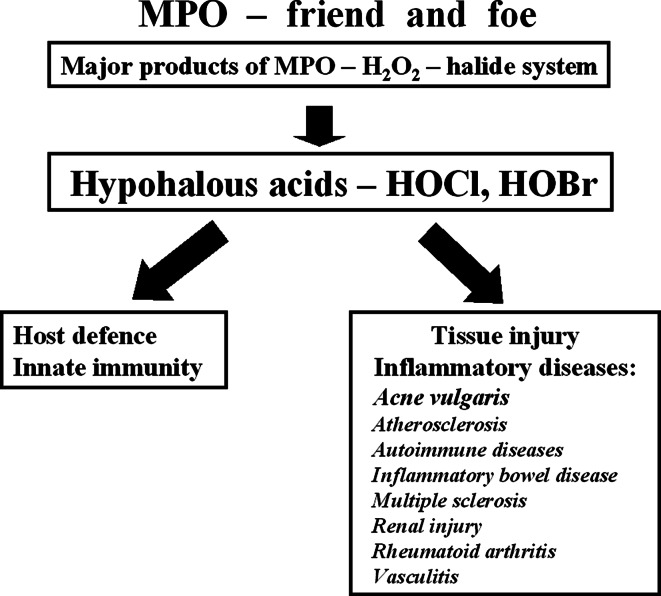
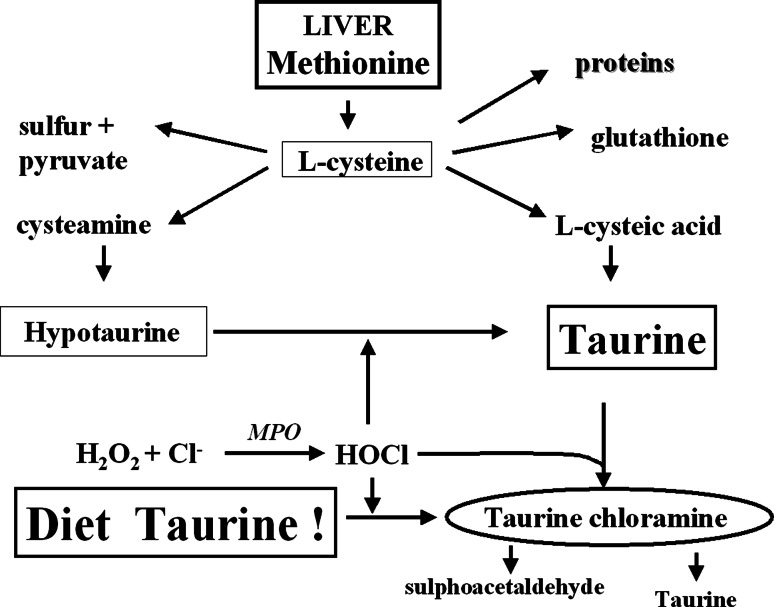
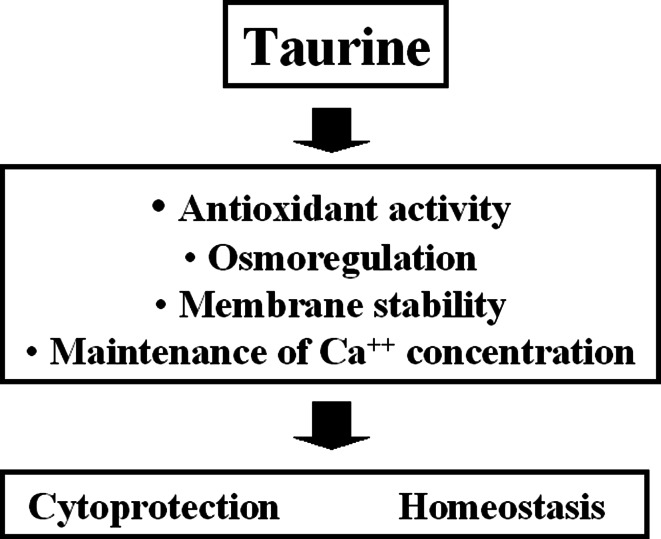
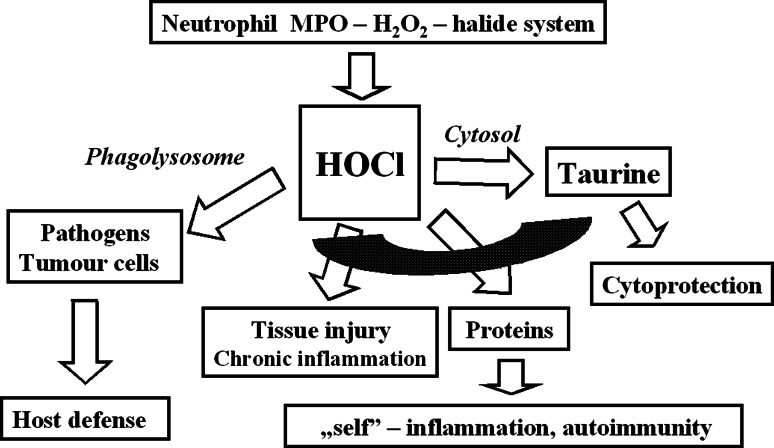
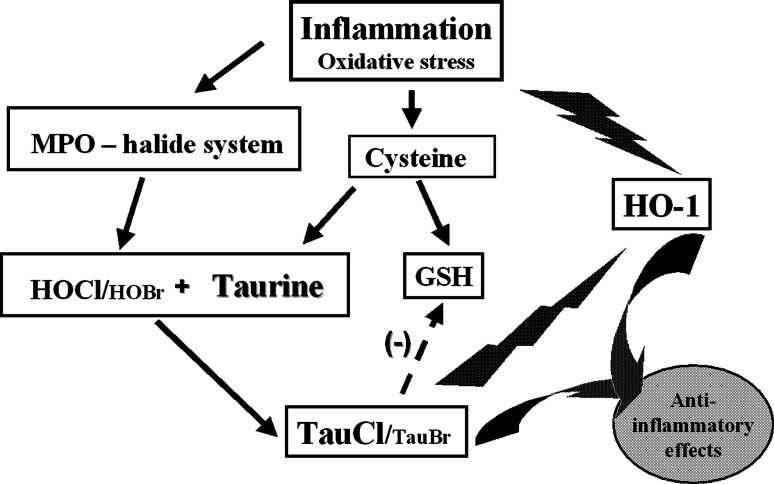
Taurine (2-aminoethanesulfonic acid) is the most abundant free amino acid in humans and plays an important role in several essential biological processes such as bile acid conjugation, maintenance of calcium homeostasis, osmoregulation and membrane stabilization. Moreover, attenuation of apoptosis and its antioxidant activity seem to be crucial for the cytoprotective effects of taurine. Although these properties are not tissue specific, taurine reaches particularly high concentrations in tissues exposed to elevated levels of oxidants (e.g., inflammatory cells). It suggests that taurine may play an important role in inflammation associated with oxidative stress. Indeed, at the site of inflammation, taurine is known to react with and detoxify hypochlorous acid generated by the neutrophil myeloperoxidase (MPO)-halide system. This reaction results in the formation of less toxic taurine chloramine (TauCl). Both haloamines, TauCl and taurine bromamine (TauBr), the product of taurine reaction with hypobromous acid (HOBr), exert antimicrobial and anti-inflammatory properties. In contrast to a well-documented regulatory role of taurine and taurine haloamines (TauCl, TauBr) in acute inflammation, their role in the pathogenesis of inflammatory diseases is not clear. This review summarizes our current knowledge concerning the role of taurine, TauCl and TauBr in the pathogenesis of inflammatory diseases initiated or propagated by MPO-derived oxidants. The aim of this paper is to show links between inflammation, neutrophils, MPO, oxidative stress and taurine. We will discuss the possible contribution of taurine and taurine haloamines to the pathogenesis of inflammatory diseases, especially in the best studied example of rheumatoid arthritis.
Overview
The claims and statistics of this paper haven’t been checked yet.
Free: it reads the open-access text and checks the first 5 claims that cite a source we can check. Create a free account to check every claim.
Integrity signals
Registry
Cites
Statistics
Figures
Verification
Claims the paper makes
The claims and statistics of this paper haven’t been checked yet.
Free: it reads the open-access text and checks the first 5 claims that cite a source we can check. Create a free account to check every claim.
Claims other papers make about this one
Each is checked against this paper’s own text: does it say what the citing paper says it does?
The cited source says what the claim attributes to it.
In the citing paper
“Strikingly, neutrophils represent a large reservoir of free taurine compromising approximately 50% of the cellular amino acid/amino acid-derivative pool thought to be involved in direct chemical protection against cytotoxic consequences of the respiratory burst associated with microbicidal HOCl formation (114).”
From Hypochlorous Acid: From Innate Immune Factor and Environmental Toxicant to Chemopreventive Agent Targeting Solar UV-Induced Skin Cancer (2022) · cites this paper as [114]
Self-check
Percentages, sums and reported differences re-computed from the paper’s own numbers.
The self-check needs the paper’s full text.
Citations
Cites
Bacterial Biofilms: A Common Cause of Persistent Infections
Costerton, J. W., Stewart, P. S., & Greenberg, E. P. (1999) · Science · doi:10.1126/science.284.5418.1318 · Cited by 12,167 · cited 2×
“Recently, there has been a tremendous interest in the role of biofilms in chronic infectious diseases and in the resistance of biofilms to antibiotics, disinfectants and phagocytosis (Costeron et al. 1991).”
BackgroundTissue Destruction by Neutrophils
Epstein, F. H., & Weiss, S. J. (1989) · New England Journal of Medicine · doi:10.1056/nejm198902093200606 · Cited by 3,950 · cited 9×
“On the other hand, overproduction of these oxidants and insufficient neutralization by antioxidants may lead to the development of oxidative stress and chronic inflammation (Smith 1994; Weiss 1988).”
BackgroundInfluentialTissue Destruction by Neutrophils
(1989) · New England Journal of Medicine · doi:10.1056/nejm198908033210513 · Cited by 3,631
Biofilm formation as microbial development
O'Toole, G., Kaplan, H. B., & Kolter, R. (2000) · Annual Review of Microbiology · doi:10.1146/annurev.micro.54.1.49 · Cited by 3,571 · cited 1×
“As microbial biofilms are the most common mode of growth of bacteria and fungi in nature (O’Toole et al. 2000), it is reasonable to study whether TauCl and TauBr are able to kill bacteria hidden in a biofilm or destroy a protective exopolymeric matrix of growing biofilms.”
BackgroundGregersen, P. K., Silver, J., & Winchester, R. J. (1987) · Arthritis & Rheumatism · doi:10.1002/art.1780301102 · Cited by 2,599 · cited 2×
“, Porphyromonas gingivalis infection) are generally accepted as participating in disease development, while repeated activation of innate immunity and deregulated adaptive immunity are thought to contribute to inflammation chronicity and self-tolerance breakdown (Gregersen et al. 1987; Detert et al. 2010; Gierut et al…”
BackgroundPhysiological actions of taurine
Huxtable, R. J. (1992) · Physiological Reviews · doi:10.1152/physrev.1992.72.1.101 · Cited by 2,595 · cited 1×
“Taurine tissue distribution is characterized by low concentrations of taurine in the plasma and extracellular fluids (ranging from 10 to 100 lM) and high intracellular concentrations of taurine reaching up to 50 mM, depending on the cell type (Huxtable 1992; Learn et al. 1990).”
BackgroundMyeloperoxidase: friend and foe
Klebanoff, S. J. (2005) · Journal of Leukocyte Biology · doi:10.1189/jlb.1204697 · Cited by 2,282 · cited 2×
“It suggests that taurine may play an important role in inflammation associated with oxidative stress.”
BackgroundFibroblast‐like synoviocytes: key effector cells in rheumatoid arthritis
Bartok, B., & Firestein, G. S. (2010) · Immunological Reviews · doi:10.1111/j.0105-2896.2009.00859.x · Cited by 1,906 · cited 2×
“age to the articular cartilage and subchondral bone (Firestein 2009; Bartok and Firestein 2010).”
BackgroundIL-1 pathways in inflammation and human diseases
Gabay, C., Lamacchia, C., & Palmer, G. (2010) · Nature Reviews Rheumatology · doi:10.1038/nrrheum.2010.4 · Cited by 897 · cited 1×
“The biological activity of IL-1b is counteracted by IL-1Ra, but for successful blockade a large molecular excess (100-fold to 1,000-fold) of IL-1Ra is required (Gabay et al. 2010).”
BackgroundMyeloperoxidase-Halide-Hydrogen Peroxide Antibacterial System
Klebanoff, S. J. (1968) · Journal of Bacteriology · doi:10.1128/jb.95.6.2131-2138.1968 · Cited by 815 · cited 4×
“In neutrophil phagolysosomes, myeloperoxidase (MPO) uses H2O2 to convert chloride ion to HOCl, or bromide ion to HOBr (Klebanoff 1968; Thomas 1979; Henderson et al. 2001)”
BackgroundInfluential
Research works printed but not linked: 2
- Marcinkiewicz J, Kontny E (2012) Taurine, taurine derivatives and immune system. In: A El Idrissi, W L’Amoreaux (eds) Taurine in health and disease, Transworld Research Network Chapter 6, 2011: 000–000 ISBN:978-81-7895-520-9
- Marcinkiewicz J Grabowska A Bereta J Stelmaszyńska T Taurine chloramine a product of activated neutrophils, inhibits in vitro the release of tumor necrosis factor in activated RAW 264.7 cells J Leukoc Biol 1995 54 119 7499964
Cited by
Items 101–200 of 581
Sun, Y., Dai, S., Tao, J., Li, Y., He, Z., Liu, Q., Zhao, J., Deng, Y., Kang, J., Zhang, X., et al. (2020) · Aging · doi:10.18632/aging.103730 · Cited by 50
“a βaminoacetic acid) is a sulfur-containing non-protein amino acid that is mainly distributed in kidney, heart, brain with the regulatory effects on osmotic pressure, cell protection, anti-oxidation, anti-inflammatory, membrane stability, ion transport, etc [14, 15].”
BackgroundMethionine: An Indispensable Amino Acid in Cellular Metabolism and Health of Atlantic Salmon
Espe, M., Adam, A., Saito, T., & Skjærven, K. H. (2023) · Aquaculture Nutrition · doi:10.1155/2023/5706177 · Cited by 48
The Influence of Nutrients on Inflammatory Bowel Diseases
Jarmakiewicz-Czaja, S., Piątek, D., & Filip, R. (2020) · Journal of Nutrition and Metabolism · doi:10.1155/2020/2894169 · Cited by 48
“Taurine has antioxidant properties which may predispose to relief of inflammation [134].”
BackgroundThe molecular targets of taurine confer anti-hyperlipidemic effects
Dong, Y., Li, X., Liu, Y., Gao, J., & Tao, J. (2021) · Life Sciences · doi:10.1016/j.lfs.2021.119579 · Cited by 48
He, Z., Liu, Z., & Gong, L. (2021) · PROTEOMICS · doi:10.1002/pmic.202100037 · Cited by 48
Kim, S., Kim, H., Song, Y., Lee, H. A., Kim, S., & Chung, J. (2021) · Journal Of Clinical Periodontology · doi:10.1111/jcpe.13516 · Cited by 47
Younis, N. S., Ghanim, A. M. H., Elmorsy, M. A., & Metwaly, H. A. (2021) · Scientific Reports · doi:10.1038/s41598-021-91666-6 · Cited by 47
RetractedMousavi, K., Niknahad, H., Mostofi, A. G., Mohammadi, H., Azarpira, N., Ommati, M. M., & Heidari, R. (2020) · Clinical and Experimental Hepatology · doi:10.5114/ceh.2020.99513 · Cited by 46
“It has been well established that Tau possesses anti-inflammatory effects in different experimental models [6, 110, 134-136].”
BackgroundLiang, Y., Zeng, T., Tian, J., Yan, J., Lan, Z., Chen, J., Xin, X., Lei, B., & Cai, Z. (2021) · The Science of The Total Environment · doi:10.1016/j.scitotenv.2021.149379 · Cited by 46
Heidari, R., Jamshidzadeh, A., Niknahad, H., Safari, F., Azizi, H., Abdoli, N., Ommati, M. M., Khodaei, F., Saeedi, A., & Najibi, A. (2016) · DOAJ (DOAJ: Directory of Open Access Journals) · doi:10.1111/tips.v2i1.59 · Cited by 44
“Taurine also showed several pharmacological properties including anti-emesis, gastroprotective, antiepileptic, and anti-inflammatory (22-26).”
BackgroundYousef, H. N., & Aboelwafa, H. R. (2017) · Experimental and Toxicologic Pathology · doi:10.1016/j.etp.2017.01.012 · Cited by 44
Kawabata, Y., Nishida, N., Awata, T., Kawasaki, E., Imagawa, A., Shimada, A., Osawa, H., Tanaka, S. A., Takahashi, K., Nagata, M., et al. (2018) · Diabetes · doi:10.2337/db18-0314 · Cited by 44
Bhat, M. A., Ahmad, K., Khan, M. S., Bhat, M. A., Almatroudi, A., Rahman, S., & Jan, A. T. (2020) · Biomolecules · doi:10.3390/biom10060863 · Cited by 44
“Additionally, taurine has been found to be involved in modulating inflammation [133,134], and acting as an antioxidant in scavenging free radicals [135,136] and in reducing apoptosis [137,138].”
BackgroundHeidari, R., Ghanbarinejad, V., Ommati, M. M., Jamshidzadeh, A., & Niknahad, H. (2018) · PharmaNutrition · doi:10.1016/j.phanu.2018.09.001 · Cited by 43
Taurine: A Maternally Derived Nutrient Linking Mother and Offspring
Tochitani, S. (2022) · Metabolites · doi:10.3390/metabo12030228 · Cited by 43
Abud, G. F., de Carvalho, F. G., Batitucci, G., Travieso, S. G., Júnior, C. R. B., Barbosa, F., Marchini, J. S., & de Freitas, E. C. (2022) · Nutrition · doi:10.1016/j.nut.2022.111706 · Cited by 43
A new therapeutic horizon in diaper dermatitis: Novel agents with novel action
Hebert, A. A. (2021) · International Journal of Women’s Dermatology · doi:10.1016/j.ijwd.2021.02.003 · Cited by 42
Taurine and Its Anticancer Functions: In Vivo and In Vitro Study
Ma, N., He, F., Kawanokuchi, J., Wang, G., & Yamashita, T. (2022) · Advances in experimental medicine and biology · doi:10.1007/978-3-030-93337-1_11 · Cited by 42
Taurine and Creatine Transporters as Potential Drug Targets in Cancer Therapy
Stary, D., & Bajda, M. (2023) · International Journal of Molecular Sciences · doi:10.3390/ijms24043788 · Cited by 41
Study on Urine Metabolic Profile of Aβ25–35-Induced Alzheimer's Disease Using UHPLC-Q-TOF-MS
Liu, Y., Wei, M., Yue, K., Hu, M., Li, S., Men, L., Pi, Z., Liu, Z., & Liu, Z. (2018) · Neuroscience · doi:10.1016/j.neuroscience.2018.10.001 · Cited by 41
Ben‐Azu, B., Uruaka, C. I., Ajayi, A. M., Jarikre, T. A., Nwangwa, E. K., Chilaka, K. C., Chijioke, B. S., Omonyeme, M. G., Ozege, C. B., Ofili, E. C., et al. (2022) · Neurochemical Research · doi:10.1007/s11064-022-03808-5 · Cited by 41
Halogenation Activity of Mammalian Heme Peroxidases
Arnhold, J., & Malle, E. (2022) · Antioxidants · doi:10.3390/antiox11050890 · Cited by 40
“ti icr ial a a tii fla at r acti it [183]”
BackgroundInfluentialTaurine, a non-proteinous essential amino acid for human body systems: an overview
Rais, N., Ved, A., Shadab, M., Ahmad, R., & Shahid, M. (2022) · Arab Gulf Journal of Scientific Research · doi:10.1108/agjsr-04-2022-0019 · Cited by 40
An evolutionary learning and network approach to identifying key metabolites for osteoarthritis
Hu, T., Oksanen, K., Zhang, W., Randell, E., Furey, A. J., Sun, G., & Zhai, G. (2018) · PLoS Computational Biology · doi:10.1371/journal.pcbi.1005986 · Cited by 40
“For example, taurine is the most abundant free amino acid in humans, and may play an important role in inflammation associated with oxidative stress [39].”
Ramos, C. D. O., Campos, K. K. D., Costa, G. D. P., Cangussú, S. D., Talvani, A., & Bezerra, F. S. (2018) · Regulatory Toxicology and Pharmacology · doi:10.1016/j.yrtph.2018.07.008 · Cited by 40
The ubiquitin–proteasome system and autophagy are defective in the taurine-deficient heart
Jong, C. J., Ito, T., & Schaffer, S. W. (2015) · Amino Acids · doi:10.1007/s00726-015-2053-7 · Cited by 40
“Several physiological actions have been attributed to taurine, with metabolic, antioxidant, anti-inflammatory and cytoprotective activities being the most important (Mozaffari et al. 1986; Jong et al. 2012; Marcinkiewicz and Kontny 2014; Ramila et al. 2015).”
BackgroundEffects of glutamine, taurine and their association on inflammatory pathway markers in macrophages
Sartori, T., dos Santos, G. G., Nogueira‐Pedro, A., Makiyama, E. N., Rogero, M. M., Borelli, P., & Fock, R. A. (2017) · Inflammopharmacology · doi:10.1007/s10787-017-0406-4 · Cited by 39
“This suggests that glutamine acts as a substrate to taurine and facilitates the plasma availability of taurine, which can improve the osmotic disturbances commonly observed after traumas conditions (Boelens et al. 2003; Marcinkiewicz and Kontny 2014).”
BackgroundTaurine Attenuates Carcinogenicity in Ulcerative Colitis-Colorectal Cancer Mouse Model
Wang, G., Ma, N., He, F., Kawanishi, S., Kobayashi, H., Oikawa, S., & Murata, M. (2020) · Oxidative Medicine and Cellular Longevity · doi:10.1155/2020/7935917 · Cited by 39
“Marcinkiewicz and Kontny [2] reviewed a possible contribution of taurine to protect against the pathogenesis of inflammatory diseases.”
BackgroundMaleki, V., Alizadeh, M., Esmaeili, F., & Mahdavi, R. (2020) · Amino Acids · doi:10.1007/s00726-020-02859-8 · Cited by 39
Seol, S.-I., Kim, H. J., Choi, E. B., Kang, I. S., Lee, H., Lee, J.-K., & Kim, C. (2021) · Antioxidants · doi:10.3390/antiox10030372 · Cited by 39
“Tau-Cl plays an anti-oxidative role by inhibiting ROS production and increasing the levels of antioxidants, such as glutathione, HO-1, GPx, Prx, and catalase [3,40].”
Ahmed, O., Abdel‐Halim, M., Farid, A., & Elamir, A. M. (2021) · Chemico-Biological Interactions · doi:10.1016/j.cbi.2021.109715 · Cited by 39
Shen, Z., Zhao, H., Yao, H., Pan, X., Yang, J., Zhang, S., Han, G., & Zhang, X. (2022) · Chemical Science · doi:10.1039/d1sc06366a · Cited by 39
Terrill, J. R., Grounds, M. D., & Arthur, P. G. (2016) · PLoS Currents · doi:10.1371/currents.md.77be6ec30e8caf19529a00417614a072 · Cited by 38
Human splanchnic amino-acid metabolism
Neis, E. P. J. G., Sabrkhany, S., Hundscheid, I. H. R., Schellekens, D. H. S. M., Lenaerts, K., Damink, S. W. M. O., Blaak, E. E., Dejong, C. H. C., & Rensen, S. S. (2016) · Amino Acids · doi:10.1007/s00726-016-2344-7 · Cited by 38
“Taurine, which is the most abundant amino acid in white blood cells, especially reaches high concentrations in tissues with a high oxidative activity and in tissues exposed to increased levels of oxidizing agents, including the spleen and kidneys (Marcinkiewicz and Kontny 2014).”
BackgroundUnderstanding taurine CNS activity using alternative zebrafish models
Mezzomo, N. J., Fontana, B. D., Kalueff, A. V., Barcellos, L. J. G., & Rosemberg, D. B. (2017) · Neuroscience & Biobehavioral Reviews · doi:10.1016/j.neubiorev.2017.09.008 · Cited by 38
“T 2013) and inflammation (Marcinkiewicz and Kontny, 2014), also acting as an endogenous neuroprotector (Menzie et al., 2014).”
BackgroundInfluentialLi, J., Ding, H., Meng, Y., Li, G., Fu, Q., Guo, Q., Yin, Z., Ye, Z., Zhou, H., & Shen, N. (2020) · Arthritis & Rheumatology · doi:10.1002/art.41419 · Cited by 38
“Taurine is found at particularly high concentrations in tissues exposed to elevated levels of oxidants, including inflammatory lesions (39).”
BackgroundSnell, J. A., Jandova, J., & Wondrak, G. T. (2022) · Frontiers in Oncology · doi:10.3389/fonc.2022.887220 · Cited by 37
“Strikingly, neutrophils represent a large reservoir of free taurine compromising approximately 50% of the cellular amino acid/amino acid-derivative pool thought to be involved in direct chemical protection against cytotoxic consequences of the respiratory burst associated with microbicidal HOCl formation (114).”
BackgroundColeman, D. N., Alharthi, A. S., Lopreiato, V., Trevisi, E., Miura, M., Pan, Y., & Loor, J. J. (2019) · Journal of Dairy Science · doi:10.3168/jds.2019-16406 · Cited by 37
“as its antioxidant functions neutralizing hypochlorous acid and enhancing antioxidant enzymes (Marcinkiewicz and Kontny, 2014).”
BackgroundRoşca, A. E., Vlădăreanu, A., Mirică, R., Timaru, C. M., Mititelu, A., Popescu, B. O., Căruntu, C., Voiculescu, S. E., Gologan, S., Onisâi, M., et al. (2022) · Journal of Clinical Medicine · doi:10.3390/jcm11030666 · Cited by 37
Dietary phytochemicals alleviate the premature skin aging: A comprehensive review
Singh, H., Kamal, Y. T., Pandohee, J., Mishra, A. K., Biswas, A., Mohanto, S., Kumar, A., Nag, S., Mishra, A., Singh, M., et al. (2024) · Experimental Gerontology · doi:10.1016/j.exger.2024.112660 · Cited by 36
Free amino acids: an innovative treatment for ocular surface disease
Rusciano, D., Roszkowska, A. M., Gagliano, C., & Pezzino, S. (2016) · European Journal of Pharmacology · doi:10.1016/j.ejphar.2016.04.029 · Cited by 37
Barbiera, A., Sorrentino, S., Fard, D., Lepore, E., Sica, G., Dobrowolny, G., Tamagnone, L., & Scicchitano, B. M. (2022) · Antioxidants · doi:10.3390/antiox11051016 · Cited by 36
“Taurine has been found at particularly high concentrations in tissues exposed to elevated levels of oxidants, suggesting a role in the attenuation of oxidative stress [40,60,61].”
BackgroundTaurine Reduced Epidural Fibrosis in Rat Models after Laminectomy via Downregulating EGR1
Yang, L., Tang, J. X., Chen, H., Ge, D., Sui, T., Que, J., Cao, X., & Ge, Y. (2016) · Cellular Physiology and Biochemistry · doi:10.1159/000445581 · Cited by 35
Gruber, M., Moser, I., Nagl, M., & Lackner, M. (2017) · Antimicrobial Agents and Chemotherapy · doi:10.1128/aac.02527-16 · Cited by 35
“decreases in nuclear factor B levels) and upregulation of hemoxygenase-1 (33, 34), and”
BackgroundLiu, Y., Wei, M., Yue, K., Wang, R., Ma, Y., Men, L., Pi, Z., Liu, Z., & Liu, Z. (2018) · Journal of Chromatography B · doi:10.1016/j.jchromb.2018.11.015 · Cited by 35
Murakami, S., Funahashi, K., Tamagawa, N., Ma, N., & Ito, T. (2022) · Metabolites · doi:10.3390/metabo12060524 · Cited by 35
Rafiee, S., Ashkani‐Esfahani, S., Zarifi, F., Asgari, Q., Samadnejad, A., & Noorafshan, A. (2014) · Advanced Biomedical Research · doi:10.4103/2277-9175.142314 · Cited by 34
Wang, Y., Ding, F., Sun, X., Chen, S., Huang, H., & Chen, H. (2021) · Talanta · doi:10.1016/j.talanta.2021.122655 · Cited by 34
Compositional Alteration of Gut Microbiota in Psoriasis Treated with IL-23 and IL-17 Inhibitors
Huang, Y., Chang, L., Chang, Y., Chung, W., Yang, S., & Su, S. (2023) · International Journal of Molecular Sciences · doi:10.3390/ijms24054568 · Cited by 34
Metabolic pathway alterations in microvascular endothelial cells in response to hypoxia
Cohen, E. B., Geck, R. C., & Toker, A. (2020) · PLoS ONE · doi:10.1371/journal.pone.0232072 · Cited by 33
“Taurine levels are known to increase during inflammation or oxidative stress [59] and in other cell types exposed to hypoxia [60,61].”
BackgroundThe versatile utility of cysteine as a target for cancer treatment
Min, J.-Y., Chun, K., & Kim, D. (2023) · Frontiers in Oncology · doi:10.3389/fonc.2022.997919 · Cited by 33
“Frontiers in Oncology 05 that taurine has cytoprotection function and maintains the homeostasis of cells involved in acute and chronic inflammatory/oxidative stress (37).”
BackgroundHe, F., Ma, N., Midorikawa, K., Hiraku, Y., Oikawa, S., Zhang, Z., Huang, G., Takeuchi, K., & Murata, M. (2018) · Amino Acids · doi:10.1007/s00726-018-2651-2 · Cited by 33
Marcinkiewicz, J., & Walczewska, M. (2019) · Current Medicinal Chemistry · doi:10.2174/0929867326666190819123300 · Cited by 33
Self-citationWu, L. L., Zhang, Q., Li, Y., Song, W., Chen, A., Liu, J., & Xuan, X. (2021) · Annals of Translational Medicine · doi:10.21037/atm-21-2739 · Cited by 32
“In the immune system, taurine plays a major role due to its enduring anti-oxidative effect (18-20).”
BackgroundTolerability of inhaled N-chlorotaurine in humans: a double-blind randomized phase I clinical study
Arnitz, R., Stein, M., Bauer, P., Lanthaler, B., Jamnig, H., Scholl‐Bürgi, S., Stempfl-Al-Jazrawi, K., Ulmer, H., Baumgartner, B., Embacher-Aichhorn, S., et al. (2018) · Therapeutic Advances in Respiratory Disease · doi:10.1177/1753466618778955 · Cited by 32
Abdoli, N., Sadeghian, I., Azarpira, N., Ommati, M. M., & Heidari, R. (2021) · Clinical and Experimental Hepatology · doi:10.5114/ceh.2021.104675 · Cited by 31
“On the other hand, it has been found that TAU significantly provided a positive impact on different diseases [1-7].”
BackgroundLi, H., Ruan, W.-J., Liu, L., Wan, H., Yang, X., Zhu, W., Yu, L., Zhang, X.-L., & Wan, F. (2019) · Chinese Medical Journal · doi:10.1097/cm9.0000000000000162 · Cited by 31
“endogenous anti-injury substance in the human body and is a good endogenous cytoprotective agent.([12-14]) In clinics, performed by dividing the cells into seven groups: Control, Tau 10 mmol/L, Tau 20 mmol/L, Tau 40 mmol/L, Tau Chinese Medical Journal 2019;132(8) www.”
BackgroundRetractedCaetano, L. C., Bonfleur, M. L., Ribeiro, R. A., Nardelli, T. R., Lubaczeuski, C., da Silva, J. D. N., Carneiro, E. M., & Balbo, S. L. (2015) · European Journal of Nutrition · doi:10.1007/s00394-015-1114-8 · Cited by 30
Ma, X., Wang, Y., Wu, H., Li, F. R., Feng, X., Xie, Y., Xie, D., Wang, W., Lo, E. C. M., & Lu, H. (2021) · The EPMA Journal · doi:10.1007/s13167-021-00239-0 · Cited by 29
“Taurine, a type of free amino acid with antimicrobial and antioxidant activities, has a great impact on important biological processes related to inflammation [38, 39].”
BackgroundA novel treatment of diaper dermatitis in children and adults
Dall’Oglio, F., Musumeci, M. L., Puglisi, D. F., & Micali, G. (2021) · Journal of Cosmetic Dermatology · doi:10.1111/jocd.14091 · Cited by 29
Hassanein, E. H. M., Althagafy, H. S., Atwa, A. M., Kozman, M. R., El-Sayed, M. I. K., & Soubh, A. A. (2022) · Life Sciences · doi:10.1016/j.lfs.2022.121180 · Cited by 30
Lackner, M., Rössler, A., Volland, A., Stadtmüller, M., Müllauer, B., Bánki, Z., Ströhle, J., Luttick, A., Fenner, J., Sarg, B., et al. (2022) · Emerging Microbes & Infections · doi:10.1080/22221751.2022.2065932 · Cited by 29
“a central principle of the antimicrobial action of NCT and may underline such a function in innate immunity besides its anti-inflammatory one [15,20,23].”
BackgroundInfluentialChupel, M. U., Minuzzi, L. G., Furtado, G. E., Santos, M. L. A. S., Ferreira, J. P., Filaire, E., & Teixeira, A. M. A. J. (2021) · Amino Acids · doi:10.1007/s00726-021-02952-6 · Cited by 28
Tepp, K., Puurand, M., Timohhina, N., Adamson, J., Klepinin, A., Truu, L., Shevchuk, I. N., Chekulayev, V. A., & Käämbre, T. (2017) · Molecular and Cellular Biochemistry · doi:10.1007/s11010-017-3005-1 · Cited by 28
Ding, F., Han, W., Zhuo, R., Li, J., Zheng, H., Deng, Y., Shen, J., & He, X. (2021) · Analytica Chimica Acta · doi:10.1016/j.aca.2021.338472 · Cited by 28
Mechanism and risk factors of oral biofilm formation
Pasich, E., Walczewska, M., Pasich, A., & Marcinkiewicz, J. (2013) · Postępy Higieny i Medycyny Doświadczalnej · doi:10.5604/17322693.1061393 · Cited by 28
Self-citationTerrill, J. R., Pinniger, G. J., Nair, K. V., Grounds, M. D., & Arthur, P. G. (2017) · PLoS ONE · doi:10.1371/journal.pone.0187317 · Cited by 28
Bian, Y., Wang, H., & Sun, S. (2018) · Redox Report · doi:10.1080/13510002.2018.1445581 · Cited by 28
“Moreover, anti-apoptosis and antioxidant properties are essential for the cytoprotective functions of taurine [11,12].”
BackgroundMaha, I. F., Xie, X., Zhou, S., Yu, Y., Liu, X., Zahid, A., Lei, Y., Ma, R., Yin, F., & Qian, D. (2019) · Fish & Shellfish Immunology · doi:10.1016/j.fsi.2019.09.027 · Cited by 27
Qiu, R., Wang, B., Shang, J., Guo-jun, H., Yu, L., & Gao, X. (2024) · Journal of Molecular Liquids · doi:10.1016/j.molliq.2024.124965 · Cited by 27
Taurine Homeostasis and Volume Control
Pasantes‐Morales, H. (2017) · Advances in neurobiology · doi:10.1007/978-3-319-55769-4_3 · Cited by 27
Portales‐Castillo, I., & Sterns, R. H. (2018) · American Journal of Kidney Diseases · doi:10.1053/j.ajkd.2018.10.004 · Cited by 27
Kostyuk, A. I., Tossounian, M., Panova, A. S., Thauvin, M., Raevskii, R. I., Ezeriņa, D., Wahni, K., Molle, I. V., Sergeeva, A. D., Vertommen, D., et al. (2022) · Nature Communications · doi:10.1038/s41467-021-27796-2 · Cited by 27
Bai, J., Yao, X., Jiang, L., Qiu, T., Liu, S., Qi, B.-X., Zheng, Y., Kong, Y., Yang, G., Chen, M., et al. (2016) · Biochimie · doi:10.1016/j.biochi.2016.01.002 · Cited by 27
Kim, S. H., Yum, H.-W., Kim, S. H., Kim, S., Kim, K., Kim, C., Suh, Y., & Surh, Y. (2021) · Antioxidants · doi:10.3390/antiox10060867 · Cited by 26
“HOCl then reacts with taurine to generate taurine chloramine (TauCl) that has strong anti-inflammatory as well as antioxidant properties [17].”
BackgroundHarrison, A., Dubois, L. G., John‐Williams, L. S., Moseley, M. A., Hardison, R. L., Heimlich, D. R., Stoddard, A., Kerschner, J. E., Justice, S. S., Thompson, J. W., et al. (2016) · Molecular & Cellular Proteomics · doi:10.1074/mcp.m115.052498 · Cited by 26
“Taurine is a potent antioxidant and is produced at higher levels in response to oxidative stress and the only molecule significantly increased (74).”
BackgroundPharmacometabolomics of Meglumine Antimoniate in Patients With Cutaneous Leishmaniasis
Vargas, D. A., Prieto, M. D., Martínez-Valencia, A. J., Cossio, A., Burgess, K. E., Burchmore, R., & Gómez, M. A. (2019) · Frontiers in Pharmacology · doi:10.3389/fphar.2019.00657 · Cited by 25
“Taurine concentrations were based on those found in plasma in healthy individuals (Marcinkiewicz and Kontny, 2014) and those reported as cytoprotective concentrations (Eppler and Dawson, 2002).”
BackgroundNoto, A., Pomero, G., Mussap, M., Barberini, L., Fattuoni, C., Palmas, F., Dalmazzo, C., Delogu, A., Dessì, A., Fanos, V., et al. (2016) · Annals of Translational Medicine · doi:10.21037/atm.2016.11.27 · Cited by 25
“In addition, taurine and its analogues exert anti-neurotoxic and anti-inflammatory effects (43).”
BackgroundJiao, J., Tang, Q., Wang, T., Fan, J., Zhang, T.-R., Bi, K., Li, Q., & Liu, R. (2022) · Journal of Chromatography B · doi:10.1016/j.jchromb.2022.123250 · Cited by 24
Caffeine and Taurine from Energy Drinks—A Review
MIHĂIESCU, T. C., Turti, S., Souca, M., Muresan, R., Achim, L., Prifti, E., Papuc, I., Munteanu, C., & Mârza, S. M. (2024) · Cosmetics · doi:10.3390/cosmetics11010012 · Cited by 25
“This may This may offer antiaging benefits and improve the health of the skin [86]. offer antiaging benefits and improve the [86].”
BackgroundOlsen, E. K., Søderholm, K. L., Isaksson, J. M., Andersen, J. H., & Hansen, E. H. (2016) · Journal of Natural Products · doi:10.1021/acs.jnatprod.5b00966 · Cited by 25
Kim, K. S., Ji, H.-I., Chung, H., Kim, C., Lee, S. H., Lee, Y.-A., Yang, H.-I., Yoo, M. C., & Hong, S. J. (2013) · Amino Acids · doi:10.1007/s00726-013-1612-z · Cited by 24
Understanding taurine CNS activity using alternative zebrafish models
Mezzomo, N. J., Fontana, B. D., Kalueff, A. V., Barcellos, L. J. G., & Rosemberg, D. B. (2018) · Neuroscience & Biobehavioral Reviews · doi:10.1016/j.neubiorev.2018.04.012 · Cited by 23
Swiderski, J., Sakkal, S., Apostolopoulos, V., Zulli, A., & Gadanec, L. K. (2023) · Nutrients · doi:10.3390/nu15112562 · Cited by 23
“Understanding the anti-inflammatory targets of taurine and terpenes may provide further evidence of their therapeutic use for CVDs (Figure 2, Table 1), as well as other conditions such as inflammatory bowel disease [45], rheumatoid arthritis [45], and traumatic brain injury where inflammation is a well-known critical…”
BackgroundThe Role of Amino Acids in Non-Enzymatic Antioxidant Mechanisms in Cancer: A Review
Dyachenko, E. I., & Bel’skaya, L. V. (2023) · Metabolites · doi:10.3390/metabo14010028 · Cited by 23
“Taurine has been shown to have cytoprotective functions and maintain cell homeostasis [183].”
BackgroundSeol, S.-I., Kang, I. S., Lee, J. S., Lee, J.-K., & Kim, C. (2024) · Antioxidants · doi:10.3390/antiox13020169 · Cited by 23
“Furthermore, taurine confers protective effects on infections and inflammation [6,7].”
BackgroundBactericidal Activity of N -Chlorotaurine against Biofilm-Forming Bacteria Grown on Metal Disks
Coraça-Huber, D. C., Ammann, C. G., Fille, M., Hausdorfer, J., Nogler, M., & Nagl, M. (2014) · Antimicrobial Agents and Chemotherapy · doi:10.1128/aac.02700-13 · Cited by 23
“Tolerability upon joint irrigation and efficacy in joint infections and collagen-induced arthritis have already been shown in mouse models (7, 19, 31, 32).”
BackgroundRoles of the MST1-JNK signaling pathway in apoptosis of colorectal cancer cells induced by Taurine
Liu, Z., Xia, Y., Zhang, X., Liu, L., Tu, S., Zhu, W., Yu, L., Wan, H., Yu, B., & Wan, F. (2018) · Libyan Journal of Medicine · doi:10.1080/19932820.2018.1500346 · Cited by 23
“It normally exists in tissues and cells in the free form, does not participate in protein synthesis, and is an important endogenous anti-injury substance in the human body [18,19].”
BackgroundKhodayar, M. J., Kalantari, H., Khorsandi, L., Ahangar, N., Samimi, A., & Alidadi, H. (2021) · Molecular Biology Reports · doi:10.1007/s11033-021-06428-4 · Cited by 24
“Numerous researches have that indicated the antioxidant properties of Tau improve cellular defense mechanisms by reducing oxidative stress status [15, 16].”
BackgroundAlkholifi, F. K., & Albers, D. S. (2015) · Brain Research · doi:10.1016/j.brainres.2015.06.041 · Cited by 23
Taurine Concentrations Decrease in Critically Ill Patients With Shock Given Enteral Nutrition
Vermeulen, M. A. R., van Stijn, M. F. M., Visser, M., Lemmens, S. M. P., Houdijk, A. P. J., van Leeuwen, P. A. M., & Straaten, H. M. O. (2015) · Journal of Parenteral and Enteral Nutrition · doi:10.1177/0148607114567199 · Cited by 23
Chokesuwattanaskul, S., Alarcon, M. F., Mangalakumaran, S., Grosman, R., Cross, A. L., Chapman, E. A., Mason, D., Moots, R. J., Phelan, M. M., & Wright, H. L. (2022) · Metabolites · doi:10.3390/metabo12070650 · Cited by 22
“Taurine is the most abundant free amino acid in humans, and it is known to be the primary molecule to react with and detoxify hypochlorous acid (HOCl) produced by the neutrophil myeloperoxidase (MPO), forming a less toxic taurine chloramine [49,50].”
BackgroundHLA-C1 ligands are associated with increased susceptibility to systemic lupus erythematosus
Gambino, C. M., Bona, D. D., Aiello, A., Carru, C., Duro, G., Guggino, G., Ferrante, A., Zinellu, A., Caruso, C., Candore, G., et al. (2018) · Human Immunology · doi:10.1016/j.humimm.2018.01.005 · Cited by 22
Ghaffari, M. H., Sadri, H., Schuh, K., Dusel, G., Frieten, D., Koch, C., Prehn, C. P., Adamski, J., & Sauerwein, H. (2019) · Journal of Dairy Science · doi:10.3168/jds.2018-16034 · Cited by 22
Genetics of fulminant type 1 diabetes
Kawabata, Y., & Ikegami, H. (2020) · Diabetology International · doi:10.1007/s13340-020-00468-0 · Cited by 22
Mangiferin and Taurine Ameliorate MSRV Infection by Suppressing NF-κB Signaling
Dai, C., Yu, L., Wang, Z., Deng, P., Li, L., Gu, Z., He, X., Wang, J., & Yuan, J. (2023) · Microbiology Spectrum · doi:10.1128/spectrum.05146-22 · Cited by 21
“In addition to their antioxidant activity, a growing body of literature shows the anti-inflammatory properties of mangiferin and taurine (32).”
BackgroundJiang, Y., Qing, T., Qiao, X., Yang, Y., Chen, P., Han, M., Dong, K., Zhang, W., Xu, M., Wang, D., et al. (2025) · Frontiers in Immunology · doi:10.3389/fimmu.2025.1508730 · Cited by 21
Wang, M., Ying, D., Liu, C., Yang, X., Qin, P.-W., Qi, Z., Ji, M., & Li, X. (2019) · Bioorganic Chemistry · doi:10.1016/j.bioorg.2019.03.017 · Cited by 21
“inflammatory actions and antimicrobial activity [29,30].”
Massalska, M., & Gober, H.-J. (2021) · Frontiers in Immunology · doi:10.3389/fimmu.2021.646894 · Cited by 21
“Another alternative to COVID-19 treatment due to its antioxidant activity and cytoprotective effects may be the most abundant free amino acid in humans, taurine (101).”
BackgroundNutritional deficiencies that may predispose to long COVID
Schloss, J. V. (2023) · Inflammopharmacology · doi:10.1007/s10787-023-01183-3 · Cited by 21
Metadata
- Authors
- Marcinkiewicz, J., & Kontny, E.
- Affiliations
- Jagiellonian University (PL)
- National Institute of Geriatrics, Rheumatology and Rehabilitation (PL)
- Corresponding author
- Marcinkiewicz, Janusz
- Venue
- Amino Acids
- Published
- 2012-07-19
- Volume
- 46
- Issue
- 1
- Pages
- 7-20
- ISSN
- 0939-4451 (ISSN-L)
- 1438-2199
- PMC
- PMC3894431
- OpenAlex
- W1968690534
- Cited by
- 531
- References
- 106
- Citations by year
- 2026: 35 · 2025: 46 · 2024: 46 · 2023: 36 · 2022: 64 · 2021: 64 · 2020: 48 · 2019: 35 · 2018: 47 · 2017: 36 · 2016: 26 · 2015: 25 · 2014: 8 · 2013: 12 · 2012: 2
- FWCI
- 1.38
- Type
- journal article
- Language
- en
- Open access
- hybrid
- doi.org
- Licence
- cc-by
- Locations
- Amino Acids (publishedVersion, cc-by)
- Europe PMC (PubMed Central) (publishedVersion, cc-by)
- PubMed Central (publishedVersion, cc-by)
- PubMed (publishedVersion)
- Homo Politicus (Academy of Humanities and Economics in Lodz) (submittedVersion, cc-by-nc-nd)
- Homo Politicus (Academy of Humanities and Economics in Lodz) (submittedVersion)
- Jagiellonian University Repository (Jagiellonian University) (submittedVersion, cc-by-nc-nd)
- Funders
- Uniwersytet Jagielloński Collegium Medicum (K/ZDS/001008)
- Topics
- Life Sciences › Biochemistry, Genetics and Molecular Biology › Cell Biology › Aldose Reductase and Taurine
- Life Sciences › Immunology and Microbiology › Immunology › Neutrophil, Myeloperoxidase and Oxidative Mechanisms
- Health Sciences › Medicine › Biochemistry (medical) › Antioxidant Activity and Oxidative Stress
- Keywords
- taurine, taurine chloramine, inflammatory diseases, rheumatoid arthritis, myeloperoxidase, neutrophils, oxidative stress, hypochlorous acid, hypobromous acid, antimicrobial activity, anti-inflammatory activity, apoptosis, antioxidant activity, pathogenesis
- MeSH terms
- Animals, Anti-Infective Agents, Arthritis, Rheumatoid, Bile Acids and Salts, Calcium, Humans, Inflammation, Peroxidase, Taurine, Apoptosis, Osmoregulation
About these checks
Registry, retraction, Cites and statistics results are computed, not judged, with one exception: a printed reference that no index lists is read once by a model before it counts as a citation error. Claims are extracted by a model and kept only when their quote appears verbatim in the text; each cited source is then checked, with a model’s help, for whether it says what the claim relies on. Those verdicts can be wrong — read the claim’s quote and the cited source before relying on one.
Statistics and arithmetic are recomputed, not judged.
Confidence bands are shown only for fields calibrated on our annotated test set. None is calibrated yet, so no band is shown.
What counts as a claim ›How we measure confidence ›How we check this ›
Are you an author, or do you see a problem with this page? Request a review
Data sources
Bibliographic data: Semantic Scholar, OpenAlex, Crossref.
Contains information from the Semantic Scholar Academic Graph Datasets, made available under the ODC Attribution License (ODC-BY 1.0).
Semantic Scholar’s data is described in: Kinney, R., et al. (2023). The Semantic Scholar Open Data Platform. arXiv:2301.10140.
