

Towards enhanced cybersecurity in industrial control systems: a systematic review of context-based modeling, digital twins, and machine learning approaches
Open accessThe DOI matches its Crossref record; 60 of the 60 references it cites were found in a registry or an index; 15 of the 61 sources its claims cite were checked for support.
Abstract
The increasing integration of Industrial Control Systems (ICS) and Cyber-Physical Systems (CPS) with the Internet of Things (IoT) has significantly enhanced their operational efficiency but also exposed them to advanced cyber threats. Traditional cybersecurity approaches, often tailored for IT systems, must address the unique complexities of ICS and CPS environments. This paper systematically reviews the integration of three critical areas: context-based modeling, digital twins, and machine learning (ML), to enhance cybersecurity for ICS and CPS. Context-based modeling provides dynamic, situational awareness; digital twins offer real-time system replicas for monitoring and simulation; and ML delivers predictive and adaptive threat detection and response capabilities. The review synthesizes findings from recent literature to answer four research questions focusing on methodologies in context-based modeling, applications of digital twins and ML in attack detection, and integrating these approaches for improved cyber resilience. The results demonstrate the synergistic potential of combining these technologies, enabling real-time anomaly detection, predictive threat analysis, and adaptive response mechanisms. Challenges such as data limitations, scalability, and verification complexities are vital areas requiring further research. This integrated framework offers a robust pathway for securing critical infrastructure and advancing cybersecurity practices in increasingly interconnected ICS and CPS environments.
Overview
CoChat Summary
## TL;DR
This systematic review synthesizes how context-based modeling, digital twins, and machine learning can be combined to improve cybersecurity in ICS/CPS, especially for anomaly, intrusion, and attack detection. The paper argues that the integration supports multi-layered defense, but also highlights major open problems in data scarcity, scalability, and verification.
## Key findings
- The review screened three evidence bases and included 29 studies for RQ1, 10 studies for RQ2, and 12 studies for RQ3 from IEEE Xplore, Scopus, and SpringerLink.
- Digital twins in the reviewed attack-detection literature were used mainly for replication, simulation, and dataset generation; Table 2 lists roles such as attack detection, intrusion detection, and anomaly detection.
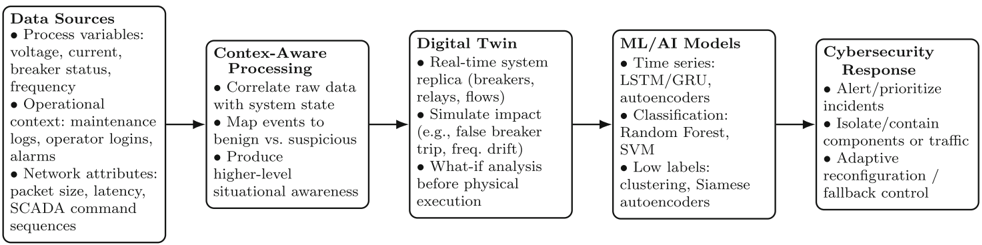
- Machine learning methods in attack detection were used to identify normal patterns, detect anomalies, and classify attack types; the paper specifically mentions one-class classifiers, autoencoders, CNN autoencoders, GRU-LSTM, SVM, Random Forest, Gradient Boosting, k-means, and Siamese autoencoders.
- The paper reports that SAE-based solutions outperformed existing anomaly detection methods across hyperparameter settings and overall performance, and that they performed better when trained on digital twin-generated data than on real-world data alone.
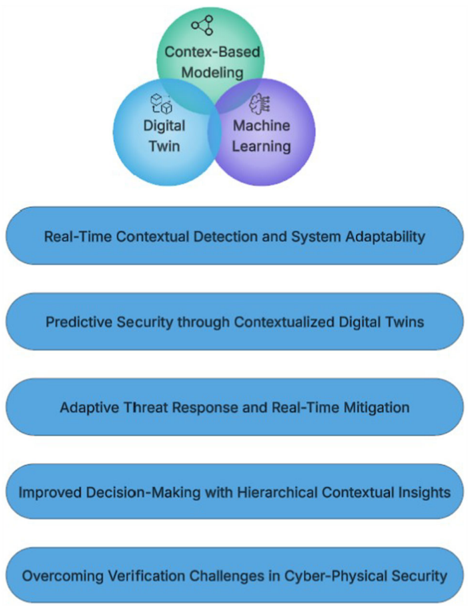
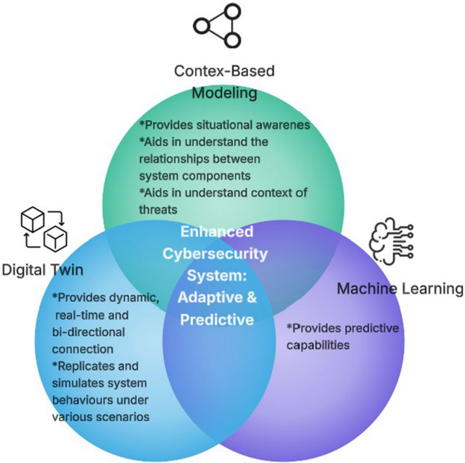
- The integrated framework is presented as a multi-layered defense that improves situational awareness, predictive threat detection, and adaptive response; the authors also note that false alarms can be reduced by context-aware anomaly detection.
## Methods
- The authors conducted a systematic literature review to answer four research questions covering context-based modeling, digital twins with machine learning for detection, ML-enabled threat modeling, and their integration.
- They searched IEEE Xplore, Scopus, and SpringerLink using controlled Boolean strings, then applied two-stage screening (title/abstract, then full text) with inclusion/exclusion criteria for peer-reviewed English ICS/CPS studies.
- Data extraction covered domain and asset context, data attributes, modeling form, DT type and synchronization, ML family, datasets, evaluation design/metrics, and reported security outcomes; the synthesis was narrative and no meta-analysis was attempted.
## Limitations
- The paper states that data limitations are a major challenge: real-world labeled ICS/CPS data are scarce or restricted, so much of the literature relies on synthetic data, which may not capture real attack complexity.
- It states that scalability is a concern because large distributed ICS/CPS environments require substantial computation, synchronization, and resource allocation; secure use of cloud solutions is also raised as a concern.
- It explicitly notes verification complexity, including the difficulty of verifying context-aware systems under evolving, uncertain, and adversarial conditions.
- Evident from the text: the review is qualitative/narrative and no meta-analysis was performed, so the paper does not provide pooled effect sizes or a quantitative comparison across studies.
Model-written summary. Check it against the paper before relying on it.
Integrity signals
Registry
Cites
Statistics
Figures
Verification
Claims the paper makes
14 Valid · 2 Not valid · 39 Not checked · 95 Own results and interpretations
The cited sources support only part of this claim — read each source’s verdict below.
In the paper
“The Semantic Sensor Network (SSN) ontology, proposed by Giallonardo et al. (2019), is an example of how semantic models can support context-aware systems [20]. Their work extends the SSN ontology to create logical sensors and actuators, allowing systems to infer high-level context from raw data.”
What the sources say
- Partly supportedcites [20] 20. Giallonardo, E., Poggi, F., Rossi, D., Zimeo, E., and others, Context-aware Reactive Systems based on Runtime Semantic Models, in Proc. of the International Conference on Software Engineering and Knowledge Engineering (SEKE), 301-403 (2019) sourceExperimental — accuracy not yet measured
Split into 2 atoms — 0 confirmed, 2 partially supported, 0 disputed, 0 misattributed, 0 unverifiable. Expand the claim to see per-atom verdicts.
plainstates a cause- Asserted: passes — The authors put it forward as true.
- Checkable: passes — It can be checked against evidence.
- Load-bearing: unclear — It is unclear whether the paper’s conclusions depend on it.
- Based: passes — The paper gives a reason why it holds.
- Partly supported
The sources with a verdict support this claim; the rest weren’t checked yet, have no full text we could read, or their verdicts aren’t rated yet.
In the paper
“However, as ICS and CPS become more interconnected, they become vulnerable to cyber threats that were previously uncommon in isolated industrial environments [5-8].”
What the sources say
- Not checked — no full text of the sourcecites [5] 5. Lou, X., Tellabi, A.: Cybersecurity threats, vulnerability and analysis in safety critical industrial control system (ICS). Recent Developments on Industrial Control Systems Resilience. Springer, 75-97 (2020) source
- Not checked — no full text of the sourcecites [6] 6. Ali, S., Al Balushi, T., Nadir, Z., Khadeer, O.: Hussain.: ICS/SCADA system security for CPS. Cyber Security for Cyber Physical Systems. Springer, 89-113 (2018) source
- Supportedcites [7] 7. Kayan, H., Nunes, M., Rana, O., Burnap, P., Perera, C.: Cybersecurity of industrial cyber-physical systems: A review. ACM Comput. Surv. (CSUR) 54 (11s), 1-35 (2022) source
The Industrial Control Systems section says ICS were formerly air-gapped but are now integrated with newer networked technologies. Section 4.4 says that integrating IT with operational technology creates new vulnerabilities exploitable by threat actors; the discussion on p. 27 adds that greater interconnection increases the attack surface. (LLM, conf=0.93)
- Not checked — no full text of the sourcecites [8] 8. Sheikh, Z.A., Singh, Y., Singh, P.K., Ghafoor, K.Z.: Intelligent and secure framework for critical infrastructure (CPS): Current trends, challenges, and future scope. Comput. Commun. 193 , 302-331 (2022) source
plainstates a cause- Asserted: passes — The authors put it forward as true.
- Checkable: passes — It can be checked against evidence.
- Load-bearing: passes — The paper’s conclusions depend on it.
- Based: passes — The paper gives a reason why it holds.
The cited sources support only part of this claim — read each source’s verdict below.
In the paper
“For example, supervised learning methods such as Support Vector Machines (SVM) and Random Forests have been applied to classify attack versus non-attack conditions using features extracted from sensor and network data [26, 27].”
What the sources say
- Not checked — no full text of the sourcecites [26] 26. Akbarian, F., Fitzgerald, E., Kihl, M.: Intrusion detection in digital twins for industrial control systems. 2020 International Conference on Software, Telecommunications and Computer Networks (SoftCOM). IEEE, (2020) source
- Partly supportedcites [27] 27. Varghese, S.A. et al.: Digital twin-based intrusion detection for industrial control systems. 2022 IEEE International Conference on Pervasive Computing and Communications Workshops and other Affiliated Events (PerCom Workshops). IEEE, (2022) sourceExperimental — accuracy not yet measured
Section C (p. 3) says the paper evaluated supervised classifiers including SVM and Random Forest on labeled normal and attack process measurements. The Conclusions (p. 6) identify feeding network traffic data to the IDS as future work, so the paper does not support the claim that its classifiers used features from both sensor and network data. (LLM, conf=0.88)
plain- Asserted: passes — The authors put it forward as true.
- Checkable: passes — It can be checked against evidence.
- Load-bearing: unclear — It is unclear whether the paper’s conclusions depend on it.
- Based: passes — The paper gives a reason why it holds.
Every source the paper cites for this claim was checked and supports it.
In the paper
“Given the complexity of these systems and the unique nature of their operations, traditional cybersecurity tools, which are often optimized for IT environments, may not provide adequate protection [10].”
What the sources say
- Supportedcites [10] 10. Jeffrey, N., Tan, Q., Villar, J.R.: A review of anomaly detection strategies to detect threats to cyber-physical systems. Electronics 12 (15), 3283 (2023) source
The Introduction says enterprise IT networks have mature IDS/IPS tools while CPS lacks equivalent capabilities. Section 5 adds that extending IT-network IDS/IPS into CPS is challenging and can produce high rates of false positives and false negatives, supporting the claim that traditional tools may not adequately protect these systems. (LLM, conf=0.92)
hedgedstates a possible cause- Asserted: passes — The authors put it forward as true.
- Checkable: passes — It can be checked against evidence.
- Load-bearing: passes — The paper’s conclusions depend on it.
- Based: passes — The paper gives a reason why it holds.
- Supported
The cited sources support only part of this claim — read each source’s verdict below.
In the paper
“Machine Learning offers promising solutions for threat detection in ICS and CPS by analyzing large volumes of data and identifying patterns that might indicate malicious activity [11].”
What the sources say
- Partly supportedcites [11] 11. Salem, A.H., et al.: Advancing cybersecurity: a comprehensive review of AI-driven detection techniques. J. Big Data 11 (1), 105 (2024) sourceExperimental — accuracy not yet measured
The Background says AI, including ML, can handle large datasets and identify malicious activity by analyzing patterns. The paper also discusses intrusion detection in industrial IoT networks, but the cited passages do not establish the claim specifically for both industrial control systems (ICS) and cyber-physical systems (CPS). (LLM, conf=0.84)
hedgedstates a possible cause- Asserted: passes — The authors put it forward as true.
- Checkable: passes — It can be checked against evidence.
- Load-bearing: passes — The paper’s conclusions depend on it.
- Based: passes — The paper gives a reason why it holds.
- Partly supported
63 more claims · 5 with their cited sources checked
Create a free account to see all 150 claims and to verify the 18 references still open.
- It may state two separate claims as one. 49
- Probably not a substantial claim. 56
- The quote only partly states this claim. 1
Self-check
Percentages, sums and reported differences re-computed from the paper’s own numbers.
Each contradiction between two passages listed here was confirmed by an independent check.
Rated major: it would touch a result — a value a result rests on, reported and recomputed p-values on opposite sides of the significance level, two passages that conflict with no sign which is right, or a cited work retracted before this paper was published.
In the paper
§ 3.4 Threat modeling with machine learning
“This part examines threat models designed for detection systemsthatincorporatemachinelearning.Thereviewedarticles did not contain any examples of threat modeling applications that utilize machine learning.”
§ 3.4 Threat modeling with machine learning
“A practical application of machine learning in developing threat model systems is presented by Schaad et al. [24] (2020). This automating threat analysis method on software architectures, which uses the STRIDE method, leverages machine learning to identify and prioritize threats effectively.”
Citations
Cites
Dey, A. K., Abowd, G. D., & Salber, D. (2001) · Human–Computer Interaction · doi:10.1207/s15327051hci16234_02 · Cited by 2,951
Cyber-physical systems: the next computing revolution
Rajkumar, R. (., Lee, I., Sha, L., & Stankovic, J. (2010) · Proceedings of the 47th Design Automation Conference · doi:10.1145/1837274.1837461 · Cited by 1,986
Rathore, M. M., Shah, S. A., Shukla, D., Bentafat, E., & Bakiras, S. (2021) · IEEE Access · doi:10.1109/access.2021.3060863 · Cited by 616
DeepFed: Federated Deep Learning for Intrusion Detection in Industrial Cyber–Physical Systems
Li, B., Wu, Y., Song, J., Lu, R., Li, T., & Zhao, L. (2021) · IEEE Transactions on Industrial Informatics · doi:10.1109/tii.2020.3023430 · Cited by 597
Advancing cybersecurity: a comprehensive review of AI-driven detection techniques
Salem, A. H., Azzam, S. M., Emam, O. E., & Abohany, A. A. (2024) · Journal of Big Data · doi:10.1186/s40537-024-00957-y · Cited by 282 · cited 1×
“Machine Learning offers promising solutions for threat detection in ICS and CPS by analyzing large volumes of data and identifying patterns that might indicate malicious activity [11].”
Cybersecurity of industrial cyber-physical systems: A review
Kayan, H., Nunes, M., Rana, O., Burnap, P., & Perera, C. (2022) · ACM Computing Surveys · doi:10.1145/3510410 · Cited by 261
Djenna, A., Harous, S., & Saidouni, D. E. (2021) · Applied Sciences · doi:10.3390/app11104580 · Cited by 199 · cited 1×
“This exposure opens them up to potential cyber-attacks that could disrupt operations, sab-otage systems, or even endanger public safety [9].”
Real-World Anomaly Detection by Using Digital Twin Systems and Weakly Supervised Learning
Castellani, A., Schmitt, S., & Squartini, S. (2021) · IEEE Transactions on Industrial Informatics · doi:10.1109/tii.2020.3019788 · Cited by 181 · cited 6×
“This dataset was used to enhance anomaly detection [30].”
InfluentialCyber-Physical Systems in the Context of Industry 4.0: A Review, Categorization and Outlook
Oks, S. J., Jalowski, M., Lechner, M., Mirschberger, S., Merklein, M., Vogel-Heuser, B., & Möslein, K. M. (2024) · Information Systems Frontiers · doi:10.1007/s10796-022-10252-x · Cited by 160
A Review of Anomaly Detection Strategies to Detect Threats to Cyber-Physical Systems
Jeffrey, N., Tan, Q., & Villar, J. R. (2023) · Electronics · doi:10.3390/electronics12153283 · Cited by 160
Iliuţă, M.-E., Moisescu, M.-A., Pop, E., Ionita, A.-D., Caramihai, S.-I., & Mitulescu, T.-C. (2024) · Applied Sciences · doi:10.3390/app14135454 · Cited by 134
Digital Twin-Based Cyber-Attack Detection Framework for Cyber-Physical Manufacturing Systems
Balta, E. C., Pease, M., Moyne, J., Barton, K., & Tilbury, D. M. (2024) · IEEE Transactions on Automation Science and Engineering · doi:10.1109/tase.2023.3243147 · Cited by 125
Karnouskos, S., Leitao, P., Ribeiro, L., & Colombo, A. W. (2020) · IEEE Industrial Electronics Magazine · doi:10.1109/mie.2019.2962225 · Cited by 123
Szvetits, M., & Zdun, U. (2013) · Software & Systems Modeling · doi:10.1007/s10270-013-0394-9 · Cited by 117
Introduction to Cyber-Physical System Security: A Cross-Layer Perspective
Wurm, J., Jin, Y., Liu, Y., Hu, S., Heffner, K., Rahman, F., & Tehranipoor, M. (2017) · IEEE Transactions on Multi-Scale Computing Systems · doi:10.1109/tmscs.2016.2569446 · Cited by 102
Threat modeling of industrial control systems: A systematic literature review
Khalil, S. M., Bahşi, H., & Korõtko, T. (2023) · Computers & Security · doi:10.1016/j.cose.2023.103543 · Cited by 102
Modeling Digital Twin Data and Architecture: A Building Guide With FIWARE as Enabling Technology
Conde, J., Muñoz-Arcentales, A., Alonso, Á., López‐Pernas, S., & Salvachúa, J. (2021) · IEEE Internet Computing · doi:10.1109/mic.2021.3056923 · Cited by 98
Smart Grid Anomaly Detection using a Deep Learning Digital Twin
Danilczyk, W., Sun, Y. L., & He, H. (2021) · 2020 52nd North American Power Symposium (NAPS) · doi:10.1109/naps50074.2021.9449682 · Cited by 89 · cited 4×
“In the literature study, attack detection [28, 33], intrusion detection[26, 27, 29] and anomaly detection [30– 32, 34, 35] studies created using these two technologies were examined.”
InfluentialDigital Twin-based Intrusion Detection for Industrial Control Systems
Varghese, S. A., Dehlaghi Ghadim, A., Balador, A., Alimadadi, Z., & Papadimitratos, P. (2022) · 2022 IEEE International Conference on Pervasive Computing and Communications Workshops and other Affiliated Events (PerCom Workshops) · doi:10.1109/percomworkshops53856.2022.9767492 · Cited by 85 · cited 6×
“In the literature study, attack detection [28, 33], intrusion detection[26, 27, 29] and anomaly detection [30– 32, 34, 35] studies created using these two technologies were examined.”
InfluentialIntegrating digital twin security simulations in the security operations center
Dietz, M., Vielberth, M., & Pernul, G. (2020) · Proceedings of the 15th International Conference on Availability, Reliability and Security · doi:10.1145/3407023.3407039 · Cited by 77
A context-based model for Knowledge Management embodied in work processes
Nunes, V., Santoro, F. M., & Borges, M. R. S. (2009) · Information Sciences · doi:10.1016/j.ins.2009.01.033 · Cited by 70
A context model for knowledge-intensive case-based reasoning
Öztürk, P., & Aamodt, A. (1998) · International Journal of Human-Computer Studies · doi:10.1006/ijhc.1997.0174 · Cited by 68
Ayodeji, A., Liu, Y.-K., Chao, N., & Yang, L.-Q. (2020) · Nuclear Engineering and Technology · doi:10.1016/j.net.2020.05.012 · Cited by 66
Intrusion Detection in Digital Twins for Industrial Control Systems
Akbarian, F., Fitzgerald, E., & Kihl, M. (2020) · 2020 International Conference on Software, Telecommunications and Computer Networks (SoftCOM) · doi:10.23919/softcom50211.2020.9238162 · Cited by 58 · cited 4×
“In the literature study, attack detection [28, 33], intrusion detection[26, 27, 29] and anomaly detection [30– 32, 34, 35] studies created using these two technologies were examined.”
InfluentialVälja, M., Heiding, F., Franke, U., & Lagerström, R. (2020) · Cybersecurity · doi:10.1186/s42400-020-00060-8 · Cited by 57
Sheikh, Z. A., Singh, Y., Singh, P. K., & Ghafoor, K. Z. (2022) · Computer Communications · doi:10.1016/j.comcom.2022.07.007 · Cited by 49
Digital Twin-based Anomaly Detection with Curriculum Learning in Cyber-physical Systems
Xu, Q., Ali, S., & Yue, T. (2023) · ACM Transactions on Software Engineering and Methodology · doi:10.1145/3582571 · Cited by 49 · cited 7×
“Importance of historical data: Historical data was also used in the articles examined[28, 32, 33].”
InfluentialLi, Z., Duan, M., Xiao, B., & Yang, S. (2023) · IEEE Transactions on Industrial Informatics · doi:10.1109/tii.2022.3231923 · Cited by 45
Tancredi, G. P. C., Vignali, G., & Bottani, E. (2022) · Sensors · doi:10.3390/s22114143 · Cited by 44
MUD enabled deep learning framework for anomaly detection in IoT integrated smart building
Mirdula, S., & Roopa, M. (2023) · e-Prime - Advances in Electrical Engineering Electronics and Energy · doi:10.1016/j.prime.2023.100186 · Cited by 44
Krishnaveni, S., Chen, T. M., Sathiyanarayanan, M., & Amutha, B. (2024) · Cluster Computing · doi:10.1007/s10586-024-04320-x · Cited by 44
Issa, M. M., Aljanabi, M., & Muhialdeen, H. M. (2024) · Journal of Intelligent Systems · doi:10.1515/jisys-2023-0248 · Cited by 35
Liu, G., Zhang, W., Li, X., Fan, K., & Yu, S. (2022) · Science China Information Sciences · doi:10.1007/s11432-021-3455-1 · Cited by 29
Reinpold, L. M., Wagner, L. P., Gehlhoff, F., Ramonat, M., Kilthau, M., Gill, M. S., Reif, J. T., Henkel, V., Scholz, L., & Fay, A. (2025) · Journal of Intelligent Manufacturing · doi:10.1007/s10845-023-02278-y · Cited by 27 · cited 2×
“Another contribution to dynamic context modeling comes from Reinpold et al. (2024), who combine digital twins with context-aware models in smart manufacturing [22].”
Towards a knowledge graph framework for ad hoc analysis in manufacturing
Meyers, B., Vangheluwe, H., Lietaert, P., Vanderhulst, G., Van Noten, J., Schaffers, M., Maes, D., & Gadeyne, K. (2024) · Journal of Intelligent Manufacturing · doi:10.1007/s10845-023-02319-6 · Cited by 23 · cited 3×
“Similarly, Meyers et al. (2023) focus on knowledge representation through knowledge graphs, which provide a structure for managing heterogeneous data in smart man-123 ufacturing systems [21].”
InfluentialLing, E. R., Lagerström, R., & Ekstedt, M. (2020) · Lecture notes in computer science · doi:10.1007/978-3-030-58295-1_4 · Cited by 20
TrIDS: an intelligent behavioural trust based IDS for smart healthcare system
Singh, A., Chatterjee, K., & Satapathy, S. C. (2023) · Cluster Computing · doi:10.1007/s10586-022-03614-2 · Cited by 20
A survey on verification strategies for intelligent transportation systems
Schmidtke, H. R. (2018) · Journal of Reliable Intelligent Environments · doi:10.1007/s40860-018-0070-5 · Cited by 19 · cited 3×
“Schmidtke (2018) highlights that digital twins provide a safe, isolated environment to simulate attack scenarios and validate defensive responses, which is essential for ensuring the reliability of safety-critical CPS systems [55].”
(2021) · doi:10.1007/978-3-030-78086-9_6 · Cited by 19 · cited 3×
“(what-if), and control-oriented recommendation [22, 24, 25].”
DT4I4-Secure: Digital Twin Framework for Industry 4.0 Systems Security
Lin, Y.-Z., Shao, S., Rahman, M. H., Shafae, M., & Satam, P. (2023) · 2023 IEEE 14th Annual Ubiquitous Computing, Electronics & Mobile Communication Conference (UEMCON) · doi:10.1109/uemcon59035.2023.10316090 · Cited by 14
ICS/SCADA System Security for CPS
Ali, S., Al Balushi, T., Nadir, Z., & Hussain, O. K. (2018) · Studies in Computational Intelligence · doi:10.1007/978-3-319-75880-0_5 · Cited by 13
Cybersecurity Threats, Vulnerability and Analysis in Safety Critical Industrial Control System (ICS)
Lou, X., & Tellabi, A. (2020) · Studies in Systems, Decision and Control · doi:10.1007/978-3-030-31328-9_4 · Cited by 13 · cited 1×
“However, as ICS and CPS become more interconnected, they become vulnerable to cyber threats that were previously uncommon in isolated industrial environments [5–8].”
Using Contextual Information to Identify Cyber-Attacks
AlEroud, A., & Karabatis, G. (2017) · Studies in Computational Intelligence · doi:10.1007/978-3-319-44257-0_1 · Cited by 12 · cited 1×
“To overcome these challenges, IDSs need to provide a higher level of context using contextual information and have the necessary information to understand how attacks evolve [38].”
Marrying Graph Kernel with Deep Neural Network: A Case Study for Network Anomaly Detection
Yao, Y., Su, L., Zhang, C., et al. (2019) · Lecture notes in computer science · doi:10.1007/978-3-030-22741-8_8 · Cited by 12
Understanding the threat to SCADA networks
Gonda, O. (2014) · Network Security · doi:10.1016/s1353-4858(14)70093-5 · Cited by 11
Saurabh, K., Gajjala, D., Kaipa, K., Vyas, R., Vyas, O. P., & Khondoker, R. (2024) · Arabian Journal for Science and Engineering · doi:10.1007/s13369-023-08600-3 · Cited by 11 · cited 3×
“However, current ICS threat modeling methods cannot comprehensively analyze cyber threats [50].”
Power-Based Intrusion Detection for Additive Manufacturing: A Deep Learning Approach
Rott, M., & Monroy, S. A. S. (2021) · Lecture notes of the Institute for Computer Sciences, Social Informatics and Telecommunications Engineering · doi:10.1007/978-3-030-71061-3_11 · Cited by 7
Context-aware Reactive Systems based on Runtime Semantic Models (S)
Giallonardo, E., Poggi, F., Rossi, D., & Zimeo, E. (2019) · International Conferences on Software Engineering and Knowledge Engineering · doi:10.18293/seke2019-169 · Cited by 6 · cited 2×
“The Semantic Sensor Network (SSN) ontology, proposed by Giallonardo et al. (2019), is an example of how semantic models can support context-aware systems [20].”
LSTM-Based Anomalous Behavior Detection in Multi-Agent Reinforcement Learning
Lischke, C., Liu, T., McCalmon, J., Rahman, M. A., Halabi, T., & Alqahtani, S. (2022) · IEEE International Conference on Cyber Security and Resilience (CSR) · doi:10.1109/csr54599.2022.9850343 · Cited by 6
Digital Twin-Enhanced Methodology for Training Edge-Based Models for Cyber Security Applications
Allison, D., Smith, P., & McLaughlin, K. (2022) · 2022 IEEE 20th International Conference on Industrial Informatics (INDIN) · doi:10.1109/indin51773.2022.9976095 · Cited by 6
Horváth, I., Tepjit, S., & Rusák, Z. (2018) · Volume 1A: 38th Computers and Information in Engineering Conference · doi:10.1115/detc2018-85107 · Cited by 5
Al-Tahee, M., Easa, H. K., Jabbar, K. A., Al-Tahee, M., Alzubaidi, L. H. J., Alatba, S. R., & Mohammed, M. A. (2024) · International Conference on Smart Systems for Electrical, Electronics, Communication and Computer Engineering (ICSSEECC) · doi:10.1109/icsseecc61126.2024.10649428 · Cited by 5
(2020) · doi:10.1007/978-3-030-49669-2_16 · Cited by 5
Protecting the Cyberphysical System Against Intrusion Dection
Sharma, P. (2023) · 2023 2nd International Conference on Futuristic Technologies (INCOFT) · doi:10.1109/incoft60753.2023.10425148 · Cited by 2
Dynamic Spatial Context Computation for Time-Varying Process Scenarios
Horváth, I., Li, Y., Rusák, Z., et al. (2016) · doi:10.1115/detc2016-59046 · Cited by 1
Resilient Reactive Systems Based on Runtime Semantic Models
Giallonardo, E., Poggi, F., Rossi, D., & Zimeo, E. (2019) · IEEE International Symposium on Software Reliability Engineering Workshops (ISSREW) · doi:10.1109/issrew.2019.00069 · Cited by 1
Reinpold, L. M., Wagner, L. P., Gehlhoff, F., Ramonat, M., Kilthau, M., Gill, M. S., Reif, J., Henkel, V., Scholz, L., & Fay, A. (2023) · Zenodo (CERN European Organization for Nuclear Research) · doi:10.5281/zenodo.8120623 · Cited by 1
Lou, X., & Tellabi, A. (2020) · Studies in Systems, Decision and Control · doi:10.1007/978-3-030-31328-9_14
Ling, E., Lagerström, R., & Ekstedt, M. (2020) · Lecture Notes in Computer Science · doi:10.1007/978-3-030-58295-1_8
Digital Twin-based Cyber-Attack Detection Framework for Cyber-Physical Manufacturing Systems
Balta, E. C., Pease, M., Moyne, J., et al. (2022) · doi:10.36227/techrxiv.21258102
Cited by
Chang, R.-I., Hsieh, D.-M., & Liao, W.-J. (2025) · WSEAS Transactions on Computers archive · doi:10.37394/23205.2025.24.34
Explainable Reinforcement Learning for Automated Incident Response in Critical Infrastructure
Alauthman, M., Almomani, A., Al–Qerem, A., Albesani, G., & Alkasassbeh, M. S. (2026) · International Conference on Computational Intelligence Approaches and Applications (ICCIAA) · doi:10.1109/icciaa68481.2026.11543556
Improved spatio-temporal feature fusion-based anomaly detection in industrial digital twins
Li, J., Lu, B., & Zhang, W. (2026) · International Journal of Critical Infrastructure Protection · doi:10.1016/j.ijcip.2026.100877
Mahfouz, A., El-Hajj, M. I., Dawood, M., & Attar, A. E. (2026) · Array · doi:10.1016/j.array.2026.101182
Metadata
- Authors
- Abraham, D., Erceylan, G., Gkioulos, V., & Houmb, S. H.
- Affiliations
- Norwegian University of Science and Technology (NO)
- Corresponding author
- Abraham, Doney
- Venue
- International Journal of Information Security
- Published
- 2025-11-20
- Volume
- 24
- Issue
- 6
- ISSN
- 1615-5262 (ISSN-L)
- 1615-5270
- OpenAlex
- W4416424431
- Semantic Scholar
- ca74517f84837c5c2ad8ad668ed53e5c1d54191a
- Cited by
- 10
- References
- 50
- Citations by year
- 2026: 9 · 2025: 1
- FWCI
- 1.44
- Type
- journal article
- Language
- en
- Open access
- hybrid
- doi.org
- Licence
- other-oa
- creativecommons.org/licenses/by/4.0 (tdm)
- creativecommons.org/licenses/by/4.0 (vor)
- Locations
- International Journal of Information Security (publishedVersion, other-oa)
- Funders
- NTNU Norwegian University of Science and Technology
- Topics
- Physical Sciences › Computer Science › Computer Networks and Communications › Network Security and Intrusion Detection
- Physical Sciences › Engineering › Control and Systems Engineering › Smart Grid Security and Resilience
- Physical Sciences › Computer Science › Information Systems › Information and Cyber Security
- Keywords
- industrial control systems, cyber-physical systems, ICS cybersecurity, digital twin, machine learning for threat detection, anomaly detection, cyber resilience, IoT integration, critical infrastructure security
About these checks
Registry, retraction, Cites and statistics results are computed, not judged, with one exception: a printed reference that no index lists is read once by a model before it counts as a citation error. Claims are extracted by a model and kept only when their quote appears verbatim in the text; each cited source is then checked, with a model’s help, for whether it says what the claim relies on. Those verdicts can be wrong — read the claim’s quote and the cited source before relying on one.
The claim verdicts this report counts are experimental: their accuracy is not yet measured.
A language model drew the claims from the paper on 2026-10-10, under version 3 of the claim definition (model deepseek-v4.1-flash, prompt extract-v3).
A second model labelled each claim on 2026-10-10 (model jev-1.13-20260917, definition revision gold-guideline-v0.2).
Cited sources are checked with a language model’s help (gpt-6-sol).
Statistics and arithmetic are recomputed, not judged.
Confidence bands are shown only for fields calibrated on our annotated test set. None is calibrated yet, so no band is shown.
What counts as a claim ›How we measure confidence ›How we check this ›
Are you an author, or do you see a problem with this page? Request a review
Data sources
Bibliographic data: Semantic Scholar, OpenAlex, Crossref.
Contains information from the Semantic Scholar Academic Graph Datasets, made available under the ODC Attribution License (ODC-BY 1.0).
Semantic Scholar’s data is described in: Kinney, R., et al. (2023). The Semantic Scholar Open Data Platform. arXiv:2301.10140.
