

Active inference, sensory attenuation and illusions
Open accessThe DOI matches its Crossref record; 81 of the 81 references it cites were found in a registry or an index.
Abstract
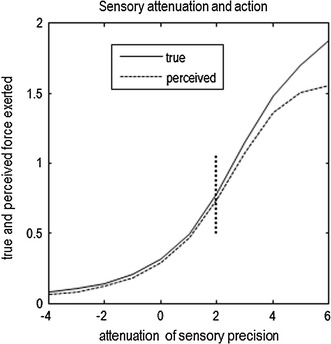
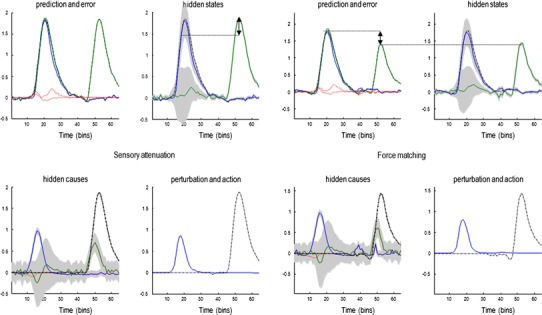
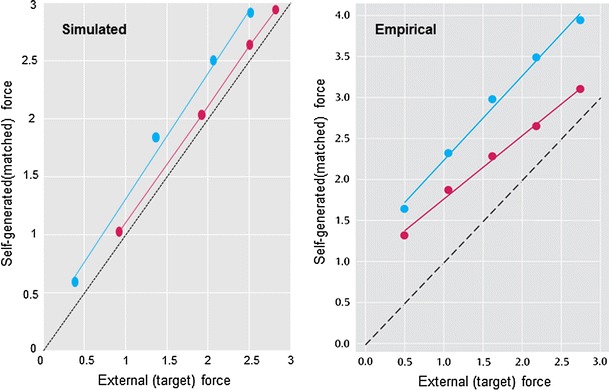
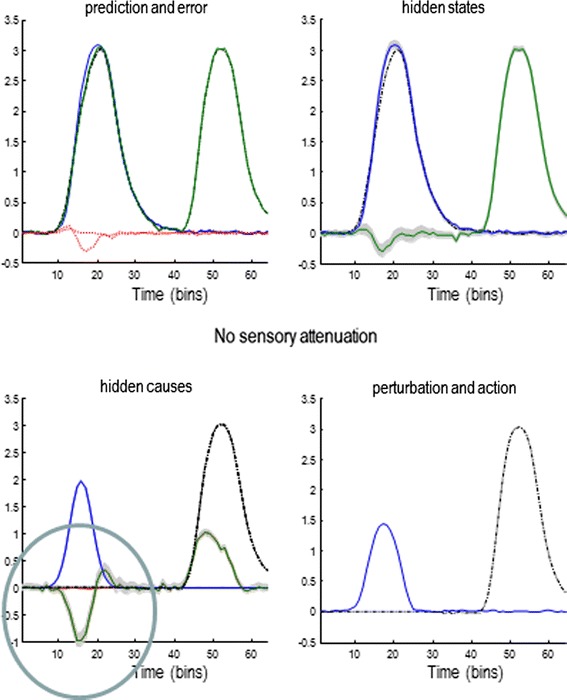
Active inference provides a simple and neurobiologically plausible account of how action and perception are coupled in producing (Bayes) optimal behaviour. This can be seen most easily as minimising prediction error: we can either change our predictions to explain sensory input through perception. Alternatively, we can actively change sensory input to fulfil our predictions. In active inference, this action is mediated by classical reflex arcs that minimise proprioceptive prediction error created by descending proprioceptive predictions. However, this creates a conflict between action and perception; in that, self-generated movements require predictions to override the sensory evidence that one is not actually moving. However, ignoring sensory evidence means that externally generated sensations will not be perceived. Conversely, attending to (proprioceptive and somatosensory) sensations enables the detection of externally generated events but precludes generation of actions. This conflict can be resolved by attenuating the precision of sensory evidence during movement or, equivalently, attending away from the consequences of self-made acts. We propose that this Bayes optimal withdrawal of precise sensory evidence during movement is the cause of psychophysical sensory attenuation. Furthermore, it explains the force-matching illusion and reproduces empirical results almost exactly. Finally, if attenuation is removed, the force-matching illusion disappears and false (delusional) inferences about agency emerge. This is important, given the negative correlation between sensory attenuation and delusional beliefs in normal subjects--and the reduction in the magnitude of the illusion in schizophrenia. Active inference therefore links the neuromodulatory optimisation of precision to sensory attenuation and illusory phenomena during the attribution of agency in normal subjects. It also provides a functional account of deficits in syndromes characterised by false inference and impaired movement--like schizophrenia and Parkinsonism--syndromes that implicate abnormal modulatory neurotransmission.
Overview
The claims and statistics of this paper haven’t been checked yet.
Free: it reads the open-access text and checks the first 5 claims that cite a source we can check. Create a free account to check every claim.
Integrity signals
Registry
Cites
Statistics
Figures
Verification
Claims the paper makes
The claims and statistics of this paper haven’t been checked yet.
Free: it reads the open-access text and checks the first 5 claims that cite a source we can check. Create a free account to check every claim.
Claims other papers make about this one
Each is checked against this paper’s own text: does it say what the citing paper says it does?
The source backs part of the claim, not all of it — or backs it for a different population, condition or comparison.
In the citing paper
“In other words, we have to infer both the cause of our sensations and the context, in terms of the (expected or subjective) precision of sensory evidence.”
From Active interoceptive inference and the emotional brain (2016) · cites this paper as [38]
Experimental — accuracy not yet measuredThe source backs part of the claim, not all of it — or backs it for a different population, condition or comparison.
In the citing paper
“All perceptual inference is at some level active – in the sense that we actively sample our sensorium to create our own sensations (Wurtz et al., 2011; Brown et al., 2013).”
From Virtual reality and consciousness inference in dreaming (2014) · cites this paper as Brown et al., 2013
Experimental — accuracy not yet measuredThe cited source says what the claim attributes to it.
In the citing paper
“Acting thus involves both generating a prediction of the sensory input expected to result from intended movement, and ‘fulfilling’ this prediction by executing the movement, thus effectively suppressing a prediction error signal that would otherwise emerge”
From 'Seeing the Dark': Grounding Phenomenal Transparency and Opacity in Precision Estimation for Active Inference (2018) · cites this paper as Brown et al., 2013
The cited source says what the claim attributes to it.
In the citing paper
“Action initiation involves ‘systematic misrepresentation’ (Wiese 2017)—whereby proprioceptive evidence that, for instance, my arm is not moving, is attenuated to allow the system to bring about the desired movement (Adams et al. 2013; Brown et al. 2013).”
From Consciousness in active inference: Deep self-models, other minds, and the challenge of psychedelic-induced ego-dissolution (2021) · cites this paper as Brown et al. 2013
The cited source says what the claim attributes to it.
In the citing paper
“The first to consider is ‘physiological sensory attenuation’ (Palmer et al. 2016), which is critical for movement initiation in active inference (Brown et al. 2013).”
From Consciousness in active inference: Deep self-models, other minds, and the challenge of psychedelic-induced ego-dissolution (2021) · cites this paper as Brown et al. 2013
2 more claims about this paper
Create a free account to see every claim other papers make about this one.
Self-check
Percentages, sums and reported differences re-computed from the paper’s own numbers.
The self-check needs the paper’s full text.
Citations
Cites
Rao, R. P. N., & Ballard, D. H. (1999) · Nature Neuroscience · doi:10.1038/4580 · Cited by 5,483 · cited 2×
“Within predictive coding formulations of perception (Rao and Ballard 1999; Friston 2005), prediction errors play a crucial role in perception, but again, they are not the percept itself; the percept is a synthesis of prior beliefs and sensory evidence that is conveyed by prediction errors.”
BackgroundMethodA theory of cortical responses.
Friston, K. (2005) · Philosophical Transactions of the Royal Society B: Biological Sciences · doi:10.1098/rstb.2005.1622 · Cited by 4,578 · cited 1×
“Within predictive coding formulations of perception (Rao and Ballard 1999; Friston 2005), prediction errors play a crucial role in perception, but again, they are not the percept itself; the percept is a synthesis of prior beliefs and sensory evidence that is conveyed by prediction errors.”
BackgroundSelf-citationThe Dopamine Hypothesis of Schizophrenia: Version III--The Final Common Pathway
Howes, O. D., & Kapur, S. (2009) · Schizophrenia Bulletin · doi:10.1093/schbul/sbp006 · Cited by 2,693 · cited 2×
“candidate for this modulation is the dopaminergic system, a classical ascending neuromodulatory transmitter system (Howes and Kapur 2009).”
BackgroundHaken, H. (2009) · Encyclopedia of Complexity and Systems Science · doi:10.1007/978-0-387-30440-3_534 · Cited by 2,336
The free-energy principle: a rough guide to the brain?
Friston, K. (2009) · Trends in Cognitive Sciences · doi:10.1016/j.tics.2009.04.005 · Cited by 1,831 · cited 1×
“The final assumption is the Laplace assumption that, in terms of neural codes, leads to the Laplace code that is arguably the simplest and most flexible of all neural codes (Friston 2009).”
BackgroundSelf-citationPredictive coding under the free-energy principle
Friston, K., & Kiebel, S. (2009) · Philosophical Transactions of the Royal Society B: Biological Sciences · doi:10.1098/rstb.2008.0300 · Cited by 1,579 · cited 2×
“This is the essence of recurrent message passing between hierarchical levels to optimise free energy or suppress prediction error: see (Friston and Kiebel 2009a, b; Feldman and Friston 2010) for a more detailed discussion.”
BackgroundSelf-citation(2021) · Modern Aspects of Superconductivity · doi:10.1142/9789811234521_0001 · Cited by 1,498
Central cancellation of self-produced tickle sensation
Blakemore, S.-J., Wolpert, D. M., & Frith, C. D. (1998) · Nature Neuroscience · doi:10.1038/2870 · Cited by 1,467 · cited 2×
“1999a, b, 2001) and thalamic (Blakemore et al. 1998) activity is reduced for self-produced versus externally”
BackgroundHaken, H. (1983) · Springer Series in Synergetics · doi:10.1007/978-3-642-88338-5 · Cited by 1,431
Attention, uncertainty, and free-energy
Feldman, H., & Friston, K. J. (2010) · Frontiers in Human Neuroscience · doi:10.3389/fnhum.2010.00215 · Cited by 1,365 · cited 3×
“This is the essence of recurrent message passing between hierarchical levels to optimise free energy or suppress prediction error: see (Friston and Kiebel 2009a, b; Feldman and Friston 2010) for a more detailed discussion.”
BackgroundSelf-citation
Research works printed but not linked: 1
- Weber E (1846) Der Tatsinn und das Gemeingefuhl. In: Wagner R (ed) Handwörterbuch der Physiologie. Wilhelm Engelmann, Leipzig
Cited by
Items 401–500 of 503
Tactile suppression during movement as optimal integration of somatosensory feedback across timePreprint
Tatai, F., Voudouris, D., Straub, D., Fiehler, K., & Rothkopf, C. A. (2026) · bioRxiv (Cold Spring Harbor Laboratory) · doi:10.64898/2026.02.25.707903 · Cited by 1
“Compared to other models, such as active inference [59, 60] or causal inference [61], OFC explicitly accounts for how uncertain sensory feedback and motor noise interact with the goals of the movement task.”
Allen, M., Fardo, F., Dietz, M. J., Hillebrandt, H. F., Rees, G. E., & Roepstorff, A. (2015) · doi:10.7287/peerj.preprints.1203v1
“2 INTRODUCTION The sense of self and experience of emotion are known to rely on highly multimodal interactions between interoceptive, somatosensory and proprioceptive signals, as well as prior beliefs about the causes of these sensations (Gallagher 2005; Brown et al. 2013).”
BackgroundTemporal Binding of Action and its Consequences Stimulus-identity prediction and neural correlates
Sinnes, T. (2014) · NVA (Nasjonalt vitenarkiv)
Interdependence between Our Mental Workspace and External Environment
Kiyonaga, A. (2015)
The influence of actions on auditory perception: cognitive and neural mechanisms
Cao, L. (2016) · Enlighten: Theses (The University of Glasgow)
The challenges of investigating the sense of agency by explicit and implicit methods
Havlíček, O. (2016) · Electronic Theses of LMU Munich (Ludwig-Maximilians-Universität München) · doi:10.5282/edoc.21547 · Cited by 1
Predictive processing and source monitoringin the psychosis continuum
Humpston, C. S. (2017) · ORCA Online Research @Cardiff (Cardiff University) · Cited by 2
Vuust, P. (2018) · Lecture notes in computer science · doi:10.1007/978-3-030-01692-0_7 · Cited by 1
Sensory prediction mechanisms in action
Yon, D. (2018) · Birkbeck Institutional Research Online (BiRO) - Theses · doi:10.18743/pub.00040362
Action Intentions and the Puzzle of Non-Willed Behaviour
Colton, J. (2019) · PEARL (University of Plymouth) · doi:10.24382/814
Holmes, J. A., & Nolte, T. (2019) · In Analysis · doi:10.1016/j.inan.2019.06.011
Kukkonen, K. (2019) · Oxford University Press eBooks · doi:10.1093/oso/9780190050955.003.0010
Kukkonen, K. (2019) · Oxford University Press eBooks · doi:10.1093/oso/9780190050955.003.0011
Kukkonen, K. (2019) · Oxford University Press eBooks · doi:10.1093/oso/9780190050955.003.0015 · Cited by 1
Kukkonen, K. (2019) · Oxford University Press eBooks · doi:10.1093/oso/9780190050955.003.0006
Artificial, in the Best Sense of the Word
Kukkonen, K. (2019) · Oxford University Press eBooks · doi:10.1093/oso/9780190050955.003.0012
Pleasures and Precision Shifts
Kukkonen, K. (2019) · Oxford University Press eBooks · doi:10.1093/oso/9780190050955.003.0007
Plots and Probability Transformations
Kukkonen, K. (2019) · Oxford University Press eBooks · doi:10.1093/oso/9780190050955.003.0002
Literature as a Designer Environment
Kukkonen, K. (2019) · Oxford University Press eBooks · doi:10.1093/oso/9780190050955.003.0014
Intertextual Precision Expectations
Kukkonen, K. (2019) · Oxford University Press eBooks · doi:10.1093/oso/9780190050955.003.0009
Introduction: Literature and Predictive Processing
Kukkonen, K. (2019) · Oxford University Press eBooks · doi:10.1093/oso/9780190050955.003.0001
Kukkonen, K. (2019) · Oxford University Press eBooks · doi:10.1093/oso/9780190050955.003.0013
Kukkonen, K. (2019) · Oxford University Press eBooks · doi:10.1093/oso/9780190050955.003.0004
МАНІПУЛЯЦІЯ СОЦІАЛЬНИМИ СПОДІВАННЯМИ:
Masіuk, O. (2019) · Epistemological Studies in Philosophy Social and Political Sciences · doi:10.15421/341921
Moumdjian, L. (2020) · Ghent University Academic Bibliography (Ghent University) · Cited by 1
The Impact of Comorbidities and Expectations on Functional Neurological Disorder Symptoms (FND)
Artigas, H., & del Pilar, D. (2020) · Minerva Access (University of Melbourne)
Testing a computational theory of brain functioning with virtual reality
Vasser, M. (2020) · DSpace repository (University of Tartu) · Cited by 39
Neurobehavioral Differences across Strategies Used in Cardiac RecognitionPreprint
Hodossy, L., & Tsakiris, M. (2019) · PsyArXiv (OSF Preprints) · doi:10.31234/osf.io/649p7
Sensory attenuation develops as a result of sensorimotor experience.Preprint
Idei, H., Ohata, W., Yamashita, Y., Ogata, T., & Tani, J. (2021) · arXiv (Cornell University)
A 400 micro W Tx/380 microW Rx 2.4GHz super-regenerative GaAs transceiver
McGregor, I. A., Whyte, G., Elgaid, K., Wasige, E., & Thayne, I. (2006) · Cited by 1
Kukkonen, K. (2019) · Oxford University Press eBooks · doi:10.1093/oso/9780190050955.003.0005
From aliens to invisible limbs: The transitions that never make it into conscious experiencePreprint
Aru, J. (2018) · PsyArXiv (OSF Preprints) · doi:10.31234/osf.io/rbauz
Computational Psychiatry and the Bayesian Brain
Friston, K. J., & Dolan, R. J. (2017) · Oxford University Press eBooks · doi:10.1093/med/9780190681425.003.0072
Self-citationKukkonen, K. (2019) · Oxford University Press eBooks · doi:10.1093/oso/9780190050955.003.0008
Faculty Opinions recommendation of Symptom perception, placebo effects, and the Bayesian brain.
Chwistek, M. (2019) · Faculty Opinions – Post-Publication Peer Review of the Biomedical Literature · doi:10.3410/f.733816406.793554728
Fukushima, H. (2018) · PsyArXiv (OSF Preprints) · doi:10.31234/osf.io/sknxt
Manrique, H. M., & WALKER, M. J. (2022) · PsyArXiv (OSF Preprints) · doi:10.31234/osf.io/2k63x
Moving Hands Feel Stimuli Before Stationary Hands
Drewing, K., & Vroomen, J. (2022) · Lecture notes in computer science · doi:10.1007/978-3-031-06249-0_2
Boonstra, E., & Slagter, H. A. (2022) · bioRxiv (Cold Spring Harbor Laboratory) · doi:10.1101/2022.11.15.516578
“From this perspective as well, the violation of internally and externally generated predictions are thought to be weighted differently (Brown et al., 2013), but to our knowledge no study has made this comparison directly for the visual domain within the context of Bayesian predictive perceptual…”
BackgroundThe Extension of the Indicator-Function of Feelings
Pliushch, I., & Proust, J. (2016) · The MIT Press eBooks · doi:10.7551/mitpress/10603.003.0095
The Cruel and Unusual Phenomenologies of Torture and Solitary Confinement
Gallagher, S. (2023) · Oxford University Press eBooks · doi:10.1093/oso/9780198873068.003.0011
Autonomy in the Self-pattern: Implications for Deep Brain Stimulation and Affordance-based Therapies
Gallagher, S. (2023) · Oxford University Press eBooks · doi:10.1093/oso/9780198873068.003.0008
Disorder, Dissociation, and Disruption in Self-narrative
Gallagher, S. (2023) · Oxford University Press eBooks · doi:10.1093/oso/9780198873068.003.0006
Gallagher, S. (2023) · Oxford University Press eBooks · doi:10.1093/oso/9780198873068.003.0003
Mindfulness in the Self-pattern
Gallagher, S. (2023) · Oxford University Press eBooks · doi:10.1093/oso/9780198873068.003.0010
Gallagher, S. (2023) · Oxford University Press eBooks · doi:10.1093/oso/9780198873068.002.0004
Dynamical Relations in the Self-pattern and Psychopathology
Gallagher, S. (2023) · Oxford University Press eBooks · doi:10.1093/oso/9780198873068.003.0005
Gallagher, S. (2023) · Oxford University Press eBooks · doi:10.1093/oso/9780198873068.002.0007
Gallagher, S. (2023) · Oxford University Press eBooks · doi:10.1093/oso/9780198873068.002.0008
Artificial Transformations of the Self-pattern
Gallagher, S. (2023) · Oxford University Press eBooks · doi:10.1093/oso/9780198873068.003.0009
A Threefold Method for Studying Self-pattern Dynamics
Gallagher, S. (2023) · Oxford University Press eBooks · doi:10.1093/oso/9780198873068.003.0004 · Cited by 1
Gallagher, S. (2023) · Oxford University Press eBooks · doi:10.1093/oso/9780198873068.002.0003
Computational modeling and autonomic control
Suksasilp, C., Friston, K. J., & Garfinkel, S. N. (2024) · Elsevier eBooks · doi:10.1016/b978-0-12-820480-1.00076-0
Self-citationThe role of prediction and attention in phantom voice perception
Duggirala, S. X. (2024) · Research Publications (Maastricht University) · doi:10.26481/dis.20240423sd · Cited by 1
From falling keys to dreams—Dynamic reorganization
Northoff, G. (2024) · Elsevier eBooks · doi:10.1016/b978-0-12-821935-5.00009-0
From Salvador Dali to dreams—topographic reorganization model of dreams
Northoff, G. (2024) · Elsevier eBooks · doi:10.1016/b978-0-12-821935-5.00019-3
Learning to Attenuate Myself: A Predictive Processing Account of the Body-Scan MeditationPreprint
Becattini, V. (2024) · PsyArXiv (OSF Preprints) · doi:10.31234/osf.io/6mu85
Kukkonen, K. (2020) · Oxford University Press eBooks · doi:10.1093/oso/9780190050955.002.0005
Kukkonen, K. (2020) · Oxford University Press eBooks · doi:10.1093/oso/9780190050955.002.0008
Kukkonen, K. (2020) · Oxford University Press eBooks · doi:10.1093/oso/9780190050955.002.0003
Salaminios, G., Debbané, M., Barrantes-Vidal, N., & Luyten, P. (2024) · Frontiers research topics · doi:10.3389/978-2-8325-5141-7
Computational Psychiatry and the Bayesian Brain
Friston, K. J., & Gu, X. (2025) · Oxford University Press eBooks · doi:10.1093/med/9780197640654.003.0071
Self-citationRole and limits of socio-normative influences in delusions of control
Pacherie, É. (2025) · Synthese · doi:10.1007/s11229-025-05010-w
“In the context of active inference, delusions of control in schizophrenia would result from an abnormally high weighting of the expected precision of current somatosensory evidence associated with some intended movements (Adams et al., 2013, 2015 ; Brown et al., 2013).”
Manrique, H. M., Friston, K. J., & WALKER, M. J. (2026) · Biosystems · doi:10.1016/j.biosystems.2026.105793 · Cited by 1
Self-citationFinger and nerve selectivity of an early somatic-motor interaction: a magnetoencephalogram study
Kida, T., Tanaka, E., & Inui, K. (2025) · Cerebral Cortex · doi:10.1093/cercor/bhaf113
It’s Movement all the Way Down: Broken Rhythms and Embodied Selfhood in DepersonalizationPreprint
Alekseeva, V., & Ciaunica, A. (2025) · PsyArXiv (OSF Preprints) · doi:10.31234/osf.io/sa9j5_v1
It’s Movement all the Way Down: Broken Rhythms and Embodied Selfhood in DepersonalizationPreprint
Alekseeva, V., & Ciaunica, A. (2025) · PsyArXiv (OSF Preprints) · doi:10.31234/osf.io/sa9j5_v2
The effects of task-relevant suggestions on motivated cognitive control
Zahedi, A., & Sommer, W. (2025) · International review of neurobiology · doi:10.1016/bs.irn.2025.06.003 · Cited by 1
Active inference and speech motor control: a review and theoryPreprint
Bradshaw, A. R., Press, C., & Davis, M. H. (2025) · PsyArXiv (OSF Preprints) · doi:10.31234/osf.io/eq4kh_v2
A scale-free measure of relaxation anisotropy in precision-weighted variational inferencePreprint
Mykhailenko, M. (2026) · SSRN Electronic Journal · doi:10.2139/ssrn.5853487
Brown, H. R. (2014) · UCL Discovery (University College London)
Self-citationMechanisms of apathy in health and Parkinson's disease
Hezemans, F. H. (2020) · Apollo (University of Cambridge) · doi:10.17863/cam.63928
The neural organ explains the mind
Hohwy, J. (2015) · Gutenberg Open Science · doi:10.25358/openscience-149 · Cited by 7
Self-deception within the predictive coding framework
Pliushch, I. (2016) · Gutenberg Open Science · doi:10.25358/openscience-1036
Elijah, R. B. (2018) · UNSWorks (UNSW Sydney) · doi:10.26190/unsworks/20753
Gilsoul, J. (2020) · ORBi (University of Liège)
Choquet, F. (2021) · Archipel (Université du Québec à Montréal)
Sense of Agency for Eye Movements
Gutzeit, J. (2025) · Online Publication Service of Würzburg University (Würzburg University) · doi:10.25972/opus-42836
Why can we hurt ourselves? Human agency and embodied action in the attenuation of self-induced pain
Wang, S., Eccleston, C., Wilmut, K., Keefe, F. J., & Keogh, E. (2025) · Pain · doi:10.1097/j.pain.0000000000003899
Sustained Facilitation of Embodied Fake Hand Movement on Voluntary Movement Execution
Shibuya, S. (2026) · European Journal of Neuroscience · doi:10.1111/ejn.70416
“Second, the active inference framework posits that somatosensory attenuation plays a crucial role in the initiation of voluntary movement (Brown et al. 2013; Palmer et al. 2016).”
Modulation of sensory attenuation by intensive meditation practice: an active inference perspective
Poublan‐Couzardot, A., Foncelle, A., Koun, É., Rossetti, Y., Abdoun, O., Pagnoni, G., & Lutz, A. (2026) · Neuroscience of Consciousness · doi:10.1093/nc/niaf051 · Cited by 1
“…suggested that a failure to attenuate the somatosensory consequences of movements in patients with schizophrenia (Shergill et al., 2005, 2014) or functional movement disorders (Pareés et al., 2014), is at the basis of false inferences about agency in these clinical populations (Brown et al., 2013).”
Kawaminami, S., OKUYAMA, T., & TANAKA, M. (2026) · Transactions of the JSME (in Japanese) · doi:10.1299/transjsme.25-00218
Beyond introspective illusions, a brain computer interface approach to decision awareness
Rebouillat, B. (2020) · theses.fr (ABES) · doi:10.70675/b8f16473zb6e9z434bz80c5zdaaff6ec46b2
The Generative Posture Framework: A Unified Account of Postural Generation, Persistence, and ChangePreprint
Miller, S. (2026) · SSRN Electronic Journal · doi:10.2139/ssrn.6577078 · Cited by 1
Entropy and the free energy principle in psychopathology
Faccini, J., & Del-Monte, J. (2026) · New Ideas in Psychology · doi:10.1016/j.newideapsych.2026.101265
Parvizi-Wayne, D., Pedersen, R., & Rankin, J. (2026) · Review of Philosophy and Psychology · doi:10.1007/s13164-026-00828-w
“This mecha - nism is the attenuation of the precision of current sensory input, otherwise known as sensory attenuation (Adams et al. 2013 ; Brown et al. 2013; Friston et al. 2010 ), which 10 Although note that task switching likely induces other psychological phenomena that are hypothetically…”
Gravitational expectations simultaneously attract and repel perceptionPreprint
Simpson, N., Rittershofer, K., Ward, E. K., Mazor, M., & Press, C. (2026) · bioRxiv (Cold Spring Harbor Laboratory) · doi:10.64898/2026.06.15.732061
“In fact, perceptual repulsion may also provide adaptive benefits, because it likely results from the amplification of the surprising features of our environment (Brown et al., 2013; Wolpert et al., 2003).”
Bertoli, M., Doncker, W. D., & Kuppuswamy, A. (2026) · bioRxiv (Cold Spring Harbor Laboratory) · doi:10.64898/2026.07.08.737231
“Under active-inference accounts of motor control 14,15 , the motor system generates predictions about the sensory consequences of its commands and applies a high-precision gain function to these descending signals, attenuating predicted reafference and labelling it as self-generated.”
InfluentialReduced Sensory Attenuation Scales with Tic Severity in Tourette Syndrome
Stanco, G., Marotta, A., Mariano, M., Andani, M. E., Fiorio, M., Porta, M., & Zapparoli, L. (2026) · Movement Disorders · doi:10.1002/mds.70590
Zhang, X., Yin, M., Hu, H., Liu, Y., Cheng, Q., & Zhang, L. (2026) · Journal of Brain and Spine · doi:10.1016/j.jbs.2026.07.002
Conative inference as a mechanism of allostatic resilience: wanting to be and being to want
Krupnik, V. (2026) · Cognitive Affective & Behavioral Neuroscience · doi:10.3758/s13415-026-01485-3
Tom, J. (2026) · TSpace (University of Toronto)
Wang, Z., 谭支内, Zhang, Y., Li, Y., Lin, J., Xu, Y., Li, Y., & Chen, T. (2026) · Acta Neurologica Belgica · doi:10.1007/s13760-026-03168-9
Sato, S., Kato, T., & Toyoizumi, T. (2026) · Schizophrenia Bulletin · doi:10.1093/schbul/sbag095
“27 – 29 This computational tradition was further connected to synaptic-gain abnormalities in SZ, 30 and has recently been reorganized from the perspective of dynamic belief updating across computational approaches.”
Yu, Q., Zhang, Z., Wang, P., Raab, M., Herold, F., Heath, M. D., Mavilidi, M. F., PAAS, F. G. W. C., & Zou, L. (2026) · Journal of sport and health science/Journal of Sport and Health Science · doi:10.1016/j.jshs.2026.101177
Illumination Onset: A Theoretical Neuroscience Framework for the Sudden Aha Moment
Kim, K. H. (2026) · Behavioral Sciences · doi:10.3390/bs16101740
“Brown et al. (2013) proposed that movement attenuates sensation by reducing the precision assigned to sensory evidence.”
The phantastic organ: predictive processing in the brain
Friston, K. J., & Parr, T. (2026) · Frontiers in Psychology · doi:10.3389/fpsyg.2026.1901293
“In one sense – following Todorov and colleagues (Todorov, 2008; Kappen et al., 2012) – we already know the answer: one simply uses a predictive coding scheme to control the motor plant (Adams et al., 2013a).”
InfluentialSelf-citationAttention and prediction during action and aesthetic appreciation
Sarasso, P. (n.d.) · Institutional Research Information System University of Turin (University of Turin)
Investigating the interplay of physiological and psychological processes in fatigue in Long COVID
Thomas, B. (2025) · ORCA Online Research @Cardiff (Cardiff University)
Metadata
- Authors
- Brown, H., Adams, R. A., Parees, I., Edwards, M., & Friston, K.
- Affiliations
- Wellcome Centre for Human Neuroimaging (GB)
- University College London (GB)
- Corresponding author
- Brown, Harriet
- Venue
- Cognitive Processing
- Published
- 2013-06-07
- Volume
- 14
- Issue
- 4
- Pages
- 411-427
- ISSN
- 1612-4782 (ISSN-L)
- 1612-4790
- PMC
- PMC3824582
- OpenAlex
- W2151496011
- Semantic Scholar
- 6291e49d4e7c30272a43a212e14aec9fe37dac38
- Cited by
- 488
- References
- 81
- Citations by year
- 2026: 24 · 2025: 38 · 2024: 31 · 2023: 63 · 2022: 45 · 2021: 48 · 2020: 39 · 2019: 58 · 2018: 38 · 2017: 29 · 2016: 22 · 2015: 23 · 2014: 23 · 2013: 5
- FWCI
- 2.09
- Type
- journal article
- Language
- en
- Open access
- hybrid
- doi.org
- Locations
- Cognitive Processing (publishedVersion, cc-by)
- Europe PMC (PubMed Central) (publishedVersion, cc-by)
- PubMed Central (publishedVersion, cc-by)
- PubMed (publishedVersion)
- St George's Online Research Archive (St George's University of London) (acceptedVersion)
- UCL Discovery (University College London) (submittedVersion)
- Funders
- Wellcome Trust (091593, 088130)
- Topics
- Life Sciences › Neuroscience › Cognitive Neuroscience › Embodied and Extended Cognition
- Social Sciences › Arts and Humanities › Philosophy › Free Will and Agency
- Social Sciences › Psychology › Social Psychology › Action Observation and Synchronization
- Keywords
- active inference, sensory attenuation, proprioception, prediction error, sensory precision, schizophrenia, parkinsonism, perception-action coupling, neuromodulation
- MeSH terms
- Algorithms, Attention, Bayes Theorem, Behavior, Humans, Illusions, Psychophysics, Sensation
About these checks
Registry, retraction, Cites and statistics results are computed, not judged, with one exception: a printed reference that no index lists is read once by a model before it counts as a citation error. Claims are extracted by a model and kept only when their quote appears verbatim in the text; each cited source is then checked, with a model’s help, for whether it says what the claim relies on. Those verdicts can be wrong — read the claim’s quote and the cited source before relying on one.
Statistics and arithmetic are recomputed, not judged.
Confidence bands are shown only for fields calibrated on our annotated test set. None is calibrated yet, so no band is shown.
What counts as a claim ›How we measure confidence ›How we check this ›
Are you an author, or do you see a problem with this page? Request a review
Data sources
Bibliographic data: Semantic Scholar, OpenAlex, Crossref.
Contains information from the Semantic Scholar Academic Graph Datasets, made available under the ODC Attribution License (ODC-BY 1.0).
Semantic Scholar’s data is described in: Kinney, R., et al. (2023). The Semantic Scholar Open Data Platform. arXiv:2301.10140.
