

Advancing a Conceptual Model of Evidence-Based Practice Implementation in Public Service Sectors
Open accessThe DOI matches its Crossref record; 159 of the 171 references it cites were found in a registry or an index; 18 of the 120 sources its claims cite were checked for support.
Abstract
Implementation science is a quickly growing discipline. Lessons learned from business and medical settings are being applied but it is unclear how well they translate to settings with different historical origins and customs (e.g., public mental health, social service, alcohol/drug sectors). The purpose of this paper is to propose a multi-level, four phase model of the implementation process (i.e., Exploration, Adoption/Preparation, Implementation, Sustainment), derived from extant literature, and apply it to public sector services. We highlight features of the model likely to be particularly important in each phase, while considering the outer and inner contexts (i.e., levels) of public sector service systems.
Overview
CoChat Summary
TL;DR
This conceptual paper proposes a multi-level, four-phase model of evidence-based practice (EBP) implementation — Exploration, Adoption/Preparation, Implementation, and Sustainment — derived from extant literature and applied specifically to public sector services such as child welfare and specialty mental health. It argues that different outer-context (sociopolitical/funding, interorganizational networks, leadership) and inner-context (organizational characteristics, culture/climate, individual adopter characteristics) factors matter differentially across phases, and that sustainment can recursively inform future implementation efforts.
Key findings
- The model divides implementation into four phases (Exploration, Adoption/Preparation, Active Implementation, Sustainment) and holds that "different aspects of the outer and inner context may be more prominent or manifest differently during different phases" — a feature the authors say few prior models explicitly recognize.
- Exploration is shaped by outer-context forces (sociopolitical/funding, client advocacy, interorganizational networks) and inner-context factors including absorptive capacity, readiness for change, and receptive context; the authors note child welfare agencies often have "varied levels of education and considerable workloads" and few venues for knowledge sharing.
- Sustainment is described as under-studied: "there has been little empirical work examining factors that either facilitate or limit sustainability of EBPs in public sector social services," and the authors state "we currently lack comprehensive models of factors that support maintenance or sustainment."
- Sustainment factors discussed include ongoing fidelity monitoring and support, a critical mass of EBP use, staffing/selection practices, leadership and culture-embedding mechanisms, and funding; the paper cites turnover rates in public sector service organizations "range from 20% to 50% annually" as a sustainment challenge.
Methods
- Design: conceptual/theoretical paper advancing a framework, not an empirical study; the model is "derived from extant literature" and illustrated with examples primarily from child welfare and specialty mental health, with the claim that many factors are "common to public sector services in general."
- Data/sample: none — the paper synthesizes prior implementation models and literature (e.g., RE-AIM, ORC, ARC, QUERI, CDT, IHI collaborative) rather than collecting data.
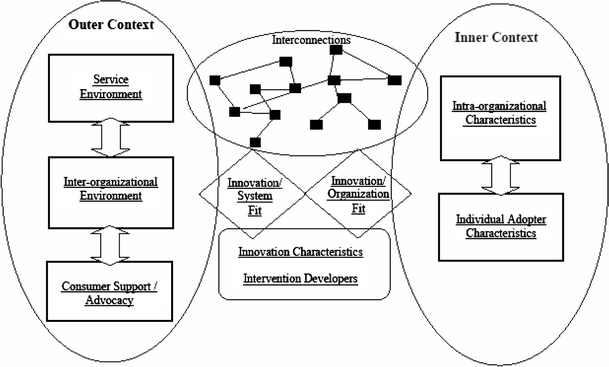
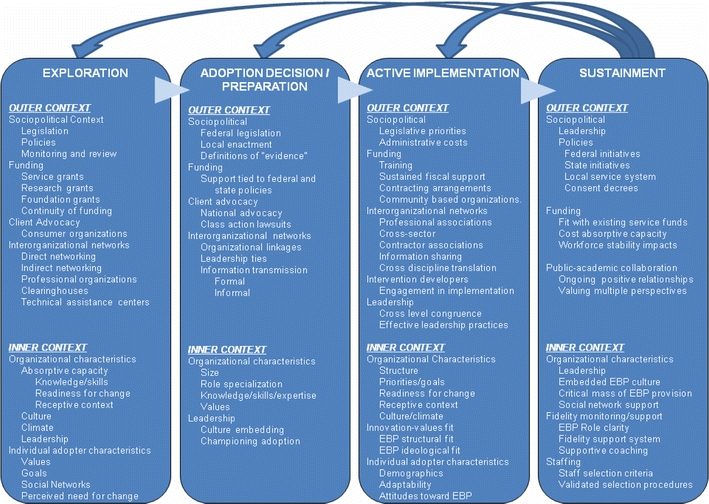
- Analysis: narrative synthesis organized by implementation phase and by outer vs. inner context levels, presented in two conceptual figures (Fig. 1 global factors; Fig. 2 phases and factors).
Limitations
- Stated: the authors note "few, if any, good measures of the process or progression through the phases" exist, and that process-based measures would be needed to assess status, progression, milestones, and speed of phase traversal.
- Stated: the paper repeatedly acknowledges thin empirical support — "there are few data supporting the importance of the other drivers of EBP exploration suggested by the literature," and consensus on core implementation drivers exists but "the body of concrete research evidence for each core driver in many cases remains to be developed."
- Evident from the text: the model is explicitly a hypothesis-generating framework ("variables hypothesized to play important roles"), its emphasis is skewed toward child welfare with mental health examples, and it offers no empirical test of the proposed phase-specific relationships.
Model-written summary. Check it against the paper before relying on it.
Integrity signals
Registry
Cites
Statistics
Figures
Verification
Claims the paper makes
16 Valid · 9 Not valid · 60 Not checked · 33 Own results and interpretations
The cited sources support only part of this claim — read each source’s verdict below.
In the paper
“Federal and state agencies may fund implementation demonstration projects and research studies to facilitate the implementation of EBPs, however, there has been little empirical work examining factors that either facilitate or limit sustainability of EBPs in public sector social services (Greenhalgh et al. 2004).”
§ Advancing a Conceptual Model of Evidence-Based Practice Implementation in Public Service Sectors > Sustainment Phase
What the sources say
- Partly supportedcites Greenhalgh et al. 2004 matched to “Diffusion of Innovations in Service Organizations: Systematic Review and Recommendations” (2004) sourceExperimental — accuracy not yet measured
The review says the literature on the sustainability of service innovations was very sparse (passage 1, page unavailable). It focused particularly on health care, however, and does not establish that empirical work on factors affecting sustainability of evidence-based practices was scarce specifically in public-sector social services. (LLM, conf=0.88)
plain- Asserted: passes — The authors put it forward as true.
- Checkable: passes — It can be checked against evidence.
- Load-bearing: passes — The paper’s conclusions depend on it.
- Based: passes — The paper gives a reason why it holds.
- Partly supported
The cited sources support only part of this claim — read each source’s verdict below.
In the paper
“The policies and funding needed for sustained use of practices typically follow from leaders who develop initiatives or set visions that can be maintained over time (Hoagwood et al. 2006).”
§ Advancing a Conceptual Model of Evidence-Based Practice Implementation in Public Service Sectors > Sustainment Phase > Outer Context
What the sources say
- Partly supportedcites Hoagwood et al. 2006 matched to “Implementation of evidence-based practices for children in four countries: a project of the World Psychiatric Association” (2006) sourceExperimental — accuracy not yet measured
The Discussion (page unavailable) says innovative leaders aided implementation and that all site Directors made plans for sustainability. The paper does not say that policies and funding typically follow from leaders’ initiatives or visions; it instead notes that continuation in Israel depended on securing funding. (LLM, conf=0.83)
plainstates a cause- Asserted: passes — The authors put it forward as true.
- Checkable: passes — It can be checked against evidence.
- Load-bearing: unclear — It is unclear whether the paper’s conclusions depend on it.
- Based: passes — The paper gives a reason why it holds.
- Partly supported
The cited sources support only part of this claim — read each source’s verdict below.
In the paper
“Conversely, severe budget restrictions discourage the exploration of innovations since exploration demands staff time, which may be limited when work forces are cut due to funding restrictions”
§ Advancing a Conceptual Model of Evidence-Based Practice Implementation in Public Service Sectors > Exploration Phase1 > The Outer Context
What the sources say
- Partly supportedcites Greenhalgh et al. 2004 matched to “Diffusion of Innovations in Service Organizations: Systematic Review and Recommendations” (2004) sourceExperimental — accuracy not yet measured
The paper’s discussion of organizational innovativeness (section labeled Abstract; page unavailable) associates slack resources with innovation, and its ‘Dedicated Time and Resources’ passage says adequate, continuing resources make assimilation more likely. It does not specifically say that severe budget restrictions lead to workforce cuts that leave staff too little time to explore innovations. (LLM, conf=0.86)
hedgedstates a cause- Asserted: passes — The authors put it forward as true.
- Checkable: passes — It can be checked against evidence.
- Load-bearing: unclear — It is unclear whether the paper’s conclusions depend on it.
- Based: passes — The paper gives a reason why it holds.
- Partly supported
The cited sources support only part of this claim — read each source’s verdict below.
In the paper
“Interorganizational forces, which focus on how individual organizations relate to, partner with, and compete with one another also play a potentially powerful role in adoption decisions.”
§ Advancing a Conceptual Model of Evidence-Based Practice Implementation in Public Service Sectors > Adoption Decision/Preparation Phase > Outer Context
What the sources say
- Partly supportedcites Chamberlain et al. 2008 matched to “Engaging and Recruiting Counties in an Experiment on Implementing Evidence-based Practice in California” (2008) sourceExperimental — accuracy not yet measured
The conceptual-model passage (Abstract; page unavailable) identifies prior cross-agency collaboration and positive relationships between counties and the California Institute for Mental Health as factors expected to influence adoption. This supports the claim about relationships and partnerships, but our copy does not address competition between organizations as an adoption influence. (LLM, conf=0.84)
- Not checked — no full text of the sourcecites Glisson and Schoenwald 2005 matched to “The ARC Organizational and Community Intervention Strategy for Implementing Evidence-Based Children's Mental Health Treatments” (2005) source
- Not matchedcites Institute for Healthcare Improvement [IHI] 2003
An author–year citation the paper’s reference list doesn’t settle. We don’t search these by name.
hedgedstates a possible cause- Asserted: passes — The authors put it forward as true.
- Checkable: passes — It can be checked against evidence.
- Load-bearing: unclear — It is unclear whether the paper’s conclusions depend on it.
- Based: passes — The paper gives a reason why it holds.
- Partly supported
The cited sources support only part of this claim — read each source’s verdict below.
In the paper
“Organizations that start with good knowledge/skills, can incorporate new knowledge, are highly specialized, and have mechanisms in place to spread knowledge throughout the organization, are much more likely to explore EBPs and eventually initiate them”
§ Advancing a Conceptual Model of Evidence-Based Practice Implementation in Public Service Sectors > Exploration Phase1 > The Inner Context
What the sources say
- Not checked — no full text of the sourcecites Damanpour 1991 matched to “Organizational innovation: A meta-analysis of effects of determinants and moderators” (1991) source
- Not checked — no full text of the sourcecites Ferlie and Shortell 2001 matched to “Improving the Quality of Health Care in the United Kingdom and the United States: A Framework for Change” (2001) source
- Partly supportedcites Greenhalgh et al. 2004 matched to “Diffusion of Innovations in Service Organizations: Systematic Review and Recommendations” (2004) sourceExperimental — accuracy not yet measured
The passages on structural determinants and absorptive capacity (indexed as Abstract; page unavailable) link specialization, an existing knowledge base, and knowledge sharing to greater organizational innovativeness and assimilation. They do not establish that organizations with these features are *much* more likely to explore and then initiate evidence-based practices specifically; the paper also describes assimilation as a process that can move back and forth between stages. (LLM, conf=0.84)
hedgedstates an association- Asserted: passes — The authors put it forward as true.
- Checkable: passes — It can be checked against evidence.
- Load-bearing: passes — The paper’s conclusions depend on it.
- Based: passes — The paper gives a reason why it holds.
57 more claims · 2 with their cited sources checked
Create a free account to see all 118 claims and to verify the 1 reference still open.
- Probably not a substantial claim. 31
- It may state two separate claims as one. 35
Claims other papers make about this one
Each is checked against this paper’s own text: does it say what the citing paper says it does?
The source backs part of the claim, not all of it — or backs it for a different population, condition or comparison.
In the citing paper
“Specifically, unlike traditional feasibility and pilot studies that may include the preliminary testing of interventions on individual clinical or public health outcomes, implementation feasibility and pilot studies that explore strategies to improve intervention implementation often require assessing changes across multiple levels including individuals (e.g. service providers or clinicians) and”
From Guidance for conducting feasibility and pilot studies for implementation trials (2020) · cites this paper as [21]
Experimental — accuracy not yet measuredThe source backs part of the claim, not all of it — or backs it for a different population, condition or comparison.
In the citing paper
“we propose that the concept of the individual might incorporate: capability, capacity, motivation (including recognising a need for change), resilience, acceptability, feelings, knowledge and beliefs (including self efficacy) about the intervention/evidence, position and fit within the organization/social system, and approach to decision-making (e.g., experimentation, use of information).”
From The role of evidence, context, and facilitation in an implementation trial: implications for the development of the PARIHS framework (2013) · cites this paper as [8]
Experimental — accuracy not yet measuredThe source backs part of the claim, not all of it — or backs it for a different population, condition or comparison.
In the citing paper
“Implementation strategies are too often designed in an unsystematic manner and fail to address key contextual determinants (13–16).”
From Enhancing the Impact of Implementation Strategies in Healthcare: A Research Agenda (2019) · cites this paper as [13]
Experimental — accuracy not yet measuredThe source backs part of the claim, not all of it — or backs it for a different population, condition or comparison.
In the citing paper
“Even if strategies are meticulously described in a study protocol or trial registry, it is often unrealistic to expect that they will not need to be altered as determinants emerge across implementation phases (13, 93, 94).”
From Enhancing the Impact of Implementation Strategies in Healthcare: A Research Agenda (2019) · cites this paper as [13]
Experimental — accuracy not yet measuredThe source backs part of the claim, not all of it — or backs it for a different population, condition or comparison.
In the citing paper
“Extent, quality, and timeliness of the completion of activities related to specific implementation process strategies”
From Beyond “implementation strategies”: classifying the full range of strategies used in implementation science and practice (2017) · cites this paper as [30]
Experimental — accuracy not yet measured
34 more claims about this paper
Create a free account to see every claim other papers make about this one.
Self-check
Percentages, sums and reported differences re-computed from the paper’s own numbers.
Each contradiction between two passages listed here was confirmed by an independent check.
Rated minor: it would not touch a result — a value no result rests on, a p-value that stays on the same side of the significance level, or a conflict that is clerical, resolved elsewhere in the paper, or outside its own findings.
In the paper
§ Advancing a Conceptual Model of Evidence-Based Practice Implementation in Public Service Sectors > References
“Data Path Design. (2010). ASWB projects.”
§ Advancing a Conceptual Model of Evidence-Based Practice Implementation in Public Service Sectors > References
“Retrieved June 10, 2009”
Citations
Cites
Rogers, E. M., Singhal, A., & Quinlan, M. M. (2019) · An Integrated Approach to Communication Theory and Research · doi:10.4324/9780203710753-35 · Cited by 37,322
The fifth discipline, the art and practice of the learning organization
Senge, P. M. (1991) · Performance + Instruction · doi:10.1002/pfi.4170300510 · Cited by 20,060
Organizational culture and leadership
(1993) · Long Range Planning · doi:10.1016/0024-6301(93)90120-5 · Cited by 16,462
Damschroder, L. J., Aron, D. C., Keith, R. E., Kirsh, S. R., Alexander, J. A., & Lowery, J. C. (2009) · Implementation Science · doi:10.1186/1748-5908-4-50 · Cited by 14,496
Valente, T. W. (2003) · Genetics in Medicine · doi:10.1097/01.gim.0000061743.67794.c4 · Cited by 13,723
(1994) · Cited by 13,126
Proctor, E., Silmere, H., Raghavan, R., Hovmand, P., Aarons, G., Bunger, A., Griffey, R., & Hensley, M. (2011) · Administration and Policy in Mental Health and Mental Health Services Research · doi:10.1007/s10488-010-0319-7 · Cited by 8,721
Self-citationDiffusion of Innovations in Service Organizations: Systematic Review and Recommendations
GREENHALGH, T., ROBERT, G., MACFARLANE, F., BATE, P., & KYRIAKIDOU, O. (2004) · The Milbank Quarterly · doi:10.1111/j.0887-378x.2004.00325.x · Cited by 7,448 · cited 11×
“Beginning at the broadest level, the state and federal sociopolitical and funding contexts influence the exploration of innovative interventions or practices (Davies and Nutley 2008; Ganju 2003; Hoagwood 2003).”
BackgroundInfluentialEvaluating the public health impact of health promotion interventions: the RE-AIM framework.
Glasgow, R. E., Vogt, T. M., & Boles, S. M. (1999) · American Journal of Public Health · doi:10.2105/ajph.89.9.1322 · Cited by 7,217 · cited 2×
“The RE-AIM model (Glasgow et al. 1999; Glasgow et al. 2006) explicitly identifies the ‘‘maintenance’’ phase of implementation as critical in sustaining effective health interventions.”
MethodOrganizational innovation: A meta-analysis of effects of determinants and moderators
Damanpour, F. (1991) · Academy of Management Journal · doi:10.2307/256406 · Cited by 6,542 · cited 9×
“Because the implementation literature has been developed in areas where the adoption of innovation is driven by profit or science, there is little attention to this first phase in the extant literature (Damanpour 1991).”
BackgroundMethodInfluential
Research works printed but not linked: 9
- Aos S Intensive family preservation programs: program fidelity influences effectiveness revised (No. 06-02-3901) 2006 Olympia Washington State Institute for Public Policy
- Backer T The failure of success: Challenges of disseminating effective substance abuse prevention programs Journal of Community Psychology 2000 28 3 363 373 · DOI · Paper page
- California Institute for Mental Health [CIMH] Community Development Team model: Supporting the model adherent implementation of programs and practices 2006 Sacramento California Institute for Mental Health
- Chadwick Center Closing the quality chasm in child abuse treatment: Identifying and disseminating best practices 2004 San Diego, CA Children’s Hospital-San Diego, Chadwich Center for Children and Families
- Davies HTO Nutley SM Learning more about how research-based knowledge gets used: Guidance in the development of new empirical research 2008 New York, NY William T. Grant Foundation
- Institute of Medicine [IOM] The state of quality improvement and implementation research: Expert views. Workshop summary 2007 Washington, DC The National Academies Press
- National Association of Public Child Welfare Administrators [NAPCWA] Guide for child welfare administrators on evidence based practice 2005 Washington DC APHSA
- National Institute of Mental Health [NIMH] Blueprint for change: Research on child and adolescent mental health 2001 Bethesda, MD National Institutes of Health
- Srivastava SK Bathla A Correlational study of organizational climate and work adjustment among industrial workers Social Science International 1996 12 1 52 60
Cited by
Items 1,201–1,300 of 3,223
Jones, M. D., Jones, K., Almirol, E. A., Payne, G., Graves, B., Schneider, J. A., Rijos, D., Zawitz, C. J., Zimmerman, R. S., Seal, D. W., et al. (2022) · AIDS and Behavior · doi:10.1007/s10461-022-03866-4 · Cited by 14
Houghtaling, B., Misyak, S. A., Serrano, E. L., Dombrowski, R. D., Holston, D., Singleton, C. R., & Harden, S. M. (2023) · Journal of Nutrition Education and Behavior · doi:10.1016/j.jneb.2022.10.002 · Cited by 17
Robertson, A. A., Gardner, S. K., Dembo, R., Dennis, M. L., Pankow, J., & Wilson, K. J. (2023) · Health & Justice · doi:10.1186/s40352-023-00210-3 · Cited by 17
“The study was divided into discrete phases that were aligned with the EPIS model to monitor implementation achievements (Aarons et al., 2011; Becan et al., 2020): Exploration (E; T1 Baseline), Preparation (P; T2 Pre-Randomization), Implementation (I; T3 Early Experiment, T4 Late Experiment), and…”
MethodCruden, G., Crable, E. L., Lengnick‐Hall, R., & Purtle, J. (2023) · Implementation Science Communications · doi:10.1186/s43058-023-00492-6 · Cited by 17
“…policy actors (developers, disseminators, implementers, influ-encers, and enforcers) across policy types (Big P or little p), contexts (inner, outer), and the four, non-linear phases of implementation outlined by the EPIS framework (Exploration, Preparation, Implementation, Sustainment) [12, 31].”
BackgroundPatel, Z. S., Becker, S. J., Olson, M. B., Rinella, H., & Scott, K. (2024) · Implementation Science Communications · doi:10.1186/s43058-024-00549-0 · Cited by 18
“First, implementation measures often evaluate efforts that engage diverse partners across multiple levels (patient, provider, organization) [1, 35].”
BackgroundRoseen, E. J., Joyce, C. T., Winbush, S., Pavco‐Luttschwager, N., Morone, N. E., Saper, R. B., Bartels, S. J., Patel, K. V., Keysor, J. J., Bean, J. F., et al. (2024) · PM&R · doi:10.1002/pmrj.13183 · Cited by 17
“11 Although implementation science theories and frameworks (eg, the Consolidated Framework for Implementation Research [CFIR] 12,13 ) can guide the systematic assessment of implementation determinants, they have rarely been used to evaluate the barriers to nonpharmacologic treatment use for LBP in…”
Mackey, B. J., Johnson, J. E., Ramezani, N., Hailemariam, M., Rosen, R. K., Thurman, T., Viglione, J., & Taxman, F. S. (2024) · Criminal Justice and Behavior · doi:10.1177/00938548241280391 · Cited by 13
“Implementation science models such as the Exploration, Preparation, Implementation, and Sustainment framework (Aarons et al., 2011) distinguish the inner and outer contexts of an organization.”
InfluentialBina, R., Barak, A., Posmontier, B., Glasser, S., & Cinamon, T. (2017) · Health & Social Care in the Community · doi:10.1111/hsc.12479 · Cited by 13
Implementing the teen marijuana check-up in schools—a study protocol
Hartzler, B. J., Lyon, A. R., Walker, D. D., Matthews, L., King, K. M., & McCollister, K. E. (2017) · Implementation Science · doi:10.1186/s13012-017-0633-5 · Cited by 15
“This hybrid type II effectiveness/implementation trial models the ‘Exploration, Preparation, Implementation, Sustainment’ (EPIS) framework [54].”
MethodBrown, L. (2019) · International Social Work · doi:10.1177/0020872818818247 · Cited by 26
“…has highlighted a vast range of factors that have been incorporated into a number of frameworks that offer support to the process of adopting and implementing complex interventions in secondary sites (Aarons et al., 2011; Damschroeder et al., 2009; Greehalgh et al., 2017; Pfadenhauer et al., 2017).”
BackgroundMYERS, B. J., Williams, P. P., Govender, R., Manderscheid, R., & Koch, J. R. (2019) · Journal of Studies on Alcohol and Drugs Supplement · doi:10.15288/jsads.2019.s18.131 · Cited by 13
“Guided by the implementation science literature (Aarons et al., 2011; Rogers, 2003; Stamatakis et al., 2012), the work group identified five domains potentially associated with implementation (leadership, organizational climate, resources, staff skills, system utility), and developed an indicator…”
MethodH, D. B. M. P., Henry, B. F., & McCollister, K. E. (2019) · Health Services Insights · doi:10.1177/1178632919855037 · Cited by 15
Leeman, J., & Toles, M. (2019) · Journal of Advanced Nursing · doi:10.1111/jan.14239 · Cited by 13
Pollastri, A. R., Wang, L., Youn, S. J., Ablon, J. S., & Marques, L. M. (2020) · Journal of Community Psychology · doi:10.1002/jcop.22325 · Cited by 16
Rudes, D. S., Viglione, J., Sheidow, A. J., McCart, M. R., Chapman, J. E., & Taxman, F. S. (2020) · Journal of Substance Abuse Treatment · doi:10.1016/j.jsat.2020.108144 · Cited by 14
“…can influence whether they use a new practice (Melas et al., 2012), with research finding positive attitudes of EBTs being predictors of use of EBTs in practice (Nelson & Steele, 2007) and uptake, sustainability, and fidelity to the intervention (Aarons, 2004; Aarons et al., 2011; Rogers, 2003).”
BackgroundFarewell, C. V., Puma, J. E., Bergling, E., Webb, J., Quinlan, J., Shah, P. Y., & Maiurro, E. (2020) · Health Education Research · doi:10.1093/her/cyaa038 · Cited by 13
Marquez, S. M., Chang, C.-H. D., & Arnetz, J. E. (2020) · Journal of Occupational and Environmental Medicine · doi:10.1097/jom.0000000000002036 · Cited by 15
“ht © 2020 American College of Occupational and Environmental e722 202 Therefore, the intervention may have bolstered employees’ sense of unity and responsibility to others in their unit, promoting greater adherence to intervention procedures.(24,26) We also sought to investigate whether the trend of favorable safety p…”
BackgroundRusch, A., DeCamp, L., Liebrecht, C., Choi, S. Y., Dalack, G. W., Kilbourne, A. M., & Smith, S. N. (2021) · Frontiers in Public Health · doi:10.3389/fpubh.2021.655999 · Cited by 15
“Frameworks such as the Consolidated Framework for Implementation Research (CFIR) (17), Exploration, Preparation, Implementation, Sustainment (EPIS) (18), and Reach, Effectiveness, Adoption, Implementation, and Maintenance (RE-AIM) (19), among others, have been created to help implementation scientists understand and c…”
BackgroundProgram staff perspectives on implementing youth‐initiated mentoring with systems‐involved youth
Spencer, R., Drew, A. L., & Horn, J. P. (2021) · Journal of Community Psychology · doi:10.1002/jcop.22514 · Cited by 17
Fagnan, L. J., Ramsey, K., Dickinson, C., Kline, T., & Parchman, M. L. (2021) · The Journal of the American Board of Family Medicine · doi:10.3122/jabfm.2021.04.210011 · Cited by 14
Becker‐Haimes, E. M., Mandell, D. S., Fishman, J., Williams, N. J., Wolk, C. B., Wislocki, K. E., Reich, D., Schaechter, T., Brady, M., Maples, N. J., et al. (2021) · Implementation Science Communications · doi:10.1186/s43058-021-00245-3 · Cited by 12
“Constructs from implementation science frameworks, which typically posit multilevel constructs that influence the implementation process [14, 22], are integrated in the model in two ways.”
BackgroundMethodSalloum, R. G., Bilello, L. A., Bian, J., Diiulio, J., Paz, L. G., Gurka, M. J., Gutierrez, M., Hurley, R. W., Jones, R. E., Martinez-Wittinghan, F., et al. (2022) · Implementation Science · doi:10.1186/s13012-022-01217-4 · Cited by 15
“The CDS implementation will be guided by the Exploration, Preparation, Implementation, Sustainment (EPIS) framework.”
BackgroundMethodInfluentialKarabukayeva, A., Hearld, L. R., Kelly, R. J., Hall, A. G., & Singh, J. A. (2022) · BMC Health Services Research · doi:10.1186/s12913-022-08736-2 · Cited by 14
Harker, A., Cordoba, N., Moya, A., & Piñeros-Leaño, M. (2023) · Frontiers in Psychology · doi:10.3389/fpsyg.2023.1134094 · Cited by 15
“A recommended strategy to integrate the lessons learned in the first implementation efforts in Tumaco and prepare to expand the program to other communities, is to explicitly develop protocols around the four implementation stages proposed in the “EPIS conceptual model” (Aarons et al., 2011): (E)xploration stage, whic…”
BackgroundWendt, J., Scheller, D. A., Banik, A., Łuszczyńska, A., Forberger, S., Zeeb, H., Scheidmeir, M., Kubiak, T., Lien, N., Meshkovska, B., et al. (2023) · BMC Public Health · doi:10.1186/s12889-023-15775-9 · Cited by 23
“, 1) exploration, 2) adoption decision/preparation, 3) active implementation, 4) sustainment [10]) and is realised by means of implementation strategies (also referred to as policy instruments) such as training for implementers, formal practice protocols and guidelines as well as economic, fiscal, and regulatory strat…”
BackgroundLessons from Peru to reduce under-5 mortality: understanding program implementation and context
Garcia, P. J., Williams, A. L., Garcia, M. H. C., VanderZanden, A., & Binagwaho, A. (2024) · BMC Pediatrics · doi:10.1186/s12887-023-03890-w · Cited by 15
“This framework, modified from Aar-ons and colleagues [16], focused on specific stages of implementation of MCH programs: Exploration, Preparation, Implementation, Adaptation, and Sustainability (EPIAS) [15].”
MethodMoore, L. A., Aarons, G. A., Davis, J. H., & Novins, D. K. (2015) · Psychological Services · doi:10.1037/ser0000022 · Cited by 14
“Research in implementation science suggests the quality of the EBT implementation process is as important as the EBT itself (Aarons et al., 2011; Fixsen, Blase, Naoom, & Wallace, 2009).”
BackgroundMethodInfluentialSelf-citationWilliams, J. R., Williams, W. O., Dusablon, T., Blais, M. P., Tregear, S., Banks, D., & Hennessy, K. D. (2013) · The Journal of Behavioral Health Services & Research · doi:10.1007/s11414-013-9369-4 · Cited by 13
Implementing the Strengths Model of Case Management: Group Supervision Fidelity Outcomes
Petrakis, M., Wilson, M., & Hamilton, B. E. (2012) · Community Mental Health Journal · doi:10.1007/s10597-012-9546-6 · Cited by 16
“Evidence-based practice methods are increasingly being developed (1-3).”
BackgroundMethodBack to the Future: Using Social Work Research to Improve Social Work Practice
DePanfilis, D. (2014) · Journal of the Society for Social Work and Research · doi:10.1086/675852 · Cited by 18
Ukawa, N., Ikai, H., & Imanaka, Y. (2014) · International Journal for Quality in Health Care · doi:10.1093/intqhc/mzu073 · Cited by 12
“According to an evidence-based practice implementation model [26], quality improvement activities follow a cycle that includes an implementation phase and a sustainment phase.”
MethodSandler, I. N., Wolchik, S. A., Berkel, C., Jones, S. L., Mauricio, A. M., Tein, J., & Winslow, E. B. (2016) · Cambridge University Press eBooks · doi:10.1017/9781316104453.006 · Cited by 14
Smith, T. H., Iadarola, S., Mandell, D. S., Harwood, R., & Kasari, C. L. (2017) · Academic Pediatrics · doi:10.1016/j.acap.2017.04.017 · Cited by 14
Gravesteijn, M., & Wilderom, C. P. M. (2018) · Journal of Organizational Change Management · doi:10.1108/jocm-05-2016-0100 · Cited by 22
Novel Methods for Screening: Contributions from Attachment and Biobehavioral Catch-up
Caron, E., Roben, C. K. P., Yarger, H. A., & Dozier, M. (2018) · Prevention Science · doi:10.1007/s11121-018-0894-5 · Cited by 15
“Similar to implementation frameworks in other fields (Damschroder and Hagedorn 2011; Tabak et al. 2012), the conceptual model of implementation in the public service sector includes different levels and phases (Aarons et al. 2011).”
Karlin, B. E., Brown, G. K., Jager-Hyman, S., Green, K. L., Wong, M., Lee, D. S., Bertagnolli, A., & Ross, T. B. (2019) · Behavior Therapy · doi:10.1016/j.beth.2018.08.002 · Cited by 12
Perspectives on the implementation of an evidence-based neglect program within child welfare
Weegar, K., Moorman, J., Stenason, L., & Romano, E. (2018) · Children and Youth Services Review · doi:10.1016/j.childyouth.2018.08.035 · Cited by 16
Characterizing evidence-based practice and training resource barriers: A needs assessment.
Meyer, A. E., Reilly, E. E., Daniel, K. E., Hollon, S. D., Jensen‐Doss, A., Mennin, D. S., Muroff, J. R., Schuler, T. A., White, B. C., & Teachman, B. A. (2020) · Training and Education in Professional Psychology · doi:10.1037/tep0000261 · Cited by 15
Pickard, K. E., Blakeley-Smith, A., Boles, R., Duncan, A., Keefer, A. J., O’Kelley, S. E., & Reaven, J. (2020) · Research in Autism · doi:10.1016/j.rasd.2020.101532 · Cited by 16
Community Mental Health Professionals’ Perceptions About Engaging Underserved Populations
Park, A. L., Boustani, M. M., Saifan, D., Gellatly, R., Letamendi, A. M., Stanick, C., Regan, J., Perez, G., Manners, D., Reding, M. E. J., et al. (2019) · Administration and Policy in Mental Health and Mental Health Services Research · doi:10.1007/s10488-019-00994-3 · Cited by 11
Santens, T., Hannes, K., Levy, S., Diamond, G., & Bosmans, G. (2020) · Family Process · doi:10.1111/famp.12504 · Cited by 12
Watson, D. P., Snow‐Hill, N. L., Saldana, L., Walden, A. L., Staton, M. D., Kong, A., & Donenberg, G. R. (2020) · Implementation Research and Practice · doi:10.1177/2633489520974974 · Cited by 15
“However, there is often a lack of consideration of the multiple dimensions of context that exist for an implementing organization (Aarons et al., 2011; Damschroder et al., 2009; Johns, 2006).”
BackgroundSridhar, A., Drahota, A., & Walsworth, K. (2021) · Implementation Science Communications · doi:10.1186/s43058-021-00158-1 · Cited by 12
“The adapted EPIS Framework [17], which also guided toolkit development, allowed for analysis of contextual and innovation determinants to toolkit use.”
MethodInfluentialBarriers to Universal Suicide Risk Screening for Youth in the Emergency Department
Seag, D. E. M., Cervantes, P. E., Baroni, A., Gerson, R., Knapp, K., Tay, E. T., Wiener, E., & Horwitz, S. M. (2021) · Pediatric Emergency Care · doi:10.1097/pec.0000000000002506 · Cited by 15
“In addition, all 9 studies focused on youth/caregiver attitudes during the exploration and implementation phases of screening, with little attention to provider attitudes, other stages of the implementation process, or other factors outlined in the EPIS model.11 Importantly, based on available data, it is unclear if c…”
BackgroundResultInfluentialSelf-citationDissemination and Implementation Science: A Primer and Applications in Nephrology
Urbanski, M. A., Wilk, A. S., Escoffery, C., & Patzer, R. E. (2022) · Kidney360 · doi:10.34067/kid.0005662021 · Cited by 13
“Commonly used frameworks include the Consolidated Framework for Implementation Research (CFIR) (7), which is frequently used to identify factors that may influence implementation outcomes (i.e., barriers and facilitators to implementation within and outside the organization); the Exploration, Preparation, Implementati…”
BackgroundBryson, S. A., & Ostmeyer, K. F. (2014) · Administration and Policy in Mental Health and Mental Health Services Research · doi:10.1007/s10488-013-0533-1 · Cited by 16
Driving Child Protection Reform: Evidence or Ideology?
Gillingham, P. (2014) · Australian Social Work · doi:10.1080/0312407x.2013.877948 · Cited by 13
“From the above analysis, it is reasonable to suggest that technocratic ideology was an additional force that mitigated against an extended “exploration phase”, which should involve the identification of a range of possible reform strategies (Aarons et al., 2011) rather than a single solution.”
BackgroundWillging, C. E., Trott, E. M., Fettes, D. L., Gunderson, L. M., Green, A. E., Hurlburt, M. S., & Aarons, G. A. (2015) · Research on Social Work Practice · doi:10.1177/1049731515601897 · Cited by 13
“This is consistent with a system, organization, and practice culture change that is likely to occur when a new innovation becomes instantiated and sustained (Aarons, Horowitz, Dlugosz, & Ehrhart, 2012; Aarons et al., 2011).”
BackgroundSelf-citationReadiness and barriers to adopt evidence-based practices for substance abuse treatment in Mexico
Horigian, V. E., Espinal, P. S., Alonso, E., Verdeja, R. E., Duan, R., Usaga, I. M., Pérez, A. P., Marín-Navarrete, R., & Feaster, D. J. (2016) · Salud Mental · doi:10.17711/sm.0185-3325.2016.004 · Cited by 16
Viglione, J. (2016) · International Journal of Offender Therapy and Comparative Criminology · doi:10.1177/0306624x16675630 · Cited by 15
Dickerson, D. L., Moore, L. A., Rieckmann, T. R., Croy, C. D., Venner, K. L., Moghaddam, J. F., Gueco, R., & Novins, D. K. (2017) · The Journal of Behavioral Health Services & Research · doi:10.1007/s11414-016-9549-0 · Cited by 11
Chuang, E., Collins‐Camargo, C., & McBeath, B. (2017) · Implementation Science · doi:10.1186/s13012-017-0580-1 · Cited by 15
“Challenges to the use of research evidence, and particularly to the adoption, implementation, and sustainment of EBTs, are well documented [8, 22, 23].”
BackgroundHermes, E. D. A., Burrone, L., Perez, E., Martino, S., & Rowe, M. (2018) · JMIR Mental Health · doi:10.2196/mental.9600 · Cited by 13
“For instance, in a study implementing evidence-based practices for the treatment of chronic diseases in primary care, the use of checklists by providers and self-management among patients were identified as important determinants of practice [20].”
Orengo‐Aguayo, R., Stewart, R. W., de Arellano, M. A., Pastrana, F. A., Villalobos, B. T., Martinez‐Gonzalez, K. G., Suárez-Kindy, J. L., & Brymer, M. J. (2019) · Journal of Family Strengths · doi:10.58464/2168-670x.1399 · Cited by 13
Stanick, C., Halko, H., Mettert, K., Dorsey, C., Moullin, J., Weiner, B., Powell, B., & Lewis, C. C. (2021) · Implementation Research and Practice · doi:10.1177/26334895211000458 · Cited by 11
“…articles contained in each measure packet; number of scales; number of items; setting in which measure had been used; level of analysis; target problem; and stage of implementation as defined by the Exploration, Adoption/ Preparation, Implementation, Sustainment (EPIS) model [Aarons et al., 2011]).”
MethodHarnessing Implementation Science in Clinical Psychology: Past, Present, and Future
Beidas, R. S., Boyd, M. R., Casline, E. P., Scott, K., Patel, Z. S., Mills, C., Mustanski, B. S., Schriger, S. H., Williams, F. S., Waller, C., et al. (2025) · Annual Review of Clinical Psychology · doi:10.1146/annurev-clinpsy-081423-021727 · Cited by 14
“The four phases of EPIS emphasize understanding the context prior to implementation, the factors impacting implementation over time, and tailored strategies for each phase (Aarons et al. 2011).”
InfluentialMatson, T. E., Hermes, E. D. A., Lyon, A. R., Quanbeck, A., Schueller, S. M., Wilson, S. M., & Glass, J. E. (2025) · Annals of Epidemiology · doi:10.1016/j.annepidem.2025.02.007 · Cited by 13
Fisher, G., Smith, C. L., Pagano, L., Spanos, S., Zurynski, Y. A., & Braithwaite, J. (2025) · The Lancet Planetary Health · doi:10.1016/s2542-5196(25)00056-7 · Cited by 12
Garner, B. R., Hunter, S. B., Slaughter, M. E., Han, B., & Godley, S. H. (2017) · Drug and Alcohol Dependence · doi:10.1016/j.drugalcdep.2017.08.011 · Cited by 12
“…organizational-level measures examined as part of the current study far from represent the wide array of organizational-level measures that have been proposed to be important influences on implementing evidence-based practices (Aarons et al., 2011; Damschroder et al., 2009; Proctor et al., 2011).”
Nielsen, B., Slinning, K., Oddli, H. W., & Drozd, F. (2018) · JMIR Research Protocols · doi:10.2196/10312 · Cited by 13
“Several implementation theories such as Fixsen’s [24] Active Implementation Framework (AIF), the Dynamic Adaptation Process model [25], and Consolidated Framework for Implementation Research model [26] acknowledge the importance of evaluation and reflective phases in continuous cycles of quality…”
BackgroundAbdala, I. G., Murta, S. G., de Menezes, J. C. L., Nobre-Sandoval, L. D. A., Gomes, M. D. S. M., Duailibe, K. D., & Farias, D. A. (2020) · International Journal of Environmental Research and Public Health · doi:10.3390/ijerph17196979 · Cited by 18
“Implementation is understood as the delivery of the intervention, while preimplementation refers to the previous exploratory and preparatory stages of the intervention’s implementation itself, both of which are affected by multiple contextual factors [26,27].”
BackgroundMerle, J. L., Larson, M. F., Cook, C. R., Brewer, S. K., Hamlin, C., Duong, M. T., McGinnis, J. L., Thayer, A. J., Gaias, L. M., & Lyon, A. R. (2022) · Psychology in the Schools · doi:10.1002/pits.22732 · Cited by 21
Gopalan, G., Lee, K. A., Pisciotta, C., Hooley, C., Stephens, T. N., & Acri, M. C. (2022) · Journal of Emotional and Behavioral Disorders · doi:10.1177/10634266221120532 · Cited by 11
Thabrew, H., Biro, R., & Kumar, H. (2023) · School Mental Health · doi:10.1007/s12310-023-09577-y · Cited by 14
“Implementation may be supported by research using established models such as EPIS (exploration preparation, implementation and sustainability) (Aarons et al., 2011; Moullin et al., 2020).”
MethodSridhar, A., Olesegun, O., & Drahota, A. (2023) · Global Implementation Research and Applications · doi:10.1007/s43477-023-00086-3 · Cited by 16
Implementation science in plain language: The use of nonjargon terms to facilitate collaboration
Dorsey, S., Johnson, C. M., Soi, C., Meza, R. D., Whetten, K., & Mbwayo, A. (2023) · Implementation Research and Practice · doi:10.1177/26334895231177474 · Cited by 14
Strehlenert, H., Rundgren, E. H., Sjunnestrand, M., & Hasson, H. (2023) · The British Journal of Social Work · doi:10.1093/bjsw/bcad170 · Cited by 19
“…twenty-four were general implementation frameworks, such as the Exploration, Preparation, Implementation and Sustainment framework (EPIS) ( n ¼ 6) (Aarons et al. , 2011), the Active Implementation Frameworks model ( n ¼ 6) (Fixsen et al. , 2005), the Consolidated Framework for Implementation…”
Itanyi, I. U., Viglione, C., Rositch, A. F., Olawepo, J. O., Olakunde, B. O., Ikpeazu, A., Nwokwu, U., Lasebikan, N. N., Ezeanolue, E. E., & Aarons, G. A. (2023) · Frontiers in Public Health · doi:10.3389/fpubh.2023.1228434 · Cited by 12
“We utilized the Exploration, Preparation, Implementation, Sustainment framework to guide and contextualize our activities and goals (18, 19).”
MethodSelf-citationFrank, H. E., Evans, L., Phillips, G. S., Dellinger, R. P., Goldstein, J., Harmon, L. A., Portelli, D. C., Sarani, N., Schorr, C., Terry, K. M., et al. (2023) · Trials · doi:10.1186/s13063-023-07644-y · Cited by 13
“The implementation strategy will be guided by the EPIS (Exploration, Preparation, Implementation, Sustainment) Framework [45], a commonly used approach that delineates phases of implementation and associated constructs.”
MethodGryglewicz, K., Totura, C. M. W., Childs, K. K., Labouliere, C. D., & Karver, M. S. (2023) · Administration and Policy in Mental Health and Mental Health Services Research · doi:10.1007/s10488-023-01308-4 · Cited by 12
“…including agency leadership, social norms, cross-system collaborations, credibility or alliance with trainers, and individual characteristics such as attitudes, work role expectations, and capacities (Aarons et al., 2011; Fixsen et al., 2009; Knaak et al., 2019; Platt et al., 2019).”
Ramani-Chander, A., Thrift, A. G., van Olmen, J., Wouters, E., Delobelle, P., Vedanthan, R., Miranda, J. J., Sherwood, S. G., Teede, H. J., & Joshi, R. (2023) · BMJ Global Health · doi:10.1136/bmjgh-2023-012804 · Cited by 15
Palitsky, R., Lyons, M. J., & Kaplan, D. M. (2023) · Mindfulness · doi:10.1007/s12671-023-02276-4 · Cited by 11
“…likely to have relevance for mindfulness in global public health is the Exploration, Preparation, Implementation, Sustainment (EPIS) framework (Aarons et al., 2011), because of its attention to multi-sector, multi-level, and multi-context translation and elucidation of priorities for multiple…”
Freeman, J. A., Farrar, J., Placencio‐Castro, M., Desrosiers, A., Brennan, R. T., Hansen, N. B., Akinsulure‐Smith, A. M., Su, S., Bangura, J., & Betancourt, T. S. (2023) · Journal of the American Academy of Child & Adolescent Psychiatry · doi:10.1016/j.jaac.2023.09.552 · Cited by 14
Jensen‐Doss, A., Casline, E. P., Woodard, G. S., Phillips, D. A., Lane, E., Palafu, T., Waye, C., Ramirez, V., Cheron, D. M., & Okamura, K. H. (2024) · Administration and Policy in Mental Health and Mental Health Services Research · doi:10.1007/s10488-024-01354-6 · Cited by 13
“Positive attitudes about an evidence-based practice are considered foundational to engaging in behavior change (Aarons et al., 2011), and assessment of MBC attitudes has been identified a key pre-implementation strat - egy (Mellor-Clark et al., 2016 ).”
Subedi, R. K., VanderZanden, A., Adhikari, K., Bastola, S., Hirschhorn, L. R., Binagwaho, A., & Maskey, M. K. (2024) · BMC Pediatrics · doi:10.1186/s12887-023-03889-3 · Cited by 12
“We included contextual factors associated with national, subnational, and community implementation adapted from the Consolidated Framework for Implementation Research and other publications on factors related to U5M, to reflect factors associated with national implementation in LMICs [14, 21–23].”
MethodUse of implementation logic models in the Quadruple Aim QUERI: conceptualization and evolution
Glasgow, R. E., McCreight, M. S., Morgan, B. R., Sjoberg, H., Hale, A., Motta, L. U., McKown, L., Kenney, R. R., Gilmartin, H., Jones, C. D., et al. (2025) · Implementation Science Communications · doi:10.1186/s43058-024-00678-6 · Cited by 13
Ardito, V., Cappellaro, G., Compagni, A., Petracca, F., & Preti, L. M. (2025) · Digital Health · doi:10.1177/20552076251355680 · Cited by 16
“Furthermore, adoption, as conceptualized in this work, can be characterized through three progressive stages, adapted based on Aaron et al. 18 The fi rst stage, development and experimentation , includes internal development, clinical studies, and proof-of-concept projects.”
The Reporting of Core Program Components: An Overlooked Barrier for Moving Research Into Practice
Maggin, D. M., & Johnson, A. H. (2015) · Preventing School Failure Alternative Education for Children and Youth · doi:10.1080/1045988x.2013.837812 · Cited by 15
Schoenwald, S. K. (2016) · The Cognitive Behaviour Therapist · doi:10.1017/s1754470x15000604 · Cited by 13
“School district and state level policies – aspects of the ‘outer context’ of implementation (Aarons et al. 2011) – also played a more prominent role in service delivery and supervision than had been anticipated.”
BackgroundPeltzer, K., Prado, G. J., Horigian, V. E., Weiss, S. M., Cook, R., Sifunda, S., & Jones, D. L. (2016) · Journal of Psychology in Africa · doi:10.1080/14330237.2016.1219537 · Cited by 13
“Individual staff provider characteristics such as preexisting PMTCT implementation protocol knowledge and skills leadership, and previous experience with innovations, might influence the fidelity with which it is translated into practice (Aarons, 2004; Aarons et al., 2011).”
BackgroundService providers' initial stance toward the adoption of an evidence-based parenting program
Charest, É., & Gagné, M. (2019) · Children and Youth Services Review · doi:10.1016/j.childyouth.2019.104410 · Cited by 14
Ahmadi, H., Sadoughi, F., Gholamhosseini, L., Azadi, T., Sheikhtaheri, A., Nilashi, M., & Dehnad, A. (2019) · International Conference on Web Research (ICWR) · doi:10.1109/icwr.2019.8765270 · Cited by 13
“Organizations, which are benefited from prior knowledge, experience and skills, host a well structured environment to merge new knowledge and innovation with ultimate adoption [43].”
BackgroundA Case Study of Implementing Grant-Funded Integrated Care in a Community Mental Health Center
Aby, M. (2019) · The Journal of Behavioral Health Services & Research · doi:10.1007/s11414-019-09671-7 · Cited by 11
“…and sustain primary care integrated practice within community mental health clinics (CMHCs).8–10 To advance the implementation of evidence-based practices (EBPs) within the public service sector, Aarons et al.11 created the Exploration, Preparation, Implementation, and Sustainment (EPIS) framework.”
BackgroundCollier‐Meek, M. A., Sanetti, L. M. H., Gould, K. M., & Pereira, B. A. (2020) · Journal of Educational and Psychological Consultation · doi:10.1080/10474412.2020.1777874 · Cited by 13
Brown, V., Tran, H. N. Q., Blake, M. R., Rachel, L., & Moodie, M. (2020) · Health Research Policy and Systems · doi:10.1186/s12961-020-00633-6 · Cited by 11
Developmental Language Disorder: Considerations for Implementing School-Based Screenings
Komesidou, R., & Summy, R. (2020) · Clinical Psychology and Special Education · doi:10.17759/cpse.2020090303 · Cited by 19
“, inner context, outer context), determine specific needs, and find evidence-based resources to match those needs [1; 20; 23; 43; 53].”
BackgroundMeasuring Stakeholder Perceptions: A Review of Social Validity Reporting in ASHA Journals
Olszewski, A., & Rae, K. (2021) · American Journal of Speech-Language Pathology · doi:10.1044/2021_ajslp-20-00169 · Cited by 14
The Intersection of Dissemination Research and Acupuncture: Applications for Chronic Low Back Pain
Roseen, E. J., Purtle, J., Zhang, W., Miller, D. W., Schwartz, A. W., Ramanadhan, S., & Sherman, K. J. (2021) · Global Advances in Health and Medicine · doi:10.1177/2164956120980694 · Cited by 10
“Effective dissemination of information about an evidence-based practice is often a pre-requisite for its successful implementation within usual care settings.(25,43) Acupuncture researchers should be aware of the various strategies by which they can “push” their findings to key stakeholders.”
BackgroundCervantes, P. E., Seag, D. E. M., Nelson, K. L., Purtle, J., Hoagwood, K., & Horwitz, S. M. (2021) · Psychiatric Services · doi:10.1176/appi.ps.202000582 · Cited by 11
Self-citationNaar, S., Pennar, A. L., Wang, B., Brogan-Hartlieb, K., & Fortenberry, J. D. (2021) · Health Psychology · doi:10.1037/hea0001071 · Cited by 13
Broom, J. K., Broom, A. F., Kenny, K., Post, J. J., & Koneçny, P. (2021) · BMJ Open · doi:10.1136/bmjopen-2021-055215 · Cited by 14
Connor, C. M., May, H., Sparapani, N., Hwang, J. K., Adams, A. M., Wood, T., Siegal, S. W., Wolfe, C., & Day, S. (2022) · Journal of Educational Psychology · doi:10.1037/edu0000758 · Cited by 13
Brooke‐Sumner, C., Williams, P. P., Sorsdahl, K. R., Kruger, J., Mahomed, H., & MYERS, B. J. (2022) · Global Health Action · doi:10.1080/16549716.2022.2123005 · Cited by 15
“interventions at scale is not straightforward, relying on the coordination of a variety of individuals, relationships and processes [18,19].”
BackgroundCervantes, P. E., Palinkas, L. A., Conlon, G. R., Richards-Rachlin, S., Sullivan, K. A., Baroni, A., & Horwitz, S. M. (2024) · Journal of Autism and Developmental Disorders · doi:10.1007/s10803-024-06364-9 · Cited by 17
“Questions were also informed by previous interview guides used in similar studies of mental health service needs of autistic individuals (e.g., Maddox et al., 2020) and the Exploration, Preparation, Implementation, Sustainment (EPIS) framework (Aarons et al., 2011).”
Self-citationTreating Aggression in Forensic Psychiatric Settings.
Trestman, R. L. (2017) · PubMed · Cited by 12
Assessment and Decision Making to Improve Outcomes in Child Protection
Shlonsky, A., & Mildon, R. L. (2017) · doi:10.1057/978-1-137-44130-0_8 · Cited by 15
Garland, A. F., Lebensohn‐Chialvo, F., Hall, K. G., & Cameron, E. (2017) · Behavioral Sciences & the Law · doi:10.1002/bsl.2296 · Cited by 14
Rieth, S. R., Stahmer, A. C., & Brookman-Frazee, L. I. (2018) · Autism and child psychopathology series · doi:10.1007/978-3-319-90994-3_27 · Cited by 11
Vitopoulos, N. A., Frederick, T. J., Leon, S. C., Daley, M., McDonald, C., Morales, S., Kielburger, L. C., Cohen, S. T., Eacott, K., Howes, C., et al. (2018) · Children and Youth Services Review · doi:10.1016/j.childyouth.2018.08.038 · Cited by 14
Stakeholder input into the implementation of a new music therapy program in a mental health service
Bibb, J., Castle, D. J., & McFerran, K. S. (2018) · Mental Health Review Journal · doi:10.1108/mhrj-12-2017-0056 · Cited by 10
Metadata
- Authors
- Aarons, G. A., Hurlburt, M., & Horwitz, S. M.
- Affiliations
- University of California San Diego (US)
- University of Southern California (US)
- Rady Children's Hospital-San Diego (US)
- Corresponding author
- Aarons, Gregory A.
- Venue
- Administration and Policy in Mental Health and Mental Health Services Research
- Published
- 2010-12-14
- Volume
- 38
- Issue
- 1
- Pages
- 4-23
- ISSN
- 0894-587X (ISSN-L)
- 1573-3289
- PMC
- PMC3025110
- OpenAlex
- W2044858486
- Cited by
- 3,240
- References
- 171
- Citations by year
- 2026: 306 · 2025: 331 · 2024: 333 · 2023: 311 · 2022: 307 · 2021: 274 · 2020: 251 · 2019: 257 · 2018: 170 · 2017: 168 · 2016: 111 · 2015: 143 · 2014: 107 · 2013: 96 · 2012: 48
- FWCI
- 93.26
- Type
- journal article
- Language
- en
- Open access
- hybrid
- doi.org
- Licence
- cc-by-nc
- Locations
- Administration and Policy in Mental Health and Mental Health Services Research (publishedVersion, cc-by-nc)
- PubMed Central (publishedVersion, cc-by-nc)
- PubMed (publishedVersion)
- Funders
- National Institute of Mental Health (P30MH074678, R01MH072961)
- Topics
- Health Sciences › Health Professions › General Health Professions › Health Policy Implementation Science
- Health Sciences › Health Professions › General Health Professions › Health Sciences Research and Education
- Social Sciences › Public Administration › Evaluation and Performance Assessment
- Keywords
- evidence-based practice implementation, implementation science, public service sector, conceptual model, multi-level model, implementation stages, exploration, adoption, implementation, program sustainability, public mental health services, social services, drug and alcohol services, organizational context
- MeSH terms
- Child, Child Welfare, Diffusion of Innovation, Health Plan Implementation, Humans, Mental Health Services, Social Work, United States, Models, Organizational, Evidence-Based Practice
About these checks
Registry, retraction, Cites and statistics results are computed, not judged, with one exception: a printed reference that no index lists is read once by a model before it counts as a citation error. Claims are extracted by a model and kept only when their quote appears verbatim in the text; each cited source is then checked, with a model’s help, for whether it says what the claim relies on. Those verdicts can be wrong — read the claim’s quote and the cited source before relying on one.
The claim verdicts this report counts are experimental: their accuracy is not yet measured.
A language model drew the claims from the paper on 2026-10-10, under version 3 of the claim definition (model deepseek-v4.1-flash, prompt extract-v3).
A second model labelled each claim on 2026-10-10 (model jev-1.13-20260917, definition revision gold-guideline-v0.2).
Cited sources are checked with a language model’s help (gpt-6-sol).
Statistics and arithmetic are recomputed, not judged.
Confidence bands are shown only for fields calibrated on our annotated test set. None is calibrated yet, so no band is shown.
What counts as a claim ›How we measure confidence ›How we check this ›
Are you an author, or do you see a problem with this page? Request a review
Data sources
Bibliographic data: Semantic Scholar, OpenAlex, Crossref.
Contains information from the Semantic Scholar Academic Graph Datasets, made available under the ODC Attribution License (ODC-BY 1.0).
Semantic Scholar’s data is described in: Kinney, R., et al. (2023). The Semantic Scholar Open Data Platform. arXiv:2301.10140.
