

Advancing a Conceptual Model of Evidence-Based Practice Implementation in Public Service Sectors
Open accessThe DOI matches its Crossref record; 159 of the 171 references it cites were found in a registry or an index; 18 of the 120 sources its claims cite were checked for support.
Abstract
Implementation science is a quickly growing discipline. Lessons learned from business and medical settings are being applied but it is unclear how well they translate to settings with different historical origins and customs (e.g., public mental health, social service, alcohol/drug sectors). The purpose of this paper is to propose a multi-level, four phase model of the implementation process (i.e., Exploration, Adoption/Preparation, Implementation, Sustainment), derived from extant literature, and apply it to public sector services. We highlight features of the model likely to be particularly important in each phase, while considering the outer and inner contexts (i.e., levels) of public sector service systems.
Overview
CoChat Summary
TL;DR
This conceptual paper proposes a multi-level, four-phase model of evidence-based practice (EBP) implementation — Exploration, Adoption/Preparation, Implementation, and Sustainment — derived from extant literature and applied specifically to public sector services such as child welfare and specialty mental health. It argues that different outer-context (sociopolitical/funding, interorganizational networks, leadership) and inner-context (organizational characteristics, culture/climate, individual adopter characteristics) factors matter differentially across phases, and that sustainment can recursively inform future implementation efforts.
Key findings
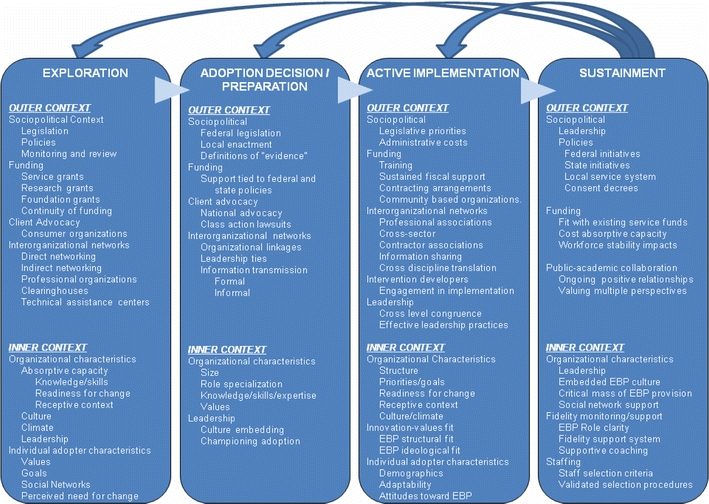
- The model divides implementation into four phases (Exploration, Adoption/Preparation, Active Implementation, Sustainment) and holds that "different aspects of the outer and inner context may be more prominent or manifest differently during different phases" — a feature the authors say few prior models explicitly recognize.
- Exploration is shaped by outer-context forces (sociopolitical/funding, client advocacy, interorganizational networks) and inner-context factors including absorptive capacity, readiness for change, and receptive context; the authors note child welfare agencies often have "varied levels of education and considerable workloads" and few venues for knowledge sharing.
- Sustainment is described as under-studied: "there has been little empirical work examining factors that either facilitate or limit sustainability of EBPs in public sector social services," and the authors state "we currently lack comprehensive models of factors that support maintenance or sustainment."
- Sustainment factors discussed include ongoing fidelity monitoring and support, a critical mass of EBP use, staffing/selection practices, leadership and culture-embedding mechanisms, and funding; the paper cites turnover rates in public sector service organizations "range from 20% to 50% annually" as a sustainment challenge.
Methods
- Design: conceptual/theoretical paper advancing a framework, not an empirical study; the model is "derived from extant literature" and illustrated with examples primarily from child welfare and specialty mental health, with the claim that many factors are "common to public sector services in general."
- Data/sample: none — the paper synthesizes prior implementation models and literature (e.g., RE-AIM, ORC, ARC, QUERI, CDT, IHI collaborative) rather than collecting data.
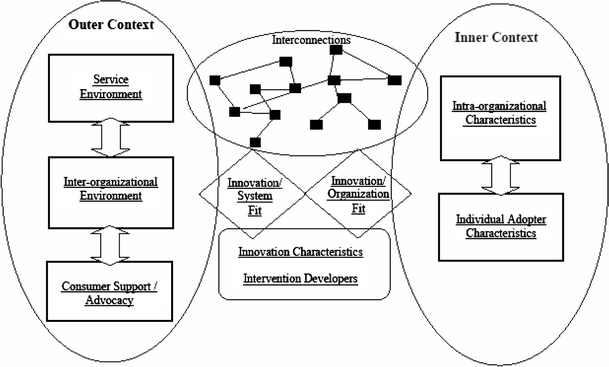
- Analysis: narrative synthesis organized by implementation phase and by outer vs. inner context levels, presented in two conceptual figures (Fig. 1 global factors; Fig. 2 phases and factors).
Limitations
- Stated: the authors note "few, if any, good measures of the process or progression through the phases" exist, and that process-based measures would be needed to assess status, progression, milestones, and speed of phase traversal.
- Stated: the paper repeatedly acknowledges thin empirical support — "there are few data supporting the importance of the other drivers of EBP exploration suggested by the literature," and consensus on core implementation drivers exists but "the body of concrete research evidence for each core driver in many cases remains to be developed."
- Evident from the text: the model is explicitly a hypothesis-generating framework ("variables hypothesized to play important roles"), its emphasis is skewed toward child welfare with mental health examples, and it offers no empirical test of the proposed phase-specific relationships.
Model-written summary. Check it against the paper before relying on it.
Integrity signals
Registry
Cites
Statistics
Figures
Verification
Claims the paper makes
16 Valid · 9 Not valid · 60 Not checked · 33 Own results and interpretations
The cited sources support only part of this claim — read each source’s verdict below.
In the paper
“Federal and state agencies may fund implementation demonstration projects and research studies to facilitate the implementation of EBPs, however, there has been little empirical work examining factors that either facilitate or limit sustainability of EBPs in public sector social services (Greenhalgh et al. 2004).”
§ Advancing a Conceptual Model of Evidence-Based Practice Implementation in Public Service Sectors > Sustainment Phase
What the sources say
- Partly supportedcites Greenhalgh et al. 2004 matched to “Diffusion of Innovations in Service Organizations: Systematic Review and Recommendations” (2004) sourceExperimental — accuracy not yet measured
The review says the literature on the sustainability of service innovations was very sparse (passage 1, page unavailable). It focused particularly on health care, however, and does not establish that empirical work on factors affecting sustainability of evidence-based practices was scarce specifically in public-sector social services. (LLM, conf=0.88)
plain- Asserted: passes — The authors put it forward as true.
- Checkable: passes — It can be checked against evidence.
- Load-bearing: passes — The paper’s conclusions depend on it.
- Based: passes — The paper gives a reason why it holds.
- Partly supported
The cited sources support only part of this claim — read each source’s verdict below.
In the paper
“The policies and funding needed for sustained use of practices typically follow from leaders who develop initiatives or set visions that can be maintained over time (Hoagwood et al. 2006).”
§ Advancing a Conceptual Model of Evidence-Based Practice Implementation in Public Service Sectors > Sustainment Phase > Outer Context
What the sources say
- Partly supportedcites Hoagwood et al. 2006 matched to “Implementation of evidence-based practices for children in four countries: a project of the World Psychiatric Association” (2006) sourceExperimental — accuracy not yet measured
The Discussion (page unavailable) says innovative leaders aided implementation and that all site Directors made plans for sustainability. The paper does not say that policies and funding typically follow from leaders’ initiatives or visions; it instead notes that continuation in Israel depended on securing funding. (LLM, conf=0.83)
plainstates a cause- Asserted: passes — The authors put it forward as true.
- Checkable: passes — It can be checked against evidence.
- Load-bearing: unclear — It is unclear whether the paper’s conclusions depend on it.
- Based: passes — The paper gives a reason why it holds.
- Partly supported
The cited sources support only part of this claim — read each source’s verdict below.
In the paper
“Conversely, severe budget restrictions discourage the exploration of innovations since exploration demands staff time, which may be limited when work forces are cut due to funding restrictions”
§ Advancing a Conceptual Model of Evidence-Based Practice Implementation in Public Service Sectors > Exploration Phase1 > The Outer Context
What the sources say
- Partly supportedcites Greenhalgh et al. 2004 matched to “Diffusion of Innovations in Service Organizations: Systematic Review and Recommendations” (2004) sourceExperimental — accuracy not yet measured
The paper’s discussion of organizational innovativeness (section labeled Abstract; page unavailable) associates slack resources with innovation, and its ‘Dedicated Time and Resources’ passage says adequate, continuing resources make assimilation more likely. It does not specifically say that severe budget restrictions lead to workforce cuts that leave staff too little time to explore innovations. (LLM, conf=0.86)
hedgedstates a cause- Asserted: passes — The authors put it forward as true.
- Checkable: passes — It can be checked against evidence.
- Load-bearing: unclear — It is unclear whether the paper’s conclusions depend on it.
- Based: passes — The paper gives a reason why it holds.
- Partly supported
The cited sources support only part of this claim — read each source’s verdict below.
In the paper
“Interorganizational forces, which focus on how individual organizations relate to, partner with, and compete with one another also play a potentially powerful role in adoption decisions.”
§ Advancing a Conceptual Model of Evidence-Based Practice Implementation in Public Service Sectors > Adoption Decision/Preparation Phase > Outer Context
What the sources say
- Partly supportedcites Chamberlain et al. 2008 matched to “Engaging and Recruiting Counties in an Experiment on Implementing Evidence-based Practice in California” (2008) sourceExperimental — accuracy not yet measured
The conceptual-model passage (Abstract; page unavailable) identifies prior cross-agency collaboration and positive relationships between counties and the California Institute for Mental Health as factors expected to influence adoption. This supports the claim about relationships and partnerships, but our copy does not address competition between organizations as an adoption influence. (LLM, conf=0.84)
- Not checked — no full text of the sourcecites Glisson and Schoenwald 2005 matched to “The ARC Organizational and Community Intervention Strategy for Implementing Evidence-Based Children's Mental Health Treatments” (2005) source
- Not matchedcites Institute for Healthcare Improvement [IHI] 2003
An author–year citation the paper’s reference list doesn’t settle. We don’t search these by name.
hedgedstates a possible cause- Asserted: passes — The authors put it forward as true.
- Checkable: passes — It can be checked against evidence.
- Load-bearing: unclear — It is unclear whether the paper’s conclusions depend on it.
- Based: passes — The paper gives a reason why it holds.
- Partly supported
The cited sources support only part of this claim — read each source’s verdict below.
In the paper
“Organizations that start with good knowledge/skills, can incorporate new knowledge, are highly specialized, and have mechanisms in place to spread knowledge throughout the organization, are much more likely to explore EBPs and eventually initiate them”
§ Advancing a Conceptual Model of Evidence-Based Practice Implementation in Public Service Sectors > Exploration Phase1 > The Inner Context
What the sources say
- Not checked — no full text of the sourcecites Damanpour 1991 matched to “Organizational innovation: A meta-analysis of effects of determinants and moderators” (1991) source
- Not checked — no full text of the sourcecites Ferlie and Shortell 2001 matched to “Improving the Quality of Health Care in the United Kingdom and the United States: A Framework for Change” (2001) source
- Partly supportedcites Greenhalgh et al. 2004 matched to “Diffusion of Innovations in Service Organizations: Systematic Review and Recommendations” (2004) sourceExperimental — accuracy not yet measured
The passages on structural determinants and absorptive capacity (indexed as Abstract; page unavailable) link specialization, an existing knowledge base, and knowledge sharing to greater organizational innovativeness and assimilation. They do not establish that organizations with these features are *much* more likely to explore and then initiate evidence-based practices specifically; the paper also describes assimilation as a process that can move back and forth between stages. (LLM, conf=0.84)
hedgedstates an association- Asserted: passes — The authors put it forward as true.
- Checkable: passes — It can be checked against evidence.
- Load-bearing: passes — The paper’s conclusions depend on it.
- Based: passes — The paper gives a reason why it holds.
57 more claims · 2 with their cited sources checked
Create a free account to see all 118 claims and to verify the 1 reference still open.
- Probably not a substantial claim. 31
- It may state two separate claims as one. 35
Claims other papers make about this one
Each is checked against this paper’s own text: does it say what the citing paper says it does?
The source backs part of the claim, not all of it — or backs it for a different population, condition or comparison.
In the citing paper
“Specifically, unlike traditional feasibility and pilot studies that may include the preliminary testing of interventions on individual clinical or public health outcomes, implementation feasibility and pilot studies that explore strategies to improve intervention implementation often require assessing changes across multiple levels including individuals (e.g. service providers or clinicians) and”
From Guidance for conducting feasibility and pilot studies for implementation trials (2020) · cites this paper as [21]
Experimental — accuracy not yet measuredThe source backs part of the claim, not all of it — or backs it for a different population, condition or comparison.
In the citing paper
“we propose that the concept of the individual might incorporate: capability, capacity, motivation (including recognising a need for change), resilience, acceptability, feelings, knowledge and beliefs (including self efficacy) about the intervention/evidence, position and fit within the organization/social system, and approach to decision-making (e.g., experimentation, use of information).”
From The role of evidence, context, and facilitation in an implementation trial: implications for the development of the PARIHS framework (2013) · cites this paper as [8]
Experimental — accuracy not yet measuredThe source backs part of the claim, not all of it — or backs it for a different population, condition or comparison.
In the citing paper
“Implementation strategies are too often designed in an unsystematic manner and fail to address key contextual determinants (13–16).”
From Enhancing the Impact of Implementation Strategies in Healthcare: A Research Agenda (2019) · cites this paper as [13]
Experimental — accuracy not yet measuredThe source backs part of the claim, not all of it — or backs it for a different population, condition or comparison.
In the citing paper
“Even if strategies are meticulously described in a study protocol or trial registry, it is often unrealistic to expect that they will not need to be altered as determinants emerge across implementation phases (13, 93, 94).”
From Enhancing the Impact of Implementation Strategies in Healthcare: A Research Agenda (2019) · cites this paper as [13]
Experimental — accuracy not yet measuredThe source backs part of the claim, not all of it — or backs it for a different population, condition or comparison.
In the citing paper
“Extent, quality, and timeliness of the completion of activities related to specific implementation process strategies”
From Beyond “implementation strategies”: classifying the full range of strategies used in implementation science and practice (2017) · cites this paper as [30]
Experimental — accuracy not yet measured
34 more claims about this paper
Create a free account to see every claim other papers make about this one.
Self-check
Percentages, sums and reported differences re-computed from the paper’s own numbers.
Each contradiction between two passages listed here was confirmed by an independent check.
Rated minor: it would not touch a result — a value no result rests on, a p-value that stays on the same side of the significance level, or a conflict that is clerical, resolved elsewhere in the paper, or outside its own findings.
In the paper
§ Advancing a Conceptual Model of Evidence-Based Practice Implementation in Public Service Sectors > References
“Data Path Design. (2010). ASWB projects.”
§ Advancing a Conceptual Model of Evidence-Based Practice Implementation in Public Service Sectors > References
“Retrieved June 10, 2009”
Citations
Cites
Rogers, E. M., Singhal, A., & Quinlan, M. M. (2019) · An Integrated Approach to Communication Theory and Research · doi:10.4324/9780203710753-35 · Cited by 37,322
The fifth discipline, the art and practice of the learning organization
Senge, P. M. (1991) · Performance + Instruction · doi:10.1002/pfi.4170300510 · Cited by 20,060
Organizational culture and leadership
(1993) · Long Range Planning · doi:10.1016/0024-6301(93)90120-5 · Cited by 16,462
Damschroder, L. J., Aron, D. C., Keith, R. E., Kirsh, S. R., Alexander, J. A., & Lowery, J. C. (2009) · Implementation Science · doi:10.1186/1748-5908-4-50 · Cited by 14,496
Valente, T. W. (2003) · Genetics in Medicine · doi:10.1097/01.gim.0000061743.67794.c4 · Cited by 13,723
(1994) · Cited by 13,126
Proctor, E., Silmere, H., Raghavan, R., Hovmand, P., Aarons, G., Bunger, A., Griffey, R., & Hensley, M. (2011) · Administration and Policy in Mental Health and Mental Health Services Research · doi:10.1007/s10488-010-0319-7 · Cited by 8,721
Self-citationDiffusion of Innovations in Service Organizations: Systematic Review and Recommendations
GREENHALGH, T., ROBERT, G., MACFARLANE, F., BATE, P., & KYRIAKIDOU, O. (2004) · The Milbank Quarterly · doi:10.1111/j.0887-378x.2004.00325.x · Cited by 7,448 · cited 11×
“Beginning at the broadest level, the state and federal sociopolitical and funding contexts influence the exploration of innovative interventions or practices (Davies and Nutley 2008; Ganju 2003; Hoagwood 2003).”
BackgroundInfluentialEvaluating the public health impact of health promotion interventions: the RE-AIM framework.
Glasgow, R. E., Vogt, T. M., & Boles, S. M. (1999) · American Journal of Public Health · doi:10.2105/ajph.89.9.1322 · Cited by 7,217 · cited 2×
“The RE-AIM model (Glasgow et al. 1999; Glasgow et al. 2006) explicitly identifies the ‘‘maintenance’’ phase of implementation as critical in sustaining effective health interventions.”
MethodOrganizational innovation: A meta-analysis of effects of determinants and moderators
Damanpour, F. (1991) · Academy of Management Journal · doi:10.2307/256406 · Cited by 6,542 · cited 9×
“Because the implementation literature has been developed in areas where the adoption of innovation is driven by profit or science, there is little attention to this first phase in the extant literature (Damanpour 1991).”
BackgroundMethodInfluential
Research works printed but not linked: 9
- Aos S Intensive family preservation programs: program fidelity influences effectiveness revised (No. 06-02-3901) 2006 Olympia Washington State Institute for Public Policy
- Backer T The failure of success: Challenges of disseminating effective substance abuse prevention programs Journal of Community Psychology 2000 28 3 363 373 · DOI · Paper page
- California Institute for Mental Health [CIMH] Community Development Team model: Supporting the model adherent implementation of programs and practices 2006 Sacramento California Institute for Mental Health
- Chadwick Center Closing the quality chasm in child abuse treatment: Identifying and disseminating best practices 2004 San Diego, CA Children’s Hospital-San Diego, Chadwich Center for Children and Families
- Davies HTO Nutley SM Learning more about how research-based knowledge gets used: Guidance in the development of new empirical research 2008 New York, NY William T. Grant Foundation
- Institute of Medicine [IOM] The state of quality improvement and implementation research: Expert views. Workshop summary 2007 Washington, DC The National Academies Press
- National Association of Public Child Welfare Administrators [NAPCWA] Guide for child welfare administrators on evidence based practice 2005 Washington DC APHSA
- National Institute of Mental Health [NIMH] Blueprint for change: Research on child and adolescent mental health 2001 Bethesda, MD National Institutes of Health
- Srivastava SK Bathla A Correlational study of organizational climate and work adjustment among industrial workers Social Science International 1996 12 1 52 60
Cited by
Items 1,101–1,200 of 3,223
Benhayoun, I., Amrani, M. E., Barhdadi, A., & Azzaoui, W. (2025) · Journal of financial reporting & accounting · doi:10.1108/jfra-07-2024-0468 · Cited by 23
Building an Evidence-Driven Child Welfare Workforce: A University–Agency Partnership
Lery, B., Wiegmann, W., & Berrick, J. D. (2015) · Journal of Social Work Education · doi:10.1080/10437797.2015.1073080 · Cited by 15
“Finally, in adopting new routines and practices, early efforts are strengthened when organizational cultures welcome innovation and promote exploration of new practices in response to challenges (Aarons et al., 2011; Aarons & Sommerfeld, 2012; Wang et al., 2010).”
BackgroundSustainability of Evidence-Based Practices for HIV Prevention among Female Sex Workers in Mexico
Palinkas, L. A., Chavarin, C. V., Rafful, C. M., Um, M. Y., Mendoza, D. V., Staines, H., Aarons, G. A., & Patterson, T. L. (2015) · PLOS ONE · doi:10.1371/journal.pone.0141508 · Cited by 14
“Many of these models consider sustainment to be the final stage of the process of implementation [22,25], but the factors that predict sustainment are not well understood [26,27].”
BackgroundInfluentialSelf-citationde Melo, M. N. T., de Sá, R. M. P. F., & Filho, D. A. D. M. (2016) · Ciência & Saúde Coletiva · doi:10.1590/1413-81232015216.08752016 · Cited by 41
Dissemination and Implementation of Behavioral Treatments for Anxiety in ASD
Drahota, A., Chlebowski, C., Stadnick, N. A., Baker-Ericzén, M. J., & Brookman-Frazee, L. I. (2017) · Elsevier eBooks · doi:10.1016/b978-0-12-805122-1.00012-0 · Cited by 17
Pitpitan, E. V., Semple, S. J., Aarons, G. A., Palinkas, L. A., Chavarin, C. V., Mendoza, D. V., Magis-Rodríguez, C. L., Staines, H., & Patterson, T. L. (2018) · PLoS ONE · doi:10.1371/journal.pone.0201954 · Cited by 13
“Although structural factors associated with implementation outcomes have been proposed [4,5], few studies have provided empirical evidence of their impact on intervention effectiveness.”
BackgroundSelf-citationBrittain, A. W., Tevendale, H. D., Mueller, T. E., Kulkarni, A. D., Middleton, D., Garrison, M. L. B., Read-Wahidi, M. R., & Koumans, E. H. A. (2019) · Journal of Community Health · doi:10.1007/s10900-019-00781-z · Cited by 19
Aby, M. (2020) · Administration and Policy in Mental Health and Mental Health Services Research · doi:10.1007/s10488-020-01033-2 · Cited by 14
Graaf, G., & Snowden, L. (2021) · Administration and Policy in Mental Health and Mental Health Services Research · doi:10.1007/s10488-020-01061-y · Cited by 14
School-Based Clinicians Sustained Use of a Cognitive Behavioral Treatment for Anxiety Disorders
LoCurto, J., Pella, J. E., Chan, G., & Ginsburg, G. S. (2020) · School Mental Health · doi:10.1007/s12310-020-09381-y · Cited by 17
Shanley, J. R., Armistead, L. P., Musyimi, C. W., Nyamai, D. N., Ishiekwene, M. N., Mutiso, V., & Ndetei, D. M. (2020) · Child Abuse & Neglect · doi:10.1016/j.chiabu.2020.104772 · Cited by 19
“Community awareness is a key factor to program buy-in (Aarons et al., 2011; Baumann et al., 2019) and another strength to leverage in addressing child maltreatment in Kenya.”
BackgroundInfluentialGarneau, H. C., Hurley, B., Fisher, T., Newman, S., Copeland, M., Caton, L., Cheng, H. L., & McGovern, M. P. (2021) · Journal of Substance Abuse Treatment · doi:10.1016/j.jsat.2021.108395 · Cited by 14
Trisakti, F., & Djajasinga, N. D. (2021) · Advances in Social Science, Education and Humanities Research/Advances in social science, education and humanities research · doi:10.2991/assehr.k.210615.010 · Cited by 14
“Public Understanding of the legal basis or known public policies is one of the key factors in maintaining quality public service standards (Aarons et al., 2011).”
BackgroundCamilleri, L. J., Maras, K., & Brosnan, M. (2022) · PLoS ONE · doi:10.1371/journal.pone.0262598 · Cited by 22
“However, the effectiveness and integrity of the intervention will still depend on the competence of the author of the story [49].”
BackgroundZbukvic, I., Rheinberger, D., Rosebrock, H., Lim, J., McGillivray, L., Mok, K., Stamate, E., McGill, K., Shand, F., Torok, M., et al. (2022) · Implementation Research and Practice · doi:10.1177/26334895211065786 · Cited by 20
Szefler, S. J., Cicutto, L. C., Brewer, S. E., Gleason, M. C., McFarlane, A. E., DeCamp, L. R., Brinton, J. T., & Huebschmann, A. G. (2022) · Journal of Allergy and Clinical Immunology · doi:10.1016/j.jaci.2022.04.029 · Cited by 16
Implementation Science: Increasing the Public Health Impact of Audiology Research
Studts, C. R. (2022) · American Journal of Audiology · doi:10.1044/2022_aja-21-00205 · Cited by 17
“…et al., 2009); the Exploration, Preparation, Implementation, Sustainment (EPIS) Studts: Implementation Science and Audiology 851 framework (Aarons et al., 2011); and the Promoting Action on Research Implementation in Health Services (PARIHS) framework (Harvey & Kitson, 2016), among many…”
BackgroundPervin, M. M., & Hagmayer, Y. (2022) · Administration and Policy in Mental Health and Mental Health Services Research · doi:10.1007/s10488-022-01205-2 · Cited by 23
“Research also showed that attitudes towards EBP may differ as a function of demographic variables and organizational factors (Aarons, 2004, Aarons et al., 2010, 2011, 2012; Beidas et al., 2015; Connors et al., 2019; Damschroder et al., 2009; Greenhalgh et al., 2004; Locke et al., 2019; Okamura…”
BackgroundLowell, A. F., Suchman, N. E., Byatt, N., Feinberg, E., Friedmann, P. D., & Peacock‐Chambers, E. (2023) · Infant Mental Health Journal · doi:10.1002/imhj.22041 · Cited by 14
Terminology for Dissemination and Implementation Research
Rabin, B. A., Viglione, C., & Brownson, R. C. (2023) · Oxford University Press eBooks · doi:10.1093/oso/9780197660690.003.0002 · Cited by 18
Evidence-Based Programs in “Real World” Settings: Finding the Best Fit
Powell, B. J., Bosk, E. A., Wilen, J. S., Danko, C. M., Scoyoc, A. V., & Banman, A. (2015) · Child maltreatment · doi:10.1007/978-3-319-16327-7_7 · Cited by 16
Rich, P., Aarons, G. A., Takemoto, M., Cárdenas, V., Crist, K., Bolling, K., Lewars, B., Castro, C. M., Natarajan, L., Shi, Y., et al. (2017) · BMC Public Health · doi:10.1186/s12889-017-4584-1 · Cited by 14
“The implementation measures draw upon Proctor’s implementation research framework [21], Aarons’ conceptual model of evidence based practice implementation (EPIS) [22], and Damschroder’s consolidating framework for implementation research (CFIR) [23].”
MethodSelf-citationPinto, R. M., Spector, A. Y., & Rahman, R. (2019) · International Journal of Environmental Research and Public Health · doi:10.3390/ijerph16050862 · Cited by 19
“Organizational culture and context, practitioner demographics, and client satisfaction all influence implementation of new practices [53].”
BackgroundParolini, A., Tan, W. W., & Shlonsky, A. (2019) · PLoS ONE · doi:10.1371/journal.pone.0223129 · Cited by 15
“An important concept of the Sustainment phase is the impact of experiences or lessons learned in one implementation project on future iterations of the same project or different implementation efforts [7].”
Adelfio, M., Hamiduddin, I., & Miedema, E. (2020) · Urban Research & Practice · doi:10.1080/17535069.2019.1710860 · Cited by 19
Hasson, H., Gröndal, H., Rundgren, Å. H., Avby, G., Uvhagen, H., & Schwarz, U. V. T. (2020) · Implementation Science Communications · doi:10.1186/s43058-020-00005-9 · Cited by 17
“For instance, workforce, provider capacity, staff training, welfare systems, resources, and service user characteristics can be different [14].”
BackgroundGumport, N. B., Yu, S. H., & Harvey, A. G. (2020) · Psychiatry Research · doi:10.1016/j.psychres.2020.113443 · Cited by 17
Characteristics of consulting firms associated with the diffusion of big data analytics
Oyewo, B. M., Ajibola, O., & Ajape, M. K. (2020) · Journal of Asian Business and Economic Studies · doi:10.1108/jabes-03-2020-0018 · Cited by 23
Development of a Comprehensive Tool for School Health Policy Evaluation: The WellSAT WSCC
Koriakin, T. A., McKee, S. L., Schwartz, M. B., & Chafouleas, S. M. (2020) · Journal of School Health · doi:10.1111/josh.12956 · Cited by 14
School nurse perception of asthma care in school-based telehealth
MacGeorge, C. A., King, K. L., Andrews, A. L., Sterba, K. R., Johnson, E. E., Brinton, D. L., Teufel, R. J., Kruis, R. D., & Ford, D. W. (2021) · Journal of Asthma · doi:10.1080/02770903.2021.1904978 · Cited by 16
“We used the Exploration, Preparation, Implementation and Sustainment (EPIS) framework (28,29) because it highlights a comprehensive set of internal and external contextual factors that potentially influence implementation processes in a particular setting.”
MethodMethodological Issues in Child Welfare and Children’s Mental Health Implementation Research
Horwitz, S. M., & Landsverk, J. A. (2010) · Administration and Policy in Mental Health and Mental Health Services Research · doi:10.1007/s10488-010-0316-x · Cited by 15
“The first paper in the series, ‘‘Advancing a conceptual model of evidence-based practice implementation in public service sectors’ (Aarons et al. 2011) presents a comprehensive, multi-level implementation model that highlights elements hypothesized or empirically supported for each of four phases of the implementation…”
BackgroundSelf-citationSirkka, M., Larsson-Lund, M., & Zingmark, K. (2014) · Scandinavian Journal of Occupational Therapy · doi:10.3109/11038128.2013.872183 · Cited by 20
“Sustainability is also seen as a central aspect of the successful implementation of an evidence-based intervention and is described as the continued use of evidence-based intervention in practice (9).”
BackgroundA Supervisor-Targeted Implementation Approach to Promote System Change: The R3 Model
Saldana, L., Chamberlain, P., & Chapman, J. E. (2016) · Administration and Policy in Mental Health and Mental Health Services Research · doi:10.1007/s10488-016-0730-9 · Cited by 15
“This pilot provides an example of how both the inner and outer context not only is necessary to consider for successful implementation (Aarons et al. 2011) but, importantly, how these contexts can drive the development of interventions and implementation approaches.”
BackgroundGlobal comparative municipal e-governance: factors and trends
Manoharan, A., Zheng, Y., & Melitski, J. (2017) · International Review of Public Administration · doi:10.1080/12294659.2017.1292031 · Cited by 17
“…organizational studies demonstrate that as the size of an organization increases so does the willingness and capacity to adopt new technologies (Aarons, Hurlburt, & Horwitz, 2011; Daft, 1978; Damanpour, 1992; Greenhalgh et al., 2004; Kimberly & Evanisko, 1981; Nord & Tucker, 1987; Weare et…”
BackgroundKillaspy, H. T., King, M., Holloway, F. A., Craig, T., Cook, S., Mundy, T., Leavey, G., McCrone, P., Koeser, L., Omar, R., et al. (2017) · Programme Grants for Applied Research · doi:10.3310/pgfar05070 · Cited by 19
Roadmap for implementing a multi-tiered system of supports framework to improve school attendance.
Graczyk, P. A., & Kearney, C. A. (2024) · Current Psychology · doi:10.1007/s12144-023-05478-0 · Cited by 14
“In the IS literature, implementation is recognized as a process that unfolds over time in steps, stages, or phases (Aarons et al., 2011; Bertram et al., 2015; Hurlburt et al., 2014; Meyers et al., 2012).”
Mantell, J. E., Bauman, L. J., Bonett, S., Buchbinder, S., Hoffman, S., Storholm, E. D., McCoy, K., Rael, C. T., Cowan, E. A., Gonzalez-Argoti, T., et al. (2025) · JAIDS Journal of Acquired Immune Deficiency Syndromes · doi:10.1097/qai.0000000000003610 · Cited by 16
Rodgers, M., South, E., Harden, M., Whitehead, M. M., & Sowden, A. J. (2025) · Archives of Public Health · doi:10.1186/s13690-025-01644-x · Cited by 24
“…as the Consolidated Framework for Implementation Research (CFIR) [67, 68], Exploration, Preparation, Implementation, Sustainment Framework (EPIS) [69], Practical Implementation Sustainability Model (PRISM) [70], or Integrated Promoting Action on Research Implementation in Health Services…”
Miskovic‐Wheatley, J., Vatter, S., Ong, S. H., Carroll, B., Touyz, S. W., Griffiths, K. R., & Maguire, S. (2025) · International Journal of Eating Disorders · doi:10.1002/eat.24503 · Cited by 19
McBeath, B., Mosley, J. E., Hopkins, K., Guerrero, E. G., Austin, M. J., & Tropman, J. E. (2019) · Social Work Research · doi:10.1093/swr/svz003 · Cited by 13
“…of how extra-organizational dynamics (for example, funding) and within-agency factors (for example, administrative leadership) inform the frontline implementation and sustainment of EBPs (for example, program design) that connect to individual outcomes (Aarons et al., 2011; Guerrero et al., 2017).”
InfluentialCOVID-19 Testing in K-12 Schools: Insights from Early Adopters
Faherty, L. J., Master, B. K., Steiner, E. D., Kaufman, J. H., Predmore, Z., Stelitano, L., Leschitz, J. T., Phillips, B. N., Schwartz, H. L., & Wolfe, R. L. (2021) · RAND Corporation eBooks · doi:10.7249/wra1103-1 · Cited by 13
Hohmeier, K. C., Renfro, C. P., Turner, K. L., Patel, P., Ndrianasy, E., Williams-Clark, R., Underwood, L., & Gatwood, J. D. (2021) · BMC Health Services Research · doi:10.1186/s12913-021-07193-7 · Cited by 16
“been shown beneficial in the implementation of new clinical initiatives in other professions [41, 42].”
BackgroundShattuck, D. G., Richard, B. O., Jaramillo, E. T., Byrd, E., & Willging, C. E. (2022) · Frontiers in Health Services · doi:10.3389/frhs.2022.920790 · Cited by 16
“Inner contexts encompass the internal environments of schools, including physical and social organization and the attitudes and practices of staff and students (55).”
BackgroundInfluentialCommunity implementation of contingency management to address stimulant use
Hartzler, B. J., Gray, K., Marx, M., Kirk-Lewis, K., Payne-Smith, K., & McIlveen, J. W. (2023) · Journal of Substance Use and Addiction Treatment · doi:10.1016/j.josat.2022.208941 · Cited by 15
Beyond Effectiveness: Implementation Science 101 for Clinicians and Clinical Researchers
Ramly, E., & Brown, H. W. (2023) · Urogynecology · doi:10.1097/spv.0000000000001322 · Cited by 17
Hasson, R. E., Eisman, A. B., Wassmann, A., Beemer, L. R., Templin, T. J., Malinoff, L., Zernicke, R. F., & Rabaut, L. (2023) · Journal of School Health · doi:10.1111/josh.13321 · Cited by 26
Hyzak, K. A., Bunger, A. C., Herrmann, S. A., Kerlek, A. J., Lauden, S. M., Dudley, S., Underwood, A. L., & Berlan, E. D. (2023) · Global Implementation Research and Applications · doi:10.1007/s43477-023-00082-7 · Cited by 16
“Creating an implementation plan, or blueprint, is a foundational step to prepare for launching a new program, model, or intervention (Aarons et al., 2011).”
BackgroundChange agent’s role in facilitating use of technology in residential aged care: A systematic review
Rigby, K., Redley, B., & Hutchinson, A. M. (2023) · International Journal of Medical Informatics · doi:10.1016/j.ijmedinf.2023.105216 · Cited by 13
Implementation Science in School-Based, Universal-Level Intervention Research: A Scoping Review
Gallagher, A., Murphy, R., Eochaidh, C. N., Fitzgerald, J., Murphy, C., & Law, J. (2023) · Language Speech and Hearing Services in Schools · doi:10.1044/2023_lshss-22-00181 · Cited by 17
Design and validation of a scale of core components of community interventions in mental health
Agudelo‐Hernández, F., & Andrade, R. M. R. (2023) · The International Journal of Health Planning and Management · doi:10.1002/hpm.3711 · Cited by 15
Knudsen, H. K., Freeman, P. R., Oyler, D. R., Oser, C. B., & WALSH, S. L. (2023) · Addiction Science & Clinical Practice · doi:10.1186/s13722-023-00426-6 · Cited by 16
“Drawing upon the EPIS model [26] and inspired by efforts to expand medication for OUD through the “Hub and Spoke Model” [46], this paper describes a centralized “Naloxone Hub with Many Spokes” approach to implementing OEND in eight Kentucky communities as part of the HEALing (Helping to End…”
BackgroundMethodMoller, N., Tellegen, C. L., Ma, T., & Sanders, M. R. (2024) · School Mental Health · doi:10.1007/s12310-023-09629-3 · Cited by 26
“…of use was also positively predicted by satisfaction with program features, which incorporates factors commonly included in implementation frameworks such as the quality of materials, training flexibility, and conversion from research to practice (Aarons et al., 2010; Shelton et al., 2018).”
InfluentialAdaptation in Dissemination and Implementation Science
Baumann, A. A., Stirman, S. W., & Cabassa, L. J. (2023) · Oxford University Press eBooks · doi:10.1093/oso/9780197660690.003.0008 · Cited by 14
Brookman-Frazee, L. I., Lau, A. S., Roesch, S. C., Jobin, A., Chlebowski, C., Mello, M., Caplan, B., Naar, S., Aarons, G. A., & Stahmer, A. C. (2025) · Journal of the American Academy of Child & Adolescent Psychiatry · doi:10.1016/j.jaac.2025.01.003 · Cited by 17
“20,35,36 Provider attitudes regarding learning and delivering an EBI are a promising target for improving implementation and clinical outcomes.”
Self-citationGuerrero, E. G., Heslin, K. C., Chang, E. T., Fenwick, K. M., & Yano, E. M. (2014) · Administration and Policy in Mental Health and Mental Health Services Research · doi:10.1007/s10488-014-0582-0 · Cited by 13
Implementing Evidence-Based Practices in Early Childhood Classroom Settings
Boyd, B. A., Kucharczyk, S., & Wong, C. (2016) · Springer eBooks · doi:10.1007/978-3-319-28492-7_17 · Cited by 22
Delawarde, C., Gagné, M., Brunson, L., & Drapeau, S. (2018) · Children and Youth Services Review · doi:10.1016/j.childyouth.2018.03.009 · Cited by 19
Deane, F. P., Goff, R. O., Pullman, J., Sommer, J., & Lim, P. (2018) · International Journal of Mental Health and Addiction · doi:10.1007/s11469-018-9885-9 · Cited by 14
“Providers engaged in discussing consumer and clinical practice risks in a multi-disciplinary team felt that the responsibility of taking risks had become shared (Aarons et al. 2011).”
BackgroundDubrowski, R., Barwick, M. A., & Dubrowski, A. (2018) · Springer eBooks · doi:10.1007/978-3-319-90518-1_10 · Cited by 17
Cheron, D. M., Chiu, A. W., Stanick, C., Stern, H. G., Donaldson, A. R., Daleiden, E. L., & Chorpita, B. F. (2019) · Administration and Policy in Mental Health and Mental Health Services Research · doi:10.1007/s10488-019-00922-5 · Cited by 16
Wingood, G. M., Lambert, D. N., Renfro, T. L., Ali, M. K., & DiClemente, R. J. (2019) · American Journal of Public Health · doi:10.2105/ajph.2019.304990 · Cited by 13
Redden, S. M., Clark, L., Tracy, S. J., & Shafer, M. S. (2019) · Communication Monographs · doi:10.1080/03637751.2019.1621361 · Cited by 13
Coyle, K. K., Anderson, P. M., Franks, H. M., Walker, J. D., & Glassman, J. R. (2019) · The Journal of Primary Prevention · doi:10.1007/s10935-019-00569-w · Cited by 15
Luecking, C. T., Vaughn, A., Burney, R. V., Hennink-Kaminski, H. J., Hales, D. P., & Ward, D. S. (2021) · Translational Behavioral Medicine · doi:10.1093/tbm/ibab001 · Cited by 13
“The low levels of fidelity observed among ECE providers providing implementation support and parents delivering home components suggest greater emphasis needs to be placed on selection and adaptation of implementation strategies for each level of multilevel interventions [46, 47].”
BackgroundLocke, J. J., Hugh, M. L., Pullmann, M. D., Cook, H., Coifman, J., McRee, E., Joshi, M., Lyon, A. R., & Schwartz, I. S. (2021) · International Journal of Educational Research · doi:10.1016/j.ijer.2021.101779 · Cited by 18
Zanti, S., & Thomas, M. L. (2021) · Global Implementation Research and Applications · doi:10.1007/s43477-021-00028-x · Cited by 18
Borge, R. H., Egeland, K. M., Aarons, G. A., Ehrhart, M. G., Sklar, M., & Skar, A. S. (2022) · Administration and Policy in Mental Health and Mental Health Services Research · doi:10.1007/s10488-022-01199-x · Cited by 22
Self-citationLovero, K. L., dos Santos, P. F., Adam, S. E., Bila, C., Fernandes, M. E., Kann, B., Rodrigues, T. A. O., Jumbe, A. M., Duarte, C. S., Beidas, R. S., et al. (2022) · Frontiers in Public Health · doi:10.3389/fpubh.2022.876062 · Cited by 16
“Temporality of implementation strategies was specified using the EPIS framework (27).”
BackgroundMethodRomero-Portier, C., & Darlington, E. (2022) · Revue d Épidémiologie et de Santé Publique · doi:10.1016/j.respe.2022.05.005 · Cited by 17
State Policies that Impact the Design of Children’s Mental Health Services: A Modified Delphi Study
Nelson, K. L., Powell, B. J., Langellier, B. A., Lê‐Scherban, F., Shattuck, P. T., Hoagwood, K., & Purtle, J. (2022) · Administration and Policy in Mental Health and Mental Health Services Research · doi:10.1007/s10488-022-01201-6 · Cited by 13
Corbin, C. M., Hugh, M. L., Ehrhart, M. G., Locke, J. J., Davis, C. J., Brown, E. C., Cook, C. R., & Lyon, A. R. (2022) · School Mental Health · doi:10.1007/s12310-022-09528-z · Cited by 22
Ma, T., Tellegen, C. L., McWilliam, J., & Sanders, M. R. (2022) · Administration and Policy in Mental Health and Mental Health Services Research · doi:10.1007/s10488-022-01226-x · Cited by 16
Dias, E., Walker, T. J., Craig, D. W., Gibson, R. W., Szeszulski, J., Brandt, H. M., Johnson, H., Lamont, A. E., Wandersman, A. H., & Fernández, M. E. (2023) · Journal of Community Psychology · doi:10.1002/jcop.23041 · Cited by 13
“…factor for successful implementation across settings (Scaccia et al., 2015) and is a central construct in several implementation frameworks (Aarons et al., 2011; Damschroder et al., 2009; Greenhalgh et al., 2004), including the Interactive Systems Framework for Dissemination DIAS ET AL .…”
BackgroundSloboda, Z., Johnson, K., Fishbein, D. H., Brown, C. H., Coatsworth, J. D., Fixsen, D. L., Kandel, D. B., Paschall, M. J., Silva, F. S., Sumnall, H. R., et al. (2023) · Prevention Science · doi:10.1007/s11121-023-01532-2 · Cited by 14
Oyler, D. R., Knudsen, H. K., Oser, C. B., WALSH, S. L., Roberts, M. F., Nigam, S., Westgate, P. M., & Freeman, P. R. (2024) · Drug and Alcohol Dependence Reports · doi:10.1016/j.dadr.2023.100207 · Cited by 13
“…to the intervention) using a “ Hub with Many Spokes ” strategy (i.e., a central naloxone hub that provided training, technical assistance, and naloxone to partnering agencies) (Knudsen et al., 2023) based on the Exploration, Preparation, Implementation, and Sustainment model (Aarons et al., 2011).”
MethodPromoting Outcome Achievement in Child Welfare: Predictors of Evidence-Informed Practice
Collins‐Camargo, C., & Garstka, T. A. (2014) · Journal of Evidence-Based Social Work · doi:10.1080/15433714.2012.759465 · Cited by 16
“The current study examines the interrelationships among factors in the inner context (Aarons et al., 2011), including organizational culture and climate; leadership; worker attitudes toward EBP, with particular focus on frontline supervision; and a team-based focus on outcome and goal achievement.”
BackgroundPredictors of the Decision to Adopt Motivational Interviewing in Community Health Settings
Williams, J. R., Blais, M. P., Banks, D., Dusablon, T., Williams, W. O., & Hennessy, K. D. (2013) · The Journal of Behavioral Health Services & Research · doi:10.1007/s11414-013-9357-8 · Cited by 14
Wolf, D. A. P. S., Dulmus, C. N., Maguin, E., Keesler, J. M., & Powell, B. J. (2014) · Human Services Organizations Management Leadership & Governance · doi:10.1080/23303131.2014.884032 · Cited by 22
Factors Supporting Implementation among CDSMP Organizations
Paone, D. L. (2015) · Frontiers in Public Health · doi:10.3389/fpubh.2014.00237 · Cited by 17
“Other researchers studying implementation and sustainability have noted that fiscal support is a critical external factor in some or all stages of adoption, implementation, and sustainability (6, 27).”
BackgroundInnovations in the Field of Child Abuse and Neglect Prevention: A Review of the Literature.
Benedetti, G. B. (2012) · Cited by 14
The Impact of Inner and Outer Context on Line Managers’ Implementation Leadership
Mosson, R., Schwarz, U. V. T., Richter, A., & Hasson, H. (2017) · The British Journal of Social Work · doi:10.1093/bjsw/bcx077 · Cited by 19
Crowe, S., & Deane, F. P. (2017) · The Journal of Mental Health Training Education and Practice · doi:10.1108/jmhtep-05-2017-0039 · Cited by 16
Evaluating the Implementation of a Collaborative Juvenile Reentry System in Oakland, California
Jain, S., Cohen, A. K., Jagannathan, P., Leung, Y., Bassey, H., & Bedford, S. (2018) · International Journal of Offender Therapy and Comparative Criminology · doi:10.1177/0306624x18755480 · Cited by 14
Lau, A. S., Rodríguez, A., Bando, L., Innes-Gomberg, D., & Brookman-Frazee, L. I. (2019) · Administration and Policy in Mental Health and Mental Health Services Research · doi:10.1007/s10488-019-00939-w · Cited by 15
Votova, K., Laberge, A., Grimshaw, J., & Wilson, B. J. (2019) · Healthcare Management Forum · doi:10.1177/0840470419867427 · Cited by 16
Rojas, Y., & Stenström, N. (2019) · Human Services Organizations Management Leadership & Governance · doi:10.1080/23303131.2019.1683667 · Cited by 16
Implementing a State‐Adopted High School Health Curriculum: A Case Study
Eisman, A. B., Kilbourne, A. M., Ngo, Q., Fridline, J., Zimmerman, M. A., Greene, D., & Cunningham, R. M. (2020) · Journal of School Health · doi:10.1111/josh.12892 · Cited by 17
Health and public health approach to ending child abuse and neglect
Bross, D. C., & Krugman, R. D. (2020) · Child Abuse & Neglect · doi:10.1016/j.chiabu.2020.104619 · Cited by 27
Hare, M. M., & Graziano, P. A. (2020) · Administration and Policy in Mental Health and Mental Health Services Research · doi:10.1007/s10488-020-01083-6 · Cited by 18
Villodas, M. T., Moses, J. O., Cromer, K. D., Mendez, L., Magariño, L. S., Villodas, F. M., & Bagner, D. M. (2021) · Child Abuse & Neglect · doi:10.1016/j.chiabu.2021.105063 · Cited by 19
Overview of Out-of-Home Placements and Placement Decision-Making in Child Welfare
Chor, K. H. B. (2013) · Journal of Public Child Welfare · doi:10.1080/15548732.2013.779357 · Cited by 23
“Rather, key literature in innovation adoption (Aarons et al., 2011; Greenhalgh, Robert, Macfarlane, Bate, & Kyriakidou, 2004) would suggest that buy-in from target adopters from frontline caseworkers to agency ad-”
BackgroundAn Investigation of Counselor Educators' Attitudes Toward Evidence‐Based Practices
Patel, S. H., Hagedorn, W. B., & Bai, H. (2013) · Counselor Education and Supervision · doi:10.1002/j.1556-6978.2013.00031.x · Cited by 19
Whitaker, K. M., Fortier, A., Bruns, E. J., Nicodimos, S., Ludwig, K. A., Lyon, A. R., Pullmann, M. D., Short, K. H., & McCauley, E. (2018) · School Mental Health · doi:10.1007/s12310-017-9243-2 · Cited by 19
Ford, J. H., Cheng, H. L., Gassman, M., Fontaine, H., Garneau, H. C., Keith, R., Michael, E., & McGovern, M. P. (2022) · Implementation Science · doi:10.1186/s13012-022-01239-y · Cited by 15
“In this study, we developed the contextual determinant inventory (CDI) following the CFIR, EPIS, and Health Equity Implementation Framework [61].”
BackgroundMethodInfluentialRolls-Reutz, J., Kerns, S. E. U., Sedivy, J. A., & Mitchell, C. (2020) · Journal of Family Social Work · doi:10.1080/10522158.2019.1694342 · Cited by 16
“The EPIS model (Aarons et al., 2011), which theCEBCuses to guide their implementation technical assistance efforts, identifies fidelity monitoring and support as a key component of the “Sustainment” phase.”
MethodScreening Adolescents for Sensitive Health Topics in Primary Care: A Scoping Review
Davis, M., Hoskins, K., Phan, M. L., Hoffacker, C. P., Reilly, M. E., Fugo, P. B., Young, J. F., & Beidas, R. S. (2021) · Journal of Adolescent Health · doi:10.1016/j.jadohealth.2021.10.028 · Cited by 16
Social Workers’ Attitudes towards Evidence-based Practice: A Multidimensional Perspective
Kagan, M. (2022) · The British Journal of Social Work · doi:10.1093/bjsw/bcac067 · Cited by 15
Garner, B. R., Knudsen, H. K., Zulkiewicz, B. A., Tueller, S., Gotham, H. J., Martin, E. G., Donohoe, T., Toro, A. K., Loyd, K., & Gordon, T. J. (2022) · JAIDS Journal of Acquired Immune Deficiency Syndromes · doi:10.1097/qai.0000000000002981 · Cited by 14
Evaluating the sustainability of non-communicable diseases programs in Malaysia
Shanmuganathan, S., Mustapha, F. I., & Wilson, A. J. (2022) · BMC Public Health · doi:10.1186/s12889-022-13891-6 · Cited by 23
“The overriding challenge is ensuring the continuation of effective health programs beyond the implementation stage as there is limited research on what happens to programs once they have been implemented [4].”
BackgroundGrim, K., Bergmark, M., Argentzell, E., & Rosenberg, D. (2022) · Journal of Psychosocial Rehabilitation and Mental Health · doi:10.1007/s40737-022-00311-6 · Cited by 17
Metadata
- Authors
- Aarons, G. A., Hurlburt, M., & Horwitz, S. M.
- Affiliations
- University of California San Diego (US)
- University of Southern California (US)
- Rady Children's Hospital-San Diego (US)
- Corresponding author
- Aarons, Gregory A.
- Venue
- Administration and Policy in Mental Health and Mental Health Services Research
- Published
- 2010-12-14
- Volume
- 38
- Issue
- 1
- Pages
- 4-23
- ISSN
- 0894-587X (ISSN-L)
- 1573-3289
- PMC
- PMC3025110
- OpenAlex
- W2044858486
- Cited by
- 3,240
- References
- 171
- Citations by year
- 2026: 306 · 2025: 331 · 2024: 333 · 2023: 311 · 2022: 307 · 2021: 274 · 2020: 251 · 2019: 257 · 2018: 170 · 2017: 168 · 2016: 111 · 2015: 143 · 2014: 107 · 2013: 96 · 2012: 48
- FWCI
- 93.26
- Type
- journal article
- Language
- en
- Open access
- hybrid
- doi.org
- Licence
- cc-by-nc
- Locations
- Administration and Policy in Mental Health and Mental Health Services Research (publishedVersion, cc-by-nc)
- PubMed Central (publishedVersion, cc-by-nc)
- PubMed (publishedVersion)
- Funders
- National Institute of Mental Health (P30MH074678, R01MH072961)
- Topics
- Health Sciences › Health Professions › General Health Professions › Health Policy Implementation Science
- Health Sciences › Health Professions › General Health Professions › Health Sciences Research and Education
- Social Sciences › Public Administration › Evaluation and Performance Assessment
- Keywords
- evidence-based practice implementation, implementation science, public service sector, conceptual model, multi-level model, implementation stages, exploration, adoption, implementation, program sustainability, public mental health services, social services, drug and alcohol services, organizational context
- MeSH terms
- Child, Child Welfare, Diffusion of Innovation, Health Plan Implementation, Humans, Mental Health Services, Social Work, United States, Models, Organizational, Evidence-Based Practice
About these checks
Registry, retraction, Cites and statistics results are computed, not judged, with one exception: a printed reference that no index lists is read once by a model before it counts as a citation error. Claims are extracted by a model and kept only when their quote appears verbatim in the text; each cited source is then checked, with a model’s help, for whether it says what the claim relies on. Those verdicts can be wrong — read the claim’s quote and the cited source before relying on one.
The claim verdicts this report counts are experimental: their accuracy is not yet measured.
A language model drew the claims from the paper on 2026-10-10, under version 3 of the claim definition (model deepseek-v4.1-flash, prompt extract-v3).
A second model labelled each claim on 2026-10-10 (model jev-1.13-20260917, definition revision gold-guideline-v0.2).
Cited sources are checked with a language model’s help (gpt-6-sol).
Statistics and arithmetic are recomputed, not judged.
Confidence bands are shown only for fields calibrated on our annotated test set. None is calibrated yet, so no band is shown.
What counts as a claim ›How we measure confidence ›How we check this ›
Are you an author, or do you see a problem with this page? Request a review
Data sources
Bibliographic data: Semantic Scholar, OpenAlex, Crossref.
Contains information from the Semantic Scholar Academic Graph Datasets, made available under the ODC Attribution License (ODC-BY 1.0).
Semantic Scholar’s data is described in: Kinney, R., et al. (2023). The Semantic Scholar Open Data Platform. arXiv:2301.10140.
