

Advancing a Conceptual Model of Evidence-Based Practice Implementation in Public Service Sectors
Open accessThe DOI matches its Crossref record; 159 of the 171 references it cites were found in a registry or an index; 18 of the 120 sources its claims cite were checked for support.
Abstract
Implementation science is a quickly growing discipline. Lessons learned from business and medical settings are being applied but it is unclear how well they translate to settings with different historical origins and customs (e.g., public mental health, social service, alcohol/drug sectors). The purpose of this paper is to propose a multi-level, four phase model of the implementation process (i.e., Exploration, Adoption/Preparation, Implementation, Sustainment), derived from extant literature, and apply it to public sector services. We highlight features of the model likely to be particularly important in each phase, while considering the outer and inner contexts (i.e., levels) of public sector service systems.
Overview
CoChat Summary
TL;DR
This conceptual paper proposes a multi-level, four-phase model of evidence-based practice (EBP) implementation — Exploration, Adoption/Preparation, Implementation, and Sustainment — derived from extant literature and applied specifically to public sector services such as child welfare and specialty mental health. It argues that different outer-context (sociopolitical/funding, interorganizational networks, leadership) and inner-context (organizational characteristics, culture/climate, individual adopter characteristics) factors matter differentially across phases, and that sustainment can recursively inform future implementation efforts.
Key findings
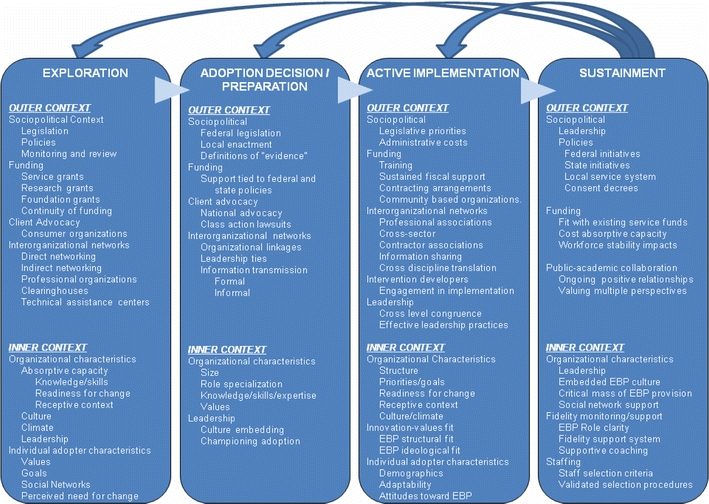
- The model divides implementation into four phases (Exploration, Adoption/Preparation, Active Implementation, Sustainment) and holds that "different aspects of the outer and inner context may be more prominent or manifest differently during different phases" — a feature the authors say few prior models explicitly recognize.
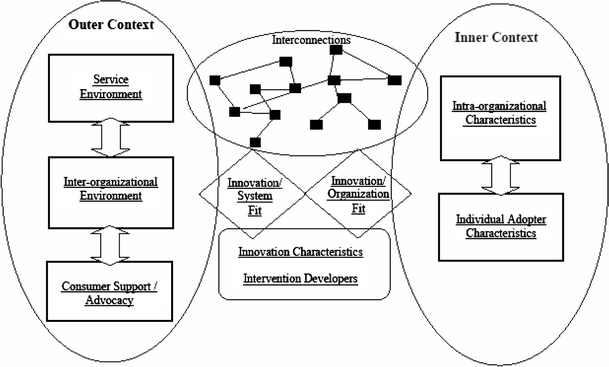
- Exploration is shaped by outer-context forces (sociopolitical/funding, client advocacy, interorganizational networks) and inner-context factors including absorptive capacity, readiness for change, and receptive context; the authors note child welfare agencies often have "varied levels of education and considerable workloads" and few venues for knowledge sharing.
- Sustainment is described as under-studied: "there has been little empirical work examining factors that either facilitate or limit sustainability of EBPs in public sector social services," and the authors state "we currently lack comprehensive models of factors that support maintenance or sustainment."
- Sustainment factors discussed include ongoing fidelity monitoring and support, a critical mass of EBP use, staffing/selection practices, leadership and culture-embedding mechanisms, and funding; the paper cites turnover rates in public sector service organizations "range from 20% to 50% annually" as a sustainment challenge.
Methods
- Design: conceptual/theoretical paper advancing a framework, not an empirical study; the model is "derived from extant literature" and illustrated with examples primarily from child welfare and specialty mental health, with the claim that many factors are "common to public sector services in general."
- Data/sample: none — the paper synthesizes prior implementation models and literature (e.g., RE-AIM, ORC, ARC, QUERI, CDT, IHI collaborative) rather than collecting data.
- Analysis: narrative synthesis organized by implementation phase and by outer vs. inner context levels, presented in two conceptual figures (Fig. 1 global factors; Fig. 2 phases and factors).
Limitations
- Stated: the authors note "few, if any, good measures of the process or progression through the phases" exist, and that process-based measures would be needed to assess status, progression, milestones, and speed of phase traversal.
- Stated: the paper repeatedly acknowledges thin empirical support — "there are few data supporting the importance of the other drivers of EBP exploration suggested by the literature," and consensus on core implementation drivers exists but "the body of concrete research evidence for each core driver in many cases remains to be developed."
- Evident from the text: the model is explicitly a hypothesis-generating framework ("variables hypothesized to play important roles"), its emphasis is skewed toward child welfare with mental health examples, and it offers no empirical test of the proposed phase-specific relationships.
Model-written summary. Check it against the paper before relying on it.
Integrity signals
Registry
Cites
Statistics
Figures
Verification
Claims the paper makes
16 Valid · 9 Not valid · 60 Not checked · 33 Own results and interpretations
The cited sources support only part of this claim — read each source’s verdict below.
In the paper
“Federal and state agencies may fund implementation demonstration projects and research studies to facilitate the implementation of EBPs, however, there has been little empirical work examining factors that either facilitate or limit sustainability of EBPs in public sector social services (Greenhalgh et al. 2004).”
§ Advancing a Conceptual Model of Evidence-Based Practice Implementation in Public Service Sectors > Sustainment Phase
What the sources say
- Partly supportedcites Greenhalgh et al. 2004 matched to “Diffusion of Innovations in Service Organizations: Systematic Review and Recommendations” (2004) sourceExperimental — accuracy not yet measured
The review says the literature on the sustainability of service innovations was very sparse (passage 1, page unavailable). It focused particularly on health care, however, and does not establish that empirical work on factors affecting sustainability of evidence-based practices was scarce specifically in public-sector social services. (LLM, conf=0.88)
plain- Asserted: passes — The authors put it forward as true.
- Checkable: passes — It can be checked against evidence.
- Load-bearing: passes — The paper’s conclusions depend on it.
- Based: passes — The paper gives a reason why it holds.
- Partly supported
The cited sources support only part of this claim — read each source’s verdict below.
In the paper
“The policies and funding needed for sustained use of practices typically follow from leaders who develop initiatives or set visions that can be maintained over time (Hoagwood et al. 2006).”
§ Advancing a Conceptual Model of Evidence-Based Practice Implementation in Public Service Sectors > Sustainment Phase > Outer Context
What the sources say
- Partly supportedcites Hoagwood et al. 2006 matched to “Implementation of evidence-based practices for children in four countries: a project of the World Psychiatric Association” (2006) sourceExperimental — accuracy not yet measured
The Discussion (page unavailable) says innovative leaders aided implementation and that all site Directors made plans for sustainability. The paper does not say that policies and funding typically follow from leaders’ initiatives or visions; it instead notes that continuation in Israel depended on securing funding. (LLM, conf=0.83)
plainstates a cause- Asserted: passes — The authors put it forward as true.
- Checkable: passes — It can be checked against evidence.
- Load-bearing: unclear — It is unclear whether the paper’s conclusions depend on it.
- Based: passes — The paper gives a reason why it holds.
- Partly supported
The cited sources support only part of this claim — read each source’s verdict below.
In the paper
“Conversely, severe budget restrictions discourage the exploration of innovations since exploration demands staff time, which may be limited when work forces are cut due to funding restrictions”
§ Advancing a Conceptual Model of Evidence-Based Practice Implementation in Public Service Sectors > Exploration Phase1 > The Outer Context
What the sources say
- Partly supportedcites Greenhalgh et al. 2004 matched to “Diffusion of Innovations in Service Organizations: Systematic Review and Recommendations” (2004) sourceExperimental — accuracy not yet measured
The paper’s discussion of organizational innovativeness (section labeled Abstract; page unavailable) associates slack resources with innovation, and its ‘Dedicated Time and Resources’ passage says adequate, continuing resources make assimilation more likely. It does not specifically say that severe budget restrictions lead to workforce cuts that leave staff too little time to explore innovations. (LLM, conf=0.86)
hedgedstates a cause- Asserted: passes — The authors put it forward as true.
- Checkable: passes — It can be checked against evidence.
- Load-bearing: unclear — It is unclear whether the paper’s conclusions depend on it.
- Based: passes — The paper gives a reason why it holds.
- Partly supported
The cited sources support only part of this claim — read each source’s verdict below.
In the paper
“Interorganizational forces, which focus on how individual organizations relate to, partner with, and compete with one another also play a potentially powerful role in adoption decisions.”
§ Advancing a Conceptual Model of Evidence-Based Practice Implementation in Public Service Sectors > Adoption Decision/Preparation Phase > Outer Context
What the sources say
- Partly supportedcites Chamberlain et al. 2008 matched to “Engaging and Recruiting Counties in an Experiment on Implementing Evidence-based Practice in California” (2008) sourceExperimental — accuracy not yet measured
The conceptual-model passage (Abstract; page unavailable) identifies prior cross-agency collaboration and positive relationships between counties and the California Institute for Mental Health as factors expected to influence adoption. This supports the claim about relationships and partnerships, but our copy does not address competition between organizations as an adoption influence. (LLM, conf=0.84)
- Not checked — no full text of the sourcecites Glisson and Schoenwald 2005 matched to “The ARC Organizational and Community Intervention Strategy for Implementing Evidence-Based Children's Mental Health Treatments” (2005) source
- Not matchedcites Institute for Healthcare Improvement [IHI] 2003
An author–year citation the paper’s reference list doesn’t settle. We don’t search these by name.
hedgedstates a possible cause- Asserted: passes — The authors put it forward as true.
- Checkable: passes — It can be checked against evidence.
- Load-bearing: unclear — It is unclear whether the paper’s conclusions depend on it.
- Based: passes — The paper gives a reason why it holds.
- Partly supported
The cited sources support only part of this claim — read each source’s verdict below.
In the paper
“Organizations that start with good knowledge/skills, can incorporate new knowledge, are highly specialized, and have mechanisms in place to spread knowledge throughout the organization, are much more likely to explore EBPs and eventually initiate them”
§ Advancing a Conceptual Model of Evidence-Based Practice Implementation in Public Service Sectors > Exploration Phase1 > The Inner Context
What the sources say
- Not checked — no full text of the sourcecites Damanpour 1991 matched to “Organizational innovation: A meta-analysis of effects of determinants and moderators” (1991) source
- Not checked — no full text of the sourcecites Ferlie and Shortell 2001 matched to “Improving the Quality of Health Care in the United Kingdom and the United States: A Framework for Change” (2001) source
- Partly supportedcites Greenhalgh et al. 2004 matched to “Diffusion of Innovations in Service Organizations: Systematic Review and Recommendations” (2004) sourceExperimental — accuracy not yet measured
The passages on structural determinants and absorptive capacity (indexed as Abstract; page unavailable) link specialization, an existing knowledge base, and knowledge sharing to greater organizational innovativeness and assimilation. They do not establish that organizations with these features are *much* more likely to explore and then initiate evidence-based practices specifically; the paper also describes assimilation as a process that can move back and forth between stages. (LLM, conf=0.84)
hedgedstates an association- Asserted: passes — The authors put it forward as true.
- Checkable: passes — It can be checked against evidence.
- Load-bearing: passes — The paper’s conclusions depend on it.
- Based: passes — The paper gives a reason why it holds.
57 more claims · 2 with their cited sources checked
Create a free account to see all 118 claims and to verify the 1 reference still open.
- Probably not a substantial claim. 31
- It may state two separate claims as one. 35
Claims other papers make about this one
Each is checked against this paper’s own text: does it say what the citing paper says it does?
The source backs part of the claim, not all of it — or backs it for a different population, condition or comparison.
In the citing paper
“Specifically, unlike traditional feasibility and pilot studies that may include the preliminary testing of interventions on individual clinical or public health outcomes, implementation feasibility and pilot studies that explore strategies to improve intervention implementation often require assessing changes across multiple levels including individuals (e.g. service providers or clinicians) and”
From Guidance for conducting feasibility and pilot studies for implementation trials (2020) · cites this paper as [21]
Experimental — accuracy not yet measuredThe source backs part of the claim, not all of it — or backs it for a different population, condition or comparison.
In the citing paper
“we propose that the concept of the individual might incorporate: capability, capacity, motivation (including recognising a need for change), resilience, acceptability, feelings, knowledge and beliefs (including self efficacy) about the intervention/evidence, position and fit within the organization/social system, and approach to decision-making (e.g., experimentation, use of information).”
From The role of evidence, context, and facilitation in an implementation trial: implications for the development of the PARIHS framework (2013) · cites this paper as [8]
Experimental — accuracy not yet measuredThe source backs part of the claim, not all of it — or backs it for a different population, condition or comparison.
In the citing paper
“Implementation strategies are too often designed in an unsystematic manner and fail to address key contextual determinants (13–16).”
From Enhancing the Impact of Implementation Strategies in Healthcare: A Research Agenda (2019) · cites this paper as [13]
Experimental — accuracy not yet measuredThe source backs part of the claim, not all of it — or backs it for a different population, condition or comparison.
In the citing paper
“Even if strategies are meticulously described in a study protocol or trial registry, it is often unrealistic to expect that they will not need to be altered as determinants emerge across implementation phases (13, 93, 94).”
From Enhancing the Impact of Implementation Strategies in Healthcare: A Research Agenda (2019) · cites this paper as [13]
Experimental — accuracy not yet measuredThe source backs part of the claim, not all of it — or backs it for a different population, condition or comparison.
In the citing paper
“Extent, quality, and timeliness of the completion of activities related to specific implementation process strategies”
From Beyond “implementation strategies”: classifying the full range of strategies used in implementation science and practice (2017) · cites this paper as [30]
Experimental — accuracy not yet measured
34 more claims about this paper
Create a free account to see every claim other papers make about this one.
Self-check
Percentages, sums and reported differences re-computed from the paper’s own numbers.
Each contradiction between two passages listed here was confirmed by an independent check.
Rated minor: it would not touch a result — a value no result rests on, a p-value that stays on the same side of the significance level, or a conflict that is clerical, resolved elsewhere in the paper, or outside its own findings.
In the paper
§ Advancing a Conceptual Model of Evidence-Based Practice Implementation in Public Service Sectors > References
“Data Path Design. (2010). ASWB projects.”
§ Advancing a Conceptual Model of Evidence-Based Practice Implementation in Public Service Sectors > References
“Retrieved June 10, 2009”
Citations
Cites
Rogers, E. M., Singhal, A., & Quinlan, M. M. (2019) · An Integrated Approach to Communication Theory and Research · doi:10.4324/9780203710753-35 · Cited by 37,322
The fifth discipline, the art and practice of the learning organization
Senge, P. M. (1991) · Performance + Instruction · doi:10.1002/pfi.4170300510 · Cited by 20,060
Organizational culture and leadership
(1993) · Long Range Planning · doi:10.1016/0024-6301(93)90120-5 · Cited by 16,462
Damschroder, L. J., Aron, D. C., Keith, R. E., Kirsh, S. R., Alexander, J. A., & Lowery, J. C. (2009) · Implementation Science · doi:10.1186/1748-5908-4-50 · Cited by 14,496
Valente, T. W. (2003) · Genetics in Medicine · doi:10.1097/01.gim.0000061743.67794.c4 · Cited by 13,723
(1994) · Cited by 13,126
Proctor, E., Silmere, H., Raghavan, R., Hovmand, P., Aarons, G., Bunger, A., Griffey, R., & Hensley, M. (2011) · Administration and Policy in Mental Health and Mental Health Services Research · doi:10.1007/s10488-010-0319-7 · Cited by 8,721
Self-citationDiffusion of Innovations in Service Organizations: Systematic Review and Recommendations
GREENHALGH, T., ROBERT, G., MACFARLANE, F., BATE, P., & KYRIAKIDOU, O. (2004) · The Milbank Quarterly · doi:10.1111/j.0887-378x.2004.00325.x · Cited by 7,448 · cited 11×
“Beginning at the broadest level, the state and federal sociopolitical and funding contexts influence the exploration of innovative interventions or practices (Davies and Nutley 2008; Ganju 2003; Hoagwood 2003).”
BackgroundInfluentialEvaluating the public health impact of health promotion interventions: the RE-AIM framework.
Glasgow, R. E., Vogt, T. M., & Boles, S. M. (1999) · American Journal of Public Health · doi:10.2105/ajph.89.9.1322 · Cited by 7,217 · cited 2×
“The RE-AIM model (Glasgow et al. 1999; Glasgow et al. 2006) explicitly identifies the ‘‘maintenance’’ phase of implementation as critical in sustaining effective health interventions.”
MethodOrganizational innovation: A meta-analysis of effects of determinants and moderators
Damanpour, F. (1991) · Academy of Management Journal · doi:10.2307/256406 · Cited by 6,542 · cited 9×
“Because the implementation literature has been developed in areas where the adoption of innovation is driven by profit or science, there is little attention to this first phase in the extant literature (Damanpour 1991).”
BackgroundMethodInfluential
Research works printed but not linked: 9
- Aos S Intensive family preservation programs: program fidelity influences effectiveness revised (No. 06-02-3901) 2006 Olympia Washington State Institute for Public Policy
- Backer T The failure of success: Challenges of disseminating effective substance abuse prevention programs Journal of Community Psychology 2000 28 3 363 373 · DOI · Paper page
- California Institute for Mental Health [CIMH] Community Development Team model: Supporting the model adherent implementation of programs and practices 2006 Sacramento California Institute for Mental Health
- Chadwick Center Closing the quality chasm in child abuse treatment: Identifying and disseminating best practices 2004 San Diego, CA Children’s Hospital-San Diego, Chadwich Center for Children and Families
- Davies HTO Nutley SM Learning more about how research-based knowledge gets used: Guidance in the development of new empirical research 2008 New York, NY William T. Grant Foundation
- Institute of Medicine [IOM] The state of quality improvement and implementation research: Expert views. Workshop summary 2007 Washington, DC The National Academies Press
- National Association of Public Child Welfare Administrators [NAPCWA] Guide for child welfare administrators on evidence based practice 2005 Washington DC APHSA
- National Institute of Mental Health [NIMH] Blueprint for change: Research on child and adolescent mental health 2001 Bethesda, MD National Institutes of Health
- Srivastava SK Bathla A Correlational study of organizational climate and work adjustment among industrial workers Social Science International 1996 12 1 52 60
Cited by
Items 501–600 of 3,223
The Building Blocks of Implementation Frameworks and Models in Primary Care: A Narrative Review
Huybrechts, I., Declercq, A., Verté, E., Raeymaeckers, P., & Anthierens, S. (2021) · Frontiers in Public Health · doi:10.3389/fpubh.2021.675171 · Cited by 53
“Social work Conceptual Model of Evidence-Based Practice Implementation in Public Services Sectors (22) Conceptual Model of Evidence-Based Practice Implementation in Public Services Sectors (22), the CAIMeR Theory (52)”
BackgroundMethodInfluentialWilliford, A. P., Wolcott, C. S., Whittaker, J. V., & LoCasale‐Crouch, J. (2015) · Prevention Science · doi:10.1007/s11121-015-0544-0 · Cited by 47
“Several comprehensive reviews provide useful frameworks for understanding and organizing the factors that may be linked with intervention implementation (Aarons et al. 2011; Damschroder et al. 2009; Durlak and Dupre 2008).”
BackgroundGuastaferro, K., & Collins, L. M. (2021) · Implementation Research and Practice · doi:10.1177/26334895211054363 · Cited by 42
“…but not limited to the Consolidated Framework for Implementation Research (Damschroder et al., 2009), RE-AIM (Glasgow et al., 2019), and EPIS (Aarons et al., 2011), which seek to better understand the contexts in which interventions are implemented or mechanisms by which an intervention may…”
BackgroundBarriers and facilitators for access to mental health services by traumatized youth
Damian, A. J., Gallo, J. J., & Mendelson, T. (2018) · Children and Youth Services Review · doi:10.1016/j.childyouth.2018.01.003 · Cited by 38
Hodge, L. M., Turner, K. M. T., Sanders, M. R., & Filus, A. (2017) · The Journal of Behavioral Health Services & Research · doi:10.1007/s11414-016-9505-z · Cited by 38
“These scales were selected because they measure important influences on continued program use identified in the literature as described in the BIntroduction^ section,(20) include key inner context factors measured at the practitioner (program) and team (organization) level (to match the theory), and have adequate to g…”
BackgroundMethodInfluentialPredictors of Use of Evidence-Based Practices for Children and Adolescents in Usual Care
Higa-McMillan, C. K., Nakamura, B. J., Morris, A., Jackson, D. S., & Slavin, L. (2015) · Administration and Policy in Mental Health and Mental Health Services Research · doi:10.1007/s10488-014-0578-9 · Cited by 38
“A growing body of research is dedicated to examining effective ways to disseminate and implement programs with empirical support (e.g., Aarons et al. 2011; Damschroder et al. 2009; Proctor et al. 2009).”
BackgroundYadav, U. N., Lloyd, J. E., Baral, K. P., Bhatta, N., Mehata, S., & Harris, M. (2021) · BMJ Open · doi:10.1136/bmjopen-2020-045175 · Cited by 43
Squires, J. E., Graham, I. D., Santos, W. J., Hutchinson, A. M., The ICON Team, Backman, C., Bergström, A., Brehaut, J., Brouwers, M. C., Burton, C. R., et al. (2023) · Health Research Policy and Systems · doi:10.1186/s12961-023-01028-z · Cited by 50
“…Services [21], Consolidated Framework for Implementation Research [24, 54]; and the Exploration, Preparation, Implementation, Sustainment Framework [25] make explicit distinctions between inner and outer contexts, earlier conceptualizations such as Diffusion of Innovations Theory [19], Promoting…”
BackgroundGuerrero, E. G., He, A., Kim, A., & Aarons, G. A. (2014) · Administration and Policy in Mental Health and Mental Health Services Research · doi:10.1007/s10488-013-0515-3 · Cited by 38
Self-citationTsai, M. H., & Wang, Y. (2021) · International Journal of Environmental Research and Public Health · doi:10.3390/ijerph18126272 · Cited by 44
Facilitators and Barriers to the Sustainability of a School-Based Bullying Prevention Program
Herkama, S., Kontio, M., Sainio, M., Turunen, T., Poskiparta, E., & Salmivalli, C. (2022) · Prevention Science · doi:10.1007/s11121-022-01368-2 · Cited by 76
Despard, M. (2016) · Journal of Evidence-Informed Social Work · doi:10.1080/23761407.2015.1086719 · Cited by 54
“In this section, inner and outer contextual factors (Aarons et al., 2011) that are most important to consider and/or that pose the greatest challenges for adopting, implementing, and sustaining EBP in NPHSOs are discussed.”
BackgroundInfluentialStarin, A. C., Atkins, M. S., Wehrmann, K. C., Mehta, T. G., Hesson-McInnis, M. S., Maríñez-Lora, A. M., & Mehlinger, R. (2013) · Journal of Clinical Child & Adolescent Psychology · doi:10.1080/15374416.2013.848772 · Cited by 44
Nurses’ Research Capacity, Use of Evidence, and Research Productivity in Acute Care
Duffy, J. R., Culp, S., Sand‐Jecklin, K., Stroupe, L. M., & Lucke-Wold, N. (2015) · JONA The Journal of Nursing Administration · doi:10.1097/nna.0000000000000287 · Cited by 37
Buprenorphine physician supply: Relationship with state-level prescription opioid mortality
Knudsen, H. K., Havens, J. R., Lofwall, M. R., Studts, J. L., & WALSH, S. L. (2017) · Drug and Alcohol Dependence · doi:10.1016/j.drugalcdep.2016.08.642 · Cited by 44
“Major theories of innovation implementation suggest the outer context can affect decisions to adopt and implement a novel intervention (Aarons et al., 2011; Damschroder et al., 2009; Damschroder and Hagedorn, 2011; Fixsen et al., 2005).”
Ober, A. J., Watkins, K. E., Hunter, S. B., Ewing, B. A., Lamp, K., Lind, M., Becker, K. M., Heinzerling, K. G., Osilla, K. C., Diamant, A. L., et al. (2017) · BMC Family Practice · doi:10.1186/s12875-017-0673-6 · Cited by 44
Garner, B. R., Gotham, H. J., Chaple, M., Martino, S., Ford, J. H., Roosa, M. R., Speck, K. J., Vandersloot, D., Bradshaw, M., Ball, E. L., et al. (2020) · Implementation Research and Practice · doi:10.1177/2633489520948073 · Cited by 40
“…important outcomes to identify the effective strategies for, especially given that the lack of sustainment minimizes the return-on-investments for resources expended during prior phases along the EPIS continuum (exploration phase, preparation phase, and implementation phase) (Aarons et al., 2011).”
InfluentialStaton, M., Webster, J. M., Leukefeld, C. G., Tillson, M. D., Marks, K. R., Oser, C. B., Bush, H., Fanucchi, L. C., Fallin‐Bennett, A., Garner, B. R., et al. (2021) · Journal of Substance Abuse Treatment · doi:10.1016/j.jsat.2021.108284 · Cited by 41
Kras, K. R., Rudes, D. S., & Taxman, F. S. (2015) · Journal of Crime and Justice · doi:10.1080/0735648x.2015.1085889 · Cited by 52
“The change toward using EBPs increases the demand on agencies to improve implementation of techniques and programming, as well as address quality assurance and fidelity of such reforms (Aarons et al. 2011; Crime and Justice Institute at Community Resources for Justice 2009).”
BackgroundBureaucratic Investments in Expertise: Evidence from a Randomized Controlled Field Trial
Andersen, S. C., & Moynihan, D. P. (2016) · The Journal of Politics · doi:10.1086/686029 · Cited by 44
“…overcoming bureaucratic resistance to seeking out and making use of information is a frequently cited problem in limiting the spread of evidencebased practice in medicine (Aarons, Hurlburt, and Horwitz 2011), environmental policy (Jennings and Hall 2012), and social policy (Boaz and Pawson 2005).”
BackgroundMielke, J., Brunkert, T., Zúñiga, F., Simon, M., Zullig, L. L., & Geest, S. D. (2022) · BMC Medical Research Methodology · doi:10.1186/s12874-022-01772-w · Cited by 57
“, exploration, preparation, implementation and sustainment phase [115]).”
BackgroundEtheridge, J. C., Sinyard, R. D., & Brindle, M. E. (2023) · Elsevier eBooks · doi:10.1016/b978-0-323-90300-4.00043-4 · Cited by 62
Stirman, S. W., Gutierrez‐Colina, A. M., Toder, K., Esposito, G., Barg, F. K., Castro, F., Beck, A. T., & Crits-Christoph, P. F. (2012) · Administration and Policy in Mental Health and Mental Health Services Research · doi:10.1007/s10488-012-0418-8 · Cited by 43
“…findings, clinicians in these agencies also indicated that they may not have time to participate in early preliminary consultation or ongoing EBPT support, both of which are increasingly recognized as critical to implementation and sustainability (Aarons et al. 2011; Beidas and Kendall 2010).”
BackgroundProbation Staff Attitudes Toward Substance Abuse Treatment and Evidence-Based Practices
Belenko, S. R., Johnson, I. D., Taxman, F. S., & Rieckmann, T. R. (2016) · International Journal of Offender Therapy and Comparative Criminology · doi:10.1177/0306624x16650679 · Cited by 35
Lyon, A. R., Connors, E. H., Jensen‐Doss, A., Landes, S. J., Lewis, C. C., McLeod, B. D., Rutt, C., Stanick, C., & Weiner, B. J. (2017) · Translational Behavioral Medicine · doi:10.1007/s13142-017-0464-6 · Cited by 45
“Relevant study characteristics may include the research context or setting, phase of implementation examined (e.g., Exploration, Adoption, Implementation, Sustainment; [31]), levels at which data were collected (e.g., inner context, outer context, individual), and overall complexity of study design.”
BackgroundPalinkas, L. A., Um, M. Y., Jeong, C. H., Chor, K. H. B., Olin, S., Horwitz, S. M., & Hoagwood, K. E. (2017) · Health Research Policy and Systems · doi:10.1186/s12961-017-0190-z · Cited by 36
Self-citationSustained Effectiveness of Evidence-Based Parenting Programs After the Research Trial Ends
Gray, G., Totsika, V., & Lindsay, G. (2018) · Frontiers in Psychology · doi:10.3389/fpsyg.2018.02035 · Cited by 46
Koh, S., Lee, M., Brotzman, L., & Shelton, R. C. (2018) · Translational Behavioral Medicine · doi:10.1093/tbm/iby095 · Cited by 45
“Several D&I frameworks organize constructs into sequential and ordered stages or lifecycles within which program development, dissemination, and implementation activities take place (e.g., [13–15]).”
BackgroundAssessment of Primary Care Practitioners’ Attitudes and Interest in Pharmacogenomic Testing
Smith, D. M., Namvar, T., Brown, R. P., Springfield, T. B., Peshkin, B. N., Walsh, R. J., Welsh, J. C., Levin, B. E., Brandt, N. E., & Swain, S. M. (2020) · Pharmacogenomics · doi:10.2217/pgs-2020-0064 · Cited by 39
A Case Study of a Whole System Approach to Improvement in an Acute Hospital Setting
Ward, M. E., Daly, A., McNamara, M. S., Garvey, S., & Teeling, S. P. (2022) · International Journal of Environmental Research and Public Health · doi:10.3390/ijerph19031246 · Cited by 42
“A central tenet of implementation science is that implementation strategies will be most successful when they align with healthcare systems’ existing culture, infrastructure, and practices [29].”
BackgroundKeenan, C., Miller, S. J., Hanratty, J., Pigott, T., Hamilton, J., Coughlan, C., Mackie, P., Fitzpatrick, S., & Cowman, J. (2021) · Campbell Systematic Reviews · doi:10.1002/cl2.1165 · Cited by 48
Uncommon and preventable: Perceptions of diversion of medication for opioid use disorder in jail
Evans, E., Pivovarova, E., Stopka, T. J., Santelices, C., Ferguson, W. J., & Friedmann, P. D. (2022) · Journal of Substance Abuse Treatment · doi:10.1016/j.jsat.2022.108746 · Cited by 42
Wiltsey Stirman, S., Finley, E. P., Shields, N., Cook, J., Haine-Schlagel, R., Burgess, J. F., Dimeff, L., Koerner, K., Suvak, M., Gutner, C. A., et al. (2017) · Implementation Science · doi:10.1186/s13012-017-0544-5 · Cited by 35
“Many previous implementation studies have focused on either initial implementation, changing clinician behavior [51, 105] and skill or on promoting change at the leadership, organization, and system level [34].”
BackgroundAnderson, D. M., Gupta, A. K., Birken, S. A., Sakas, Z., & Freeman, M. C. (2021) · International Journal of Hygiene and Environmental Health · doi:10.1016/j.ijheh.2021.113792 · Cited by 44
“Many frameworks that examine the factors supporting effective implementation have been developed in a healthcare context to examine implementation by medical and allied health professionals (Aarons et al., 2011; Damschroder et al., 2009).”
BackgroundBelenko, S. R., Hiller, M. L., Visher, C. A., Copenhaver, M., O’Connell, D. J., Burdon, W. M., Pankow, J., Clarke, J. G., & Oser, C. B. (2013) · Journal of Correctional Health Care · doi:10.1177/1078345813499313 · Cited by 39
“There are a number of implementation models (Aarons et al., 2011; Fixsen et al., 2005; Klein et al., 2001; Mendel, Meredith, Schoenbaum, Sherbourne, & Wells, 2008; Proctor et al., 2009; Simpson & Flynn, 2007; see Taxman & Belenko, 2012, for a review).”
Padwa, H., Teruya, C., Tran, E., Lovinger, K., Antonini, V. P., Overholt, C., & Urada, D. I. (2015) · Journal of Substance Abuse Treatment · doi:10.1016/j.jsat.2015.10.002 · Cited by 36
“staff selection criteria, staff selection procedures) (Aarons et al., 2011).”
Akin, B. A., Brook, J., Lloyd, M. H., Bhattarai, J., Johnson‐Motoyama, M., & Moses, M. (2016) · Child Abuse & Neglect · doi:10.1016/j.chiabu.2016.06.002 · Cited by 53
Green, A. E., Willging, C. E., Ramos, M. M., Shattuck, D. G., & Gunderson, L. M. (2018) · Journal of Adolescent Health · doi:10.1016/j.jadohealth.2018.06.004 · Cited by 42
Comparative case studies in integrated care implementation from across the globe: a quest for action
Stadnick, N. A., Sadler, E., Sandall, J., Turienzo, C. F., Bennett, I. M., Borkan, J., Oladeji, B. D., Gureje, O., Aarons, G. A., & Sklar, M. (2019) · BMC Health Services Research · doi:10.1186/s12913-019-4661-5 · Cited by 43
“EPIS framework [10] was selected to guide our case study data extraction, results and discussion”
BackgroundMethodInfluentialSelf-citationLake, J. K., Tablon Modica, P., Chan, V., & Weiss, J. A. (2020) · Autism · doi:10.1177/1362361320918754 · Cited by 35
“…2005), the Framework of Dissemination in Health Services Intervention Research (Mendel et al., 2008), Reach, Effectiveness, Adoption, Implementation, Maintenance (RE-AIM; Glasgow et al., 1999), and the Exploration, Preparation, Implementation, and Sustainment framework (EPIS; Aarons et al., 2011).”
BackgroundImplementation factors for patient navigation program success: a qualitative study
Pratt‐Chapman, M. L., Silber, R., Tang, J., & Le, P. T. D. (2021) · Implementation Science Communications · doi:10.1186/s43058-021-00248-0 · Cited by 52
“Data were first deductively coded to capture examples of EPIS constructs [16], and then emergent themes were inductively coded.”
MethodFrom distal to proximal: routine educational data monitoring in school-based mental health
Lyon, A. R., Borntrager, C., Nakamura, B., & Higa-McMillan, C. (2013) · Advances in School Mental Health Promotion · doi:10.1080/1754730x.2013.832008 · Cited by 34
Emergent life events and their impact on service delivery: Should we expect the unexpected?
Chorpita, B. F., Korathu-Larson, P. A., Knowles, L. M., & Guan, K. (2014) · Professional Psychology Research and Practice · doi:10.1037/a0037746 · Cited by 45
Shin, H. D., Hamovitch, E., Gatov, E., MacKinnon, M., Samawi, L., Boateng, R., Thorpe, K. E., & Barwick, M. (2025) · PLOS Digital Health · doi:10.1371/journal.pdig.0000418 · Cited by 40
“The Exploration, Preparation, Implementation, Sustainment (EPIS) [83] is a commonly used framework that highlights key phases guiding implementation as well as factors related to the outer (system) context, inner (organizational) context and the innovation itself.”
McGuier, E. A., Kolko, D. J., Stadnick, N. A., Brookman-Frazee, L., Wolk, C. B., Yuan, C. T., Burke, C. S., & Aarons, G. A. (2023) · Implementation Research and Practice · doi:10.1177/26334895231190855 · Cited by 34
“The EPIS framework (Aarons et al., 2011; Moullin et al., 2019) is a widely used process and determinant implementation framework (Moullin et al., 2019).”
MethodSelf-citationFontaine, G., Mooney, M., Porat‐Dahlerbruch, J., Cahir, K., Ellen, M., Spinewine, A., Taylor, N., Laritz, R., Bourbeau-Allard, È., & Grimshaw, J. (2025) · Implementation Science · doi:10.1186/s13012-025-01436-5 · Cited by 56
“For instance, process models such as the Knowledge-to-Action (KTA) Model [72] and the Exploration, Preparation, Implementation and Sustainment (EPIS) Framework [73] can “systematize and/or improve the implementation process by providing practical guidelines or steps to be followed.”
Cross, W., West, J., Wyman, P. A., Schmeelk-Cone, K., Xia, Y., Tu, X., Teisl, M., Brown, C. H., & Forgatch, M. (2015) · Prevention Science · doi:10.1007/s11121-014-0488-9 · Cited by 34
“Observation There is general agreement that implementation quality has an impact on intervention outcomes (Aarons et al. 2010; Brownson et al. 2012; Durlak and DuPre 2008; Fixsen et al. 2005; Glasgow et al. 2012; Proctor et al. 2011).”
Gee, M., Bhanbhro, S., Cook, S., & Killaspy, H. T. (2016) · Journal of Advanced Nursing · doi:10.1111/jan.13232 · Cited by 42
Brookman-Frazee, L. I., Zhan, C., Stadnick, N. A., Sommerfeld, D. H., Roesch, S. C., Aarons, G. A., Innes-Gomberg, D., Bando, L., & Lau, A. S. (2018) · Frontiers in Public Health · doi:10.3389/fpubh.2018.00054 · Cited by 37
“(26)], organizational and therapist characteristics [e.”
BackgroundSelf-citationKratz, H. E., Stahmer, A. C., Xie, M., Marcus, S. C., Pellecchia, M., Locke, J. J., Beidas, R. S., & Mandell, D. S. (2019) · Journal of Consulting and Clinical Psychology · doi:10.1037/ccp0000368 · Cited by 42
“Despite this general consensus, an emergent theme across proposed implementation models is the lack of evidence about which variables are likely to play key roles in any given implementation effort or context (Aarons et al., 2011).”
Identifying strategies to promote team science in dissemination and implementation research
Aarons, G. A., Reeder, K., Miller, C. J., & Stadnick, N. A. (2019) · Journal of Clinical and Translational Science · doi:10.1017/cts.2019.413 · Cited by 41
“60,61 It is useful to consider how multidisciplinary teams of different configurations might be useful at different phases of the implementation process and also for understanding outer and inner context factors.”
BackgroundSelf-citationLau, A. S., Lind, T., Crawley, M., Rodríguez, A., Smith, A. M., & Brookman-Frazee, L. I. (2019) · Administration and Policy in Mental Health and Mental Health Services Research · doi:10.1007/s10488-019-00987-2 · Cited by 38
Kim, M. E. (2020) · Violence Against Women · doi:10.1177/1077801219889176 · Cited by 42
“Despite the critical need for implementation science, its application to the adoption of new practices within human services has lagged behind other fields (Aarons et al., 2011; Mitchell, 2011).”
BackgroundInfluentialDykens, J. A., Smith, J. S., Demment, M. M., Marshall, E., Schuh, T. L., Peters, K., Irwin, T. E., McIntosh, S. E., Sy, A. U., & Dye, T. (2020) · Cancer Causes & Control · doi:10.1007/s10552-020-01290-4 · Cited by 51
Caton, L., Cheng, H. L., Garneau, H. C., Fisher, T., Harris-Mills, B., Hurley, B., Newman, S., & McGovern, M. P. (2021) · Journal of General Internal Medicine · doi:10.1007/s11606-020-06436-3 · Cited by 37
“Exploration, Preparation, Implementation and Sustainment (EPIS) stages: Exploration and Preparation (startup OUD practice) and Implementation and Sustainment (scale-up OUD practice).(23) Many clinics resided in rural and/ or medically underserved areas.”
BackgroundSteffen, K. M., Holdsworth, L. M., Ford, M. A., Lee, G. M., Asch, S. M., & Proctor, E. K. (2021) · Implementation Science · doi:10.1186/s13012-021-01080-9 · Cited by 41
Sarkies, M., Robinson, S., Ludwick, T., Braithwaite, J., Nilsén, P., Aarons, G. A., Weiner, B. J., & Moullin, J. C. (2021) · Journal of Health Organization and Management · doi:10.1108/jhom-02-2021-0056 · Cited by 43
Self-citationVroom, E. B., & Massey, O. T. (2021) · The Journal of Behavioral Health Services & Research · doi:10.1007/s11414-021-09765-1 · Cited by 38
“An organization adopting an EBP without first considering implementation and its associated barriers may not be able to ensure effective outcomes among clients.(16,33,36,37) To achieve positive outcomes, EBPs must not simply be implemented but implemented with quality.”
BackgroundBeales, D. J., Fried, K., Nicholas, M. K., Blyth, F., Finniss, D. G., & Moseley, G. L. (2016) · Best Practice & Research Clinical Rheumatology · doi:10.1016/j.berh.2016.08.011 · Cited by 37
Rosen, C. S., Eftekhari, A., Crowley, J. J., Smith, B. N., Kuhn, E. R., Trent, L. R., Martin, N., Tran, T. L., & Ruzek, J. I. (2017) · Journal of Traumatic Stress · doi:10.1002/jts.22153 · Cited by 36
Keys to Implementation of Child Welfare Systems Change Initiatives
Lambert, D., Richards, T., & Merrill, T. (2015) · Journal of Public Child Welfare · doi:10.1080/15548732.2015.1113226 · Cited by 36
Winters, A. M., Collins‐Camargo, C., Antle, B. F., & Verbist, A. N. (2019) · Children and Youth Services Review · doi:10.1016/j.childyouth.2019.104580 · Cited by 37
Important Factors for Evidence-Based Implementation in Child Welfare Settings: A Systematic Review
Weeks, A. (2020) · Journal of Evidence-Based Social Work · doi:10.1080/26408066.2020.1807433 · Cited by 40
Implementation and effectiveness of the Indian Child Welfare Act: A systematic review
Francis, A. M., Hall, W. J., Ansong, D., Lanier, P., Albritton, T., & McMillan, A. (2023) · Children and Youth Services Review · doi:10.1016/j.childyouth.2022.106799 · Cited by 38
Rutten, L. J. F., Ridgeway, J. L., & Griffin, J. M. (2024) · Mayo Clinic Proceedings · doi:10.1016/j.mayocp.2023.02.005 · Cited by 48
Lyon, A. R., Pullmann, M. D., Walker, S. C., & D'Angelo, G. (2015) · Administration and Policy in Mental Health and Mental Health Services Research · doi:10.1007/s10488-015-0650-0 · Cited by 33
“Alignment among strategies used at different levels is likely to be important if efficient and effective implementation is to be realized (Aarons et al. 2011).”
BackgroundMacPherson, H. A., Leffler, J. M., & Fristad, M. A. (2013) · Journal of Marital and Family Therapy · doi:10.1111/jmft.12013 · Cited by 36
“Similarly, interventions associated with incentives or conducted in accord with external policies will often experience implementation success (Aarons et al., 2011; Damschroder et al., 2009).”
BackgroundThe Role of Leadership in Organizational Implementation and Sustainment in Service Agencies
Moullin, J. C., Ehrhart, M. G., & Aarons, G. A. (2017) · Research on Social Work Practice · doi:10.1177/1049731517718361 · Cited by 48
Self-citationBurau, V., Carstensen, K., Fredens, M., & Kousgaard, M. B. (2018) · BMC Health Services Research · doi:10.1186/s12913-018-2850-2 · Cited by 40
“Studies often distinguish between the external and internal contexts of organisations [24].”
BackgroundMethodGarcia, A. R., DeNard, C., Morones, S. M., & Eldeeb, N. (2019) · Children and Youth Services Review · doi:10.1016/j.childyouth.2019.03.005 · Cited by 62
Wright, N. J., Abantanga, F. A., Amoah, M., Appeadu‐Mensah, W., Bokhary, Z. M., Bvulani, B., Davies, J. I., Miti, S., Nandi, B., Nimako, B., et al. (2019) · Wellcome Open Research · doi:10.12688/wellcomeopenres.15113.1 · Cited by 36
Ziemann, A., Brown, L., Sadler, E., Ocloo, J. E., Boaz, A., & Sandall, J. (2019) · Systematic Reviews · doi:10.1186/s13643-019-1180-8 · Cited by 40
Maniatopoulos, G., Hunter, D. J., Erskine, J., & Hudson, B. (2020) · Journal of Health Organization and Management · doi:10.1108/jhom-05-2019-0144 · Cited by 44
The value of implementation science in bridging the evidence gap in bereavement care
Breen, L. J., & Moullin, J. C. (2020) · Death Studies · doi:10.1080/07481187.2020.1747572 · Cited by 43
“The Exploration, Preparation, Implementation, Sustainment Framework The Exploration, Preparation, Implementation, Sustainment (EPIS) framework (Aarons et al., 2011; Moullin et al., 2019) is a multiphase, multilevel framework comprising factors influencing implementation within the outer context of a service system and…”
BackgroundRamanadhan, S., Galbraith‐Gyan, K. V., Revette, A. C., Foti, A., James, C. R., Martinez-Dominguez, V., Miller, E., Tappin, J., Tracy, N. R., Bruff, C., et al. (2020) · Translational Behavioral Medicine · doi:10.1093/tbm/ibz177 · Cited by 42
“, variable and mismatched funding streams, community context, and organizational constraints related to resources and staffing, practitioner attributes and resources, and multi-level demands on EBP recipients) echo those noted in the underlying theoretical model, the EPIS framework, as well as the extension of that fr…”
BackgroundMethodInfluentialKilbourne, A. M., Goodrich, D. E., Nord, K. M., Van Poppelen, C., Kyle, J., Bauer, M. S., Waxmonsky, J. A., Lai, Z., Kim, H. M., Eisenberg, D., et al. (2015) · Administration and Policy in Mental Health and Mental Health Services Research · doi:10.1007/s10488-014-0598-5 · Cited by 33
“…studies incorporate principals of quality improvement that promote improved clinic workflow, information system integration, and outcomes benchmarking (e.g., Aarons et al. 2011; Knox et al. 2011; Pina et al. 2014; Solberg 2007; Wandersman et al. 2008; Chambers et al. 2013; Michie et al. 2009).”
BackgroundLyon, A. R., Maras, M. A., Pate, C. M., Igusa, T., & Stoep, A. V. (2015) · Administration and Policy in Mental Health and Mental Health Services Research · doi:10.1007/s10488-015-0628-y · Cited by 41
“Researchers encounter difficulties when attempting to quantify the impact of novel programs within complex service systems, where they interact with existing programs, policies, and norms at a variety of levels (Aarons et al. 2011;Damschroder et al. 2009).”
InfluentialCombined pharmacotherapy-multimodal psychotherapy in children with Disruptive Behavior Disorders
Masi, G., Milone, A., Manfredi, A., Brovedani, P., Pisano, S., & Muratori, P. (2016) · Psychiatry Research · doi:10.1016/j.psychres.2016.02.010 · Cited by 42
They’re Doing What? A Brief Paper on Service Use and Attitudes in ASD Community-Based Agencies
Pickard, K., Meza, R., Drahota, A., & Brikho, B. (2018) · Journal of Mental Health Research in Intellectual Disabilities · doi:10.1080/19315864.2017.1408725 · Cited by 33
“…leadership, adopter characteristics) and outer contextual factors (i.e., sociopolitical context, funding, interorganizational networks; Aarons et al., 2012) that may influence the dissemination and implementation of EBPs and that may enable de-implementation of unsupported practices…”
BackgroundBennett, J. B., Weaver, J., Senft, M., & Neeper, M. A. (2017) · Wiley eBooks · doi:10.1002/9781118993811.ch35 · Cited by 51
“Creative Financing”: Funding Evidence-Based Interventions in Human Service Systems
Jaramillo, E. T., Willging, C. E., Green, A. E., Gunderson, L. M., Fettes, D. L., & Aarons, G. A. (2019) · The Journal of Behavioral Health Services & Research · doi:10.1007/s11414-018-9644-5 · Cited by 33
“, organizations and their administrators and staff) affect implementation and sustainment, individually and in interaction with one another.(2) A key outer-context element shaping the inner context is funding.”
Self-citationReview of family‐based treatments from 2010 to 2019 for suicidal ideation and behavior
Frey, L. M., Hunt, Q. A., Russon, J. M., & Diamond, G. (2022) · Journal of Marital and Family Therapy · doi:10.1111/jmft.12568 · Cited by 32
Williams, N. J., Ehrhart, M. G., Aarons, G. A., Esp, S. M., Sklar, M., Carandang, K. M., Vega, N. R., Brookman-Frazee, L. I., & Marcus, S. C. (2024) · Implementation Science · doi:10.1186/s13012-024-01356-w · Cited by 41
Self-citationSustainment of Smoking Cessation Programs in Substance Use Disorder Treatment Organizations
Knudsen, H. K., Muilenburg, J. L., & Eby, L. T. (2012) · Nicotine & Tobacco Research · doi:10.1093/ntr/nts242 · Cited by 33
“In addition, conceptual models have contended that resources, particularly staff expertise, are vital to sustainability (Aarons et al., 2011; Johnson et al., 2004), and these data support such claims.”
BackgroundWang, B., STANTON, B. F., Deveaux, L., Lunn, S., Rolle, G., Adderley, R., Poitier, M., Koci, V., Marshall, S. P., & Gomez, P. (2017) · Implementation Science · doi:10.1186/s13012-016-0539-7 · Cited by 33
“attitudes (the “inner context” elements) with regard to the intervention as indicators or guides to moving the intervention towards successful implementation [20].”
BackgroundHe, A. S. (2017) · Journal of Substance Abuse Treatment · doi:10.1016/j.jsat.2017.05.006 · Cited by 40
Mello, M. J., Becker, S. J., Bromberg, J. R., Baird, J. R., Zonfrillo, M. R., & Spirito, A. (2018) · Implementation Science · doi:10.1186/s13012-018-0725-x · Cited by 34
“Expanding upon prior research conceptualizing implementation as a “process” that occurs over multiple stages [23, 24], we have divided implementation activities into three key phases: preparation, implementation, and sustainability.”
Ehrhart, M. G., Torres, E. M., Hwang, J., Sklar, M., & Aarons, G. A. (2019) · Substance Abuse Treatment Prevention and Policy · doi:10.1186/s13011-019-0222-5 · Cited by 35
“As a guide for the factors that may affect implementation in public service sectors, Aarons and colleagues [24] developed the Exploration, Preparation, Implementation, Sustainment (EPIS) multilevel implementation framework, which characterizes four phases of the implementation process and categorizes implementation fa…”
BackgroundSelf-citationYadav, K., Stahmer, A. C., Mistry, R. D., & May, L. S. (2019) · Academic Emergency Medicine · doi:10.1111/acem.13873 · Cited by 33
Guerin, R. J., Harden, S. M., Rabin, B. A., Rohlman, D. S., Cunningham, T. R., TePoel, M. R. W., Parish, M., & Glasgow, R. E. (2021) · International Journal of Environmental Research and Public Health · doi:10.3390/ijerph182111050 · Cited by 41
“Table 2 highlights select D&I TMFs such as the Consolidated Framework for Implementation Research (CFIR) [55], the RE-AIM (Reach, Effectiveness, Adoption, Implementation, Maintenance) framework [8,9], the EPIS (Exploration, Planning, Implementation, Sustainment) framework [56], the diffusion of innovations theory [31]…”
BackgroundInfluentialKukhareva, P., Weir, C. R., Fiol, G. D., Aarons, G. A., Taft, T., Schlechter, C. R., Reese, T. J., Curran, R. L., Nanjo, C. J., Borbolla, D. A., et al. (2022) · Journal of Biomedical Informatics · doi:10.1016/j.jbi.2022.104014 · Cited by 53
Self-citationOrganizational Change: A Conceptual Framework to Advance the Evidence Base
Packard, T. (2013) · Journal of Human Behavior in the Social Environment · doi:10.1080/10911359.2013.739534 · Cited by 32
“In similar vein, the growing literature on implementation science addresses change tactics by outlining steps to be taken when implementing a new, and typically evidencebased, program (Aarons et al., 2011; Fixsen, Blase, Naoom, & Wallace, 2009).”
BackgroundDisseminating Child Maltreatment Interventions: Research on Implementing Evidence-Based Programs
Self‐Brown, S., Whitaker, D. J., Berliner, L., & Kolko, D. J. (2012) · Child Maltreatment · doi:10.1177/1077559511436211 · Cited by 40
Edmunds, J. M., Read, K. L., Ringle, V. A., Brodman, D. M., Kendall, P. C., & Beidas, R. S. (2014) · Implementation Science · doi:10.1186/s13012-014-0089-9 · Cited by 31
“one of the first frameworks to delineate a separate stage for sustainment, as well as offer guidance regarding contextual factors likely to impact sustainment [4].”
InfluentialMeasuring sustainment of prevention programs and initiatives: a study protocol
Palinkas, L. A., Spear, S. E., Mendon, S. J., Villamar, J., Valente, T., Chou, C.-P., Landsverk, J., Kellam, S. G., & Brown, C. H. (2015) · Implementation Science · doi:10.1186/s13012-016-0467-6 · Cited by 32
“Many of these models consider sustainment to be the final stage of the process of implementation [19, 20], but the factors that predict sustainment are not well understood [21, 22].”
BackgroundBaker-Ericzén, M. J., Brookman-Frazee, L. I., & Brodkin, E. S. (2018) · Autism · doi:10.1177/1362361317738646 · Cited by 49
“Implementation studies extend effectiveness research, which focuses on individual outcomes, to include outcomes at the provider, organization, and service system levels (Aarons et al., 2011).”
BackgroundKho, A., Daumit, G. L., Truesdale, K. P., Brown, A. F., Kilbourne, A. M., Ladapo, J. A., Wali, S., Cicutto, L. C., Matthews, A. K., Smith, J. D., et al. (2022) · Health Services Research · doi:10.1111/1475-6773.13983 · Cited by 30
“Using the Exploration, Preparation, Implementation, Sustainment (EPIS) framework, we are planning a multi-level intervention for hypertension control that will complete Exploration/ Preparation stages in the UG3 phase and the Implementation/ Sustainment stages in the UH3 phase.(21) Through patient and stakeholder inte…”
MethodPartnerships Between Faith Communities and the Mental Health Sector: A Scoping Review
Perez, L. G., Cardenas, C., Blagg, T., & Wong, E. C. (2024) · Psychiatric Services · doi:10.1176/appi.ps.20240077 · Cited by 54
Do aftercare mental health services reduce risk of psychiatric rehospitalization for children?
Trask, E. V., Fawley-King, K., Garland, A. F., & Aarons, G. A. (2015) · Psychological Services · doi:10.1037/ser0000043 · Cited by 38
Self-citationUse of effective and efficient quality control methods to implement psychosocial interventions.
Garland, A. F., & Schoenwald, S. K. (2013) · Clinical Psychology Science and Practice · doi:10.1111/cpsp.12021 · Cited by 39
Metadata
- Authors
- Aarons, G. A., Hurlburt, M., & Horwitz, S. M.
- Affiliations
- University of California San Diego (US)
- University of Southern California (US)
- Rady Children's Hospital-San Diego (US)
- Corresponding author
- Aarons, Gregory A.
- Venue
- Administration and Policy in Mental Health and Mental Health Services Research
- Published
- 2010-12-14
- Volume
- 38
- Issue
- 1
- Pages
- 4-23
- ISSN
- 0894-587X (ISSN-L)
- 1573-3289
- PMC
- PMC3025110
- OpenAlex
- W2044858486
- Cited by
- 3,240
- References
- 171
- Citations by year
- 2026: 306 · 2025: 331 · 2024: 333 · 2023: 311 · 2022: 307 · 2021: 274 · 2020: 251 · 2019: 257 · 2018: 170 · 2017: 168 · 2016: 111 · 2015: 143 · 2014: 107 · 2013: 96 · 2012: 48
- FWCI
- 93.26
- Type
- journal article
- Language
- en
- Open access
- hybrid
- doi.org
- Licence
- cc-by-nc
- Locations
- Administration and Policy in Mental Health and Mental Health Services Research (publishedVersion, cc-by-nc)
- PubMed Central (publishedVersion, cc-by-nc)
- PubMed (publishedVersion)
- Funders
- National Institute of Mental Health (P30MH074678, R01MH072961)
- Topics
- Health Sciences › Health Professions › General Health Professions › Health Policy Implementation Science
- Health Sciences › Health Professions › General Health Professions › Health Sciences Research and Education
- Social Sciences › Public Administration › Evaluation and Performance Assessment
- Keywords
- evidence-based practice implementation, implementation science, public service sector, conceptual model, multi-level model, implementation stages, exploration, adoption, implementation, program sustainability, public mental health services, social services, drug and alcohol services, organizational context
- MeSH terms
- Child, Child Welfare, Diffusion of Innovation, Health Plan Implementation, Humans, Mental Health Services, Social Work, United States, Models, Organizational, Evidence-Based Practice
About these checks
Registry, retraction, Cites and statistics results are computed, not judged, with one exception: a printed reference that no index lists is read once by a model before it counts as a citation error. Claims are extracted by a model and kept only when their quote appears verbatim in the text; each cited source is then checked, with a model’s help, for whether it says what the claim relies on. Those verdicts can be wrong — read the claim’s quote and the cited source before relying on one.
The claim verdicts this report counts are experimental: their accuracy is not yet measured.
A language model drew the claims from the paper on 2026-10-10, under version 3 of the claim definition (model deepseek-v4.1-flash, prompt extract-v3).
A second model labelled each claim on 2026-10-10 (model jev-1.13-20260917, definition revision gold-guideline-v0.2).
Cited sources are checked with a language model’s help (gpt-6-sol).
Statistics and arithmetic are recomputed, not judged.
Confidence bands are shown only for fields calibrated on our annotated test set. None is calibrated yet, so no band is shown.
What counts as a claim ›How we measure confidence ›How we check this ›
Are you an author, or do you see a problem with this page? Request a review
Data sources
Bibliographic data: Semantic Scholar, OpenAlex, Crossref.
Contains information from the Semantic Scholar Academic Graph Datasets, made available under the ODC Attribution License (ODC-BY 1.0).
Semantic Scholar’s data is described in: Kinney, R., et al. (2023). The Semantic Scholar Open Data Platform. arXiv:2301.10140.
