

Advancing a Conceptual Model of Evidence-Based Practice Implementation in Public Service Sectors
Open accessThe DOI matches its Crossref record; 159 of the 171 references it cites were found in a registry or an index; 18 of the 120 sources its claims cite were checked for support.
Abstract
Implementation science is a quickly growing discipline. Lessons learned from business and medical settings are being applied but it is unclear how well they translate to settings with different historical origins and customs (e.g., public mental health, social service, alcohol/drug sectors). The purpose of this paper is to propose a multi-level, four phase model of the implementation process (i.e., Exploration, Adoption/Preparation, Implementation, Sustainment), derived from extant literature, and apply it to public sector services. We highlight features of the model likely to be particularly important in each phase, while considering the outer and inner contexts (i.e., levels) of public sector service systems.
Overview
CoChat Summary
TL;DR
This conceptual paper proposes a multi-level, four-phase model of evidence-based practice (EBP) implementation — Exploration, Adoption/Preparation, Implementation, and Sustainment — derived from extant literature and applied specifically to public sector services such as child welfare and specialty mental health. It argues that different outer-context (sociopolitical/funding, interorganizational networks, leadership) and inner-context (organizational characteristics, culture/climate, individual adopter characteristics) factors matter differentially across phases, and that sustainment can recursively inform future implementation efforts.
Key findings
- The model divides implementation into four phases (Exploration, Adoption/Preparation, Active Implementation, Sustainment) and holds that "different aspects of the outer and inner context may be more prominent or manifest differently during different phases" — a feature the authors say few prior models explicitly recognize.
- Exploration is shaped by outer-context forces (sociopolitical/funding, client advocacy, interorganizational networks) and inner-context factors including absorptive capacity, readiness for change, and receptive context; the authors note child welfare agencies often have "varied levels of education and considerable workloads" and few venues for knowledge sharing.
- Sustainment is described as under-studied: "there has been little empirical work examining factors that either facilitate or limit sustainability of EBPs in public sector social services," and the authors state "we currently lack comprehensive models of factors that support maintenance or sustainment."
- Sustainment factors discussed include ongoing fidelity monitoring and support, a critical mass of EBP use, staffing/selection practices, leadership and culture-embedding mechanisms, and funding; the paper cites turnover rates in public sector service organizations "range from 20% to 50% annually" as a sustainment challenge.
Methods
- Design: conceptual/theoretical paper advancing a framework, not an empirical study; the model is "derived from extant literature" and illustrated with examples primarily from child welfare and specialty mental health, with the claim that many factors are "common to public sector services in general."
- Data/sample: none — the paper synthesizes prior implementation models and literature (e.g., RE-AIM, ORC, ARC, QUERI, CDT, IHI collaborative) rather than collecting data.
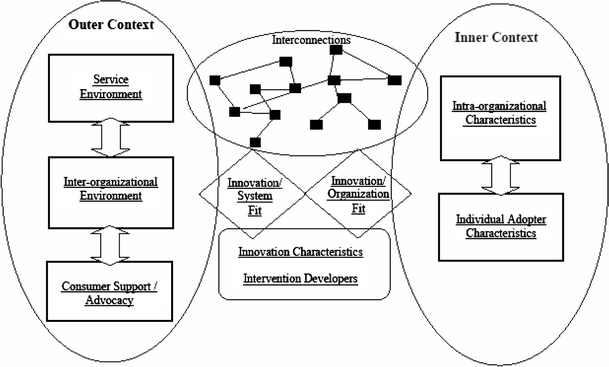
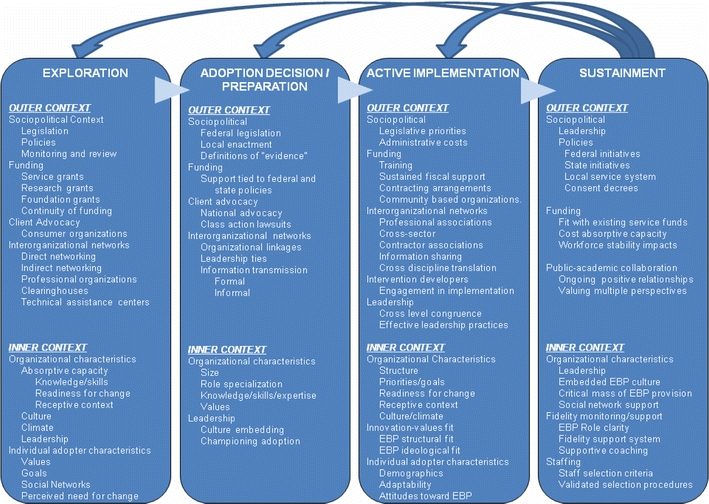
- Analysis: narrative synthesis organized by implementation phase and by outer vs. inner context levels, presented in two conceptual figures (Fig. 1 global factors; Fig. 2 phases and factors).
Limitations
- Stated: the authors note "few, if any, good measures of the process or progression through the phases" exist, and that process-based measures would be needed to assess status, progression, milestones, and speed of phase traversal.
- Stated: the paper repeatedly acknowledges thin empirical support — "there are few data supporting the importance of the other drivers of EBP exploration suggested by the literature," and consensus on core implementation drivers exists but "the body of concrete research evidence for each core driver in many cases remains to be developed."
- Evident from the text: the model is explicitly a hypothesis-generating framework ("variables hypothesized to play important roles"), its emphasis is skewed toward child welfare with mental health examples, and it offers no empirical test of the proposed phase-specific relationships.
Model-written summary. Check it against the paper before relying on it.
Integrity signals
Registry
Cites
Statistics
Figures
Verification
Claims the paper makes
16 Valid · 9 Not valid · 60 Not checked · 33 Own results and interpretations
The cited sources support only part of this claim — read each source’s verdict below.
In the paper
“Federal and state agencies may fund implementation demonstration projects and research studies to facilitate the implementation of EBPs, however, there has been little empirical work examining factors that either facilitate or limit sustainability of EBPs in public sector social services (Greenhalgh et al. 2004).”
§ Advancing a Conceptual Model of Evidence-Based Practice Implementation in Public Service Sectors > Sustainment Phase
What the sources say
- Partly supportedcites Greenhalgh et al. 2004 matched to “Diffusion of Innovations in Service Organizations: Systematic Review and Recommendations” (2004) sourceExperimental — accuracy not yet measured
The review says the literature on the sustainability of service innovations was very sparse (passage 1, page unavailable). It focused particularly on health care, however, and does not establish that empirical work on factors affecting sustainability of evidence-based practices was scarce specifically in public-sector social services. (LLM, conf=0.88)
plain- Asserted: passes — The authors put it forward as true.
- Checkable: passes — It can be checked against evidence.
- Load-bearing: passes — The paper’s conclusions depend on it.
- Based: passes — The paper gives a reason why it holds.
- Partly supported
The cited sources support only part of this claim — read each source’s verdict below.
In the paper
“The policies and funding needed for sustained use of practices typically follow from leaders who develop initiatives or set visions that can be maintained over time (Hoagwood et al. 2006).”
§ Advancing a Conceptual Model of Evidence-Based Practice Implementation in Public Service Sectors > Sustainment Phase > Outer Context
What the sources say
- Partly supportedcites Hoagwood et al. 2006 matched to “Implementation of evidence-based practices for children in four countries: a project of the World Psychiatric Association” (2006) sourceExperimental — accuracy not yet measured
The Discussion (page unavailable) says innovative leaders aided implementation and that all site Directors made plans for sustainability. The paper does not say that policies and funding typically follow from leaders’ initiatives or visions; it instead notes that continuation in Israel depended on securing funding. (LLM, conf=0.83)
plainstates a cause- Asserted: passes — The authors put it forward as true.
- Checkable: passes — It can be checked against evidence.
- Load-bearing: unclear — It is unclear whether the paper’s conclusions depend on it.
- Based: passes — The paper gives a reason why it holds.
- Partly supported
The cited sources support only part of this claim — read each source’s verdict below.
In the paper
“Conversely, severe budget restrictions discourage the exploration of innovations since exploration demands staff time, which may be limited when work forces are cut due to funding restrictions”
§ Advancing a Conceptual Model of Evidence-Based Practice Implementation in Public Service Sectors > Exploration Phase1 > The Outer Context
What the sources say
- Partly supportedcites Greenhalgh et al. 2004 matched to “Diffusion of Innovations in Service Organizations: Systematic Review and Recommendations” (2004) sourceExperimental — accuracy not yet measured
The paper’s discussion of organizational innovativeness (section labeled Abstract; page unavailable) associates slack resources with innovation, and its ‘Dedicated Time and Resources’ passage says adequate, continuing resources make assimilation more likely. It does not specifically say that severe budget restrictions lead to workforce cuts that leave staff too little time to explore innovations. (LLM, conf=0.86)
hedgedstates a cause- Asserted: passes — The authors put it forward as true.
- Checkable: passes — It can be checked against evidence.
- Load-bearing: unclear — It is unclear whether the paper’s conclusions depend on it.
- Based: passes — The paper gives a reason why it holds.
- Partly supported
The cited sources support only part of this claim — read each source’s verdict below.
In the paper
“Interorganizational forces, which focus on how individual organizations relate to, partner with, and compete with one another also play a potentially powerful role in adoption decisions.”
§ Advancing a Conceptual Model of Evidence-Based Practice Implementation in Public Service Sectors > Adoption Decision/Preparation Phase > Outer Context
What the sources say
- Partly supportedcites Chamberlain et al. 2008 matched to “Engaging and Recruiting Counties in an Experiment on Implementing Evidence-based Practice in California” (2008) sourceExperimental — accuracy not yet measured
The conceptual-model passage (Abstract; page unavailable) identifies prior cross-agency collaboration and positive relationships between counties and the California Institute for Mental Health as factors expected to influence adoption. This supports the claim about relationships and partnerships, but our copy does not address competition between organizations as an adoption influence. (LLM, conf=0.84)
- Not checked — no full text of the sourcecites Glisson and Schoenwald 2005 matched to “The ARC Organizational and Community Intervention Strategy for Implementing Evidence-Based Children's Mental Health Treatments” (2005) source
- Not matchedcites Institute for Healthcare Improvement [IHI] 2003
An author–year citation the paper’s reference list doesn’t settle. We don’t search these by name.
hedgedstates a possible cause- Asserted: passes — The authors put it forward as true.
- Checkable: passes — It can be checked against evidence.
- Load-bearing: unclear — It is unclear whether the paper’s conclusions depend on it.
- Based: passes — The paper gives a reason why it holds.
- Partly supported
The cited sources support only part of this claim — read each source’s verdict below.
In the paper
“Organizations that start with good knowledge/skills, can incorporate new knowledge, are highly specialized, and have mechanisms in place to spread knowledge throughout the organization, are much more likely to explore EBPs and eventually initiate them”
§ Advancing a Conceptual Model of Evidence-Based Practice Implementation in Public Service Sectors > Exploration Phase1 > The Inner Context
What the sources say
- Not checked — no full text of the sourcecites Damanpour 1991 matched to “Organizational innovation: A meta-analysis of effects of determinants and moderators” (1991) source
- Not checked — no full text of the sourcecites Ferlie and Shortell 2001 matched to “Improving the Quality of Health Care in the United Kingdom and the United States: A Framework for Change” (2001) source
- Partly supportedcites Greenhalgh et al. 2004 matched to “Diffusion of Innovations in Service Organizations: Systematic Review and Recommendations” (2004) sourceExperimental — accuracy not yet measured
The passages on structural determinants and absorptive capacity (indexed as Abstract; page unavailable) link specialization, an existing knowledge base, and knowledge sharing to greater organizational innovativeness and assimilation. They do not establish that organizations with these features are *much* more likely to explore and then initiate evidence-based practices specifically; the paper also describes assimilation as a process that can move back and forth between stages. (LLM, conf=0.84)
hedgedstates an association- Asserted: passes — The authors put it forward as true.
- Checkable: passes — It can be checked against evidence.
- Load-bearing: passes — The paper’s conclusions depend on it.
- Based: passes — The paper gives a reason why it holds.
57 more claims · 2 with their cited sources checked
Create a free account to see all 118 claims and to verify the 1 reference still open.
- Probably not a substantial claim. 31
- It may state two separate claims as one. 35
Claims other papers make about this one
Each is checked against this paper’s own text: does it say what the citing paper says it does?
The source backs part of the claim, not all of it — or backs it for a different population, condition or comparison.
In the citing paper
“Specifically, unlike traditional feasibility and pilot studies that may include the preliminary testing of interventions on individual clinical or public health outcomes, implementation feasibility and pilot studies that explore strategies to improve intervention implementation often require assessing changes across multiple levels including individuals (e.g. service providers or clinicians) and”
From Guidance for conducting feasibility and pilot studies for implementation trials (2020) · cites this paper as [21]
Experimental — accuracy not yet measuredThe source backs part of the claim, not all of it — or backs it for a different population, condition or comparison.
In the citing paper
“we propose that the concept of the individual might incorporate: capability, capacity, motivation (including recognising a need for change), resilience, acceptability, feelings, knowledge and beliefs (including self efficacy) about the intervention/evidence, position and fit within the organization/social system, and approach to decision-making (e.g., experimentation, use of information).”
From The role of evidence, context, and facilitation in an implementation trial: implications for the development of the PARIHS framework (2013) · cites this paper as [8]
Experimental — accuracy not yet measuredThe source backs part of the claim, not all of it — or backs it for a different population, condition or comparison.
In the citing paper
“Implementation strategies are too often designed in an unsystematic manner and fail to address key contextual determinants (13–16).”
From Enhancing the Impact of Implementation Strategies in Healthcare: A Research Agenda (2019) · cites this paper as [13]
Experimental — accuracy not yet measuredThe source backs part of the claim, not all of it — or backs it for a different population, condition or comparison.
In the citing paper
“Even if strategies are meticulously described in a study protocol or trial registry, it is often unrealistic to expect that they will not need to be altered as determinants emerge across implementation phases (13, 93, 94).”
From Enhancing the Impact of Implementation Strategies in Healthcare: A Research Agenda (2019) · cites this paper as [13]
Experimental — accuracy not yet measuredThe source backs part of the claim, not all of it — or backs it for a different population, condition or comparison.
In the citing paper
“Extent, quality, and timeliness of the completion of activities related to specific implementation process strategies”
From Beyond “implementation strategies”: classifying the full range of strategies used in implementation science and practice (2017) · cites this paper as [30]
Experimental — accuracy not yet measured
34 more claims about this paper
Create a free account to see every claim other papers make about this one.
Self-check
Percentages, sums and reported differences re-computed from the paper’s own numbers.
Each contradiction between two passages listed here was confirmed by an independent check.
Rated minor: it would not touch a result — a value no result rests on, a p-value that stays on the same side of the significance level, or a conflict that is clerical, resolved elsewhere in the paper, or outside its own findings.
In the paper
§ Advancing a Conceptual Model of Evidence-Based Practice Implementation in Public Service Sectors > References
“Data Path Design. (2010). ASWB projects.”
§ Advancing a Conceptual Model of Evidence-Based Practice Implementation in Public Service Sectors > References
“Retrieved June 10, 2009”
Citations
Cites
Rogers, E. M., Singhal, A., & Quinlan, M. M. (2019) · An Integrated Approach to Communication Theory and Research · doi:10.4324/9780203710753-35 · Cited by 37,322
The fifth discipline, the art and practice of the learning organization
Senge, P. M. (1991) · Performance + Instruction · doi:10.1002/pfi.4170300510 · Cited by 20,060
Organizational culture and leadership
(1993) · Long Range Planning · doi:10.1016/0024-6301(93)90120-5 · Cited by 16,462
Damschroder, L. J., Aron, D. C., Keith, R. E., Kirsh, S. R., Alexander, J. A., & Lowery, J. C. (2009) · Implementation Science · doi:10.1186/1748-5908-4-50 · Cited by 14,496
Valente, T. W. (2003) · Genetics in Medicine · doi:10.1097/01.gim.0000061743.67794.c4 · Cited by 13,723
(1994) · Cited by 13,126
Proctor, E., Silmere, H., Raghavan, R., Hovmand, P., Aarons, G., Bunger, A., Griffey, R., & Hensley, M. (2011) · Administration and Policy in Mental Health and Mental Health Services Research · doi:10.1007/s10488-010-0319-7 · Cited by 8,721
Self-citationDiffusion of Innovations in Service Organizations: Systematic Review and Recommendations
GREENHALGH, T., ROBERT, G., MACFARLANE, F., BATE, P., & KYRIAKIDOU, O. (2004) · The Milbank Quarterly · doi:10.1111/j.0887-378x.2004.00325.x · Cited by 7,448 · cited 11×
“Beginning at the broadest level, the state and federal sociopolitical and funding contexts influence the exploration of innovative interventions or practices (Davies and Nutley 2008; Ganju 2003; Hoagwood 2003).”
BackgroundInfluentialEvaluating the public health impact of health promotion interventions: the RE-AIM framework.
Glasgow, R. E., Vogt, T. M., & Boles, S. M. (1999) · American Journal of Public Health · doi:10.2105/ajph.89.9.1322 · Cited by 7,217 · cited 2×
“The RE-AIM model (Glasgow et al. 1999; Glasgow et al. 2006) explicitly identifies the ‘‘maintenance’’ phase of implementation as critical in sustaining effective health interventions.”
MethodOrganizational innovation: A meta-analysis of effects of determinants and moderators
Damanpour, F. (1991) · Academy of Management Journal · doi:10.2307/256406 · Cited by 6,542 · cited 9×
“Because the implementation literature has been developed in areas where the adoption of innovation is driven by profit or science, there is little attention to this first phase in the extant literature (Damanpour 1991).”
BackgroundMethodInfluential
Research works printed but not linked: 9
- Aos S Intensive family preservation programs: program fidelity influences effectiveness revised (No. 06-02-3901) 2006 Olympia Washington State Institute for Public Policy
- Backer T The failure of success: Challenges of disseminating effective substance abuse prevention programs Journal of Community Psychology 2000 28 3 363 373 · DOI · Paper page
- California Institute for Mental Health [CIMH] Community Development Team model: Supporting the model adherent implementation of programs and practices 2006 Sacramento California Institute for Mental Health
- Chadwick Center Closing the quality chasm in child abuse treatment: Identifying and disseminating best practices 2004 San Diego, CA Children’s Hospital-San Diego, Chadwich Center for Children and Families
- Davies HTO Nutley SM Learning more about how research-based knowledge gets used: Guidance in the development of new empirical research 2008 New York, NY William T. Grant Foundation
- Institute of Medicine [IOM] The state of quality improvement and implementation research: Expert views. Workshop summary 2007 Washington, DC The National Academies Press
- National Association of Public Child Welfare Administrators [NAPCWA] Guide for child welfare administrators on evidence based practice 2005 Washington DC APHSA
- National Institute of Mental Health [NIMH] Blueprint for change: Research on child and adolescent mental health 2001 Bethesda, MD National Institutes of Health
- Srivastava SK Bathla A Correlational study of organizational climate and work adjustment among industrial workers Social Science International 1996 12 1 52 60
Cited by
Items 101–200 of 3,223
Predicting program start-up using the stages of implementation measure
Saldana, L., Chamberlain, P., Wang, W., & Hendricks Brown, C. (2012) · Administration and Policy in Mental Health and Mental Health Services Research · doi:10.1007/s10488-011-0363-y · Cited by 148
“Recently, there has been an increased effort to understand what steps in the implementation process are essential to effectively transport EBPs to a diverse range of communities, and how to best measure if these steps have occurred well (Aarons et al. 2010; Glasgow et al. 1999).”
BackgroundMeasuring implementation outcomes: An updated systematic review of measures’ psychometric properties
Mettert, K., Lewis, C., Dorsey, C., Halko, H., & Weiner, B. (2020) · Implementation Research and Practice · doi:10.1177/2633489520936644 · Cited by 162
“(1) country of origin, (2) concept defined by authors, (3) number of articles contained in each measure packet, (4) number of scales, (5) number of items, (6) setting in which measure had been used, (7) level of analysis, (8) target problem, and (9) stage of implementation as defined by the Exploration, Adoption/Prepa…”
BackgroundMethodLinking Sustainability Research to Intervention Types
Scheirer, M. A. (2013) · American Journal of Public Health · doi:10.2105/ajph.2012.300976 · Cited by 161
Aarons, G. A., Ehrhart, M. G., Moullin, J. C., Torres, E. M., & Green, A. E. (2017) · Implementation Science · doi:10.1186/s13012-017-0562-3 · Cited by 159
“LOCI is framed within the Exploration, Preparation, Implementation, Sustainment (EPIS) framework [21], fo-”
MethodSelf-citationThe role of treatment fidelity on outcomes during a randomized field trial of an autism intervention
Mandell, D. S., Stahmer, A. C., Shin, S., Xie, M., Reisinger, E., & Marcus, S. C. (2013) · Autism · doi:10.1177/1362361312473666 · Cited by 156
“This is especially true in human service organizations such as schools, in which interventions are delivered through the behavior of individuals, who are heavily influenced by the culture and resources of their work environment (Aarons et al., 2011).”
BackgroundPractitioner Review: Empirical evolution of youth psychotherapy toward transdiagnostic approaches
Marchette, L. K., & Weisz, J. R. (2017) · Journal of Child Psychology and Psychiatry · doi:10.1111/jcpp.12747 · Cited by 156
“Intervention developers and their teams may vary in their understanding of the challenges of implementation across different service delivery systems, organizations, and clinicians (Aarons et al., 2011).”
BackgroundWALSH, S. L., El‐Bassel, N., Jackson, R. D., Samet, J. H., Aggarwal, M., Aldridge, A., Baker, T. J., Barbosa, C., Barocas, J. A., Battaglia, T. A., et al. (2020) · Drug and Alcohol Dependence · doi:10.1016/j.drugalcdep.2020.108335 · Cited by 177
Stone, A. B., Yuan, C. T., Rosen, M. A., Grant, M. C., Benishek, L. E., Hanahan, E., Lubomski, L. H., Ko, C. Y., & Wick, E. C. (2018) · JAMA Surgery · doi:10.1001/jamasurg.2017.5565 · Cited by 179
Cost data in implementation science: categories and approaches to costing
Gold, H. T., McDermott, C., Hoomans, T., & Wagner, T. H. (2022) · Implementation Science · doi:10.1186/s13012-021-01172-6 · Cited by 152
“Those stages could include pre-implementation, exploratory, and planning, as well as adaptation, implementation, sustainment, spread, and de-implementation [46].”
BackgroundBoyd, M. R., Powell, B. J., Endicott, D., & Lewis, C. C. (2018) · Behavior Therapy · doi:10.1016/j.beth.2017.11.012 · Cited by 137
Williams, N. J., Wolk, C. B., Becker-Haimes, E. M., & Beidas, R. S. (2020) · Implementation Science · doi:10.1186/s13012-020-0970-7 · Cited by 144
Langlois, E. V., Becerril Montekio, V., Young, T., Song, K., Alcalde-Rabanal, J., & Tran, N. (2016) · Health Research Policy and Systems · doi:10.1186/s12961-016-0089-0 · Cited by 143
“greater ownership of evidence-to-policy processes [22].”
Shelton, R. C., Lee, M., Brotzman, L., Wolfenden, L., Nathan, N., & Wainberg, M. L. (2020) · International Journal of Behavioral Medicine · doi:10.1007/s12529-020-09848-x · Cited by 163
“Exploration, Preparation, Implementation, Sustainment (EPIS) Framework [75] The EPIS Framework highlights key phases that guide and describe the implementation process and enumerates common and unique factors within and across levels of outer context (system) and inner (organizational) context across phases, factors t…”
BackgroundMethodImproving Community-Based Mental Health Care for Children: Translating Knowledge into Action
Garland, A. F., Haine-Schlagel, R., Brookman-Frazee, L., Baker-Ericzen, M., Trask, E., & Fawley-King, K. (2013) · Administration and Policy in Mental Health and Mental Health Services Research · doi:10.1007/s10488-012-0450-8 · Cited by 142
“…strategies (e.g., Powell et al. 2012), or postulate generalizable theoretical models for implementation of specific EB practices (e.g., Aarons et al. 2011), the purpose of this paper is to provide a synthesized review of descriptive and intervention effectiveness research on usual…”
InfluentialPeirson, L., Ciliska, D. K., Dobbins, M., & Mowat, D. L. (2012) · BMC Public Health · doi:10.1186/1471-2458-12-137 · Cited by 153
Rosen, C. S., Matthieu, M. M., Stirman, S. W., Cook, J. M., Landes, S. J., Bernardy, N. C., Chard, K. M., Crowley, J. J., Eftekhari, A., Finley, E. P., et al. (2016) · Administration and Policy in Mental Health and Mental Health Services Research · doi:10.1007/s10488-016-0755-0 · Cited by 153
“Even with this tremendous systemlevel support, there is wide variation in the inner context (Aarons et al. 2011) that relate to the uptake of the EBPs for treating PTSD within the VHA.”
BackgroundMethodCollaborative, T. A. P. P., Manzi, A., Hirschhorn, L. R., Sherr, K., Chirwa, C., Baynes, C. D., & Awoonor‐Williams, J. K. (2017) · BMC Health Services Research · doi:10.1186/s12913-017-2656-7 · Cited by 162
“tices in implementation science, where understanding internal and external context to then adapt the intervention and implementation pathway is associated with success and increased sustainability [46, 47].”
Backgroundvon Thiele Schwarz, U., Aarons, G. A., & Hasson, H. (2019) · BMC Health Services Research · doi:10.1186/s12913-019-4668-y · Cited by 134
“, creating fit with practical circumstances by changing from individual treatment to group format to align with funding contract [50]”
BackgroundSelf-citationCappella, E., Hamre, B. K., Kim, H. Y., Henry, D. B., Frazier, S. L., Atkins, M. S., & Schoenwald, S. K. (2012) · Journal of Consulting and Clinical Psychology · doi:10.1037/a0027725 · Cited by 161
Interagency collaborative team model for capacity building to scale-up evidence-based practice
Hurlburt, M., Aarons, G. A., Fettes, D., Willging, C., Gunderson, L., & Chaffin, M. J. (2014) · Children and Youth Services Review · doi:10.1016/j.childyouth.2013.10.005 · Cited by 132
“…Zagursky, Fettes, & Palinkas, 2009; Frambach & Schillewaert, 2002), level of involvement of practice developers in the implementation process (Aarons et al., 2011), and the presence of cross-organizational knowledge of and commitment to the new practice (Glisson & Schoenwald, 2005; Sosna &…”
BackgroundMethodSelf-citationRye, M., Torres, E. M., Friborg, O., Skre, I., & Aarons, G. A. (2017) · Implementation Science · doi:10.1186/s13012-017-0573-0 · Cited by 133
“Moreover, the implementation process encompasses different phases involving complex multilevel challenges, such as the exploration, the preparation, the implementation, and the sustainment phase characterized by the Exploration Preparation Implementation and Sustainment (EPIS) implementation framework [10].”
BackgroundStrengthening health systems through embedded research
Ghaffar, A., Langlois, É. V., Rasanathan, K., Peterson, S. S., Adedokun, L., & Tran, N. T. (2017) · Bulletin of the World Health Organization · doi:10.2471/blt.16.189126 · Cited by 157
Implementation of Clinical Practice Guidelines in the Health Care Setting: A Concept Analysis
Beauchemin, M., Cohn, E. G., & Shelton, R. C. (2019) · Advances in Nursing Science · doi:10.1097/ans.0000000000000263 · Cited by 174
Cook, C. R., Lyon, A. R., Kubergovic, D., Browning Wright, D., & Zhang, Y. (2015) · School Mental Health · doi:10.1007/s12310-014-9139-3 · Cited by 131
“…focus on altering beliefs and attitudes prior to actual implementation are likely to pay significant dividends during the subsequent phases of the implementation process (e.g., implementation and sustainment) when professionals’ attitudes about EBP become particularly salient (Aarons et al., 2011).”
BackgroundThe biopsychosocial model of pain 40 years on: time for a reappraisal?
Nicholas, M. K. (2022) · Pain · doi:10.1097/j.pain.0000000000002654 · Cited by 188
Hagermoser Sanetti, L. M., & Collier-Meek, M. A. (2019) · Journal of School Psychology · doi:10.1016/j.jsp.2019.07.008 · Cited by 129
Hoagwood, K., Olin, S.-C. S., Horwitz, S. M., McKay, M. M., Cleek, A. F., Gleacher, A. A., Lewandowski, E., Nadeem, E., Acri, M. C., Chor, K. H. B., et al. (2014) · Journal of Clinical Child & Adolescent Psychology · doi:10.1080/15374416.2013.869749 · Cited by 162
“…involved in large-scale dissemination (Chamberlain, Bickman, Chaffin, Mittman) have suggested a set of “implementation salvage strategies” guided by the Aarons, Hurlburt, and Horwitz (2011) model to avert or at least learn from failures (Hoagwood, Chaffin, Chamberlain, Bickman, & Mittman, 2011).”
BackgroundSelf-citationWang, D. Y., Wong, E. L., Nilsén, P., Chung, V. C., Tian, Y., & Yeoh, E. (2023) · Implementation Science · doi:10.1186/s13012-023-01296-x · Cited by 175
Locke, J., Lawson, G. M., Beidas, R. S., Aarons, G. A., Xie, M., Lyon, A. R., Stahmer, A., Seidman, M., Frederick, L., Oh, C., et al. (2019) · Implementation Science · doi:10.1186/s13012-019-0877-3 · Cited by 126
Self-citationReyes, A. D. L., Cook, C. R., Gresham, F. M., Makol, B. A., & Wang, M. (2019) · Journal of School Psychology · doi:10.1016/j.jsp.2019.05.005 · Cited by 151
Aarons, G. A., Fettes, D. L., Hurlburt, M. S., Palinkas, L. A., Gunderson, L., Willging, C. E., & Chaffin, M. J. (2014) · Journal of Clinical Child & Adolescent Psychology · doi:10.1080/15374416.2013.876642 · Cited by 126
“…discussion and negotiation, entails consideration of competing priorities, accurate or inaccurate assumptions, and structures and processes that can either facilitate or hinder effective movement through the EPIS model phases of Exploration, Preparation, and Implementation (Aarons et al., 2011).”
InfluentialSelf-citationProctor, E. K., Landsverk, J., Baumann, A. A., Mittman, B. S., Aarons, G. A., Brownson, R. C., Glisson, C., & Chambers, D. (2013) · Implementation Science · doi:10.1186/1748-5908-8-105 · Cited by 126
Self-citationGreen, A. E., & Aarons, G. A. (2011) · Implementation Science · doi:10.1186/1748-5908-6-104 · Cited by 126
“The findings from this study and our previous work [5,14] provide a lens through which implementation can be viewed.”
BackgroundResultInfluentialSelf-citationPalinkas, L. A., Fuentes, D., Finno, M., Garcia, A. R., Holloway, I. W., & Chamberlain, P. (2014) · Administration and Policy in Mental Health and Mental Health Services Research · doi:10.1007/s10488-012-0437-5 · Cited by 116
“Numerous models and frameworks exist for understanding the complex array of factors responsible for successful implementation of EBPs in organizational settings (Aarons et al. 2011; Fixsen et al. 2005; Greenhalgh et al. 2004; Schoenwald et al. 2008; Simpson 2002).”
BackgroundMethodInfluentialMancini, M. A. (2017) · Community Mental Health Journal · doi:10.1007/s10597-017-0145-4 · Cited by 142
Beidas, R. S., Stewart, R. E., Adams, D. R., Fernandez, T., Lustbader, S., Powell, B. J., Aarons, G. A., Hoagwood, K. E., Evans, A. C., Hurford, M. O., et al. (2016) · Administration and Policy in Mental Health and Mental Health Services Research · doi:10.1007/s10488-015-0705-2 · Cited by 122
“2009), and specifically the EPIS framework which guided our research questions (Aarons et al. 2011).”
BackgroundMethodInfluentialSelf-citationBirken, S. A., Haines, E. R., Hwang, S., Chambers, D. A., Bunger, A. C., & Nilsen, P. (2020) · Implementation Science · doi:10.1186/s13012-020-01040-9 · Cited by 122
Hogue, A., Dauber, S., Lichvar, E., Bobek, M., & Henderson, C. E. (2015) · Administration and Policy in Mental Health and Mental Health Services Research · doi:10.1007/s10488-014-0548-2 · Cited by 122
“…19th floor, New York, NY 10017, USA e-mail: athogue@aol.com; ahogue@casacolumbia.org C. E. Henderson Department of Psychology, Sam Houston State University, Huntsville, TX 77340, USA supervised providers, and in accordance with specified principles, procedures, and techniques (Aarons et al. 2011).”
Aarons, G. A., Green, A. E., Willging, C. E., Ehrhart, M. G., Roesch, S. C., Hecht, D. B., & Chaffin, M. J. (2014) · Implementation Science · doi:10.1186/s13012-014-0183-z · Cited by 107
“This current study is consistent with conceptual models that propose multiple phases or stages in the implementation process [5,7-9], and focuses explicitly on the period of sustainment.”
BackgroundMethodResultInfluentialSelf-citationHodge, L. M., & Turner, K. M. T. (2016) · American Journal of Community Psychology · doi:10.1002/ajcp.12082 · Cited by 120
Atkins, M. S., Rusch, D. B., Mehta, T. G., & Lakind, D. (2015) · Journal of Clinical Child & Adolescent Psychology · doi:10.1080/15374416.2015.1050724 · Cited by 141
Becan, J. E., Bartkowski, J. P., Knight, D. K., Wiley, T. R. A., DiClemente, R., Ducharme, L., Welsh, W. N., Bowser, D., McCollister, K., Hiller, M., et al. (2018) · Health & Justice · doi:10.1186/s40352-018-0068-3 · Cited by 119
“It was initially designed for implementation science research focused on public sector services including mental health and child welfare, and similarly organized systems such as substance use disorder treatment (Aarons et al., 2011).”
BackgroundMethodInfluentialSelf-citationSnell‐Rood, C., Ruble, L. A., Kleinert, H. L., McGrew, J. H., Adams, M., Rodgers, A. D., Odom, J., Wong, W. H., & Yu, Y. (2020) · Autism · doi:10.1177/1362361319894827 · Cited by 158
“…EPIS conceptual model assisted in the design and analysis of our study due to its focus on the interacting multilevel policies, long-term collaborative relationships, and organizational and provider factors that impact how best practices are sustained (Aarons et al., 2011; Moullin et al., 2019).”
MethodMurray, L. K., Tol, W., Jordans, M., Sabir, G., Amin, A. M., Bolton, P., Bass, J., Bonilla-Escobar, F. J., & Thornicroft, G. (2014) · Intervention · doi:10.1097/wtf.0000000000000070 · Cited by 118
“There is also general agreement that it is crucial to consider dissemination and implementation over time: from pre-implementation (and adoption in principle), early/mid implementation, and longer term maintenance and sustainability implementation to maintenance (Aarons et al., 2011).”
BackgroundCrable, E. L., Lengnick‐Hall, R., Stadnick, N. A., Moullin, J. C., & Aarons, G. A. (2022) · Implementation Science · doi:10.1186/s13012-022-01256-x · Cited by 143
“, Consolidated Framework for Implementation Research; CFIR [49]), conceptualizes an outer context to describe a broad environment of influential factors, and an inner context comprised of local organizational factors that impact D&I efforts [32, 44].”
BackgroundMethodInfluentialSelf-citationAtkins, M. S., Cappella, E., Shernoff, E. S., Mehta, T. G., & Gustafson, E. L. (2017) · Annual Review of Clinical Psychology · doi:10.1146/annurev-clinpsy-032816-045234 · Cited by 149
Lewis, C. C., Scott, K., & Marriott, B. R. (2018) · Implementation Science · doi:10.1186/s13012-018-0761-6 · Cited by 123
“Implementation Research (CFIR; [25], the Exploration Preparation Implementation Sustainment (EPIS; [8]) model, or the Dynamic Sustainability Framework [26].”
BackgroundDesigning the Future of Children’s Mental Health Services
Lyon, A. R., Dopp, A. R., Brewer, S. K., Kientz, J. A., & Munson, S. A. (2020) · Administration and Policy in Mental Health and Mental Health Services Research · doi:10.1007/s10488-020-01038-x · Cited by 115
Pérez Jolles, M., Willging, C. E., Stadnick, N. A., Crable, E. L., Lengnick-Hall, R., Hawkins, J., & Aarons, G. A. (2022) · Frontiers in Health Services · doi:10.3389/frhs.2022.942658 · Cited by 116
“This engagement early on during exploration and preparation phases (16) facilitated partners’ ability to fill in relatively quickly for colleagues no longer at the organization.”
BackgroundInfluentialSelf-citationStirman, S. W., Gutner, C. A., Langdon, K., & Graham, J. R. (2016) · Behavior Therapy · doi:10.1016/j.beth.2015.12.001 · Cited by 103
Zimmerman, L., Lounsbury, D. W., Rosen, C. S., Kimerling, R. E., Trafton, J. A., & Lindley, S. E. (2016) · Administration and Policy in Mental Health and Mental Health Services Research · doi:10.1007/s10488-016-0754-1 · Cited by 134
“Phase III Simulate: System Dynamics Modeling Analyses”
BackgroundInfluentialRitchie, M. J., Parker, L. E., Edlund, C. N., & Kirchner, J. E. (2017) · BMC Health Services Research · doi:10.1186/s12913-017-2217-0 · Cited by 113
“For example, engaged and supportive leaders can sanction changes, reinforce priorities and authorize necessary resources for implementation efforts [19, 20].”
BackgroundLeveraging Implementation Science to Improve Cancer Care Delivery and Patient Outcomes
Mitchell, S. A., & Chambers, D. (2017) · Journal of Oncology Practice · doi:10.1200/jop.2017.024729 · Cited by 122
“Various implementation strategies may be particularly fitting and timely at different phases of the change process.(3) To guide the selection of implementation strategies for a given implementation need, we propose a Strategic Implementation Framework derived from the literature.”
MethodFostering More-Effective Public Health by Identifying Administrative Evidence-Based Practices
Brownson, R. C., Allen, P., Duggan, K., Stamatakis, K. A., & Erwin, P. C. (2012) · American Journal of Preventive Medicine · doi:10.1016/j.amepre.2012.06.006 · Cited by 114
Karlin, B. E., Brown, G. K., Trockel, M., Cunning, D., Zeiss, A. M., & Taylor, C. B. (2012) · Journal of Consulting and Clinical Psychology · doi:10.1037/a0029328 · Cited by 113
Advancing health equity through a theoretically critical implementation science
Snell‐Rood, C., Jaramillo, E. T., Hamilton, A. B., Raskin, S. E., Nicosia, F. M., & Willging, C. E. (2021) · Translational Behavioral Medicine · doi:10.1093/tbm/ibab008 · Cited by 132
“Popular conceptual models in implementation science, such as the Consolidated Framework for Implementation Research (CFIR) [41] and the Exploration, Preparation, Implementation, and Sustainment (EPIS) model [42] commonly approach institutional systems and policies as broad “external contextual factors” shaping the imp…”
Eiraldi, R., Wolk, C. B., Locke, J., & Beidas, R. (2015) · Advances in School Mental Health Promotion · doi:10.1080/1754730x.2015.1037848 · Cited by 112
Letourneau, E. J., Schaeffer, C. M., Bradshaw, C. P., & Feder, K. A. (2017) · Child Maltreatment · doi:10.1177/1077559517692439 · Cited by 111
Expanding Implementation Research to Prevent Chronic Diseases in Community Settings
Mazzucca, S., Arredondo, E. M., Hoelscher, D. M., Haire-Joshu, D. L., Tabak, R. G., Kumanyika, S., & Brownson, R. C. (2021) · Annual Review of Public Health · doi:10.1146/annurev-publhealth-090419-102547 · Cited by 129
Transforming the Treatment of Schizophrenia in the United States: The RAISE Initiative
Dixon, L. B., Goldman, H. H., Srihari, V. H., & Kane, J. M. (2018) · Annual Review of Clinical Psychology · doi:10.1146/annurev-clinpsy-050817-084934 · Cited by 112
Advances in EBI Development for Diverse Populations: Towards a Science of Intervention Adaptation
Castro, F. G., & Yasui, M. (2017) · Prevention Science · doi:10.1007/s11121-017-0809-x · Cited by 108
“In planning this integrative approach, systems-level analyses are essential for coordinating intervention activities within macro- and micro-level organizational structures and processes (Aarons et al. 2011).”
Sustainable business model innovation literature: a bibliometrics analysis
Pan, L., Xu, Z., & Škare, M. (2022) · Review of Managerial Science · doi:10.1007/s11846-022-00548-2 · Cited by 153
A review of treatment adherence measurement methods.
Schoenwald, S. K., & Garland, A. F. (2013) · Psychological Assessment · doi:10.1037/a0029715 · Cited by 109
“…the realm of efficacy research to effectiveness and implementation research, and ultimately into implementation monitoring systems used in practice (Aarons et al., 2011), it will be important to develop evidence for the feasible, reliable, and valid use of adherence instruments for particular…”
BackgroundMoullin, J. C., Sabater-Hernández, D., & Benrimoj, S. I. (2016) · BMC Health Services Research · doi:10.1186/s12913-016-1689-7 · Cited by 108
“This process is described as a nonlinear, iterative and complex that may be divided into a number of stages [22–24] and activities/steps [25, 26].”
Patel, S. R., Margolies, P. J., Covell, N. H., Lipscomb, C., & Dixon, L. B. (2018) · Frontiers in Public Health · doi:10.3389/fpubh.2018.00113 · Cited by 107
“Specifically, we (1) describe the application of an instructional design framework, ADDIE, in the iterative development of e-learning modules for IPS; (2) conduct a large-scale dissemination of the IPS e-learning modules throughout the state using an LMS; (3) evaluate learner reaction, self-reported knowledge, and pra…”
BackgroundMethodAdvancing the application, quality and harmonization of implementation science measures
Rabin, B. A., Purcell, P., Naveed, S., Moser, R. P., Henton, M. D., Proctor, E. K., Brownson, R. C., & Glasgow, R. E. (2012) · Implementation Science · doi:10.1186/1748-5908-7-119 · Cited by 106
“First, measurement can help refine the meaning and understanding of constructs and help enhance conceptual frameworks, models, and theories [13,14].”
BackgroundFriedmann, P. D., Wilson, D., Knudsen, H. K., Ducharme, L. J., Welsh, W. N., Frisman, L. K., Knight, K. K., Lin, H., James, A., Albizu‐García, C. E., et al. (2014) · Journal of Substance Abuse Treatment · doi:10.1016/j.jsat.2014.10.001 · Cited by 111
Nathan, N., Powell, B. J., Shelton, R. C., Laur, C. V., Wolfenden, L., Hailemariam, M., Yoong, S. L., Sutherland, R., Kingsland, M., Waltz, T. J., et al. (2022) · Frontiers in Health Services · doi:10.3389/frhs.2022.905909 · Cited by 105
The Importance of Mental Models in Implementation Science
Holtrop, J. S., Scherer, L. D., Matlock, D. D., Glasgow, R. E., & Green, L. A. (2021) · Frontiers in Public Health · doi:10.3389/fpubh.2021.680316 · Cited by 138
“Certainly, frameworks, such as the Consolidated Framework for Implementation Research (CFIR) (5), iPARIHS (9), the Practical Robust Implementation and Sustainability Model (PRISM; an extension of RE-AIM) (10, 11), and the Exploration, Preparation, Implementation and Sustainability (EPIS) (12, 13) can point to places t…”
MethodAligning implementation science with improvement practice: a call to action
Leeman, J., Rohweder, C. L., Lee, M., Brenner, A. T., Dwyer, A. J., Ko, L. K., O’Leary, M. C., Ryan, G. W., Vu, T. T., & Ramanadhan, S. (2021) · Implementation Science Communications · doi:10.1186/s43058-021-00201-1 · Cited by 123
Powell, B. J., Mandell, D. S., Hadley, T. R., Rubin, R. M., Evans, A. C., Hurford, M. O., & Beidas, R. S. (2017) · Implementation Science · doi:10.1186/s13012-017-0593-9 · Cited by 102
“Moreover, we hypothesized that more positive strategic organizational contexts for implementation would be associated with higher levels of knowledge and more positive attitudes toward EBPs, as those contexts would be characterized by EBPs being expected, supported, and rewarded [24, 44] and by leaders who provide the…”
BackgroundBruns, E. J., Parker, E. M. L., Hensley, S., Pullmann, M. D., Benjamin, P. H., Lyon, A. R., & Hoagwood, K. (2019) · Implementation Science · doi:10.1186/s13012-019-0944-9 · Cited by 125
Interventions for youth aging out of foster care: A state of the science review
Greeson, J. K. P., Garcia, A. R., Tan, F., Chacon, A., & Ortiz, A. J. (2020) · Children and Youth Services Review · doi:10.1016/j.childyouth.2020.105005 · Cited by 99
Reilly, K. L., Kennedy, S., Porter, G., & Estabrooks, P. (2020) · Frontiers in Public Health · doi:10.3389/fpubh.2020.00430 · Cited by 102
“For example, when considering the phases proposed in the Exploration, Preparation, Implementation, and Sustainment Model (EPIS) (13) differential levels of salience are proposed for each outcome.”
BackgroundFinley, E. P., Garcia, H. A., Ketchum, N. S., McGeary, D. D., McGeary, C. A., Stirman, S. W., & Peterson, A. L. (2015) · Psychological Services · doi:10.1037/ser0000014 · Cited by 102
Murray, L. K., Dorsey, S., Skavenski, S., Kasoma, M., Imasiku, M., Bolton, P., Bass, J., & Cohen, J. A. (2013) · International Journal of Mental Health Systems · doi:10.1186/1752-4458-7-24 · Cited by 101
Ringle, V. A., Read, K. L., Edmunds, J. M., Brodman, D. M., Kendall, P. C., Barg, F., & Beidas, R. S. (2015) · Psychiatric Services · doi:10.1176/appi.ps.201400134 · Cited by 102
“The factors identified in this study are consistent with various implementation frameworks, such as the exploration, preparation, implementation, and sustainment framework (10).”
MethodA service research contribution to the global challenge of sustainability
Saviano, M., Barile, S., Spohrer, J., & Caputo, F. (2017) · Journal of Service Theory and Practice · doi:10.1108/jstp-10-2015-0228 · Cited by 111
Cooperative, T. J.-T., Knight, D. K., Belenko, S., Wiley, T., Robertson, A. A., Arrigona, N., Dennis, M., Bartkowski, J. P., McReynolds, L. S., Becan, J. E., et al. (2015) · Implementation Science · doi:10.1186/s13012-016-0423-5 · Cited by 100
“The problem-solving orientation inherent in EPIS [35] is valuable in understanding the myriad factors that may affect system change: outer context issues, inner context organizational issues, and consumer concerns.”
BackgroundMethodLourida, I., Abbott, R. A., Rogers, M., Lang, I. A., Stein, K., Kent, B., & Thompson Coon, J. (2017) · BMC Geriatrics · doi:10.1186/s12877-017-0528-y · Cited by 100
“[29] there are four phases of implementation: Exploration, Preparation, Implementation, and Sustainment.”
BackgroundGlisson, C. A., Hemmelgarn, A. L., Green, P., & Williams, N. J. (2013) · Journal of the American Academy of Child & Adolescent Psychiatry · doi:10.1016/j.jaac.2013.02.005 · Cited by 109
“growing body of research suggests that organization-specific contextual characterA istics have an impact on the delivery of mental health services and interact with efforts to improve services within community-based organizational settings.(1-8) This line of research suggests that the organizational social contexts in…”
BackgroundHuynh, A. K., Hamilton, A. B., Farmer, M. M., Bean-Mayberry, B., Stirman, S. W., Moin, T., & Finley, E. P. (2018) · Frontiers in Public Health · doi:10.3389/fpubh.2018.00134 · Cited by 100
“And in the maintenance and evolution phase, emphasis is placed on planning and recustomi zing for long-term sustainment and spread (22, 23).”
BackgroundMethodWood, J. J., McLeod, B. D., Klebanoff, S., & Brookman-Frazee, L. I. (2014) · Behavior Therapy · doi:10.1016/j.beth.2014.07.003 · Cited by 116
Proctor, E., Hooley, C., Morse, A., McCrary, S., Kim, H., & Kohl, P. L. (2019) · Implementation Science · doi:10.1186/s13012-018-0845-3 · Cited by 99
Bendall, S., Eastwood, O., Cox, G., Farrelly-Rosch, A., Nicoll, H., Peters, W., Bailey, A. P., McGorry, P. D., & Scanlan, F. (2020) · Child Maltreatment · doi:10.1177/1077559520927468 · Cited by 120
“…which purport that, while training is extremely important, many other factors must be considered to ensure service change across an organization (e.g., leadership, staffing, funding, client advocacy, interorganizational networks, fidelity monitoring, readiness for change; Aarons et al., 2011).”
BackgroundUsing Participatory Implementation Science to Advance Health Equity
Ramanadhan, S., Alemán, R., Bradley, C., Cruz, J. L., Safaeinili, N., Simonds, V. W., & Aveling, E. (2023) · Annual Review of Public Health · doi:10.1146/annurev-publhealth-060722-024251 · Cited by 125
Aarons, G. A., Sommerfeld, D. H., & Willging, C. E. (2011) · Psychological Services · doi:10.1037/a0026196 · Cited by 98
Self-citationGroup prenatal care: model fidelity and outcomes
Novick, G., Reid, A. E., Lewis, J., Kershaw, T. S., Rising, S. S., & Ickovics, J. R. (2013) · American Journal of Obstetrics and Gynecology · doi:10.1016/j.ajog.2013.03.026 · Cited by 96
“Biobehavioral interventions are particularly vulnerable to loss of fidelity when implemented, owing to their intrinsic complexity and to factors in clinical settings that impede adherence.(10,14,16,29,30) CenteringPregnancy has been previously demonstrated to reduce preterm birth, and the effect on this intractable pr…”
BackgroundPotthoff, S., Finch, T. L., Bührmann, L., Etzelmüller, A., van Genugten, C., Girling, M., May, C. R., Perkins, N., Vis, C., & Rapley, T. (2023) · Health Expectations · doi:10.1111/hex.13808 · Cited by 122
“, exploration, preparation, implementation and sustainment).(7) Engaging stakeholders across the implementation process can facilitate the identification of context‐specific barriers and the matching of more acceptable implementation strategies.”
BackgroundReding, M. E. J., Chorpita, B. F., Lau, A. S., & Innes-Gomberg, D. (2014) · Administration and Policy in Mental Health and Mental Health Services Research · doi:10.1007/s10488-013-0525-1 · Cited by 96
Wainer, A. L., Hepburn, S., & McMahon Griffith, E. (2017) · Autism · doi:10.1177/1362361315622411 · Cited by 95
“Finally, and of critical importance, is the notion that in order to reach a greater number of families of young children with ASD, parent-mediated interventions should “fit” the community context (Aarons et al., 2011) in which they will eventually be implemented.”
BackgroundBaker-Ericzén, M. J., Jenkins, M. M., & Haine-Schlagel, R. (2013) · Journal of Child and Family Studies · doi:10.1007/s10826-012-9644-7 · Cited by 96
“training, funding and adoption) and the need for understanding the community context (Aarons et al. 2011; Damschroder et al. 2009; Powell et al. 2012).”
BackgroundComplexity and the science of implementation in health IT—Knowledge gaps and future visions
Abbott, P. A., Foster, J., Marin, H. D. F., & Dykes, P. C. (2014) · International Journal of Medical Informatics · doi:10.1016/j.ijmedinf.2013.10.009 · Cited by 95
Beidas, R. S., Edmunds, J., Ditty, M., Watkins, J., Walsh, L., Marcus, S., & Kendall, P. (2014) · Administration and Policy in Mental Health and Mental Health Services Research · doi:10.1007/s10488-013-0529-x · Cited by 95
“The exploration, preparation, implementation, and sustainment framework (EPIS; Aarons et al. 2011) is a multilevel and multi-phase conceptual model that provides a lens through which to understand both the implementation process as well as important contextual factors that impact implementation.”
InfluentialWilliams, N. J., Ehrhart, M. G., Aarons, G. A., Marcus, S. C., & Beidas, R. S. (2018) · Implementation Science · doi:10.1186/s13012-018-0781-2 · Cited by 94
“The present study demonstrates that there is a need for more nuance in how we consider implementation frameworks to theorize and test the ways in which organizational context may influence adoption, implementation, and sustainment of EBPs in usual care and public sector settings [10].”
BackgroundResultInfluentialSelf-citationDefining the external implementation context: an integrative systematic literature review
Watson, D. P., Adams, E. L., Shue, S., Coates, H., McGuire, A., Chesher, J., Jackson, J., & Omenka, O. I. (2018) · BMC Health Services Research · doi:10.1186/s12913-018-3046-5 · Cited by 92
“Consolidate Framework for Implementation Research (CFIR) [3] Exploration, Preparation, Implementation, Sustainment (EPIS) [4] Integrated Promoting Action on Research Implementation in Health Services (i-PARiHS) [6] Multi-level framework (MLF) predicting implementation outcomes [5]”
BackgroundMethodInfluentialA conceptual model to guide research on the activities and effects of innovation champions
Shea, C. M. (2021) · Implementation Research and Practice · doi:10.1177/2633489521990443 · Cited by 113
“Clearly, implementation processes and quality improvement methods are not always linear (Aarons et al., 2011); however, even iterative approaches may involve completing phases (e.”
Organizational Interventions for Health and Well-being: A Handbook for Evidence-Based Practice
Martin, A., & LaMontagne, A. (2018) · Routledge eBooks · doi:10.4324/9781315410494 · Cited by 105
Gleacher, A. A., Olin, S. S., Nadeem, E., Pollock, M., Ringle, V., Bickman, L., Douglas, S., & Hoagwood, K. (2016) · Administration and Policy in Mental Health and Mental Health Services Research · doi:10.1007/s10488-015-0642-0 · Cited by 91
“, sociopolitical, funding, interorganizational networks, client advocacy) influence the adoption and implementation of innovations (Aarons et al. 2011).”
InfluentialEvidence-Based Public Health 2017
Vanagas, G., Bala, M., & Lhachimi, S. K. (2017) · BioMed Research International · doi:10.1155/2017/2607397 · Cited by 91
Metadata
- Authors
- Aarons, G. A., Hurlburt, M., & Horwitz, S. M.
- Affiliations
- University of California San Diego (US)
- University of Southern California (US)
- Rady Children's Hospital-San Diego (US)
- Corresponding author
- Aarons, Gregory A.
- Venue
- Administration and Policy in Mental Health and Mental Health Services Research
- Published
- 2010-12-14
- Volume
- 38
- Issue
- 1
- Pages
- 4-23
- ISSN
- 0894-587X (ISSN-L)
- 1573-3289
- PMC
- PMC3025110
- OpenAlex
- W2044858486
- Cited by
- 3,240
- References
- 171
- Citations by year
- 2026: 306 · 2025: 331 · 2024: 333 · 2023: 311 · 2022: 307 · 2021: 274 · 2020: 251 · 2019: 257 · 2018: 170 · 2017: 168 · 2016: 111 · 2015: 143 · 2014: 107 · 2013: 96 · 2012: 48
- FWCI
- 93.26
- Type
- journal article
- Language
- en
- Open access
- hybrid
- doi.org
- Licence
- cc-by-nc
- Locations
- Administration and Policy in Mental Health and Mental Health Services Research (publishedVersion, cc-by-nc)
- PubMed Central (publishedVersion, cc-by-nc)
- PubMed (publishedVersion)
- Funders
- National Institute of Mental Health (P30MH074678, R01MH072961)
- Topics
- Health Sciences › Health Professions › General Health Professions › Health Policy Implementation Science
- Health Sciences › Health Professions › General Health Professions › Health Sciences Research and Education
- Social Sciences › Public Administration › Evaluation and Performance Assessment
- Keywords
- evidence-based practice implementation, implementation science, public service sector, conceptual model, multi-level model, implementation stages, exploration, adoption, implementation, program sustainability, public mental health services, social services, drug and alcohol services, organizational context
- MeSH terms
- Child, Child Welfare, Diffusion of Innovation, Health Plan Implementation, Humans, Mental Health Services, Social Work, United States, Models, Organizational, Evidence-Based Practice
About these checks
Registry, retraction, Cites and statistics results are computed, not judged, with one exception: a printed reference that no index lists is read once by a model before it counts as a citation error. Claims are extracted by a model and kept only when their quote appears verbatim in the text; each cited source is then checked, with a model’s help, for whether it says what the claim relies on. Those verdicts can be wrong — read the claim’s quote and the cited source before relying on one.
The claim verdicts this report counts are experimental: their accuracy is not yet measured.
A language model drew the claims from the paper on 2026-10-10, under version 3 of the claim definition (model deepseek-v4.1-flash, prompt extract-v3).
A second model labelled each claim on 2026-10-10 (model jev-1.13-20260917, definition revision gold-guideline-v0.2).
Cited sources are checked with a language model’s help (gpt-6-sol).
Statistics and arithmetic are recomputed, not judged.
Confidence bands are shown only for fields calibrated on our annotated test set. None is calibrated yet, so no band is shown.
What counts as a claim ›How we measure confidence ›How we check this ›
Are you an author, or do you see a problem with this page? Request a review
Data sources
Bibliographic data: Semantic Scholar, OpenAlex, Crossref.
Contains information from the Semantic Scholar Academic Graph Datasets, made available under the ODC Attribution License (ODC-BY 1.0).
Semantic Scholar’s data is described in: Kinney, R., et al. (2023). The Semantic Scholar Open Data Platform. arXiv:2301.10140.
