

The DOI matches its Crossref record; 24 of the 24 references it cites were found in a registry or an index.
Towards a Cure for BCI Illiteracy
Open accessAbstract
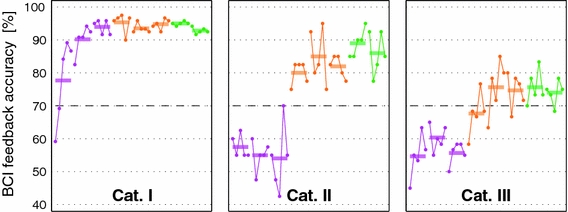
Brain-Computer Interfaces (BCIs) allow a user to control a computer application by brain activity as acquired, e.g., by EEG. One of the biggest challenges in BCI research is to understand and solve the problem of "BCI Illiteracy", which is that BCI control does not work for a non-negligible portion of users (estimated 15 to 30%). Here, we investigate the illiteracy problem in BCI systems which are based on the modulation of sensorimotor rhythms. In this paper, a sophisticated adaptation scheme is presented which guides the user from an initial subject-independent classifier that operates on simple features to a subject-optimized state-of-the-art classifier within one session while the user interacts the whole time with the same feedback application. While initial runs use supervised adaptation methods for robust co-adaptive learning of user and machine, final runs use unsupervised adaptation and therefore provide an unbiased measure of BCI performance. Using this approach, which does not involve any offline calibration measurement, good performance was obtained by good BCI participants (also one novice) after 3-6 min of adaptation. More importantly, the use of machine learning techniques allowed users who were unable to achieve successful feedback before to gain significant control over the BCI system. In particular, one participant had no peak of the sensory motor idle rhythm in the beginning of the experiment, but could develop such peak during the course of the session (and use voluntary modulation of its amplitude to control the feedback application).
Overview
The claims and statistics of this paper haven’t been checked yet.
Run the check — free, no account needed. It reads the open-access text and checks the sources it cites.
Integrity signals
Registry
Cites
Statistics
Figures
Verification
Claims the paper makes
The claims and statistics of this paper haven’t been checked yet.
Run the check — free, no account needed. It reads the open-access text and checks the sources it cites.
Claims other papers make about this one
Each is checked against this paper’s own text: does it say what the citing paper says it does?
The cited source says what the claim attributes to it.
In the citing paper
“Indeed, mutual learning has been claimed mostly on the grounds of adequate and improved BCI classification accuracy [25,27,30–35] or application performances [36,37].”
From The Cybathlon BCI race: Successful longitudinal mutual learning with two tetraplegic users (2018) · cites this paper as [25]
The cited source says what the claim attributes to it.
In the citing paper
“and standard calibration pipelines fail to produce a functional classifier for a non-negligible portion of users [5].”
From ERP-XTTN: interpretable prototype-guided cross-attention for cross-subject ERP classification (2026) · cites this paper as [5]
In the citing paper
“Evidence that co-adaptive MI BCIs might also be able to promote and increase the ability of the users to voluntary modulate their brain signals (subject learning) is, in fact, scarce, most often indirect and rather inconclusive.”
From The Cybathlon BCI race: Successful longitudinal mutual learning with two tetraplegic users (2018) · cites this paper as [25]
In the citing paper
“Firstly, works where users acquired BCI control (able-bodied [3,25] and end-users [40,41,51,62,63]) do not report any learning metric over time.”
From The Cybathlon BCI race: Successful longitudinal mutual learning with two tetraplegic users (2018) · cites this paper as [25]
In the citing paper
“Some works find no evident learning effects at the neural correlate level [25,34].”
From The Cybathlon BCI race: Successful longitudinal mutual learning with two tetraplegic users (2018) · cites this paper as [25]
In the citing paper
“Lack of robustness is a well-known issue of all BCI paradigms and has been associated to the nonstationarity of brain signals [18,25,27].”
From The Cybathlon BCI race: Successful longitudinal mutual learning with two tetraplegic users (2018) · cites this paper as [25]
Self-check
Percentages, sums and reported differences re-computed from the paper’s own numbers.
The self-check needs the paper’s full text.
Citations
Cites
Brain–computer interfaces for communication and control
Wolpaw, J. R., Birbaumer, N., McFarland, D. J., Pfurtscheller, G., & Vaughan, T. M. (2002) · Clinical Neurophysiology · doi:10.1016/s1388-2457(02)00057-3 · Cited by 7,927
A well-conditioned estimator for large-dimensional covariance matrices
Ledoit, O., & Wolf, M. (2004) · Journal of Multivariate Analysis · doi:10.1016/s0047-259x(03)00096-4 · Cited by 3,046
Optimizing Spatial filters for Robust EEG Single-Trial Analysis
Blankertz, B., Tomioka, R., Lemm, S., Kawanabe, M., & Muller, K.-R. (2008) · IEEE Signal Processing Magazine · doi:10.1109/msp.2008.4408441 · Cited by 2,080 · cited 5×
“Its speed was determined by the classi-fication output (similar to Blankertz et al. (2007, 2008a)).”
BackgroundMethodInfluentialSelf-citationHoney, I Shrunk the Sample Covariance Matrix
Ledoit, O., & Wolf, M. (2004) · The Journal of Portfolio Management · doi:10.3905/jpm.2004.110 · Cited by 1,279
Dimensionality Reduction of Multimodal Labeled Data by Local Fisher Discriminant Analysis
Sugiyama, M. (2007) · doi:10.5555/1248659.1248694 · Cited by 1,031
Blankertz, B., Dornhege, G., Krauledat, M., Müller, K., & Curio, G. (2007) · NeuroImage · doi:10.1016/j.neuroimage.2007.01.051 · Cited by 941
Self-citationToward Brain-Computer Interfacing
Dornhege, G., Millán, J. D. R., Hinterberger, T., McFarland, D. J., & Müller, K.-R. (2007) · The MIT Press eBooks · doi:10.7551/mitpress/7493.001.0001 · Cited by 789
Covariate Shift Adaptation by Importance Weighted Cross Validation
Sugiyama, M., Krauledat, M., & Müller, K. (2007) · doi:10.5555/1314498.1390324 · Cited by 733
Dornhege, G., Blankertz, B., Curio, G., & Müller, K. R. (2004) · IEEE Transactions on Biomedical Engineering · doi:10.1109/tbme.2004.827088 · Cited by 638
Self-citationBrain-computer communication: Unlocking the locked in.
Kübler, A., Kotchoubey, B., Kaiser, J., Wolpaw, J. R., & Birbaumer, N. (2001) · Psychological Bulletin · doi:10.1037/0033-2909.127.3.358 · Cited by 565
Research works printed but not linked: 1
- Vidaurre C, Schlögl A, Blankertz B, Kawanabe M, Müller KR (2008) Unsupervised adaptation of the LDA classifier for brain–computer interfaces. In: Proceedings of the 4th international brain–computer interface workshop and training course 2008, Verlag der Technischen Universität Graz, pp 122–127
Cited by
Sorted by citations
Items 201–300 of 501
Reichert, C., Dürschmid, S., Bartsch, M. V., Hopf, J., Heinze, H., & Hinrichs, H. (2020) · Journal of Neural Engineering · doi:10.1088/1741-2552/abb692 · Cited by 21
Unveiling Thoughts: A Review of Advancements in EEG Brain Signal Decoding Into Text
Murad, S. A., & Rahimi, N. (2024) · IEEE Transactions on Cognitive and Developmental Systems · doi:10.1109/tcds.2024.3462452 · Cited by 27
Wang, Z., Liu, Y., Huang, S., Huang, H., Wu, W., Wang, Y., An, X., & Ming, D. (2024) · IEEE Transactions on Neural Systems and Rehabilitation Engineering · doi:10.1109/tnsre.2024.3486551 · Cited by 20
3D graphics, virtual reality, and motion-onset visual evoked potentials in neurogaming
Beveridge, R., Wilson, S., & Coyle, D. (2016) · Progress in brain research · doi:10.1016/bs.pbr.2016.06.006 · Cited by 21
Effects of Background Music on Objective and Subjective Performance Measures in an Auditory BCI
Zhou, S., Allison, B. Z., Kübler, A., Cichocki, A. S., Wang, X., & Jin, J. (2016) · Frontiers in Computational Neuroscience · doi:10.3389/fncom.2016.00105 · Cited by 20
Performance of Brain–Computer Interfacing Based on Tactile Selective Sensation and Motor Imagery
Yao, L., Sheng, X., Mrachacz‐Kersting, N., Zhu, X., Farina, D., & Jiang, N. (2017) · IEEE Transactions on Neural Systems and Rehabilitation Engineering · doi:10.1109/tnsre.2017.2769686 · Cited by 20
Transfer Learning for SSVEP-based BCI Using Riemannian Similarities Between Users
Kalunga, E. K., Chevallier, S., & Barthélemy, Q. (2018) · European Signal Processing Conference (EUSIPCO) · doi:10.23919/eusipco.2018.8553441 · Cited by 20
Brandmeyer, A., Farquhar, J. D. R., McQueen, J. M., & Desain, P. (2013) · PLoS ONE · doi:10.1371/journal.pone.0068261 · Cited by 22
Gamification of motor imagery brain-computer interface training protocols: A systematic review
Atilla, F., Postma, M., & Alimardani, M. (2024) · Computers in Human Behavior Reports · doi:10.1016/j.chbr.2024.100508 · Cited by 29
Stimuli and Feature Extraction Algorithms for Brain-Computer Interfaces: A Systematic Comparison
Bittencourt-Villalpando, M., & Maurits, N. M. (2018) · IEEE Transactions on Neural Systems and Rehabilitation Engineering · doi:10.1109/tnsre.2018.2855801 · Cited by 19
Corticomuscular Co-Activation Based Hybrid Brain-Computer Interface for Motor Recovery Monitoring
Chowdhury, A., Dutta, A., & Prasad, G. (2020) · IEEE Access · doi:10.1109/access.2020.3026037 · Cited by 19
Lateralized responses during covert attention are modulated by target eccentricity
Bahramisharif, A., Heskes, T., Jensen, O. B., & van Gerven, M. A. J. (2011) · Neuroscience Letters · doi:10.1016/j.neulet.2011.01.003 · Cited by 19
Performance monitoring for brain-computer-interface actions
Schurger, A., Gale, S., Gozel, O., & Blanke, O. (2016) · Brain and Cognition · doi:10.1016/j.bandc.2016.09.009 · Cited by 19
Micoulaud‐Franchi, J., Fond, G. B., & Dumas, G. (2013) · Frontiers in Human Neuroscience · doi:10.3389/fnhum.2013.00463 · Cited by 19
Lisi, G., Hamaya, M., Noda, T., & Morimoto, J. (2016) · Proceedings - IEEE International Conference on Robotics and Automation/Proceedings · doi:10.1109/icra.2016.7487227 · Cited by 18
Towards Empathic Neurofeedback for Interactive Storytelling
Cavazza, M., Aranyi, G., Charles, F., Porteous, J., Gilroy, S. W., Klovatch, I., Jackont, G., Soreq, E., Keynan, J. N., Cohen, A., et al. (2014) · Kent Academic Repository (University of Kent) · doi:10.4230/oasics.cmn.2014.42 · Cited by 21
High Aptitude Motor-Imagery BCI Users Have Better Visuospatial Memory
Leeuwis, N., & Alimardani, M. (2020) · Conference proceedings/Conference proceedings - IEEE International Conference on Systems, Man, and Cybernetics · doi:10.1109/smc42975.2020.9283259 · Cited by 17
Yakovlev, L., Syrov, N., & Kaplan, A. (2023) · Frontiers in Neuroscience · doi:10.3389/fnins.2023.1202951 · Cited by 17
Borgheai, S. B., Zisk, A. H., McLinden, J., McIntyre, J., Sadjadi, R., & Shahriari, Y. (2023) · Computers in Biology and Medicine · doi:10.1016/j.compbiomed.2023.107658 · Cited by 18
Sarasola-Sanz, A., Ray, A. M., Insausti-Delgado, A., Irastorza-Landa, N., Mahmoud, W. J., Brötz, D., Bibián, C., Helmhold, F., Zrenner, C., Ziemann, U., et al. (2024) · Frontiers in Bioengineering and Biotechnology · doi:10.3389/fbioe.2024.1330330 · Cited by 17
Assessment and Communication for People with Disorders of Consciousness
Ortner, R., Allison, B. Z., Pichler, G., Heilinger, A., Sabathiel, N., & Guger, C. (2017) · Journal of Visualized Experiments · doi:10.3791/53639 · Cited by 17
Shin, J., & Im, C. (2020) · Frontiers in Neuroscience · doi:10.3389/fnins.2020.00168 · Cited by 18
Shu, X., Chen, S., Chai, G., Sheng, X., Jia, J., & Zhu, X. (2018) · Annual International Conference of the IEEE Engineering in Medicine and Biology Society (EMBC) · doi:10.1109/embc.2018.8512860 · Cited by 17
Evaluating the Feasibility of Visual Imagery for an EEG-Based Brain–Computer Interface
Kilmarx, J., Tashev, I., Millán, J. D. R., Sulzer, J. S., & Lewis‐Peacock, J. A. (2024) · IEEE Transactions on Neural Systems and Rehabilitation Engineering · doi:10.1109/tnsre.2024.3410870 · Cited by 16
Getting stress-related disorders under control: the untapped potential of neurofeedback
Krause, F., Linden, D. E. J., & Hermans, E. J. (2024) · Trends in Neurosciences · doi:10.1016/j.tins.2024.08.007 · Cited by 22
Towards improvement of MI-BCI performance of subjects with BCI deficiency
Bamdadian, A., Guan, C., Ang, K. K., & Xu, J. (2015) · International IEEE/EMBS Conference on Neural Engineering · doi:10.1109/ner.2015.7146549 · Cited by 16
Minati, L., Nigri, A., Rosazza, C., & Bruzzone, M. G. (2012) · Medical Engineering & Physics · doi:10.1016/j.medengphy.2012.02.004 · Cited by 16
Post-Adaptation Effects in a Motor Imagery Brain-Computer Interface Online Coadaptive Paradigm
Cunha, J. D., Perdikis, S., Halder, S., & Scherer, R. (2021) · IEEE Access · doi:10.1109/access.2021.3064226 · Cited by 18
Hybrid interface: Integrating BCI in multimodal human-machine interfaces
Kalunga, E. K., Chevallier, S., Rabreau, O., & Monacelli, É. (2014) · IEEE/ASME International Conference on Advanced Intelligent Mechatronics · doi:10.1109/aim.2014.6878132 · Cited by 16
On the need for alternative feedback training approaches for BCIPreprint
Lotte, F. (2012) · HAL (Le Centre pour la Communication Scientifique Directe) · Cited by 16
Intelligent Classification Technique of Hand Motor Imagery Using EEG Beta Rebound Follow-Up Pattern
Wang, J., Chen, Y.-H., Yang, J., & Sawan, M. (2022) · Biosensors · doi:10.3390/bios12060384 · Cited by 15
EEG-based vibrotactile evoked brain-computer interfaces system: A systematic review
Huang, X., Liang, S., Li, Z., Lai, C. Y. Y., & Choi, K. (2022) · PLoS ONE · doi:10.1371/journal.pone.0269001 · Cited by 15
A brief review of motor imagery and bimanual coordination
Sisti, H. M., Beebe, A., Bishop, M., & Gabrielsson, E. (2022) · Frontiers in Human Neuroscience · doi:10.3389/fnhum.2022.1037410 · Cited by 15
Tools don’t—and won’t—make the man: A cognitive look at the future.
Osiurak, F., Navarro, J., Reynaud, E., & Thomas, G. (2018) · Journal of Experimental Psychology General · doi:10.1037/xge0000432 · Cited by 15
Chabuda, A., Dovgialo, M., Duszyk-Bogorodzka, A., Stróż, A., Pawlisz, M., & Durka, P. J. (2020) · Acta Neurobiologiae Experimentalis · doi:10.21307/ane-2019-039 · Cited by 14
The overlooked potential for social factors to improve effectiveness of brain-computer interfaces
Sexton, C. A. (2015) · Frontiers in Systems Neuroscience · doi:10.3389/fnsys.2015.00070 · Cited by 16
Comparison of Classification Methods for EEG Signals of Real and Imaginary Motion
Szczuko, P., Lech, M., & Czyżewski, A. (2017) · Intelligent systems reference library · doi:10.1007/978-3-319-67588-6_12 · Cited by 15
Automatic motor task selection via a bandit algorithm for a brain-controlled button
Fruitet, J., Carpentier, A., Munos, R., & Clerc, M. (2013) · Journal of Neural Engineering · doi:10.1088/1741-2560/10/1/016012 · Cited by 15
Motor task-to-task transfer learning for motor imagery brain-computer interfaces
Gwon, D., & Ahn, M. (2024) · NeuroImage · doi:10.1016/j.neuroimage.2024.120906 · Cited by 14
Shin, J., & Im, C. (2018) · International Journal of Neural Systems · doi:10.1142/s0129065718500235 · Cited by 14
A Hybrid Brain-Computer Interface Based on Visual Evoked Potential and Pupillary Response
Jiang, L., Li, X., Pei, W., Gao, X., & Wang, Y. (2022) · Frontiers in Human Neuroscience · doi:10.3389/fnhum.2022.834959 · Cited by 14
Machado, S. E. D. C., Almada, L. F., & Annavarapu, R. N. (2013) · Cited by 14
A novel method to reduce the motor imagery BCI illiteracy
Wang, T., Du, S., & Dong, E. (2021) · Medical & Biological Engineering & Computing · doi:10.1007/s11517-021-02449-0 · Cited by 14
Amygdala self-neuromodulation capacity as a window for process-related network recruitment
Gurevitch, G., Lubianiker, N., Markovits, T., Or‐Borichev, A., Sharon, H., Fine, N. B., Fruchtman-Steinbok, T., Keynan, J. N., Shahar, M., Friedman, A., et al. (2024) · Philosophical Transactions of the Royal Society B Biological Sciences · doi:10.1098/rstb.2024.0186 · Cited by 14
Multiclass Classification Based on Combined Motor Imageries
Lindig-León, C., Rimbert, S., & Bougrain, L. (2020) · Frontiers in Neuroscience · doi:10.3389/fnins.2020.559858 · Cited by 12
Kang, J.-H., Youn, J., Kim, S.-H., & Kim, J. (2021) · Frontiers in Neuroscience · doi:10.3389/fnins.2021.663101 · Cited by 12
Short-Term Kinesthetic Training for Sensorimotor Rhythms: Effects in Experts and Amateurs
Zapała, D., Zabielska‐Mendyk, E., Cudo, A., Krzysztofiak, A., Augustynowicz, P., & Francuz, P. (2014) · Journal of Motor Behavior · doi:10.1080/00222895.2014.982067 · Cited by 12
EEG-based Endogenous Online Co-Adaptive Brain-Computer Interfaces: Strategy for Success?
Scherer, R., Faller, J., Sajda, P., & Vidaurre, C. (2018) · Computer Science and Electronic Engineering Conference · doi:10.1109/ceec.2018.8674198 · Cited by 13
Self-citationTwo Tell-tale Perspectives of PTSD
Shahid, F., Rahman, W., Islam, A., Paul, N., Khan, N. S., Rahman, M. S., Haque, M. M., & Islam, A. B. M. A. A. (2019) · Proceedings of the ACM on Interactive Mobile Wearable and Ubiquitous Technologies · doi:10.1145/3351259 · Cited by 13
Design and Implementation of an Asynchronous BCI System With Alpha Rhythm and SSVEP
Zhang, L., Wu, X., Guo, X., Liu, J., & Zhou, B. (2019) · IEEE Access · doi:10.1109/access.2019.2946301 · Cited by 14
Detecting Mental States by Machine Learning Techniques: The Berlin Brain–Computer Interface
Blankertz, B., Tangermann, M., Vidaurre, C., Dickhaus, T., Sannelli, C., Popescu, F., Fazli, S., Danóczy, M., Curio, G., & Müller, K. (2009) · The frontiers collection · doi:10.1007/978-3-642-02091-9_7 · Cited by 13
Self-citationquEEGNet: Quantum AI for Biosignal Processing
Koike–Akino, T., & Wang, Y. (2022) · IEEE-EMBS International Conference on Biomedical and Health Informatics (BHI ...) · doi:10.1109/bhi56158.2022.9926814 · Cited by 12
Díez, P. (2018) · Elsevier eBooks · doi:10.1016/b978-0-12-812892-3.00001-7 · Cited by 14
Ivanov, N., & Chau, T. T. (2023) · Frontiers in Computational Neuroscience · doi:10.3389/fncom.2023.1108889 · Cited by 12
Quantifying Electrode Reliability During Brain–Computer Interface Operation
Sagha, H., Perdikis, S., Millán, J. D. R., & Chavarriaga, R. (2014) · IEEE Transactions on Biomedical Engineering · doi:10.1109/tbme.2014.2366554 · Cited by 12
Krell, M. M., Wilshusen, N., Seeland, A., & Kim, S. K. (2017) · Journal of Neural Engineering · doi:10.1088/1741-2552/aa5166 · Cited by 12
Exploring the neurophysiology of affect during human-media interaction
Mühl, C. (2012) · doi:10.3990/1.9789036533621 · Cited by 12
Human Learning for Brain–Computer Interfaces
Jeunet, C., Lotte, F., & N’Kaoua, B. (2016) · Wiley eBooks · doi:10.1002/9781119144977.ch11 · Cited by 14
Decoding of Motor Coordination Imagery Involving the Lower Limbs by the EEG‐Based Brain Network
Fu, Y., Zhou, Z., Gong, A., Qian, Q., Su, L., & Zhao, L. (2021) · Computational Intelligence and Neuroscience · doi:10.1155/2021/5565824 · Cited by 11
5 Hz rTMS improves motor-imagery based BCI classification performance
Jia, T., Mo, L., Li, C., Liu, A., Li, Z., & Ji, L. (2021) · Annual International Conference of the IEEE Engineering in Medicine and Biology Society (EMBC) · doi:10.1109/embc46164.2021.9630102 · Cited by 11
Tobón-Henao, M., Álvarez-Meza, A. M., & Castellanos-Dominguez, G. (2023) · Computers · doi:10.3390/computers12070145 · Cited by 11
Integrating virtual agents in BCI neurofeedback systems
Cavazza, M., Charles, F., Gilroy, S. W., Porteous, J., Aranyi, G., Raz, G., Keynan, J. N., Cohen, A., Jackont, G., Jacob, Y., et al. (2014) · Virtual Reality International Conference · doi:10.1145/2617841.2620713 · Cited by 11
Classifying mental gestures with in-ear EEG
Merrill, N., Curran, M. T., Yang, J.-K., & Chuang, J. C.-I. (2016) · Wearable and Implantable Body Sensor Networks · doi:10.1109/bsn.2016.7516246 · Cited by 11
Gao, Z., Zhou, X.-J., Yang, Y., Dang, W., Qu, C., & Dong, N. (2019) · Europhysics Letters (EPL) · doi:10.1209/0295-5075/127/40004 · Cited by 11
Kwon, J., & Im, C. (2020) · IEEE Transactions on Neural Systems and Rehabilitation Engineering · doi:10.1109/tnsre.2020.3030639 · Cited by 11
Wang, S., Song, X., Song, X., Gu, Y., Cong, Z., Shen, Y., & Yu, L. (2026) · Nano-Micro Letters · doi:10.1007/s40820-025-02042-2 · Cited by 11
A Human–Machine Joint Learning Framework to Boost Endogenous BCI Training
Wang, H., Qi, Y., Yao, L., Wang, Y., Farina, D., & Pan, G. (2023) · IEEE Transactions on Neural Networks and Learning Systems · doi:10.1109/tnnls.2023.3305621 · Cited by 10
Wang, Z., Liu, Y., Huang, S., Qiu, S., Zhang, Y., Huang, H., An, X., & Ming, D. (2024) · IEEE Journal of Biomedical and Health Informatics · doi:10.1109/jbhi.2024.3452701 · Cited by 10
HYBRID BRAIN–COMPUTER INTERFACE PARADIGM — A STUDY
Singla, R. K. (2018) · Biomedical Engineering Applications Basis and Communications · doi:10.4015/s1016237218500229 · Cited by 10
Sequence-based manipulation of robotic arm control in brain machine interface
Kilmarx, J., Abiri, R., Borhani, S., Jiang, Y., & Zhao, X. (2018) · International Journal of Intelligent Robotics and Applications · doi:10.1007/s41315-018-0049-7 · Cited by 10
Feeling Positive? Predicting Emotional Image Similarity from Brain Signals
Ruotsalo, T., Mäkelä, K., Spapé, M., & Leiva, L. A. (2023) · ACM International Conference on Multimedia (ACM MM) · doi:10.1145/3581783.3613442 · Cited by 10
Wheelchair Control Based on Multimodal Brain-Computer Interfaces
Li, J., Ji, H., Cao, L., Gu, R., Xia, B., & Huang, Y. (2013) · Lecture notes in computer science · doi:10.1007/978-3-642-42054-2_54 · Cited by 10
Choi, J. W., & Kim, K. H. (2019) · Computational Intelligence and Neuroscience · doi:10.1155/2019/4259369 · Cited by 10
Online Event Detection Requirements in Closed-Loop Neuroscience
Varona, P., Arroyo, D., Rodrı́guez, F. B., & Nowotny, T. (2016) · Elsevier eBooks · doi:10.1016/b978-0-12-802452-2.00006-8 · Cited by 12
An Impending Paradigm Shift in Motor Imagery Based Brain-Computer Interfaces
Papadopoulos, S., Bonaiuto, J. J., & Mattout, J. (2022) · Frontiers in Neuroscience · doi:10.3389/fnins.2021.824759 · Cited by 12
RSVP-based BCI for inconspicuous targets: detection, localization, and modulation of attention
Zhou, Q., Zhang, Q., Wang, B., Yang, Y., Yuan, Z., Li, S., Zhao, Y., Zhu, Y., Gao, Z., Zhou, J., et al. (2024) · Journal of Neural Engineering · doi:10.1088/1741-2552/ad658e · Cited by 9
Lukito, S., Lam, S.-L., Criaud, M., Westwood, S. J., Kowalczyk, O. S., Curran, S. R., Barrett, N., Abbott, C., Liang, H., Simonoff, E. A., et al. (2024) · Philosophical Transactions of the Royal Society B Biological Sciences · doi:10.1098/rstb.2023.0097 · Cited by 10
Bellicha, A., Struber, L., Pasteau, F., Juillard, V., Devigne, L., Karakas, S., Chabardès, S., Marie Babel, A., & Charvet, G. (2025) · Journal of Neural Engineering · doi:10.1088/1741-2552/adae36 · Cited by 12
Spelling with Brain-Computer Interfaces Current trends and prospects
Cecotti, H. (2010) · Cited by 8
Affective Relevance: Inferring Emotional Responses via fNIRS Neuroimaging
Ruotsalo, T., Mäkelä, K., Spapé, M., & Leiva, L. A. (2023) · International ACM SIGIR Conference on Research and Development in Information Retrieval (SIGIR) · doi:10.1145/3539618.3591946 · Cited by 9
Zhang, Y., Liu, D., Zhang, P., Li, T., Li, Z., & Gao, F. (2022) · Frontiers in Neuroscience · doi:10.3389/fnins.2022.938518 · Cited by 9
Iturrate, I., Montesano, L., Chavarriaga, R., Millán, J. D. R., & Mínguez, J. (2011) · Annual International Conference of the IEEE Engineering in Medicine and Biology Society (EMBC) · doi:10.1109/iembs.2011.6091572 · Cited by 9
Fruitet, J., Carpentier, A., Munos, R., & Clerc, M. (2012) · HAL · Cited by 9
Heim, M., Heinrichs, F., Hueppe, M., Nunez, F., Szameitat, A., Reuter, M., Goetz, S. M., & Weber, C. (2025) · IEEE Access · doi:10.1109/access.2025.3569932 · Cited by 8
Kim, D.-W., Kim, E., Lee, C., & Im, C. (2019) · Journal of Korean Medical Science · doi:10.3346/jkms.2019.34.e285 · Cited by 8
Meng, M., Yin, X. X., She, Q., Gao, Y., Kong, W., & Luo, Z. (2021) · Journal of Neuroscience Methods · doi:10.1016/j.jneumeth.2021.109274 · Cited by 8
Beta bursts question the ruling power for brain–computer interfaces
Papadopoulos, S., Szul, M. J., Congedo, M., Bonaiuto, J. J., & Mattout, J. (2024) · Journal of Neural Engineering · doi:10.1088/1741-2552/ad19ea · Cited by 8
Coyle, D., Stow, J., McCreadie, K. A., Sciacca, N., McElligott, J. M., & Carroll, Á. M. (2017) · Springer briefs in electrical and computer engineering · doi:10.1007/978-3-319-57132-4_5 · Cited by 8
Comparison of Classification Algorithms Towards Subject-Specific and Subject-Independent BCI
Ghane, P., Naghsh, N. Z., & Braga-Neto, U. (2021) · International Winter Conference on Brain-Computer Interface (BCI) · doi:10.1109/bci51272.2021.9385339 · Cited by 9
Tong, J., Wei, X., Dong, E., Sun, Z., Du, S., & Duan, F. (2022) · Journal of Neural Engineering · doi:10.1088/1741-2552/ac9a01 · Cited by 8
The effect of selective attention on multiple ASSRs for future BCI application
Kaongoen, N., & Jo, S. (2017) · International Winter Conference on Brain-Computer Interface (BCI) · doi:10.1109/iww-bci.2017.7858144 · Cited by 8
Iwama, S., Morishige, M., Kodama, M., Takahashi, Y., Hirose, R., & Ushiba, J. (2023) · Scientific Data · doi:10.1038/s41597-023-02260-6 · Cited by 9
Investigating critical brain area for EEG-based binocular color fusion and rivalry with EEGNet
Lv, Z., Liu, X., Dai, M., Jin, X., Huang, X., & Chen, Z. (2024) · Frontiers in Neuroscience · doi:10.3389/fnins.2024.1361486 · Cited by 10
Chen, J., Liu, Q., Chen, G., Cai, G., Jiang, J., Yang, X., Tan, C., Zhang, C., Xu, G., & Lan, Y. (2025) · Journal of NeuroEngineering and Rehabilitation · doi:10.1186/s12984-025-01688-8 · Cited by 7
Towards a general architecture for a co-learning of brain computer interfaces
Kosmyna, N., Tarpin-Bernard, F., & Rivet, B. (2013) · International IEEE/EMBS Conference on Neural Engineering · doi:10.1109/ner.2013.6696118 · Cited by 7
Kleih, S. C., Lukito, S., & Kübler, A. (2012) · Ergonomics design and management · doi:10.1201/b13019-12 · Cited by 7
Noninvasive Brain Machine Interfaces for Assistive and Rehabilitation Robotics
Lisi, G., & Morimoto, J. (2016) · Elsevier eBooks · doi:10.1016/b978-0-12-803137-7.00006-9 · Cited by 7
Does Fractional Anisotropy Predict Motor Imagery Neurofeedback Performance in Healthy Older Adults?
Meekes, J., Debener, S., Zich, C., Bleichner, M. G., & Kranczioch, C. (2019) · Frontiers in Human Neuroscience · doi:10.3389/fnhum.2019.00069 · Cited by 7
Variability and Nonstationarity in Brain Computer Interfaces
Roijendijk, L. (2009) · Cited by 7
Importance of Reliable EEG Data in Motor Imagery Classification: Attention Level-based Approach
Lee, S., Kim, Y.-T., Hwang, S.-O., Kim, H., & Kim, D. (2020) · International Winter Conference on Brain-Computer Interface (BCI) · doi:10.1109/bci48061.2020.9061647 · Cited by 7
Metadata
- Authors
- Vidaurre, C., & Blankertz, B.
- Affiliations
- Technische Universität Berlin (DE)
- Corresponding author
- Vidaurre, Carmen
- Venue
- Brain Topography
- Published
- 2009-11-28
- Volume
- 23
- Issue
- 2
- Pages
- 194-198
- ISSN
- 0896-0267 (ISSN-L)
- 1573-6792
- PMC
- PMC2874052
- OpenAlex
- W2003621157
- Cited by
- 501
- References
- 24
- Citations by year
- 2026: 31 · 2025: 24 · 2024: 30 · 2023: 28 · 2022: 33 · 2021: 42 · 2020: 45 · 2019: 32 · 2018: 46 · 2017: 31 · 2016: 37 · 2015: 29 · 2014: 30 · 2013: 23 · 2012: 19
- FWCI
- 6.38
- Type
- journal article
- Language
- en
- Open access
- hybrid
- doi.org
- Licence
- cc-by-nc
- Locations
- Brain Topography (publishedVersion, cc-by-nc)
- PubMed Central (publishedVersion, cc-by-nc)
- PubMed (publishedVersion)
- TECNALIA Publications (Fundación TECNALIA Research & Innovation) (submittedVersion, cc-by-nc)
- Publikationsdatenbank der Fraunhofer-Gesellschaft (Fraunhofer-Gesellschaft) (submittedVersion)
- Fraunhofer-Publica (Fraunhofer-Gesellschaft) (submittedVersion)
- Funders
- European Commission (224631, 216886)
- Deutsche Forschungsgemeinschaft (01GQ0850)
- Bundesministerium für Bildung und Forschung (01GQ0850, 01IB001A)
- Topics
- Life Sciences › Neuroscience › Cognitive Neuroscience › EEG and Brain-Computer Interfaces
- Physical Sciences › Computer Science › Human-Computer Interaction › Gaze Tracking and Assistive Technology
- Physical Sciences › Computer Science › Artificial Intelligence › Emotion and Mood Recognition
- Keywords
- BCI illiteracy, brain-computer interface, sensorimotor rhythm, EEG, online adaptation, unsupervised adaptation, supervised adaptation, novice users, motor imagery
- MeSH terms
- Algorithms, Artificial Intelligence, Brain, Electroencephalography, Humans, Imagination, Learning, Motor Activity, Signal Processing, Computer-Assisted, Time Factors, User-Computer Interface, Feedback, Psychological
About these checks
Registry, retraction, Cites and statistics results are computed, not judged, with one exception: a printed reference that no index lists is read once by a model before it counts as a citation error. Claims are extracted by a model and kept only when their quote appears verbatim in the text; each cited source is then checked, with a model’s help, for whether it says what the claim relies on. Those verdicts can be wrong — read the claim’s quote and the cited source before relying on one.
Statistics and arithmetic are recomputed, not judged.
Confidence bands are shown only for fields calibrated on our annotated test set. None is calibrated yet, so no band is shown.
What counts as a claim ›How we measure confidence ›How we check this ›
Are you an author, or do you see a problem with this page? Request a review
