

The DOI matches its Crossref record; 24 of the 24 references it cites were found in a registry or an index.
Towards a Cure for BCI Illiteracy
Open accessAbstract
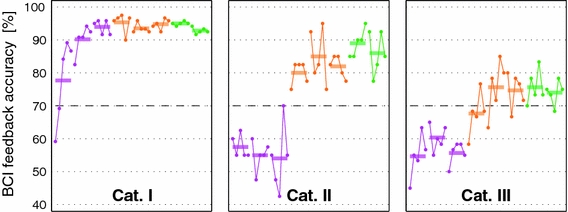
Brain-Computer Interfaces (BCIs) allow a user to control a computer application by brain activity as acquired, e.g., by EEG. One of the biggest challenges in BCI research is to understand and solve the problem of "BCI Illiteracy", which is that BCI control does not work for a non-negligible portion of users (estimated 15 to 30%). Here, we investigate the illiteracy problem in BCI systems which are based on the modulation of sensorimotor rhythms. In this paper, a sophisticated adaptation scheme is presented which guides the user from an initial subject-independent classifier that operates on simple features to a subject-optimized state-of-the-art classifier within one session while the user interacts the whole time with the same feedback application. While initial runs use supervised adaptation methods for robust co-adaptive learning of user and machine, final runs use unsupervised adaptation and therefore provide an unbiased measure of BCI performance. Using this approach, which does not involve any offline calibration measurement, good performance was obtained by good BCI participants (also one novice) after 3-6 min of adaptation. More importantly, the use of machine learning techniques allowed users who were unable to achieve successful feedback before to gain significant control over the BCI system. In particular, one participant had no peak of the sensory motor idle rhythm in the beginning of the experiment, but could develop such peak during the course of the session (and use voluntary modulation of its amplitude to control the feedback application).
Overview
The claims and statistics of this paper haven’t been checked yet.
Run the check — free, no account needed. It reads the open-access text and checks the sources it cites.
Integrity signals
Registry
Cites
Statistics
Figures
Verification
Claims the paper makes
The claims and statistics of this paper haven’t been checked yet.
Run the check — free, no account needed. It reads the open-access text and checks the sources it cites.
Claims other papers make about this one
Each is checked against this paper’s own text: does it say what the citing paper says it does?
The cited source says what the claim attributes to it.
In the citing paper
“and standard calibration pipelines fail to produce a functional classifier for a non-negligible portion of users [5].”
From ERP-XTTN: interpretable prototype-guided cross-attention for cross-subject ERP classification (2026) · cites this paper as [5]
In the citing paper
“Evidence that co-adaptive MI BCIs might also be able to promote and increase the ability of the users to voluntary modulate their brain signals (subject learning) is, in fact, scarce, most often indirect and rather inconclusive.”
From The Cybathlon BCI race: Successful longitudinal mutual learning with two tetraplegic users (2018) · cites this paper as [25]
In the citing paper
“Indeed, mutual learning has been claimed mostly on the grounds of adequate and improved BCI classification accuracy [25,27,30–35] or application performances [36,37].”
From The Cybathlon BCI race: Successful longitudinal mutual learning with two tetraplegic users (2018) · cites this paper as [25]
In the citing paper
“Firstly, works where users acquired BCI control (able-bodied [3,25] and end-users [40,41,51,62,63]) do not report any learning metric over time.”
From The Cybathlon BCI race: Successful longitudinal mutual learning with two tetraplegic users (2018) · cites this paper as [25]
In the citing paper
“Some works find no evident learning effects at the neural correlate level [25,34].”
From The Cybathlon BCI race: Successful longitudinal mutual learning with two tetraplegic users (2018) · cites this paper as [25]
In the citing paper
“Lack of robustness is a well-known issue of all BCI paradigms and has been associated to the nonstationarity of brain signals [18,25,27].”
From The Cybathlon BCI race: Successful longitudinal mutual learning with two tetraplegic users (2018) · cites this paper as [25]
Self-check
Percentages, sums and reported differences re-computed from the paper’s own numbers.
The self-check needs the paper’s full text.
Citations
Cites
Brain–computer interfaces for communication and control
Wolpaw, J. R., Birbaumer, N., McFarland, D. J., Pfurtscheller, G., & Vaughan, T. M. (2002) · Clinical Neurophysiology · doi:10.1016/s1388-2457(02)00057-3 · Cited by 7,927
A well-conditioned estimator for large-dimensional covariance matrices
Ledoit, O., & Wolf, M. (2004) · Journal of Multivariate Analysis · doi:10.1016/s0047-259x(03)00096-4 · Cited by 3,046
Optimizing Spatial filters for Robust EEG Single-Trial Analysis
Blankertz, B., Tomioka, R., Lemm, S., Kawanabe, M., & Muller, K.-R. (2008) · IEEE Signal Processing Magazine · doi:10.1109/msp.2008.4408441 · Cited by 2,080 · cited 5×
“Its speed was determined by the classi-fication output (similar to Blankertz et al. (2007, 2008a)).”
BackgroundMethodInfluentialSelf-citationHoney, I Shrunk the Sample Covariance Matrix
Ledoit, O., & Wolf, M. (2004) · The Journal of Portfolio Management · doi:10.3905/jpm.2004.110 · Cited by 1,279
Dimensionality Reduction of Multimodal Labeled Data by Local Fisher Discriminant Analysis
Sugiyama, M. (2007) · doi:10.5555/1248659.1248694 · Cited by 1,031
Blankertz, B., Dornhege, G., Krauledat, M., Müller, K., & Curio, G. (2007) · NeuroImage · doi:10.1016/j.neuroimage.2007.01.051 · Cited by 941
Self-citationToward Brain-Computer Interfacing
Dornhege, G., Millán, J. D. R., Hinterberger, T., McFarland, D. J., & Müller, K.-R. (2007) · The MIT Press eBooks · doi:10.7551/mitpress/7493.001.0001 · Cited by 789
Covariate Shift Adaptation by Importance Weighted Cross Validation
Sugiyama, M., Krauledat, M., & Müller, K. (2007) · doi:10.5555/1314498.1390324 · Cited by 733
Dornhege, G., Blankertz, B., Curio, G., & Müller, K. R. (2004) · IEEE Transactions on Biomedical Engineering · doi:10.1109/tbme.2004.827088 · Cited by 638
Self-citationBrain-computer communication: Unlocking the locked in.
Kübler, A., Kotchoubey, B., Kaiser, J., Wolpaw, J. R., & Birbaumer, N. (2001) · Psychological Bulletin · doi:10.1037/0033-2909.127.3.358 · Cited by 565
Research works printed but not linked: 1
- Vidaurre C, Schlögl A, Blankertz B, Kawanabe M, Müller KR (2008) Unsupervised adaptation of the LDA classifier for brain–computer interfaces. In: Proceedings of the 4th international brain–computer interface workshop and training course 2008, Verlag der Technischen Universität Graz, pp 122–127
Cited by
Sorted by citations
Items 101–200 of 501
Meng, J., & He, B. (2019) · Frontiers in Human Neuroscience · doi:10.3389/fnhum.2019.00128 · Cited by 59
Performance enhancement of a brain-computer interface using high-density multi-distance NIRS
Shin, J., Kwon, J., Choi, J., & Im, C. (2017) · Scientific Reports · doi:10.1038/s41598-017-16639-0 · Cited by 59
Large-Scale Assessment of a Fully Automatic Co-Adaptive Motor Imagery-Based Brain Computer Interface
Acqualagna, L., Botrel, L., Vidaurre, C., Kübler, A., & Blankertz, B. (2016) · PLoS ONE · doi:10.1371/journal.pone.0148886 · Cited by 61
Self-citationBanville, H. J., & Falk, T. H. (2016) · Brain-Computer Interfaces · doi:10.1080/2326263x.2015.1134958 · Cited by 60
Brain computer interface: A comprehensive survey
Tiwari, N., Edla, D. R., Dodia, S. J., & Bablani, A. (2018) · Biologically Inspired Cognitive Architectures · doi:10.1016/j.bica.2018.10.005 · Cited by 60
An FDES-Based Shared Control Method for Asynchronous Brain-Actuated Robot
Liu, R., Wang, Y., & Zhang, L. (2015) · IEEE Transactions on Cybernetics · doi:10.1109/tcyb.2015.2469278 · Cited by 56
Sun, B., Wu, Z., Hu, Y., & Li, T. (2022) · Neural Networks · doi:10.1016/j.neunet.2022.03.025 · Cited by 55
Meng, J., Streitz, T. D., Gulachek, N., Suma, D., & He, B. (2018) · IEEE Transactions on Biomedical Engineering · doi:10.1109/tbme.2018.2872855 · Cited by 59
Kwon, J., Shin, J., & Im, C.-H. (2020) · PLOS ONE · doi:10.1371/journal.pone.0230491 · Cited by 53
Hiremath, S. V., Chen, W., Wang, W., Foldes, S., Yang, Y., Tyler-Kabara, E. C., Collinger, J. L., & Boninger, M. L. (2015) · Frontiers in Integrative Neuroscience · doi:10.3389/fnint.2015.00040 · Cited by 53
A P300-based brain computer interface system for words typing
Akram, F., Han, H., & Kim, T. (2013) · Computers in Biology and Medicine · doi:10.1016/j.compbiomed.2013.12.001 · Cited by 52
Dry Electrode-Based Fully Isolated EEG/fNIRS Hybrid Brain-Monitoring System
Lee, S., Shin, Y., Kumar, A., Kim, M., & Lee, H.-N. (2018) · IEEE Transactions on Biomedical Engineering · doi:10.1109/tbme.2018.2866550 · Cited by 52
How Many People Can Use a BCI System?
Edlinger, G., Allison, B. Z., & Guger, C. (2014) · Springer eBooks · doi:10.1007/978-4-431-55037-2_3 · Cited by 50
Heunis, S., Lamerichs, R. M. J. N., Zinger, S., Caballero‐Gaudes, C., Jansen, J. F. A., Aldenkamp, A. P., & Breeuwer, M. M. (2020) · Human Brain Mapping · doi:10.1002/hbm.25010 · Cited by 50
Zhang, R., Li, F., Zhang, T., Yao, D., & Xu, P. (2020) · Brain Science Advances · doi:10.26599/bsa.2020.9050021 · Cited by 55
Selective Sensation Based Brain-Computer Interface via Mechanical Vibrotactile Stimulation
Yao, L., Meng, J., Zhang, D., Sheng, X., & Zhu, X. (2013) · PLoS ONE · doi:10.1371/journal.pone.0064784 · Cited by 48
The predictive role of pre-cue EEG rhythms on MI-based BCI classification performance
Bamdadian, A., Guan, C., Ang, K. K., & Xu, J. (2014) · Journal of Neuroscience Methods · doi:10.1016/j.jneumeth.2014.06.011 · Cited by 48
A Low Cost Eeg Based Bci Prosthetic Using Motor Imagery
Elstob, D., & Secco, E. L. (2016) · International Journal of Advanced Information Technology · doi:10.5121/ijitcs.2016.6103 · Cited by 48
Network neuroscience for optimizing brain–computer interfaces
Fallani, F. D. V., & Bassett, D. S. (2019) · Physics of Life Reviews · doi:10.1016/j.plrev.2018.10.001 · Cited by 47
Kwon, J., & Im, C. (2021) · Frontiers in Human Neuroscience · doi:10.3389/fnhum.2021.646915 · Cited by 47
Assisted closed-loop optimization of SSVEP-BCI efficiency
Fernández-Vargas, J., Pfaff, H. U., Rodrı́guez, F. B., & Varona, P. (2013) · Frontiers in Neural Circuits · doi:10.3389/fncir.2013.00027 · Cited by 46
Eugster, M. J. A., Ruotsalo, T., Spapé, M., Barral, O., Ravaja, N., Jacucci, G., & Samuel Kaski, A. (2016) · Scientific Reports · doi:10.1038/srep38580 · Cited by 46
Vourvopoulos, A., Badia, S. B. I., & Liarokapis, F. (2016) · The Visual Computer · doi:10.1007/s00371-016-1304-2 · Cited by 46
Tang, Z., Yu, H., Lu, C., Liu, P., & Jin, X. (2019) · IEEE Access · doi:10.1109/access.2019.2940034 · Cited by 46
Bauer, R., & Gharabaghi, A. (2015) · Frontiers in Behavioral Neuroscience · doi:10.3389/fnbeh.2015.00021 · Cited by 43
Multi-scale neural decoding and analysis
Lu, H., Lorenc, E. S., Zhu, H., Kilmarx, J., Sulzer, J. S., Xie, C., Tobler, P. N., Watrous, A. J., Orsborn, A. L., Lewis‐Peacock, J. A., et al. (2021) · Journal of Neural Engineering · doi:10.1088/1741-2552/ac160f · Cited by 47
A hybrid steady-state visual evoked response-based brain-computer interface with MEG and EEG
Li, X., Chen, J., Shi, N., Yang, C., Gao, P., Chen, X., Wang, Y., Gao, S., & Gao, X. (2023) · Expert Systems with Applications · doi:10.1016/j.eswa.2023.119736 · Cited by 43
Zhang, R., Xu, P., Liu, T., Zhang, Y., Guo, L., Li, P., & Yao, D. (2013) · Computational and Mathematical Methods in Medicine · doi:10.1155/2013/591216 · Cited by 42
Binias, B., Myszor, D., & Cyran, K. A. (2018) · Computational Intelligence and Neuroscience · doi:10.1155/2018/2703513 · Cited by 43
Comparison of subject-independent and subject-specific EEG-based BCI using LDA and SVM classifiers
Santos, E., San-Martin, R., & Fraga, F. J. (2023) · Medical & Biological Engineering & Computing · doi:10.1007/s11517-023-02769-3 · Cited by 42
Enhanced Motor Imagery-Based BCI Performance via Tactile Stimulation on Unilateral Hand
Shu, X., Yao, L., Sheng, X., Zhang, D., & Zhu, X. (2017) · Frontiers in Human Neuroscience · doi:10.3389/fnhum.2017.00585 · Cited by 42
A visual parallel-BCI speller based on the time–frequency coding strategy
Xu, M., Chen, L., Zhang, L., Qi, H., Ma, L., Tang, J., Wan, B., & Ming, D. (2014) · Journal of Neural Engineering · doi:10.1088/1741-2560/11/2/026014 · Cited by 42
Wu, J. F., Ang, A. M. S., Tsui, K. M., Wu, H.-E., Hung, Y. S., Hu, Y. S., Mak, J. N., Chan, S. C., & Zhang, Z. G. (2014) · IEEE Transactions on Circuits & Systems II Express Briefs · doi:10.1109/tcsii.2014.2368617 · Cited by 40
Brain-computer interfaces for 3D games
Lotte, F. (2011) · International Conference on the Foundations of Digital Games (FDG) · doi:10.1145/2159365.2159427 · Cited by 40
A BCI System Based on Somatosensory Attentional Orientation
Yao, L., Sheng, X., Zhang, D., Jiang, N., Farina, D., & Zhu, X. (2016) · IEEE Transactions on Neural Systems and Rehabilitation Engineering · doi:10.1109/tnsre.2016.2572226 · Cited by 40
An emergency call system for patients in locked‐in state using an SSVEP‐based brain switch
Lim, J., Kim, Y., Lee, J., An, K.-O., Hwang, H., Cha, H., Han, C. H., & Im, C. (2017) · Psychophysiology · doi:10.1111/psyp.12916 · Cited by 40
CNN With Large Data Achieves True Zero-Training in Online P300 Brain-Computer Interface
Lee, J., Won, K., Kwon, M., Jun, S. C., & Ahn, M. (2020) · IEEE Access · doi:10.1109/access.2020.2988057 · Cited by 40
How Much Control Is Enough? Influence of Unreliable Input on User Experience
van de Laar, B., Bos, D. P.-O., Reuderink, B., Poel, M., & Nijholt, A. (2013) · IEEE Transactions on Cybernetics · doi:10.1109/tcyb.2013.2282279 · Cited by 39
Pitt, K. M., & Brumberg, J. S. (2018) · American Journal of Speech-Language Pathology · doi:10.1044/2018_ajslp-17-0135 · Cited by 41
Functional disconnection of associative cortical areas predicts performance during BCI training
Corsi, M., Chávez, M., Schwartz, D., George, N., Hugueville, L., Kahn, A. E., Dupont, S., Bassett, D. S., & Fallani, F. D. V. (2020) · NeuroImage · doi:10.1016/j.neuroimage.2019.116500 · Cited by 43
Prediction of Pilot's Reaction Time Based on EEG Signals
Binias, B., Myszor, D., Palus, H., & Cyran, K. A. (2020) · Frontiers in Neuroinformatics · doi:10.3389/fninf.2020.00006 · Cited by 39
Towards solving of the Illiteracy phenomenon for VEP-based brain-computer interfaces
Volosyak, I., Rezeika, A., Benda, M., Gembler, F. W., & Stawicki, P. (2020) · Biomedical Physics & Engineering Express · doi:10.1088/2057-1976/ab87e6 · Cited by 38
Phase/Amplitude Synchronization of Brain Signals During Motor Imagery BCI Tasks
Cattai, T., Colonnese, S., Corsi, M., Bassett, D. S., Scarano, G., & Fallani, F. D. V. (2021) · IEEE Transactions on Neural Systems and Rehabilitation Engineering · doi:10.1109/tnsre.2021.3088637 · Cited by 37
Bauer, R. H., Fels, M., Royter, V., Raco, V., & Gharabaghi, A. (2016) · Clinical Neurophysiology · doi:10.1016/j.clinph.2016.06.020 · Cited by 37
Learned self-regulation of the lesioned brain with epidural electrocorticography
Gharabaghi, A., Naros, G., Khademi, F., Jesser, J., Spüler, M., Walter, A., Bogdan, M., Rosenstiel, W., & Birbaumer, N. (2014) · Frontiers in Behavioral Neuroscience · doi:10.3389/fnbeh.2014.00429 · Cited by 38
Yang, D., Nguyen, T.-H., & Chung, W. (2020) · Sensors · doi:10.3390/s20195474 · Cited by 36
Jiang, Y., Jessee, W., Hoyng, S. C., Borhani, S., Liu, Z., Zhao, X., Price, L. K., High, W. M., Suhl, J., & Cerel‐Suhl, S. (2022) · Frontiers in Aging Neuroscience · doi:10.3389/fnagi.2022.780817 · Cited by 35
Performance Enhancement of P300 Detection by Multiscale-CNN
Wang, H., Pei, Z., Xu, L., Xu, T., Bezerianos, A., Sun, Y., & Li, J. (2021) · IEEE Transactions on Instrumentation and Measurement · doi:10.1109/tim.2021.3067943 · Cited by 35
Sensorimotor Functional Connectivity: A Neurophysiological Factor Related to BCI Performance
Vidaurre, C., Haufe, S., Jorajuría, T., Müller, K., & Nikulin, V. V. (2020) · Frontiers in Neuroscience · doi:10.3389/fnins.2020.575081 · Cited by 35
Self-citationAdaptive Classification on Brain-Computer Interfaces Using Reinforcement Signals
Llera, A., Gómez, V., & Kappen, H. J. (2012) · Neural Computation · doi:10.1162/neco_a_00348 · Cited by 33
Brain-Computer Interfaces for Stroke Motor Rehabilitation
Tonin, A., Semprini, M., Kiper, P., & Mantini, D. (2025) · Bioengineering · doi:10.3390/bioengineering12080820 · Cited by 33
Effects of Task Complexity on Motor Imagery-Based Brain–Computer Interface
Mashat, M. E. M., Lin, C., & Zhang, D. (2019) · IEEE Transactions on Neural Systems and Rehabilitation Engineering · doi:10.1109/tnsre.2019.2936987 · Cited by 32
Attention based Inception model for robust EEG motor imagery classification
Amin, S. U., Altaheri, H., Muhammad, G., Alsulaiman, M., & Abdul, W. (2021) · IEEE International Instrumentation and Measurement Technology Conference · doi:10.1109/i2mtc50364.2021.9460090 · Cited by 33
Brain-Computer Interfaces: A Neuroscience Paradigm of Social Interaction? A Matter of Perspective
Mattout, J. (2012) · Frontiers in Human Neuroscience · doi:10.3389/fnhum.2012.00114 · Cited by 37
Perruchoud, D., Pisotta, I., Carda, S., Murray, M. M., & Ionta, S. (2016) · Journal of Neural Engineering · doi:10.1088/1741-2560/13/4/041001 · Cited by 32
Osiurak, F., Navarro, J., & Reynaud, E. (2018) · Frontiers in Psychology · doi:10.3389/fpsyg.2018.00293 · Cited by 37
Shin, J., Kim, D.-W., Müller, K., & Hwang, H.-J. (2018) · Sensors · doi:10.3390/s18061827 · Cited by 32
Wittevrongel, B., & Hulle, M. M. V. (2017) · Frontiers in Neuroscience · doi:10.3389/fnins.2017.00630 · Cited by 32
Review of public motor imagery and execution datasets in brain-computer interfaces
Gwon, D., Won, K., Song, M., Nam, C. S., Jun, S. C., & Ahn, M. (2023) · Frontiers in Human Neuroscience · doi:10.3389/fnhum.2023.1134869 · Cited by 31
Shin, J. (2020) · Frontiers in Human Neuroscience · doi:10.3389/fnhum.2020.00236 · Cited by 31
Sensorimotor learning with stereo auditory feedback for a brain–computer interface
McCreadie, K. A., Coyle, D., & Prasad, G. (2012) · Medical & Biological Engineering & Computing · doi:10.1007/s11517-012-0992-7 · Cited by 31
Towards EEG-based BCI driven by emotions for addressing BCI-Illiteracy: a meta-analytic review
Spezialetti, M., Cinque, L., Tavares, J. M. R. S., & Placidi, G. (2018) · Behaviour and Information Technology · doi:10.1080/0144929x.2018.1485745 · Cited by 32
Liu, Y., Wang, Z., Huang, S., Wang, W., & Ming, D. (2022) · Journal of Neural Engineering · doi:10.1088/1741-2552/ac49a6 · Cited by 29
Zhong, Y., Yao, L., Wang, J., & Wang, Y. (2022) · IEEE Transactions on Biomedical Engineering · doi:10.1109/tbme.2022.3201241 · Cited by 30
Usability and Cost-effectiveness in Brain-Computer Interaction
Vourvopoulos, A., & Badia, S. B. I. (2016) · Augmented Human International Conference · doi:10.1145/2875194.2875244 · Cited by 29
Emotion-Inducing Imagery Versus Motor Imagery for a Brain-Computer Interface
Bigirimana, A. D., Siddique, N. H., & Coyle, D. (2020) · IEEE Transactions on Neural Systems and Rehabilitation Engineering · doi:10.1109/tnsre.2020.2978951 · Cited by 29
On the Better Performance of Pianists with Motor Imagery-Based Brain-Computer Interface Systems
Riquelme-Ros, J.-V., Rodríguez-Bermúdez, G., Rodríguez‐Rodríguez, I., Rodríguez, J., & Molina‐García‐Pardo, J. (2020) · Sensors · doi:10.3390/s20164452 · Cited by 30
Performance Variation of a Somatosensory BCI Based on Imagined Sensation: A Large Population Study
Yao, L., Jiang, N., Mrachacz‐Kersting, N., Zhu, X., Farina, D., & Wang, Y. (2022) · IEEE Transactions on Neural Systems and Rehabilitation Engineering · doi:10.1109/tnsre.2022.3198970 · Cited by 29
Calibration-Free BCI Based Control
Grizou, J., Iturrate, I., Montesano, L., Oudeyer, P., & Lopes, M. C. (2014) · Proceedings of the AAAI Conference on Artificial Intelligence · doi:10.1609/aaai.v28i1.8923 · Cited by 29
Iturrate, I., Grizou, J., Omedes, J., Oudeyer, P., Lopes, M. C., & Montesano, L. (2015) · PLoS ONE · doi:10.1371/journal.pone.0131491 · Cited by 31
Kim, D.-H., Shin, D., & Kam, T. (2023) · Frontiers in Human Neuroscience · doi:10.3389/fnhum.2023.1194751 · Cited by 28
Towards emotional regulation through neurofeedback
Cavazza, M., Charles, F., Aranyi, G., Porteous, J., Gilroy, S. W., Raz, G., Keynan, J. N., Cohen, A., Jackont, G., Jacob, Y., et al. (2014) · Augmented Human International Conference · doi:10.1145/2582051.2582093 · Cited by 30
Common spatial pattern patches - An optimized filter ensemble for adaptive brain-computer interfaces
Sannelli, C., Vidaurre, C., Müller, K., & Blankertz, B. (2010) · Annual International Conference of the IEEE Engineering in Medicine and Biology Society (EMBC) · doi:10.1109/iembs.2010.5626227 · Cited by 27
Self-citationFels, M., Bauer, R. H., & Gharabaghi, A. (2015) · Journal of Neural Engineering · doi:10.1088/1741-2560/12/4/046029 · Cited by 26
Cross-Platform Implementation of an SSVEP-Based BCI for the Control of a 6-DOF Robotic Arm
Quiles, E., Dadone, J., Chio, N., & García, E. (2022) · Sensors · doi:10.3390/s22135000 · Cited by 28
Enhancing the Hybrid BCI Performance With the Common Frequency Pattern in Dual-Channel EEG
Ko, L.-W., Komarov, O., & Lin, S.-C. (2019) · IEEE Transactions on Neural Systems and Rehabilitation Engineering · doi:10.1109/tnsre.2019.2920748 · Cited by 26
Bhadra, K., Giraud, A., & Marchesotti, S. (2025) · Communications Biology · doi:10.1038/s42003-025-07464-7 · Cited by 31
Influence of iTBS on the Acute Neuroplastic Change After BCI Training
Ding, Q., Lin, T., Wu, M., Yang, W., Li, W., Jing, Y., Ren, X., Gong, Y.-L., Xu, G., & Lan, Y. (2021) · Frontiers in Cellular Neuroscience · doi:10.3389/fncel.2021.653487 · Cited by 25
Gant, K. L., Guerra, S., Zimmerman, L., Parks, B. A., Prins, N. W., & Prasad, A. (2018) · Biomedical Physics & Engineering Express · doi:10.1088/2057-1976/aabb13 · Cited by 26
Wu, S., Bhadra, K., Giraud, A., & Marchesotti, S. (2024) · Brain Sciences · doi:10.3390/brainsci14030196 · Cited by 30
Hypothesis-driven methods to augment human cognition by optimizing cortical oscillations
Horschig, J. M., Zumer, J. M., & Bahramisharif, A. (2014) · Frontiers in Systems Neuroscience · doi:10.3389/fnsys.2014.00119 · Cited by 26
A Multi-Class Tactile Brain–Computer Interface Based on Stimulus-Induced Oscillatory Dynamics
Yao, L., Chen, M. L., Sheng, X., Mrachacz‐Kersting, N., Zhu, X., Farina, D., & Jiang, N. (2017) · IEEE Transactions on Neural Systems and Rehabilitation Engineering · doi:10.1109/tnsre.2017.2731261 · Cited by 24
Statthaler, K., Schwarz, A., Steyrl, D., Kobler, R., Höller, M. K., Brandstetter, J., Hehenberger, L., Bigga, M., & Müller-Putz, G. (2017) · Journal of NeuroEngineering and Rehabilitation · doi:10.1186/s12984-017-0344-9 · Cited by 24
Shin, J., Kwon, J., Choi, J., & Im, C. (2018) · IEEE Access · doi:10.1109/access.2018.2822238 · Cited by 23
Neural correlates of user learning during long-term BCI training for the Cybathlon competition
Tortora, S., Beraldo, G., Bettella, F., Formaggio, E., Rubega, M., Felice, A. D., Masiero, S., Carli, R., Petrone, N., Menegatti, E., et al. (2022) · Journal of NeuroEngineering and Rehabilitation · doi:10.1186/s12984-022-01047-x · Cited by 24
EEG-Based BCI System Using Adaptive Features Extraction and Classification Procedures
Mondini, V., Mangia, A. L., & Cappello, A. (2016) · Computational Intelligence and Neuroscience · doi:10.1155/2016/4562601 · Cited by 24
Szczuko, P. (2017) · Multimedia Tools and Applications · doi:10.1007/s11042-017-4458-7 · Cited by 23
Choi, I., Kwon, G. H., Lee, S., & Nam, C. S. (2020) · Brain Sciences · doi:10.3390/brainsci10080512 · Cited by 24
Feasibility and Safety of Bilateral Hybrid EEG/EOG Brain/Neural–Machine Interaction
Nann, M., Peekhaus, N., Angerhöfer, C., & Soekadar, S. R. (2020) · Frontiers in Human Neuroscience · doi:10.3389/fnhum.2020.580105 · Cited by 25
Errors in Human-Robot Interactions and Their Effects on Robot Learning
Kim, S. K., Kirchner, E. A., Schloßmüller, L., & Kirchner, F. (2020) · Frontiers in Robotics and AI · doi:10.3389/frobt.2020.558531 · Cited by 22
Challenges of neural interfaces for stroke motor rehabilitation
Vidaurre, C., Irastorza-Landa, N., Sarasola-Sanz, A., Insausti-Delgado, A., Ray, A. M., Bibián, C., Helmhold, F., Mahmoud, W. J., Ortego-Isasa, I., López‐Larraz, E., et al. (2023) · Frontiers in Human Neuroscience · doi:10.3389/fnhum.2023.1070404 · Cited by 23
Self-citationMarkov Switching Model for Quick Detection of Event Related Desynchronization in EEG
Lisi, G., Rivela, D., Takai, A., & Morimoto, J. (2018) · Frontiers in Neuroscience · doi:10.3389/fnins.2018.00024 · Cited by 22
How using brain-machine interfaces influences the human sense of agency
Caspar, É. A., Beir, A. D., Lauwers, G., Axel Cleeremans, B., & Vanderborght, B. (2021) · PLoS ONE · doi:10.1371/journal.pone.0245191 · Cited by 23
Behboodi, A., Kline, J. E., Gravunder, A. J., Phillips, C. M., Parker, S. M., & Damiano, D. L. (2024) · Frontiers in Human Neuroscience · doi:10.3389/fnhum.2024.1346050 · Cited by 29
Wearable EEG-Based Brain–Computer Interface for Stress Monitoring
Premchand, B., Liang, L., Phua, K. S., Zhang, Z., Wang, C., Ling, G., Ang, J., Koh, J., Yong, X., & Ang, K. K. (2024) · NeuroSci · doi:10.3390/neurosci5040031 · Cited by 26
Decoding motor imagery tasks using ESI and hybrid feature CNN
Fang, T., Song, Z., Zhan, G., Zhang, X., Mu, W., Wang, P., Zhang, L., & Kang, X. (2022) · Journal of Neural Engineering · doi:10.1088/1741-2552/ac4ed0 · Cited by 20
Eyes-closed hybrid brain-computer interface employing frontal brain activation
Shin, J., Müller, K., & Hwang, H.-J. (2018) · PLoS ONE · doi:10.1371/journal.pone.0196359 · Cited by 21
A review of feature extraction and classification algorithms for image RSVP-based BCI
Wang, Z., Healy, G. F., Smeaton, A. F., & Ward, T. E. (2018) · Institution of Engineering and Technology eBooks · doi:10.1049/pbce114e_ch12 · Cited by 21
Tian, Y., Zhang, H., Jiang, Y., Li, P., & Li, Y. (2019) · IEEE Transactions on Neural Systems and Rehabilitation Engineering · doi:10.1109/tnsre.2019.2936997 · Cited by 21
Intralobular and Interlobular Parietal Functional Network Correlated to MI-BCI Performance
Phang, C., & Ko, L. (2020) · IEEE Transactions on Neural Systems and Rehabilitation Engineering · doi:10.1109/tnsre.2020.3038657 · Cited by 21
Metadata
- Authors
- Vidaurre, C., & Blankertz, B.
- Affiliations
- Technische Universität Berlin (DE)
- Corresponding author
- Vidaurre, Carmen
- Venue
- Brain Topography
- Published
- 2009-11-28
- Volume
- 23
- Issue
- 2
- Pages
- 194-198
- ISSN
- 0896-0267 (ISSN-L)
- 1573-6792
- PMC
- PMC2874052
- OpenAlex
- W2003621157
- Cited by
- 501
- References
- 24
- Citations by year
- 2026: 31 · 2025: 24 · 2024: 30 · 2023: 28 · 2022: 33 · 2021: 42 · 2020: 45 · 2019: 32 · 2018: 46 · 2017: 31 · 2016: 37 · 2015: 29 · 2014: 30 · 2013: 23 · 2012: 19
- FWCI
- 6.38
- Type
- journal article
- Language
- en
- Open access
- hybrid
- doi.org
- Licence
- cc-by-nc
- Locations
- Brain Topography (publishedVersion, cc-by-nc)
- PubMed Central (publishedVersion, cc-by-nc)
- PubMed (publishedVersion)
- TECNALIA Publications (Fundación TECNALIA Research & Innovation) (submittedVersion, cc-by-nc)
- Publikationsdatenbank der Fraunhofer-Gesellschaft (Fraunhofer-Gesellschaft) (submittedVersion)
- Fraunhofer-Publica (Fraunhofer-Gesellschaft) (submittedVersion)
- Funders
- European Commission (224631, 216886)
- Deutsche Forschungsgemeinschaft (01GQ0850)
- Bundesministerium für Bildung und Forschung (01GQ0850, 01IB001A)
- Topics
- Life Sciences › Neuroscience › Cognitive Neuroscience › EEG and Brain-Computer Interfaces
- Physical Sciences › Computer Science › Human-Computer Interaction › Gaze Tracking and Assistive Technology
- Physical Sciences › Computer Science › Artificial Intelligence › Emotion and Mood Recognition
- Keywords
- BCI illiteracy, brain-computer interface, sensorimotor rhythm, EEG, online adaptation, unsupervised adaptation, supervised adaptation, novice users, motor imagery
- MeSH terms
- Algorithms, Artificial Intelligence, Brain, Electroencephalography, Humans, Imagination, Learning, Motor Activity, Signal Processing, Computer-Assisted, Time Factors, User-Computer Interface, Feedback, Psychological
About these checks
Registry, retraction, Cites and statistics results are computed, not judged, with one exception: a printed reference that no index lists is read once by a model before it counts as a citation error. Claims are extracted by a model and kept only when their quote appears verbatim in the text; each cited source is then checked, with a model’s help, for whether it says what the claim relies on. Those verdicts can be wrong — read the claim’s quote and the cited source before relying on one.
Statistics and arithmetic are recomputed, not judged.
Confidence bands are shown only for fields calibrated on our annotated test set. None is calibrated yet, so no band is shown.
What counts as a claim ›How we measure confidence ›How we check this ›
Are you an author, or do you see a problem with this page? Request a review
