

The DOI matches its Crossref record; 24 of the 24 references it cites were found in a registry or an index.
Towards a Cure for BCI Illiteracy
Open accessAbstract
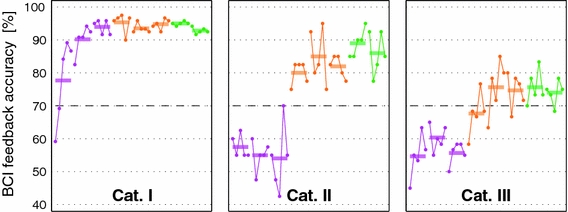
Brain-Computer Interfaces (BCIs) allow a user to control a computer application by brain activity as acquired, e.g., by EEG. One of the biggest challenges in BCI research is to understand and solve the problem of "BCI Illiteracy", which is that BCI control does not work for a non-negligible portion of users (estimated 15 to 30%). Here, we investigate the illiteracy problem in BCI systems which are based on the modulation of sensorimotor rhythms. In this paper, a sophisticated adaptation scheme is presented which guides the user from an initial subject-independent classifier that operates on simple features to a subject-optimized state-of-the-art classifier within one session while the user interacts the whole time with the same feedback application. While initial runs use supervised adaptation methods for robust co-adaptive learning of user and machine, final runs use unsupervised adaptation and therefore provide an unbiased measure of BCI performance. Using this approach, which does not involve any offline calibration measurement, good performance was obtained by good BCI participants (also one novice) after 3-6 min of adaptation. More importantly, the use of machine learning techniques allowed users who were unable to achieve successful feedback before to gain significant control over the BCI system. In particular, one participant had no peak of the sensory motor idle rhythm in the beginning of the experiment, but could develop such peak during the course of the session (and use voluntary modulation of its amplitude to control the feedback application).
Overview
The claims and statistics of this paper haven’t been checked yet.
Run the check — free, no account needed. It reads the open-access text and checks the sources it cites.
Integrity signals
Registry
Cites
Statistics
Figures
Verification
Claims the paper makes
The claims and statistics of this paper haven’t been checked yet.
Run the check — free, no account needed. It reads the open-access text and checks the sources it cites.
Claims other papers make about this one
Each is checked against this paper’s own text: does it say what the citing paper says it does?
The cited source says what the claim attributes to it.
In the citing paper
“and standard calibration pipelines fail to produce a functional classifier for a non-negligible portion of users [5].”
From ERP-XTTN: interpretable prototype-guided cross-attention for cross-subject ERP classification (2026) · cites this paper as [5]
In the citing paper
“Evidence that co-adaptive MI BCIs might also be able to promote and increase the ability of the users to voluntary modulate their brain signals (subject learning) is, in fact, scarce, most often indirect and rather inconclusive.”
From The Cybathlon BCI race: Successful longitudinal mutual learning with two tetraplegic users (2018) · cites this paper as [25]
In the citing paper
“Indeed, mutual learning has been claimed mostly on the grounds of adequate and improved BCI classification accuracy [25,27,30–35] or application performances [36,37].”
From The Cybathlon BCI race: Successful longitudinal mutual learning with two tetraplegic users (2018) · cites this paper as [25]
In the citing paper
“Firstly, works where users acquired BCI control (able-bodied [3,25] and end-users [40,41,51,62,63]) do not report any learning metric over time.”
From The Cybathlon BCI race: Successful longitudinal mutual learning with two tetraplegic users (2018) · cites this paper as [25]
In the citing paper
“Some works find no evident learning effects at the neural correlate level [25,34].”
From The Cybathlon BCI race: Successful longitudinal mutual learning with two tetraplegic users (2018) · cites this paper as [25]
In the citing paper
“Lack of robustness is a well-known issue of all BCI paradigms and has been associated to the nonstationarity of brain signals [18,25,27].”
From The Cybathlon BCI race: Successful longitudinal mutual learning with two tetraplegic users (2018) · cites this paper as [25]
Self-check
Percentages, sums and reported differences re-computed from the paper’s own numbers.
The self-check needs the paper’s full text.
Citations
Cites
Brain–computer interfaces for communication and control
Wolpaw, J. R., Birbaumer, N., McFarland, D. J., Pfurtscheller, G., & Vaughan, T. M. (2002) · Clinical Neurophysiology · doi:10.1016/s1388-2457(02)00057-3 · Cited by 7,927
A well-conditioned estimator for large-dimensional covariance matrices
Ledoit, O., & Wolf, M. (2004) · Journal of Multivariate Analysis · doi:10.1016/s0047-259x(03)00096-4 · Cited by 3,046
Optimizing Spatial filters for Robust EEG Single-Trial Analysis
Blankertz, B., Tomioka, R., Lemm, S., Kawanabe, M., & Muller, K.-R. (2008) · IEEE Signal Processing Magazine · doi:10.1109/msp.2008.4408441 · Cited by 2,080 · cited 5×
“Its speed was determined by the classi-fication output (similar to Blankertz et al. (2007, 2008a)).”
BackgroundMethodInfluentialSelf-citationHoney, I Shrunk the Sample Covariance Matrix
Ledoit, O., & Wolf, M. (2004) · The Journal of Portfolio Management · doi:10.3905/jpm.2004.110 · Cited by 1,279
Dimensionality Reduction of Multimodal Labeled Data by Local Fisher Discriminant Analysis
Sugiyama, M. (2007) · doi:10.5555/1248659.1248694 · Cited by 1,031
Blankertz, B., Dornhege, G., Krauledat, M., Müller, K., & Curio, G. (2007) · NeuroImage · doi:10.1016/j.neuroimage.2007.01.051 · Cited by 941
Self-citationToward Brain-Computer Interfacing
Dornhege, G., Millán, J. D. R., Hinterberger, T., McFarland, D. J., & Müller, K.-R. (2007) · The MIT Press eBooks · doi:10.7551/mitpress/7493.001.0001 · Cited by 789
Covariate Shift Adaptation by Importance Weighted Cross Validation
Sugiyama, M., Krauledat, M., & Müller, K. (2007) · doi:10.5555/1314498.1390324 · Cited by 733
Dornhege, G., Blankertz, B., Curio, G., & Müller, K. R. (2004) · IEEE Transactions on Biomedical Engineering · doi:10.1109/tbme.2004.827088 · Cited by 638
Self-citationBrain-computer communication: Unlocking the locked in.
Kübler, A., Kotchoubey, B., Kaiser, J., Wolpaw, J. R., & Birbaumer, N. (2001) · Psychological Bulletin · doi:10.1037/0033-2909.127.3.358 · Cited by 565
Research works printed but not linked: 1
- Vidaurre C, Schlögl A, Blankertz B, Kawanabe M, Müller KR (2008) Unsupervised adaptation of the LDA classifier for brain–computer interfaces. In: Proceedings of the 4th international brain–computer interface workshop and training course 2008, Verlag der Technischen Universität Graz, pp 122–127
Cited by
Sorted by citations
Single-trial analysis and classification of ERP components — A tutorial
Blankertz, B., Lemm, S., Treder, M., Haufe, S., & Müller, K.-R. (2011) · NeuroImage · doi:10.1016/j.neuroimage.2010.06.048 · Cited by 1,138
Self-citationCombining brain-computer interfaces and assistive technologies: state-of-the-art and challenges
Millán, J. D. R. (2010) · Frontiers in Neuroscience · doi:10.3389/fnins.2010.00161 · Cited by 905
Towards the utilization of EEG as a brain imaging tool
Michel, C. M., & Murray, M. M. (2011) · NeuroImage · doi:10.1016/j.neuroimage.2011.12.039 · Cited by 774
Introduction to machine learning for brain imaging
Lemm, S., Blankertz, B., Dickhaus, T., & Müller, K. (2010) · NeuroImage · doi:10.1016/j.neuroimage.2010.11.004 · Cited by 658
Self-citationEEG-Based Brain-Computer Interfaces Using Motor-Imagery: Techniques and Challenges
Padfield, N., Zabalza, J., Zhao, H., Masero, V., & Ren, J. (2019) · Sensors · doi:10.3390/s19061423 · Cited by 598
EEG dataset and OpenBMI toolbox for three BCI paradigms: an investigation into BCI illiteracy
Lee, M.-H., Kwon, O., Kim, Y.-J., Kim, H.-K., Lee, Y.-E., Williamson, J., Fazli, S., & Lee, S. (2019) · GigaScience · doi:10.1093/gigascience/giz002 · Cited by 591
Progress in Brain Computer Interface: Challenges and Opportunities
Saha, S., Mamun, K. A., Ahmed, K., Mostafa, R., Naik, G. R., Darvishi, S., Khandoker, A. H., & Baumert, M. (2021) · Frontiers in Systems Neuroscience · doi:10.3389/fnsys.2021.578875 · Cited by 428
The Berlin Brain–Computer Interface: Non-Medical Uses of BCI Technology
Blankertz, B., Tangermann, M., Vidaurre, C., Fazli, S., Sannelli, C., Haufe, S., Maeder, C., Ramsey, L., Sturm, I., Curio, G., et al. (2010) · Frontiers in Neuroscience · doi:10.3389/fnins.2010.00198 · Cited by 357
Self-citationIntra- and Inter-subject Variability in EEG-Based Sensorimotor Brain Computer Interface: A Review
Saha, S., & Baumert, M. (2020) · Frontiers in Computational Neuroscience · doi:10.3389/fncom.2019.00087 · Cited by 368
Trends in EEG-BCI for daily-life: Requirements for artifact removal
Minguillón, J., López-Gordo, M. A., & Pelayo, F. J. (2016) · Biomedical Signal Processing and Control · doi:10.1016/j.bspc.2016.09.005 · Cited by 303
EEG-Based Strategies to Detect Motor Imagery for Control and Rehabilitation
Ang, K. K., & Guan, C. (2016) · IEEE Transactions on Neural Systems and Rehabilitation Engineering · doi:10.1109/tnsre.2016.2646763 · Cited by 291
Open Access Dataset for EEG+NIRS Single-Trial Classification
Shin, J., von Lühmann, A., Blankertz, B., Kim, D.-W., Jeong, J., Hwang, H., & Müller, K. (2016) · IEEE Transactions on Neural Systems and Rehabilitation Engineering · doi:10.1109/tnsre.2016.2628057 · Cited by 283
Self-citationDecoding of four movement directions using hybrid NIRS-EEG brain-computer interface
Khan, M. J., Hong, M. J., & Hong, K.-S. (2014) · Frontiers in Human Neuroscience · doi:10.3389/fnhum.2014.00244 · Cited by 280
Kostas, D., Aroca-Ouellette, S., & Rudzicz, F. (2021) · Frontiers in Human Neuroscience · doi:10.3389/fnhum.2021.653659 · Cited by 348
Review of Machine Learning Techniques for EEG Based Brain Computer Interface
Aggarwal, S., & Chugh, N. (2022) · Archives of Computational Methods in Engineering · doi:10.1007/s11831-021-09684-6 · Cited by 272
Fahimi, F., Zhang, Z. D., Goh, W. B., Lee, T.-S., Ang, K. K., & Guan, C. (2018) · Journal of Neural Engineering · doi:10.1088/1741-2552/aaf3f6 · Cited by 269
Xu, M., Xiao, X., Wang, Y., Qi, H., Jung, T., & Ming, D. (2018) · IEEE Transactions on Biomedical Engineering · doi:10.1109/tbme.2018.2799661 · Cited by 228
Hybrid EEG–fNIRS-Based Eight-Command Decoding for BCI: Application to Quadcopter Control
Khan, M. J., & Hong, K. (2017) · Frontiers in Neurorobotics · doi:10.3389/fnbot.2017.00006 · Cited by 235
Brain–machine interfaces for controlling lower-limb powered robotic systems
He, Y., Eguren, D., Azorín, J. M., Grossman, R. G., Luu, T. P., & Contreras-Vidal, J. L. (2018) · Journal of Neural Engineering · doi:10.1088/1741-2552/aaa8c0 · Cited by 229
Hramov, A. E., Александрович, М. В., & Pisarchik, A. N. (2021) · Physics Reports · doi:10.1016/j.physrep.2021.03.002 · Cited by 228
Consumer grade EEG devices: are they usable for control tasks?
Maskeliūnas, R., Damaševičius, R., Martišius, I., & Vasiljevas, M. (2016) · PeerJ · doi:10.7717/peerj.1746 · Cited by 227
Foong, R., Ang, K. K., Quek, C. H., Guan, C., Phua, K. S., Kuah, C. W. K., Vishwanath, D. A., Yam, L. H. L., Rajeswaran, D. K., Tang, N., et al. (2019) · IEEE Transactions on Biomedical Engineering · doi:10.1109/tbme.2019.2921198 · Cited by 197
Jeunet, C., Jahanpour, E., & Lotte, F. (2016) · Journal of Neural Engineering · doi:10.1088/1741-2560/13/3/036024 · Cited by 192
Sparse Group Representation Model for Motor Imagery EEG Classification
Jiao, Y., Zhang, Y., Chen, X., Yin, E., Jin, J., Wang, X., & Cichocki, A. S. (2018) · IEEE Journal of Biomedical and Health Informatics · doi:10.1109/jbhi.2018.2832538 · Cited by 192
Zich, C., Debener, S., Kranczioch, C., Bleichner, M. G., Gutberlet, I., & Vos, M. D. (2015) · NeuroImage · doi:10.1016/j.neuroimage.2015.04.020 · Cited by 186
EEG-based BCI and video games: a progress report
Kerouš, B., Škola, F., & Liarokapis, F. (2017) · Virtual Reality · doi:10.1007/s10055-017-0328-x · Cited by 183
BCI Demographics II: How Many (and What Kinds of) People Can Use a High-Frequency SSVEP BCI?
Volosyak, I., Valbuena, D., Lüth, T., Malechka, T., & Gräser, A. (2011) · IEEE Transactions on Neural Systems and Rehabilitation Engineering · doi:10.1109/tnsre.2011.2121919 · Cited by 175
Brain–Computer Interface Games Based on Consumer-Grade EEG Devices: A Systematic Literature Review
Vasiljevic, G. A. M., & de Miranda, L. C. (2019) · International Journal of Human-Computer Interaction · doi:10.1080/10447318.2019.1612213 · Cited by 178
Spelling with non-invasive Brain–Computer Interfaces – Current and future trends
Cecotti, H. (2011) · Journal of Physiology-Paris · doi:10.1016/j.jphysparis.2011.08.003 · Cited by 177
Commanding a Brain-Controlled Wheelchair Using Steady-State Somatosensory Evoked Potentials
Kim, K.-T., Suk, H., & Lee, S. (2016) · IEEE Transactions on Neural Systems and Rehabilitation Engineering · doi:10.1109/tnsre.2016.2597854 · Cited by 166
The Cybathlon BCI race: Successful longitudinal mutual learning with two tetraplegic users
Perdikis, S., Tonin, L., Saeedi, S., Schneider, C., & Millán, J. D. R. (2018) · PLOS Biology · doi:10.1371/journal.pbio.2003787 · Cited by 166
EEG classification using sparse Bayesian extreme learning machine for brain–computer interface
Jin, Z., Zhou, G., Gao, D., & Zhang, Y. (2018) · Neural Computing and Applications · doi:10.1007/s00521-018-3735-3 · Cited by 161
Díez, P., Müller, S. M. T., Mut, V. A., Laciar, E., Avila, E., Bastos-Filho, T., & Sarcinelli-Filho, M. (2013) · Medical Engineering & Physics · doi:10.1016/j.medengphy.2012.12.005 · Cited by 157
A Survey on Unmanned Aerial Vehicle Remote Control Using Brain–Computer Interface
Nourmohammadi, A., Jafari, M., & Zander, T. O. (2018) · IEEE Transactions on Human-Machine Systems · doi:10.1109/thms.2018.2830647 · Cited by 157
Critiquing the Concept of BCI Illiteracy
Thompson, M. C. (2018) · Science and Engineering Ethics · doi:10.1007/s11948-018-0061-1 · Cited by 157
Kaufmann, T., Schulz, S. M., Köblitz, A., Renner, G., Wessig, C., & Kübler, A. (2012) · Clinical Neurophysiology · doi:10.1016/j.clinph.2012.11.006 · Cited by 154
Brain–Computer Interface for Neurorehabilitation of Upper Limb After Stroke
Ang, K. K., & Guan, C. (2015) · Proceedings of the IEEE · doi:10.1109/jproc.2015.2415800 · Cited by 152
A new hybrid BCI paradigm based on P300 and SSVEP
Wang, M., Daly, I. P., Allison, B. Z., Jin, J., Zhang, Y., Chen, L., & Wang, X. (2014) · Journal of Neuroscience Methods · doi:10.1016/j.jneumeth.2014.06.003 · Cited by 144
A hybrid ERD/SSVEP BCI for continuous simultaneous two dimensional cursor control
Allison, B. Z., Brunner, C., Altstätter, C., Wagner, I. C., Grissmann, S., & Neuper, C. (2012) · Journal of Neuroscience Methods · doi:10.1016/j.jneumeth.2012.06.022 · Cited by 144
A systematic review of the psychological factors that influence neurofeedback learning outcomes
Kadosh, K. C., & Staunton, G. (2018) · NeuroImage · doi:10.1016/j.neuroimage.2018.10.021 · Cited by 144
A hybrid BCI speller paradigm combining P300 potential and the SSVEP blocking feature
Xu, M., Qi, H., Wan, B., Yin, T., Liu, Z., & Ming, D. (2013) · Journal of Neural Engineering · doi:10.1088/1741-2560/10/2/026001 · Cited by 134
A systematic review of hybrid brain-computer interfaces: Taxonomy and usability perspectives
Choi, I., Rhiu, I., Lee, Y., Yun, M. H., & Nam, C. S. (2017) · PLoS ONE · doi:10.1371/journal.pone.0176674 · Cited by 133
Toward a Direct Measure of Video Quality Perception Using EEG
Scholler, S., Bosse, S., Treder, M. S., Blankertz, B., Curio, G., Müller, K., & Wiegand, T. (2012) · IEEE Transactions on Image Processing · doi:10.1109/tip.2012.2187672 · Cited by 130
Self-citationMachado, S. E. D. C., Araújo, F., Paes, F., Velasques, B., Cunha, M., Budde, H., Basile, L., Anghinah, R., Arias-Carrión, Ó., Cagy, M., et al. (2010) · Reviews in the Neurosciences · doi:10.1515/revneuro.2010.21.6.451 · Cited by 127
Zuberer, A., Brandeis, D., & Drechsler, R. (2015) · Frontiers in Human Neuroscience · doi:10.3389/fnhum.2015.00135 · Cited by 113
Lee, M.-H., Fazli, S., Mehnert, J., & Lee, S. (2015) · Pattern Recognition · doi:10.1016/j.patcog.2015.03.010 · Cited by 118
Zhang, T., Liu, T., Li, F., Li, M., Liu, D., Zhang, R., He, H., Li, P., Gong, J., Luo, C., et al. (2016) · NeuroImage · doi:10.1016/j.neuroimage.2016.04.030 · Cited by 119
A review of user training methods in brain computer interfaces based on mental tasks
Roc, A., Pillette, L., Mladenović, J., Benaroch, C., N’Kaoua, B., Jeunet, C., & Lotte, F. (2020) · Journal of Neural Engineering · doi:10.1088/1741-2552/abca17 · Cited by 124
Vučković, A., & Osuagwu, B. (2013) · Clinical Neurophysiology · doi:10.1016/j.clinph.2013.02.016 · Cited by 112
Quantifying the role of motor imagery in brain-machine interfaces
Marchesotti, S., Bassolino, M., Serino, A., Bleuler, H., & Blanke, O. (2016) · Scientific Reports · doi:10.1038/srep24076 · Cited by 111
Covert neurofeedback without awareness shapes cortical network spontaneous connectivity
Ramot, M., Grossman, S., Friedman, D. A., & Malach, R. (2016) · Proceedings of the National Academy of Sciences · doi:10.1073/pnas.1516857113 · Cited by 104
Predicting BCI Subject Performance Using Probabilistic Spatio-Temporal Filters
Suk, H., Fazli, S., Mehnert, J., Müller, K., & Lee, S. (2014) · PLoS ONE · doi:10.1371/journal.pone.0087056 · Cited by 106
A Brain-Machine Interface Based on ERD/ERS for an Upper-Limb Exoskeleton Control
Tang, Z., Sun, S., Zhang, S., Chen, Y., Li, C., & Chen, S. (2016) · Sensors · doi:10.3390/s16122050 · Cited by 109
Online SSVEP-based BCI using Riemannian geometry
Kalunga, E. K., Chevallier, S., Barthélemy, Q., Djouani, K., Monacelli, É., & Hamam, Y. (2016) · Neurocomputing · doi:10.1016/j.neucom.2016.01.007 · Cited by 104
Brain-computer interfacing using modulations of alpha activity induced by covert shifts of attention
Treder, M. S., Bahramisharif, A., Schmidt, N. M., van Gerven, M. A. J., & Blankertz, B. (2011) · Journal of NeuroEngineering and Rehabilitation · doi:10.1186/1743-0003-8-24 · Cited by 104
Self-citationBrain–Computer Interfaces for Augmentative and Alternative Communication: A Tutorial
Brumberg, J. S., Pitt, K. M., Mantie-Kozlowski, A., & Burnison, J. D. (2018) · American Journal of Speech-Language Pathology · doi:10.1044/2017_ajslp-16-0244 · Cited by 100
Chowdhury, A., Meena, Y. K., Raza, H., Bhushan, B., Uttam, A. K., Pandey, N., Hashmi, A. A., Bajpai, A., Dutta, A., & Prasad, G. (2018) · IEEE Journal of Biomedical and Health Informatics · doi:10.1109/jbhi.2018.2863212 · Cited by 98
Mak, J. N., McFarland, D. J., Vaughan, T. M., McCane, L. M., Tsui, P. Z., Zeitlin, D., Sellers, E. W., & Wolpaw, J. R. (2012) · Journal of Neural Engineering · doi:10.1088/1741-2560/9/2/026014 · Cited by 98
Hwang, H.-J., Lim, J., Kim, D.-W., & Im, C. (2014) · Journal of Biomedical Optics · doi:10.1117/1.jbo.19.7.077005 · Cited by 96
Is It Significant? Guidelines for Reporting BCI Performance
Billinger, M., Daly, I. P., Kaiser, V., Jin, J., Allison, B. Z., Müller-Putz, G., & Brunner, C. (2012) · Biological and medical physics series · doi:10.1007/978-3-642-29746-5_17 · Cited by 97
A Survey on the Use of Haptic Feedback for Brain-Computer Interfaces and Neurofeedback
Fleury, M., Lioi, G., Barillot, C., & Lécuyer, A. (2020) · Frontiers in Neuroscience · doi:10.3389/fnins.2020.00528 · Cited by 107
Bridging the gap between motor imagery and motor execution with a brain–robot interface
Bauer, R. H., Fels, M., Vukelić, M., Ziemann, U., & Gharabaghi, A. (2014) · NeuroImage · doi:10.1016/j.neuroimage.2014.12.026 · Cited by 98
Shin, J., Kwon, J., & Im, C. (2018) · Frontiers in Neuroinformatics · doi:10.3389/fninf.2018.00005 · Cited by 92
A high-speed brain-computer interface (BCI) using dry EEG electrodes
Spüler, M. (2017) · PLoS ONE · doi:10.1371/journal.pone.0172400 · Cited by 91
Feature extraction of four-class motor imagery EEG signals based on functional brain network
Ai, Q., Chen, A., Chen, K., Liu, Q., Zhou, T., Xin, S., & Ji, Z. (2019) · Journal of Neural Engineering · doi:10.1088/1741-2552/ab0328 · Cited by 94
Brain-Machine Interfaces: A Tale of Two Learners
Perdikis, S., & Millán, J. D. R. (2020) · IEEE Systems Man and Cybernetics Magazine · doi:10.1109/msmc.2019.2958200 · Cited by 92
Predicting term-relevance from brain signals
Eugster, M. J. A., Ruotsalo, T., Spapé, M., Kosunen, I., Barral, O., Ravaja, N., Jacucci, G., & Samuel Kaski, A. (2014) · International ACM SIGIR Conference on Research and Development in Information Retrieval (SIGIR) · doi:10.1145/2600428.2609594 · Cited by 89
Fazli, S., Dähne, S., Samek, W., Bieszmann, F., & Müller, K. (2015) · Proceedings of the IEEE · doi:10.1109/jproc.2015.2413993 · Cited by 90
Zhang, R., Xu, P., Chen, R., Li, F., Guo, L., Li, P., Zhang, T., & Yao, D. (2015) · Brain Topography · doi:10.1007/s10548-015-0429-3 · Cited by 84
Characterization of kinesthetic motor imagery compared with visual motor imageries
Yang, Y. J., Jeon, E. J., Kim, J. S., & Chung, C. K. (2021) · Scientific Reports · doi:10.1038/s41598-021-82241-0 · Cited by 82
Scherer, R., Faller, J., Friedrich, E. V. C., Opisso, E., Costa, U. M., Kübler, A., & Muller-Putz, G. R. (2015) · PLoS ONE · doi:10.1371/journal.pone.0123727 · Cited by 79
Blokland, Y., Spyrou, L., Thijssen, D. H. J., Eijsvogels, T. M. H., Colier, W. N. J. M., Floor, M., Vlek, R. J., Bruhn, J., & Farquhar, J. D. R. (2014) · IEEE Transactions on Neural Systems and Rehabilitation Engineering · doi:10.1109/tnsre.2013.2292995 · Cited by 84
The science and engineering behind sensitized brain-controlled bionic hands
Pandarinath, C., & Bensmaïa, S. J. (2021) · Physiological Reviews · doi:10.1152/physrev.00034.2020 · Cited by 79
Park, S., Cha, H., & Im, C. (2019) · IEEE Access · doi:10.1109/access.2019.2952613 · Cited by 81
Irimia, D.-C., Ortner, R., Poboroniuc, M.-S., Ignat, B. E., & Guger, C. (2018) · Frontiers in Robotics and AI · doi:10.3389/frobt.2018.00130 · Cited by 77
Vourvopoulos, A., Ferreira, A., & Badia, S. B. I. (2016) · International Conference on Physiological Computing Systems (PhyCS) · doi:10.5220/0005939400430053 · Cited by 77
Soekadar, S. R., Witkowski, M., Mellinger, J., Ramos‐Murguialday, A., Birbaumer, N., & Cohen, L. G. (2011) · IEEE Transactions on Neural Systems and Rehabilitation Engineering · doi:10.1109/tnsre.2011.2166809 · Cited by 76
Ron-Angevín, R., Velasco-Álvarez, F., Fernández-Rodríguez, Á., Estrella, A. D., Blanca, M. J., & Vizcaíno-Martín, F.-J. (2017) · Journal of NeuroEngineering and Rehabilitation · doi:10.1186/s12984-017-0261-y · Cited by 75
SSVEP-Based Brain–Computer Interfaces Using FSK-Modulated Visual Stimuli
Kimura, Y., Tanaka, T., Higashi, H., & Morikawa, N. (2013) · IEEE Transactions on Biomedical Engineering · doi:10.1109/tbme.2013.2265260 · Cited by 75
Brain–computer interfaces in amyotrophic lateral sclerosis: A metanalysis
Marchetti, M., & Priftis, K. (2014) · Clinical Neurophysiology · doi:10.1016/j.clinph.2014.09.017 · Cited by 77
Huang, G., Zhao, Z., Zhang, S., Hu, Z., Fan, J., Fu, M., Chen, J., Xiao, Y., Wang, J., & Guo, D. (2023) · Frontiers in Neuroscience · doi:10.3389/fnins.2023.1122661 · Cited by 74
Shin, J., Müller, K.-R., & Hwang, H.-J. (2016) · Scientific Reports · doi:10.1038/srep36203 · Cited by 73
Shu, X., Chen, S., Yao, L., Sheng, X., Zhang, D., Jiang, N., Jia, J., & Zhu, X. (2018) · Frontiers in Neuroscience · doi:10.3389/fnins.2018.00093 · Cited by 73
Integrating EEG and MEG Signals to Improve Motor Imagery Classification in Brain–Computer Interface
Corsi, M., Chávez, M., Schwartz, D., Hugueville, L., Khambhati, A. N., Bassett, D. S., & Fallani, F. D. V. (2018) · International Journal of Neural Systems · doi:10.1142/s0129065718500144 · Cited by 73
Challenges and Opportunities for the Future of Brain-Computer Interface in Neurorehabilitation
Simon, C., Bolton, D. A. E., Kennedy, N. C., Soekadar, S. R., & Ruddy, K. L. (2021) · Frontiers in Neuroscience · doi:10.3389/fnins.2021.699428 · Cited by 70
A brain-controlled lower-limb exoskeleton for human gait training
Liu, D., Chen, W., Pei, Z., & Wang, J. (2017) · Review of Scientific Instruments · doi:10.1063/1.5006461 · Cited by 70
Reinforcement learning of self-regulated β-oscillations for motor restoration in chronic stroke
Naros, G., & Gharabaghi, A. (2015) · Frontiers in Human Neuroscience · doi:10.3389/fnhum.2015.00391 · Cited by 71
Review of Wireless Brain-Computer Interface Systems
Lee, S., Shin, Y., Woo, S., Kim, K., & Lee, H.-N. (2013) · InTech eBooks · doi:10.5772/56436 · Cited by 68
Lee, W., Kim, S., Kim, B., Lee, C., Chung, Y. A., Kim, L., & Yoo, S. (2017) · PLoS ONE · doi:10.1371/journal.pone.0178476 · Cited by 69
Towards improved BCI based on human learning principles
Lotte, F., & Jeunet, C. (2015) · International Winter Conference on Brain-Computer Interface (BCI) · doi:10.1109/iww-bci.2015.7073024 · Cited by 67
Task-dependent signal variations in EEG error-related potentials for brain–computer interfaces
Iturrate, I., Montesano, L., & Mínguez, J. (2013) · Journal of Neural Engineering · doi:10.1088/1741-2560/10/2/026024 · Cited by 67
Coyle, D., Stow, J., McCreadie, K. A., McElligott, J. M., & Carroll, Á. M. (2015) · Archives of Physical Medicine and Rehabilitation · doi:10.1016/j.apmr.2014.08.024 · Cited by 62
Combining Cryptography with EEG Biometrics
Damaševičius, R., Maskeliūnas, R., Kazanavičius, E., & Woźniak, M. (2018) · Computational Intelligence and Neuroscience · doi:10.1155/2018/1867548 · Cited by 64
The effect of multimodal and enriched feedback on SMR-BCI performance
Sollfrank, T., Ramsay, A., Perdikis, S., Williamson, J. H., Murray‐Smith, R., Leeb, R., Millán, J. D. R., & Kübler, A. (2015) · Clinical Neurophysiology · doi:10.1016/j.clinph.2015.06.004 · Cited by 63
Roy, S., Chowdhury, A., McCreadie, K. A., & Prasad, G. (2020) · Frontiers in Neuroscience · doi:10.3389/fnins.2020.00918 · Cited by 62
Bauer, R. H., & Gharabaghi, A. (2015) · Frontiers in Neuroscience · doi:10.3389/fnins.2015.00036 · Cited by 62
Hwang, H., Choi, H. N., Kim, J.-Y., Chang, W.-D., Kim, D.-W., Kim, K., Jo, S., & Im, C. (2016) · Journal of Biomedical Optics · doi:10.1117/1.jbo.21.9.091303 · Cited by 62
Vukelić, M., Bauer, R. H., Naros, G., Naros, I., Braun, C., & Gharabaghi, A. (2013) · NeuroImage · doi:10.1016/j.neuroimage.2013.10.003 · Cited by 60
Grigorev, N., Savosenkov, A., Lukoyanov, M. V., Udoratina, A., Shusharina, N. N., Kaplan, A., Hramov, A. E., Kazantsev, V., & Gordleeva, S. (2021) · IEEE Transactions on Neural Systems and Rehabilitation Engineering · doi:10.1109/tnsre.2021.3102304 · Cited by 62
Self-recalibrating classifiers for intracortical brain–computer interfaces
Bishop, W. E., Chestek, C. A., Gilja, V., Nuyujukian, P., Foster, J. D., Ryu, S. I., Shenoy, K. V., & Yu, B. M. (2014) · Journal of Neural Engineering · doi:10.1088/1741-2560/11/2/026001 · Cited by 64
Metadata
- Authors
- Vidaurre, C., & Blankertz, B.
- Affiliations
- Technische Universität Berlin (DE)
- Corresponding author
- Vidaurre, Carmen
- Venue
- Brain Topography
- Published
- 2009-11-28
- Volume
- 23
- Issue
- 2
- Pages
- 194-198
- ISSN
- 0896-0267 (ISSN-L)
- 1573-6792
- PMC
- PMC2874052
- OpenAlex
- W2003621157
- Cited by
- 501
- References
- 24
- Citations by year
- 2026: 31 · 2025: 24 · 2024: 30 · 2023: 28 · 2022: 33 · 2021: 42 · 2020: 45 · 2019: 32 · 2018: 46 · 2017: 31 · 2016: 37 · 2015: 29 · 2014: 30 · 2013: 23 · 2012: 19
- FWCI
- 6.38
- Type
- journal article
- Language
- en
- Open access
- hybrid
- doi.org
- Licence
- cc-by-nc
- Locations
- Brain Topography (publishedVersion, cc-by-nc)
- PubMed Central (publishedVersion, cc-by-nc)
- PubMed (publishedVersion)
- TECNALIA Publications (Fundación TECNALIA Research & Innovation) (submittedVersion, cc-by-nc)
- Publikationsdatenbank der Fraunhofer-Gesellschaft (Fraunhofer-Gesellschaft) (submittedVersion)
- Fraunhofer-Publica (Fraunhofer-Gesellschaft) (submittedVersion)
- Funders
- European Commission (224631, 216886)
- Deutsche Forschungsgemeinschaft (01GQ0850)
- Bundesministerium für Bildung und Forschung (01GQ0850, 01IB001A)
- Topics
- Life Sciences › Neuroscience › Cognitive Neuroscience › EEG and Brain-Computer Interfaces
- Physical Sciences › Computer Science › Human-Computer Interaction › Gaze Tracking and Assistive Technology
- Physical Sciences › Computer Science › Artificial Intelligence › Emotion and Mood Recognition
- Keywords
- BCI illiteracy, brain-computer interface, sensorimotor rhythm, EEG, online adaptation, unsupervised adaptation, supervised adaptation, novice users, motor imagery
- MeSH terms
- Algorithms, Artificial Intelligence, Brain, Electroencephalography, Humans, Imagination, Learning, Motor Activity, Signal Processing, Computer-Assisted, Time Factors, User-Computer Interface, Feedback, Psychological
About these checks
Registry, retraction, Cites and statistics results are computed, not judged, with one exception: a printed reference that no index lists is read once by a model before it counts as a citation error. Claims are extracted by a model and kept only when their quote appears verbatim in the text; each cited source is then checked, with a model’s help, for whether it says what the claim relies on. Those verdicts can be wrong — read the claim’s quote and the cited source before relying on one.
Statistics and arithmetic are recomputed, not judged.
Confidence bands are shown only for fields calibrated on our annotated test set. None is calibrated yet, so no band is shown.
What counts as a claim ›How we measure confidence ›How we check this ›
Are you an author, or do you see a problem with this page? Request a review
