

The DOI matches its Crossref record; 24 of the 24 references it cites were found in a registry or an index.
Towards a Cure for BCI Illiteracy
Open accessAbstract
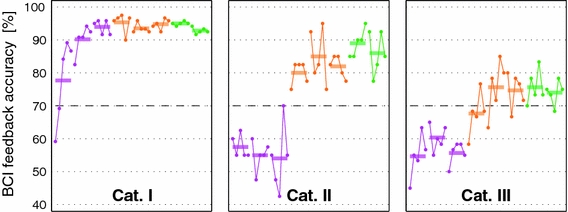
Brain-Computer Interfaces (BCIs) allow a user to control a computer application by brain activity as acquired, e.g., by EEG. One of the biggest challenges in BCI research is to understand and solve the problem of "BCI Illiteracy", which is that BCI control does not work for a non-negligible portion of users (estimated 15 to 30%). Here, we investigate the illiteracy problem in BCI systems which are based on the modulation of sensorimotor rhythms. In this paper, a sophisticated adaptation scheme is presented which guides the user from an initial subject-independent classifier that operates on simple features to a subject-optimized state-of-the-art classifier within one session while the user interacts the whole time with the same feedback application. While initial runs use supervised adaptation methods for robust co-adaptive learning of user and machine, final runs use unsupervised adaptation and therefore provide an unbiased measure of BCI performance. Using this approach, which does not involve any offline calibration measurement, good performance was obtained by good BCI participants (also one novice) after 3-6 min of adaptation. More importantly, the use of machine learning techniques allowed users who were unable to achieve successful feedback before to gain significant control over the BCI system. In particular, one participant had no peak of the sensory motor idle rhythm in the beginning of the experiment, but could develop such peak during the course of the session (and use voluntary modulation of its amplitude to control the feedback application).
Overview
The claims and statistics of this paper haven’t been checked yet.
Run the check — free, no account needed. It reads the open-access text and checks the sources it cites.
Integrity signals
Registry
Cites
Statistics
Figures
Verification
Claims the paper makes
The claims and statistics of this paper haven’t been checked yet.
Run the check — free, no account needed. It reads the open-access text and checks the sources it cites.
Claims other papers make about this one
Each is checked against this paper’s own text: does it say what the citing paper says it does?
The cited source says what the claim attributes to it.
In the citing paper
“Indeed, mutual learning has been claimed mostly on the grounds of adequate and improved BCI classification accuracy [25,27,30–35] or application performances [36,37].”
From The Cybathlon BCI race: Successful longitudinal mutual learning with two tetraplegic users (2018) · cites this paper as [25]
The cited source says what the claim attributes to it.
In the citing paper
“and standard calibration pipelines fail to produce a functional classifier for a non-negligible portion of users [5].”
From ERP-XTTN: interpretable prototype-guided cross-attention for cross-subject ERP classification (2026) · cites this paper as [5]
In the citing paper
“Evidence that co-adaptive MI BCIs might also be able to promote and increase the ability of the users to voluntary modulate their brain signals (subject learning) is, in fact, scarce, most often indirect and rather inconclusive.”
From The Cybathlon BCI race: Successful longitudinal mutual learning with two tetraplegic users (2018) · cites this paper as [25]
In the citing paper
“Firstly, works where users acquired BCI control (able-bodied [3,25] and end-users [40,41,51,62,63]) do not report any learning metric over time.”
From The Cybathlon BCI race: Successful longitudinal mutual learning with two tetraplegic users (2018) · cites this paper as [25]
In the citing paper
“Some works find no evident learning effects at the neural correlate level [25,34].”
From The Cybathlon BCI race: Successful longitudinal mutual learning with two tetraplegic users (2018) · cites this paper as [25]
In the citing paper
“Lack of robustness is a well-known issue of all BCI paradigms and has been associated to the nonstationarity of brain signals [18,25,27].”
From The Cybathlon BCI race: Successful longitudinal mutual learning with two tetraplegic users (2018) · cites this paper as [25]
Self-check
Percentages, sums and reported differences re-computed from the paper’s own numbers.
The self-check needs the paper’s full text.
Citations
Cites
Brain–computer interfaces for communication and control
Wolpaw, J. R., Birbaumer, N., McFarland, D. J., Pfurtscheller, G., & Vaughan, T. M. (2002) · Clinical Neurophysiology · doi:10.1016/s1388-2457(02)00057-3 · Cited by 7,927
A well-conditioned estimator for large-dimensional covariance matrices
Ledoit, O., & Wolf, M. (2004) · Journal of Multivariate Analysis · doi:10.1016/s0047-259x(03)00096-4 · Cited by 3,046
Optimizing Spatial filters for Robust EEG Single-Trial Analysis
Blankertz, B., Tomioka, R., Lemm, S., Kawanabe, M., & Muller, K.-R. (2008) · IEEE Signal Processing Magazine · doi:10.1109/msp.2008.4408441 · Cited by 2,080 · cited 5×
“Its speed was determined by the classi-fication output (similar to Blankertz et al. (2007, 2008a)).”
BackgroundMethodInfluentialSelf-citationHoney, I Shrunk the Sample Covariance Matrix
Ledoit, O., & Wolf, M. (2004) · The Journal of Portfolio Management · doi:10.3905/jpm.2004.110 · Cited by 1,279
Dimensionality Reduction of Multimodal Labeled Data by Local Fisher Discriminant Analysis
Sugiyama, M. (2007) · doi:10.5555/1248659.1248694 · Cited by 1,031
Blankertz, B., Dornhege, G., Krauledat, M., Müller, K., & Curio, G. (2007) · NeuroImage · doi:10.1016/j.neuroimage.2007.01.051 · Cited by 941
Self-citationToward Brain-Computer Interfacing
Dornhege, G., Millán, J. D. R., Hinterberger, T., McFarland, D. J., & Müller, K.-R. (2007) · The MIT Press eBooks · doi:10.7551/mitpress/7493.001.0001 · Cited by 789
Covariate Shift Adaptation by Importance Weighted Cross Validation
Sugiyama, M., Krauledat, M., & Müller, K. (2007) · doi:10.5555/1314498.1390324 · Cited by 733
Dornhege, G., Blankertz, B., Curio, G., & Müller, K. R. (2004) · IEEE Transactions on Biomedical Engineering · doi:10.1109/tbme.2004.827088 · Cited by 638
Self-citationBrain-computer communication: Unlocking the locked in.
Kübler, A., Kotchoubey, B., Kaiser, J., Wolpaw, J. R., & Birbaumer, N. (2001) · Psychological Bulletin · doi:10.1037/0033-2909.127.3.358 · Cited by 565
Research works printed but not linked: 1
- Vidaurre C, Schlögl A, Blankertz B, Kawanabe M, Müller KR (2008) Unsupervised adaptation of the LDA classifier for brain–computer interfaces. In: Proceedings of the 4th international brain–computer interface workshop and training course 2008, Verlag der Technischen Universität Graz, pp 122–127
Cited by
Sorted by citations
Items 401–500 of 501
Wang, J., Wang, J., Li, M., Zhao, J., & Wu, Z. (2026) · Biomedical Signal Processing and Control · doi:10.1016/j.bspc.2026.110477 · Cited by 1
Cheng, Y., 郭向奎, Dong, L., Deng, Q., Qiu, M., & Luo, Z. (2026) · Frontiers in Neurology · doi:10.3389/fneur.2026.1861673 · Cited by 1
Yao, L., Xie, T., Shu, X., Sheng, X., Zhang, D., & Zhu, X. (2015) · International IEEE/EMBS Conference on Neural Engineering · doi:10.1109/ner.2015.7146567 · Cited by 1
Brain-Controlled Selection of Objects Combined with Autonomous Robotic Grasping
Reichert, C., Kennel, M., Kruse, R., Heinze, H., Schmucker, U., Hinrichs, H., & Rieger, J. W. (2015) · Springer series in computational neuroscience · doi:10.1007/978-3-319-15997-3_5 · Cited by 1
Iturrate, I., Montesano, L., Chavarriaga, R., Millán, J. D. R., & Mínguez, J. (2011) · Infoscience (Ecole Polytechnique Fédérale de Lausanne) · Cited by 1
Co-adaptivity in Unsupervised Adaptive Brain-Computer Interfacing: a Simulation Approach
Spüler, M., Rosenstiel, W., & Bogdan, M. (2012) · Cited by 1
Methodology of improving illiteracy in P3 speller system with ICA blind detection
Yoon, J., Whang, M., & Lee, J.-N. (2016) · HCI Korea · doi:10.17210/hcik.2016.01.87 · Cited by 1
Combining Neural Population Recordings: Theory and Application
Bishop, W. E. (2015) · KiltHub Repository · doi:10.1184/r1/6715196 · Cited by 1
Improving Learning from Label proportions by Reducing the Feature Dimensionality.
Hübner, D., Kindermans, P.-J., Verhoeven, T., & Tangermann, M. (2017) · GBCIC · Cited by 1
Bushkova, Y., Ivanova, G. Е., Стаховская, Л. В., & Фролов, А. А. (2019) · Вестник Российского государственного медицинского университета · doi:10.24075/vrgmu.2019.078 · Cited by 1
Practical, Conceptual and Ethical Dimensions of a Neuro-controlled Speech Neuroprosthesis
Rainey, S. (2021) · Advances in neuroethics · doi:10.1007/978-3-030-64590-8_13 · Cited by 1
Alfeo, A. L., Catrambone, V., Cimino, M. G. C. A., Vaglini, G., & Valenza, G. (2021) · Annual International Conference of the IEEE Engineering in Medicine and Biology Society (EMBC) · doi:10.1109/embc46164.2021.9629900 · Cited by 1
Coyle, D., & Sosnik, R. (2015) · Springer eBooks · doi:10.1007/978-3-662-43505-2_39 · Cited by 1
Connelly, A., Li, P., Rangpong, P., Wilaiprasitporn, T., & Yagi, T. (2023) · IEEE International Symposium on Medical Measurements and Applications (MeMeA) · doi:10.1109/memea57477.2023.10171918 · Cited by 1
Evolving Trends and Future Prospects of Transformer Models in EEG-Based Motor-Imagery BCI Systems
Keutayeva, A., Zollanvari, A., & Abibullaev, B. (2024) · Springer eBooks · doi:10.1007/978-3-031-66656-8_10 · Cited by 1
Acción, performatividad y autoridad: reflexiones desde Arendt y Butler
Straehle, E. (2017) · Isegoría · doi:10.3989/isegoria.2017.056.11 · Cited by 1
BCI driven by self-induced emotions: a multi-class study
Placidi, G., Polsinelli, M., Spezialetti, M., & Cinque, L. (2018) · IEEE International Symposium on Medical Measurements and Applications (MeMeA) · doi:10.1109/memea.2018.8438817 · Cited by 1
Asynchronous Brain Computer Interfaces Using Echo State Networks
Zakkay, E., Abu-Rmileh, A., Geva, A. B., & Shriki, O. (2020) · International Joint Conference on Neural Networks (IJCNN) · doi:10.1109/ijcnn48605.2020.9207481 · Cited by 1
Towards Brain-Machine Interface-Based Rehabilitation for Patients with Chronic Complete Paraplegia
Shokur, S. (2021) · Springer briefs in electrical and computer engineering · doi:10.1007/978-3-030-60460-8_14 · Cited by 1
Xu, D., & Li, M. (2022) · PubMed Central · doi:10.7507/1001-5515.202108060 · Cited by 1
Use of linguistic signified to support information communication
dos Santos, M., & Duque, C. G. (2022) · RDBCI Revista Digital de Biblioteconomia e Ciência da Informação · doi:10.20396/rdbci.v20i00.8668196 · Cited by 1
Gant, K. L. (2016) · Cited by 1
Ravi, A. (2019) · UWSpace (University of Waterloo) · Cited by 1
Daeglau, M., Zich, C., Welzel, J., Saak, S. K., Scheffels, J. F., & Kranczioch, C. (2020) · bioRxiv (Cold Spring Harbor Laboratory) · doi:10.1101/2020.12.11.420919 · Cited by 1
Li, C., Qin, C., & Fang, J. (2021) · arXiv (Cornell University) · doi:10.48550/arxiv.2108.12295 · Cited by 1
Why Don't You Click: Neural Correlates of Non-Click Behaviors in Web SearchPreprint
Ye, Z., Xie, X., Liu, Y., Wang, Z., Li, X., Li, J., Chen, X., Zhang, M., & Ma, S. (2021) · arXiv (Cornell University) · doi:10.48550/arxiv.2109.10560 · Cited by 1
Noninvasive Brain-Computer Interfaces
Allison, B. Z., & Krusienski, D. J. (2015) · Springer eBooks · doi:10.1007/978-1-4614-6675-8_707 · Cited by 1
Krause, F., Linden, D. E. J., & Hermans, E. J. (2022) · doi:10.31219/osf.io/vxnbk · Cited by 1
A multi-subject and multi-session EEG dataset for modelling human visual object recognition
Xue, S., Jin, B., Jiang, J., Guo, L., Jin, Z., Wang, C., & Liu, J. (2025) · Scientific Data · doi:10.1038/s41597-025-04843-x · Cited by 2
Fleury, M. (2021) · theses.fr (ABES) · doi:10.70675/eb46e415z1b2ez4636z943fz076695b04c2d · Cited by 1
ERP-XTTN: interpretable prototype-guided cross-attention for cross-subject ERP classification
Genevier Wyman, C., & Hirshfield, L. (2026) · Journal of Neural Engineering · doi:10.1088/1741-2552/ae9f95
“Classification must generalize across subjects, since per-subject calibration delays setup and limits scalability [4], and standard calibration pipelines fail to produce a functional classifier for a non-negligible portion of users [5].”
Apprentissage statistique pour le signal: applications aux interfaces cerveau-machine
Flamary, R. (2011) · HAL
Shoureshi, R. A., & Aasted, C. M. (2014) · Advances in science and technology · doi:10.4028/www.scientific.net/ast.96.89
Towards closed-loop stimulation for stroke rehabilitation
Walter, A. (2013)
Obstacles in using a computer screen for steady-state visually evoked potential stimulation
Olze, K., Wehrmann, C., Mu, L., & Schilling, M. (2017) · Biomedizinische Technik/Biomedical Engineering · doi:10.1515/bmt-2016-0243
Ezquerro, S., Bertomeu-Motos, A., Barios, J. A., Pérez, L. D. L., Catalan, J. M., & García-Aracil, N. (2020) · Jornadas de Automática · doi:10.17979/spudc.9788497497565.0108
Voluntary Self-Regulation BCI with Real-Time User Feedback in an Adolescent Population
Abdoli, R. (2018) · TSpace (University of Toronto)
Combination of connectivity and spectral features for motor-imagery BCI
Cattai, T., Colonnese, S., Corsi, M., Bassett, D. S., Scarano, G., & Fallani, F. D. V. (2020) · HAL · doi:10.3217/978-3-85125-682-6-32
Brain-computer interface for mental attention
Fahimi, F. (2019) · doi:10.32657/10356/137001
Enabling Brain-Computer Interface Co-Adaptation with Performance-Related Signals
Wilson, N. R. (2019) · ResearchWorks at the University of Washington (University of Washington)
Emotion-robust EEG Classification for Motor ImageryPreprint
Moeed, A. (2020) · arXiv (Cornell University) · doi:10.48550/arxiv.2005.13523
Investigation of EEG Correlate in NIRS Signal for BCI
Johar, A. H., Yousaf, T., Asgher, U., Ayaz, Y., Nazir, S., Khan, M. J., Mustafa, L., & Khalil, K. (2020) · Advances in intelligent systems and computing · doi:10.1007/978-3-030-51041-1_42
Personalised Signal Processing for Cortical and Cardiac Applications
Saha, S. (2020) · Adelaide Research & Scholarship (AR&S) (University of Adelaide)
Spatiotemporal neural correlates of brain-computer interface learningPreprint
Corsi, M., Chávez, M., Schwartz, D., George, N., Hugueville, L., Khan, A. E., Dupont, S., Bassett, D. S., & Fallani, F. D. V. (2018) · bioRxiv (Cold Spring Harbor Laboratory) · doi:10.1101/487074
Applications and Statistical Modeling of Electroencephalograms using Identity Vectors
Ward, C. R. (2019) · TUScholarShare (Temple University)
Utilizing Machine Learning and Virtual Reality to Facilitate Brain-computer Interface Control
Reyhani-Masoleh, B. (2019) · TSpace (University of Toronto)
Effects of Interpretation Error on User Learning in Novel Input Mechanisms
Lam, K. C. (2021) · HARVEST (University of Saskatchewan)
Harvesting Brain Signal Using Machine Learning Methods
Matsuno, K., & Nandikolla, V. K. (2021) · Journal of Engineering and Science in Medical Diagnostics and Therapy · doi:10.1115/1.4053064
Brain Computer Interface Using Response of Alpha Wave to Word Task
Nishifuji, S., Yasunaga, K., Matsubara, A., & Nakashima, S. (2021) · IEEE Global Conference on Consumer Electronics (GCCE) · doi:10.1109/gcce53005.2021.9621831
A functional BCI model by the P2731 working group: psychology
Zapała, D., Hossaini, A., Kianpour, M., Sahonero-Alvarez, G., & Ayesh, A. (2021) · Brain-Computer Interfaces · doi:10.1080/2326263x.2021.1935124
Cutellic, P., & Qureshi, N. K. (2022) · Research Square · doi:10.21203/rs.3.rs-1206625/v1
Chung, C. K., Yang, Y. J., Ryun, S., & Kim, J. S. (2022) · Research Square · doi:10.21203/rs.3.rs-1402386/v1
Specificities of ERD lateralization during motion execution
Smirnov, N. M., Kurkin, S., & Hramov, A. E. (2022) · Computational Biophysics and Nanobiophotonics · doi:10.1117/12.2626745
Mensch und Technik in der angewandten Forschung
Müller, N. H., Schütz, A. E., & Fertig, T. (2022) · Edition HMD · doi:10.1007/978-3-658-34524-2_1
(2014) · Advances in medical technologies and clinical practice book series · doi:10.4018/978-1-4666-6130-1.ch004
(2019) · Bulletin of Russian State Medical University · doi:10.24075/vrgmu.2019-06
Osiurak, F. (2020) · doi:10.1002/9781119720348.refs
Müller, K. (2019) · Faculty Opinions – Post-Publication Peer Review of the Biomedical Literature · doi:10.3410/f.734961664.793562918
(2019) · Вестник Российского государственного медицинского университета · doi:10.24075/brsmu.2019-06
Noninvasive Brain-Computer Interfaces
Allison, B. Z., & Krusienski, D. J. (2022) · Springer eBooks · doi:10.1007/978-1-0716-1006-0_707
Xu, Y., Ding, S., Liang, S., Yuan, Z., Sun, L., Wang, D., & Zhang, H. (2022) · International Conference on Advanced Robotics and Mechatronics (ICARM) · doi:10.1109/icarm54641.2022.9959667
Masuo, A., Sakuma, T., & Kato, S. (2023) · Advanced Biomedical Engineering · doi:10.14326/abe.12.129
Quadcopter Control using Labview for a Brain Computer Interface System
Alwasiti, H., & Yusoff, M. Z. (2021) · Advanced Journal of Technical and Vocational Education · doi:10.26666/rmp.ajtve.2021.3.2
Collura, T. F., Keizer, A. W., Pérez-Elvira, R., Warner, S., & Feiner, T. F. (2023) · Elsevier eBooks · doi:10.1016/b978-0-323-89827-0.00027-9
Chang, L.-F., Lu, P.-S., Ko, L., & Chen, C. (2023) · International Automatic Control Conference · doi:10.1109/cacs60074.2023.10325860
Exploring connectivity of resting-state EEG between BCI-literate and -illiterate groupsPreprint
Park, H., & Jun, S. C. (2023) · bioRxiv (Cold Spring Harbor Laboratory) · doi:10.1101/2023.11.25.568691
Improving motor imagery through a mirror box for BCI users
Gómez, D. M. C., & Braidot, A. A. A. (2024) · Journal of Neurophysiology · doi:10.1152/jn.00121.2023
Mirror Visual Feedback as a Tool for Training Users to Achieve Control Over the BCI
Gómez, D. M. C., & Braidot, A. A. A. (2024) · World Congress on Medical Physics and Biomedical Engineering, September 7 - 12, 2009, Munich, Germany · doi:10.1007/978-3-031-51723-5_9
Addressing Motor Imagery Performance Bias in Neurofeedback Training to Improve BCI Performance
Connelly, A., Li, P., Rangpong, P., Wilaiprasitporn, T., & Yagi, T. (2024) · IEEJ Transactions on Electronics Information and Systems · doi:10.1541/ieejeiss.144.431
Cryptographic Algorithm Designed by Extracting Brainwave Patterns
Dragu, M.-A., Nicolae, I.-E., & Frunzete, M.-C. (2024) · Mathematics · doi:10.3390/math12131971
Comparing a BCI communication system in a patient with Multiple System Atrophy, with an animal model
Premchand, B., Toe, K. K., Wang, C., Wan, K. R., Selvaratnam, T., Toh, V. E., Ng, W. H., Libedinsky, C., Chen, W., Lim, R., et al. (2025) · Brain Research Bulletin · doi:10.1016/j.brainresbull.2025.111289
Emergency Motor Intention Detection Based on Unpredictable Anticipatory Activity: An EEG Study
Chen, L., He, J., Zhang, L., Xu, M., Wang, Z., & Ming, D. (2025) · IEEE Transactions on Human-Machine Systems · doi:10.1109/thms.2025.3619064
Cueva, V. M., Lotte, F., Bougrain, L., & Rimbert, S. (2025) · Annual International Conference of the IEEE Engineering in Medicine and Biology Society (EMBC) · doi:10.1109/embc58623.2025.11254356
Transformer-based hybrid systems to combat BCI illiteracy
Pfeffer, M. A., Wong, J. K. W., & Ling, S. H. (2025) · Computers in Biology and Medicine · doi:10.1016/j.compbiomed.2025.111378
Successful single-session neural self-regulation through neurofeedback varies between featuresPreprint
Syrjänen, E., Silva, J., & Ästrand, E. (2026) · bioRxiv (Cold Spring Harbor Laboratory) · doi:10.64898/2026.01.07.698228
de Vos, J. H., Leibold, N. K., Lührs, M., Eck, J., Schruers, K. R. J., Goebel, R., & Linden, D. E. J. (2026) · Neuropsychologia · doi:10.1016/j.neuropsychologia.2026.109435
Jawad, M. A. (2026) · University of Michigan Undergraduate Research Journal · doi:10.3998/umurj.9818
张, 扬. (2026) · Hans Journal of Biomedicine · doi:10.12677/hjbm.2026.162031
Gaume, A. (2016) · theses.fr (ABES) · doi:10.70675/53cc1893z83e8z4d77za68ez96adfd9528ee · Cited by 2
Méthodes pour l'électroencéphalographie multi-sujet et application aux interfaces cerveau-ordinateur
Korczowski, L. (2018) · theses.fr (ABES) · doi:10.70675/38d2a12fz024fz4d84z8a8az0dc16b2cff6a
陈, 忆. (2026) · Asian Case Reports in Emergency Medicine · doi:10.12677/acrem.2026.142034
Optimization of cVEP Classification Approaches for 3D VR Based Brain Computer Interfaces
Gouret, A., Woelffel, V., Delaux, A., Bars, S. L., & Zilelioglu, H. (2026) · International Conference on Current Research in Artificial Intelligence and Data Science (ICCRAIDS) · doi:10.1109/iccraids67816.2026.11519663
D’Aquino, A., & Schack, T. (2026) · Frontiers in Human Neuroscience · doi:10.3389/fnhum.2026.1849674
Xia, X., Kang, X., Jia, L., Wang, Q., Zhang, L., Zhang, R., Wang, Y., Wu, X., Chen, X., & Liu, L. (2026) · Frontiers in Neurology · doi:10.3389/fneur.2026.1839697
Motor imagery interventions in stroke patients modulate their brain-heart network dynamicsPreprint
Candia‐Rivera, D., Corsi, M., Gonzalez-Astudillo, J., Rosso, C., Fallani, F. D. V., & Chávez, M. (2026) · medRxiv · doi:10.64898/2026.06.23.26355958
Benoit, L., Lioi, G., Ouahidi, Y. E., Farrugia, N., Mattout, J., Maby, E., Bougard, C., & Dauguet, J. (2026) · Lecture notes in computer science · doi:10.1007/978-981-95-9575-4_30
Jin, F., Feng, L., Qian, Z., & Ao, X. (2026) · Communications in computer and information science · doi:10.1007/978-981-92-3560-5_36
Otarbay, Z., Kyzyrkanov, A. E., Турсынова, Н., Amirov, A., & Saltanat, A. (2026) · IEEE International Conference on Smart Information Systems and Technologies (SIST) · doi:10.1109/sist61674.2026.11596141
Conditional discrimination of electroencephalogram alpha amplitudes in humans
Kuroda, T., & Kawanabe, M. (2026) · Journal of the Experimental Analysis of Behavior · doi:10.1002/jeab.70128
Enhancing Motor Imagery Performance with Real-time Augmented Reality Feedback
Rangpong, P., Connelly, A., Zhang, Z., & Yagi, T. (2026) · IEEE International Conference on Mechatronics and Automation (ICMA) · doi:10.1109/icma69663.2026.11647339
Vermehren, M., Peekhaus, N., Colucci, A., Wiskow, M., Haslacher, D., Curio, G., & Soekadar, S. R. (2026) · IEEE Transactions on Neural Systems and Rehabilitation Engineering · doi:10.1109/tnsre.2026.3732552
Liu, S., Zhang, G., Wu, C., Li, W., Zhang, Y., Wei, B., Ma, Y., Wang, H., & Huang, X. (2026) · Brain Sciences · doi:10.3390/brainsci16090910
Kim, R., Lee, H.-J., & Kang, N. (2026) · Symmetry · doi:10.3390/sym18091484
Moufassih, M., Tarahi, O., Hamou, S., Agounad, S., Mazid, A., & Azami, H. I. (2026) · Biomedical Signal Processing and Control · doi:10.1016/j.bspc.2026.111485
Althobaiti, M. (2026) · Results in Engineering · doi:10.1016/j.rineng.2026.113146
EEG-Based Neuroadaptive Fitness Framework with AI and VR Integration
Choudhury, A., Choudhury, S. J., & Verma, S. (2026) · IEEE World Conference on Applied Intelligence and Computing (AIC) · doi:10.1109/aic70896.2026.11717326
Wang, Y., Gu, M., Zhang, Y., Gao, X., & Chen, X. (2026) · ENGINEERING Health & Rehabilitation Engineering · doi:10.2738/enghre.2026.0012
Metadata
- Authors
- Vidaurre, C., & Blankertz, B.
- Affiliations
- Technische Universität Berlin (DE)
- Corresponding author
- Vidaurre, Carmen
- Venue
- Brain Topography
- Published
- 2009-11-28
- Volume
- 23
- Issue
- 2
- Pages
- 194-198
- ISSN
- 0896-0267 (ISSN-L)
- 1573-6792
- PMC
- PMC2874052
- OpenAlex
- W2003621157
- Cited by
- 501
- References
- 24
- Citations by year
- 2026: 31 · 2025: 24 · 2024: 30 · 2023: 28 · 2022: 33 · 2021: 42 · 2020: 45 · 2019: 32 · 2018: 46 · 2017: 31 · 2016: 37 · 2015: 29 · 2014: 30 · 2013: 23 · 2012: 19
- FWCI
- 6.38
- Type
- journal article
- Language
- en
- Open access
- hybrid
- doi.org
- Licence
- cc-by-nc
- Locations
- Brain Topography (publishedVersion, cc-by-nc)
- PubMed Central (publishedVersion, cc-by-nc)
- PubMed (publishedVersion)
- TECNALIA Publications (Fundación TECNALIA Research & Innovation) (submittedVersion, cc-by-nc)
- Publikationsdatenbank der Fraunhofer-Gesellschaft (Fraunhofer-Gesellschaft) (submittedVersion)
- Fraunhofer-Publica (Fraunhofer-Gesellschaft) (submittedVersion)
- Funders
- European Commission (224631, 216886)
- Deutsche Forschungsgemeinschaft (01GQ0850)
- Bundesministerium für Bildung und Forschung (01GQ0850, 01IB001A)
- Topics
- Life Sciences › Neuroscience › Cognitive Neuroscience › EEG and Brain-Computer Interfaces
- Physical Sciences › Computer Science › Human-Computer Interaction › Gaze Tracking and Assistive Technology
- Physical Sciences › Computer Science › Artificial Intelligence › Emotion and Mood Recognition
- Keywords
- BCI illiteracy, brain-computer interface, sensorimotor rhythm, EEG, online adaptation, unsupervised adaptation, supervised adaptation, novice users, motor imagery
- MeSH terms
- Algorithms, Artificial Intelligence, Brain, Electroencephalography, Humans, Imagination, Learning, Motor Activity, Signal Processing, Computer-Assisted, Time Factors, User-Computer Interface, Feedback, Psychological
About these checks
Registry, retraction, Cites and statistics results are computed, not judged, with one exception: a printed reference that no index lists is read once by a model before it counts as a citation error. Claims are extracted by a model and kept only when their quote appears verbatim in the text; each cited source is then checked, with a model’s help, for whether it says what the claim relies on. Those verdicts can be wrong — read the claim’s quote and the cited source before relying on one.
Statistics and arithmetic are recomputed, not judged.
Confidence bands are shown only for fields calibrated on our annotated test set. None is calibrated yet, so no band is shown.
What counts as a claim ›How we measure confidence ›How we check this ›
Are you an author, or do you see a problem with this page? Request a review
