

The DOI matches its Crossref record; 24 of the 24 references it cites were found in a registry or an index.
Towards a Cure for BCI Illiteracy
Open accessAbstract
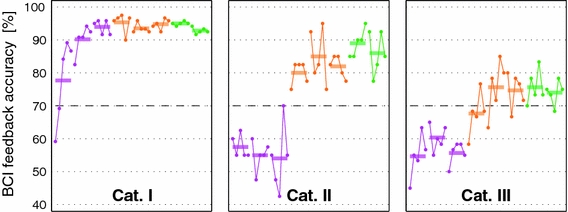
Brain-Computer Interfaces (BCIs) allow a user to control a computer application by brain activity as acquired, e.g., by EEG. One of the biggest challenges in BCI research is to understand and solve the problem of "BCI Illiteracy", which is that BCI control does not work for a non-negligible portion of users (estimated 15 to 30%). Here, we investigate the illiteracy problem in BCI systems which are based on the modulation of sensorimotor rhythms. In this paper, a sophisticated adaptation scheme is presented which guides the user from an initial subject-independent classifier that operates on simple features to a subject-optimized state-of-the-art classifier within one session while the user interacts the whole time with the same feedback application. While initial runs use supervised adaptation methods for robust co-adaptive learning of user and machine, final runs use unsupervised adaptation and therefore provide an unbiased measure of BCI performance. Using this approach, which does not involve any offline calibration measurement, good performance was obtained by good BCI participants (also one novice) after 3-6 min of adaptation. More importantly, the use of machine learning techniques allowed users who were unable to achieve successful feedback before to gain significant control over the BCI system. In particular, one participant had no peak of the sensory motor idle rhythm in the beginning of the experiment, but could develop such peak during the course of the session (and use voluntary modulation of its amplitude to control the feedback application).
Overview
The claims and statistics of this paper haven’t been checked yet.
Run the check — free, no account needed. It reads the open-access text and checks the sources it cites.
Integrity signals
Registry
Cites
Statistics
Figures
Verification
Claims the paper makes
The claims and statistics of this paper haven’t been checked yet.
Run the check — free, no account needed. It reads the open-access text and checks the sources it cites.
Claims other papers make about this one
Each is checked against this paper’s own text: does it say what the citing paper says it does?
The cited source says what the claim attributes to it.
In the citing paper
“Indeed, mutual learning has been claimed mostly on the grounds of adequate and improved BCI classification accuracy [25,27,30–35] or application performances [36,37].”
From The Cybathlon BCI race: Successful longitudinal mutual learning with two tetraplegic users (2018) · cites this paper as [25]
The cited source says what the claim attributes to it.
In the citing paper
“and standard calibration pipelines fail to produce a functional classifier for a non-negligible portion of users [5].”
From ERP-XTTN: interpretable prototype-guided cross-attention for cross-subject ERP classification (2026) · cites this paper as [5]
In the citing paper
“Evidence that co-adaptive MI BCIs might also be able to promote and increase the ability of the users to voluntary modulate their brain signals (subject learning) is, in fact, scarce, most often indirect and rather inconclusive.”
From The Cybathlon BCI race: Successful longitudinal mutual learning with two tetraplegic users (2018) · cites this paper as [25]
In the citing paper
“Firstly, works where users acquired BCI control (able-bodied [3,25] and end-users [40,41,51,62,63]) do not report any learning metric over time.”
From The Cybathlon BCI race: Successful longitudinal mutual learning with two tetraplegic users (2018) · cites this paper as [25]
In the citing paper
“Some works find no evident learning effects at the neural correlate level [25,34].”
From The Cybathlon BCI race: Successful longitudinal mutual learning with two tetraplegic users (2018) · cites this paper as [25]
In the citing paper
“Lack of robustness is a well-known issue of all BCI paradigms and has been associated to the nonstationarity of brain signals [18,25,27].”
From The Cybathlon BCI race: Successful longitudinal mutual learning with two tetraplegic users (2018) · cites this paper as [25]
Self-check
Percentages, sums and reported differences re-computed from the paper’s own numbers.
The self-check needs the paper’s full text.
Citations
Cites
Brain–computer interfaces for communication and control
Wolpaw, J. R., Birbaumer, N., McFarland, D. J., Pfurtscheller, G., & Vaughan, T. M. (2002) · Clinical Neurophysiology · doi:10.1016/s1388-2457(02)00057-3 · Cited by 7,927
A well-conditioned estimator for large-dimensional covariance matrices
Ledoit, O., & Wolf, M. (2004) · Journal of Multivariate Analysis · doi:10.1016/s0047-259x(03)00096-4 · Cited by 3,046
Optimizing Spatial filters for Robust EEG Single-Trial Analysis
Blankertz, B., Tomioka, R., Lemm, S., Kawanabe, M., & Muller, K.-R. (2008) · IEEE Signal Processing Magazine · doi:10.1109/msp.2008.4408441 · Cited by 2,080 · cited 5×
“Its speed was determined by the classi-fication output (similar to Blankertz et al. (2007, 2008a)).”
BackgroundMethodInfluentialSelf-citationHoney, I Shrunk the Sample Covariance Matrix
Ledoit, O., & Wolf, M. (2004) · The Journal of Portfolio Management · doi:10.3905/jpm.2004.110 · Cited by 1,279
Dimensionality Reduction of Multimodal Labeled Data by Local Fisher Discriminant Analysis
Sugiyama, M. (2007) · doi:10.5555/1248659.1248694 · Cited by 1,031
Blankertz, B., Dornhege, G., Krauledat, M., Müller, K., & Curio, G. (2007) · NeuroImage · doi:10.1016/j.neuroimage.2007.01.051 · Cited by 941
Self-citationToward Brain-Computer Interfacing
Dornhege, G., Millán, J. D. R., Hinterberger, T., McFarland, D. J., & Müller, K.-R. (2007) · The MIT Press eBooks · doi:10.7551/mitpress/7493.001.0001 · Cited by 789
Covariate Shift Adaptation by Importance Weighted Cross Validation
Sugiyama, M., Krauledat, M., & Müller, K. (2007) · doi:10.5555/1314498.1390324 · Cited by 733
Dornhege, G., Blankertz, B., Curio, G., & Müller, K. R. (2004) · IEEE Transactions on Biomedical Engineering · doi:10.1109/tbme.2004.827088 · Cited by 638
Self-citationBrain-computer communication: Unlocking the locked in.
Kübler, A., Kotchoubey, B., Kaiser, J., Wolpaw, J. R., & Birbaumer, N. (2001) · Psychological Bulletin · doi:10.1037/0033-2909.127.3.358 · Cited by 565
Research works printed but not linked: 1
- Vidaurre C, Schlögl A, Blankertz B, Kawanabe M, Müller KR (2008) Unsupervised adaptation of the LDA classifier for brain–computer interfaces. In: Proceedings of the 4th international brain–computer interface workshop and training course 2008, Verlag der Technischen Universität Graz, pp 122–127
Cited by
Sorted by citations
Items 301–400 of 501
Philosophical Reflections on Brain–Computer Interfaces
Tamburrini, G. (2014) · The International library of ethics, law and technology · doi:10.1007/978-94-017-8996-7_13 · Cited by 7
Correlation of fronto-central phase coupling with sensorimotor rhythm modulation
Chung, Y. G., Kang, J.-H., & Kim, S.-P. (2012) · Neural Networks · doi:10.1016/j.neunet.2012.08.006 · Cited by 7
Human-Centered Shared Autonomy for Motor Planning, Learning, and Control Applications
Farhadi, M. H., Rabiee, A., Ghafoori, S., Cetera, A., Xu, W., & Abiri, R. (2025) · Springer eBooks · doi:10.1007/978-3-032-06713-5_14 · Cited by 9
Phang, C., Chen, C., Cheng, Y., Chen, Y., & Ko, L. (2022) · IEEE Transactions on Neural Systems and Rehabilitation Engineering · doi:10.1109/tnsre.2022.3217298 · Cited by 6
Self-induced emotions as alternative paradigm for driving brain–computer interfaces
Placidi, G., Polsinelli, M., Spezialetti, M., Cinque, L., Giamberardino, P. D., & Iacoviello, D. (2018) · Computer Methods in Biomechanics and Biomedical Engineering Imaging & Visualization · doi:10.1080/21681163.2018.1479312 · Cited by 6
Dynamic functional connectivity correlates of mental workload
Xu, Z., Huang, J., Liu, C., Zhang, Q., Gu, H., Xiaoli Li, A., Di, Z., & Li, Z. (2024) · Cognitive Neurodynamics · doi:10.1007/s11571-024-10101-4 · Cited by 6
Ethical Issues in Brain–Computer Interface Research and Systems for Motor Control
Mattia, D., & Tamburrini, G. (2014) · Springer eBooks · doi:10.1007/978-94-007-4707-4_42 · Cited by 7
Real-time brain computer interface using imaginary movements
El-Madani, A., Sørensen, H. B. D., Kjær, T. W., Thomsen, C. E., & Puthusserypady, S. K. (2015) · EPJ Nonlinear Biomedical Physics · doi:10.1140/epjnbp/s40366-015-0024-2 · Cited by 6
Vourvopoulos, A., Ferreira, A., & Badia, S. (2016) · International Conference on Physiological Computing Systems · doi:10.1007/978-3-030-27950-9_1 · Cited by 3
A neurophysiological approach to spatial filter selection for adaptive brain–computer interfaces
Bennett, J. D., John, S. E., Grayden, D. B., & Burkitt, A. N. (2020) · Journal of Neural Engineering · doi:10.1088/1741-2552/abd51f · Cited by 10
Skalski‐Bednarz, S. B., Pochwatko, G., & Balas, R. (2021) · Infant and Child Development · doi:10.1002/icd.2242 · Cited by 8
Zhou, Z., Gong, A., Qian, Q., Su, L., Zhao, L., & Fu, Y. (2021) · Translational Neuroscience · doi:10.1515/tnsci-2020-0199 · Cited by 6
Thielen, J. (2025) · Biomedical Physics & Engineering Express · doi:10.1088/2057-1976/ade316 · Cited by 5
Frontal Alpha Asymmetry Neurofeedback For Brain-Computer Interfaces
Cavazza, M., Aranyi, G., Charles, F., Porteous, J., Gilroy, S. W., Jackont, G., Klovatch, I., Raz, G., Keynan, J. N., Cohen, A., et al. (2020) · RMIT Research Repository (RMIT University Library) · doi:10.3217/978-3-85125-378-8-92 · Cited by 5
Dual model transfer learning to compensate for individual variability in brain-computer interface
Kim, J. S., Kim, H., Chung, C. K., & Kim, J. S. (2024) · Computer Methods and Programs in Biomedicine · doi:10.1016/j.cmpb.2024.108294 · Cited by 5
Identification of perceived sentences using deep neural networks in EEG
del Valle, C. H. G., Méndez‐Orellana, C., Herff, C., & Rodriguez-Fernández, M. (2024) · Journal of Neural Engineering · doi:10.1088/1741-2552/ad88a3 · Cited by 5
Zhong, Y., Wang, Y., Farina, D., & Yao, L. (2025) · IEEE Transactions on Biomedical Engineering · doi:10.1109/tbme.2025.3560713 · Cited by 7
Overcoming Long-Term Variability in Local Field Potentials Using an Adaptive Decoder
Tadipatri, V. A., Tewfik, A. H., Pellizzer, G., & Ashe, J. (2016) · IEEE Transactions on Biomedical Engineering · doi:10.1109/tbme.2016.2557070 · Cited by 5
Czyżewski, A., Kurowski, A., Odya, P., & Szczuko, P. (2020) · BioMedical Engineering OnLine · doi:10.1186/s12938-019-0746-y · Cited by 5
Prediction of Inefficient BCI Users Based on Cognitive Skills and Personality Traits
Hagedorn, L. J., Leeuwis, N., & Alimardani, M. (2021) · Communications in computer and information science · doi:10.1007/978-3-030-92310-5_10 · Cited by 5
Brain-Computer Interfaces and Visual Activity
Vidaurre, C., Kübler, A., Tangermann, M., Müller, K., & Millán, J. D. R. (2013) · IGI Global eBooks · doi:10.4018/978-1-4666-4422-9.ch081 · Cited by 5
Self-citationBabiloni, F. (2010) · Brain Topography · doi:10.1007/s10548-010-0146-x · Cited by 5
Quality and denoising in real-time fMRI neurofeedback: a methods reviewPreprint
Heunis, S., Lamerichs, R. M. J. N., Zinger, S., Caballero‐Gaudes, C., Jansen, J. F. A., Aldenkamp, A. P., & Breeuwer, M. M. (2018) · doi:10.31219/osf.io/xubhq · Cited by 5
Individualized brain-computer interface for people with disabilities: a review
Saha, S., Karlsson, P., Anderson, C. J., Kavehei, O., & McEwan, A. L. (2026) · Frontiers in Human Neuroscience · doi:10.3389/fnhum.2026.1738876 · Cited by 5
Shuqfa, Z., & Lakas, A. (2024) · IEEE/ACM International Conference on Big Data Computing, Applications and Technologies (BDCAT) · doi:10.1109/bdcat63179.2024.00050 · Cited by 4
Improved motor imagery training for subject’s self-modulation in EEG-based brain-computer interface
Xu, Y., Jie, L., Jian, W., Yi, W., Yin, H., & Peng, Y. (2024) · Frontiers in Human Neuroscience · doi:10.3389/fnhum.2024.1447662 · Cited by 4
Ravi, A., Wolfe, P., Tung, J. Y., & Jiang, N. (2025) · IEEE Transactions on Neural Systems and Rehabilitation Engineering · doi:10.1109/tnsre.2025.3544479 · Cited by 5
Reliable predictor of BCI motor imagery performance using median nerve stimulation
Cueva, V. M., Bougrain, L., Lotte, F., & Rimbert, S. (2025) · Journal of Neural Engineering · doi:10.1088/1741-2552/adc48d · Cited by 4
Using Coherence for Robust Online Brain-Computer Interface (BCI) Control
Spüler, M., Rosenstiel, W., & Bogdan, M. (2014) · Communications in computer and information science · doi:10.1007/978-3-319-08672-9_43 · Cited by 4
Merrill, N., Maillart, T., Johnson, B., & Chuang, J. C.-I. (2015) · International Conference on Physiological Computing Systems (PhyCS) · doi:10.5220/0005238800440051 · Cited by 4
Generalization of Local Temporal Correlation Common Spatial Patterns Using Lp-norm (0 < p < 2)
Fang, N., & Wang, H. (2017) · Lecture notes in computer science · doi:10.1007/978-3-319-70093-9_82 · Cited by 4
Santos, E., Fernandes, C. A., & Castellano, G. (2023) · Research on Biomedical Engineering · doi:10.1007/s42600-023-00284-w · Cited by 4
Parenthoën, M., Murie, F., & Théry, F. (2015) · Motion in Games · doi:10.1145/2822013.2822038 · Cited by 4
Predictive Modeling on MEG Signal to Classify Hand and Wrist Movement using UNEQ and KNN
Goni, M. R., & Rahman, T. (2020) · IEEE Region 10 Symposium (TENSYMP) · doi:10.1109/tensymp50017.2020.9230860 · Cited by 4
Karan, S. (2013) · International Conference on Human Computer Interactions (ICHCI) · doi:10.1109/ichci-ieee.2013.6887788 · Cited by 4
Sensorimotor functional connectivity: a neurophysiological factor related to BCI performancePreprint
Vidaurre, C., Haufe, S., Jorajuría, T., Müller, K., & Nikulin, V. V. (2020) · bioRxiv (Cold Spring Harbor Laboratory) · doi:10.1101/2020.07.24.220145 · Cited by 4
Self-citationNoninvasive Brain-Computer Interfaces
Allison, B. Z., & Krusienski, D. J. (2014) · Springer eBooks · doi:10.1007/978-1-4614-7320-6_707-1 · Cited by 4
Neuronal avalanches as a predictive biomarker for guiding tailored BCI training programs
Mannino, C., Sorrentino, P., Chávez, M., & Corsi, M. (2026) · Imaging Neuroscience · doi:10.1162/imag.a.1259 · Cited by 5
Implantable Neural Speech Decoders: Recent Advances, Future Challenges
Jhilal, S., Marchesotti, S., Thirion, B., Soudrie, B., Giraud, A., & Mandonnet, E. (2025) · Neurorehabilitation and neural repair · doi:10.1177/15459683251369468 · Cited by 8
Uncovering attempted movements of the paralyzed upper limb after stroke through EEG and EMG
López‐Larraz, E., Sarasola-Sanz, A., Birbaumer, N., & Ramos‐Murguialday, A. (2025) · Journal of NeuroEngineering and Rehabilitation · doi:10.1186/s12984-025-01687-9 · Cited by 8
Naas, A., Rohrbach, S., Shabestari, P. S., Neff, P. K. A., & Sonderegger, A. (2025) · Frontiers in Human Neuroscience · doi:10.3389/fnhum.2025.1678940 · Cited by 3
Investigating Visual Imagery as a BCI Control Strategy: A Pilot Study
Kilmarx, J., Gamper, H., Emmanouilidou, D., Johnston, D., Cutrell, E., Wilson, A. D., & Tashev, I. (2022) · International Winter Conference on Brain-Computer Interface (BCI) · doi:10.1109/bci53720.2022.9734919 · Cited by 3
Farabbi, A., Figueiredo, P., Ghiringhelli, F., Mainardi, L. T., Sanches, J., Moreno, P., Santos-Victor, J., & Vourvopoulos, A. (2023) · Frontiers in Neuroergonomics · doi:10.3389/fnrgo.2023.1080794 · Cited by 3
Connectivity study on resting-state EEG between motor imagery BCI-literate and BCI-illiterate groups
Park, H., & Jun, S. C. (2024) · Journal of Neural Engineering · doi:10.1088/1741-2552/ad6187 · Cited by 3
Subspace metrics for multivariate dictionaries and application to EEG
Chevallier, S., Barthélemy, Q., & Jamal Atif, C. (2014) · IEEE International Conference on Acoustics Speech and Signal Processing · doi:10.1109/icassp.2014.6854993 · Cited by 3
Music Imagery for Brain-Computer Interface Control
Chen, M. L., Yao, L., & Jiang, N. (2017) · Lecture notes in computer science · doi:10.1007/978-3-319-58625-0_21 · Cited by 4
EEG function network analysis of left and right hand motor imagery
Zhang, R., Yan, Y., Hu, Y., Shi, L., Wan, H., & Shi, L. (2017) · Chinese Automation Congress · doi:10.1109/cac.2017.8242790 · Cited by 3
Bushkova, Y. V. B., Ivanova, G. Е., Stakhovskaya, L. V., & Frolov, A. (2019) · Bulletin of Russian State Medical University · doi:10.24075/brsmu.2019.078 · Cited by 3
Do User-Centered Designed Paradigms for BCIs improve the Modulation of EEG Signals?
Mercado, V., Alonso-Valerdi, L. M., Salas‐Garza, M., Lopez-Montoya, A., Garza-Ibarra, E., & Chávez-Madero, C. (2021) · International IEEE/EMBS Conference on Neural Engineering · doi:10.1109/ner49283.2021.9441423 · Cited by 3
Shen, T., Zhang, L., Yan, S., & Hu, Y. (2022) · Journal of Integrated Design and Process Science · doi:10.3233/jid-220001 · Cited by 3
Irastorza-Landa, N., Sarasola-Sanz, A., Bibián, C., Ray, A. M., Insausti-Delgado, A., Helmhold, F., Mahmoud, W. J., Ortego-Isasa, I., López‐Larraz, E., & Ramos‐Murguialday, A. (2023) · Handbook of Neuroengineering · doi:10.1007/978-981-16-5540-1_120 · Cited by 3
A Co-adaptive Training Paradigm for Motor Imagery Based Brain-Computer Interface
Xia, B., Zhang, Q., Xie, H., Li, S., Li, J., & He, L. (2012) · Lecture notes in computer science · doi:10.1007/978-3-642-31346-2_49 · Cited by 3
Towards multi-user brain-robot interfaces for humanoid robot control
Finke, A., Rudgalwis, B., Jakusch, H., & Ritter, H. J. (2012) · IEEE-RAS International Conference on Humanoid Robots (Humanoids) · doi:10.1109/humanoids.2012.6651571 · Cited by 3
Quantitative analysis of task selection for brain–computer interfaces
Llera, A., Gómez, V., & Kappen, H. J. (2014) · Journal of Neural Engineering · doi:10.1088/1741-2560/11/5/056002 · Cited by 3
Enhanced detection of movement onset in EEG through deep oversampling
Moubayed, N. A., Hasan, B. A. S., & McGough, A. S. (2017) · International Joint Conference on Neural Networks (IJCNN) · doi:10.1109/ijcnn.2017.7965838 · Cited by 3
Comparison of Methods for Real and Imaginary Motion Classification from EEG Signals
Szczuko, P., Lech, M., & Czyżewski, A. (2018) · Studies in big data · doi:10.1007/978-3-319-77604-0_18 · Cited by 3
IMPROVING THE PERFORMANCE OF MOTOR IMAGERY EEG-BASED BCIS VIA AN ADAPTIVE EPOCH TRIMMING MECHANISM
Kalantar, G., Mirgholami, M., Asif, A. A., & Mohammadi, A. (2018) · IEEE Global Conference on Signal and Information Processing · doi:10.1109/globalsip.2018.8646445 · Cited by 3
Song, Y.-J., & Sepulveda, F. (2020) · Journal of NeuroEngineering and Rehabilitation · doi:10.1186/s12984-020-0651-4 · Cited by 3
A Functional BCI Model by the P2731 working group: Physiology
Hossaini, A., Valeriani, D., Nam, C. S., Ferrante, R., & Mahmud, M. (2021) · Brain-Computer Interfaces · doi:10.1080/2326263x.2021.1968665 · Cited by 3
Marahat, M. H., Zahari, M. A. A., Mohamad, H., & Kasim, S. R. (2019) · AIP conference proceedings · doi:10.1063/1.5089373 · Cited by 3
Identification of Real and Imaginary Movements in EEG Using Machine Learning Models
Moreira, J., Moreira, M. K. D. M., Pombo, N. G. C. C., Silva, B. M. C., & García, N. M. (2019) · World Congress on Medical Physics and Biomedical Engineering, September 7 - 12, 2009, Munich, Germany · doi:10.1007/978-3-030-17971-7_70 · Cited by 3
Hohlefeld, F. U. (2011) · Universitätsbibliothek der FU Berlin Hochschulschriftenstelle u. Dokumentenserver · doi:10.17169/refubium-10445 · Cited by 3
Unveiling Movement Intention after Stroke: Integrating EEG and EMG for Motor RehabilitationPreprint
López‐Larraz, E., Sarasola-Sanz, A., Birbaumer, N., & Ramos‐Murguialday, A. (2024) · bioRxiv (Cold Spring Harbor Laboratory) · doi:10.1101/2024.02.22.581596 · Cited by 3
Wang, Z., Liu, Y., Wu, W., Huang, S., An, X., & Ming, D. (2024) · Annual International Conference of the IEEE Engineering in Medicine and Biology Society (EMBC) · doi:10.1109/embc53108.2024.10782967 · Cited by 2
Liu, Y., Wu, W., Gui, Z., Yan, D., Wang, Z., Han, N., Gao, R., Zhang, Z., Cui, L., Wu, J., et al. (2025) · IEEE Transactions on Neural Systems and Rehabilitation Engineering · doi:10.1109/tnsre.2025.3637128 · Cited by 2
Toward Brain-Computer Interface motor rehabilitation for people with Multiple Sclerosis
Sebastián-Romagosa, M., Cho, W., Ortner, R., Sieghartsleitner, S., Guger, M., von Oertzen, T. J., Meuth, S. G., Laureys, S., Allison, B. Z., & Guger, C. (2026) · Frontiers in Medicine · doi:10.3389/fmed.2025.1661972 · Cited by 4
Suwandjieff, P., Crell, M. R., Kostoglou, K., & Müller-Putz, G. (2026) · Journal of Neural Engineering · doi:10.1088/1741-2552/ae6bef · Cited by 3
BCIs for DOC Patients: Assessment, Communication, and New Directions
Ortner, R., Annen, J., von Oertzen, T. J., Espinosa, A., Rodriguez, J., Allison, B. Z., Edlinger, G., Laureys, S., Hamberger, M., Kammerhofer, A., et al. (2016) · Lecture notes in computer science · doi:10.1007/978-3-319-40244-4_7 · Cited by 2
Reject option to reduce false prediction rates for EEG-motor imagery based BCI
Ganeshkumar, M., Ang, K. K., & So, R. Q. (2017) · Annual International Conference of the IEEE Engineering in Medicine and Biology Society (EMBC) · doi:10.1109/embc.2017.8037479 · Cited by 2
Updating BCI paradigms: Why to design in terms of the user?
Alonso-Valerdi, L. M., & Mercado, V. (2021) · International IEEE/EMBS Conference on Neural Engineering · doi:10.1109/ner49283.2021.9441337 · Cited by 2
Daeglau, M., Zich, C., Welzel, J., Saak, S. K., Scheffels, J. F., & Kranczioch, C. (2021) · Neuroimage Reports · doi:10.1016/j.ynirp.2021.100058 · Cited by 2
Classification of Three Intentions Based on Auditory Steady State Response to Natural Sound
Harada, K., Matsubara, A., Nakashima, S., & Nishifuji, S. (2022) · IEEE Global Conference on Consumer Electronics (GCCE) · doi:10.1109/gcce56475.2022.10014143 · Cited by 2
Beyond Within-Subject Performance: A Multi-Dataset Study of Fine-Tuning in the EEG Domain
Sartzetaki, C., Antoniadis, P., Antonopoulos, N., Gkinis, I., Krasoulis, A., Perdikis, S., & Pitsikalis, V. (2023) · Conference proceedings/Conference proceedings - IEEE International Conference on Systems, Man, and Cybernetics · doi:10.1109/smc53992.2023.10394335 · Cited by 3
Ivanov, N., & Chau, T. T. (2024) · Brain-Apparatus Communication A Journal of Bacomics · doi:10.1080/27706710.2024.2366193 · Cited by 2
Phang, C., & Hirata, A. (2025) · Annals of the New York Academy of Sciences · doi:10.1111/nyas.15322 · Cited by 2
Decoding of EEG Activity from Object Views: Active Detection vs. Passive Visual Tasks
Sasane, S., & Schwabe, L. (2012) · Lecture notes in computer science · doi:10.1007/978-3-642-35139-6_26 · Cited by 2
Virtual Agents in Brain-Computer Interfaces
Cavazza, M., Charles, F., Gilroy, S. W., Porteous, J., Aranyi, G., Cordry, J., Raz, G., Keynan, J. N., Cohen, A., Jackont, G., et al. (2015) · International Journal of Virtual Reality · doi:10.20870/ijvr.2015.15.1.2868 · Cited by 2
Dynamic time warp distances as feedback for EEG feature density
Ward, C. R., & Iyad Obeid, A. (2015) · IEEE Signal Processing in Medicine and Biology Symposium · doi:10.1109/spmb.2015.7405419 · Cited by 2
Considerations on the Individualization of Motor Imagery Neurofeedback Training
Filho, C. A. S., Attux, R., & Castellano, G. (2019) · Communications in computer and information science · doi:10.1007/978-3-030-36636-0_17 · Cited by 2
Assessment and Communication for People with Disorders of Consciousness
Ortner, R., Allison, B. Z., Pichler, G., Heilinger, A., Sabathiel, N., & Guger, C. (2017) · Journal of Visualized Experiments · doi:10.3791/53639-v · Cited by 2
Brain-Computer Interfaces and Visual Activity
Vidaurre, C., Kübler, A., Tangermann, M., Müller, K., & Millán, J. D. R. (2012) · IGI Global eBooks · doi:10.4018/978-1-61350-098-9.ch012 · Cited by 2
Self-citationIrastorza-Landa, N., Sarasola-Sanz, A., Bibián, C., Ray, A. M., Insausti-Delgado, A., Helmhold, F., Mahmoud, W. J., Ortego-Isasa, I., López‐Larraz, E., & Ramos‐Murguialday, A. (2022) · Handbook of Neuroengineering · doi:10.1007/978-981-15-2848-4_120-1 · Cited by 2
Subramanian, A., Shamsi, F., & Najafizadeh, L. (2023) · Springer eBooks · doi:10.1007/978-3-031-21236-9_3 · Cited by 2
Analysis of the Impact of the Presence of Physical Pain in fNIRS-based BCI Systems
Subramanian, A., Shamsi, F., & Najafizadeh, L. (2022) · IEEE Signal Processing in Medicine and Biology Symposium · doi:10.1109/spmb55497.2022.10014741 · Cited by 2
Decoding accuracies as well as ERP amplitudes do not show between-task correlations
Ehinger, B., & Bonasch, H. (2023) · Conference on Cognitive Computational Neuroscience (CCN) · doi:10.32470/ccn.2023.1029-0 · Cited by 2
MEANSP: How Many Channels are Needed to Predict the Performance of a SMR-Based BCI?
Jorajuría, T., Nikulin, V. V., Kapralov, N., Gómez, M., & Vidaurre, C. (2023) · IEEE Transactions on Neural Systems and Rehabilitation Engineering · doi:10.1109/tnsre.2023.3339612 · Cited by 2
Self-citationEEG Characteristic Investigation of the Sixth-Finger Motor Imagery
Liu, Y., Wang, Z., Huang, S., Wei, J., Li, X., & Ming, D. (2021) · Lecture notes in computer science · doi:10.1007/978-3-030-89095-7_62 · Cited by 2
Neghabi, M., Marateb, H. R., & Mahnam, A. (2022) · Brain-Computer Interfaces · doi:10.1080/2326263x.2022.2050513 · Cited by 2
Quek, M. (2013) · Enlighten: Theses (The University of Glasgow) · Cited by 2
Why BCIs work poorly with the patients who need them the most?Preprint
Séguin, P., Maby, E., & Mattout, J. (2020) · arXiv (Cornell University) · doi:10.3217/978-3-85125-682-6-48 · Cited by 3
Understanding Human Reading Comprehension with Brain Signals.Preprint
Ye, Z., Xie, X., Liu, Y., Wang, Z., Chen, X., Zhang, M., & Ma, S. (2021) · arXiv (Cornell University) · Cited by 2
Wu, S., Bhadra, K., Giraud, A., & Marchesotti, S. (2023) · bioRxiv (Cold Spring Harbor Laboratory) · doi:10.1101/2023.12.12.571206 · Cited by 2
Brain–Computer Interfaces and Their Place in the Management of Disorders of Consciousness
Meys, M., Thibaut, A., & Annen, J. (2023) · Springer eBooks · doi:10.1007/978-3-031-50563-8_3 · Cited by 1
Cao, L., Cai, X., & Dong, Y. (2025) · IEEE Internet of Things Journal · doi:10.1109/jiot.2025.3588343 · Cited by 1
How to build a brain–computer interface from beginning to end
Lotte, F., Dreyer, P., Rimbert, S., Trocellier, D., & Welter, M. (2025) · Elsevier eBooks · doi:10.1016/b978-0-443-24824-5.00004-1 · Cited by 1
Ma, J., Lv, W., & Ren, X. (2025) · Journal of Intelligence · doi:10.3390/jintelligence13090106 · Cited by 1
Two Seconds to Speak: Increasing Communication Speed for fMRI-Based Brain–Computer Interfaces
Evenblij, D., Lührs, M., Rafeh, R. W., Benitez-Andonegui, A., Kurban, D., Valente, G., & Sorger, B. (2025) · Brain Connectivity · doi:10.1177/21580014251376731 · Cited by 1
Candia‐Rivera, D., Chávez, M., Fallani, F. D. V., & Corsi, M. (2026) · NeuroImage · doi:10.1016/j.neuroimage.2026.121804 · Cited by 1
Tidare, J., Johansson-Alvarez, M., Plantin, J., Palmcrantz, S. M., & Ästrand, E. (2026) · Journal of Neural Engineering · doi:10.1088/1741-2552/ae512c · Cited by 1
Metadata
- Authors
- Vidaurre, C., & Blankertz, B.
- Affiliations
- Technische Universität Berlin (DE)
- Corresponding author
- Vidaurre, Carmen
- Venue
- Brain Topography
- Published
- 2009-11-28
- Volume
- 23
- Issue
- 2
- Pages
- 194-198
- ISSN
- 0896-0267 (ISSN-L)
- 1573-6792
- PMC
- PMC2874052
- OpenAlex
- W2003621157
- Cited by
- 501
- References
- 24
- Citations by year
- 2026: 31 · 2025: 24 · 2024: 30 · 2023: 28 · 2022: 33 · 2021: 42 · 2020: 45 · 2019: 32 · 2018: 46 · 2017: 31 · 2016: 37 · 2015: 29 · 2014: 30 · 2013: 23 · 2012: 19
- FWCI
- 6.38
- Type
- journal article
- Language
- en
- Open access
- hybrid
- doi.org
- Licence
- cc-by-nc
- Locations
- Brain Topography (publishedVersion, cc-by-nc)
- PubMed Central (publishedVersion, cc-by-nc)
- PubMed (publishedVersion)
- TECNALIA Publications (Fundación TECNALIA Research & Innovation) (submittedVersion, cc-by-nc)
- Publikationsdatenbank der Fraunhofer-Gesellschaft (Fraunhofer-Gesellschaft) (submittedVersion)
- Fraunhofer-Publica (Fraunhofer-Gesellschaft) (submittedVersion)
- Funders
- European Commission (224631, 216886)
- Deutsche Forschungsgemeinschaft (01GQ0850)
- Bundesministerium für Bildung und Forschung (01GQ0850, 01IB001A)
- Topics
- Life Sciences › Neuroscience › Cognitive Neuroscience › EEG and Brain-Computer Interfaces
- Physical Sciences › Computer Science › Human-Computer Interaction › Gaze Tracking and Assistive Technology
- Physical Sciences › Computer Science › Artificial Intelligence › Emotion and Mood Recognition
- Keywords
- BCI illiteracy, brain-computer interface, sensorimotor rhythm, EEG, online adaptation, unsupervised adaptation, supervised adaptation, novice users, motor imagery
- MeSH terms
- Algorithms, Artificial Intelligence, Brain, Electroencephalography, Humans, Imagination, Learning, Motor Activity, Signal Processing, Computer-Assisted, Time Factors, User-Computer Interface, Feedback, Psychological
About these checks
Registry, retraction, Cites and statistics results are computed, not judged, with one exception: a printed reference that no index lists is read once by a model before it counts as a citation error. Claims are extracted by a model and kept only when their quote appears verbatim in the text; each cited source is then checked, with a model’s help, for whether it says what the claim relies on. Those verdicts can be wrong — read the claim’s quote and the cited source before relying on one.
Statistics and arithmetic are recomputed, not judged.
Confidence bands are shown only for fields calibrated on our annotated test set. None is calibrated yet, so no band is shown.
What counts as a claim ›How we measure confidence ›How we check this ›
Are you an author, or do you see a problem with this page? Request a review
