

The DOI matches its Crossref record; 93 of the 95 references it cites were found in a registry or an index; none of the 25 sources its claims cite is checked for support yet.
Understanding the Interplay Among Regulatory Self-Efficacy, Moral Disengagement, and Academic Cheating Behaviour During Vocational Education: A Three-Wave Study
Open accessAbstract
The literature has suggested that to understand the diffusion of unethical conduct in the workplace, it is important to investigate the underlying processes sustaining engagement in misbehaviour and to study what occurs during vocational education. Drawing on social-cognitive theory, in this study, we longitudinally examined the role of two opposite dimensions of the self-regulatory moral system, regulatory self-efficacy and moral disengagement, in influencing academic cheating behaviour. In addition, in line with the theories highlighting the bidirectional relationship between cognitive processes and behaviour, we aimed to also examine the reciprocal influence of behaviour on these dimensions over time. Overall, no previous studies have examined the longitudinal interplay between these variables. The sample included 866 (62.8% female) nursing students who were assessed three times annually from the beginning of their vocational education. The findings from a cross-lagged model confirmed that regulatory self-efficacy and moral disengagement have opposite influences on cheating behaviour, that regulatory self-efficacy negatively influences not only the engagement in misconduct but also the justification mechanisms that allow the divorce between moral standards and action, and that moral disengagement and cheating behaviour reciprocally support each other over time. Specifically, not only did moral disengagement influence cheating behaviour even when controlling for its prior levels, but also cheating behaviour affected moral disengagement one year later, controlling for its prior levels. These findings suggest that recourse to wrongdoing could gradually lead to further normalising this kind of behaviour and morally desensitising individuals to misconduct.
Overview
AI snapshot
Written from the paper’s full text.
TL;DR
In a three-wave study of nursing students, regulatory self-efficacy and moral disengagement had opposite longitudinal effects on academic cheating, and cheating reciprocally reinforced moral disengagement but did not weaken regulatory self-efficacy. The findings support a vicious cycle between cheating and moral disengagement and a protective role for regulatory self-efficacy.
Key findings
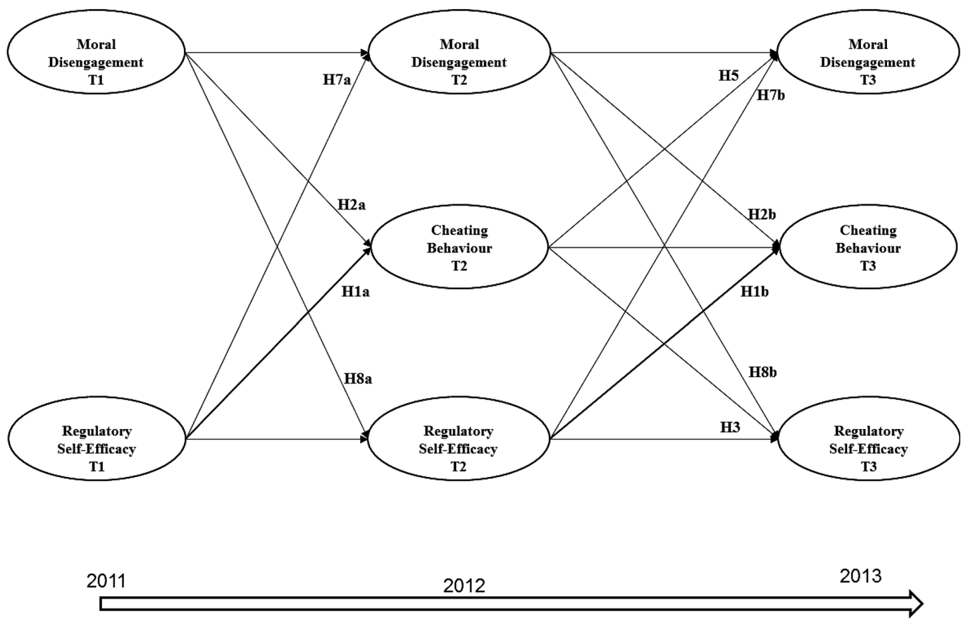
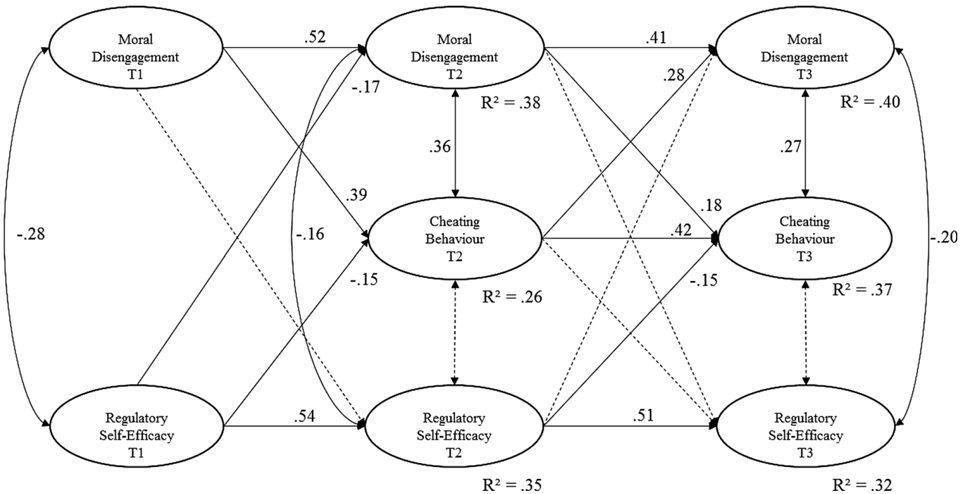
- Regulatory self-efficacy at T1 and T2 negatively influenced cheating one year later, while moral disengagement at T1 and T2 positively influenced cheating one year later.
- Cheating at T2 positively influenced moral disengagement at T3, controlling for prior moral disengagement and regulatory self-efficacy; the indirect effect MD(T1) → cheating(T2) → MD(T3) was .108, 95% CI [.032, .205].
- Cheating at T2 did not influence regulatory self-efficacy at T3; the indirect effect R-SE(T1) → cheating(T2) → R-SE(T3) was .017, 95% CI [−.012, .066].
- Regulatory self-efficacy at T1 negatively influenced moral disengagement at T2, but not from T2 to T3; the indirect effect R-SE(T1) → cheating(T2) → MD(T3) was −.043, 95% CI [−.093, −.003]. The model explained 38% of MD, 26% of cheating, and 35% of R-SE at T2, and 40% of MD, 37% of cheating, and 32% of R-SE at T3.
Methods
- Three-wave longitudinal study of nursing students in 18 schools, beginning in 2011: 866 students at T1 (62.8% female, M age = 21.8, SD = 4.7), 530 at T2, and 505 at T3.
- Regulatory self-efficacy was measured with 4 items adapted from Bandura et al. (2001); moral disengagement with 12 items from the academic MD scale by Farnese et al. (2011); cheating behaviour with 5 items at T2 and T3 only. All used five-point response scales.
- Latent cross-lagged structural equation modelling in Mplus 7.4, with measurement invariance testing, FIML for missing data, gender and T1 age as covariates, and bootstrapped indirect effects based on 5,000 replications. ICCs ranged from .002 to .070, so multilevel modelling was not used.
Limitations
- The paper states that future research should integrate social and contextual variables such as peers, lecturers, supervisors, culture, and norms; use multi-method and multi-informant approaches; examine honour codes and sanction systems; and follow students into the labour market.
- The paper states that cheating behaviour was collected only at T2 and T3, not T1, so it could not examine whether MD and R-SE sustain cheating over time; it also relies exclusively on self-reported measures.
- Evident from the text: attrition was substantial (42.5% from T1 to T2, 27.1% from T2 to T3, and 46.9% from T1 to T3), with dropouts more likely to be male and older and slightly lower in T1 regulatory self-efficacy; the sample is nursing students, which may limit generalisation.
Model-written summary. Check it against the paper before relying on it.
Integrity signals
Registry
Cites
Statistics
Figures
Verification
Claims the paper makes
27 Own interpretation · 26 Own result · 16 Own method · 12 No full text of the sources · 9 Sources not found · 1 Check pending · 1 No basis given
A result the paper reports from its own data — it cites no other source for it, so there is none to check. The quote shows it is in the paper.
In the paper
“results of this longitudinal study showed that although MD is moderately stable across time, so students who were more prone to morally disengage in the past are also more prone to morally disengage in the present and future”
§ Understanding the Interplay Among Regulatory Self-Efficacy, Moral Disengagement, and Academic Cheating Behaviour During Vocational Education: A Three-Wave Study > Theoretical Implications
plain- Asserted: passes — The authors put it forward as true.
- Checkable: passes — It can be checked against evidence.
- Load-bearing: passes — The paper’s conclusions depend on it.
- Based: passes — The paper gives a reason why it holds.
A result the paper reports from its own data — it cites no other source for it, so there is none to check. The quote shows it is in the paper.
In the paper
“Consistently, results of the indirect effect (Table 2) showed that R-SE at T1 did not affect R-SE at T3 through cheating behaviour at T2 (Hypothesis 4).”
§ Understanding the Interplay Among Regulatory Self-Efficacy, Moral Disengagement, and Academic Cheating Behaviour During Vocational Education: A Three-Wave Study > Preliminary Results
plain- Asserted: passes — The authors put it forward as true.
- Checkable: passes — It can be checked against evidence.
- Load-bearing: passes — The paper’s conclusions depend on it.
- Based: passes — The paper gives a reason why it holds.
- Rests on an assumption: The temporal ordering of the three waves (T1, T2, T3) can be interpreted as causal influence in the cross-lagged model.
- Rests on an assumption: Self-report measures of cheating behaviour, R-SE, and MD provide valid assessments of the underlying constructs.
A result the paper reports from its own data — it cites no other source for it, so there is none to check. The quote shows it is in the paper.
In the paper
“but also cheating behaviour affected moral disengagement one year later, controlling for its prior levels.”
- Also stated in: § Abstract · plain
“and that moral disengagement and cheating behaviour reciprocally support each other over time.”
§ Understanding the Interplay Among Regulatory Self-Efficacy, Moral Disengagement, and Academic Cheating Behaviour During Vocational Education: A Three-Wave Study > Abstract
plaindirect- Asserted: passes — The authors put it forward as true.
- Checkable: passes — It can be checked against evidence.
- Load-bearing: passes — The paper’s conclusions depend on it.
- Based: passes — The paper gives a reason why it holds.
- Also stated in: § Abstract · plain
A result the paper reports from its own data — it cites no other source for it, so there is none to check. The quote shows it is in the paper.
In the paper
“R-SE not only hinders the engagement in misconduct”
- Also stated in: § Conclusion · boosted
“this study provides support for the protective role of R-SE in hindering cheating behaviour and MD over time”
§ Understanding the Interplay Among Regulatory Self-Efficacy, Moral Disengagement, and Academic Cheating Behaviour During Vocational Education: A Three-Wave Study > Theoretical Implications
boosteddirect- Asserted: passes — The authors put it forward as true.
- Checkable: passes — It can be checked against evidence.
- Load-bearing: passes — The paper’s conclusions depend on it.
- Based: passes — The paper gives a reason why it holds.
- Also stated in: § Conclusion · boosted
A result the paper reports from its own data — it cites no other source for it, so there is none to check. The quote shows it is in the paper.
In the paper
“In line with Hypotheses 1a and 1b, R-SE at T1 and T2 influence negatively cheating behaviour one year later.”
- Also stated in: § Discussion · boosted
“Our findings confirmed that those students with higher R-SE engage to a lesser extent in cheating behaviour (Hypotheses 1a and 1b).”
§ Understanding the Interplay Among Regulatory Self-Efficacy, Moral Disengagement, and Academic Cheating Behaviour During Vocational Education: A Three-Wave Study > Preliminary Results
boosteddirect- Asserted: passes — The authors put it forward as true.
- Checkable: passes — It can be checked against evidence.
- Load-bearing: passes — The paper’s conclusions depend on it.
- Based: passes — The paper gives a reason why it holds.
- Rests on an assumption: The temporal ordering of the three waves (T1, T2, T3) can be interpreted as causal influence in the cross-lagged model.
- Rests on an assumption: Self-report measures of cheating behaviour, R-SE, and MD provide valid assessments of the underlying constructs.
- Also stated in: § Discussion · boosted
A result the paper reports from its own data — it cites no other source for it, so there is none to check. The quote shows it is in the paper.
In the paper
“Hp10 MD(T1) ?CHEAT(T2) ?R-SE(T3) -.044 -.126 to .038”
§ Understanding the Interplay Among Regulatory Self-Efficacy, Moral Disengagement, and Academic Cheating Behaviour During Vocational Education: A Three-Wave Study > Discussion
plain- Asserted: passes — The authors put it forward as true.
- Checkable: passes — It can be checked against evidence.
- Load-bearing: passes — The paper’s conclusions depend on it.
- Based: passes — The paper gives a reason why it holds.
- Rests on an assumption: The temporal ordering of the three waves (T1, T2, T3) can be interpreted as causal influence in the cross-lagged model.
- Rests on an assumption: Self-report measures of cheating behaviour, R-SE, and MD provide valid assessments of the underlying constructs.
A result the paper reports from its own data — it cites no other source for it, so there is none to check. The quote shows it is in the paper.
In the paper
“In addition, contrary to our expectation, cheating behaviour at T2 did not influence R-SE at T3 (Hypothesis 3).”
§ Understanding the Interplay Among Regulatory Self-Efficacy, Moral Disengagement, and Academic Cheating Behaviour During Vocational Education: A Three-Wave Study > Preliminary Results
plain- Asserted: passes — The authors put it forward as true.
- Checkable: passes — It can be checked against evidence.
- Load-bearing: passes — The paper’s conclusions depend on it.
- Based: passes — The paper gives a reason why it holds.
- Rests on an assumption: The temporal ordering of the three waves (T1, T2, T3) can be interpreted as causal influence in the cross-lagged model.
- Rests on an assumption: Self-report measures of cheating behaviour, R-SE, and MD provide valid assessments of the underlying constructs.
A result the paper reports from its own data — it cites no other source for it, so there is none to check. The quote shows it is in the paper.
In the paper
“Our findings provide evidence for the interplay among R-SE, MD, and academic dishonesty during vocational education.”
§ Understanding the Interplay Among Regulatory Self-Efficacy, Moral Disengagement, and Academic Cheating Behaviour During Vocational Education: A Three-Wave Study > Conclusion
plaincorrelational- Asserted: passes — The authors put it forward as true.
- Checkable: passes — It can be checked against evidence.
- Load-bearing: passes — The paper’s conclusions depend on it.
- Based: passes — The paper gives a reason why it holds.
A result the paper reports from its own data — it cites no other source for it, so there is none to check. The quote shows it is in the paper.
In the paper
“that regulatory self-efficacy negatively influences not only the engagement in misconduct but also the justification mechanisms that allow the divorce between moral standards and action”
§ Understanding the Interplay Among Regulatory Self-Efficacy, Moral Disengagement, and Academic Cheating Behaviour During Vocational Education: A Three-Wave Study > Abstract
plaindirect- Asserted: passes — The authors put it forward as true.
- Checkable: passes — It can be checked against evidence.
- Load-bearing: passes — The paper’s conclusions depend on it.
- Based: passes — The paper gives a reason why it holds.
The paper states this without a source or data behind it here, so there is nothing to check it against. The quote shows it is in the paper.
In the paper
“Moreover, all variables were fairly stable across waves.”
§ Understanding the Interplay Among Regulatory Self-Efficacy, Moral Disengagement, and Academic Cheating Behaviour During Vocational Education: A Three-Wave Study > Preliminary Results
plain- Asserted: passes — The authors put it forward as true.
- Checkable: passes — It can be checked against evidence.
- Load-bearing: unclear — It is unclear whether the paper’s conclusions depend on it.
- Based: passes — The paper gives a reason why it holds.
- Rests on an assumption: Self-report measures of cheating behaviour, R-SE, and MD provide valid assessments of the underlying constructs.
- It may state two separate claims as one. 25
- The quote only partly states this claim. 1
- Probably not a substantial claim. 25
A result the paper reports from its own data — it cites no other source for it, so there is none to check. The quote shows it is in the paper.
In the paper
“Finally, older students scored lower in MD at T1 (b = -.22),cheating behaviour at T2 (b = -.16), and higher R-SE at T1 (b = .10).”
§ Understanding the Interplay Among Regulatory Self-Efficacy, Moral Disengagement, and Academic Cheating Behaviour During Vocational Education: A Three-Wave Study > Preliminary Results
plaincorrelational- Asserted: passes — The authors put it forward as true.
- Checkable: passes — It can be checked against evidence.
- Load-bearing: unclear — It is unclear whether the paper’s conclusions depend on it.
- Based: passes — The paper gives a reason why it holds.
It may state two separate claims as one.
- Rests on an assumption: Self-report measures of cheating behaviour, R-SE, and MD provide valid assessments of the underlying constructs.
A result the paper reports from its own data — it cites no other source for it, so there is none to check. The quote shows it is in the paper.
In the paper
“Overall, all variables showed significant and strong autoregressive paths across time points, suggesting that R-SE, MD, and cheating behaviour were fairly stable across waves.”
§ Understanding the Interplay Among Regulatory Self-Efficacy, Moral Disengagement, and Academic Cheating Behaviour During Vocational Education: A Three-Wave Study > Preliminary Results
hedgedcorrelational- Asserted: passes — The authors put it forward as true.
- Checkable: passes — It can be checked against evidence.
- Load-bearing: unclear — It is unclear whether the paper’s conclusions depend on it.
- Based: passes — The paper gives a reason why it holds.
It may state two separate claims as one.
- Rests on an assumption: Self-report measures of cheating behaviour, R-SE, and MD provide valid assessments of the underlying constructs.
A result the paper reports from its own data — it cites no other source for it, so there is none to check. The quote shows it is in the paper.
In the paper
“In addition, females scored lower in MD at each time point and higher in R-SE at T1 and T3.”
§ Understanding the Interplay Among Regulatory Self-Efficacy, Moral Disengagement, and Academic Cheating Behaviour During Vocational Education: A Three-Wave Study > Preliminary Results
plain- Asserted: passes — The authors put it forward as true.
- Checkable: passes — It can be checked against evidence.
- Load-bearing: unclear — It is unclear whether the paper’s conclusions depend on it.
- Based: passes — The paper gives a reason why it holds.
It may state two separate claims as one.
- Rests on an assumption: Self-report measures of cheating behaviour, R-SE, and MD provide valid assessments of the underlying constructs.
A result the paper reports from its own data — it cites no other source for it, so there is none to check. The quote shows it is in the paper.
In the paper
“Regarding the role of covariates, the results showed that females scored lower in MD at T1 and T3 (in both cases, b = -.13) and higher in R-SE at T1 (b = .18)and T3 (b = .13).”
§ Understanding the Interplay Among Regulatory Self-Efficacy, Moral Disengagement, and Academic Cheating Behaviour During Vocational Education: A Three-Wave Study > Preliminary Results
plaincorrelational- Asserted: passes — The authors put it forward as true.
- Checkable: passes — It can be checked against evidence.
- Load-bearing: unclear — It is unclear whether the paper’s conclusions depend on it.
- Based: passes — The paper gives a reason why it holds.
It may state two separate claims as one.
- Rests on an assumption: Self-report measures of cheating behaviour, R-SE, and MD provide valid assessments of the underlying constructs.
A result the paper reports from its own data — it cites no other source for it, so there is none to check. The quote shows it is in the paper.
In the paper
“In addition, MD did not exert any significant influence on R-SE neither from T1 to T2 (Hypothesis 8a) nor from T2 to T3 (Hypothesis 8b).”
§ Understanding the Interplay Among Regulatory Self-Efficacy, Moral Disengagement, and Academic Cheating Behaviour During Vocational Education: A Three-Wave Study > Preliminary Results
plain- Asserted: passes — The authors put it forward as true.
- Checkable: passes — It can be checked against evidence.
- Load-bearing: passes — The paper’s conclusions depend on it.
- Based: passes — The paper gives a reason why it holds.
It may state two separate claims as one.
- Rests on an assumption: The temporal ordering of the three waves (T1, T2, T3) can be interpreted as causal influence in the cross-lagged model.
- Rests on an assumption: Self-report measures of cheating behaviour, R-SE, and MD provide valid assessments of the underlying constructs.
A result the paper reports from its own data — it cites no other source for it, so there is none to check. The quote shows it is in the paper.
In the paper
“Indeed, R-SE negatively influenced MD from T1 to T2 (Hypothesis 7a) but not from T2 to T3 (Hypothesis 7b).”
- Also stated in: § Discussion · plain
“Specifically, while R-SE directly influenced MD only from Time 1 to Time 2 (Hypothesis 7a) but not from Time 2 to Time 3 (Hypothesis 7b), it indirectly influenced MD at Time 3 through cheating behaviour at Time 2 (Hypothesis 9).”
§ Understanding the Interplay Among Regulatory Self-Efficacy, Moral Disengagement, and Academic Cheating Behaviour During Vocational Education: A Three-Wave Study > Preliminary Results
plaindirect- Asserted: passes — The authors put it forward as true.
- Checkable: passes — It can be checked against evidence.
- Load-bearing: passes — The paper’s conclusions depend on it.
- Based: passes — The paper gives a reason why it holds.
It may state two separate claims as one.
- Rests on an assumption: The temporal ordering of the three waves (T1, T2, T3) can be interpreted as causal influence in the cross-lagged model.
- Rests on an assumption: Self-report measures of cheating behaviour, R-SE, and MD provide valid assessments of the underlying constructs.
- Also stated in: § Discussion · plain
A result the paper reports from its own data — it cites no other source for it, so there is none to check. The quote shows it is in the paper.
In the paper
“The percentage of students reporting that they engaged in cheating behaviour 'at least rarely' ranged from 43.4% (e.g., using someone else's text without referencing it) to 90.8% (e.g., giving hints to classmates during exams) at T2 and from 46.7% (e.g., using someone else's text without referencing it) to 93.6% (e.g., giving hints to classmates during exams) at T3.”
§ Understanding the Interplay Among Regulatory Self-Efficacy, Moral Disengagement, and Academic Cheating Behaviour During Vocational Education: A Three-Wave Study > Preliminary Results
plain- Asserted: passes — The authors put it forward as true.
- Checkable: passes — It can be checked against evidence.
- Load-bearing: unclear — It is unclear whether the paper’s conclusions depend on it.
- Based: passes — The paper gives a reason why it holds.
It may state two separate claims as one.
- Rests on an assumption: Self-report measures of cheating behaviour, R-SE, and MD provide valid assessments of the underlying constructs.
A result the paper reports from its own data — it cites no other source for it, so there is none to check. The quote shows it is in the paper.
In the paper
“Furthermore, MD and cheating behaviour are positively associated, while R-SE was negatively associated with them at each time point.”
§ Understanding the Interplay Among Regulatory Self-Efficacy, Moral Disengagement, and Academic Cheating Behaviour During Vocational Education: A Three-Wave Study > Preliminary Results
plaincorrelational- Asserted: passes — The authors put it forward as true.
- Checkable: passes — It can be checked against evidence.
- Load-bearing: passes — The paper’s conclusions depend on it.
- Based: passes — The paper gives a reason why it holds.
It may state two separate claims as one.
- Rests on an assumption: Self-report measures of cheating behaviour, R-SE, and MD provide valid assessments of the underlying constructs.
A result the paper reports from its own data — it cites no other source for it, so there is none to check. The quote shows it is in the paper.
In the paper
“Finally, older students scored lower in both MD and cheating behaviours at all time points (with the only exception of MD at T3), and higher in R-SE (except T1).”
§ Understanding the Interplay Among Regulatory Self-Efficacy, Moral Disengagement, and Academic Cheating Behaviour During Vocational Education: A Three-Wave Study > Preliminary Results
plaincorrelational- Asserted: passes — The authors put it forward as true.
- Checkable: passes — It can be checked against evidence.
- Load-bearing: unclear — It is unclear whether the paper’s conclusions depend on it.
- Based: passes — The paper gives a reason why it holds.
It may state two separate claims as one.
- Rests on an assumption: Self-report measures of cheating behaviour, R-SE, and MD provide valid assessments of the underlying constructs.
A result the paper reports from its own data — it cites no other source for it, so there is none to check. The quote shows it is in the paper.
In the paper
“Overall, the model explained 38% of the variance of MD, 26% of cheating behaviour, and 35% of R-SE measured at T2, and 40% of MD, 37% of cheating behaviour, and 32% of R-SE measured at T3.”
§ Understanding the Interplay Among Regulatory Self-Efficacy, Moral Disengagement, and Academic Cheating Behaviour During Vocational Education: A Three-Wave Study > Preliminary Results
plaincorrelational- Asserted: passes — The authors put it forward as true.
- Checkable: passes — It can be checked against evidence.
- Load-bearing: passes — The paper’s conclusions depend on it.
- Based: passes — The paper gives a reason why it holds.
It may state two separate claims as one.
A result the paper reports from its own data — it cites no other source for it, so there is none to check. The quote shows it is in the paper.
In the paper
“that regulatory self-efficacy negatively influences not only the engagement in misconduct but also the justification mechanisms that allow the divorce between moral standards and action”
- Also stated in: § Abstract · boosted
“The findings from a cross-lagged model confirmed that regulatory self-efficacy and moral disengagement have opposite influences on cheating behaviour”
§ Understanding the Interplay Among Regulatory Self-Efficacy, Moral Disengagement, and Academic Cheating Behaviour During Vocational Education: A Three-Wave Study > Abstract
boosteddirect- Asserted: passes — The authors put it forward as true.
- Checkable: passes — It can be checked against evidence.
- Load-bearing: passes — The paper’s conclusions depend on it.
- Based: passes — The paper gives a reason why it holds.
The quote only partly states this claim.
- Also stated in: § Abstract · boosted
A conclusion the paper draws from its own results — it cites no other source for it, so there is none to check. The quote shows it is in the paper.
In the paper
“More specifically, this protective role of R-SE is exerted both directly and indirectly through its hindering effect on cheating behaviour.”
§ Understanding the Interplay Among Regulatory Self-Efficacy, Moral Disengagement, and Academic Cheating Behaviour During Vocational Education: A Three-Wave Study > Discussion
plaindirect- Asserted: passes — The authors put it forward as true.
- Checkable: passes — It can be checked against evidence.
- Load-bearing: passes — The paper’s conclusions depend on it.
- Based: passes — The paper gives a reason why it holds.
It may state two separate claims as one.
- Rests on an assumption: The temporal ordering of the three waves (T1, T2, T3) can be interpreted as causal influence in the cross-lagged model.
In the paper
“who suggested that ethics can be taught”
§ Understanding the Interplay Among Regulatory Self-Efficacy, Moral Disengagement, and Academic Cheating Behaviour During Vocational Education: A Three-Wave Study > Practical Implications
What the sources say
- Not matchedcites Trevin ˜o and Nelson (2011)
Couldn’t be matched to a paper in Crossref, so it can’t be checked.
hedgeddirect- Asserted: passes — The authors put it forward as true.
- Checkable: passes — It can be checked against evidence.
- Load-bearing: passes — The paper’s conclusions depend on it.
- Based: passes — The paper gives a reason why it holds.
Probably not a substantial claim.
- Not matched
A conclusion the paper draws from its own results — it cites no other source for it, so there is none to check. The quote shows it is in the paper.
In the paper
“Hence, findings showed that while R-SE influenced cheating behaviour, the reciprocal relationship was not supported.”
§ Understanding the Interplay Among Regulatory Self-Efficacy, Moral Disengagement, and Academic Cheating Behaviour During Vocational Education: A Three-Wave Study > Preliminary Results
plaindirect- Asserted: passes — The authors put it forward as true.
- Checkable: passes — It can be checked against evidence.
- Load-bearing: passes — The paper’s conclusions depend on it.
- Based: passes — The paper gives a reason why it holds.
It may state two separate claims as one.
- Rests on an assumption: The temporal ordering of the three waves (T1, T2, T3) can be interpreted as causal influence in the cross-lagged model.
A conclusion the paper draws from its own results — it cites no other source for it, so there is none to check. The quote shows it is in the paper.
In the paper
“a cheating student, who passed previous exams using dishonest shortcuts, would be considered by clinical supervisors as equally prepared as any other honest student, and this may lead to possible risks for patients' health and quality of care.”
§ Understanding the Interplay Among Regulatory Self-Efficacy, Moral Disengagement, and Academic Cheating Behaviour During Vocational Education: A Three-Wave Study > Academic Cheating Behaviour
hedgedconditional- Asserted: passes — The authors put it forward as true.
- Checkable: passes — It can be checked against evidence.
- Load-bearing: passes — The paper’s conclusions depend on it.
- Based: fails — The paper may give no reason why it holds.
Probably not a substantial claim. The paper may give no reason why it holds. It may state two separate claims as one.
What the paper did — it cites no source for this, so there is none to check. The quote shows it is in the paper.
In the paper
“As can be seen, MD, cheating behaviour, and R-SE measures are normally distributed and reliable across waves.”
§ Understanding the Interplay Among Regulatory Self-Efficacy, Moral Disengagement, and Academic Cheating Behaviour During Vocational Education: A Three-Wave Study > Preliminary Results
plain- Asserted: passes — The authors put it forward as true.
- Checkable: passes — It can be checked against evidence.
- Load-bearing: unclear — It is unclear whether the paper’s conclusions depend on it.
- Based: passes — The paper gives a reason why it holds.
It may state two separate claims as one.
In the paper
“Consequently, we did not take into account the nested structure of the data.”
§ Understanding the Interplay Among Regulatory Self-Efficacy, Moral Disengagement, and Academic Cheating Behaviour During Vocational Education: A Three-Wave Study > Preliminary Results
What the sources say
- Not checked — no full text of the sourcecites Hox 2010 source
plain- Asserted: passes — The authors put it forward as true.
- Checkable: passes — It can be checked against evidence.
- Load-bearing: passes — The paper’s conclusions depend on it.
- Based: passes — The paper gives a reason why it holds.
It may state two separate claims as one.
In the paper
“and that unethical behaviour is not just the result of bad character”
§ Understanding the Interplay Among Regulatory Self-Efficacy, Moral Disengagement, and Academic Cheating Behaviour During Vocational Education: A Three-Wave Study > Practical Implications
What the sources say
- Not matchedcites Trevin ˜o and Nelson (2011)
Couldn’t be matched to a paper in Crossref, so it can’t be checked.
plain- Asserted: passes — The authors put it forward as true.
- Checkable: fails — It may be too vague to check against evidence.
- Load-bearing: passes — The paper’s conclusions depend on it.
- Based: passes — The paper gives a reason why it holds.
Probably not a substantial claim. It may be too vague to check against evidence.
- Not matched
What the paper did — it cites no source for this, so there is none to check. The quote shows it is in the paper.
In the paper
“The research team member also clarified that participation was on a voluntary basis that the research was not commissioned by the university they were enrolled in, and that students were free to withdraw at any time.”
§ Understanding the Interplay Among Regulatory Self-Efficacy, Moral Disengagement, and Academic Cheating Behaviour During Vocational Education: A Three-Wave Study > Procedure
plain- Asserted: passes — The authors put it forward as true.
- Checkable: passes — It can be checked against evidence.
- Load-bearing: fails — The paper’s conclusions may not depend on it.
- Based: passes — The paper gives a reason why it holds.
Probably not a substantial claim. The paper’s conclusions may not depend on it. It may state two separate claims as one.
In the paper
“student self-report is the most common method for assessing cheating and has been shown to provide reasonable accurate estimates”
§ Understanding the Interplay Among Regulatory Self-Efficacy, Moral Disengagement, and Academic Cheating Behaviour During Vocational Education: A Three-Wave Study > Limitations and Future Directions
What the sources say
- Not checked — no full text of the sourcecites Finn and Frone 2004 source
plain- Asserted: passes — The authors put it forward as true.
- Checkable: passes — It can be checked against evidence.
- Load-bearing: passes — The paper’s conclusions depend on it.
- Based: passes — The paper gives a reason why it holds.
It may state two separate claims as one.
In the paper
“Bandura (1997) underlined that actual behaviour is a key element influencing self-efficacy beliefs.”
§ Understanding the Interplay Among Regulatory Self-Efficacy, Moral Disengagement, and Academic Cheating Behaviour During Vocational Education: A Three-Wave Study > The Social-Cognitive Perspective on Transgressive Behaviour
What the sources say
- Not matchedcites Bandura 1997
Couldn’t be matched to a paper in Crossref, so it can’t be checked.
plaindirect- Asserted: passes — The authors put it forward as true.
- Checkable: passes — It can be checked against evidence.
- Load-bearing: passes — The paper’s conclusions depend on it.
- Based: passes — The paper gives a reason why it holds.
Probably not a substantial claim.
- Not matched
What the paper did — it cites no source for this, so there is none to check. The quote shows it is in the paper.
In the paper
“Cheating behaviour was assessed at T2 and T3 by five items that measure the frequency of different types of academic cheating behaviour.”
§ Understanding the Interplay Among Regulatory Self-Efficacy, Moral Disengagement, and Academic Cheating Behaviour During Vocational Education: A Three-Wave Study > Measures
plain- Asserted: passes — The authors put it forward as true.
- Checkable: passes — It can be checked against evidence.
- Load-bearing: passes — The paper’s conclusions depend on it.
- Based: passes — The paper gives a reason why it holds.
Probably not a substantial claim.
In the paper
“Regulatory self-efficacy was assessed from T1 to T3 by four items adapted from the R-SE scale developed by Bandura et al. (2001).”
§ Understanding the Interplay Among Regulatory Self-Efficacy, Moral Disengagement, and Academic Cheating Behaviour During Vocational Education: A Three-Wave Study > Measures
What the sources say
- Not checked — no full text of the sourcecites Bandura et al. (2001) source
plain- Asserted: passes — The authors put it forward as true.
- Checkable: passes — It can be checked against evidence.
- Load-bearing: passes — The paper’s conclusions depend on it.
- Based: passes — The paper gives a reason why it holds.
Probably not a substantial claim.
What the paper did — it cites no source for this, so there is none to check. The quote shows it is in the paper.
In the paper
“The procedures and informed consent were approved beforehand by the university the ethics review board.”
§ Understanding the Interplay Among Regulatory Self-Efficacy, Moral Disengagement, and Academic Cheating Behaviour During Vocational Education: A Three-Wave Study > Procedure
plain- Asserted: passes — The authors put it forward as true.
- Checkable: passes — It can be checked against evidence.
- Load-bearing: fails — The paper’s conclusions may not depend on it.
- Based: passes — The paper gives a reason why it holds.
Probably not a substantial claim. The paper’s conclusions may not depend on it.
In the paper
“within nursing vocational education, students' misconduct may potentially affect the healthcare system in which they are placed for clinical training”
§ Understanding the Interplay Among Regulatory Self-Efficacy, Moral Disengagement, and Academic Cheating Behaviour During Vocational Education: A Three-Wave Study > Practical Implications
What the sources say
- Not checked — no full text of the sourcecites Park et al. 2013 source
hedgedconditional- Asserted: passes — The authors put it forward as true.
- Checkable: passes — It can be checked against evidence.
- Load-bearing: fails — The paper’s conclusions may not depend on it.
- Based: passes — The paper gives a reason why it holds.
Probably not a substantial claim. The paper’s conclusions may not depend on it.
In the paper
“self-perception theory (Bem 1972), which posits a direct influence of behaviour on personal beliefs, attitudes, and, more generally, cognitive processes.”
§ Understanding the Interplay Among Regulatory Self-Efficacy, Moral Disengagement, and Academic Cheating Behaviour During Vocational Education: A Three-Wave Study > The Social-Cognitive Perspective on Transgressive Behaviour
What the sources say
- Not checked — no full text of the sourcecites Bem 1972 source
plaindirect- Asserted: passes — The authors put it forward as true.
- Checkable: passes — It can be checked against evidence.
- Load-bearing: passes — The paper’s conclusions depend on it.
- Based: passes — The paper gives a reason why it holds.
Probably not a substantial claim.
In the paper
“Moral disengagement was assessed from T1 to T3 by 12 items of the academic MD scale developed by Farnese et al. (2011).”
§ Understanding the Interplay Among Regulatory Self-Efficacy, Moral Disengagement, and Academic Cheating Behaviour During Vocational Education: A Three-Wave Study > Measures
What the sources say
- Not checked — no full text of the sourcecites Farnese et al. (2011) source
plain- Asserted: passes — The authors put it forward as true.
- Checkable: passes — It can be checked against evidence.
- Load-bearing: passes — The paper’s conclusions depend on it.
- Based: passes — The paper gives a reason why it holds.
Probably not a substantial claim.
A conclusion the paper draws from its own results — it cites no other source for it, so there is none to check. The quote shows it is in the paper.
In the paper
“Hence, it is plausible to hypothesise that the influence of R-SE on MD may be fully mediated by the behaviour people engage in, as attested by the significant results of the indirect effects of the relationship between R-SE at Time 1 and MD at Time 3.”
§ Understanding the Interplay Among Regulatory Self-Efficacy, Moral Disengagement, and Academic Cheating Behaviour During Vocational Education: A Three-Wave Study > Discussion
hedgedconditional- Asserted: passes — The authors put it forward as true.
- Checkable: passes — It can be checked against evidence.
- Load-bearing: passes — The paper’s conclusions depend on it.
- Based: passes — The paper gives a reason why it holds.
Probably not a substantial claim.
- Rests on an assumption: The temporal ordering of the three waves (T1, T2, T3) can be interpreted as causal influence in the cross-lagged model.
In the paper
“although MD for some individuals tends to be stable across time (Paciello et al. 2008), in the general population this stability is on average moderate.”
§ Understanding the Interplay Among Regulatory Self-Efficacy, Moral Disengagement, and Academic Cheating Behaviour During Vocational Education: A Three-Wave Study > The Social-Cognitive Perspective on Transgressive Behaviour
What the sources say
- Not checked — no full text of the sourcecites Paciello et al. 2008 source
plain- Asserted: passes — The authors put it forward as true.
- Checkable: passes — It can be checked against evidence.
- Load-bearing: fails — The paper’s conclusions may not depend on it.
- Based: passes — The paper gives a reason why it holds.
Probably not a substantial claim. The paper’s conclusions may not depend on it.
In the paper
“As suggested by Bandura (2016) MD 'is not a dispositional trait' (p.26)”
§ Understanding the Interplay Among Regulatory Self-Efficacy, Moral Disengagement, and Academic Cheating Behaviour During Vocational Education: A Three-Wave Study > The Social-Cognitive Perspective on Transgressive Behaviour
What the sources say
- Not matchedcites Bandura 2016
Couldn’t be matched to a paper in Crossref, so it can’t be checked.
hedged- Asserted: passes — The authors put it forward as true.
- Checkable: passes — It can be checked against evidence.
- Load-bearing: passes — The paper’s conclusions depend on it.
- Based: passes — The paper gives a reason why it holds.
Probably not a substantial claim.
- Not matched
A conclusion the paper draws from its own results — it cites no other source for it, so there is none to check. The quote shows it is in the paper.
In the paper
“Indeed, it is by not engaging in misbehaviour due to R-SE that individuals strengthen the moral control and do not morally disengage.”
§ Understanding the Interplay Among Regulatory Self-Efficacy, Moral Disengagement, and Academic Cheating Behaviour During Vocational Education: A Three-Wave Study > Discussion
plaindirect- Asserted: passes — The authors put it forward as true.
- Checkable: passes — It can be checked against evidence.
- Load-bearing: passes — The paper’s conclusions depend on it.
- Based: passes — The paper gives a reason why it holds.
It may state two separate claims as one.
- Rests on an assumption: The temporal ordering of the three waves (T1, T2, T3) can be interpreted as causal influence in the cross-lagged model.
In the paper
“the study conducted by Shu et al. (2011) finding that MD is a 'behavioural consequence' of cheating.”
§ Understanding the Interplay Among Regulatory Self-Efficacy, Moral Disengagement, and Academic Cheating Behaviour During Vocational Education: A Three-Wave Study > The Social-Cognitive Perspective on Transgressive Behaviour
What the sources say
- Not checked — no full text of the sourcecites Shu et al. 2011 source
plaindirect- Asserted: passes — The authors put it forward as true.
- Checkable: passes — It can be checked against evidence.
- Load-bearing: passes — The paper’s conclusions depend on it.
- Based: passes — The paper gives a reason why it holds.
Probably not a substantial claim.
What the paper did — it cites no source for this, so there is none to check. The quote shows it is in the paper.
In the paper
“No other significant effects were detected.”
§ Understanding the Interplay Among Regulatory Self-Efficacy, Moral Disengagement, and Academic Cheating Behaviour During Vocational Education: A Three-Wave Study > Preliminary Results
plain- Asserted: passes — The authors put it forward as true.
- Checkable: passes — It can be checked against evidence.
- Load-bearing: fails — The paper’s conclusions may not depend on it.
- Based: passes — The paper gives a reason why it holds.
Probably not a substantial claim. The paper’s conclusions may not depend on it.
A conclusion the paper draws from its own results — it cites no other source for it, so there is none to check. The quote shows it is in the paper.
In the paper
“engagement in cheating behaviour, in turn, makes the cognition, beliefs, and reasoning that sustain it more accessible”
§ Understanding the Interplay Among Regulatory Self-Efficacy, Moral Disengagement, and Academic Cheating Behaviour During Vocational Education: A Three-Wave Study > Conclusion
plaindirect- Asserted: passes — The authors put it forward as true.
- Checkable: passes — It can be checked against evidence.
- Load-bearing: passes — The paper’s conclusions depend on it.
- Based: passes — The paper gives a reason why it holds.
It may state two separate claims as one.
A conclusion the paper draws from its own results — it cites no other source for it, so there is none to check. The quote shows it is in the paper.
In the paper
“These findings suggest that recourse to wrongdoing could gradually lead to further normalising this kind of behaviour and morally desensitising individuals to misconduct.”
§ Understanding the Interplay Among Regulatory Self-Efficacy, Moral Disengagement, and Academic Cheating Behaviour During Vocational Education: A Three-Wave Study > Abstract
hedgeddirect- Asserted: passes — The authors put it forward as true.
- Checkable: passes — It can be checked against evidence.
- Load-bearing: passes — The paper’s conclusions depend on it.
- Based: passes — The paper gives a reason why it holds.
It may state two separate claims as one.
A conclusion the paper draws from its own results — it cites no other source for it, so there is none to check. The quote shows it is in the paper.
In the paper
“This is the first paper examining the longitudinal interplay between two opposite social-cognitive dimensions of the self-regulatory system in influencing misbehaviour over time.”
§ Understanding the Interplay Among Regulatory Self-Efficacy, Moral Disengagement, and Academic Cheating Behaviour During Vocational Education: A Three-Wave Study > Introduction
plaindirect- Asserted: passes — The authors put it forward as true.
- Checkable: passes — It can be checked against evidence.
- Load-bearing: passes — The paper’s conclusions depend on it.
- Based: fails — The paper may give no reason why it holds.
Probably not a substantial claim. The paper may give no reason why it holds.
- Rests on an assumption: No previous studies have examined the longitudinal interplay between regulatory self-efficacy, moral disengagement, and academic cheating behaviour, including their reciprocal influences.
What the paper did — it cites no source for this, so there is none to check. The quote shows it is in the paper.
In the paper
“using only self-reported data may underestimate the phenomenon”
§ Understanding the Interplay Among Regulatory Self-Efficacy, Moral Disengagement, and Academic Cheating Behaviour During Vocational Education: A Three-Wave Study > Limitations and Future Directions
hedgedconditional- Asserted: passes — The authors put it forward as true.
- Checkable: passes — It can be checked against evidence.
- Load-bearing: fails — The paper’s conclusions may not depend on it.
- Based: passes — The paper gives a reason why it holds.
Probably not a substantial claim. The paper’s conclusions may not depend on it.
What the paper did — it cites no source for this, so there is none to check. The quote shows it is in the paper.
In the paper
“However, a small significant multivariate effect was detected when considering MD and R-SE at T1 as dependent variables and the categorical variable representing the attrition between T1 and T3 as the MAN-OVA factor (Wilk's K = .991,F [1, 864] = 4.09, p = .017,partial g 2 = .009).”
§ Understanding the Interplay Among Regulatory Self-Efficacy, Moral Disengagement, and Academic Cheating Behaviour During Vocational Education: A Three-Wave Study > Preliminary Results
plaincorrelational- Asserted: passes — The authors put it forward as true.
- Checkable: passes — It can be checked against evidence.
- Load-bearing: fails — The paper’s conclusions may not depend on it.
- Based: passes — The paper gives a reason why it holds.
Probably not a substantial claim. The paper’s conclusions may not depend on it.
A conclusion the paper draws from its own results — it cites no other source for it, so there is none to check. The quote shows it is in the paper.
In the paper
“potentially shaping future conduct in the workplace”
§ Understanding the Interplay Among Regulatory Self-Efficacy, Moral Disengagement, and Academic Cheating Behaviour During Vocational Education: A Three-Wave Study > Conclusion
hedgedconditional- Asserted: passes — The authors put it forward as true.
- Checkable: fails — It may be too vague to check against evidence.
- Load-bearing: passes — The paper’s conclusions depend on it.
- Based: passes — The paper gives a reason why it holds.
Probably not a substantial claim. It may be too vague to check against evidence.
In the paper
“Although Bandura (1986) posited a reciprocal relationship between cognitive processes and behaviour”
§ Understanding the Interplay Among Regulatory Self-Efficacy, Moral Disengagement, and Academic Cheating Behaviour During Vocational Education: A Three-Wave Study > Introduction
What the sources say
- Not matchedcites Bandura 1986
Couldn’t be matched to a paper in Crossref, so it can’t be checked.
plaincorrelational- Asserted: passes — The authors put it forward as true.
- Checkable: passes — It can be checked against evidence.
- Load-bearing: passes — The paper’s conclusions depend on it.
- Based: passes — The paper gives a reason why it holds.
Probably not a substantial claim.
- Not matched
A conclusion the paper draws from its own results — it cites no other source for it, so there is none to check. The quote shows it is in the paper.
In the paper
“Specifically, it is likely that wrongdoing over time may make the misconduct itself more tolerable and acceptable, and may reduce the discomfort associated with it.”
§ Understanding the Interplay Among Regulatory Self-Efficacy, Moral Disengagement, and Academic Cheating Behaviour During Vocational Education: A Three-Wave Study > Discussion
hedgedconditional- Asserted: passes — The authors put it forward as true.
- Checkable: passes — It can be checked against evidence.
- Load-bearing: passes — The paper’s conclusions depend on it.
- Based: passes — The paper gives a reason why it holds.
It may state two separate claims as one.
- Rests on an assumption: The temporal ordering of the three waves (T1, T2, T3) can be interpreted as causal influence in the cross-lagged model.
What the paper did — it cites no source for this, so there is none to check. The quote shows it is in the paper.
In the paper
“The percentage of participants who dropped out from T1 to T2 was 42.5% of the T1 sample, from T2 to T3 was 27.1% of the T2 sample, and from T1 to T3 was 46.9% of the T1 sample.”
§ Understanding the Interplay Among Regulatory Self-Efficacy, Moral Disengagement, and Academic Cheating Behaviour During Vocational Education: A Three-Wave Study > Method Participants
plain- Asserted: passes — The authors put it forward as true.
- Checkable: passes — It can be checked against evidence.
- Load-bearing: fails — The paper’s conclusions may not depend on it.
- Based: passes — The paper gives a reason why it holds.
Probably not a substantial claim. The paper’s conclusions may not depend on it. It may state two separate claims as one.
A conclusion the paper draws from its own results — it cites no other source for it, so there is none to check. The quote shows it is in the paper.
In the paper
“Overall, these findings attested that R-SE negatively influences not only the engagement in misconduct but also the justification mechanisms that allow the divorce between moral standards and action.”
§ Understanding the Interplay Among Regulatory Self-Efficacy, Moral Disengagement, and Academic Cheating Behaviour During Vocational Education: A Three-Wave Study > Discussion
boosteddirect- Asserted: passes — The authors put it forward as true.
- Checkable: passes — It can be checked against evidence.
- Load-bearing: passes — The paper’s conclusions depend on it.
- Based: passes — The paper gives a reason why it holds.
It may state two separate claims as one.
- Rests on an assumption: The temporal ordering of the three waves (T1, T2, T3) can be interpreted as causal influence in the cross-lagged model.
In the paper
“Thus, we used a full information maximum likelihood (FIML) parameter estimate method (Arbuckle 1996) to handle missing data in the model.”
§ Understanding the Interplay Among Regulatory Self-Efficacy, Moral Disengagement, and Academic Cheating Behaviour During Vocational Education: A Three-Wave Study > Preliminary Results
What the sources say
- Not matchedcites Arbuckle 1996
Couldn’t be matched to a paper in Crossref, so it can’t be checked.
plain- Asserted: passes — The authors put it forward as true.
- Checkable: passes — It can be checked against evidence.
- Load-bearing: passes — The paper’s conclusions depend on it.
- Based: passes — The paper gives a reason why it holds.
Probably not a substantial claim.
- Not matched
A conclusion the paper draws from its own results — it cites no other source for it, so there is none to check. The quote shows it is in the paper.
In the paper
“In line with our expectations, the results of the crosslagged model confirmed that cheating behaviour influenced (Hypothesis 5) and sustained (Hypothesis 6) MD over time.”
§ Understanding the Interplay Among Regulatory Self-Efficacy, Moral Disengagement, and Academic Cheating Behaviour During Vocational Education: A Three-Wave Study > Discussion
boosteddirect- Asserted: passes — The authors put it forward as true.
- Checkable: passes — It can be checked against evidence.
- Load-bearing: passes — The paper’s conclusions depend on it.
- Based: passes — The paper gives a reason why it holds.
It may state two separate claims as one.
- Rests on an assumption: The temporal ordering of the three waves (T1, T2, T3) can be interpreted as causal influence in the cross-lagged model.
What the paper did — it cites no source for this, so there is none to check. The quote shows it is in the paper.
In the paper
“we were able to examine the role of cheating behaviour in influencing MD and R-SE but not the role of MD and R-SE in sustaining the engagement in cheating behaviour over time”
§ Understanding the Interplay Among Regulatory Self-Efficacy, Moral Disengagement, and Academic Cheating Behaviour During Vocational Education: A Three-Wave Study > Limitations and Future Directions
plain- Asserted: passes — The authors put it forward as true.
- Checkable: passes — It can be checked against evidence.
- Load-bearing: passes — The paper’s conclusions depend on it.
- Based: passes — The paper gives a reason why it holds.
It may state two separate claims as one.
A claim is checked only against the cited paper’s full text, never its abstract, and none is available for its sources.
In the paper
“A lenient mindset in relation to unethical conduct can have a critical effect on students' approach to the profession as well as their ability to provide adequate care to patients”
§ Understanding the Interplay Among Regulatory Self-Efficacy, Moral Disengagement, and Academic Cheating Behaviour During Vocational Education: A Three-Wave Study > Practical Implications
What the sources say
plaindirect- Asserted: passes — The authors put it forward as true.
- Checkable: passes — It can be checked against evidence.
- Load-bearing: fails — The paper’s conclusions may not depend on it.
- Based: passes — The paper gives a reason why it holds.
Probably not a substantial claim. The paper’s conclusions may not depend on it.
What the paper did — it cites no source for this, so there is none to check. The quote shows it is in the paper.
In the paper
“In addition, we included age and gender as covariates.”
§ Understanding the Interplay Among Regulatory Self-Efficacy, Moral Disengagement, and Academic Cheating Behaviour During Vocational Education: A Three-Wave Study > Preliminary Results
plain- Asserted: passes — The authors put it forward as true.
- Checkable: passes — It can be checked against evidence.
- Load-bearing: fails — The paper’s conclusions may not depend on it.
- Based: passes — The paper gives a reason why it holds.
Probably not a substantial claim. The paper’s conclusions may not depend on it.
The paper relies on this without support.
No previous studies have examined the longitudinal interplay between regulatory self-efficacy, moral disengagement, and academic cheating behaviour, including their reciprocal influences.
“Overall, no previous studies have examined the longitudinal interplay between these variables.”
“no previous studies have tested their reciprocal influence”
“no studies have investigated the cross-lagged relationships of both MD and R-SE with misbehaviours”
The paper relies on this without support.
Regulatory self-efficacy has not been previously examined in relation to cheating behaviour.
“However, R-SE has not been previously examined in relation to cheating behaviour, a form of deviant conduct that is instrumental, common, and, in some cases, even approved and promoted by peers.”
The paper relies on this without support.
There are no longitudinal studies empirically testing the influence of behaviour on regulatory self-efficacy or the reciprocal influence between regulatory self-efficacy and behaviour.
“while the previously mentioned studies provide evidence for the influence of R-SE on behaviour, to the best of our knowledge, there are no longitudinal studies empirically testing neither the opposite relationship nor the reciprocal influence.”
The paper relies on this without support.
The role of behaviour in influencing the different dimensions of the moral self-regulatory system has been overlooked.
“the role of behaviour in influencing the different dimensions of the moral self-regulatory system has been overlooked.”
The paper relies on this without support.
Only a few studies have examined the role of behaviour in reinforcing justification mechanisms.
“only a few studies have examined the role of behaviour in reinforcing justification mechanisms.”
The paper relies on this without support.
The temporal ordering of the three waves (T1, T2, T3) can be interpreted as causal influence in the cross-lagged model.
“In line with Hypotheses 1a and 1b, R-SE at T1 and T2 influence negatively cheating behaviour one year later.”
The paper relies on this without support.
Self-report measures of cheating behaviour, R-SE, and MD provide valid assessments of the underlying constructs.
“Cheating behaviour was assessed at T2 and T3 by five items that measure the frequency of different types of academic cheating behaviour.”
Citations
Cites
Hu, L., & Bentler, P. M. (1999) · Structural Equation Modeling A Multidisciplinary Journal · doi:10.1080/10705519909540118 · Cited by 108,788
Tabachnick, B. G., & Fidell, L. S. (1983) · Cited by 79,882
Self-efficacy: The exercise of control
Bandura, A., Freeman, W. H., & Lightsey, R. (1999) · Journal of Cognitive Psychotherapy · doi:10.1891/0889-8391.13.2.158 · Cited by 46,835
Comparative fit indexes in structural models.
Bentler, P. M. (1990) · Psychological Bulletin · doi:10.1037/0033-2909.107.2.238 · Cited by 25,266
Self-efficacy: the exercise of control
(1997) · Choice Reviews Online · doi:10.5860/choice.35-1826 · Cited by 24,451
Advances In Experimental Social Psychology
(2022) · Advances in experimental social psychology · doi:10.1016/s0065-2601(22)x0002-6 · Cited by 22,559
(1985) · Medical Entomology and Zoology · Cited by 19,180
Structural Equations with Latent Variables
Bollen, K. A. (1989) · Wiley series in probability and statistics · doi:10.1002/9781118619179 · Cited by 17,953
Structural Equations with Latent Variables.
Clogg, C. C., & Bollen, K. A. (1991) · Contemporary Sociology A Journal of Reviews · doi:10.2307/2072165 · Cited by 17,475
Evaluating Goodness-of-Fit Indexes for Testing Measurement Invariance
Cheung, G. W., & Rensvold, R. B. (2002) · Structural Equation Modeling: A Multidisciplinary Journal · doi:10.1207/s15328007sem0902_5 · Cited by 16,280
Cited by
Sorted by citations
Moral Disengagement at Work: A Review and Research Agenda
Newman, A., Le, H., North‐Samardzic, A., & Cohen, M. (2019) · Journal of Business Ethics · doi:10.1007/s10551-019-04173-0 · Cited by 321
Personality, attitude, and demographic correlates of academic dishonesty: A meta-analysis.
Lee, S. D., Kuncel, N. R., & Gau, J. (2020) · Psychological Bulletin · doi:10.1037/bul0000300 · Cited by 154
Sanaie, N., Vasli, P., Sedighi, L., & Sadeghi, B. (2019) · Nurse Education Today · doi:10.1016/j.nedt.2019.05.022 · Cited by 131
Sulaiman, N. S., Fauzi, M. A., Hussain, S., & Wider, W. (2022) · Information · doi:10.3390/info13090413 · Cited by 108
Schaefer, U., & Bouwmeester, O. (2020) · Journal of Business Ethics · doi:10.1007/s10551-020-04520-6 · Cited by 103
Moral Disengagement and the Motivational Gap in Climate Change
Peeters, W., Diependaele, L., & Sterckx, S. (2019) · Ethical Theory and Moral Practice · doi:10.1007/s10677-019-09995-5 · Cited by 74
Eissa, G. M., & Lester, S. W. (2021) · Journal of Business Ethics · doi:10.1007/s10551-021-04787-3 · Cited by 66
Bjärehed, M., Thornberg, R., Wänström, L., & Gini, G. (2019) · Journal of Interpersonal Violence · doi:10.1177/0886260519860889 · Cited by 66
Yang, M., Tuấn, L. T., & Hoang, G. T. (2023) · International Journal of Hospitality Management · doi:10.1016/j.ijhm.2023.103548 · Cited by 63
Mihelič, K. K., & Culiberg, B. (2018) · Journal of Business Ethics · doi:10.1007/s10551-018-3933-z · Cited by 56
Toward an understanding of transgressive behavior in sport: Progress and prospects
Kavussanu, M. (2019) · Psychology of sport and exercise · doi:10.1016/j.psychsport.2019.01.009 · Cited by 55
Tests and academic cheating: do learning tasks influence cheating by way of negative evaluations?
Wenzel, K., & Reinhard, M. (2020) · Social Psychology of Education · doi:10.1007/s11218-020-09556-0 · Cited by 52
Interplay of rationality and morality in using ChatGPT for academic misconduct
Zhang, L., Amos, C., & Pentina, I. (2025) · Behaviour & Information Technology · doi:10.1080/0144929x.2024.2325023 · Cited by 48
Machiavellian Ways to Academic Cheating: A Mediational and Interactional Model
Barbaranelli, C., Farnese, M. L., Tramontano, C., Fida, R., Ghezzi, V., Paciello, M., & Long, P. (2018) · Frontiers in Psychology · doi:10.3389/fpsyg.2018.00695 · Cited by 46
Self-citationPaciello, M., Fida, R., Skovgaard‐Smith, I., Barbaranelli, C., & Caprara, G. V. (2022) · Group & Organization Management · doi:10.1177/10596011221078665 · Cited by 37
Self-citationVoice or silence: antecedents of whistleblowing intentions
Iwai, T., Yeung, L. L.-T., & Artes, R. (2021) · RAUSP Management Journal · doi:10.1108/rausp-06-2020-0126 · Cited by 33
Self-efficacy and ethical decision-making
Stenmark, C. K., Redfearn, R. A., & Kreitler, C. M. (2020) · Ethics & Behavior · doi:10.1080/10508422.2020.1776617 · Cited by 32
Cheng, J., Sun, X., Lu, J., & He, Y. (2022) · Frontiers in Psychology · doi:10.3389/fpsyg.2021.732463 · Cited by 30
Liu, F., Liang, J., & Chen, M. (2021) · Management and Organization Review · doi:10.1017/mor.2020.75 · Cited by 30
Academic misconduct – Helping students retain their moral compass
Tee, S., & Curtis, K. (2017) · Nurse Education Today · doi:10.1016/j.nedt.2017.11.030 · Cited by 26
Eissa, G. M., & Lester, S. W. (2025) · Journal of Business Research · doi:10.1016/j.jbusres.2025.115206 · Cited by 25
Waqas, M., Hania, A., & Chunyan, X. U. (2025) · Studies in Higher Education · doi:10.1080/03075079.2025.2497479 · Cited by 25
Self-efficacy and nontask performance at work. A meta-analytic summary
Fida, R., Marzocchi, I., Arshad, M., Paciello, M., Barbaranelli, C., & Tramontano, C. (2025) · Personality and Individual Differences · doi:10.1016/j.paid.2025.113179 · Cited by 23
Self-citationYu, X., Tao, Y., Wang, D., & Yang, M. M.-H. (2022) · Industrial Marketing Management · doi:10.1016/j.indmarman.2022.05.020 · Cited by 21
Santiago-Torner, C., Marfil, J. A. C., Jiménez-Pérez, Y., & Tarrats-Pons, E. (2025) · Behavioral Sciences · doi:10.3390/bs15010095 · Cited by 20
Fida, R., Ghezzi, V., Paciello, M., Tramontano, C., Dentale, F., & Barbaranelli, C. (2021) · Personality and Social Psychology Bulletin · doi:10.1177/0146167220984293 · Cited by 20
Self-citationBlasco, M. (2021) · Journal of Business Ethics · doi:10.1007/s10551-021-04759-7 · Cited by 19
Cho, S., & Jang, S. J. (2022) · Nursing & Health Sciences · doi:10.1111/nhs.12968 · Cited by 18
Druică, E., Vâlsan, C., Ianole-Călin, R., Papuc, R. M., & Munteanu, I. (2019) · Mathematics · doi:10.3390/math7121241 · Cited by 18
Rico, D. A., Panesso, C., Caro, J. S. A., Gutiérrez, G. C., Isaac, V., Escobar, M. J., & Herrera, E. (2024) · Children · doi:10.3390/children11010070 · Cited by 17
Ethical and legal observations on contract cheating services as an agreement
Tauginienė, L., & Jurkevičius, V. (2017) · International Journal for Educational Integrity · doi:10.1007/s40979-017-0020-7 · Cited by 16
Guo, Y., Li, R., & Xia, L. (2023) · British Journal of Psychology · doi:10.1111/bjop.12674 · Cited by 15
Dias-Oliveira, E., Morais, C., Pasion, R., & Hodgson, J. A. K. (2024) · SAGE Open · doi:10.1177/21582440241266091 · Cited by 15
Intishar, I. N., Ampuni, S., & Buwono, S. B. S. (2024) · Jurnal Psikologi · doi:10.22146/jpsi.90823 · Cited by 15
Feigning Symptoms to Obtain Prescription Stimulants: A Vignette-Based Study on Its Conditions
van Veen, F., Sattler, S., Mehlkop, G., & Hasselhorn, F. A. (2021) · Journal of Drug Issues · doi:10.1177/00220426211055433 · Cited by 15
Sharma, V., Eissa, G. M., Newman, A., Lester, S. W., & Pandey, J. (2023) · Applied Psychology · doi:10.1111/apps.12496 · Cited by 14
Duliba, Y., Petroye, O., Pletsan, K. V., Havryliuk, A., Antonenko, V., & Антонова, О. (2022) · Revista Romaneasca pentru Educatie Multidimensionala · doi:10.18662/rrem/14.4sup1/656 · Cited by 13
Kim, D., Jesiek, B. K., & Howland, S. J. (2021) · Ethics & Behavior · doi:10.1080/10508422.2021.1958330 · Cited by 12
Insight into hackers’ reaction toward information security breach
Chan, S. H., & Janjarasjit, S. (2019) · International Journal of Information Management · doi:10.1016/j.ijinfomgt.2019.07.010 · Cited by 11
Öğretmenlerde Mental İyi Oluşun Yordayıcısı Olarak Ahlaki Çözülme ve Öz-Yeterlilik
Söner, O., & Eldeleklioğlu, J. (2022) · Okul Psikolojik Danışmanlığı Dergisi · doi:10.58433/opdd.1076100 · Cited by 10
Conflicts between academic misconduct and University honor codes: implications for ethical behavior
Okolo, E., Appiah, I., & Wingenbach, G. (2025) · International Journal for Educational Integrity · doi:10.1007/s40979-025-00198-3 · Cited by 9
Faculty versus students: different perceptions of misconducts at university
Fradejas, N. A., Navarro, M. M., & Alesón, M. L. R. (2024) · Frontiers in Psychology · doi:10.3389/fpsyg.2024.1348057 · Cited by 8
How and when does leader-signaled knowledge hiding lead to subordinate knowledge hiding?
Zhao, H., & Ma, Y. (2025) · Knowledge Management Research & Practice · doi:10.1080/14778238.2025.2526813 · Cited by 8
Mitigating the Risk of Contract Cheating in UK Higher Education: A Multi-Level Solution
Spruin, E. (2022) · Journal of Higher Education Policy And Leadership Studies · doi:10.52547/johepal.3.1.109 · Cited by 8
Contract Cheating and Ghostwriting among University Students in Health Specialties
Hamza, M. A., Assadi, F. R. A., Khojah, A. A., Alhanaki, R. M., Alotaibi, N. T., Kheimi, R. M., Salem, A. H., & Marar, S. D. (2022) · Journal of Empirical Research on Human Research Ethics · doi:10.1177/15562646221128418 · Cited by 7
Payne, K. (2023) · Journal of Leadership Accountability and Ethics · doi:10.33423/jlae.v20i5.6607 · Cited by 7
Antecedent factors of violation of information security rules
Cappellozza, A., de Moraes, G. H. S. M., Perez, G., & Simões, A. L. (2021) · RAUSP Management Journal · doi:10.1108/rausp-02-2021-0022 · Cited by 7
Grit and Self-Efficacy on Growth Mindset- A Review Based Analysis
Buvana, R., & Talwar, P. (2023) · International Journal of Management Technology and Social Sciences · doi:10.47992//ijmts.2581.6012.0254 · Cited by 6
Tiwari, P. (2024) · SN Business & Economics · doi:10.1007/s43546-024-00630-9 · Cited by 6
Moral disengagement in critical care nurses: a conventional content analysis
Khanipour-Kencha, A., Jackson, A. C., Rizi, S. B., & Bahramnezhad, F. (2025) · BMC Medical Ethics · doi:10.1186/s12910-025-01282-6 · Cited by 5
Factors associated with academic dishonesty in Peruvian engineering students
Valdivia, V. E. R., Bayona, H., & Davila, F. A. D. (2020) · International Symposium on Accreditation of Engineering and Computing Education (ICACIT) · doi:10.1109/icacit50253.2020.9277689 · Cited by 5
The Influence of Trait Mindfulness and Self-Regulatory Efficacy on Academic Cheating Intention
Armanyous, C., & Paparo, J. (2024) · Journal of Academic Ethics · doi:10.1007/s10805-024-09559-y · Cited by 4
Rule of law, legal culture, education and academic integrity
Duliba, Y., Avramova, O. Y., Куліш, А. М., & Myrhorod-Karpova, V. V. (2022) · Bulletin of Kharkiv National University of Internal Affairs · doi:10.32631/v.2022.3.01 · Cited by 4
Ullah, I., & Khan, W. (2025) · Journal of Academic Ethics · doi:10.1007/s10805-025-09597-0 · Cited by 4
The Role Of Patience Disposition On The Effect Of Self-Efficacy On Academic Cheating
Rozi, F. (2021) · Psikis Jurnal Psikologi Islami · doi:10.19109/psikis.v7i1.5633 · Cited by 4
Model Pendidikan Minat Bakat Melalui Self-Efficacy di Sekolah
Humairah, I., Reihannah, R., Fitriana, D. D., & Safitri, R. (2024) · Nidhomiyyah Jurnal Manajemen Pendidikan Islam · doi:10.38073/nidhomiyyah.v5i2.1659 · Cited by 4
Jamaluddin, S. F., & Lufityanto, G. (2021) · ANIMA Indonesian Psychological Journal · doi:10.24123/aipj.v36i1.2500 · Cited by 4
What are the Perspectives of Day and Evening Nursing Education Students About Cheating?
İz, F. B., Aslankoç, R., & ŞAHİN, G. (2023) · Journal of Academic Ethics · doi:10.1007/s10805-023-09488-2 · Cited by 3
Jannat, T., Arefin, S., Hosen, M., Omar, N. A., Mamun, A. A., & Hoque, M. E. (2024) · Asian Journal of Business Ethics · doi:10.1007/s13520-024-00218-4 · Cited by 3
Moral Disengagement, Machiavellianism and Academic Dishonesty
Prince, M., Wang, J. E., & Priporas, C. (2025) · Journal of Academic Ethics · doi:10.1007/s10805-025-09644-w · Cited by 3
A fish rots from the head down: how exploitative leadership breeds unethical behavior
Han, Z., Peng, Y., Li, Q., & Zhang, Y. (2026) · Current Psychology · doi:10.1007/s12144-025-08522-3 · Cited by 3
Putting the Honor Back in Academic Honor Systems
Cheung, K., & Vaish, A. (2024) · Journal of Academic Ethics · doi:10.1007/s10805-024-09575-y · Cited by 3
Corbelli, G., Paciello, M., Sportelli, C., Cicirelli, P. G., & D’Errico, F. (2025) · Behavioral Sciences · doi:10.3390/bs15020169 · Cited by 3
Self-citationLíneas de investigación en desconexión moral y su impacto en el comportamiento social
Tabares, Á. S. G. (2025) · Dilemas - Revista de Estudos de Conflito e Controle Social · doi:10.4322/dilemas.v18.n2.60966 · Cited by 3
The Group Nature of Academic Dishonesty & Diffusion of Responsibility in Online Student Chat Groups
Norton, N., & Rowan, Z. (2022) · Deviant Behavior · doi:10.1080/01639625.2022.2154179 · Cited by 3
He, X., Nazario, A. G., & Monang, Z. P. (2025) · Journal of Knowledge Management · doi:10.1108/jkm-08-2024-0992 · Cited by 2
The Role of Values in Academic Cheating at University Online
Vlasenko, A., & Широканова, А. А. (2022) · Communications in computer and information science · doi:10.1007/978-3-030-93715-7_21 · Cited by 2
Formation and consequences of employee time theft: A motivational perspective
Hu, B., & Meng, L. (2024) · Advances in Psychological Science · doi:10.3724/sp.j.1042.2024.00433 · Cited by 2
Kurniawan, R. Y., Kamalia, P. U., Ranu, M. E., Marlena, N., Trisnawati, N., & Irawan, N. (2025) · Journal of Lifestyle and SDGs Review · doi:10.47172/2965-730x.sdgsreview.v5.n01.pe04887 · Cited by 2
Butale, C., & Motswagosele, D. P. (2019) · Advances in higher education and professional development book series · doi:10.4018/978-1-5225-7531-3.ch009 · Cited by 2
Cheating Motivation Scale: Evidence Of Validity And Reliability
de Moura, H. M., Gouveia, R. S. V., Grangeiro, A. S. D. M., de Figueiredo, C. V., & Gouveia, V. V. (2022) · Psico-USF · doi:10.1590/1413-82712023270302 · Cited by 1
Shaikh, A., Haque, R., Ullah, S., Shahid, E., & Sharif, A. (2024) · Journal of Policy Research · doi:10.61506/02.00175 · Cited by 1
Packalen, K. A. (2025) · Journal of Scholarly Publishing · doi:10.3138/jsp-2024-1117 · Cited by 1
Cheating by university students and its relationship to Dark Personality
CLEMENTE, M., Espinosa, P., Aguilar-Valera, J. A., & Patricio, E. C. (2025) · Revista de Estudios e Investigación en Psicología y Educación · doi:10.17979/reipe.2025.12.2.12608 · Cited by 1
Lingán-Huamán, S. K., Domínguez-Lara, S., Cárdenas-Quispe, S., & Baca-Miyasato, Y. (2026) · International Journal of Adolescence and Youth · doi:10.1080/02673843.2026.2629235 · Cited by 1
Butale, C., & Motswagosele, D. P. (2022) · IGI Global eBooks · doi:10.4018/978-1-6684-6315-4.ch020 · Cited by 1
Youth Moral Construction Strategy in the Development of Islamic Dakwah Through Religious Activities
Burhanuddin, B., Sabri, Y., Amrt, E., & Ferc, E. (2022) · Journal International Dakwah and Communication · doi:10.55849/jidc.v2i1.109 · Cited by 1
طه, م. ف. م. (2023) · التربية (الأزهر) مجلة علمية محکمة للبحوث التربوية والنفسية والاجتماعية) · doi:10.21608/jsrep.2023.310614 · Cited by 1
I Own, so I do Not Cheat: How Psychological Ownership Reduces Unethical BehaviorPreprint
Wang, W., Li, J., Niu, X., Li, D., & Pierce, J. L. (2024) · SSRN Electronic Journal · doi:10.2139/ssrn.4745827 · Cited by 1
Burnett, J. A. L. (2022) · The Research Repository @ WVU (West Virginia University) · doi:10.33915/etd.11439
การวิเคราะห์ปัจจัยที่ส่งผลต่อเจตนาการทุจริตในการทดสอบทางการศึกษา
อารุณโรจน์, อ. (2018) · Chula Digiverse · doi:10.58837/chula.the.2018.680
فايز, د. س. (2023) · المجلة العلمية لکلية التجارة (أسيوط) · doi:10.21608/sjcf.2024.196485.1041
Payne, K. (2024) · ASEE Annual Conference & Exposition · doi:10.18260/1-2--47757
Rengifo, M., & Laham, S. M. (2024) · Cognition & Emotion · doi:10.1080/02699931.2024.2407041
Liu, S., Wei, H., & Cheng, P. (2025) · Basic and Applied Social Psychology · doi:10.1080/01973533.2025.2588242
Budion, A. (2024) · Repositório do ISCTE-IUL
Abdulghani, R. (2026) · International Journal of Educational Methodology · doi:10.12973/ijem.12.1.37
Why Creators Break Rules: Quantitative Evidence on Moral Disengagement and Self-Control
Li, Y., Hernandez, R. H., Gui, X., & Kou, Y. (2026) · CHI Conference on Human Factors in Computing Systems · doi:10.1145/3772318.3791692
Agbor, N. (2026) · Doria (University of Helsinki)
Zhou, D. (2026) · Communications in Statistics - Simulation and Computation · doi:10.1080/03610918.2026.2660858
Cao, T., Liu, J., Cheng, J., & Hu, X. (2026) · Journal of Business Ethics · doi:10.1007/s10551-026-06398-2
Xhigoli, D., & Schaarschmidt, M. (2026) · Electronic Markets · doi:10.1007/s12525-026-00919-7
Zhao, L., Peng, J., Li, Y., Wang, N., & Lee, K. (2026) · Journal of Educational Psychology · doi:10.1037/edu0001062
Abrawi, S. A. (2026) · Nursing Education Perspectives · doi:10.1097/01.nep.0000000000001600
Logo, R., Nggandung, Y., & Saragih, F. (2026) · Varied Knowledge Journal · doi:10.71094/vkj.v4i1.310
Liu, P., Sun, M., & Zhu, H. (2026) · Journal of Business Research · doi:10.1016/j.jbusres.2026.116567
Peran Mediasi Moral Disengagement antara Trait Cynicism dan Intention to Corruption pada Mahasiswa
Subandriyo, S. M. P., Muslikah, E. D., & Nainggolan, E. E. (2025) · Arus Jurnal Psikologi dan Pendidikan. · doi:10.57250/ajpp.v4i3.1760
Siregar, M. N. N., & Kusmiyati, I. (2025) · Jurnal Pendidikan Akuntansi (JPAK)
Im, A. Y., Kim, M. J., & Kim, D.-Y. (2026) · International Journal of Hospitality & Tourism Administration · doi:10.1080/15256480.2026.2742263
How peer behavior shapes academic misconduct: The roles of moral disengagement and shame
Yang, Y., & 洪, 蘭. (2026) · PLoS ONE · doi:10.1371/journal.pone.0358871
Metadata
- Authors
- Fida, R., Tramontano, C., Paciello, M., Ghezzi, V., & Barbaranelli, C.
- Affiliations
- University of East Anglia (GB)
- Coventry University (GB)
- UniNettuno University (IT)
- Sapienza University of Rome (IT)
- Corresponding author
- Fida, Roberta
- Venue
- Journal of Business Ethics
- Published
- 2016-11-09
- Volume
- 153
- Issue
- 3
- Pages
- 725-740
- ISSN
- 0167-4544 (ISSN-L)
- 1573-0697
- OpenAlex
- W2555371534
- Semantic Scholar
- 85ca6dfc2b92bb6495a0866770795d251be72211
- Cited by
- 101
- References
- 95
- Citations by year
- 2026: 15 · 2025: 18 · 2024: 16 · 2023: 8 · 2022: 16 · 2021: 10 · 2020: 5 · 2019: 8 · 2018: 3 · 2017: 2
- FWCI
- 15.04
- Type
- journal article
- Language
- en
- Open access
- hybrid
- doi.org
- Licence
- Locations
- Journal of Business Ethics (publishedVersion, cc-by)
- UEA Digital Repository (University of East Anglia) (acceptedVersion)
- IRIS Research product catalog (Sapienza University of Rome) (submittedVersion, other-oa)
- RePEc: Research Papers in Economics (submittedVersion)
- Coventry University Open Collections (Coventry university) (submittedVersion)
- Pure (Coventry University) (submittedVersion, cc-by)
- The Open Collections (Coventry University) (submittedVersion)
- Funders
- Sapienza Università di Roma (C26V118AWM)
- Topics
- Social Sciences › Education › Academic integrity and plagiarism
- Social Sciences › Business, Management and Accounting › Organizational Behavior and Human Resource Management › Ethics in Business and Education
- Social Sciences › Sociology and Political Science › Corruption and Economic Development
- Keywords
- moral disengagement, academic dishonesty, unethical behavior, vocational education, nursing students, social cognitive theory, moral self-regulation, bidirectional effects
About these checks
Registry, retraction, Cites and statistics results are computed, not judged, with one exception: a printed reference that no index lists is read once by a model before it counts as a citation error. Claims are extracted by a model and kept only when their quote appears verbatim in the text; each cited source is then checked, with a model’s help, for whether it says what the claim relies on. Those verdicts can be wrong — read the claim’s quote and the cited source before relying on one.
A language model drew the claims from the paper on 2026-11-11, under version 3 of the claim definition (model deepseek-v4.1-flash, prompt extract-v3).
A second model labelled each claim on 2026-11-11 (model jev-1.13-20260917, definition revision gold-guideline-v0.2).
Statistics and arithmetic are recomputed, not judged.
Confidence bands are shown only for fields calibrated on our annotated test set. None is calibrated yet, so no band is shown.
What counts as a claim ›How we measure confidence ›How we check this ›
Are you an author, or do you see a problem with this page? Request a review
