

“They Did Not Walk the Green Talk!:” How Information Specificity Influences Consumer Evaluations of Disconfirmed Environmental Claims
Open accessThe DOI matches its Crossref record; 50 of the 50 references it cites were found in a registry or an index.
Abstract
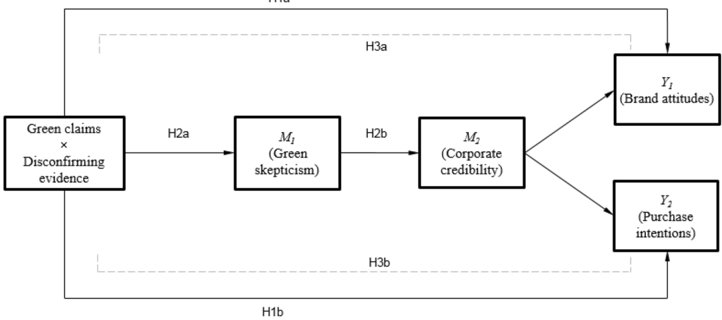
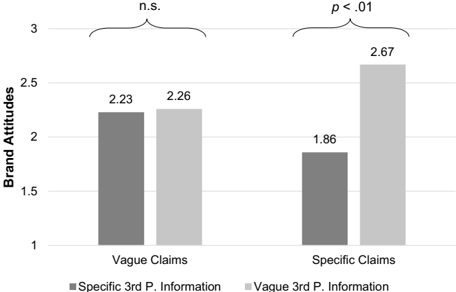
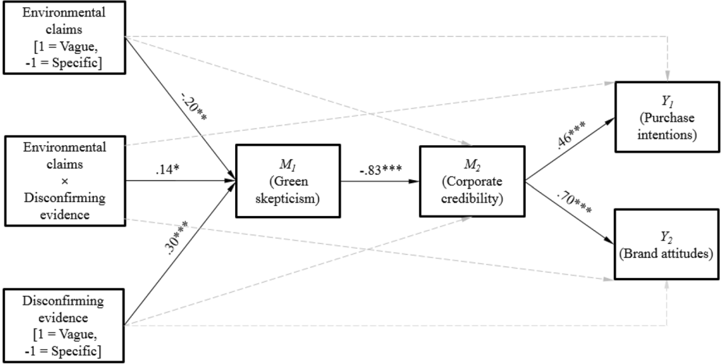
While environmental claims are increasingly used by companies to appeal consumers, they also attract greater scrutiny from independent parties interested in consumer protection. Consumers are now able to compare corporate environmental claims against external, often disconfirming, information to form their brand attitudes and purchase intentions. What remains unclear is how the level of information specificity of both the environmental claims and external disconfirming information interact to influence consumer reactions. Two experiments address this gap in the CSR communication literature. When specific (vs. vague) claims are countered by specific (vs. vague) external information, consumers report more negative brand attitudes and lower purchase intentions (Experiment 1). The effect is serially mediated by (1) skepticism toward the claims and (2) lack of corporate credibility (Experiment 2). We conclude by discussing strategies that firms can utilize to avoid information dilution and ensure that external disconfirming information percolates to consumers as specific.
Overview
The claims and statistics of this paper haven’t been checked yet.
Free: it reads the open-access text and checks the first 5 claims that cite a source we can check. Create a free account to check every claim.
Integrity signals
Registry
Cites
Statistics
Figures
Verification
Claims the paper makes
The claims and statistics of this paper haven’t been checked yet.
Free: it reads the open-access text and checks the first 5 claims that cite a source we can check. Create a free account to check every claim.
Claims other papers make about this one
Each is checked against this paper’s own text: does it say what the citing paper says it does?
The cited source says what the claim attributes to it.
In the citing paper
“brand attitudes and purchase intentions decreased sequentially through increased skepticism and diminished corporate credibility when specific (as opposed to vague) environmental claims were refuted by specific (compared to vague) external disconfirming information [39].”
From Substantiated vs. Vague Circular Economy Claims in Fashion Brands: Claim Support Credibility, Authenticity, and Trust in Greece vs. the UK (2026) · cites this paper as [39]
Self-check
Percentages, sums and reported differences re-computed from the paper’s own numbers.
The self-check needs the paper’s full text.
Citations
Cites
The theory of planned behavior
Ajzen, I. (1991) · Organizational Behavior and Human Decision Processes · doi:10.1016/0749-5978(91)90020-t · Cited by 134,657 · cited 2×
“A second limitation is that we considered brand attitudes and purchase intentions as highly correlated, in the sense that our predicted effect would arise and the process would be the same for both dependent variables (Ajzen 1991).”
Evaluating Structural Equation Models with Unobservable Variables and Measurement Error
Fornell, C., & Larcker, D. F. (1981) · Journal of Marketing Research · doi:10.2307/3151312 · Cited by 109,314
Evaluating structural equation models with unobservable variables and measurement error
Fornell, C., & Larcker, D. F. (1981) · Journal of Marketing Research · doi:10.1177/002224378101800104 · Cited by 109,190 · cited 2×
“Table 3 provides evidence of discriminant validity, as the AVE of each construct was greater than the shared variance between each pair of constructs (Fornell and Larcker 1981).”
Background(2013) · Cited by 44,563
The Elaboration Likelihood Model of Persuasion
Petty, R. E., & Cacioppo, J. T. (1986) · Advances in Experimental Social Psychology · doi:10.1016/s0065-2601(08)60214-2 · Cited by 8,822 · cited 2×
“Our findings indeed align with and extend prior research showing how direct countering evidence is most useful in persuasion (Fabrigar and Petty 1999; Petty and Cacioppo 1986).”
ResultIntroduction to mediation, moderation, and conditional process analysis :
Hayes, A. F., & names (2015) · Cited by 7,004
Assessing construct validity in organizational research
Bagozzi, R. P., Yi, Y., & Phillips, L. W. (1991) · Administrative Science Quarterly · doi:10.2307/2393203 · Cited by 6,621
Ohanian, R. (1990) · Journal of Advertising · doi:10.1080/00913367.1990.10673191 · Cited by 4,043 · cited 2×
“They also completed 3-item, 7-point Likert scales measuring credibility toward the company (α = 0.97; Ohanian 1990) and skepticism toward the environmental claims (α = 0.92; Matthes and Wonneberger 2014).”
BackgroundInfluentialGigerenzer, G., & Gaissmaier, W. (2011) · Annual Review of Psychology · doi:10.1146/annurev-psych-120709-145346 · Cited by 4,037 · cited 4×
“Extant literature provides strong support for the contention that, for brands about which consumers do not hold pre-existing attitudes, consumers rely on available cues to inform their judgment (Gigerenzer and Gaissmaier 2011; Payne et al.”
BackgroundInfluentialThe Predictive Validity of Multiple-Item versus Single-Item Measures of the Same Constructs
Bergkvist, L., & Rossiter, J. R. (2007) · Journal of Marketing Research · doi:10.1509/jmkr.44.2.175 · Cited by 3,107 · cited 1×
“After exposure to the experimental stimuli, participants reported their purchase intentions on a 7-point item adapted from Mitchell and Olson (1981) and widely used in marketing research (Bergkvist and Rossiter 2007).”
Method
Cited by
Drivers to green consumption: a systematic review
Testa, F., Pretner, G., Iovino, R., Bianchi, G., Tessitore, S., & Iraldo, F. (2021) · Environment, Development and Sustainability · doi:10.1007/s10668-020-00844-5 · Cited by 333
“2018) that have, in turn, reduced the consumers’ trustworthy toward green claims (Orazi and Chan 2018).”
BackgroundAcuti, D., Pizzetti, M., & Dolničar, S. (2022) · Psychology and Marketing · doi:10.1002/mar.21709 · Cited by 216
Sustainability, responsibility and ethics: different concepts for a single path
Torelli, R. (2020) · Social Responsibility Journal · doi:10.1108/srj-03-2020-0081 · Cited by 182
Companies, Meet Ethical Consumers: Strategic CSR Management to Impact Consumer Choice
Kuokkanen, H., & Sun, W. (2020) · Journal of Business Ethics · doi:10.1007/s10551-019-04145-4 · Cited by 172
“Consumers may regard unsubstantiated or contested CSR claims as greenwashing or mere public relations, and this creates a threat to credible CSR and reduces potential business benefits (Orazi and Chan, 2018; Nyilasy et al., 2013; Parguel et al., 2011).”
BackgroundThe influence of blockchain-based food traceability on retailer choice: The mediating role of trust
Garaus, M., & Treiblmaier, H. (2021) · Food Control · doi:10.1016/j.foodcont.2021.108082 · Cited by 169
Metadata
- Authors
- Orazi, D. C., & Chan, E. Y.
- Affiliations
- Monash University (AU)
- Corresponding author
- Orazi, Davide C.
- Venue
- Journal of Business Ethics
- Published
- 2018-10-04
- Volume
- 163
- Issue
- 1
- Pages
- 107-123
- ISSN
- 0167-4544 (ISSN-L)
- 1573-0697
- OpenAlex
- W2894605789
- Cited by
- 84
- References
- 49
- Citations by year
- 2026: 17 · 2025: 19 · 2024: 11 · 2023: 15 · 2022: 9 · 2021: 9 · 2020: 2 · 2019: 2
- FWCI
- 5.84
- Type
- journal article
- Language
- en
- Open access
- hybrid
- doi.org
- Licence
- cc-by
- creativecommons.org/licenses/by/4.0 (tdm)
- Locations
- Journal of Business Ethics (publishedVersion, cc-by)
- PhilPapers (PhilPapers Foundation) (submittedVersion, cc-by)
- Monash University Research Portal (Monash University) (submittedVersion, other-oa)
- RePEc: Research Papers in Economics (submittedVersion)
- PhilPapers (PhilPapers Foundation) (submittedVersion)
- Funders
- McGill University
- Topics
- Social Sciences › Business, Management and Accounting › Marketing › Environmental Sustainability in Business
- Social Sciences › Business, Management and Accounting › Strategy and Management › Corporate Social Responsibility Reporting
- Social Sciences › Business, Management and Accounting › Marketing › Consumer Behavior in Brand Consumption and Identification
- Keywords
- environmental claims, information specificity, consumer skepticism, institutional credibility, brand attitude, purchase intention, CSR communication, consumer protection
About these checks
Registry, retraction, Cites and statistics results are computed, not judged, with one exception: a printed reference that no index lists is read once by a model before it counts as a citation error. Claims are extracted by a model and kept only when their quote appears verbatim in the text; each cited source is then checked, with a model’s help, for whether it says what the claim relies on. Those verdicts can be wrong — read the claim’s quote and the cited source before relying on one.
Statistics and arithmetic are recomputed, not judged.
Confidence bands are shown only for fields calibrated on our annotated test set. None is calibrated yet, so no band is shown.
What counts as a claim ›How we measure confidence ›How we check this ›
Are you an author, or do you see a problem with this page? Request a review
Data sources
Bibliographic data: Semantic Scholar, OpenAlex, Crossref.
Contains information from the Semantic Scholar Academic Graph Datasets, made available under the ODC Attribution License (ODC-BY 1.0).
Semantic Scholar’s data is described in: Kinney, R., et al. (2023). The Semantic Scholar Open Data Platform. arXiv:2301.10140.
