

“They Did Not Walk the Green Talk!:” How Information Specificity Influences Consumer Evaluations of Disconfirmed Environmental Claims
Open accessThe DOI matches its Crossref record; 50 of the 50 references it cites were found in a registry or an index.
Abstract
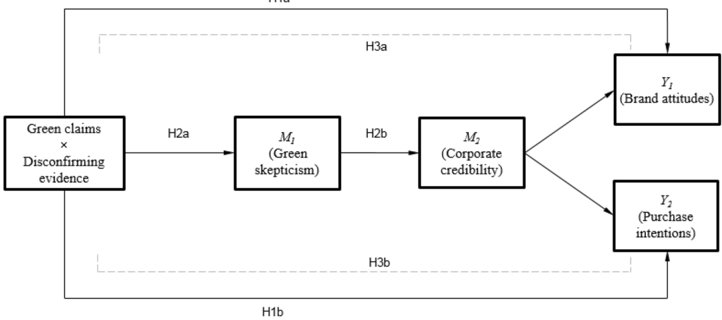
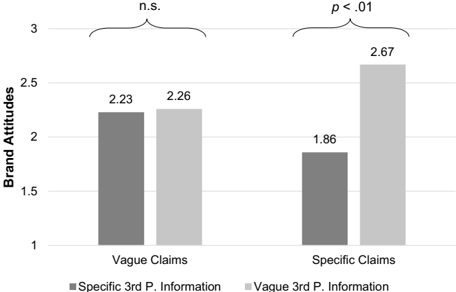
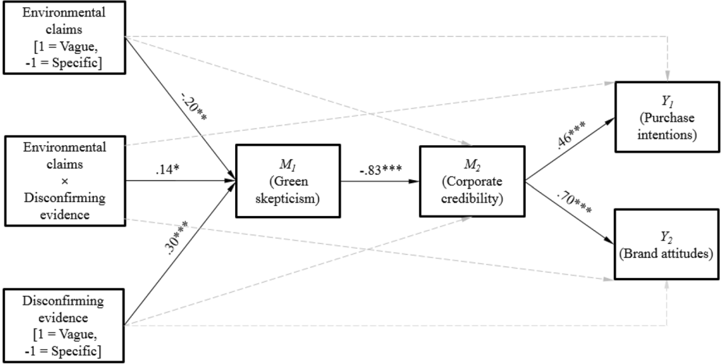
While environmental claims are increasingly used by companies to appeal consumers, they also attract greater scrutiny from independent parties interested in consumer protection. Consumers are now able to compare corporate environmental claims against external, often disconfirming, information to form their brand attitudes and purchase intentions. What remains unclear is how the level of information specificity of both the environmental claims and external disconfirming information interact to influence consumer reactions. Two experiments address this gap in the CSR communication literature. When specific (vs. vague) claims are countered by specific (vs. vague) external information, consumers report more negative brand attitudes and lower purchase intentions (Experiment 1). The effect is serially mediated by (1) skepticism toward the claims and (2) lack of corporate credibility (Experiment 2). We conclude by discussing strategies that firms can utilize to avoid information dilution and ensure that external disconfirming information percolates to consumers as specific.
Overview
The claims and statistics of this paper haven’t been checked yet.
Free: it reads the open-access text and checks the first 5 claims that cite a source we can check. Create a free account to check every claim.
Integrity signals
Registry
Cites
Statistics
Figures
Verification
Claims the paper makes
The claims and statistics of this paper haven’t been checked yet.
Free: it reads the open-access text and checks the first 5 claims that cite a source we can check. Create a free account to check every claim.
Claims other papers make about this one
Each is checked against this paper’s own text: does it say what the citing paper says it does?
The cited source says what the claim attributes to it.
In the citing paper
“brand attitudes and purchase intentions decreased sequentially through increased skepticism and diminished corporate credibility when specific (as opposed to vague) environmental claims were refuted by specific (compared to vague) external disconfirming information [39].”
From Substantiated vs. Vague Circular Economy Claims in Fashion Brands: Claim Support Credibility, Authenticity, and Trust in Greece vs. the UK (2026) · cites this paper as [39]
Self-check
Percentages, sums and reported differences re-computed from the paper’s own numbers.
The self-check needs the paper’s full text.
Citations
Cites
Evaluating Structural Equation Models with Unobservable Variables and Measurement Error
Fornell, C., & Larcker, D. F. (1981) · Journal of Marketing Research · doi:10.2307/3151312 · Cited by 109,314
Evaluating structural equation models with unobservable variables and measurement error
Fornell, C., & Larcker, D. F. (1981) · Journal of Marketing Research · doi:10.1177/002224378101800104 · Cited by 109,190 · cited 2×
“Table 3 provides evidence of discriminant validity, as the AVE of each construct was greater than the shared variance between each pair of constructs (Fornell and Larcker 1981).”
BackgroundThe theory of planned behavior
Ajzen, I. (1991) · Organizational Behavior and Human Decision Processes · doi:10.1016/0749-5978(91)90020-t · Cited by 90,587 · cited 2×
“A second limitation is that we considered brand attitudes and purchase intentions as highly correlated, in the sense that our predicted effect would arise and the process would be the same for both dependent variables (Ajzen 1991).”
(2013) · Cited by 44,563
The Elaboration Likelihood Model of Persuasion
Petty, R. E., & Cacioppo, J. T. (1986) · Advances in Experimental Social Psychology · doi:10.1016/s0065-2601(08)60214-2 · Cited by 8,822 · cited 2×
“Our findings indeed align with and extend prior research showing how direct countering evidence is most useful in persuasion (Fabrigar and Petty 1999; Petty and Cacioppo 1986).”
ResultIntroduction to mediation, moderation, and conditional process analysis :
Hayes, A. F., & names (2015) · Cited by 7,004
Assessing construct validity in organizational research
Bagozzi, R. P., Yi, Y., & Phillips, L. W. (1991) · Administrative Science Quarterly · doi:10.2307/2393203 · Cited by 6,621
Ohanian, R. (1990) · Journal of Advertising · doi:10.1080/00913367.1990.10673191 · Cited by 4,043 · cited 2×
“They also completed 3-item, 7-point Likert scales measuring credibility toward the company (α = 0.97; Ohanian 1990) and skepticism toward the environmental claims (α = 0.92; Matthes and Wonneberger 2014).”
BackgroundInfluentialGigerenzer, G., & Gaissmaier, W. (2011) · Annual Review of Psychology · doi:10.1146/annurev-psych-120709-145346 · Cited by 4,037 · cited 4×
“Extant literature provides strong support for the contention that, for brands about which consumers do not hold pre-existing attitudes, consumers rely on available cues to inform their judgment (Gigerenzer and Gaissmaier 2011; Payne et al.”
BackgroundInfluentialThe Predictive Validity of Multiple-Item versus Single-Item Measures of the Same Constructs
Bergkvist, L., & Rossiter, J. R. (2007) · Journal of Marketing Research · doi:10.1509/jmkr.44.2.175 · Cited by 3,107 · cited 1×
“After exposure to the experimental stimuli, participants reported their purchase intentions on a 7-point item adapted from Mitchell and Olson (1981) and widely used in marketing research (Bergkvist and Rossiter 2007).”
MethodThe impact of perceived corporate social responsibility on consumer behavior
Becker-Olsen, K. L., Cudmore, B. A., & Hill, R. P. (2006) · Journal of Business Research · doi:10.1016/j.jbusres.2005.01.001 · Cited by 2,057 · cited 3×
“Prior research points to green skepticism—or the disbelief about corporate claims praising the environmental performance of a green offering (Mohr et al. 1998; Becker-Olsen et al. 2006)—as a likely response to potentially misleading or false green claims (Nyilasy et al.”
BackgroundCorporate Social Responsibility Reporting in China: Symbol or Substance?
Marquis, C., & Qian, C. (2014) · Organization Science · doi:10.1287/orsc.2013.0837 · Cited by 1,793 · cited 1×
“2017), companies worldwide increasingly use environmental claims as part of their Corporate Social Responsibility (CSR) communication strategy (Parguel et al. 2011; Marquis and Qian 2013).”
BackgroundAre Product Attribute Beliefs the Only Mediator of Advertising Effects on Brand Attitude?
Mitchell, A. A., & Olson, J. C. (1981) · Journal of Marketing Research · doi:10.2307/3150973 · Cited by 1,472 · cited 1×
“After exposure to the experimental stimuli, participants reported their purchase intentions on a 7-point item adapted from Mitchell and Olson (1981) and widely used in marketing research (Bergkvist and Rossiter 2007).”
MethodWagner, T., Lutz, R. J., & Weitz, B. A. (2009) · Journal of Marketing · doi:10.1509/jmkg.73.6.77 · Cited by 1,339 · cited 5×
“1 3 future environmental commitment (Wagner et al. 2009).”
BackgroundInfluentialChen, Y.-S., & Chang, C.-H. (2013) · Journal of Business Ethics · doi:10.1007/s10551-012-1360-0 · Cited by 1,281
Development of a Scale to Measure Consumer Skepticism Toward Advertising
Obermiller, C., & Spangenberg, E. R. (1998) · Journal of Consumer Psychology · doi:10.1207/s15327663jcp0702_03 · Cited by 1,037 · cited 10×
“1990; Forehand and Grier 2003; Obermiller and Spangenberg 1998; Webb and Mohr 1998) while the object of credibility is the source of the communications (Forehand and Grier 2003).”
BackgroundResultInfluentialParguel, B., Benoît-Moreau, F., & Larceneux, F. (2011) · Journal of Business Ethics · doi:10.1007/s10551-011-0901-2 · Cited by 1,024 · cited 8×
“At the same time, the use of environmental claims attracts scrutiny by parties interested in protecting consumers, such as federal regulatory bodies, NGOs, and media (Parguel et al. 2011).”
BackgroundInfluentialWhen Is Honesty the Best Policy? The Effect of Stated Company Intent on Consumer Skepticism
Foreh, M. R., & Grier, S. (2003) · Journal of Consumer Psychology · doi:10.1207/s15327663jcp1303_15 · Cited by 1,003 · cited 5×
“1990; Forehand and Grier 2003; Obermiller and Spangenberg 1998; Webb and Mohr 1998) while the object of credibility is the source of the communications (Forehand and Grier 2003).”
BackgroundInfluentialA Typology of Consumer Responses to Cause-Related Marketing: From Skeptics to Socially Concerned
Webb, D. J., & Mohr, L. A. (1998) · Journal of Public Policy & Marketing · doi:10.1177/074391569801700207 · Cited by 876 · cited 4×
“Skepticism refers to distrust of marketing communications (Ford et al. 1990; Forehand and Grier 2003; Obermiller and Spangenberg 1998; Webb and Mohr 1998); credibility refers to distrust of the source of the communications (Forehand and Grier 2003).”
BackgroundInfluentialMichalos, A. C., & Poff, D. C. (2017) · Encyclopedia of Business and Professional Ethics · doi:10.1007/978-3-319-23514-1_260-1 · Cited by 856
Nyilasy, G., Gangadharbatla, H., & Paladino, A. (2014) · Journal of Business Ethics · doi:10.1007/s10551-013-1944-3 · Cited by 815 · cited 5×
“Thus, we align with CSR communication research investigating proactive environmental communications (Nyilasy et al. 2014; Brulhart et al. 2017).”
BackgroundInfluentialCSR as Reputation Insurance: Primum Non Nocere
Minor, D., & Morgan, J. (2011) · California Management Review · doi:10.1525/cmr.2011.53.3.40 · Cited by 664 · cited 2×
“2016), consists of stating environmental claims upfront to protect corporate value against the reputational consequences caused by future adverse events (Minor and Morgan 2011).”
BackgroundGray Shades of Green: Causes and Consequences of Green Skepticism
Leonidou, C. N., & Skarmeas, D. (2017) · Journal of Business Ethics · doi:10.1007/s10551-015-2829-4 · Cited by 589 · cited 3×
“2001; Obermiller and Spangenberg 1998), and are usually suspicious of green claims to begin with (Leonidou and Skarmeas 2015; Wagner et al. 2009).”
BackgroundMOHR, L. A., EROǦLU, D., & ELLEN, P. S. (1998) · Journal of Consumer Affairs · doi:10.1111/j.1745-6606.1998.tb00399.x · Cited by 564
Kang, C., Germann, F., & Grewal, R. (2016) · Journal of Marketing · doi:10.1509/jm.15.0324 · Cited by 553 · cited 2×
“Proactive environmental communications are thus distinct from reactive environmental communications, the latter typically following environmental crises as means of reparation (Kang et al. 2016).”
BackgroundPerceived Organizational Motives and Consumer Responses to Proactive and Reactive CSR
Groza, M. D., Pronschinske, M. R., & Walker, M. (2011) · Journal of Business Ethics · doi:10.1007/s10551-011-0834-9 · Cited by 552 · cited 1×
“Reactively, consumers may be even more skeptical of environmental claims as they may perceive them as a way to protect profits and corporate image (Becker-Olsen et al. 2006; Groza et al. 2011).”
BackgroundConsumer Skepticism of Advertising Claims: Testing Hypotheses from Economics of Information
Ford, G. T., Smith, D. B., & Swasy, J. L. (1990) · Journal of Consumer Research · doi:10.1086/209228 · Cited by 481 · cited 3×
“Skepticism refers to distrust of marketing communications (Ford et al. 1990; Forehand and Grier 2003; Obermiller and Spangenberg 1998; Webb and Mohr 1998); credibility refers to distrust of the source of the communications (Forehand and Grier 2003).”
BackgroundTweetjacked: The Impact of Social Media on Corporate Greenwash
Lyon, T. P., & Montgomery, A. W. (2013) · Journal of Business Ethics · doi:10.1007/s10551-013-1958-x · Cited by 450 · cited 7×
“Indeed, the network effects enabled by social media between relevant stakeholders allow information to go viral, naturally increasing the frequency of exposure to the same message (Lyon and Montgomery 2013).”
BackgroundInfluentialFabrigar, L. R., & Petty, R. E. (1999) · Personality and Social Psychology Bulletin · doi:10.1177/0146167299025003008 · Cited by 385 · cited 4×
“In the persuasion literature, vague claims give consumers room to more easily assimilate or integrate how the subsequent, supposedly contradicting information may or may not co-exist with those initial attitudes (Fabrigar and Petty 1999; Muthukrishnan et al.”
BackgroundResultInfluentialReputation management: the new face of corporate public relations?
Hutton, J. G., Goodman, M. B., Alexander, J. B., & Genest, C. M. (2001) · Public Relations Review · doi:10.1016/s0363-8111(01)00085-6 · Cited by 359
Advertising Repetition: A Meta-Analysis on Effective Frequency in Advertising
Schmidt, S., & Eisend, M. (2015) · Journal of Advertising · doi:10.1080/00913367.2015.1018460 · Cited by 345
Matthes, J., & Wonneberger, A. (2014) · Journal of Advertising · doi:10.1080/00913367.2013.834804 · Cited by 289 · cited 6×
“Second, in examining how consumers use external information to evaluate firms’ environmental claims, we also extend the literature on consumer skepticism (Obermiller and Spangenberg 1998) and green skepticism in particular (Leonidou and Skarmeas 2015; Matthes and Wonneberger 2014; Nyilasy et al.”
BackgroundInfluentialFactors Affecting Skepticism toward Green Advertising
do Paço, A. M. F., & Reis, R. (2012) · Journal of Advertising · doi:10.1080/00913367.2012.10672463 · Cited by 282 · cited 1×
“…research has mainly measured and modeled the antecedents of green skepticism, such as perceptions of CSR, corporate history, norms in the industry, intrinsic motives (Leonidou and Skarmeas 2015), environmental concerns (do Paço and Reis 2012), and green consumerism (Matthes and Wonneberger 2014).”
BackgroundAn Ethical Framework for the Marketing of Corporate Social Responsibility
van de Ven, B. (2008) · Journal of Business Ethics · doi:10.1007/s10551-008-9890-1 · Cited by 266 · cited 1×
“Many companies have specifically focused on ethical product differentiation—a particular approach to CSR communications based on differentiating a company’s offerings on grounds of social or environmental sustainability (van de Ven 2008).”
BackgroundMental Construal and the Emergence of Assimilation and Contrast Effects
Bless, H., & Schwarz, N. (2010) · Advances in Experimental Social Psychology · doi:10.1016/s0065-2601(10)42006-7 · Cited by 247 · cited 3×
“Our research is thus situated within literature showing how initial attitudes or judgments vaguely formed might assimilate specific countering information (Bless and Schwarz 2010; Pham and Muthukrishnan 2002).”
Background"Information Load" and Consumers
Scammon, D. L. (1977) · Journal of Consumer Research · doi:10.1086/208690 · Cited by 242 · cited 2×
“In an era of digital information in which external information is more than ever subject to consumer dilution and information overload effects (Scammon 1977; Lyon and Montgomery 2013), our findings echo the call of Parguel et al.”
BackgroundBalmer, J. M. T., Fukukawa, K., & Gray, E. R. (2007) · Journal of Business Ethics · doi:10.1007/s10551-006-9278-z · Cited by 240 · cited 5×
“Answering the call for more CSR communication research on the role of external information in consumer evaluation of environmental claims (Balmer et al. 2007; Parguel et al. 2011), this research sets out to explore how the information specificity levels of both corporate environmental claims and external disconfirming…”
BackgroundInfluentialEco-friendly product development strategy: antecedents, outcomes, and contingent effects
Katsikeas, C. S., Leonidou, C. N., & Zeriti, A. (2016) · Journal of the Academy of Marketing Science · doi:10.1007/s11747-015-0470-5 · Cited by 200 · cited 1×
“As consumers place a premium on green products (Luchs and Kumar 2017) and environmental friendliness (Katsikeas et al. 2016; Brulhart et al. 2017), companies worldwide increasingly use environmental claims as part of their Corporate Social Responsibility (CSR) communication strategy (Parguel et al.”
BackgroundMuehling, D. D., & Laczniak, R. N. (1988) · Journal of Advertising · doi:10.1080/00913367.1988.10673126 · Cited by 196 · cited 1×
“Next, participants reported their brand attitudes (α = 0.97) on a 3-item, 7-point Likert scale by Muehling and Laczniak (1988).”
MethodInfluentialDo Stakeholder Orientation and Environmental Proactivity Impact Firm Profitability?
Brulhart, F., Gherra, S., & Quélin, B. V. (2017) · Journal of Business Ethics · doi:10.1007/s10551-017-3732-y · Cited by 192 · cited 3×
“Thus, we align with CSR communication research investigating proactive environmental communications (Nyilasy et al. 2014; Brulhart et al. 2017).”
BackgroundLuchs, M. G., & Kumar, M. (2017) · Journal of Business Ethics · doi:10.1007/s10551-015-2695-0 · Cited by 176 · cited 1×
“As consumers place a premium on green products (Luchs and Kumar 2017) and environmental friendliness (Katsikeas et al.”
BackgroundCorporate Transparency and Green Management
Vaccaro, A., & Echeverri, D. P. (2010) · Journal of Business Ethics · doi:10.1007/s10551-010-0435-z · Cited by 137
Search and Alignment in Judgment Revision: Implications for Brand Positioning
Pham, M. T., & Muthukrishnan, A. V. (2002) · Journal of Marketing Research · doi:10.1509/jmkr.39.1.18.18929 · Cited by 135 · cited 4×
“Our research is thus situated within literature showing how initial attitudes or judgments vaguely formed might assimilate specific countering information (Bless and Schwarz 2010; Pham and Muthukrishnan 2002).”
BackgroundResultInfluentialSundar, A., & Kellaris, J. J. (2015) · Journal of Business Ethics · doi:10.1007/s10551-015-2918-4 · Cited by 118 · cited 1×
“Patent and Trademark Organization forbids companies from using the vague connotative “green” in trademarks unless they can prove their environmental friendliness (Sundar and Kellaris 2016).”
BackgroundAdvertising: An Integrated Marketing Communication Perspective
Belch, G. E. (2020) · McGraw-Hill eBooks · Cited by 73
Misleading Characteristics of Implied-Superiority Claims
Snyder, R. (1989) · Journal of Advertising · doi:10.1080/00913367.1989.10673167 · Cited by 50 · cited 1×
“This contention is in line with how direct countering evidence is more effective in persuasion (Fabrigar and Petty 1999; Petty and Cacioppo 1986; Pham and Muthukrishnan 2002; Snyder 1989).”
ResultDo Stakeholder Orientation and Environmental Proactivity Impact Firm Profitability?Preprint
Brulhart, F., Gherra, S., & Quélin, B. V. (2017) · SSRN Electronic Journal · doi:10.2139/ssrn.3078850 · Cited by 43
Stakeholder Orientation and Market Impact: Evidence from India
Adbi, A., Bhaskarabhatla, A., & Chatterjee, C. (2018) · Digital Eprints Services at ISB (DESI) (Indian School of Business) · doi:10.1007/s1055 · Cited by 38
Virtual Special Issue on ‘Sociology and Business Ethics’
Burrell, G. (2016) · Journal of Business Ethics · doi:10.1007/s10551-016-3394-1 · Cited by 22
Comparison Opportunity and Judgment Revision
Muthukrishnan, A. V., Pham, M. T., & Mungalé, A. (1999) · Organizational Behavior and Human Decision Processes · doi:10.1006/obhd.1999.2859 · Cited by 20 · cited 1×
“In the persuasion literature, vague claims give consumers room to more easily assimilate or integrate how the subsequent, supposedly contradicting information may or may not co-exist with those initial attitudes (Fabrigar and Petty 1999; Muthukrishnan et al. 1999).”
Background
Cited by
Drivers to green consumption: a systematic review
Testa, F., Pretner, G., Iovino, R., Bianchi, G., Tessitore, S., & Iraldo, F. (2021) · Environment, Development and Sustainability · doi:10.1007/s10668-020-00844-5 · Cited by 333
“2018) that have, in turn, reduced the consumers’ trustworthy toward green claims (Orazi and Chan 2018).”
BackgroundAcuti, D., Pizzetti, M., & Dolničar, S. (2022) · Psychology and Marketing · doi:10.1002/mar.21709 · Cited by 216
Sustainability, responsibility and ethics: different concepts for a single path
Torelli, R. (2020) · Social Responsibility Journal · doi:10.1108/srj-03-2020-0081 · Cited by 182
Companies, Meet Ethical Consumers: Strategic CSR Management to Impact Consumer Choice
Kuokkanen, H., & Sun, W. (2020) · Journal of Business Ethics · doi:10.1007/s10551-019-04145-4 · Cited by 172
“Consumers may regard unsubstantiated or contested CSR claims as greenwashing or mere public relations, and this creates a threat to credible CSR and reduces potential business benefits (Orazi and Chan, 2018; Nyilasy et al., 2013; Parguel et al., 2011).”
BackgroundThe influence of blockchain-based food traceability on retailer choice: The mediating role of trust
Garaus, M., & Treiblmaier, H. (2021) · Food Control · doi:10.1016/j.foodcont.2021.108082 · Cited by 169
Metadata
- Authors
- Orazi, D. C., & Chan, E. Y.
- Affiliations
- Monash University (AU)
- Corresponding author
- Orazi, Davide C.
- Venue
- Journal of Business Ethics
- Published
- 2018-10-04
- Volume
- 163
- Issue
- 1
- Pages
- 107-123
- ISSN
- 0167-4544 (ISSN-L)
- 1573-0697
- OpenAlex
- W2894605789
- Cited by
- 84
- References
- 49
- Citations by year
- 2026: 17 · 2025: 19 · 2024: 11 · 2023: 15 · 2022: 9 · 2021: 9 · 2020: 2 · 2019: 2
- FWCI
- 5.84
- Type
- journal article
- Language
- en
- Open access
- hybrid
- doi.org
- Licence
- cc-by
- creativecommons.org/licenses/by/4.0 (tdm)
- Locations
- Journal of Business Ethics (publishedVersion, cc-by)
- PhilPapers (PhilPapers Foundation) (submittedVersion, cc-by)
- Monash University Research Portal (Monash University) (submittedVersion, other-oa)
- RePEc: Research Papers in Economics (submittedVersion)
- PhilPapers (PhilPapers Foundation) (submittedVersion)
- Funders
- McGill University
- Topics
- Social Sciences › Business, Management and Accounting › Marketing › Environmental Sustainability in Business
- Social Sciences › Business, Management and Accounting › Strategy and Management › Corporate Social Responsibility Reporting
- Social Sciences › Business, Management and Accounting › Marketing › Consumer Behavior in Brand Consumption and Identification
- Keywords
- environmental claims, information specificity, consumer skepticism, institutional credibility, brand attitude, purchase intention, CSR communication, consumer protection
About these checks
Registry, retraction, Cites and statistics results are computed, not judged, with one exception: a printed reference that no index lists is read once by a model before it counts as a citation error. Claims are extracted by a model and kept only when their quote appears verbatim in the text; each cited source is then checked, with a model’s help, for whether it says what the claim relies on. Those verdicts can be wrong — read the claim’s quote and the cited source before relying on one.
Statistics and arithmetic are recomputed, not judged.
Confidence bands are shown only for fields calibrated on our annotated test set. None is calibrated yet, so no band is shown.
What counts as a claim ›How we measure confidence ›How we check this ›
Are you an author, or do you see a problem with this page? Request a review
Data sources
Bibliographic data: Semantic Scholar, OpenAlex, Crossref.
Contains information from the Semantic Scholar Academic Graph Datasets, made available under the ODC Attribution License (ODC-BY 1.0).
Semantic Scholar’s data is described in: Kinney, R., et al. (2023). The Semantic Scholar Open Data Platform. arXiv:2301.10140.
