

Technology Delivered Interventions for Depression and Anxiety in Children and Adolescents: A Systematic Review and Meta-analysis
Open accessThe DOI matches its Crossref record; 98 of the 101 references it cites were found in a registry or an index.
Abstract
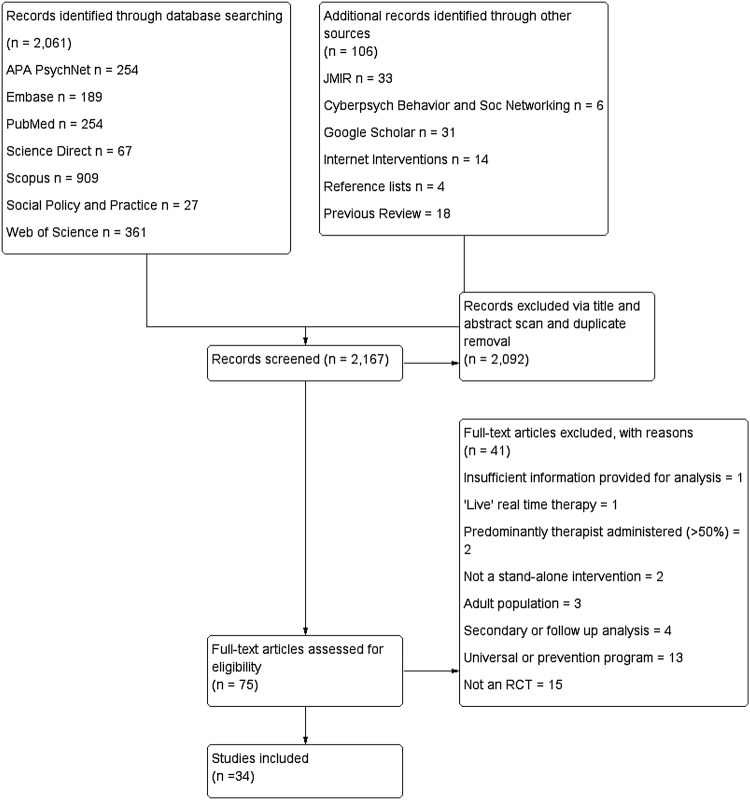
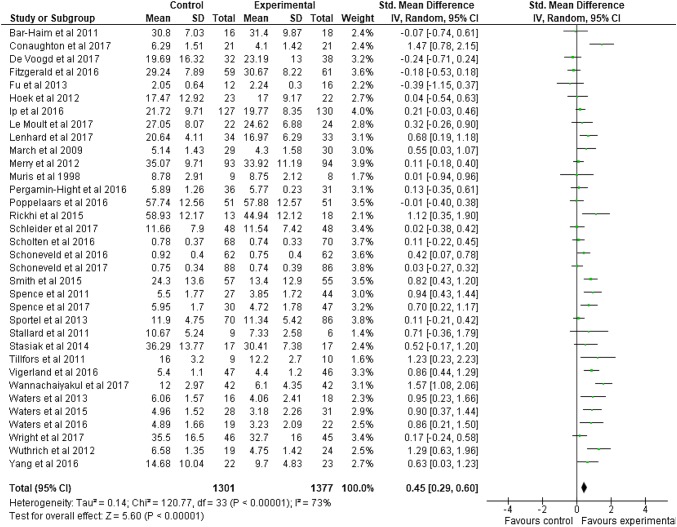
Depression and anxiety are common during adolescence. Whilst effective interventions are available treatment services are limited resulting in many adolescents being unable to access effective help. Delivering mental health interventions via technology, such as computers or the internet, offers one potential way to increase access to psychological treatment. The aim of this systematic review and meta-analysis was to update previous work and investigate the current evidence for the effect of technology delivered interventions for children and adolescents (aged up to 18 years) with depression and anxiety. A systematic search of eight electronic databases identified 34 randomized controlled trials involving 3113 children and young people aged 6-18. The trials evaluated computerized and internet cognitive behavior therapy programs (CBT: n = 17), computer-delivered attention bias modification programs (ABM: n = 8) cognitive bias modification programs (CBM: n = 3) and other interventions (n = 6). Our results demonstrated a small effect in favor of technology delivered interventions compared to a waiting list control group: g = 0.45 [95% CI 0.29, 0.60] p < 0.001. CBT interventions yielded a medium effect size (n = 17, g = 0.66 [95% CI 0.42-0.90] p < 0.001). ABM interventions yielded a small effect size (n = 8, g = 0.41 [95%CI 0.08-0.73] p < 0.01). CBM and 'other' interventions failed to demonstrate a significant benefit over control groups. Type of control condition, problem severity, therapeutic support, parental support, and continuation of other ongoing treatment significantly influenced effect sizes. Our findings suggest there is a benefit in using CBT based technology delivered interventions where access to traditional psychotherapies is limited or delayed.
Overview
The claims and statistics of this paper haven’t been checked yet.
Free: it reads the open-access text and checks the first 5 claims that cite a source we can check. Create a free account to check every claim.
Integrity signals
Registry
Cites
Statistics
Figures
Verification
Claims the paper makes
The claims and statistics of this paper haven’t been checked yet.
Free: it reads the open-access text and checks the first 5 claims that cite a source we can check. Create a free account to check every claim.
Claims other papers make about this one
Each is checked against this paper’s own text: does it say what the citing paper says it does?
The source backs part of the claim, not all of it — or backs it for a different population, condition or comparison.
In the citing paper
“Furthermore, computerized CBT, such as MoodGym, SPARX, and “Think, Feel, Do” generally have small but positive effects on mental health.96 , 97”
From Rapid Systematic Review: The Impact of Social Isolation and Loneliness on the Mental Health of Children and Adolescents in the Context of COVID-19 (2020) · cites this paper as [97]
Experimental — accuracy not yet measuredThe source backs part of the claim, not all of it — or backs it for a different population, condition or comparison.
In the citing paper
“Although mobile applications for mental health have been found to be generally acceptable to children and adolescents, there is a lack of convincing evidence of effectiveness on intended mental health outcomes98 and few mobile health apps have been thoroughly tested.97”
From Rapid Systematic Review: The Impact of Social Isolation and Loneliness on the Mental Health of Children and Adolescents in the Context of COVID-19 (2020) · cites this paper as [97]
Experimental — accuracy not yet measuredThe source backs part of the claim, not all of it — or backs it for a different population, condition or comparison.
In the citing paper
“Importantly, reviews have tended to conclude that effects are better if there is some therapist input97 , 101 and if parents are involved especially for younger children.96 , 97”
From Rapid Systematic Review: The Impact of Social Isolation and Loneliness on the Mental Health of Children and Adolescents in the Context of COVID-19 (2020) · cites this paper as [97]
Experimental — accuracy not yet measuredThe source backs part of the claim, not all of it — or backs it for a different population, condition or comparison.
In the citing paper
“Mental health interventions provided on a computer or via the Internet, which we will henceforth denote as e-mental health interventions, have acquired a solid empirical basis for the prevention and treatment of various psychological conditions in adults, including depression (Buntrock et al., 2016; Karyotaki et al., 2017), anxiety (Grist et al., 2019), and alcohol use (Riper et al., 2018).”
From The effect of e-mental health interventions on academic performance in university and college students: A meta-analysis of randomized controlled trials (2020) · cites this paper as Grist et al., 2019
Experimental — accuracy not yet measuredThe cited source says what the claim attributes to it.
In the citing paper
“A meta-analysis including 34 RCTs (17 of which were CBT-based) found that CBT-based DHIs yielded a medium effect size for reducing symptoms of depression and anxiety.45”
From Mixed-methods feasibility outcomes for a novel ACT-based video game ‘ACTing Minds’ to support mental health (2024) · cites this paper as [45]
Self-check
Percentages, sums and reported differences re-computed from the paper’s own numbers.
The self-check needs the paper’s full text.
Citations
Cites
The Efficacy of Cognitive Behavioral Therapy: A Review of Meta-analyses
Hofmann, S. G., Asnaani, A., Vonk, I. J. J., Sawyer, A. T., & Fang, A. (2012) · Cognitive Therapy and Research · doi:10.1007/s10608-012-9476-1 · Cited by 3,445
Childhood and adolescent depression: a review of the past 10 years, Part I
BIRMAHER, B., RYAN, N. D., WILLIAMSON, D. E., BRENT, D. A., KAUFMAN, J., DAHL, R. E., PEREL, J., & NELSON, B. (1996) · Journal of the American Academy of Child & Adolescent Psychiatry · doi:10.1097/00004583-199611000-00011 · Cited by 2,076
Kim-Cohen, J., Caspi, A., Moffitt, T. E., Harrington, H., Milne, B. J., & Poulton, R. (2003) · Archives of General Psychiatry · doi:10.1001/archpsyc.60.7.709 · Cited by 2,025
Merikangas, K. R., He, J.-P., Burstein, M., Swendsen, J., Avenevoli, S., Case, B., Georgiades, K., Heaton, L., Swanson, S., & Olfson, M. (2011) · Journal of the American Academy of Child & Adolescent Psychiatry · doi:10.1016/j.jaac.2010.10.006 · Cited by 1,579
Computer-based psychological treatments for depression: A systematic review and meta-analysis
Richards, D., & Richardson, T. (2012) · Clinical Psychology Review · doi:10.1016/j.cpr.2012.02.004 · Cited by 1,442
Cognitive Behavioral Therapy, Sertraline, or a Combination in Childhood Anxiety
Walkup, J. T., Albano, A. M., Piacentini, J., Birmaher, B., Compton, S. N., Sherrill, J. T., Ginsburg, G. S., Rynn, M. A., McCracken, J., Waslick, B., et al. (2008) · New England Journal of Medicine · doi:10.1056/nejmoa0804633 · Cited by 1,442
“The Medical Journal of Australia”
(1923) · Medical Journal of Australia · doi:10.5694/j.1326-5377.1923.tb64467.x · Cited by 1,439
Internet-Based and Other Computerized Psychological Treatments for Adult Depression: A Meta-Analysis
Andersson, G., & Cuijpers, P. (2009) · Cognitive Behaviour Therapy · doi:10.1080/16506070903318960 · Cited by 1,368
Andrews, G., Cuijpers, P., Craske, M. G., McEvoy, P., & Titov, N. (2010) · PLoS ONE · doi:10.1371/journal.pone.0013196 · Cited by 1,311
Youth Suicide Risk and Preventive Interventions: A Review of the Past 10 Years
GOULD, M. S., GREENBERG, T., VELTING, D. M., & SHAFFER, D. (2003) · Journal of the American Academy of Child & Adolescent Psychiatry · doi:10.1097/01.chi.0000046821.95464.cf · Cited by 1,264
Cited by
Items 201–288 of 288
Gotkiewicz, D., & Goldstein, T. R. (2021) · Clinical Pediatrics · doi:10.1177/00099228211034644 · Cited by 3
Apps for mental health problems in children and young people
Stallard, P. N. (2022) · Oxford University Press eBooks · doi:10.1093/med-psych/9780198867791.003.0027 · Cited by 2
Self-citationCOVID-19 Pandemisinin Çocuklar Üzerindeki Psikolojik Etkilerinin İncelenmesi
ÇİLHOROZ, Y. (2023) · Sağlık ve Sosyal Refah Araştırmaları Dergisi · doi:10.55050/sarad.1182479 · Cited by 2
Cognitive and Behavioral Therapies
Thase, M. E., Khazanov, G. K., & Wright, J. H. (2023) · Springer eBooks · doi:10.1007/978-3-030-42825-9_35-1 · Cited by 5
Bouclaous, C. H., Daher, R., Osseily, W., Rosario, R. V., & Hamam, H. (2023) · Canadian Journal of School Psychology · doi:10.1177/08295735231197344 · Cited by 2
“Other interventions such as computerized and internet cognitive behavioral therapy programs yielded a medium effect size while computer-delivered attention bias modification programs yielded a small effect size on anxiety and depression (Grist et al., 2019).”
BackgroundTechnological Innovations in Pediatric Psychological Consultation
Benore, E. R., Scott, E. L., & Webster, E. E. (2020) · Issues in clinical child psychology · doi:10.1007/978-3-030-35598-2_37 · Cited by 2
Schema Therapy for Adolescents with Test Anxiety
Wainer, L. M., Kolb, A. M., & Tavares, M. E. A. M. (2022) · Springer eBooks · doi:10.1007/978-3-031-12737-3_22 · Cited by 1
Awadalla, S., Davies, E. B., & Glazebrook, C. (2025) · Humanities and Social Sciences Communications · doi:10.1057/s41599-025-05037-x · Cited by 4
“‘ Internet-delivered technology ’ in counselling refers to psychological online interventions utilising various multimedia formats and interactive features to engage users and promote intervention effectiveness (Grist et al., 2019).”
Zhang, Q., Li, L., Sui, Y., Lin, F.-H., & Huang, Z. (2025) · Adolescent Research Review · doi:10.1007/s40894-025-00277-z · Cited by 1
“This is consistent with findings from other meta-analyses sug - gesting that participant age does not matter for the effect of online interventions anxiety and depression outcomes (Grist et al., 2019; von Wirth et al., 2023 ; Wickersham et al., 2022 ).”
Feng, J., Ye, X., Liu, X., Cui, J., Jin, Q., Lin, Z., Zhuang, W., Zheng, T., Yu, H., Zhang, Y., et al. (2026) · Biological Psychiatry Cognitive Neuroscience and Neuroimaging · doi:10.1016/j.bpsc.2026.02.008 · Cited by 1
Balan, R., Dobrean, A., Poetar, C.-R., Florean, I. S., Balázsi, R., Coșa, I. M., & Månsson, K. N. T. (2026) · Acta Psychologica · doi:10.1016/j.actpsy.2026.106692 · Cited by 1
Jeugdhulp in tijden van corona
Weeland, J., & van Rooij, F. B. (2021) · Kind & Adolescent Praktijk · doi:10.1007/s12454-021-0637-9 · Cited by 1
Delivering computerized Cognitive Behavioral Therapy for child and adolescent depression and anxiety
Stallard, P. N. (2022) · Elsevier eBooks · doi:10.1016/b978-0-323-91709-4.00002-0 · Cited by 1
Self-citationStørksen, H. T., Nielsen, B., Haga, S. M., & Drozd, F. (2023) · Children and Youth Services Review · doi:10.1016/j.childyouth.2023.107253 · Cited by 1
Grant, L., Mitchell, P. B., & Hulvershorn, L. A. (2023) · Springer eBooks · doi:10.1007/978-3-030-42825-9_21-1 · Cited by 1
Marzuki, A., Noor, S. F. M., Wook, T. S. M. T., & Ismail, W. S. W. (2023) · TEM Journal · doi:10.18421/tem124-57 · Cited by 3
Anekar, Y. D. D. (2024) · Journal of Electrical Systems · doi:10.52783/jes.781 · Cited by 1
“R. Grist et al., (2018) [32] have investigated the current state of study on the usefulness of online-based therapies for treating anxiety and depression to update earlier studies in this field.”
BackgroundLincke, L., Kilb, H., Martin-Döring, T., Bienioschek, S., Nolkemper, D., Daunke, A., Reis, O., & Kölch, M. G. (2025) · Kindheit und Entwicklung · doi:10.1026/0942-5403/a000484 · Cited by 1
Hipólito, J., Nunes, O., Brites, R., & Silva, B. (2021) · Psique · doi:10.26619/2183-4806.xvi.2.1 · Cited by 3
Gilani, S. M., Tanvy, A., Pasha, M. F., & Thanzami, V. (2022) · Hawaii International Conference on System Sciences (HICSS) · doi:10.24251/hicss.2022.472 · Cited by 1
Digital Technology Interventions for Preventing and Treating Youth Depression
Lira, D., & Martínez, V. (2022) · Depression and personality · doi:10.1007/978-3-031-13029-8_4 · Cited by 2
Sartes, L. M. A., Santos, C. G. B., & de Andrade, A. A. C. (2022) · Springer eBooks · doi:10.1007/978-3-031-12737-3_23 · Cited by 1
Internet Cognitive-Behavioral Therapy: Basics for the Child and Adolescent Psychiatrist
Nguyen, J. M., Lester, P. E., & Jeffrey, J. K. (2019) · JAACAP Connect · doi:10.62414/001c.92476 · Cited by 1
Awadalla, S., Davies, E. B., & Glazebrook, C. (2021) · Research Square · doi:10.21203/rs.3.rs-228617/v1 · Cited by 1
“‘Internetdelivered technology’ in counselling refers to psychological online interventions provided by utilising various multimedia formats and interactive features to engage users and promote intervention effectiveness [8].”
BackgroundNICMOS Design Reference Mission and Ground System Volume Estimate
MacKenty, J. W., & Kutina, R. (1995) · Cited by 1
Thabrew, H., Stasiak, K., Kumar, H., Naseem, T., FRAMPTON, C. M. A., & Merry, S. (2020) · doi:10.2196/preprints.26084 · Cited by 1
Werntz, A. J., Amado, S., Jasman, M., Ervin, A., & Rhodes, J. E. (2022) · doi:10.2196/preprints.42864 · Cited by 1
Jumadi, J., Puspita, K., & Anasanti, M. D. (2024) · Research Square · doi:10.21203/rs.3.rs-4471730/v1 · Cited by 1
Evidence-Based, Non-pharmacological Interventions for Pediatric Anxiety Disorders
Stoll, R. D., Mendes, S. H., Piña, A., & Silverman, W. K. (2020) · Issues in clinical child psychology · doi:10.1007/978-3-030-44226-2_5
Fyfe-Taylor, L., & Cockett, A. (2020) · Nursing Children and Young People · doi:10.7748/ncyp.2020.e1300
Shaw, J. (2021) · Open Access Victoria University of Wellington | Te Herenga Waka (Figshare) · doi:10.26686/wgtn.14471310.v1
Using peer support to strengthen mental health during the COVID-19 pandemic: a review (Preprint)Preprint
Suresh, R., Alam, A., & Karkossa, Z. (2021) · doi:10.2196/preprints.30585
Stallard, P. N. (2020) · Wiley eBooks · doi:10.1002/9781119396307.refs
Self-citationSun, K., Shivakumar, V., & Kishore, A. R. (2021) · Springer eBooks · doi:10.1007/978-3-030-62113-1_7
LITERACIA PARA A SAÚDE PARA O USO DA INTERNET POR PROFISSIONAIS DE SERVIÇOS HOSPITALARES
Santos, M. A., Vilaça, L. V. E., Martins, R. A. D. S., Saboga-Nunes, L. Â., Bernardinelli, F. C. P., & Chaváglia, S. R. R. (2022) · Enfermagem em Foco · doi:10.21675/2357-707x.2021.v12.n5.4670
Low intensity interventions for anxiety disorders in children and adolescents
Creswell, C., Chessell, C., Hill, C., & Waite, P. (2022) · Oxford University Press eBooks · doi:10.1093/med-psych/9780198867791.003.0010
Tapia‐Muñoz, T., Miranda‐Castillo, C., & Martínez, V. (2022) · Depression and personality · doi:10.1007/978-3-031-13029-8_1
Wie, M. V. (2022) · MOspace Institutional Repository (University of Missouri) · doi:10.32469/10355/94194
Increased Reports of Depression in Hawaiʻi during the first wave of COVID-19
Aumer, K., Erickson, M. A., & Tsukayama, E. (2023) · Pacific Health · doi:10.24135/pacifichealth.v6i.61
“Recent advancements in telehealth interventions may address issues regarding access to mental health providers that involve minimal physical requirements and can help reach people in rural areas and neighboring islands of Hawaiʻi (Grist et al. 2017; Grist et al. 2019).”
BackgroundLawrence‐Sidebottom, D., Huffman, L. G., Huberty, J., Guerra, R., Parikh, A., Roots, M., & Roots, K. (2023) · doi:10.2196/preprints.48902
Risk and Protective Factors of Internalizing and Externalizing Symptoms Among Mongolian Adolescents
Badrakh, A., Ganbat, M., Shijir, B., Ider, T., Bayarmagnai, N.-E., Bazarragchaa, G., Altantsatsralt, K., & Nemekh, M. (2023) · Springer eBooks · doi:10.1007/978-981-99-2613-8_1 · Cited by 1
Protecting and Promoting Young People’s Social and Emotional Health in Online and Offline Contexts
CROSS, D. S., Barnes, A., & Charlton, E. (2023) · Springer eBooks · doi:10.1007/978-981-4451-96-3_14-4
AL-Takhayneh, S. K., Al-Tarawneh, R. K., Al-Mahameed, A. S. A., Al-Shawawreh, S. Y., & Algaralleh, A. (2023) · NURTURE · doi:10.55951/nurture.v17i4.397
“In recent years, the Jordanian government has taken steps to improve access to education and healthcare for children with special needs (Grist et al., 2019).”
Backgroundeffect of the “K” technique on levels of anxiety and salivar cortisol in adolescents
Kolb, A. M., Moreno, A. L., Mainieri, A. S., & Riesgo, R. D. S. (2023) · Psico · doi:10.15448/1980-8623.2023.2.42920
Alt, A. K., Pascher, A., Seizer, L., Finkbeiner, M., Conzelmann, A., & Renner, T. J. (2024) · doi:10.2196/preprints.58561
CONFLICT AS A COMPONENT OF ADOLESCENT DEVELOPMENT
ZHUMANKULOVA, Y., Оразаева, Г. С., & Salgarayeva, G. I. (2024) · Pedagogy and Psychology · doi:10.51889/2960-1649.2024.58.1.007
Swargiary, K. (2024) · SSRN Electronic Journal · doi:10.2139/ssrn.4901292
Protecting and Promoting Young People’s Social and Emotional Health in Online and Offline Contexts
CROSS, D. S., Barnes, A., & Charlton, E. (2024) · Springer eBooks · doi:10.1007/978-981-99-8606-4_14
Grant, L., Mitchell, P. B., & Hulvershorn, L. A. (2024) · Springer eBooks · doi:10.1007/978-3-030-51366-5_21
Cognitive and Behavioral Therapies
Thase, M. E., Khazanov, G. K., & Wright, J. H. (2024) · Springer eBooks · doi:10.1007/978-3-030-51366-5_35 · Cited by 1
Affirmative Telemental Healthcare with LGBTQ+ Youth
Cyperski, M. A. (2024) · Springer eBooks · doi:10.1007/978-3-031-69264-2_9
Daniel, S., Volcko, L., Bassi, E. M., Hews‐Girard, J., Bright, K. S., Barker, M., Norman, L., Pintson, K., Henry, G., Soufi, S., et al. (2024) · doi:10.2196/preprints.69907
Runyan, T., Lich, K. H., Umble, K. E., Li, K., Baca, K. D., & Frerichs, L. (2025) · PLoS ONE · doi:10.1371/journal.pone.0317142
Casella, C. B., Farhat, L. C., Labbadia, E. M., Zuccolo, P. F., Fatori, D., Argeu, A., Salum, G. A., & Polanczyk, G. V. (2025) · Journal of Adolescent Health · doi:10.1016/j.jadohealth.2025.01.021 · Cited by 2
Thulasi, A., Rawat, V., Katla, N., Zaidi, S. Z. H., Ramsahaye, A., & Кумар, В. (2025) · Archives of Mental Health · doi:10.4103/amh.amh_181_24
Kinzett, S. (2025) · Open Access Victoria University of Wellington | Te Herenga Waka (Figshare) · doi:10.26686/wgtn.29094197
Dülsen, P., Barck, K., Wiegand‐Grefe, S., Leidger, A., Paumen, T., & Baumeister, H. (2025) · Frontiers in Digital Health · doi:10.3389/fdgth.2025.1526995 · Cited by 1
Ohashi, S., Urao, Y., Fujiwara, K., Koshiba, T., Ishikawa, S., & Shimizu, E. (2025) · Child and Adolescent Psychiatry and Mental Health · doi:10.1186/s13034-025-00956-8 · Cited by 1
“Internet-based CBT (I-CBT) is cost-effective [16] and is as effective as face-to-face CBT in treating children’s anxiety [17, 18].”
Grist, R. M., Wood, R., During, C., O'Brien, Z., & Jay, E. L. (2025) · British Journal of Guidance and Counselling · doi:10.1080/03069885.2025.2544203 · Cited by 1
Self-citationOnyeka, O. “., Riddle, D. B., Tan, S. X. L., Guzick, A. G., & Storch, E. A. (2025) · Psychiatric Clinics of North America · doi:10.1016/j.psc.2025.06.008 · Cited by 2
Lu, Y., Cao, Z., & Zhou, R. (2025) · Annual Symposium on Computer-Human Interaction in Play · doi:10.1145/3744736.3749312
Eager, S., Johnson, S., Pitman, A., Uribe, M., Qualter, P., & Pearce, E. (2024) · Figshare · doi:10.6084/m9.figshare.25678755
Moreira, H., Skvarc, D., Gomes-Pereira, B., Albuquerque, A., Góis, A. C., Fonseca, A., Pereira, A. M., Caiado, B., Paulino, B., Santos, C., et al. (2024) · Figshare · doi:10.6084/m9.figshare.26678381
Emmelkamp, J., Wisman, M. A., Beuk, N., Stikkelbroek, Y. A. J., Nauta, M. H., Dekker, J., & Christ, C. (2022) · Figshare · doi:10.6084/m9.figshare.21340304
Emmelkamp, J., Wisman, M. A., Beuk, N., Stikkelbroek, Y. A. J., Nauta, M. H., Dekker, J., & Christ, C. (2022) · Figshare · doi:10.6084/m9.figshare.21340307
Sharma, S., Hucker, A., Matthews, T., Grohmann, D., & Laws, K. R. (2021) · Figshare · doi:10.6084/m9.figshare.16725780
Eager, S., Johnson, S., Alexandra, P., Uribe, M., Qualter, P., & Pearce, E. (2024) · Figshare · doi:10.6084/m9.figshare.25678591
Liu, C., Elhai, J. D., Montag, C., & Yang, H. (2024) · Figshare · doi:10.6084/m9.figshare.26750369
Digital Interventions for Improving Mental Health and Well-Being in Young People
Katsikidou, M. (2026) · Springer eBooks · doi:10.1007/978-3-032-08980-9_10
Weng, J. H., Tan, C., Hoosainsah, H., Hong, X., Tan, T., Hu, Y., Chang, J. K., Khoo, A., Ramaravikumar, T., Kampman, O. P., et al. (2026) · doi:10.2196/preprints.93122
Conversational Artificial Intelligence for Mental Health Support and Psychological Wellbeing
Kolhe, D., Naik, A. R., & Roy, T. A. (2025) · International Conference on Transformative Computing Technologies (ICTCT) · doi:10.1109/ictct69201.2025.00042
“These systems are a convenient and stigma-free alternative/addition to traditional therapy [10].”
Yema, D. P. R., Nalipay, M. J. N., Simon, P. D., Liu, S., & King, R. (2026) · Psychology in the Schools · doi:10.1002/pits.70157 · Cited by 1
Williams, A. J., Rhodes, C. A., Cleare, S., Borschmann, R., Gross, J. J., Petrova, K., Posada, L., Tench, C. R., Chapman-Nisar, A., Martin, L., et al. (2026) · Nature Medicine · doi:10.1038/s41591-026-04422-6 · Cited by 2
“A medium effect size of 0.4 was selected as a preliminary exploration based on previous intervention research with and without Purrble 21,42,98–101 , given the uncertainty of the intervention within this population.”
InfluentialSelvaraja, K. S., Subhi, N., Razak, M. A. B. A., Aziz, N. R. A. B., & Masiran, N. B. (2026) · BMC Psychology · doi:10.21203/rs.3.rs-9765039/v1
Mental health illness in children and adolescents: Integrated mental health model of care
Zhu, S., Zeng, I., Kessler, R., Foster, M., Andajani, S., & Holroyd, E. (2026) · Journal of Pediatric Nursing · doi:10.1016/j.pedn.2026.06.007
Lüttke, S. (2026) · Praxis der Kinderpsychologie und Kinderpsychiatrie · doi:10.13109/prkk.2026.75.4.337
Sørensen, N. M., Skaarnes, H., Mathiasen, K., McLellan, L. F., Thastum, M., & Lomholt, J. J. (2026) · Child and Adolescent Mental Health · doi:10.1111/camh.70106
Pierdomenico, K. D., Bucsea, O., Hashemi, H., Leguia, A., Lovegrove, A., Cribbie, R. A., & Riddell, R. P. (2026) · npj Digital Medicine · doi:10.1038/s41746-026-03044-z · Cited by 1
McAlister, K. L., Huffman, L. G., Jewell, C. C., Childs, A. W., Cox, E., & Huberty, J. (2026) · doi:10.2196/preprints.108377
Dabrowski, A., Mackley, G., Fernando, C., Rahim, H. A., & Siena, J. A. (2026) · Frontiers in Education · doi:10.3389/feduc.2026.1812649
McKay, S., Robinson, J., McGorry, P. D., Wannan, C., Kerr, M., Amminger, G. P., Yuen, H. P., Spark, J., Wallis, N., Polari, A. R., et al. (2026) · Schizophrenia Bulletin · doi:10.1093/schbul/sbag080
“39 Similarly, evidence sugg ests that treatment approaches such as cognitive behavioral therapy can be effective for treating depression, 40 suicidal thoughts and behaviors, 41 and the risk of transition to psychosis.”
Theurel, A., Martinie, M., Krifa, I., Witt, A., Fournier, A., Mathieu, Z.-A., Macedo, M. F., Vigouroux, S. L., Flaudias, V., Millot, I., et al. (2026) · Internet Interventions · doi:10.1016/j.invent.2026.101002
“This finding may seem at odds with prior research indicating that guided digital interventions generally outperform self-guided formats (Grist et al., 2019; Mohr et al., 2011).”
McAlister, K. L., Huffman, L. G., Jewell, C. C., Childs, A. W., Cox, E., & Huberty, J. (2026) · JMIR Formative Research · doi:10.2196/108377
Lisøy, C., Neumer, S., Waaktaar, T., Wentzel‐Larsen, T., Ingul, J. M., Adolfsen, F., Holen, S., Bania, E. V., Rasmussen, L. P., Ytreland, K., et al. (2026) · Journal of Child and Adolescent Mental Health · doi:10.2989/17280583.2026.2729473
Yang, Q., Sun, Q., Hu, J., Yan, P., Chen, S., & Ren, Z. (2026) · Research Square · doi:10.21203/rs.3.rs-11129034/v1
Popov, M. Y. (2026) · S S Korsakov Journal of Neurology and Psychiatry · doi:10.17116/jnevro202612609241
Metadata
- Authors
- Grist, R., Croker, A., Denne, M., & Stallard, P.
- Affiliations
- University of Bath (GB)
- Oxford Health NHS Foundation Trust (GB)
- Corresponding author
- Grist, Rebecca
- Venue
- Clinical Child and Family Psychology Review
- Published
- 2018-09-18
- Volume
- 22
- Issue
- 2
- Pages
- 147-171
- ISSN
- 1096-4037 (ISSN-L)
- 1573-2827
- PMC
- PMC6479049
- OpenAlex
- W2892325292
- Cited by
- 287
- References
- 101
- Citations by year
- 2026: 19 · 2025: 30 · 2024: 51 · 2023: 50 · 2022: 53 · 2021: 41 · 2020: 33 · 2019: 9
- FWCI
- 2.82
- Type
- journal article
- Language
- en
- Open access
- hybrid
- doi.org
- Licence
- cc-by
- creativecommons.org/licenses/by/4.0 (tdm)
- Locations
- Clinical Child and Family Psychology Review (publishedVersion, cc-by)
- PubMed Central (publishedVersion, cc-by)
- PubMed (publishedVersion)
- University of Brighton Repository (University of Brighton) (publishedVersion, cc-by)
- University of Brighton Repository (University of Brighton) (submittedVersion, other-oa)
- Topics
- Social Sciences › Psychology › Applied Psychology › Digital Mental Health Interventions
- Social Sciences › Psychology › Experimental and Cognitive Psychology › Anxiety, Depression, Psychometrics, Treatment, Cognitive Processes
- Social Sciences › Psychology › Clinical Psychology › Child and Adolescent Psychosocial and Emotional Development
- Keywords
- technology-based interventions, depression, anxiety, children and adolescents, online therapy, attentional bias modification, cognitive bias modification, access to mental health care, waitlist control, parental support, treatment continuation
- MeSH terms
- Adolescent, Anxiety Disorders, Child, Depressive Disorder, Humans, Therapy, Computer-Assisted, Cognitive Behavioral Therapy, Telemedicine, Interrupted Time Series Analysis
About these checks
Registry, retraction, Cites and statistics results are computed, not judged, with one exception: a printed reference that no index lists is read once by a model before it counts as a citation error. Claims are extracted by a model and kept only when their quote appears verbatim in the text; each cited source is then checked, with a model’s help, for whether it says what the claim relies on. Those verdicts can be wrong — read the claim’s quote and the cited source before relying on one.
Statistics and arithmetic are recomputed, not judged.
Confidence bands are shown only for fields calibrated on our annotated test set. None is calibrated yet, so no band is shown.
What counts as a claim ›How we measure confidence ›How we check this ›
Are you an author, or do you see a problem with this page? Request a review
Data sources
Bibliographic data: Semantic Scholar, OpenAlex, Crossref.
Contains information from the Semantic Scholar Academic Graph Datasets, made available under the ODC Attribution License (ODC-BY 1.0).
Semantic Scholar’s data is described in: Kinney, R., et al. (2023). The Semantic Scholar Open Data Platform. arXiv:2301.10140.
