

Ethical principles for artificial intelligence in education
Open accessThe DOI matches its Crossref record; 75 of the 76 references it cites were found in a registry or an index; 13 of the 67 sources its claims cite were checked for support.
Abstract
The advancement of artificial intelligence in education (AIED) has the potential to transform the educational landscape and influence the role of all involved stakeholders. In recent years, the applications of AIED have been gradually adopted to progress our understanding of students' learning and enhance learning performance and experience. However, the adoption of AIED has led to increasing ethical risks and concerns regarding several aspects such as personal data and learner autonomy. Despite the recent announcement of guidelines for ethical and trustworthy AIED, the debate revolves around the key principles underpinning ethical AIED. This paper aims to explore whether there is a global consensus on ethical AIED by mapping and analyzing international organizations' current policies and guidelines. In this paper, we first introduce the opportunities offered by AI in education and potential ethical issues. Then, thematic analysis was conducted to conceptualize and establish a set of ethical principles by examining and synthesizing relevant ethical policies and guidelines for AIED. We discuss each principle and associated implications for relevant educational stakeholders, including students, teachers, technology developers, policymakers, and institutional decision-makers. The proposed set of ethical principles is expected to serve as a framework to inform and guide educational stakeholders in the development and deployment of ethical and trustworthy AIED as well as catalyze future development of related impact studies in the field.
Overview
CoChat Summary
## TL;DR
This paper maps international ethical guidelines for artificial intelligence in education and, through thematic analysis, proposes a set of principles for ethical and trustworthy AIED. It argues that AIED should be governed by a human-centered framework that addresses transparency, privacy, inclusiveness, safety, sustainability, and accountability.
## Key findings
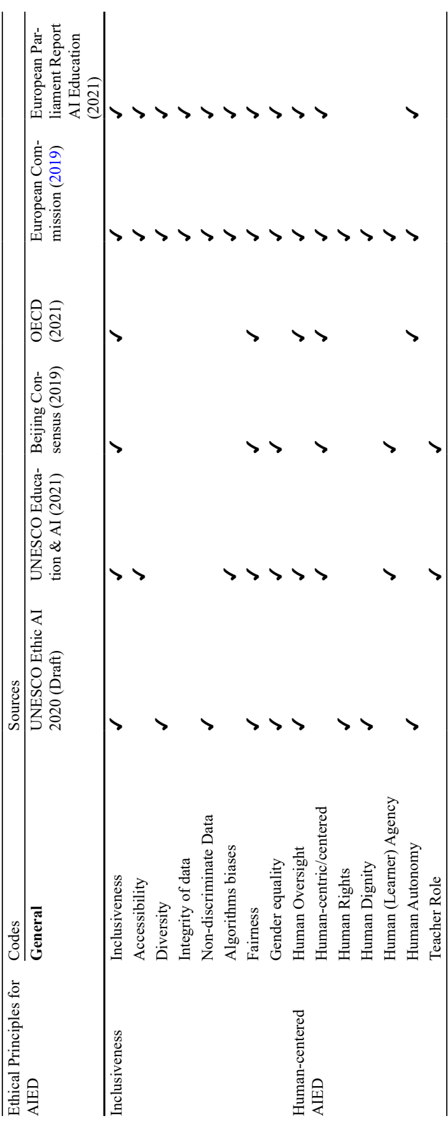
- The authors analyzed ethical guidelines and reports from 6 international sources: UNESCO Ethics AI (AHEG, 2020), UNESCO Education & AI (Miao et al., 2021), Beijing Consensus (UNESCO, 2019), OECD (2021), European Commission (2019), and European Parliament Report AI Education (2021).
- Their thematic analysis produced 39 codes that were collated into 7 themes (principles) for AIED.
- The proposed principles are: governance and stewardship, transparency and accountability, sustainability and proportionality, privacy, security and safety, inclusiveness, and human-centered AIED.
- The paper states that AIED raises concerns about personal data, learner autonomy, privacy, bias, fairness, accountability, inclusiveness, and human rights, while also offering benefits such as personalization and improved learning performance.
## Methods
- The study used thematic analysis based on Braun & Clarke (2012) to examine ethical guidelines and reports related to AIED.
- The sample consisted of policy/guideline documents from international organizations: UNESCO, OECD, European Commission, and European Parliament.
- Analysis involved familiarization, open coding, iterative theme generation, and researcher-researcher corroboration to support reliability and validity.
## Limitations
- The paper says the proposed principles are a starting point and that a precise mechanism for ethical principles in AIED “remains to be elucidated.”
- It explicitly notes that there is no universal consensus on the best ethical theory or standards for AIED, and that the issue is still evolving.
- Evident from the text: the study analyzes published policies and guidelines only, so it does not test the principles in classrooms or evaluate their effectiveness in practice.
Model-written summary. Check it against the paper before relying on it.
Integrity signals
Registry
Cites
Statistics
Figures
Verification
Claims the paper makes
12 Valid · 0 Not valid · 38 Not checked · 11 Own results and interpretations
The cited sources support only part of this claim — read each source’s verdict below.
In the paper
“Hence, there are growing evidence for the roles of AIED to “foster a transformation of knowledge, cognition, and culture” (Hwang et al., 2020, p.1).”
§ Ethical principles for artificial intelligence in education > Opportunities of artificial intelligence in education
What the sources say
- Partly supportedcites Hwang et al., 2020 matched to “Vision, challenges, roles and research issues of Artificial Intelligence in Education” (2020) sourceExperimental — accuracy not yet measured
The Conclusions (page not specified in our copy) say that integrating AI and education is a transformation of human knowledge, cognition, and cultures, supporting the central idea. The passage does not describe growing evidence for AIED’s role in that transformation, and the cited wording is not an exact quotation. (LLM, conf=0.86)
plainstates a cause- Asserted: passes — The authors put it forward as true.
- Checkable: passes — It can be checked against evidence.
- Load-bearing: unclear — It is unclear whether the paper’s conclusions depend on it.
- Based: passes — The paper gives a reason why it holds.
- Partly supported
The cited sources support only part of this claim — read each source’s verdict below.
In the paper
“However, the adoption of AIED has led to increasing ethical risks and concerns regarding several aspects such as personal data and learner autonomy.”
§ Ethical principles for artificial intelligence in education > Abstract The advancement of artificial intelligence in education (AIED) has the potential to transform the educational landscape and influence the role of all involved stakeholders. In recent years, the applications of AIED have been gradually adopted to progress our understanding of students’ learning and enhance learning performance and experience. However, the adoption of AIED has led to increasing ethical risks and concerns regarding several aspects such as personal data and learner autonomy. Despite the recent announcement of guidelines for ethical and trustworthy AIED, the debate revolves around the key principles underpinning ethical AIED. This paper aims to explore whether there is a global consensus on ethical AIED by mapping and analyzing international organizations’ current policies and guidelines. In this paper, we first introduce the opportunities offered by AI in education and potential ethical issues. Then, thematic analysis was conducted to conceptualize and establish a set of ethical principles by examining and synthesizing relevant ethical policies and guidelines for AIED. We discuss each principle and associated implications for relevant educational stakeholders, including students, teachers, technology developers, policymakers, and institutional decision-makers. The proposed set of ethical principles is expected to serve as a framework to inform and guide educational stakeholders in the development and deployment of ethical and trustworthy AIED as well as catalyze future development of related impact studies in the field.
What the sources say
- Partly supportedcites Holmes et al., 2021 matched to “Ethics of AI in Education: Towards a Community-Wide Framework” (2022) sourceExperimental — accuracy not yet measured
“The Ethics of AIED in Particular” identifies privacy concerns about the data collected by AIED, and “Most Ignored Yet Critical Ethical Issues for AIED” identifies lack of human agency as a concern. These passages support the cited concerns, but do not establish that adoption has caused risks concerning personal data and learner autonomy to increase over time. Page numbers are unavailable in our copy. (LLM, conf=0.84)
- Not matchedcites Akgun & Greenhow, 2021
An author–year citation the paper’s reference list doesn’t settle. We don’t search these by name.
- Not matchedcites Miao et al., 2021
An author–year citation the paper’s reference list doesn’t settle. We don’t search these by name.
plainstates a cause- Asserted: passes — The authors put it forward as true.
- Checkable: passes — It can be checked against evidence.
- Load-bearing: passes — The paper’s conclusions depend on it.
- Based: passes — The paper gives a reason why it holds.
- Partly supported
The cited sources support only part of this claim — read each source’s verdict below.
In the paper
“Indeed, a proliferation of studies has revealed the emergence of contrasting ethical themes relating to general AI and AIED, most of which are associated with the liability of data across settings, such as in higher education (Zawacki-Richter et al., 2019), K-12 (Holstein et al., 2019), schools (Luckin, 2017), and subjects (Hwang & Tu, 2021).”
§ Ethical principles for artificial intelligence in education > Ethical issues of AI in education Despite its capability to revolutionize education, numerous challenges also linger for researchers and practitioners who are involved in associated activities or systems (Kay & Kummerfeld, 2019) as AIED is, by nature, a “highly technology-dependent and cross-disciplinary field” (Hwang et al., 2020, p.2). At a global level, UNESCO (2019) pinpointed six challenges in achieving sustainable development of AIED: comprehensive public policy, inclusion and equity in AIED, preparing teachers for AI-powered education,preparing AI to understand education, developing quality and inclusive data systems, making research on AIED significant, ensuring ethics and transparency in data collection, use, and dissemination. At the individual level, challenges range from critical societal drawbacks such as systemic bias, discrimination, inequality for marginalized groups of students, and xenophobia (Hwang et al., 2020) to thorny ethical issues relating to privacy and bias in data collection and processing (Holmes et al., 2021). In fact, the widespread ramifications of AIED have also led to emerging concerns over the negative realities that it brings, such as the widening gaps of inequalities among learners’ commercialization of education, or the home-school divide in education (Reiss, 2021). AI may become pervasive in every sense where those involved may be exposed to risks without being aware of them, and the situation can be even intensified under the ongoing impacts of the COVID-19 pandemic (Borenstein & Howard, 2021). Such obstacles essentialize an urgent demand to induct and acquaint teachers and students with the ethical concerns surrounding AIED and how to navigate them. Furthermore, AIED also carries ethical implications and privacy risks which call for critical attention to differentiate between doing ethical things and doing things ethically (Holmes et al., 2021), or as in the words of Russell and Norvig (2002) “all AI researchers should be concerned with the ethical implications of their work” (p. 1020). Indeed, a proliferation of studies has revealed the emergence of contrasting ethical themes relating to general AI and AIED, most of which are associated with the liability of data across settings, such as in higher education (Zawacki-Richter et al., 2019), K-12 (Holstein et al., 2019), schools (Luckin, 2017), and subjects (Hwang & Tu, 2021). These covered the issues of informed consent, privacy breach, biased data assumption, fairness, accountability, and statistical apophenia. Others also question the impacts of AI-related fields such as surveillance and consent, learner privacy (Sacharidis et al., 2020), identity configuration, user confidentiality, integrity, and inclusiveness (Deshpande et al., 2017). Another stream of discussion has been drawn upon the ethics of data designated for educational use and analytics learning (e.g., Kay & Kummerfeld 2019; Kitto & Knight, 2019; Slade & Prinsloo, 2013). These incorporate the spheres of data interpretation and management, different perspective on the data usage, and the power relation among involved stakeholders such as students, teachers, and the educational objectives (Slade & Prinsloo, 2013). Other ethical issues for AIED include the problems with data collection, restricted availability of data sources, bias and representation, data ownership and control, data autonomy, AIED systems, and human agency (Akgun & Greenhow, 2021; Miao et al., 2021). That said, it is crucial to fully comprehend these values and principals before making ethically and accountability-driven decisions, and being aware of possible, even unexpected outcomes in education. Although recent work has attempted to establish different ethical frameworks for general AI use (e.g., Ashok et al., 2022), ethical and privacy issues are suggested to be contextualized (Ifenthaler & Schumacher, 2016), hence the prior guidelines established in other disciplines might not be appropriate for education. The contextual approach to the ethical design and use of AIED could play an essential role in addressing the issues of ethical and privacy concerns in education context. Prior research has emphasised the importance of the sociotechnical context configured by educational technology and educations practices in ethical considerations (Kitto & Knight, 2019). The understanding of ethics and privacy from various perspectives could promote the design of ethical and trustworthy AIED and the adoption of such systems. Furthermore, we extended the ethical view from published studies reviewed by Ashok et al., (2022) to the policies and guidelines proposed by the international organizations such as UNESCO, OECD, and European Union. The consensus assessment of policies and guidelines would inform a comprehensive and integrated instructions for different stakeholders in adopting AIED. This contributes to establishing a common ground and solid foundation for further development and implementation of AIED.
What the sources say
- Partly supportedcites Zawacki-Richter et al., 2019 matched to “Systematic review of research on artificial intelligence applications in higher education – where are the educators?” (2019) sourceExperimental — accuracy not yet measured
The Introduction identifies privacy and data protection as ethical risks of AI applications in higher education, supporting that part of the claim. But the section ‘Understanding of AI and critical reflection of challenges and risks’ reports that only two of 146 reviewed articles critically reflected on ethical implications; it does not support the claim that a proliferation of studies revealed ethical themes, most concerning data liability. (LLM, conf=0.88)
- Not checked — no full text of the sourcecites Holstein et al., 2019 matched to “Designing for Complementarity: Teacher and Student Needs for Orchestration Support in AI-Enhanced Classrooms” (2019) source
- Not checked — no full text of the sourcecites Luckin, 2017 matched to “Towards artificial intelligence-based assessment systems” (2017) source
boostedstates an association- Asserted: passes — The authors put it forward as true.
- Checkable: passes — It can be checked against evidence.
- Load-bearing: passes — The paper’s conclusions depend on it.
- Based: passes — The paper gives a reason why it holds.
- Partly supported
Every source the paper cites for this claim was checked and supports it.
In the paper
“Bostrom & Yudkowsky (2014) pointed out that AI systems must be “robust against human adversaries deliberately searching for exploitable flaws in the algorithm” (p. 317).”
§ Ethical principles for artificial intelligence in education > Ethical principles for artificial intelligence in education (AIED) > Principle of Security and Safety
What the sources say
- Supportedcites Bostrom & Yudkowsky (2014) matched to “The ethics of artificial intelligence” (2014) source
Section 1 (cited as p. 317) says AI algorithms should be robust against manipulation. It then gives a machine-vision system as an example that must withstand human adversaries searching for exploitable flaws. The quoted wording matches that example. (LLM, conf=0.94)
plain- Asserted: passes — The authors put it forward as true.
- Checkable: passes — It can be checked against evidence.
- Load-bearing: passes — The paper’s conclusions depend on it.
- Based: passes — The paper gives a reason why it holds.
- Supported
The cited sources support only part of this claim — read each source’s verdict below.
In the paper
“Data ethics emphasized the need for transparency in data usage in AIED (Larsson & Heintz, 2020).”
§ Ethical principles for artificial intelligence in education > Ethical principles for artificial intelligence in education (AIED) > Principle of transparency and accountability
What the sources say
- Partly supportedcites Larsson & Heintz, 2020 matched to “Transparency in artificial intelligence” (2020) sourceExperimental — accuracy not yet measured
The Introduction (listed under Abstract; no page given) identifies transparency as a key principle in AI ethics guidelines. Section 2, “A multidisciplinary notion of transparency” (no page given), links AI transparency to the origins of data and how personal data travels. The paper does not address data usage specifically in artificial intelligence in education (AIED), so the educational setting is unsupported. (LLM, conf=0.86)
plainstates a cause- Asserted: passes — The authors put it forward as true.
- Checkable: passes — It can be checked against evidence.
- Load-bearing: passes — The paper’s conclusions depend on it.
- Based: passes — The paper gives a reason why it holds.
- Partly supported
19 more claims
Create a free account to see all 61 claims and to verify the 8 references still open.
- It may state two separate claims as one. 19
- Probably not a substantial claim. 28
Claims other papers make about this one
Each is checked against this paper’s own text: does it say what the citing paper says it does?
The source backs part of the claim, not all of it — or backs it for a different population, condition or comparison.
In the citing paper
“The rise of AI-generated content necessitates a shift towards authentic assessment strategies emphasising higher-order thinking, creativity, and ethical responsibility [ 26 ].”
From Redefining student assessment in AI-infused learning environments: a systematic review of challenges and strategies for academic integrity (2026) · cites this paper as [26]
Experimental — accuracy not yet measuredThe cited source says what the claim attributes to it.
In the citing paper
“There is a real danger of AI becoming pervasive in every sense where those involved may be exposed to risks without being aware of them [32,90].”
From New Era of Artificial Intelligence in Education: Towards a Sustainable Multifaceted Revolution (2023) · cites this paper as [32]
The check wasn’t confident either way, so it gives no verdict — never disputed.
In the citing paper
“This aligns with the sociocultural view that ethical reasoning is dialogic and socially constructed (Nguyen et al., 2023).”
From Generative AI in Design Thinking Pedagogy: Enhancing Creativity, Critical Thinking, and Ethical Reasoning in Higher Education (2025) · cites this paper as Nguyen et al., 2023
Experimental — accuracy not yet measuredThe check wasn’t confident either way, so it gives no verdict — never disputed.
In the citing paper
“Research suggests that assessments should prioritise critical thinking, problemsolving, and creativity over rote memorisation [ 26, 34].”
From Redefining student assessment in AI-infused learning environments: a systematic review of challenges and strategies for academic integrity (2026) · cites this paper as [26]
Experimental — accuracy not yet measuredIn the citing paper
“Although many AI-related guidelines were published before the release of ChatGPT, most are generic and do not specifically address issues and challenges caused by GenAI in higher education”
From Investigating the higher education institutions’ guidelines and policies regarding the use of generative AI in teaching, learning, research, and administration (2025) · cites this paper as Nguyen et al., 2023
1 more claim about this paper
Create a free account to see every claim other papers make about this one.
Citations
Cites
The "what" and "why" of goal pursuits: Human needs and the self-determination of behavior
Deci, E. L., & Ryan, R. M. (2000) · Psychological Inquiry · doi:10.1207/s15327965pli1104_01 · Cited by 34,210
Braun, V., & Clarke, V. (2012) · APA handbook of research methods in psychology, Vol 2: Research designs: Quantitative, qualitative, neuropsychological, and biological. · doi:10.1037/13620-004 · Cited by 10,299
Zawacki-Richter, O., Marín, V. I., Bond, M., & Gouverneur, F. (2019) · International Journal of Educational Technology in Higher Education · doi:10.1186/s41239-019-0171-0 · Cited by 7,242 · cited 2×
“…the emergence of contrasting ethical themes relating to general AI and AIED, most of which are associated with the liability of data across settings, such as in higher education (Zawacki-Richter et al., 2019), K-12 (Holstein et al., 2019), schools (Luckin, 2017 ), and subjects (Hwang & Tu, 2021 ).”
Background(2014) · Medical Entomology and Zoology · Cited by 6,828
The global landscape of AI ethics guidelines
Jobin, A., Ienca, M., & Vayena, E. (2019) · Nature Machine Intelligence · doi:10.1038/s42256-019-0088-2 · Cited by 6,220 · cited 2×
“The objective is to cultivate trust among learners and provide them with insights to leverage their skills across contexts while maintaining control of their respective data and digital identities (Jobin et al., 2019).”
BackgroundThe Ethics of AI Ethics: An Evaluation of Guidelines
Hagendorff, T. (2020) · Minds and Machines · doi:10.1007/s11023-020-09517-8 · Cited by 1,911 · cited 1×
“…and open communica - tions with beneficiaries: educators, students, parents, AI developers, and policymak - ers (Berendt et al., 2020 ; Nigam et al., 2021 ; Hagendorff, 2020 ) stated that more emphasis is necessary to enforce ethical guidelines for AI systems to better align with societal values.”
BackgroundThe Ethics of AI Ethics -- An Evaluation of Guidelines
Hagendorff, T. (2019) · arXiv · doi:10.48550/arxiv.1903.03425 · Cited by 1,907 · cited 1×
“…and open communica - tions with beneficiaries: educators, students, parents, AI developers, and policymak - ers (Berendt et al., 2020 ; Nigam et al., 2021 ; Hagendorff, 2020 ) stated that more emphasis is necessary to enforce ethical guidelines for AI systems to better align with societal values.”
BackgroundArtificial Intelligence in Human Resources Management: Challenges and a Path Forward
Tambe, P., Cappelli, P., & Yakubovich, V. (2019) · California Management Review · doi:10.1177/0008125619867910 · Cited by 1,609
Artificial intelligence in education: Addressing ethical challenges in K-12 settings
Akgun, S., & Greenhow, C. (2022) · AI and Ethics · doi:10.1007/s43681-021-00096-7 · Cited by 1,473 · cited 2×
“…collaborative learning or asynchronous discussion groups, allows cost-wise personalized learning through a navigation system underpinned by algorithms (Nye, 2015 ), promoted by the use of automated assessment,facial recognition systems, and predictive analytics (Akgun & Greenhow, 2021 ).”
BackgroundMethodEthics of AI in Education: Towards a Community-Wide Framework
Holmes, W., Porayska-Pomsta, K., Holstein, K., Sutherland, E., Baker, T., Shum, S. B., Santos, O. C., Rodrigo, M. T., Cukurova, M., Bittencourt, I. I., et al. (2022) · International Journal of Artificial Intelligence in Education · doi:10.1007/s40593-021-00239-1 · Cited by 1,437 · cited 8×
“…ethical implications and privacy risks which call for critical attention to differentiate between doing ethical things and doing things ethically (Holmes et al., 2021 ), or as in the words of Russell and Norvig ( 2002 ) “all AI researchers should be concerned with the ethical implications of…”
BackgroundInfluential
Research works printed but not linked: 1
- Russel, S. J., & Norvig, P. R. (2002). Artificial Intelligence: A modern approach (2nd Ed.) Prentice Hall Upper Saddle River, NJ, USA
Cited by
Items 1,001–1,100 of 1,202
Empowering Learning: Theoretical Foundations of Agentic AI in Education
Sankathala, S., Patre, K., Kolhe, D., & Das, S. (2026) · Advances in computational intelligence and robotics book series · doi:10.4018/979-8-3373-7097-2.ch005
Jiang, M., Tang, S., & Wang, Q. N. (2026) · Sustainability · doi:10.3390/su18094278 · Cited by 3
Modeling the dynamic interplay between student creativity and Gen-AI
Idrisi, M. J., Ullah, M. S., Shamsi, N. A., Thakur, M., & Beza, D. (2026) · Discover Artificial Intelligence · doi:10.1007/s44163-026-01284-2
“Yet despite decades of progress, the integration of AI into classrooms continues to raise critical pedagogical and ethical questions [31, 38, 42].”
Far, S. B., Qazani, M. R. C., & Rad, A. I. (2026) · Artificial Intelligence Review · doi:10.1007/s10462-026-11567-w · Cited by 1
Deniz, Ü. (2026) · Journal of College Reading and Learning · doi:10.1080/10790195.2026.2667284 · Cited by 1
“Participants’ approaches to transparency and disclosure reflect concepts of ethical responsibility in technology-enhanced learning (Nguyen et al., 2023).”
Shimray, S. R., Kaba, A., Tiwari, S., & Bharti, P. (2026) · Open Information Science · doi:10.1515/opis-2025-0032 · Cited by 1
Mendiola, M. B., Hayag, G., Oling, R. J., Manulat, S., & Naparan, G. B. (2026) · Journal of Education and Learning Reviews · doi:10.60027/jelr.2026.e3069 · Cited by 1
Madale, V. A. (2026) · Discover Education · doi:10.1007/s44217-026-01571-1 · Cited by 1
“Issues related to data privacy, algorithmic bias, and overreli-ance on automated systems may affect students’ autonomy and critical thinking [24, 25].”
Fostering Learning Excellence: An Empirical Investigation into AI-Enhanced Education
Zakwani, M. H. S. A., Qamashoui, A. A. A., & Raman, A. (2026) · Lecture notes in networks and systems · doi:10.1007/978-3-032-00264-8_53
Li, J. (2026) · Acta Psychologica · doi:10.1016/j.actpsy.2026.106983 · Cited by 2
A Comprehensive Study on Adaptive Learning and Assessment with Explainable AI
Siji, K. B., & Sheela, K. (2025) · International Conference on Sustainable Computing and Smart Systems (ICSCSS) · doi:10.1109/icscss64956.2025.11500827
“We begin this paper by outlining the potential ethical concerns as well as the educational opportunities presented by AI [6].”
Szarka, K., Fehér, Z., Jaruska, L., & MÉSZÁROS, A. (2026) · Lecture notes in networks and systems · doi:10.1007/978-3-032-18891-5_14
ChatGPT-4: A fresh lens on holistic education’s reimagination
Baskara, F. R. (2025) · AIP conference proceedings · doi:10.1063/5.0261979
Osakwe, J., Mutelo, S., & Osakwe, N. C. (2025) · Lecture notes in networks and systems · doi:10.1007/978-981-96-6429-0_40
Redefining the Role of Educators in GenAI-Supported Classrooms
MERZİFONLUOĞLU, A. (2025) · Advances in computational intelligence and robotics book series · doi:10.4018/979-8-3373-1195-1.ch010 · Cited by 1
Fathi, T. E., Lamri, D., & Ibrahmi, E. M. A. (2026) · Springer eBooks · doi:10.1007/978-3-032-18030-8_10
Foundations of Artificial Intelligence in Science Education
Küçükaydın, M. A. (2026) · Springer eBooks · doi:10.1007/978-3-032-18030-8_2
Wang, R., Sun, X., Sun, Y., & Wang, J. (2026) · Frontiers in Psychology · doi:10.3389/fpsyg.2026.1794568 · Cited by 4
“International and education-focused frameworks converge on the importance of human oversight, participatory governance, and student recognition as stakeholders (Nguyen et al., 2023).”
Artificial Intelligence-Driven Personalization in ODeL for Marginalized Communities
Matchanova, B., Buriyev, S., Ravikumar, R. N., & Aarthi, S. (2026) · IGI Global eBooks · doi:10.4018/979-8-3373-5057-8.ch001
Giacosa, A., & Triki, N. (2026) · Springer eBooks · doi:10.1007/978-3-032-16520-6_7 · Cited by 1
Manojkumar, R., Gundgurti, P. E., Srinivas, T. A. S., Pittala, R. B., Konda, A. S., & Bairwa, B. (2026) · Advances in computational intelligence and robotics book series · doi:10.4018/979-8-2600-1840-8.ch005
Overview of Power, Progress, and AI in BRICS+, Global South, and the Global Struggle
Kikasu, E. T. (2026) · Advances in computational intelligence and robotics book series · doi:10.4018/979-8-3373-7205-1.ch001
Alanbouri, N. S., Kharusi, I. K. A., Elsayed, S. A., Helwa, H. S. A.-H. A., & Hussein, I. E. (2026) · Pedagogical Research · doi:10.29333/pr/18553
Ethical, Legal and Security Aspects of the Use of Artificial Intelligence in Education
Narančić, M., Lović, V., Dimitrijević, M., & Pavićević, A. (2026) · International Journal of Cognitive Research in Science Engineering and Education · doi:10.23947/2334-8496-2026-14-1-087-095
Meo, F. D. (2026) · CSR, sustainability, ethics & governance · doi:10.1007/978-3-032-16077-5_15
Kim, H., & Park, J. (2026) · AI in Education · doi:10.3390/aieduc2020016
“…introducing a standalone theory or framework, this lens synthesizes concerns already present in explainable AI, learning-science research on emotion and feedback, and responsible AI scholarship (Abdul et al., 2018; Liao et al., 2020; Nguyen et al., 2023; Pekrun & Stephens, 2012; Zhu et al., 2025).”
InfluentialStracke, C. M. (2026) · AI and Ethics · doi:10.1007/s43681-026-01092-5 · Cited by 3
“Their first analysis revealed ten common ethical principles for AI&ED clustered in seven topics, namely: Governance & Steward - ship, Transparency & Accountability, Sustainability & Pro - portionality, Privacy, Security & Safety, Inclusiveness and Human-centered AIED [84 ].”
Che, C., & Perkins, B. (2026) · Research Square · doi:10.21203/rs.3.rs-9759894/v1
Responsible AI Implementation Strategies Within Educational Administration
Das, S. D., & Bala, P. K. (2026) · Advances in computational intelligence and robotics book series · doi:10.4018/979-8-2600-0467-8.ch010
Ethical AI in Educational Administration
Sharma, A., Verma, D., Pundeer, S., & Kumar, P. (2026) · Advances in computational intelligence and robotics book series · doi:10.4018/979-8-2600-0467-8.ch008
Waruwu, Y., Waruwu, E., Gea, M., Lase, D., Harefa, A. T., Harefa, T., & Zebua, N. (2026) · Advances in computational intelligence and robotics book series · doi:10.4018/979-8-2600-0467-8.ch009
The impact of L2 learners’ use of AI on their grit, shyness, and L2 achievements
Kang, D.-M. (2026) · Applied Linguistics · doi:10.1093/applin/amag041
Kadirhanoğulları, M. K., & Köse, E. Ö. (2026) · Scientific Reports · doi:10.1038/s41598-026-53637-7 · Cited by 2
“The use of artificial intelligence systems in education raises serious concerns about ethical questions regarding the technology and how the AI ecosystem will transform the social structure 82,83 .”
Chan, C. K. Y., Dai, W., Cao, K., Poon, A. T. Y., & Colloton, T. (2026) · Applied Sciences · doi:10.3390/app16115268 · Cited by 2
Competencias docentes para integrar inteligencia artificial con criterios éticos e inclusivos
Arboleda-Barzola, A. K., Rocafuerte-Arteaga, C. R., Rocafuerte-Arteaga, R. D., Pazmiño-Camacho, L. A., & Gavilánez-Galarza, O. S. (2026) · Revista Científica Ciencia y Método · doi:10.55813/gaea/rcym/v4/n2/206
“…políticas de uso, aplicar minimización de datos, transparentar finalidades y promover acuerdos institucionales sobre plataformas permitidas; de lo contrario, la innovación puede convertirse en exposición indebida de información personal o académica (European Commission, 2022; Nguyen et al., 2023).”
InfluentialTsabedze, V. (2026) · Journal of Electronic Resources Librarianship · doi:10.1080/1941126x.2026.2669017
“Nguyen et al. (2023) found that although many students had heard of AI technologies, only about half reported confidence in their knowledge of how these tools function or how they should be used in academic settings.”
Reframing Agency in AI-Mediated Education: Comparative Insights From Spain, Chile, and Mexico
Suárez, L. M. C., & Rodríguez, C. C. (2026) · Advances in computational intelligence and robotics book series · doi:10.4018/979-8-3373-6471-1.ch012
Equity by Design: AI Ethics Guidelines for the Education Sector
Badr, S., & Charles, T. (2026) · Advances in computational intelligence and robotics book series · doi:10.4018/979-8-3373-7467-3.ch006
Generative artificial intelligence and its regulated integration across the Indian education system
Paul, A. (2026) · Discover Education · doi:10.1007/s44217-026-01712-6
Siyou, E., Djamal, A., Ndzeungue, M.-P., et al. (2026) · Communication technologies et développement · doi:10.4000/16b2n
Impact of AI on Educational Policy and Governance
Patre, K., Kunte, K., Sankathala, S., Vasa, A., & Das, S. (2026) · Advances in computational intelligence and robotics book series · doi:10.4018/979-8-2600-2163-7.ch001
Liu, X., Du, J., Wang, J., & Song, H. (2026) · Behavioral Sciences · doi:10.3390/bs16060922 · Cited by 3
“Fourth, ethical foresight, cultivating critical awareness and responsible literacy around issues such as data privacy, algorithmic bias, and human-AI relations, integrating ethics education as a normative dimension of the support system (A. Nguyen et al., 2023).”
Emotionally Adaptive Conversational AI for Personalized Learning
Alduweib, E., Hezzam, E. A., & Noman, M. (2026) · International Conference on Computational Intelligence Approaches and Applications (ICCIAA) · doi:10.1109/icciaa68481.2026.11543663
Josiah, Y. (2026) · Assessment & Evaluation in Higher Education · doi:10.1080/02602938.2026.2684019
AI-Driven Personalization and Adaptive Learning Environments
Gupta, D., Jumaeva, F., ABDINAZAROVA, N., Baxrom, J., Ibrokhimov, I., Abdullaev, T., Jamshid, P., & Mohichekhra, K. (2026) · IGI Global eBooks · doi:10.4018/979-8-2600-1674-9.ch001
AI Fundamentals for Educators: A Comprehensive Introduction
Kayyali, M. (2026) · Advances in computational intelligence and robotics book series · doi:10.4018/979-8-3373-1285-9.ch003
Gazi, M. A. I., Shinwary, S. S., Khan, W., Alam, M. N., Hashim, F., Senathirajah, A. R. B. S., & Hossain, A. I. (2026) · Multidisciplinary Reviews · doi:10.31893/multirev.2026537
“Some of the ethical issues associated with AI education are systemic bias, discrimination, inequality, and privacy (Nguyen et al., 2023).”
Behind the Screen: Generative Artificial Intelligence and English Language Teachers' Well-Being
Ahmed, S. K., Esteban‐Segura, L., & Yélamos-Guerra, M. S. (2026) · IGI Global eBooks · doi:10.4018/979-8-3373-8317-0.ch012 · Cited by 1
Exploring college educators’ behavioral intentions towards ChatGPT: a UTAUT2 framework analysis
Assali, M. A., & O’Sullivan, K. (2026) · Frontiers in Education · doi:10.3389/feduc.2026.1824013 · Cited by 1
Курилов, С. Н., Nalimova, A. S., & Rodin, A. B. (2026) · International Conference on Information Technologies in Engineering Education (Inforino) · doi:10.1109/inforino68543.2026.11556736
AI-generated feedback on student solutions to graphical problems in kinematics and dynamics
Tipaz, J., Ortega-Chávez, K., Hidalgo, J., López-Ruano, J., & Ger, D. F. C. (2026) · Frontiers in Education · doi:10.3389/feduc.2026.1769356 · Cited by 1
Coaching the machine: exploring ChatGPT as coachee and feedback partner in coaching education
Cartei, V., Neary, H., & Simmons, P. (2026) · International Journal of Mentoring and Coaching in Education · doi:10.1108/ijmce-07-2025-0096
AI-Powered Career Guidance Chatbot for Students
Kumari, P. (2026) · IGI Global eBooks · doi:10.4018/979-8-3373-5312-8.ch007
Wang, J., & Li, Y. (2026) · Cogent Education · doi:10.1080/2331186x.2026.2691562 · Cited by 2
Barrett-Maitland, N., Smith, J., Green, D., Benjamin, S. J., McKoy, J., & Brown, D. N. (2026) · Journal of International Education in Business · doi:10.1108/jieb-10-2024-0131
Abdi, A. S., & Abdullahi, A. M. (2026) · Discover Computing · doi:10.1007/s10791-026-10276-w · Cited by 4
Analysing the pedagogical potential of ChatGPT: a usability testing with educators
Shaikh, S., Yayilgan, S. Y., Klímová, B., Pikhart, M., Černá, M., & Abomhara, M. (2026) · Cogent Education · doi:10.1080/2331186x.2026.2689778
Khairallah, M. (2026) · International Symposium of Systems, Advanced Technologies and Knowledge (ISSATK) · doi:10.1109/issatk69667.2026.11566843
“From this perspective, autonomous and AAIS require governance mechanisms such as explainability tools, oversight protocols, and accountability arrangements to ensure that their operation remains aligned with educational, institutional, and societal norms [3,21,22].”
InfluentialAydın, F., Dadandı, İ., Çıtak, Ş., Saki, V., & DADANDI, P. U. (2026) · BMC Psychology · doi:10.1186/s40359-026-05014-2 · Cited by 1
“…enhance teacher efficiency by supporting both administrative tasks (e.g., grading, scheduling, tracking student progress, detecting plagiarism, and providing feedback) and instructional tasks (e.g., content delivery, lesson planning, personalized curriculum design, and syllabus preparation) [8, 9].”
Feedback indices to evaluate LLM responses to rebuttals for multiple choice type questions
Dunlap, J. C., Parent, A., & Widenhorn, R. (2026) · Discover Artificial Intelligence · doi:10.1007/s44163-026-01521-8 · Cited by 1
“The ethical implementation of LLMs by both educators and students has been widely discussed [4] [5].”
Personalized Learning and Teacher Assistance Using AI and AR: A European Perspective
Gupta, D. (2026) · Advances in computational intelligence and robotics book series · doi:10.4018/979-8-3373-9883-9.ch009
AI Across Ages: A Continuum Model From Primary Education to University Classrooms
Ahmad, I. (2026) · Advances in computational intelligence and robotics book series · doi:10.4018/979-8-3373-4893-3.ch003
Rosmayanti, V., Sabillah, B. M., & Syata, W. M. (2026) · Advances in computational intelligence and robotics book series · doi:10.4018/979-8-3373-4893-3.ch006
Developing Critical Thinking: Helping Children Question AI Outputs
Ramuloo, V. A. S. (2026) · Advances in computational intelligence and robotics book series · doi:10.4018/979-8-3373-4893-3.ch009
Addington, S. (2026) · Communications in computer and information science · doi:10.1007/978-3-032-29791-4_15
He, Z., Pang, P. C., Siu, K.-M., & Ou, Q. (2026) · Lecture notes in computer science · doi:10.1007/978-3-032-29763-1_4
Challenges of Employing Artificial Intelligence in Early Childhood Education in Sharjah
Alnaqbi, E. A. (2026) · Creative Education · doi:10.4236/ce.2026.176068
Diaz, L. S., Rosa, C. L.-D. L., & Hernandez-Larriba, R. (2026) · IEEE Global Engineering Education Conference (EDUCON) · doi:10.1109/educon67543.2026.11574419
“Ethical conscience is rooted in the Principle of Accountability [12] , [13].”
AI Can Improve the Leadership of Educational Change
Lindvig, Y., Skandsen, T., & Steimler, S.-E. S. (2026) · Springer international handbooks of education · doi:10.1007/978-3-031-88898-4_57-1
Sukiman, S. A., & Aziz, N. A. (2026) · IEEE Symposium on Computer Applications & Industrial Electronics (ISCAIE) · doi:10.1109/iscaie68866.2026.11576424
“…addition to technical transparency, responsible implementation necessitates governance procedures like informed consent, contextual interpretation, and human-in-the-loop validation to reduce the dangers of misinterpretation or excessive dependence on automated emotional inference [11], [21], [22].”
ERDEMİR, T., & Çoruk, H. (2026) · Adıyaman Üniversitesi Eğitim Bilimleri Dergisi · doi:10.17984/adyuebd.1785651
Strategic Implementation of AI in Edtech: Challenges, Benefits, and Ethical Frameworks
Anupam, A., Sharma, V., & Velusamy, P. (2026) · International Conference on Connected Intelligence for Industrial Applications (CI2A) · doi:10.1109/ci2a69097.2026.11576862
Percepción docente sobre el uso de la inteligencia artificial en la educación superior
Velasco, C. A. V. (2026) · Prohominum · doi:10.47606/acven/ph0503 · Cited by 1
Compulsive smartphone use: exploring antecedents, distorted beliefs, and inflated usage
S, R. P., & Senapati, S. (2026) · Quality & Quantity · doi:10.1007/s11135-026-02896-7
“Inaccurate perceptions about the importance and indispensability of smartphones complicate this compulsivity, giving rise to behaviorally disoriented intentions (Nguyen et al., 2022).”
Evaluating the impact of AI chatbots on student support and engagement in UK higher education
Kremantzis, M. D., Chondrogianni, A., & Essien, A. E. (2026) · Journal of Further and Higher Education · doi:10.1080/0309877x.2026.2693084 · Cited by 2
HOUDA, S. H. &. F. (2026) · Akofena revue scientifique des Sciences du Langage Lettres Langues & de la Communication · doi:10.48734/akofena.n020.vol.1.28.2026
Intelligenza Artificiale: un approccio antropocentrico, etico, inclusivo
Barca, A., & Tripaldi, M. (2026) · Community Notebook People Education and Welfare in the Society 5 0 · doi:10.61007/qdc.2026.1.408
Ikwuazom, C. T., Prasad, R., Aliyu, A. R., Benjamin, O., & USMAN, M. M. (2026) · Advances in computational intelligence and robotics book series · doi:10.4018/979-8-3373-7665-3.ch009
An Instrument for Human-Based Evaluation of GenAI Educational Alignment
Ahmed, H., López‐Pernas, S., Vogelsmeier, L. V. D. E., Tukiainen, M., & Saqr, M. (2026) · Technology Knowledge and Learning · doi:10.1007/s10758-026-10005-8
Filipović, R., Filipović, I., & Dumančić, M. (2026) · International Convention on Information and Communication Technology, Electronics and Microelectronics · doi:10.1109/mipro70003.2026.11591597
Sun, X., Liu, D., Li, X., Gu, N., & Tian, Z. (2026) · Frontiers in Psychology · doi:10.3389/fpsyg.2026.1895365
Giri, U., Sharma, P. B., Lamoria, J., & Pradhan, T. (2026) · Springer eBooks · doi:10.1007/978-981-92-0960-6_8
Jin, P. (2026) · Innovations in Education and Teaching International · doi:10.1080/14703297.2026.2702451
Alwaqdani, M. (2026) · Education and Information Technologies · doi:10.1007/s10639-026-14095-w · Cited by 1
“The rapid development of AI in education has intensified academic and policy debates about ethical governance, transparency, fairness, and accountability (Azman & Tüm - kaya, 2025; Floridi, 2019; Nguyen et al., 2022).”
Adapting Human Cognitive Skills in the Twenty-First-Century Industrial Revolutions
Iwuanyanwu, P. N. (2026) · Contemporary trends and issues in science education · doi:10.1007/978-3-032-27906-4_2
Intelligent Assistant Model for University Educational Process
Fedorenko, D., Zemlianko, H., & Pevnev, V. (2026) · Lecture notes in networks and systems · doi:10.1007/978-3-032-22372-2_18
Leading artificial intelligence amid uncertainty: Principals’ sensemaking in Irish primary schools
Gorman, A., & Brennan, A. (2026) · Management in Education · doi:10.1177/08920206261468463
Institutional Guidelines on AI in Latin American Higher Education: A Comparative Analysis
Sánchez-Torres, J. M., Chaparro-Díaz, L., Carreño-Moreno, S., Sánchez-Mendoza, Y. E., & Herrera, L. K. (2026) · Educación y Educadores · doi:10.5294/edu.2026.29.2.1 · Cited by 1
Ciubotariu, I. I., & Bosch, G. (2026) · Journal of Microbiology and Biology Education · doi:10.1128/jmbe.00044-26
AI ethics in academia among higher education students’ perceptions and practices
Ghosh, R., Gardia, A., & Mehta, D. (2026) · Discover Education · doi:10.1007/s44217-026-01881-4
“Recent studies highlight a growing emphasis on defining ethical principles for AI in higher education, alongside increasing concerns about privacy, fairness, and responsible implementation [4, 16, 48, 74].”
InfluentialSamuel Peter James, I., Angeline, D. M. D., & Prabakaran, T. (2026) · Advances in computational intelligence and robotics book series · doi:10.4018/979-8-3373-7749-0.ch010
Quality assurance in generative AI-mediated education: a bibliometric and scoping review
López-Acosta, D. Y., Pacheco-Mendoza, S. R., Alvarado-Jaramillo, D. J., & Flores, P. R. Z. (2026) · Frontiers in Artificial Intelligence · doi:10.3389/frai.2026.1844517 · Cited by 1
“…practices, academic integrity, pedagogical affordances, or technological reliability, without offering an integrated view that articulates these dimensions within a quality assurance perspective (Ali et al., 2024; Giannakos et al., 2025; Wang et al., 2024; Yan et al., 2024; Nguyen et al., 2023).”
Romero, H. R. C., Tusa, F., Ocampo, R. D. L. S., & Célleri-Pacheco, J. (2026) · Trends in Higher Education · doi:10.3390/higheredu5030067 · Cited by 3
Children as labourers: Stiegler’s Pharmakon in a time of Big Tech
Parker, L. (2026) · Ethics and Education · doi:10.1080/17449642.2026.2703049
Instructional Design for Student and Instructor Well-Being in Online Learning
Watson, W. R., Watson, S. L., Tagare, D., Baydar, S., & Hsieh, C.-J. (2026) · Oxford University Press eBooks · doi:10.1093/9780197759424.003.0006
Kadırhan, Z. (2026) · Çukurova Üniversitesi Sosyal Bilimler Enstitüsü Dergisi · doi:10.35379/cusosbil.1696829
Milakis, E. D., Argyrakou, C. C., & Chantzouli, E. (2026) · Journal of Hypermedia & Technology-Enhanced Learning (J-HyTEL) · doi:10.58536/j-hytel.235
Montero-Ulloa, D., & Sánchez, M. R. (2026) · Springer proceedings in business and economics · doi:10.1007/978-3-032-24600-4_3
Hsieh, C., Bali, S., Romadhoni, M., Yen, A.-C., Chen, T.-C., & Andania, R. A. (2026) · Quality & Quantity · doi:10.1007/s11135-026-03015-2 · Cited by 1
Zhu, M., & Wang, C. (2026) · Educational Technology Research and Development · doi:10.1007/s11423-026-10682-3
Metadata
- Authors
- Nguyen, A., Ngo, H. N., Hong, Y., Dang, B., & Nguyen, B.-P. T.
- Affiliations
- University of Oulu (FI)
- Victoria University of Wellington (NZ)
- University of Languages and International Studies (VN)
- Corresponding author
- Nguyen, Andy
- Venue
- Education and Information Technologies
- Published
- 2022-10-13
- Volume
- 28
- Issue
- 4
- Pages
- 4221-4241
- ISSN
- 1360-2357 (ISSN-L)
- 1573-7608
- PMC
- PMC9558020
- OpenAlex
- W4304943299
- Semantic Scholar
- ec13995de8797a4e977024942d79fc0d27e20b7b
- Cited by
- 1,228
- References
- 71
- Citations by year
- 2026: 367 · 2025: 479 · 2024: 303 · 2023: 78
- FWCI
- 249.31
- Type
- journal article
- Language
- en
- Open access
- hybrid
- doi.org
- Licence
- cc-by
- creativecommons.org/licenses/by/4.0 (tdm)
- creativecommons.org/licenses/by/4.0 (vor)
- Locations
- Education and Information Technologies (publishedVersion, cc-by)
- PubMed Central (publishedVersion, cc-by)
- PubMed (publishedVersion)
- Open Access Victoria University of Wellington | Te Herenga Waka (Figshare) (submittedVersion, cc-by-nc-nd)
- Victoria University of Wellington
- Funders
- University of Oulu including Oulu University Hospital
- Topics
- Physical Sciences › Computer Science › Artificial Intelligence › Ethics and Social Impacts of AI
- Social Sciences › Education › Artificial Intelligence in Education
- Physical Sciences › Computer Science › Artificial Intelligence › Intelligent Tutoring Systems and Adaptive Learning
- Keywords
- artificial intelligence in education, ethical principles, AI ethics, trustworthy AI, moral norms, personal data, learner autonomy, educational stakeholders, ethical frameworks
About these checks
Registry, retraction, Cites and statistics results are computed, not judged, with one exception: a printed reference that no index lists is read once by a model before it counts as a citation error. Claims are extracted by a model and kept only when their quote appears verbatim in the text; each cited source is then checked, with a model’s help, for whether it says what the claim relies on. Those verdicts can be wrong — read the claim’s quote and the cited source before relying on one.
The claim verdicts this report counts are experimental: their accuracy is not yet measured.
A language model drew the claims from the paper on 2026-10-10, under version 3 of the claim definition (model deepseek-v4.1-flash, prompt extract-v3).
A second model labelled each claim on 2026-10-10 (model jev-1.13-20260917, definition revision gold-guideline-v0.2).
Cited sources are checked with a language model’s help (gpt-6-sol).
Statistics and arithmetic are recomputed, not judged.
Confidence bands are shown only for fields calibrated on our annotated test set. None is calibrated yet, so no band is shown.
What counts as a claim ›How we measure confidence ›How we check this ›
Are you an author, or do you see a problem with this page? Request a review
Data sources
Bibliographic data: Semantic Scholar, OpenAlex, Crossref.
Contains information from the Semantic Scholar Academic Graph Datasets, made available under the ODC Attribution License (ODC-BY 1.0).
Semantic Scholar’s data is described in: Kinney, R., et al. (2023). The Semantic Scholar Open Data Platform. arXiv:2301.10140.
