

Ethical principles for artificial intelligence in education
Open accessThe DOI matches its Crossref record; 75 of the 76 references it cites were found in a registry or an index; 13 of the 67 sources its claims cite were checked for support.
Abstract
The advancement of artificial intelligence in education (AIED) has the potential to transform the educational landscape and influence the role of all involved stakeholders. In recent years, the applications of AIED have been gradually adopted to progress our understanding of students' learning and enhance learning performance and experience. However, the adoption of AIED has led to increasing ethical risks and concerns regarding several aspects such as personal data and learner autonomy. Despite the recent announcement of guidelines for ethical and trustworthy AIED, the debate revolves around the key principles underpinning ethical AIED. This paper aims to explore whether there is a global consensus on ethical AIED by mapping and analyzing international organizations' current policies and guidelines. In this paper, we first introduce the opportunities offered by AI in education and potential ethical issues. Then, thematic analysis was conducted to conceptualize and establish a set of ethical principles by examining and synthesizing relevant ethical policies and guidelines for AIED. We discuss each principle and associated implications for relevant educational stakeholders, including students, teachers, technology developers, policymakers, and institutional decision-makers. The proposed set of ethical principles is expected to serve as a framework to inform and guide educational stakeholders in the development and deployment of ethical and trustworthy AIED as well as catalyze future development of related impact studies in the field.
Overview
CoChat Summary
## TL;DR
This paper maps international ethical guidelines for artificial intelligence in education and, through thematic analysis, proposes a set of principles for ethical and trustworthy AIED. It argues that AIED should be governed by a human-centered framework that addresses transparency, privacy, inclusiveness, safety, sustainability, and accountability.
## Key findings
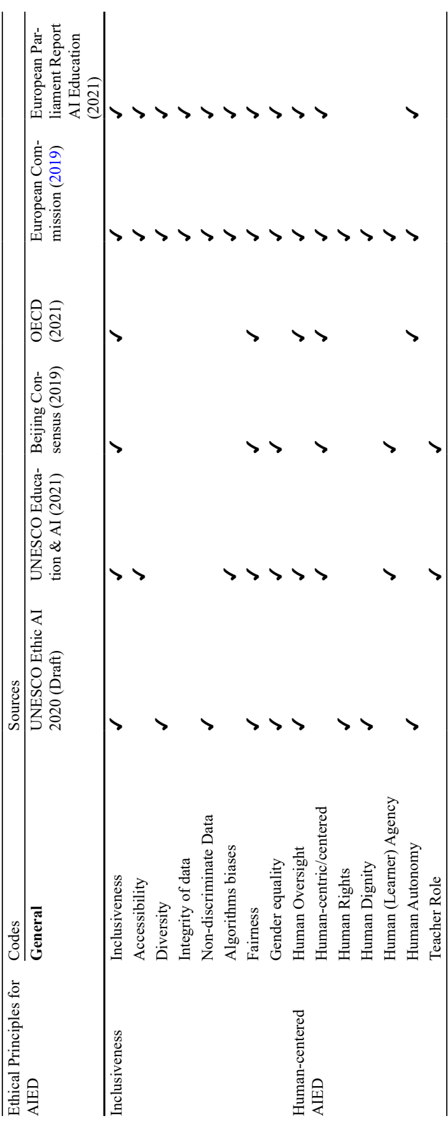
- The authors analyzed ethical guidelines and reports from 6 international sources: UNESCO Ethics AI (AHEG, 2020), UNESCO Education & AI (Miao et al., 2021), Beijing Consensus (UNESCO, 2019), OECD (2021), European Commission (2019), and European Parliament Report AI Education (2021).
- Their thematic analysis produced 39 codes that were collated into 7 themes (principles) for AIED.
- The proposed principles are: governance and stewardship, transparency and accountability, sustainability and proportionality, privacy, security and safety, inclusiveness, and human-centered AIED.
- The paper states that AIED raises concerns about personal data, learner autonomy, privacy, bias, fairness, accountability, inclusiveness, and human rights, while also offering benefits such as personalization and improved learning performance.
## Methods
- The study used thematic analysis based on Braun & Clarke (2012) to examine ethical guidelines and reports related to AIED.
- The sample consisted of policy/guideline documents from international organizations: UNESCO, OECD, European Commission, and European Parliament.
- Analysis involved familiarization, open coding, iterative theme generation, and researcher-researcher corroboration to support reliability and validity.
## Limitations
- The paper says the proposed principles are a starting point and that a precise mechanism for ethical principles in AIED “remains to be elucidated.”
- It explicitly notes that there is no universal consensus on the best ethical theory or standards for AIED, and that the issue is still evolving.
- Evident from the text: the study analyzes published policies and guidelines only, so it does not test the principles in classrooms or evaluate their effectiveness in practice.
Model-written summary. Check it against the paper before relying on it.
Integrity signals
Registry
Cites
Statistics
Figures
Verification
Claims the paper makes
12 Valid · 0 Not valid · 38 Not checked · 11 Own results and interpretations
The cited sources support only part of this claim — read each source’s verdict below.
In the paper
“Hence, there are growing evidence for the roles of AIED to “foster a transformation of knowledge, cognition, and culture” (Hwang et al., 2020, p.1).”
§ Ethical principles for artificial intelligence in education > Opportunities of artificial intelligence in education
What the sources say
- Partly supportedcites Hwang et al., 2020 matched to “Vision, challenges, roles and research issues of Artificial Intelligence in Education” (2020) sourceExperimental — accuracy not yet measured
The Conclusions (page not specified in our copy) say that integrating AI and education is a transformation of human knowledge, cognition, and cultures, supporting the central idea. The passage does not describe growing evidence for AIED’s role in that transformation, and the cited wording is not an exact quotation. (LLM, conf=0.86)
plainstates a cause- Asserted: passes — The authors put it forward as true.
- Checkable: passes — It can be checked against evidence.
- Load-bearing: unclear — It is unclear whether the paper’s conclusions depend on it.
- Based: passes — The paper gives a reason why it holds.
- Partly supported
The cited sources support only part of this claim — read each source’s verdict below.
In the paper
“However, the adoption of AIED has led to increasing ethical risks and concerns regarding several aspects such as personal data and learner autonomy.”
§ Ethical principles for artificial intelligence in education > Abstract The advancement of artificial intelligence in education (AIED) has the potential to transform the educational landscape and influence the role of all involved stakeholders. In recent years, the applications of AIED have been gradually adopted to progress our understanding of students’ learning and enhance learning performance and experience. However, the adoption of AIED has led to increasing ethical risks and concerns regarding several aspects such as personal data and learner autonomy. Despite the recent announcement of guidelines for ethical and trustworthy AIED, the debate revolves around the key principles underpinning ethical AIED. This paper aims to explore whether there is a global consensus on ethical AIED by mapping and analyzing international organizations’ current policies and guidelines. In this paper, we first introduce the opportunities offered by AI in education and potential ethical issues. Then, thematic analysis was conducted to conceptualize and establish a set of ethical principles by examining and synthesizing relevant ethical policies and guidelines for AIED. We discuss each principle and associated implications for relevant educational stakeholders, including students, teachers, technology developers, policymakers, and institutional decision-makers. The proposed set of ethical principles is expected to serve as a framework to inform and guide educational stakeholders in the development and deployment of ethical and trustworthy AIED as well as catalyze future development of related impact studies in the field.
What the sources say
- Partly supportedcites Holmes et al., 2021 matched to “Ethics of AI in Education: Towards a Community-Wide Framework” (2022) sourceExperimental — accuracy not yet measured
“The Ethics of AIED in Particular” identifies privacy concerns about the data collected by AIED, and “Most Ignored Yet Critical Ethical Issues for AIED” identifies lack of human agency as a concern. These passages support the cited concerns, but do not establish that adoption has caused risks concerning personal data and learner autonomy to increase over time. Page numbers are unavailable in our copy. (LLM, conf=0.84)
- Not matchedcites Akgun & Greenhow, 2021
An author–year citation the paper’s reference list doesn’t settle. We don’t search these by name.
- Not matchedcites Miao et al., 2021
An author–year citation the paper’s reference list doesn’t settle. We don’t search these by name.
plainstates a cause- Asserted: passes — The authors put it forward as true.
- Checkable: passes — It can be checked against evidence.
- Load-bearing: passes — The paper’s conclusions depend on it.
- Based: passes — The paper gives a reason why it holds.
- Partly supported
The cited sources support only part of this claim — read each source’s verdict below.
In the paper
“Indeed, a proliferation of studies has revealed the emergence of contrasting ethical themes relating to general AI and AIED, most of which are associated with the liability of data across settings, such as in higher education (Zawacki-Richter et al., 2019), K-12 (Holstein et al., 2019), schools (Luckin, 2017), and subjects (Hwang & Tu, 2021).”
§ Ethical principles for artificial intelligence in education > Ethical issues of AI in education Despite its capability to revolutionize education, numerous challenges also linger for researchers and practitioners who are involved in associated activities or systems (Kay & Kummerfeld, 2019) as AIED is, by nature, a “highly technology-dependent and cross-disciplinary field” (Hwang et al., 2020, p.2). At a global level, UNESCO (2019) pinpointed six challenges in achieving sustainable development of AIED: comprehensive public policy, inclusion and equity in AIED, preparing teachers for AI-powered education,preparing AI to understand education, developing quality and inclusive data systems, making research on AIED significant, ensuring ethics and transparency in data collection, use, and dissemination. At the individual level, challenges range from critical societal drawbacks such as systemic bias, discrimination, inequality for marginalized groups of students, and xenophobia (Hwang et al., 2020) to thorny ethical issues relating to privacy and bias in data collection and processing (Holmes et al., 2021). In fact, the widespread ramifications of AIED have also led to emerging concerns over the negative realities that it brings, such as the widening gaps of inequalities among learners’ commercialization of education, or the home-school divide in education (Reiss, 2021). AI may become pervasive in every sense where those involved may be exposed to risks without being aware of them, and the situation can be even intensified under the ongoing impacts of the COVID-19 pandemic (Borenstein & Howard, 2021). Such obstacles essentialize an urgent demand to induct and acquaint teachers and students with the ethical concerns surrounding AIED and how to navigate them. Furthermore, AIED also carries ethical implications and privacy risks which call for critical attention to differentiate between doing ethical things and doing things ethically (Holmes et al., 2021), or as in the words of Russell and Norvig (2002) “all AI researchers should be concerned with the ethical implications of their work” (p. 1020). Indeed, a proliferation of studies has revealed the emergence of contrasting ethical themes relating to general AI and AIED, most of which are associated with the liability of data across settings, such as in higher education (Zawacki-Richter et al., 2019), K-12 (Holstein et al., 2019), schools (Luckin, 2017), and subjects (Hwang & Tu, 2021). These covered the issues of informed consent, privacy breach, biased data assumption, fairness, accountability, and statistical apophenia. Others also question the impacts of AI-related fields such as surveillance and consent, learner privacy (Sacharidis et al., 2020), identity configuration, user confidentiality, integrity, and inclusiveness (Deshpande et al., 2017). Another stream of discussion has been drawn upon the ethics of data designated for educational use and analytics learning (e.g., Kay & Kummerfeld 2019; Kitto & Knight, 2019; Slade & Prinsloo, 2013). These incorporate the spheres of data interpretation and management, different perspective on the data usage, and the power relation among involved stakeholders such as students, teachers, and the educational objectives (Slade & Prinsloo, 2013). Other ethical issues for AIED include the problems with data collection, restricted availability of data sources, bias and representation, data ownership and control, data autonomy, AIED systems, and human agency (Akgun & Greenhow, 2021; Miao et al., 2021). That said, it is crucial to fully comprehend these values and principals before making ethically and accountability-driven decisions, and being aware of possible, even unexpected outcomes in education. Although recent work has attempted to establish different ethical frameworks for general AI use (e.g., Ashok et al., 2022), ethical and privacy issues are suggested to be contextualized (Ifenthaler & Schumacher, 2016), hence the prior guidelines established in other disciplines might not be appropriate for education. The contextual approach to the ethical design and use of AIED could play an essential role in addressing the issues of ethical and privacy concerns in education context. Prior research has emphasised the importance of the sociotechnical context configured by educational technology and educations practices in ethical considerations (Kitto & Knight, 2019). The understanding of ethics and privacy from various perspectives could promote the design of ethical and trustworthy AIED and the adoption of such systems. Furthermore, we extended the ethical view from published studies reviewed by Ashok et al., (2022) to the policies and guidelines proposed by the international organizations such as UNESCO, OECD, and European Union. The consensus assessment of policies and guidelines would inform a comprehensive and integrated instructions for different stakeholders in adopting AIED. This contributes to establishing a common ground and solid foundation for further development and implementation of AIED.
What the sources say
- Partly supportedcites Zawacki-Richter et al., 2019 matched to “Systematic review of research on artificial intelligence applications in higher education – where are the educators?” (2019) sourceExperimental — accuracy not yet measured
The Introduction identifies privacy and data protection as ethical risks of AI applications in higher education, supporting that part of the claim. But the section ‘Understanding of AI and critical reflection of challenges and risks’ reports that only two of 146 reviewed articles critically reflected on ethical implications; it does not support the claim that a proliferation of studies revealed ethical themes, most concerning data liability. (LLM, conf=0.88)
- Not checked — no full text of the sourcecites Holstein et al., 2019 matched to “Designing for Complementarity: Teacher and Student Needs for Orchestration Support in AI-Enhanced Classrooms” (2019) source
- Not checked — no full text of the sourcecites Luckin, 2017 matched to “Towards artificial intelligence-based assessment systems” (2017) source
boostedstates an association- Asserted: passes — The authors put it forward as true.
- Checkable: passes — It can be checked against evidence.
- Load-bearing: passes — The paper’s conclusions depend on it.
- Based: passes — The paper gives a reason why it holds.
- Partly supported
Every source the paper cites for this claim was checked and supports it.
In the paper
“Bostrom & Yudkowsky (2014) pointed out that AI systems must be “robust against human adversaries deliberately searching for exploitable flaws in the algorithm” (p. 317).”
§ Ethical principles for artificial intelligence in education > Ethical principles for artificial intelligence in education (AIED) > Principle of Security and Safety
What the sources say
- Supportedcites Bostrom & Yudkowsky (2014) matched to “The ethics of artificial intelligence” (2014) source
Section 1 (cited as p. 317) says AI algorithms should be robust against manipulation. It then gives a machine-vision system as an example that must withstand human adversaries searching for exploitable flaws. The quoted wording matches that example. (LLM, conf=0.94)
plain- Asserted: passes — The authors put it forward as true.
- Checkable: passes — It can be checked against evidence.
- Load-bearing: passes — The paper’s conclusions depend on it.
- Based: passes — The paper gives a reason why it holds.
- Supported
The cited sources support only part of this claim — read each source’s verdict below.
In the paper
“Data ethics emphasized the need for transparency in data usage in AIED (Larsson & Heintz, 2020).”
§ Ethical principles for artificial intelligence in education > Ethical principles for artificial intelligence in education (AIED) > Principle of transparency and accountability
What the sources say
- Partly supportedcites Larsson & Heintz, 2020 matched to “Transparency in artificial intelligence” (2020) sourceExperimental — accuracy not yet measured
The Introduction (listed under Abstract; no page given) identifies transparency as a key principle in AI ethics guidelines. Section 2, “A multidisciplinary notion of transparency” (no page given), links AI transparency to the origins of data and how personal data travels. The paper does not address data usage specifically in artificial intelligence in education (AIED), so the educational setting is unsupported. (LLM, conf=0.86)
plainstates a cause- Asserted: passes — The authors put it forward as true.
- Checkable: passes — It can be checked against evidence.
- Load-bearing: passes — The paper’s conclusions depend on it.
- Based: passes — The paper gives a reason why it holds.
- Partly supported
19 more claims
Create a free account to see all 61 claims and to verify the 8 references still open.
- It may state two separate claims as one. 19
- Probably not a substantial claim. 28
Claims other papers make about this one
Each is checked against this paper’s own text: does it say what the citing paper says it does?
The source backs part of the claim, not all of it — or backs it for a different population, condition or comparison.
In the citing paper
“The rise of AI-generated content necessitates a shift towards authentic assessment strategies emphasising higher-order thinking, creativity, and ethical responsibility [ 26 ].”
From Redefining student assessment in AI-infused learning environments: a systematic review of challenges and strategies for academic integrity (2026) · cites this paper as [26]
Experimental — accuracy not yet measuredThe cited source says what the claim attributes to it.
In the citing paper
“There is a real danger of AI becoming pervasive in every sense where those involved may be exposed to risks without being aware of them [32,90].”
From New Era of Artificial Intelligence in Education: Towards a Sustainable Multifaceted Revolution (2023) · cites this paper as [32]
The check wasn’t confident either way, so it gives no verdict — never disputed.
In the citing paper
“This aligns with the sociocultural view that ethical reasoning is dialogic and socially constructed (Nguyen et al., 2023).”
From Generative AI in Design Thinking Pedagogy: Enhancing Creativity, Critical Thinking, and Ethical Reasoning in Higher Education (2025) · cites this paper as Nguyen et al., 2023
Experimental — accuracy not yet measuredThe check wasn’t confident either way, so it gives no verdict — never disputed.
In the citing paper
“Research suggests that assessments should prioritise critical thinking, problemsolving, and creativity over rote memorisation [ 26, 34].”
From Redefining student assessment in AI-infused learning environments: a systematic review of challenges and strategies for academic integrity (2026) · cites this paper as [26]
Experimental — accuracy not yet measuredIn the citing paper
“Although many AI-related guidelines were published before the release of ChatGPT, most are generic and do not specifically address issues and challenges caused by GenAI in higher education”
From Investigating the higher education institutions’ guidelines and policies regarding the use of generative AI in teaching, learning, research, and administration (2025) · cites this paper as Nguyen et al., 2023
1 more claim about this paper
Create a free account to see every claim other papers make about this one.
Citations
Cites
The "what" and "why" of goal pursuits: Human needs and the self-determination of behavior
Deci, E. L., & Ryan, R. M. (2000) · Psychological Inquiry · doi:10.1207/s15327965pli1104_01 · Cited by 34,210
Braun, V., & Clarke, V. (2012) · APA handbook of research methods in psychology, Vol 2: Research designs: Quantitative, qualitative, neuropsychological, and biological. · doi:10.1037/13620-004 · Cited by 10,299
Zawacki-Richter, O., Marín, V. I., Bond, M., & Gouverneur, F. (2019) · International Journal of Educational Technology in Higher Education · doi:10.1186/s41239-019-0171-0 · Cited by 7,242 · cited 2×
“…the emergence of contrasting ethical themes relating to general AI and AIED, most of which are associated with the liability of data across settings, such as in higher education (Zawacki-Richter et al., 2019), K-12 (Holstein et al., 2019), schools (Luckin, 2017 ), and subjects (Hwang & Tu, 2021 ).”
Background(2014) · Medical Entomology and Zoology · Cited by 6,828
The global landscape of AI ethics guidelines
Jobin, A., Ienca, M., & Vayena, E. (2019) · Nature Machine Intelligence · doi:10.1038/s42256-019-0088-2 · Cited by 6,220 · cited 2×
“The objective is to cultivate trust among learners and provide them with insights to leverage their skills across contexts while maintaining control of their respective data and digital identities (Jobin et al., 2019).”
BackgroundThe Ethics of AI Ethics: An Evaluation of Guidelines
Hagendorff, T. (2020) · Minds and Machines · doi:10.1007/s11023-020-09517-8 · Cited by 1,911 · cited 1×
“…and open communica - tions with beneficiaries: educators, students, parents, AI developers, and policymak - ers (Berendt et al., 2020 ; Nigam et al., 2021 ; Hagendorff, 2020 ) stated that more emphasis is necessary to enforce ethical guidelines for AI systems to better align with societal values.”
BackgroundThe Ethics of AI Ethics -- An Evaluation of Guidelines
Hagendorff, T. (2019) · arXiv · doi:10.48550/arxiv.1903.03425 · Cited by 1,907 · cited 1×
“…and open communica - tions with beneficiaries: educators, students, parents, AI developers, and policymak - ers (Berendt et al., 2020 ; Nigam et al., 2021 ; Hagendorff, 2020 ) stated that more emphasis is necessary to enforce ethical guidelines for AI systems to better align with societal values.”
BackgroundArtificial Intelligence in Human Resources Management: Challenges and a Path Forward
Tambe, P., Cappelli, P., & Yakubovich, V. (2019) · California Management Review · doi:10.1177/0008125619867910 · Cited by 1,609
Artificial intelligence in education: Addressing ethical challenges in K-12 settings
Akgun, S., & Greenhow, C. (2022) · AI and Ethics · doi:10.1007/s43681-021-00096-7 · Cited by 1,473 · cited 2×
“…collaborative learning or asynchronous discussion groups, allows cost-wise personalized learning through a navigation system underpinned by algorithms (Nye, 2015 ), promoted by the use of automated assessment,facial recognition systems, and predictive analytics (Akgun & Greenhow, 2021 ).”
BackgroundMethodEthics of AI in Education: Towards a Community-Wide Framework
Holmes, W., Porayska-Pomsta, K., Holstein, K., Sutherland, E., Baker, T., Shum, S. B., Santos, O. C., Rodrigo, M. T., Cukurova, M., Bittencourt, I. I., et al. (2022) · International Journal of Artificial Intelligence in Education · doi:10.1007/s40593-021-00239-1 · Cited by 1,437 · cited 8×
“…ethical implications and privacy risks which call for critical attention to differentiate between doing ethical things and doing things ethically (Holmes et al., 2021 ), or as in the words of Russell and Norvig ( 2002 ) “all AI researchers should be concerned with the ethical implications of…”
BackgroundInfluential
Research works printed but not linked: 1
- Russel, S. J., & Norvig, P. R. (2002). Artificial Intelligence: A modern approach (2nd Ed.) Prentice Hall Upper Saddle River, NJ, USA
Cited by
Items 1,101–1,200 of 1,202
Duong, N.-A.-T., Nguyen, A., & Huynh, L. (2026) · Behaviour and Information Technology · doi:10.1080/0144929x.2026.2706668
Self-citationHabibi, M. M., & Islami, J. M. M. (2026) · Research Square · doi:10.21203/rs.3.rs-10490075/v1
Alam, A. (2026) · Advances in computational intelligence and robotics book series · doi:10.4018/979-8-3373-5213-8.ch021
Li, X. (2026) · Medical Science Educator · doi:10.1007/s40670-026-02848-8
Ethical challenges of generative AI in academia: Addressing misuse through policy and practice
Manganyi, I. J. (2026) · Elsevier eBooks · doi:10.1016/b978-0-443-36775-5.00016-3
Generative AI in curriculum design: Advancing or undermining decolonization efforts?
Dawarka, V., & Huzooree, G. (2026) · Elsevier eBooks · doi:10.1016/b978-0-443-36775-5.00005-9
Artificial Intelligence in Education: Motivational Focus of University Students
Sigacheva, N. A., & Sigachev, M. Y. (2026) · Open Education · doi:10.21686/6/1818-4243-2026-3-97-96
The AI-Driven Future of Global Chinese Education—A Synthesis of Innovation, Equity, and Geopolitics
Yu, D. (2026) · Springer eBooks · doi:10.1007/978-981-92-0978-1_14
Alyoussef, I. Y., Dahri, N. A., Alhashmi, K. A., Al-Rahmi, W. M., Muzna, P., & Dahri, F. H. (2026) · Frontiers in Artificial Intelligence · doi:10.3389/frai.2026.1833043 · Cited by 3
“Nguyen et al. (2023) state that AI systems should be able to provide details on how the outputs are created or generated so that educators and learners understand how they happened.”
InfluentialAina, I. M. Q., & Rozy, F. S. (2026) · JIEEC (Journal of Islamic Education for Early Childhood) · doi:10.30587/jieec.v8i2.11641
“Nguyen et al. (2023) emphasize that educational AI systems must prioritize transparency, accountability, and the protection of learners’ personal information.”
Ethical and Pedagogical Implications of Artificial Intelligence in Education
Sharma, A., Pamta, V., Kumar, S., Adhityaraj, & Talwandi, N. S. (2026) · Lecture notes in networks and systems · doi:10.1007/978-3-032-28304-7_3
Reis, L. K., & Schütz, P. (2026) · MedienPädagogik Zeitschrift für Theorie und Praxis der Medienbildung · doi:10.21240/mpaed/71/2026.08.05.x
Faith-Informed AI governance in education: Bridging global ethics and islamic epistemology
Johari, M. E., Ibhrim, Z., Muda, Z., Hadi, M. L., & al-Fath, A. A. (2026) · Jurnal Evolusi · doi:10.61688/jev.v7i1.566
Data privacy and AI use in primary education in Serbia: Student awareness and adult support
Škobo, M., & Šović, M. (2026) · Nastava i vaspitanje · doi:10.5937/niv75-60342
Johari, M. E. (2026) · Jurnal Evolusi · doi:10.61688/jev.v7i1.569 · Cited by 1
Kadam, S. K., Raj, C., Anawade, P. A., & Sharma, D. (2026) · Lecture notes in networks and systems · doi:10.1007/978-3-032-26905-8_2
Andayani, A., Prabowo, S., & Setiawan, B. (2026) · Advances in Science, Technology & Innovation/Advances in science, technology & innovation · doi:10.1007/978-3-032-21822-3_2
Exploring AI and Ethics in GCC’S Education Sector: A Bibliometric Study
Ekundayo, T., Nehad, A. E., & Chaudhry, S. A. (2026) · Advances in Science, Technology & Innovation/Advances in science, technology & innovation · doi:10.1007/978-3-032-24784-1_38
Self Reflective and Trust Aware Generative Models for Human Aligned AI
Leburu, N., & Joseph, S. M. (2026) · IEEE Global Symposium on Emerging and Communication Technologies (GSEACT) · doi:10.1109/gseact68539.2026.11620076
Human-centred artificial intelligence in Nigerian higher education: A conceptual review
Jekayinfa, O. J., Jekayinfa, O. J., & Ogungbemi, O. (2026) · Interdisciplinary Journal of Critical Communications · doi:10.51986/ijcc-2026.vol1.09
“…and bias auditing: Institutions should require that AI systems, especially imported tools, be explainable and periodically audited for bias against Nigerian student populations, consistent with the fairness and accountability principles articulated by Nguyen et al. (2023) and Baker and Hawn (2022)”
Ağmaz, R. F., Ergüleç, F., & Küçükaydın, M. A. (2026) · Quality & Quantity · doi:10.1007/s11135-026-03050-z
Privacy-Conscious Remote Proctoring: Balancing Academic Integrity, Surveillance, and Data Protection
Sarangal, H., & Dimitoglou, G. (2026) · Studies in systems, decision and control · doi:10.1007/978-3-032-23499-5_12
Chunqing, W. A. N. G., & Zhang, Y. (2026) · Higher education and practice. · doi:10.62381/h261611
Culturally Responsive AI-Supported Pedagogy in International Classrooms
Kayyali, M. (2026) · Advances in computational intelligence and robotics book series · doi:10.4018/979-8-3373-9898-3.ch005
Institutional Governance of AI in Internationalised Higher Education
Oyenuga, M. O. (2026) · Advances in computational intelligence and robotics book series · doi:10.4018/979-8-3373-9898-3.ch012
Explainable AI-Driven Learning Ecosystems and Emerging Technologies for STEAM Education
Barrera-Cámara, R. A., Fuque-Ehuan, D. H., Fuentes-Penna, A., & Sánchez-Martínez, F. E. (2026) · Advances in computational intelligence and robotics book series · doi:10.4018/979-8-3373-9675-0.ch001
Ensuring Educational Access for Students With Special Needs in Inclusive Settings
Julien, G. (2026) · IGI Global eBooks · doi:10.4018/979-8-2600-3693-8.ch002
Akay, S. (2026) · Advances in computational intelligence and robotics book series · doi:10.4018/979-8-3373-7837-4.ch004
Indigenous Knowledge Systems and AI
Gupta, D., Gayratovich, E. N., Akishova, S., Rasulova, I., Sottarov, A., & Nazirjon, R. (2026) · Advances in computational intelligence and robotics book series · doi:10.4018/979-8-3373-7837-4.ch008
Vázquez‐Ingelmo, A., García-Holgado, A., García‐Peñalvo, F. J., Therón, R., & Conde, M. Á. (2026) · Lecture notes in educational technology · doi:10.1007/978-981-92-1792-2_11
AI For Accessible and Inclusive Education in Developing and Least Developed Countries
Suresh, C., Varadharajan, D., Sunkesula, M. A., & Murathoti, R. N. B. (2026) · Advances in computational intelligence and robotics book series · doi:10.4018/979-8-3373-7225-9.ch013
Understanding Human Motivations in Generative Artificial Intelligence Adoption and Use
Strydom, S. C. (2026) · Springer eBooks · doi:10.1007/978-3-031-52643-5_91-1
Sun, J., Zhiying, L. I., Lai, C., & Jin, T. (2026) · TESOL Quarterly · doi:10.1002/tesq.70211
Subrahmanyam, S. (2026) · Advances in computational intelligence and robotics book series · doi:10.4018/979-8-3373-7411-6.ch007
Mah, D.-K., & Hoya, F. (2026) · Journal of Digital Learning in Teacher Education · doi:10.1080/21532974.2026.2715651
Saka, T. N., Smirnova, Y. V., & Hormiga, E. (2026) · Education + Training · doi:10.1108/et-11-2025-1000
Global Policy Playbooks for Inclusive and Ethical AI Adoption in Higher Education
Dewi, R. F., Rohi, S., & Retnawati, E. (2026) · Advances in computational intelligence and robotics book series · doi:10.4018/979-8-3373-7411-6.ch009
Karafil, B., & Uyar, A. (2026) · Batı anadolu eğitim bilimleri dergisi · doi:10.51460/baebd.1920930
The Essential Re-evaluation of Programming Education in the Age of Artificial Intelligence
Kesserwan, N., Al‐Jaroodi, J., Jathlan, T. B., Alfaifi, F., & Alharbi, A. (2026) · ASEE Annual Conference & Exposition · doi:10.18260/1-2--60406
Perez-Medina, C., Hwang, W. C., Cisternas-García, L., Ramírez‐Salgado, A., & Antonenko, P. (2026) · ASEE Annual Conference & Exposition · doi:10.18260/1-2--58639
Inclusive and Equitable AI in Diverse Learning Environments
Oyenuga, M. O. (2026) · Advances in computational intelligence and robotics book series · doi:10.4018/979-8-2600-3663-1.ch011
AI-Empowered for Computer Organization Principles Teaching Reform
Zhang, H., & Chang, C. (2026) · International Conference on Computer Science and Technologies in Education (CSTE) · doi:10.1109/cste69562.2026.11649834
“Therefore, deeply integrating AI into the teaching of the computer organization principles course is not only an effective means to address its inherent challenges [8],[9].”
Mejía-Trejo, J. (2026) · Journal of Further and Higher Education · doi:10.1080/0309877x.2026.2720475
Using Artificial Intelligence as Homework Support in Higher Education
Çoruk, H., & ERDEMİR, T. (2026) · Van Yüzüncü Yıl Üniversitesi Eğitim Fakültesi dergisi/Yüzüncü Yıl Üniversitesi Eğitim Fakültesi dergisi · doi:10.33711/yyuefd.1843076
Ramizares, M. L., & Raga, R. C. (2026) · IEEE International Conference on Innovation, Ethics & Emerging Tech in Engineering and Computing Education (IE2C) · doi:10.1109/ie2c69620.2026.11663038
“Systems perceived as reliable, transparent, and aligned with institutional objectives are more likely to be accepted, while concerns related to data privacy, ethics, and risk may reduce confidence [7], [8].”
Preparing Educators for the AI-Enhanced Classroom: Strategies and Training
Asrifan, A., Muhayyang, M., Sadaruddin, S., Syamsuardi, S., & Octaberlina, L. R. (2025) · Advances in computational intelligence and robotics book series · doi:10.4018/979-8-3693-8382-7.ch003
Николаевич, А. А., Владимировна, Б. Н., Захарова, Т. В., Амирановна, Л. Ж., & Васильевна, Ш. Т. (2026) · International journal of medicine and psychology. · doi:10.58224/2658-3313-2026-9-5-210-218
Tarik, T., Jdidou, Y., & Aammou, S. (2026) · Lecture notes in networks and systems · doi:10.1007/978-3-032-21200-9_23
EduFairBench: reproducible evaluation of large language models for educational assessment
Villegas-Ch, W. E., Mera-Navarrete, A., Tello, F. Z., & Gutierrez, R. (2026) · Frontiers in Artificial Intelligence · doi:10.3389/frai.2026.1933445 · Cited by 1
Santarén, V. R., de Frutos, S. F., Gómez-Ponce, M., & Idrovo, Í. V. J. (2026) · Social Work Education · doi:10.1080/02615479.2026.2723287
Mao, Z. (2026) · Frontiers in Public Health · doi:10.3389/fpubh.2026.1911565
Teaching Where Algorithms End: The Enduring Human Role in AI-Mediated Apprenticeships
Kushvaktov, N., Ravikumar, R. N., Jumaniyazova, I., Aarthi, S., Suyunovna, B. K., & Yuldibayevna, B. G. (2026) · Advances in computational intelligence and robotics book series · doi:10.4018/979-8-3373-8377-4.ch006
From Learning Styles to Learning Signals: Dynamic Personalisation in AI-Mediated Education
Franco, M. A., Chiappe, A., & de Bedout, L. F. (2026) · Applied Sciences · doi:10.3390/app16178656
Adaptive, ethical and responsible AI governance for smart cities and nations
Kaiser, Z. R. M. A. (2026) · Discover Cities · doi:10.1007/s44327-026-00349-2 · Cited by 1
“Bias is not merely a data issue; it reflects broader institutional failures in inclusive design, stakeholder engagement, and the implementation of ethics-by-design [20].”
Gadot, R., & Tsybulsky, D. (2026) · Education Sciences · doi:10.3390/educsci16091402
اللهيبي, ر. (2026) · مجلة ابن خلدون للدراسات والأبحاث · doi:10.56989/benkj.v6i9.2102
GENERATIVE AI IN THE SCHOOL ENVIRONMENT: ETHICAL ASPECTS AND PROFESSIONAL DEVELOPMENT
Bajúzová, M., & Mančík, M. (2026) · Journal of Technology and Information · doi:10.5507/jtie.2026.010
Privacy, Data Sovereignty, and Consent Ethics of Agentic AI in Higher Education
Nwasra, N. M., & Alharthy, A. (2026) · Advances in computational intelligence and robotics book series · doi:10.4018/979-8-2600-4050-8.ch002
Gao, H., Kumar, J., Huang, J., Hong, W., Hussain, S., & Sheeran, T. J. (2026) · Ethics & Behavior · doi:10.1080/10508422.2026.2727904
Siodo, V. M. (2026) · QualiSearch Journal of Educational Research and Practice · doi:10.66437/qjerp.v2i8.018
Hoàng, H. T., Tran, H. T., Nguyen, T. N., Vu, N. H., & Le, T. T. (2026) · Multidisciplinary Reviews · doi:10.31893/multirev.2027283
Mapping AI’s Potential for Social-Emotional Support in Second Language Acquisition: A Scoping Review
Gao, K.-W., Huang, D., Feng, S., He, W., & Zhang, J. (2026) · SAGE Open · doi:10.1177/21582440261488375
Syed, H., Ghunio, A., Jamal, M. U., Deedar, S., & Mustafa, K. (2026) · International Journal of Emerging Multidisciplinaries Social Science · doi:10.54938/ijemdss.2026.05.4.811
“It poses a significant conflict between the optimization of technologies and ethical accountability (Nguyen et al., 2023).”
InfluentialLobo, J. (2026) · Physical Education Theory and Methodology · doi:10.17309/tmfv.2026.5.02 · Cited by 1
“Broader AI-in-education scholarship has raised continuing concerns about privacy, transparency, bias, learner representation, and the balance between automation and human control (Holmes et al., 2022; Nguyen et al., 2023).”
Aponte, M. L., Sánchez, A. D. V., Chiappe, A., & Martínez-Pérez, S. (2026) · Frontiers in Psychology · doi:10.3389/fpsyg.2026.1935683
Saparbaykyzy, S., Tajibayeva, Z., Aitenova, E. A., Nauruzbaeva, A., Nakypova, G., Daukeeva, A., & Mkilima, T. (2026) · Frontiers in Artificial Intelligence · doi:10.3389/frai.2026.1899576
“Research on teacher educators in Vietnam (Nguyen, 2023) identifies a foundational framework comprising knowledge and skills, ethical manner, motivation, and self-reflection.”
Human-Centered Approaches to Generative AI in Education
Diordiev, E.-A., & Makransky, G. (2026) · Springer eBooks · doi:10.1007/978-3-032-24819-0_6 · Cited by 1
AI Literacy Among Vietnamese University Students: Current Status and Influencing Factors
An, T., Huyen, P., & Toai, D. B. (2026) · Social Sciences · doi:10.11648/j.ss.20261505.13
Negricea, D. (2026) · Religions · doi:10.3390/rel17091090
Moral reasoning and responsible academic use of generative AI among Peruvian university students
Cabe, R. B. A., Calizaya, A. A. M., Córdoba, F. B. H., et al. (2026) · Frontiers in Education · doi:10.3389/feduc.2026.1907151
Velmurugan, R., Sudarvel, J., Bhuvaneswari, R., & Thirumalaisamy, R. (2026) · Advances in computational intelligence and robotics book series · doi:10.4018/979-8-2600-0383-1.ch013
Human Rights in the AI Renaissance: Balancing Innovation and Justice
Ali, A., & Dixit, A. (2026) · Advances in computational intelligence and robotics book series · doi:10.4018/979-8-3373-4642-7.ch002
Adelana, O. P., Ebubedike, M., Crabb, E. M., & Rienties, B. (2026) · Computers and Education Open · doi:10.1016/j.caeo.2026.100423
Efe, R., & Efe, H. A. (2026) · SAGE Open · doi:10.1177/21582440261491796
Exploring the Role of ChatGPT in Students' Learning: Insights from Higher Education
Punzalan, C. H. (2025) · International Conference on E-Society, E-Education and E-Technology (ICSET) · doi:10.1145/3802409.3802420
“These concerns are not merely theoretical; they stem from real-world observations and potential impacts on students, teachers, and the educational system [28], [29].”
Explaining Cross-National Variations in AI Policy Enactment: Indonesia, Finland, and South Korea
Fitrah, M., Ruslan, R., Luthfiyah, L., Umar, U., Jayanti, M. I., Israfil, I., Sudarmin, S., Fathurrahman, F., & Aminullah, A. (2026) · Educational Point · doi:10.71176/edup/19335
대학 스포츠⋅체육교육에서 생성형 AI 활용의 가능성과 한계: 교수자의 수업 활용 경험에 관한 질적 연구
이, 민. (2026) · 한국체육학회지 · doi:10.23949/kjpe.2026.7.65.4.36
Mitkus, T., & Nedzinskaitė-Mitkė, V. (2026) · Creativity Studies · doi:10.3846/cs.2026.23866
التائب, س. (2026) · (Faculty of Arts Journal) مجلة كلية الآداب - جامعة مصراتة · doi:10.36602/faj.2026.n22.16
Baoyi, W., & Khan, F. U. (2026) · Frontiers in Psychology · doi:10.3389/fpsyg.2026.1881032
“The emergence of Generative Artificial Intelligence (Gen-AI) into online higher education has fundamentally altered traditional pedagogical methods by introducing complex and diverse ethical tensions (Aldossary et al., 2024; Chaudhry and Kazim, 2022; Nguyen et al., 2023).”
ChatGPT no dimensionamento de vigas de concreto armado
Barreto, M. G. M., Rossi, E. D., Meller, G., Silva, D. B., & Pachla, E. C. (2026) · Revista Docência do Ensino Superior · doi:10.35699/2237-5864.2026.64326
Strauch, A., & Pozniak, A. (2026) · Zeitschrift für Weiterbildungsforschung · doi:10.1007/s40955-026-00370-3
CA-DAL: Consent-Aware Permissioned-Ledger Audit Trails for Human-Centric Learning Analytics
Cahyo, A. N., Koprawi, M., & Wantoro, J. (2026) · International Conference on Information Management and Technology (ICIMTech) · doi:10.1109/icimtech202671078.2026.11698945
“Recent AI-in-education ethics and policy guidance extends these requirements into human oversight, accountability, privacy, fairness, and educator-facing governance [3], [5], [23]-[26].”
The study of Motivation for the Use of Artificial Intelligence by University Students
Sigachev, M. Y., Sigacheva, N., & Baranova, A. R. (2026) · Kazan linguistic journal · doi:10.26907/3033-8751.2026.9.3.328-338
Trends of the Creativity and Augmented Learning with Artificial Intelligence Tools
Bravo, K. L. M., Meza, J., Montenegro, S., & Moguet, J. M. (2026) · International Conference on eDemocracy & eGovernment · doi:10.1109/icedeg70169.2026.11695493
Kim, E., Lee, S., & Son, J. (2026) · SAGE Open · doi:10.1177/21582440261494461 · Cited by 1
Pastoral AI ethics for chatbots in religious education
Papakostas, C. (2026) · Ethics and Information Technology · doi:10.1007/s10676-026-09924-y · Cited by 4
“The field of AI ethics lays down fundamental principles-i.e., privacy, transparency, justice, and responsibility-that are of specific importance in the realm of RE (Mittelstadt, 2019; Nguyen et al., 2022; Swindell et al., 2024).”
Персоналізація навчання китайської мови засобами штучного інтелекту в умовах цифрової освіти
Ткаченко, А. (2026) · Проблеми сучасних трансформацій Серія педагогіка · doi:10.54929/2786-9199-2026-13-03-08
Lérias, E., Guerra, C., & Ferreira, P. (2026) · Advances in computational intelligence and robotics book series · doi:10.4018/979-8-3373-8735-2.ch004
الكعبي, ع. ف., & Qutran, Y. A. (2026) · Discover Education · doi:10.1007/s44217-026-02204-3
“This difference reflects the complexity of students’ perspectives on AI ethics, influenced by national and contextual factors [73, 79, 82], and partly due to limited comprehensive training on safe and effective AI usage [20, 82].”
Galvão, A. M., Chumbo, I., & Pais, C. (2026) · Advances in computational intelligence and robotics book series · doi:10.4018/979-8-3373-8735-2.ch005
Donoso, A. M., AGUIRRECHE, J. B., Neira-Calama, M., & Sánchez-Huete, J. C. (2026) · Youth · doi:10.3390/youth6040144
“This concern connects with a broader debate on the ethical risks of AI in education, including the possible reduction in students’ self-regulation and independent thinking when these tools are not accompanied by adequate pedagogical mediation (Nguyen et al., 2023).”
Ethical considerations in microbial nanotechnology for green energy
Kayusi, F., Chavula, P., & Mishra, H. (2026) · Elsevier eBooks · doi:10.1016/b978-0-443-43968-1.00001-2
Gunawan, K. D. H., Utami, B., Suciati, S., Antrakusuma, B., & Indrawan, I. P. O. (2026) · International Conference on ICT for Smart Society (ICISS) · doi:10.1109/iciss71466.2026.11715326
“Previous research argues that the educational adoption of AI requires more than pedagogical innovation; it also requires clear structures for privacy, accountability, institutional responsibility, ethical practice, and operational support [28], [29].”
Shahzad, M. F., Asif, M., Xu, S., Bilal, A. R., & Zahid, I. (2026) · International Journal of Information and Learning Technology · doi:10.1108/ijilt-11-2025-0340
Towards a new AI-TPACK framework: Evidence from China
Xueyi, C. H. E. N., Yu, B., Liu, X., & An, Z. (2026) · Computers and Education Artificial Intelligence · doi:10.1016/j.caeai.2026.100686 · Cited by 1
Rodríguez-Ortiz, M. Á., Santana-Mancilla, P. C., & Anido, L. (2026) · Applied Sciences · doi:10.3390/app16199865
Ayanda, A. O. (2026) · International Journal of Applied Resilience and Sustainability · doi:10.70593/deepsci.0203003
“With sufficient funds, schools tend to access superior educational technology, educator training, cloud-based AI applications, and school administrative frameworks, which facilitate the integration in the classroom [96,97].”
Metadata
- Authors
- Nguyen, A., Ngo, H. N., Hong, Y., Dang, B., & Nguyen, B.-P. T.
- Affiliations
- University of Oulu (FI)
- Victoria University of Wellington (NZ)
- University of Languages and International Studies (VN)
- Corresponding author
- Nguyen, Andy
- Venue
- Education and Information Technologies
- Published
- 2022-10-13
- Volume
- 28
- Issue
- 4
- Pages
- 4221-4241
- ISSN
- 1360-2357 (ISSN-L)
- 1573-7608
- PMC
- PMC9558020
- OpenAlex
- W4304943299
- Semantic Scholar
- ec13995de8797a4e977024942d79fc0d27e20b7b
- Cited by
- 1,228
- References
- 71
- Citations by year
- 2026: 367 · 2025: 479 · 2024: 303 · 2023: 78
- FWCI
- 249.31
- Type
- journal article
- Language
- en
- Open access
- hybrid
- doi.org
- Licence
- cc-by
- creativecommons.org/licenses/by/4.0 (tdm)
- creativecommons.org/licenses/by/4.0 (vor)
- Locations
- Education and Information Technologies (publishedVersion, cc-by)
- PubMed Central (publishedVersion, cc-by)
- PubMed (publishedVersion)
- Open Access Victoria University of Wellington | Te Herenga Waka (Figshare) (submittedVersion, cc-by-nc-nd)
- Victoria University of Wellington
- Funders
- University of Oulu including Oulu University Hospital
- Topics
- Physical Sciences › Computer Science › Artificial Intelligence › Ethics and Social Impacts of AI
- Social Sciences › Education › Artificial Intelligence in Education
- Physical Sciences › Computer Science › Artificial Intelligence › Intelligent Tutoring Systems and Adaptive Learning
- Keywords
- artificial intelligence in education, ethical principles, AI ethics, trustworthy AI, moral norms, personal data, learner autonomy, educational stakeholders, ethical frameworks
About these checks
Registry, retraction, Cites and statistics results are computed, not judged, with one exception: a printed reference that no index lists is read once by a model before it counts as a citation error. Claims are extracted by a model and kept only when their quote appears verbatim in the text; each cited source is then checked, with a model’s help, for whether it says what the claim relies on. Those verdicts can be wrong — read the claim’s quote and the cited source before relying on one.
The claim verdicts this report counts are experimental: their accuracy is not yet measured.
A language model drew the claims from the paper on 2026-10-10, under version 3 of the claim definition (model deepseek-v4.1-flash, prompt extract-v3).
A second model labelled each claim on 2026-10-10 (model jev-1.13-20260917, definition revision gold-guideline-v0.2).
Cited sources are checked with a language model’s help (gpt-6-sol).
Statistics and arithmetic are recomputed, not judged.
Confidence bands are shown only for fields calibrated on our annotated test set. None is calibrated yet, so no band is shown.
What counts as a claim ›How we measure confidence ›How we check this ›
Are you an author, or do you see a problem with this page? Request a review
Data sources
Bibliographic data: Semantic Scholar, OpenAlex, Crossref.
Contains information from the Semantic Scholar Academic Graph Datasets, made available under the ODC Attribution License (ODC-BY 1.0).
Semantic Scholar’s data is described in: Kinney, R., et al. (2023). The Semantic Scholar Open Data Platform. arXiv:2301.10140.
