

Online peer feedback in higher education: A synthesis of the literature
Open accessThe DOI matches its Crossref record; 128 of the 130 references it cites were found in a registry or an index; 36 of the 194 sources its claims cite were checked for support.
Abstract
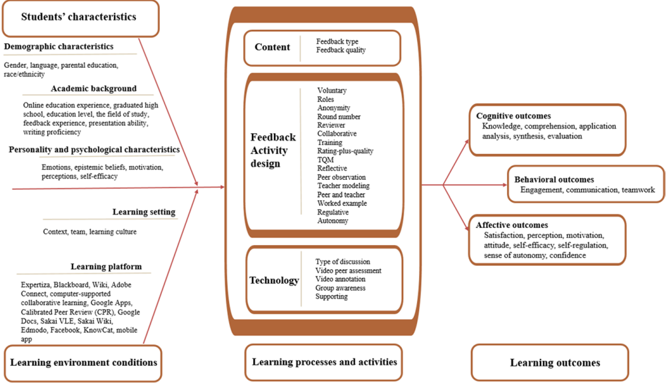
Abstract Online peer feedback is an effective instructional strategy to enhance students' learning processes and outcomes. However, the literature lacks a comprehensive understanding of the influential factors that play a key role in the effective implementation of online peer feedback. This systematic review provides an overview of the current state of online peer feedback implementation in higher education contexts and explores the role of students' characteristics and online learning environments in relation to their learning processes and outcomes. To achieve this goal, the PRISMA method was followed, and a coding scheme was developed to create a framework that can guide the implementation of online peer feedback in higher education settings. This framework depicts factors that should be taken into account for effective implementation of online peer feedback in terms of four dimensions: students' characteristics (demographic characteristics, academic background, and personality and psychological features), environmental conditions (learning platform and setting), learning processes (content, feedback activity design, and technology), and learning outcomes including cognitive outcomes (e.g., acquisition of knowledge, comprehension, application, analysis, synthesis, and evaluation), behavioral outcomes (engagement, communication, and teamwork), and affective outcomes (satisfaction, motivation, attitude, self-efficacy, sense of autonomy, and confidence). We conclude this study by discussing the framework, limitations, and ideas for future research and practice.
Overview
CoChat Summary
TL;DR
This systematic review synthesizes 83 empirical studies on online peer feedback in higher education using Biggs’ model and proposes a four-dimension framework: student characteristics, learning environment, learning processes/activities, and learning outcomes. It finds that gender, platform/setting, feedback design, technology, and cognitive/behavioral/affective outcomes are key considerations for effective implementation.
Key findings
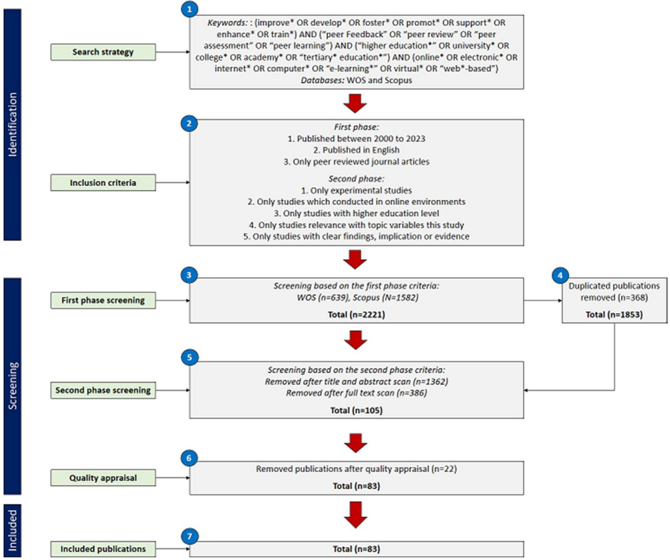
- From 2,221 identified records, 105 studies underwent quality appraisal and 83 were included. Coding produced 36 codes for student characteristics, 39 for learning environment conditions, 107 for learning processes/activities, and 165 for learning outcomes (104 cognitive, 16 behavioral, 45 affective).
- Gender was a consistently significant demographic factor: female students tended to produce higher-quality feedback and more cautious negative comments, while male students produced higher-quality argumentative essays based on peer feedback (Noroozi et al., 2020, 2022; Slee & Jacobs, 2017; Lane et al., 2018).
- Design features influenced outcomes: voluntary peer feedback led to more accurate peer rater scores than compulsory feedback; anonymity enhanced essay writing, high-quality cognitive feedback, and constructive feedback; more rounds improved writing performance and peer score validity; worked examples and scripting improved argumentative essay quality and domain-specific knowledge.
- Application was the most studied cognitive outcome (50 studies), engagement the main behavioral outcome (7 studies), and perception and attitude the main affective outcomes (12 and 14 studies, respectively).
Methods
- PRISMA-guided systematic review; Web of Science and Scopus searched; inclusion required peer-reviewed English empirical intervention studies from 2000–2023, in higher education, and in online learning environments; K-12, blended/hybrid/face-to-face, non-experimental, and conceptual works were excluded.
- Screening: 2,221 records identified; 368 duplicates removed; 491 full-text screened; 386 dropped; 105 quality-appraised; 22 failed minimum quality criteria; 83 included.
- A coding scheme based on Biggs’ (2003) four dimensions was applied in ATLAS.ti 9; inter-rater reliability was κ=0.84, p<0.001, with 84% agreement; analysis was deductive thematic coding.
Limitations
- Stated by the authors: only empirical studies were included, excluding reviews and conceptual papers; databases may have missed unindexed studies; publication bias may affect generalizability; only higher education was examined, not K-12; only English-language studies were included; and only articles from 2000–2023 were included.
- Evident from the text: included studies were geographically concentrated (30 from Taiwan, 36%; 11 from the Netherlands, 13%; 9 from the United States, 11%; 6 from China, 7%; 4 from Iran, 8%; 3 from Spain, 4%), which may limit generalizability.
- Evident from the text: the review is a qualitative synthesis without meta-analytic effect sizes; the authors themselves suggest a future meta-analysis to examine effect size.
Model-written summary. Check it against the paper before relying on it.
Integrity signals
Registry
Cites
Statistics
Figures
Verification
Claims the paper makes
29 Valid · 5 Not valid · 113 Not checked · 56 Own results and interpretations
At least one cited source doesn’t support this claim or points to a different paper, and none confirmed it — see the verdicts below.
In the paper
“Female students tended to produce higher-quality feedback (Noroozi etal., 2020, 2022; Slee & Jacobs, 2017) while providing negative comments with more caution (Lane etal., 2018).”
What the sources say
- Not matchedcites Noroozi etal., 2020, 2022
A range of references, not one source.
- Disputedcites Slee & Jacobs, 2017 matched to “Trialling the use of Google Apps together with online marking to enhance collaborative learning and provide effective feedback” (2017) sourceExperimental — accuracy not yet measured
The 'Overall analysis of the three stages' reports higher marks for female students in stages 1 and 3, but explicitly says there was no significant gender difference in stage 2 peer-assessment marks. Stage 2 is the paper’s assessment of students’ peer feedback, so the reported gender result does not support the attributed tendency toward higher-quality feedback from female students. No page number is available in our copy. (LLM, conf=0.79)
Checked by a reasoning model — may be wrong.
hedgedstates an association- Asserted: passes — The authors put it forward as true.
- Checkable: passes — It can be checked against evidence.
- Load-bearing: unclear — It is unclear whether the paper’s conclusions depend on it.
- Based: passes — The paper gives a reason why it holds.
- Not matched
The cited sources support only part of this claim — read each source’s verdict below.
In the paper
“Although the literature confirms the impacts of online learning environments on peer feedback performance (e.g., Lin, 2016, 2018a; Noroozi & Mulder, 2017), it does not say how different elements of learning environments can influence the design of peer feedback and its implementation.”
What the sources say
- Not matchedcites Lin, 2016, 2018a
A range of references, not one source.
- Partly supportedcites Noroozi & Mulder, 2017 matched to “Design and evaluation of a digital module with guided peer feedback for student learning biotechnology and molecular life sciences, attitudinal change, and satisfaction” (2017) sourceExperimental — accuracy not yet measured
The Conclusions (page unavailable) say that peer-feedback support in this digital module seemed to help students provide constructive and critical feedback. That supports an effect on feedback practice, but the paper's hedged finding about one guided module does not confirm an impact of online learning environments generally on peer-feedback performance. (LLM, conf=0.82)
boostedstates a cause- Asserted: passes — The authors put it forward as true.
- Checkable: passes — It can be checked against evidence.
- Load-bearing: unclear — It is unclear whether the paper’s conclusions depend on it.
- Based: passes — The paper gives a reason why it holds.
- Not matched
The cited sources that could be checked couldn’t confirm or dispute this claim.
In the paper
“Some of these challenges regard students' attitudes and perceptions of peers and their feedback, such as the level of trust and low tolerance for critical feedback and resistance (Hu & Lam, 2010; Panadero & Alonso-Tapia, 2013).”
What the sources say
- Not checked — no full text of the sourcecites Hu & Lam, 2010 matched to “Issues of cultural appropriateness and pedagogical efficacy: exploring peer review in a second language writing class” (2010) source
- Could not verifycites Panadero & Alonso-Tapia, 2013 matched to “Autoevaluación: Connotaciones Teóricas y Prácticas. Cuándo Ocurre, Cómo se Adquiere y qué Hacer para Potenciarla en nuestro Alumnado” (2017) sourceExperimental — accuracy not yet measured
The section “Condiciones que fomentan la autoevaluación” (page unavailable) discusses students’ motivation to assess their own work and instructional support for doing so, not challenges in receiving peer feedback. Searches for trust in peers, tolerance of criticism, and resistance found no passage in our copy addressing those claims. (LLM, conf=0.76)
plain- Asserted: passes — The authors put it forward as true.
- Checkable: passes — It can be checked against evidence.
- Load-bearing: unclear — It is unclear whether the paper’s conclusions depend on it.
- Based: passes — The paper gives a reason why it holds.
The cited sources support only part of this claim — read each source’s verdict below.
In the paper
“There were no significant differences in the mean grades of students allocated at different educational levels (Slee & Jacobs, 2017).”
What the sources say
- Partly supportedcites Slee & Jacobs, 2017 matched to “Trialling the use of Google Apps together with online marking to enhance collaborative learning and provide effective feedback” (2017) sourceExperimental — accuracy not yet measured
The ‘Overall analysis of the three stages’ section (page unavailable) reports no significant difference in mean marks between allocated groups or degree schemes. It does not compare educational levels: the Methods section (page unavailable) says the students were all taking a Level 4 module. (LLM, conf=0.88)
plain- Asserted: passes — The authors put it forward as true.
- Checkable: passes — It can be checked against evidence.
- Load-bearing: unclear — It is unclear whether the paper’s conclusions depend on it.
- Based: passes — The paper gives a reason why it holds.
- Partly supported
Every source the paper cites for this claim was checked and supports it.
In the paper
“Peer feedback training has also been found to have positive effects on writing improvement (Jiang & Yu, 2014) and text revisions (Yang & Meng, 2013), although no significant increases were observed in student assessment knowledge when participating in peer assessment training (Hoffman, 2019).”
What the sources say
- Supportedcites Yang & Meng, 2013 matched to “The Effects of Online Feedback Training on Students’ Text Revision” (2013) source
The Discussion and Conclusion states that online training in providing peer feedback had positive effects on EFL college students’ text revisions. It adds that the gains were greater for less-proficient students; the citing sentence does not claim otherwise. (LLM, conf=0.94)
plainstates a cause- Asserted: passes — The authors put it forward as true.
- Checkable: passes — It can be checked against evidence.
- Load-bearing: unclear — It is unclear whether the paper’s conclusions depend on it.
- Based: passes — The paper gives a reason why it holds.
- Supported
111 more claims · 18 with their cited sources checked
Create a free account to see all 203 claims and to verify the 17 references still open.
- Probably not a substantial claim. 47
- It may state two separate claims as one. 52
- The quote only partly states this claim. 2
Self-check
Percentages, sums and reported differences re-computed from the paper’s own numbers.
Rated minor: it would not touch a result — a value no result rests on, a p-value that stays on the same side of the significance level, or a conflict that is clerical, resolved elsewhere in the paper, or outside its own findings.
In the paper
“4 publications from Iran (8%)”
Reported 8 · recomputed 4.819277
Rated minor: it would not touch a result — a value no result rests on, a p-value that stays on the same side of the significance level, or a conflict that is clerical, resolved elsewhere in the paper, or outside its own findings.
In the paper
“| | Group awareness tools | 1 | 1% | Su et al., 2022 |”
Reported 1 · recomputed 6.25
Citations
Cites
Preferred Reporting Items for Systematic Reviews and Meta-Analyses: The PRISMA Statement
Moher, D., Liberati, A., Tetzlaff, J., Altman, D. G., & The PRISMA Group (2009) · PLoS Medicine · doi:10.1371/journal.pmed.1000097 · Cited by 64,042
Preferred Reporting Items for Systematic Reviews and Meta-Analyses: The PRISMA Statement
Moher, D., Liberati, A., Tetzlaff, J., & Altman, D. G. (2009) · Journal of Clinical Epidemiology · doi:10.1016/j.jclinepi.2009.06.005 · Cited by 19,575
Hattie, J., & Timperley, H. (2007) · Review of Educational Research · doi:10.3102/003465430298487 · Cited by 12,905
(2001) · Cited by 2,945
Contemporary Issues in Technology and Teacher Education
(2025) · Contemporary issues in technology and teacher education · doi:10.70725/833004pqfpbd · Cited by 2,368
Peer Assessment between Students in Colleges and Universities
Topping, K. (1998) · Review of Educational Research · doi:10.2307/1170598 · Cited by 2,173
A SWOT analysis of ChatGPT: Implications for educational practice and research
Farrokhnia, M., Banihashem, S. K., Noroozi, O., & Wals, A. (2024) · Innovations in Education and Teaching International · doi:10.1080/14703297.2023.2195846 · Cited by 1,384
Self-citationBurston, J. (2013) · IALLT Journal of Language Learning Technologies · doi:10.17161/iallt.v43i2.8528 · Cited by 893
Winstone, N. E., Nash, R. A., Parker, M., & Rowntree, J. (2017) · Educational Psychologist · doi:10.1080/00461520.2016.1207538 · Cited by 884
To give is better than to receive: The benefits of peer review to the reviewer's own writing
Lundstrom, K., & Baker, W. (2009) · Journal of Second Language Writing · doi:10.1016/j.jslw.2008.06.002 · Cited by 843
Research works printed but not linked: 9
- Al Abri, A., Al Baimani, S., & Al Bahlani, S. (2021). The role of web-based peer feedback in advancing EFL essay writing. Computer-Assisted Language Learning Electronic Journal (CALL-EJ) , 22(1), 374-390. 10.29140/call-ej.v22i1.420 · doi:10.29140/call-ej.v22i1.420
- Biggs, J. B. (2003). Teaching for quality learning at university: What the student does (2nd ed.). Buckingham: Open University Press
- Golonka, L. D., & Lance, T. S. (2020). Cultural Factors in Online Learning . In L. D. Golonka & T. S. Lance (Eds.), Online learning across a random family (1st ed., pp. 69-80) . Routledge.
- Li, N., Zhao, Y., Huang, X., & Tan, X. (2019b). The impact of personality traits on peer feedback in online learning environment. International Journal of Emerging Technologies in Learning, 14 (19), 77-91. https:// doi. org/ 10. 3991/ ijet. v14i19. 10605 · doi:10.3991/ijet.v14i19.10605
- Li, N., Huang, X., Zhao, Y., & Tan, X. (2021). Understanding college students' perceptions and use of peer feedback in online learning environments: The roles of prior knowledge and educational level. Educational Technology Research and Development, 69 (1), 251-272. https:// doi. org/ 10. 1007/ s11423- 020- 09959-8 · doi:10.1007/s11423-020-09959-8
- Liu, E. Z. F., & Lee, C. Y. (2013). Using peer feedback to improve learning via online peer assessment. Turkish Online Journal of Educational Technology, 12 (1), 187-199.
- Noroozi, O., Hatami, J., Latifi, S., & Fardanesh, H. (2019). The effects of argumentation training in online peer feedback environment on process and outcomes of learning. Journal of Educational Scinces, 26(2), 71–88. 10.22055/EDUS.2019.28694.2763 · DOI
- Ritzhaupt, A. D., & Kumar, P. (2015). The impact of peer feedback on communication skills in online discussions. Journal of Educational Computing Research, 53 (1), 31-50. https:// doi. org/ 10. 1177/ 07356 33115 592429 · doi:10.1177/0735633115592429
- Theelen, T., van der Slikke, R. M. A., de Mul, M., & van der Steen, J. (2019). Quality appraisal of systematic reviews on end-of-life care: A systematic review. Palliative medicine, 33 (2), 179-188. https:// doi. org/ 10. 1177/ 02692 16318 820464 <!-- image --> · doi:10.1177/0269216318820464
Cited by
Feedback sources in essay writing: peer-generated or AI-generated feedback?
Banihashem, S. K., Kerman, N. T., Noroozi, O., Moon, J., & Drachsler, H. (2024) · International Journal of Educational Technology in Higher Education · doi:10.1186/s41239-024-00455-4 · Cited by 282
“In response to this challenge, various solutions have emerged, among which peer feed-back has arisen as a promising alternative instructional approach (Er et al., 2021; Gao et al., 2024; Noroozi et al., 2023; Kerman et al., 2024).”
BackgroundSelf-citationGuo, K., Pan, M., Li, Y., & Lai, C. (2024) · The Internet and Higher Education · doi:10.1016/j.iheduc.2024.100962 · Cited by 173
XGBoost To Enhance Learner Performance Prediction
Hakkal, S., & Lahcen, A. A. (2024) · Computers and Education Artificial Intelligence · doi:10.1016/j.caeai.2024.100254 · Cited by 227
Does perception mean learning? Insights from an online peer feedback setting
Noroozi, O., Alqassab, M., Taghizadeh Kerman, N., Banihashem, S. K., & Panadero, E. (2025) · Assessment & Evaluation in Higher Education · doi:10.1080/02602938.2024.2345669 · Cited by 72
“Additionally, gender is increasingly recognized as a crucial factor in online learning environments, including peer feedback (Taghizadeh Kerman et al. 2023a).”
InfluentialSelf-citationA systematic review of the key components of online peer feedback practices in higher education
Gao, X., Noroozi, O., Gulikers, J., Biemans, H. J. A., & Banihashem, S. K. (2024) · Educational Research Review · doi:10.1016/j.edurev.2023.100588 · Cited by 61
Self-citationUsing learning analytics to explore peer learning patterns in asynchronous gamified environments
Moon, J., McNeill, L., Edmonds, C. T., Banihashem, S. K., & Noroozi, O. (2024) · International Journal of Educational Technology in Higher Education · doi:10.1186/s41239-024-00476-z · Cited by 65
“Peer learning approaches can be implemented synchronously and asynchronously (Kerman et al., 2024; Valero Haro et al., 2023).”
BackgroundSelf-citationZhang, Y., Schunn, C. D., & Wu, Y. (2024) · International Journal of Educational Technology in Higher Education · doi:10.1186/s41239-024-00458-1 · Cited by 36
“Peer review, as a student-centered pedagogical approach, has become widely used in higher education (Gao et al., 2023; Kerman et al., 2024).”
BackgroundMeyer, J., Jansen, T., & Fleckenstein, J. (2025) · Contemporary Educational Psychology · doi:10.1016/j.cedpsych.2025.102363 · Cited by 28
Rubric co-creation to promote quality, interactivity and uptake of peer feedback
Yan, D. “. (2024) · Assessment & Evaluation in Higher Education · doi:10.1080/02602938.2024.2333005 · Cited by 26
Supporting peer learning with artificial intelligence: A systematic literature review
Sichterman, B., Noroozi, O., Boetje, J., van Ginkel, S. O., Khosravi, H., & Versendaal, J. (2025) · Innovations in Education and Teaching International · doi:10.1080/14703297.2025.2530118 · Cited by 32
“These outcomes align with previous peer learning research, highlighting similar benefits of AI-driven peer learning processes in fostering these outcomes (Kerman et al., 2024).”
Self-citationThe synergistic effects in an AI-supported online scientific argumentation learning environment
Lin, Y., & Hung, C. (2025) · Computers & Education · doi:10.1016/j.compedu.2025.105251 · Cited by 29
Lahza, H. F., Demartini, G., Noroozi, O., Gašević, D., Sadiq, S., & Khosravi, H. (2025) · Computers & Education · doi:10.1016/j.compedu.2025.105260 · Cited by 16
Self-citationExploring the nature of peer feedback: An epistemic network analysis approach
Viberg, O., Baars, M., Mello, R. F., Weerheim, N., Spikol, D., Bogdan, C., Gašević, D., & PAAS, F. G. W. C. (2024) · Journal of Computer Assisted Learning · doi:10.1111/jcal.13035 · Cited by 23
Rehman, N., Huang, X., Mahmood, A., Maqbool, S., & Javed, S. (2024) · New Directions for Child and Adolescent Development · doi:10.1155/2024/1271802 · Cited by 17
Sichterman, B., Banihashem, S. K., Verstappen, M., Schipper, M., Waisvisz, P., Noroozi, O., & van Ginkel, S. O. (2025) · Interactive Learning Environments · doi:10.1080/10494820.2025.2521338 · Cited by 19
“In addition, how students perceive AI feedback is not yet clearly explored, while students ’ perceptions regarding the feedback (e.g. perceived usefulness) are considered an important factor in uptake feedback (Kerman et al., 2023).”
Self-citationAI assistance in peer feedback provision: Pedagogically sound, but minimally adopted
Pozdniakov, S., Brazil, J., Banihashem, S. K., Noroozi, O., Gašević, D., Sadiq, S., & Khosravi, H. (2026) · Computers & Education · doi:10.1016/j.compedu.2026.105591 · Cited by 11
Self-citationXu, B., & Rahim, N. (2025) · Learning and Motivation · doi:10.1016/j.lmot.2025.102126 · Cited by 15
Villegas-Ch, W. E., Govea, J., Gutierrez, R., & Mera-Navarrete, A. (2024) · IEEE Access · doi:10.1109/access.2024.3424397 · Cited by 14
“The Ask Like and Forums functionalities in Interac-tiveClass follow a familiar pattern focusing on simplified interaction and instant feedback within an online educational environment [28].”
BackgroundThe impacts of peer assessment on critical thinking competence: An epistemic network analysis
Tang, J., Liu, G., Bai, J., & Jiang, J. (2024) · Journal of Hospitality Leisure Sport & Tourism Education · doi:10.1016/j.jhlste.2024.100515 · Cited by 17
The good, bad, and ugly of comment prompts: Effects on length and helpfulness of peer feedback
Mu, H., & Schunn, C. D. (2025) · International Journal of Educational Technology in Higher Education · doi:10.1186/s41239-025-00502-8 · Cited by 17
“…gaining increasing attention in research and practice (Double et al., 2019), especially in the context of higher education and with the support of online peer feedback systems (Dawson et al., 2024; Gao et al., 2023; Kerman et al., 2024; Little et al., 2024; Nicol et al., 2014; Zhang et al., 2024).”
Xie, Q., & Chang, Z. (2024) · Computers & Education · doi:10.1016/j.compedu.2024.105167 · Cited by 14
Consistency in providing peer feedback: the role of individual and situational factors
Gao, X., Schunn, C. D., Noroozi, O., Gulikers, J. T. M., Banihashem, S. K., & Biemans, H. J. A. (2025) · Assessment & Evaluation in Higher Education · doi:10.1080/02602938.2025.2517617 · Cited by 12
Self-citationNing, Y., Seah, W. T., Chen, J., Liu, J., & Tan, P. (2026) · Computers & Education · doi:10.1016/j.compedu.2026.105572 · Cited by 11
Shulgina, G., Fanguy, M., Zhang, H., Courtney, M. G. R., Baldwin, M., & Costley, J. (2024) · Computers & Education · doi:10.1016/j.compedu.2024.105104 · Cited by 10
That's What RoBERTa Said: Explainable Classification of Peer Feedback
Huang, K., Mello, R. F., Junior, C. P., Rodrigues, L., Baars, M., & Viberg, O. (2025) · International Conference on Learning Analytics and Knowledge (LAK) · doi:10.1145/3706468.3706526 · Cited by 8
“Based on the increasing use of PF in educational settings, particularly in the CSCL setting of large courses [24], there is a growing need to automate the analysis of large datasets generated by students.”
Implementing federated learning for privacy-preserving emotion detection in educational environments
Gutierrez, R., Villegas-Ch, W. E., & Luján‐Mora, S. (2025) · Frontiers in Artificial Intelligence · doi:10.3389/frai.2025.1644844 · Cited by 13
“To this end, several real-time monitoring mechanisms and periodic adjustments to the model are implemented (Kerman et al., 2024).”
Zhang, L., Li, L., Jiang, J., & Zou, B. (2025) · Thinking Skills and Creativity · doi:10.1016/j.tsc.2025.102042 · Cited by 11
Sayeed, M. A., Gupta, D., & Kanjirangat, V. (2025) · Procedia Computer Science · doi:10.1016/j.procs.2025.04.553 · Cited by 9
Afreen, S., & Bhamare, R. S. (2024) · Discover Education · doi:10.1007/s44217-024-00355-9 · Cited by 5
“Additionally, the lack of attendance, minimal interaction in the classroom, and the continued use of traditional teaching methods in online classes contributed to the perceived irrationality of some student feedback [83, 91, 93, 94].”
Prompiengchai, S., Baby, N. K., & Joordens, S. (2024) · Social Sciences & Humanities Open · doi:10.1016/j.ssaho.2024.101058 · Cited by 8
Mustika, M., Yeh, C. Y. C., Cheng, H. N. H., Liao, C.-Y., & Chan, T.-W. (2025) · Journal of Computer Assisted Learning · doi:10.1111/jcal.70006 · Cited by 18
Özbek, T., Daumiller, M. H., Roshany-Tabrizi, A., Mömke, T., & Kollar, I. (2024) · Computers in Human Behavior Reports · doi:10.1016/j.chbr.2024.100540 · Cited by 7
A Systematic Review of Online Peer Assessment Tools for Learning Evaluation
Butarbutar, R., Sauhenda, A. F., & Marnina, M. (2025) · Innovare Journal of Education · doi:10.22159/ijoe.2025v13i2.53640 · Cited by 4
“Educators must provide clear guidelines and training to students on how to provide and receive constructive feedback, ensuring that the process is beneficial for all participants (Kerman et al., 2024; Lu & Law, 2012).”
Ren, X., & Zhou, Y. (2025) · Interactive Learning Environments · doi:10.1080/10494820.2025.2479167 · Cited by 3
“…providing constructive feedback to their peers than receiving feedback (Filius et al., 2019; Yu & Schunn, 2023), enhancing their knowledge and skills in argumentation, negotiation, evaluation, reflection, judgment, critical thinking, decision-making, and communication skills (Kerman et al., 2023).”
The role of platform design in online peer feedback: a comparison of two digital environments
Jongsma, M. V., Meeter, M., van Muijlwijk‐Koezen, J. E., & Scholten, D. J. (2025) · Education and Information Technologies · doi:10.1007/s10639-025-13598-2 · Cited by 5
García-Hormazábal, R. (2025) · Revista de Estudios y Experiencias en Educación · doi:10.21703/rexe.v24i55.3062 · Cited by 24
Zhan, Y., Huang, L., & Ba, S. (2025) · The Internet and Higher Education · doi:10.1016/j.iheduc.2025.101059 · Cited by 5
Haddadian, G., Kim, M. K., & Haddadian, N. (2025) · Research Synthesis in Applied Linguistics · doi:10.1080/29984475.2025.2598266 · Cited by 5
Enhancing coherence and student engagement through portfolio assignments and peer-feedback
Oestergaard, L. G., Hansen, J. S., Ravn, M. B., & Maribo, T. (2024) · Discover Education · doi:10.1007/s44217-024-00260-1 · Cited by 9
“The quality of student learning is significantly influenced by the uptake of feedback, which depends on its perceived trustworthiness [17].”
Ocampo, J. C. G., Panadero, E., Sánchez‐Iglesias, I., & Díez, F. (2025) · Studies In Educational Evaluation · doi:10.1016/j.stueduc.2025.101455 · Cited by 4
Rallying for Reflection: Pilot Use of Rubric to Facilitate Self‐Reflection in Dental Education
Katser, M. S., Veremis, B. M., Danciu, T., Ramaswamy, V., & Popov, V. (2025) · European Journal Of Dental Education · doi:10.1111/eje.13088 · Cited by 3
“While we saw no correlation between self-reflective practices and examination scores, a well-documented body of literature has shown that effective student learning benefits from information related to metacognition and self-regulated learning as well as from reflection [5, 6, 38].”
Abo, A. L., Wubshet, H., & Abeba, B. D. (2025) · Thinking Skills and Creativity · doi:10.1016/j.tsc.2025.102117 · Cited by 4
Meta-analyses of Peer Assessment and Affective Outcomes: Motivation, Self-efficacy, and Anxiety
Lu, Z., Lei, H., Chiu, M. M., Mao, W., & Wang, S. (2026) · Educational Psychology Review · doi:10.1007/s10648-025-10098-0 · Cited by 3
Rybicki, J.-M., Hämäläinen, W., Pitkänen, K. K., & Malmi, L. (2024) · Ampersand · doi:10.1016/j.amper.2024.100211 · Cited by 7
Zhou, D., Li, H., Sima, Y., Han, Y., & Shi, F. (2025) · International Journal of Science Education · doi:10.1080/09500693.2025.2496427 · Cited by 6
“Kerman et al. (2023) highlighted the effectiveness of peer feedback, particularly in online and collaborative learning environments.”
Syaifudin, Y. W., Funabiki, N., Kaswar, A. B., Sunandar, A., Fatmawati, T., Saputra, P. Y., Wijaya, D. C., & Irawanto, M. F. (2025) · SN Computer Science · doi:10.1007/s42979-025-04114-x · Cited by 4
“These platforms cultivate a community of practice, allowing learners to exchange information and provide mutual support while simultaneously enhancing self-efficacy through quick feedback and opportunities for practical application [7].”
Dağdeler, K. O. (2025) · SAGE Open · doi:10.1177/21582440251355772 · Cited by 4
“Although the works of Cao et al. (2022) and Kerman et al. (2024) offer a useful conceptual framework, they remain largely theoretical and call for empirical validation across diverse educational settings.”
InfluentialAdvancing Pedagogical Excellence: Strategies for Enhancing SoTL in Digital Classrooms
Makinde, S. O. (2025) · IGI Global eBooks · doi:10.4018/979-8-3693-7595-2.ch001 · Cited by 2
Fu, L., Dai, Y., Woods, D. K., Song, B., & Zhang, M. (2025) · Interactive Learning Environments · doi:10.1080/10494820.2025.2472281 · Cited by 2
“The choice of online devices significantly impacts the learning experience, with larger screens generally providing better usability (Kerman et al., 2024).”
Pace, J., Bartlett, A. D., Iu, T., La, J., & Penm, J. H.-D. (2025) · Pharmacy · doi:10.3390/pharmacy13030074 · Cited by 1
“One study highlights that students’ demographic backgrounds, academic experiences, and psychological traits can influence the effectiveness of peer feedback, ultimately shaping their engagement and learning outcomes [44].”
LEGO® SERIOUS PLAY® as a Tool for Reflective and Sustainable Learning in Optometry
Oliveira, A. P., Barbosa, B., & Martínez-Pérez, C. (2025) · Education Sciences · doi:10.3390/educsci15091216 · Cited by 1
Yan, D. “., & Gao, Y. (2025) · Computer Assisted Language Learning · doi:10.1080/09588221.2025.2569352 · Cited by 1
ЖОҒАРЫ ОҚУ ОРНЫНДА БІЛІМ БЕРУ ТЕЛЕМАТИКАСЫ АРҚЫЛЫ КЕРІ БАЙЛАНЫСТЫ ҰЙЫМДАСТЫРУ
Керімбаев, Н. Н., Adamova, K., & Azybayev, M. A. (2025) · Habaršy. Pedagogika ġylymdary seriâsy · doi:10.51889/2959-5762.2025.87.3.012 · Cited by 2
Evangelou, S. M., & Xenos, M. (2025) · Next research. · doi:10.1016/j.nexres.2025.101000 · Cited by 13
Powell, K. S., Rentzelas, P., & Kambouri, M. A. (2026) · Learning and Instruction · doi:10.1016/j.learninstruc.2026.102368 · Cited by 1
Zhou, J., Zhao, N., Gao, X., & Han, X. (2026) · Thinking Skills and Creativity · doi:10.1016/j.tsc.2026.102236 · Cited by 5
Singha, R., & Sathyamoorthy, Y. K. (2025) · Advances in social networking and online communities book series · doi:10.4018/979-8-3693-4191-9.ch001 · Cited by 1
Hofland, M., Woodstead, K., & Parson, L. J. (2024) · Advances in educational marketing, administration, and leadership book series · doi:10.4018/979-8-3693-3534-5.ch011
Enhancing the structure of feedback forms increases trustworthiness and usefulness of peer feedback
Quinton, J. M., Nesbitt, L., & Bock, J. (2025) · Assessment & Evaluation in Higher Education · doi:10.1080/02602938.2025.2468848 · Cited by 4
“Peer feedback has been employed across a range of disciplines and subjects, grade levels and institutions, learning outcomes and outputs, and oral and written formats (Topping 1998; Gielen, Dochy, and Onghena 2011; Kerman et al. 2024).”
Relato de Experiência: reflexão sobre a importância dos feedbacks online no contexto dos Cursos EAD
Silva, L. K. C., Toscano, T. S. B., de Lima, M. A., Beserra, E. P., dos Santos, V. E. F. A., & de Sales, W. N. (2025) · Cuadernos de Educación y Desarrollo · doi:10.55905/cuadv17n3-076
Tessema, A. (2025) · SSRN Electronic Journal · doi:10.2139/ssrn.5199980
Saha, S. (2025) · International Journal for Research in Applied Science and Engineering Technology · doi:10.22214/ijraset.2025.69770
A Systematic Review of Online Peer Assessment Tools for Learning EvaluationPreprint
Butarbutar, R. (2025) · SSRN Electronic Journal · doi:10.2139/ssrn.5278578
Natural Language Processing for Automated Feedback Generation in Peer-Reviewed Online Assignments
Ajitha, S., Mahalakshmi, K. V., Anbazhagan, G. K., Tutika, A., Mohammed, A. A. S., & Anuradha, S. (2025) · International Conference on Advances in Modern Age Technologies for Health and Engineering Science (AMATHE) · doi:10.1109/amathe65477.2025.11080762
“From these peer assignments, the students get to realize different analyses making their understanding of the topic diverse [2].”
Implementing a Design Framework for Enhancing Student-Centered Learning in an Online Graduate Class
Özgün, O., Sadık, O., & Bonk, C. J. (2025) · TechTrends · doi:10.1007/s11528-025-01121-w
“As Kerman et al. (2024) expressed that student characteristics, environmental conditions, learning outcomes, behavioral and affective outcomes are the dimensions for effective online peer feedback implementation.”
Matejić, J. (2025) · Journal of Educational Studies in Mathematics and Computer Science · doi:10.5937/jesmac2501056m · Cited by 1
Kurniawan, R., Purwanto, A., & Sumargo, B. (2025) · Journal of Applied Research in Higher Education · doi:10.1108/jarhe-11-2024-0612 · Cited by 2
Ocampo, J. C. G., Panadero, E., Zamorano, D., & Sánchez‐Iglesias, I. (2025) · Assessing Writing · doi:10.1016/j.asw.2025.100987 · Cited by 1
Farmasari, S., Wardana, L. A., Munandar, L. O. A. H., & Suryaningsih, H. (2025) · Journal Evaluation in Education (JEE) · doi:10.37251/jee.v6i4.2113 · Cited by 2
“Yet during the Covid-19 pandemic, the shift to digital peer assessment raised concerns about usability, grading fairness, and the quality of feedback [21], [22].”
Emery, K., & Matthews, S. J. (2025) · Community Notebook People Education and Welfare in the Society 5 0 · doi:10.61007/qdc.2025.2.379 · Cited by 1
Shulgina, G., Адамович, К., Zhang, H., Fanguy, M., Baldwin, M., & Costley, J. (2025) · Active Learning in Higher Education · doi:10.1177/14697874251389104
Adiyono, A., Fitri, A. Z., & Sanam, A. I. (2025) · Journal of Educational Research and Practice. · doi:10.70376/jerp.v3i3.414
Keleş, N., & Şenyıldız, A. (2025) · Diyalog Interkulturelle Zeitschrift Für Germanistik · doi:10.37583/diyalog.1824327
Cover Letters as a Tool to Elicit Peer Feedback Within Doctoral Writing Groups
Yallop, R., Leijen, D. A. J., & Lang, S. M. (2025) · The Journal of Writing Analytics · doi:10.37514/jwa-j.2025.8.1.02
A Case Study on Formative Assessment in Physical Education Teacher Training in Uruguay
Gallardo-Fuentes, F., Costa-Ferrari, M., Martínez-Angulo, C., Carter-Thuillier, B. I., & Gallardo-Fuentes, J. (2026) · Trends in Higher Education · doi:10.3390/higheredu5010012
“Likewise, recent studies show that effective peer feedback designs have been proven to improve performance and self-regulation [18].”
Gender Differences in Self-efficacy and Motivation in Online Peer Assessment
Almuadi, M., & Barr, M. (2026) · Lecture notes in networks and systems · doi:10.1007/978-3-032-15743-0_26
Jin, S.-H., Hoffman, D. L., Paek, S., & Kim, T.-H. (2026) · Educational Technology Research and Development · doi:10.1007/s11423-026-10603-4
Pace, J., Bartlett, A. D., Iu, T., & Penm, J. H.-D. (2026) · Pharmacy · doi:10.3390/pharmacy14020041
“These include motivational factors like satisfaction and self-efficacy [17], the influence of students’ demographic backgrounds, academic experiences, and psychological traits on shaping engagement and learning outcomes [18], as well as logistical factors, such as the timing of assignments [19].”
Research challenges and future perspectives for e-assessment technologies in higher education
Striewe, M., Strickroth, S., & Ullrich, M. (2026) · i-com · doi:10.1515/icom-2026-0008 · Cited by 2
“This method is often used in (essay) writing assignments in higher education, 97,99 but it is widely applicable and can be used when the tasks to be reviewed require some creativity – even in ill-defined domains (see ref.”
InfluentialTables to teamwork: Student canteen as a catalyst for collaborative learning in business education
Chopra, K. (2026) · The International Journal of Management Education · doi:10.1016/j.ijme.2026.101403
Validity evidence for the internal structure of the peer feedback orientation scale
Kalz, M., Schulze, A., Meeh, H., & Weidlich, J. (2026) · Technology Knowledge and Learning · doi:10.1007/s10758-026-09972-9
Yao, J., Al-Hashimy, H. N. H., & Kasuma, S. A. A. (2026) · Education + Training · doi:10.1108/et-12-2025-1131 · Cited by 2
Evaluating Peer Contributions by Rubrics, Feedback Loops, and Fair Assessment in Online Courses
Bùi, T. V. T. (2026) · IGI Global eBooks · doi:10.4018/979-8-3373-1732-8.ch007
Heymann, P., van Rosmalen, P., & Beausaert, S. A. J. (2026) · Behaviour and Information Technology · doi:10.1080/0144929x.2026.2686163
Arpacık, Ö., Aydemir, M., Küçük, S., & Durak, H. Y. (2026) · Interactive Learning Environments · doi:10.1080/10494820.2026.2699331
Prompts and recasts in language development: impacts on uptake and grammatical accuracy
Alzi’abi, S. E. (2026) · Asian-Pacific Journal of Second and Foreign Language Education · doi:10.1186/s40862-026-00418-4
“This deeper engagement is expected to lead to more frequent and accurate uptake, as well as improved retention of grammatical forms (Kerman et al., 2024; Lyster & Ranta, 1997).”
Feedback in STEM Higher Education: A Systematic Literature Review
Pirzada, P., Chen, Y., & Chai, K. K. (2026) · Education Sciences · doi:10.3390/educsci16081205 · Cited by 1
AI-Based Assessment of Revision-Associated Research Writing Development in a Peer-Feedback-Supported
Yahmadi, H. H. N. A. (2026) · Information · doi:10.3390/info17080744
Antecedents of student feedback uptake during online interactive peer assessment
Zhan, Y., Chiu, M. M., & Du, Z. (2026) · Education and Information Technologies · doi:10.1007/s10639-026-14108-8
Palacios, F. R. D. C., Vargas, L. N., Gonzales-Ortiz, Y., Espinoza, M. A. M., & Ordóñez, A. T. (2026) · Revista Simón Rodríguez · doi:10.62319/simonrodriguez.v.6i12.193
Londoño-Proaño, C., Galarza, J. C. G., & García, E. B. B. (2026) · Frontiers in Education · doi:10.3389/feduc.2026.1924482
Kahaleh, R., Imad, R., & Rishmany, J. (2026) · Interactive Learning Environments · doi:10.1080/10494820.2026.2710356
Sun, Y., Keung, J., Yu, H. K., Liao, Y., Li, Y., & Ma, X. (2026) · IEEE Annual International Computer Software and Applications Conference (COMPSAC) · doi:10.1109/compsac69091.2026.00213
“Remote teaching and home-based online learning quickly became prevalent methods to sustain educational continuity [8]–[10].”
A Structured Peer Review Model for Fostering Feedback Literacy in Programming Education
Li, X., Chen, D., Scott, G., Torrisi‐Steele, G., Vemuri, L. N. S., & Yao, T. (2026) · International Conference on Computer Science and Technologies in Education (CSTE) · doi:10.1109/cste69562.2026.11649728
“Recent reviews further emphasize that the educational value of peer review depends not on participation alone, but on how feedback activities are designed and experienced by students [3], [4].”
Cao, X., Chen, Z., Zou, D., & Wei, W. (2026) · Computer Assisted Language Learning · doi:10.1080/09588221.2026.2721289 · Cited by 1
Aladak, K. B. D. (2026) · Eurasian journal of teacher education. · doi:10.69918/ejte.1857410
Falcón, F. M. G., Rodríguez, L. K. G., Pachas, E. A. F., & Alosilla, Y. Q. (2026) · Revista Simón Rodríguez · doi:10.62319/simonrodriguez.v.6i12.213
Sridharan, B., McKay, J., & Do, Y. (2026) · Higher Education Research & Development · doi:10.1080/07294360.2026.2722379
Metadata
- Authors
- Kerman, N. T., Banihashem, S. K., Karami, M., Er, E., van Ginkel, S., & Noroozi, O.
- Affiliations
- Ferdowsi University of Mashhad (IR)
- Open University of the Netherlands (NL)
- Middle East Technical University (TR)
- Wageningen University & Research (NL)
- Corresponding author
- Noroozi, Omid
- Venue
- Education and Information Technologies
- Published
- 2023-11-14
- Volume
- 29
- Issue
- 1
- Pages
- 763-813
- ISSN
- 1360-2357 (ISSN-L)
- 1573-7608
- OpenAlex
- W4388669995
- Semantic Scholar
- 5570d70a67a2397d27d65700d6844da247702cc1
- Cited by
- 109
- References
- 124
- Citations by year
- 2026: 37 · 2025: 52 · 2024: 19 · 2023: 1
- FWCI
- 80.78
- Type
- journal article
- Language
- en
- Open access
- hybrid
- doi.org
- Licence
- cc-by
- creativecommons.org/licenses/by/4.0 (tdm)
- creativecommons.org/licenses/by/4.0 (vor)
- Locations
- Education and Information Technologies (publishedVersion, cc-by)
- OpenMETU (Middle East Technical University) (submittedVersion, cc-by-nc-nd)
- Socio-Environmental Systems Modeling (submittedVersion, cc-by)
- DSpace (Open University in the Netherlands) (submittedVersion, cc-by)
- Topics
- Social Sciences › Education › Student Assessment and Feedback
- Social Sciences › Education › Online and Blended Learning
- Social Sciences › Psychology › Developmental and Educational Psychology › Innovative Teaching and Learning Methods
- Keywords
- online peer feedback, higher education, implementation factors, student characteristics, virtual learning environments, learning outcomes, self-efficacy, student motivation, student engagement, teamwork, learning platforms, teaching methods
About these checks
Registry, retraction, Cites and statistics results are computed, not judged, with one exception: a printed reference that no index lists is read once by a model before it counts as a citation error. Claims are extracted by a model and kept only when their quote appears verbatim in the text; each cited source is then checked, with a model’s help, for whether it says what the claim relies on. Those verdicts can be wrong — read the claim’s quote and the cited source before relying on one.
The claim verdicts this report counts are experimental: their accuracy is not yet measured.
A language model drew the claims from the paper on 2026-09-30, under version 3 of the claim definition (model deepseek-v4.1-flash, prompt extract-v3).
A second model labelled each claim on 2026-09-30 (model jev-1.13-20260917, definition revision gold-guideline-v0.2).
Cited sources are checked with a language model’s help (gpt-6-sol).
Statistics and arithmetic are recomputed, not judged.
Confidence bands are shown only for fields calibrated on our annotated test set. None is calibrated yet, so no band is shown.
What counts as a claim ›How we measure confidence ›How we check this ›
Are you an author, or do you see a problem with this page? Request a review
Data sources
Bibliographic data: Semantic Scholar, OpenAlex, Crossref.
Contains information from the Semantic Scholar Academic Graph Datasets, made available under the ODC Attribution License (ODC-BY 1.0).
Semantic Scholar’s data is described in: Kinney, R., et al. (2023). The Semantic Scholar Open Data Platform. arXiv:2301.10140.
