

Online peer feedback in higher education: A synthesis of the literature
Open accessThe DOI matches its Crossref record; 128 of the 130 references it cites were found in a registry or an index; 36 of the 194 sources its claims cite were checked for support.
Abstract
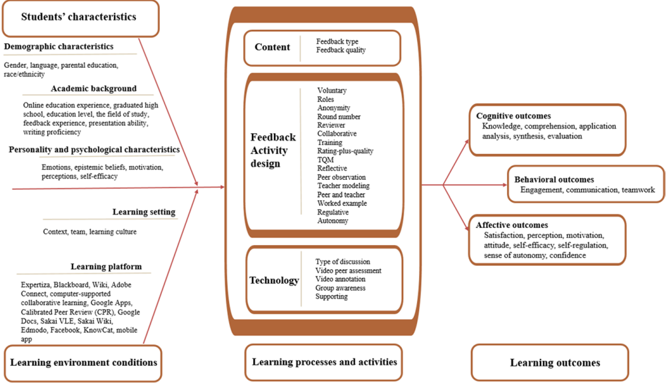
Abstract Online peer feedback is an effective instructional strategy to enhance students' learning processes and outcomes. However, the literature lacks a comprehensive understanding of the influential factors that play a key role in the effective implementation of online peer feedback. This systematic review provides an overview of the current state of online peer feedback implementation in higher education contexts and explores the role of students' characteristics and online learning environments in relation to their learning processes and outcomes. To achieve this goal, the PRISMA method was followed, and a coding scheme was developed to create a framework that can guide the implementation of online peer feedback in higher education settings. This framework depicts factors that should be taken into account for effective implementation of online peer feedback in terms of four dimensions: students' characteristics (demographic characteristics, academic background, and personality and psychological features), environmental conditions (learning platform and setting), learning processes (content, feedback activity design, and technology), and learning outcomes including cognitive outcomes (e.g., acquisition of knowledge, comprehension, application, analysis, synthesis, and evaluation), behavioral outcomes (engagement, communication, and teamwork), and affective outcomes (satisfaction, motivation, attitude, self-efficacy, sense of autonomy, and confidence). We conclude this study by discussing the framework, limitations, and ideas for future research and practice.
Overview
CoChat Summary
TL;DR
This systematic review synthesizes 83 empirical studies on online peer feedback in higher education using Biggs’ model and proposes a four-dimension framework: student characteristics, learning environment, learning processes/activities, and learning outcomes. It finds that gender, platform/setting, feedback design, technology, and cognitive/behavioral/affective outcomes are key considerations for effective implementation.
Key findings
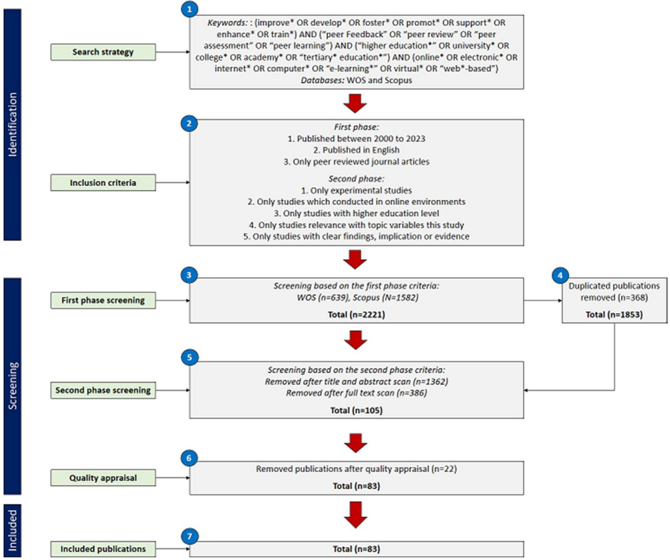
- From 2,221 identified records, 105 studies underwent quality appraisal and 83 were included. Coding produced 36 codes for student characteristics, 39 for learning environment conditions, 107 for learning processes/activities, and 165 for learning outcomes (104 cognitive, 16 behavioral, 45 affective).
- Gender was a consistently significant demographic factor: female students tended to produce higher-quality feedback and more cautious negative comments, while male students produced higher-quality argumentative essays based on peer feedback (Noroozi et al., 2020, 2022; Slee & Jacobs, 2017; Lane et al., 2018).
- Design features influenced outcomes: voluntary peer feedback led to more accurate peer rater scores than compulsory feedback; anonymity enhanced essay writing, high-quality cognitive feedback, and constructive feedback; more rounds improved writing performance and peer score validity; worked examples and scripting improved argumentative essay quality and domain-specific knowledge.
- Application was the most studied cognitive outcome (50 studies), engagement the main behavioral outcome (7 studies), and perception and attitude the main affective outcomes (12 and 14 studies, respectively).
Methods
- PRISMA-guided systematic review; Web of Science and Scopus searched; inclusion required peer-reviewed English empirical intervention studies from 2000–2023, in higher education, and in online learning environments; K-12, blended/hybrid/face-to-face, non-experimental, and conceptual works were excluded.
- Screening: 2,221 records identified; 368 duplicates removed; 491 full-text screened; 386 dropped; 105 quality-appraised; 22 failed minimum quality criteria; 83 included.
- A coding scheme based on Biggs’ (2003) four dimensions was applied in ATLAS.ti 9; inter-rater reliability was κ=0.84, p<0.001, with 84% agreement; analysis was deductive thematic coding.
Limitations
- Stated by the authors: only empirical studies were included, excluding reviews and conceptual papers; databases may have missed unindexed studies; publication bias may affect generalizability; only higher education was examined, not K-12; only English-language studies were included; and only articles from 2000–2023 were included.
- Evident from the text: included studies were geographically concentrated (30 from Taiwan, 36%; 11 from the Netherlands, 13%; 9 from the United States, 11%; 6 from China, 7%; 4 from Iran, 8%; 3 from Spain, 4%), which may limit generalizability.
- Evident from the text: the review is a qualitative synthesis without meta-analytic effect sizes; the authors themselves suggest a future meta-analysis to examine effect size.
Model-written summary. Check it against the paper before relying on it.
Integrity signals
Registry
Cites
Statistics
Figures
Verification
Claims the paper makes
29 Valid · 5 Not valid · 113 Not checked · 56 Own results and interpretations
At least one cited source doesn’t support this claim or points to a different paper, and none confirmed it — see the verdicts below.
In the paper
“Female students tended to produce higher-quality feedback (Noroozi etal., 2020, 2022; Slee & Jacobs, 2017) while providing negative comments with more caution (Lane etal., 2018).”
What the sources say
- Not matchedcites Noroozi etal., 2020, 2022
A range of references, not one source.
- Disputedcites Slee & Jacobs, 2017 matched to “Trialling the use of Google Apps together with online marking to enhance collaborative learning and provide effective feedback” (2017) sourceExperimental — accuracy not yet measured
The 'Overall analysis of the three stages' reports higher marks for female students in stages 1 and 3, but explicitly says there was no significant gender difference in stage 2 peer-assessment marks. Stage 2 is the paper’s assessment of students’ peer feedback, so the reported gender result does not support the attributed tendency toward higher-quality feedback from female students. No page number is available in our copy. (LLM, conf=0.79)
Checked by a reasoning model — may be wrong.
hedgedstates an association- Asserted: passes — The authors put it forward as true.
- Checkable: passes — It can be checked against evidence.
- Load-bearing: unclear — It is unclear whether the paper’s conclusions depend on it.
- Based: passes — The paper gives a reason why it holds.
- Not matched
The cited sources support only part of this claim — read each source’s verdict below.
In the paper
“Although the literature confirms the impacts of online learning environments on peer feedback performance (e.g., Lin, 2016, 2018a; Noroozi & Mulder, 2017), it does not say how different elements of learning environments can influence the design of peer feedback and its implementation.”
What the sources say
- Not matchedcites Lin, 2016, 2018a
A range of references, not one source.
- Partly supportedcites Noroozi & Mulder, 2017 matched to “Design and evaluation of a digital module with guided peer feedback for student learning biotechnology and molecular life sciences, attitudinal change, and satisfaction” (2017) sourceExperimental — accuracy not yet measured
The Conclusions (page unavailable) say that peer-feedback support in this digital module seemed to help students provide constructive and critical feedback. That supports an effect on feedback practice, but the paper's hedged finding about one guided module does not confirm an impact of online learning environments generally on peer-feedback performance. (LLM, conf=0.82)
boostedstates a cause- Asserted: passes — The authors put it forward as true.
- Checkable: passes — It can be checked against evidence.
- Load-bearing: unclear — It is unclear whether the paper’s conclusions depend on it.
- Based: passes — The paper gives a reason why it holds.
- Not matched
The cited sources that could be checked couldn’t confirm or dispute this claim.
In the paper
“Some of these challenges regard students' attitudes and perceptions of peers and their feedback, such as the level of trust and low tolerance for critical feedback and resistance (Hu & Lam, 2010; Panadero & Alonso-Tapia, 2013).”
What the sources say
- Not checked — no full text of the sourcecites Hu & Lam, 2010 matched to “Issues of cultural appropriateness and pedagogical efficacy: exploring peer review in a second language writing class” (2010) source
- Could not verifycites Panadero & Alonso-Tapia, 2013 matched to “Autoevaluación: Connotaciones Teóricas y Prácticas. Cuándo Ocurre, Cómo se Adquiere y qué Hacer para Potenciarla en nuestro Alumnado” (2017) sourceExperimental — accuracy not yet measured
The section “Condiciones que fomentan la autoevaluación” (page unavailable) discusses students’ motivation to assess their own work and instructional support for doing so, not challenges in receiving peer feedback. Searches for trust in peers, tolerance of criticism, and resistance found no passage in our copy addressing those claims. (LLM, conf=0.76)
plain- Asserted: passes — The authors put it forward as true.
- Checkable: passes — It can be checked against evidence.
- Load-bearing: unclear — It is unclear whether the paper’s conclusions depend on it.
- Based: passes — The paper gives a reason why it holds.
The cited sources support only part of this claim — read each source’s verdict below.
In the paper
“There were no significant differences in the mean grades of students allocated at different educational levels (Slee & Jacobs, 2017).”
What the sources say
- Partly supportedcites Slee & Jacobs, 2017 matched to “Trialling the use of Google Apps together with online marking to enhance collaborative learning and provide effective feedback” (2017) sourceExperimental — accuracy not yet measured
The ‘Overall analysis of the three stages’ section (page unavailable) reports no significant difference in mean marks between allocated groups or degree schemes. It does not compare educational levels: the Methods section (page unavailable) says the students were all taking a Level 4 module. (LLM, conf=0.88)
plain- Asserted: passes — The authors put it forward as true.
- Checkable: passes — It can be checked against evidence.
- Load-bearing: unclear — It is unclear whether the paper’s conclusions depend on it.
- Based: passes — The paper gives a reason why it holds.
- Partly supported
Every source the paper cites for this claim was checked and supports it.
In the paper
“Peer feedback training has also been found to have positive effects on writing improvement (Jiang & Yu, 2014) and text revisions (Yang & Meng, 2013), although no significant increases were observed in student assessment knowledge when participating in peer assessment training (Hoffman, 2019).”
What the sources say
- Supportedcites Yang & Meng, 2013 matched to “The Effects of Online Feedback Training on Students’ Text Revision” (2013) source
The Discussion and Conclusion states that online training in providing peer feedback had positive effects on EFL college students’ text revisions. It adds that the gains were greater for less-proficient students; the citing sentence does not claim otherwise. (LLM, conf=0.94)
plainstates a cause- Asserted: passes — The authors put it forward as true.
- Checkable: passes — It can be checked against evidence.
- Load-bearing: unclear — It is unclear whether the paper’s conclusions depend on it.
- Based: passes — The paper gives a reason why it holds.
- Supported
111 more claims · 18 with their cited sources checked
Create a free account to see all 203 claims and to verify the 17 references still open.
- Probably not a substantial claim. 47
- It may state two separate claims as one. 52
- The quote only partly states this claim. 2
Self-check
Percentages, sums and reported differences re-computed from the paper’s own numbers.
Rated minor: it would not touch a result — a value no result rests on, a p-value that stays on the same side of the significance level, or a conflict that is clerical, resolved elsewhere in the paper, or outside its own findings.
In the paper
“4 publications from Iran (8%)”
Reported 8 · recomputed 4.819277
Rated minor: it would not touch a result — a value no result rests on, a p-value that stays on the same side of the significance level, or a conflict that is clerical, resolved elsewhere in the paper, or outside its own findings.
In the paper
“| | Group awareness tools | 1 | 1% | Su et al., 2022 |”
Reported 1 · recomputed 6.25
Citations
Cites
Preferred Reporting Items for Systematic Reviews and Meta-Analyses: The PRISMA Statement
Moher, D., Liberati, A., Tetzlaff, J., Altman, D. G., & The PRISMA Group (2009) · PLoS Medicine · doi:10.1371/journal.pmed.1000097 · Cited by 64,042
Preferred Reporting Items for Systematic Reviews and Meta-Analyses: The PRISMA Statement
Moher, D., Liberati, A., Tetzlaff, J., & Altman, D. G. (2009) · Journal of Clinical Epidemiology · doi:10.1016/j.jclinepi.2009.06.005 · Cited by 19,575
Hattie, J., & Timperley, H. (2007) · Review of Educational Research · doi:10.3102/003465430298487 · Cited by 12,905
(2001) · Cited by 2,945
Contemporary Issues in Technology and Teacher Education
(2025) · Contemporary issues in technology and teacher education · doi:10.70725/833004pqfpbd · Cited by 2,368
Peer Assessment between Students in Colleges and Universities
Topping, K. (1998) · Review of Educational Research · doi:10.2307/1170598 · Cited by 2,173
A SWOT analysis of ChatGPT: Implications for educational practice and research
Farrokhnia, M., Banihashem, S. K., Noroozi, O., & Wals, A. (2024) · Innovations in Education and Teaching International · doi:10.1080/14703297.2023.2195846 · Cited by 1,384
Self-citationBurston, J. (2013) · IALLT Journal of Language Learning Technologies · doi:10.17161/iallt.v43i2.8528 · Cited by 893
Winstone, N. E., Nash, R. A., Parker, M., & Rowntree, J. (2017) · Educational Psychologist · doi:10.1080/00461520.2016.1207538 · Cited by 884
To give is better than to receive: The benefits of peer review to the reviewer's own writing
Lundstrom, K., & Baker, W. (2009) · Journal of Second Language Writing · doi:10.1016/j.jslw.2008.06.002 · Cited by 843
The nature of feedback: How different types of peer feedback affect writing performance
Nelson, M. M., & Schunn, C. D. (2009) · Instructional Science · doi:10.1007/s11251-008-9053-x · Cited by 602
Effective peer assessment processes: Research findings and future directions
van Zundert, M., Sluijsmans, D., & van Merriënboer, J. (2010) · Learning and Instruction · doi:10.1016/j.learninstruc.2009.08.004 · Cited by 536
Scaffolded writing and rewriting in the discipline: A web-based reciprocal peer review system
Cho, K., & Schunn, C. D. (2007) · Computers & Education · doi:10.1016/j.compedu.2005.02.004 · Cited by 521
The effects of trained peer review on EFL students’ revision types and writing quality
Min, H.-T. (2006) · Journal of Second Language Writing · doi:10.1016/j.jslw.2006.01.003 · Cited by 482
A review of feedback models and typologies: Towards an integrative model of feedback elements
Panadero, E., & Lipnevich, A. A. (2022) · Educational Research Review · doi:10.1016/j.edurev.2021.100416 · Cited by 389
Cho, K., Schunn, C. D., & Wilson, R. W. (2006) · Journal of Educational Psychology · doi:10.1037/0022-0663.98.4.891 · Cited by 355
Does peer assessment promote student learning? A meta-analysis
Li, H., Xiong, Y., Hunter, C. V., Guo, X., & Tywoniw, R. (2020) · Assessment & Evaluation in Higher Education · doi:10.1080/02602938.2019.1620679 · Cited by 348
The role of feedback and self-efficacy on web-based learning: The social cognitive perspective
Wang, S.-L., & Wu, P.-Y. (2008) · Computers & Education · doi:10.1016/j.compedu.2008.03.004 · Cited by 320
Huisman, B., Saab, N., van Driel, J., & van den Broek, P. (2018) · Assessment & Evaluation in Higher Education · doi:10.1080/02602938.2018.1424318 · Cited by 318
Noroozi, O., Weinberger, A., Biemans, H. J. A., Mulder, M., & Chizari, M. (2012) · Educational Research Review · doi:10.1016/j.edurev.2011.11.006 · Cited by 310
Self-citationBanihashem, S. K., Noroozi, O., van Ginkel, S., Macfadyen, L. P., & Biemans, H. J. A. (2022) · Educational Research Review · doi:10.1016/j.edurev.2022.100489 · Cited by 246
Self-citationXiao, Y., & Lucking, R. (2008) · The Internet and Higher Education · doi:10.1016/j.iheduc.2008.06.005 · Cited by 243
Dialogue within peer feedback processes: clarification and negotiation of meaning
Zhu, Q., & Carless, D. (2018) · Higher Education Research & Development · doi:10.1080/07294360.2018.1446417 · Cited by 214
Panadero, E., & Alonso-Tapia, J. (2017) · Electronic Journal of Research in Education Psychology · doi:10.14204/ejrep.30.12200 · Cited by 202
Effects of high level prompts and peer assessment on online learners’ reflection levels
Chen, N.-S., Wei, C.-W., Wu, K.-T., & Uden, L. (2009) · Computers & Education · doi:10.1016/j.compedu.2008.08.007 · Cited by 199
Web-based peer review: the learner as both adapter and reviewer
Liu, E. Z.-F., Lin, S. S. J., Chiu, C.-H., & Yuan, S.-M. (2001) · IEEE Transactions on Education · doi:10.1109/13.940995 · Cited by 196
Hu, G., & Lam, S. T. E. (2010) · Instructional Science · doi:10.1007/s11251-008-9086-1 · Cited by 182
Relations between scripted online peer feedback processes and quality of written argumentative essay
Noroozi, O., Biemans, H., & Mulder, M. (2016) · The Internet and Higher Education · doi:10.1016/j.iheduc.2016.05.002 · Cited by 176
Self-citationPeer Assessment : Learning by Judging and Discussing the Work of Other Learners
J. Topping, K. (2017) · Interdisciplinary Education and Psychology · doi:10.31532/interdiscipeducpsychol.1.1.007 · Cited by 172
Hsia, L.-H., Huang, I., & Hwang, G.-J. (2016) · Computers & Education · doi:10.1016/j.compedu.2016.02.004 · Cited by 170
Patchan, M. M., Schunn, C. D., & Correnti, R. J. (2016) · Journal of Educational Psychology · doi:10.1037/edu0000103 · Cited by 165
Latifi, S., Noroozi, O., & Talaee, E. (2021) · British Journal of Educational Technology · doi:10.1111/bjet.13054 · Cited by 163
Self-citationMoradian, A., Kalli, A., Sweredoski, M. J., & Hess, S. (2014) · PROTEOMICS · doi:10.1002/pmic.201300256 · Cited by 161
Developing science activities through a networked peer assessment system
Tsai, C.-C., Lin, S. S. J., & Yuan, S.-M. (2002) · Computers & Education · doi:10.1016/s0360-1315(01)00069-0 · Cited by 154
What is Bottom-Up and What is Top-Down in Predictive Coding?
Rauss, K., & Pourtois, G. (2013) · Frontiers in Psychology · doi:10.3389/fpsyg.2013.00276 · Cited by 147
A collaborative learning approach to dialogic peer feedback: a theoretical framework
Er, E., Dimitriadis, Y., & Gašević, D. (2021) · Assessment & Evaluation in Higher Education · doi:10.1080/02602938.2020.1786497 · Cited by 133
Self-citationGielen, M., & De Wever, B. (2015) · Computers in Human Behavior · doi:10.1016/j.chb.2015.06.019 · Cited by 122
Promoting metacognitive skills through peer scaffolding in a CSCL environment
Pifarré, M., & Cobos, R. (2010) · International Journal of Computer-Supported Collaborative Learning · doi:10.1007/s11412-010-9084-6 · Cited by 120
Assessing collaboration in a wiki: The reliability of university students' peer assessment
Wever, B. D., Keer, H. V., Schellens, T., & Valcke, M. (2011) · The Internet and Higher Education · doi:10.1016/j.iheduc.2011.07.003 · Cited by 120
Tseng, S.-C., & Tsai, C.-C. (2010) · The Internet and Higher Education · doi:10.1016/j.iheduc.2010.01.001 · Cited by 118
Online peer feedback patterns of success and failure in argumentative essay writing
Kerman, N. T., Noroozi, O., Banihashem, S. K., Karami, M., & Biemans, H. J. A. (2024) · Interactive Learning Environments · doi:10.1080/10494820.2022.2093914 · Cited by 116
Self-citationPatchan, M. M., Schunn, C. D., & Clark, R. J. (2018) · Studies in Higher Education · doi:10.1080/03075079.2017.1320374 · Cited by 112
Lin, J. (2018) · Behaviour and Information Technology · doi:10.1080/0144929x.2018.1451558 · Cited by 112
Exploring online peer feedback and automated corrective feedback on EFL writing performance
Shang, H.-F. (2022) · Interactive Learning Environments · doi:10.1080/10494820.2019.1629601 · Cited by 112
Peer Feedback Improves Students’ Academic Self-Concept in Higher Education
Simonsmeier, B. A., Peiffer, H., Flaig, M., & Schneider, M. (2020) · Research in Higher Education · doi:10.1007/s11162-020-09591-y · Cited by 112
Lin, G.-Y. (2018) · Computers & Education · doi:10.1016/j.compedu.2017.08.010 · Cited by 111
Noroozi, O., Hatami, J., Bayat, A., van Ginkel, S., Biemans, H. J. A., & Mulder, M. (2020) · Interactive Learning Environments · doi:10.1080/10494820.2018.1543200 · Cited by 107
Self-citationLatifi, S., Noroozi, O., & Talaee, E. (2023) · Interactive Learning Environments · doi:10.1080/10494820.2020.1799032 · Cited by 107
Self-citationTsai, C.-C., & Liang, J.-C. (2009) · Instructional Science · doi:10.1007/s11251-007-9047-0 · Cited by 105
Bhagat, R. S. (2002) · Academy of Management Review · doi:10.5465/amr.2002.7389951 · Cited by 105
Noroozi, O., Banihashem, S. K., Taghizadeh Kerman, N., Parvaneh Akhteh Khaneh, M., Babaee, M., Ashrafi, H., & Biemans, H. J. A. (2023) · Interactive Learning Environments · doi:10.1080/10494820.2022.2034887 · Cited by 105
Self-citationThe effects of online peer feedback and epistemic beliefs on students’ argumentation-based learning
Noroozi, O., & Hatami, J. (2019) · Innovations in Education and Teaching International · doi:10.1080/14703297.2018.1431143 · Cited by 96
Self-citationThe impact of second language proficiency in dyadic peer feedback
Allen, D., & Mills, A. (2016) · Language Teaching Research · doi:10.1177/1362168814561902 · Cited by 88
Lin, C.-J. (2019) · Journal of Computers in Education · doi:10.1007/s40692-019-00144-6 · Cited by 86
Noroozi, O., Banihashem, S. K., Biemans, H. J. A., Smits, M., Vervoort, M. T. W., & Verbaan, C.-L. (2023) · Education and Information Technologies · doi:10.1007/s10639-023-11683-y · Cited by 83
Self-citationBanihashem, S. K., Farrokhnia, M., Badali, M., & Noroozi, O. (2022) · Innovations in Education and Teaching International · doi:10.1080/14703297.2021.1890634 · Cited by 82
Self-citationYu, F., & Liu, Y. (2009) · British Journal of Educational Technology · doi:10.1111/j.1467-8535.2008.00905.x · Cited by 81
Zheng, L., Cui, P., Li, X., & Huang, R. (2018) · Assessment & Evaluation in Higher Education · doi:10.1080/02602938.2017.1370533 · Cited by 79
Evaluating peer learning and assessment in online collaborative learning environments
Altınay, Z. (2017) · Behaviour & Information Technology · doi:10.1080/0144929x.2016.1232752 · Cited by 78
Wu, Y., & Schunn, C. D. (2023) · Contemporary Educational Psychology · doi:10.1016/j.cedpsych.2023.102160 · Cited by 78
Pereira, J., Echeazarra, L., Sanz-Santamaría, S., & Gutiérrez, J. (2013) · Computers in Human Behavior · doi:10.1016/j.chb.2013.06.011 · Cited by 73
Training nursing students' communication skills with online video peer assessment
Lai, C.-Y. (2016) · Computers & Education · doi:10.1016/j.compedu.2016.02.017 · Cited by 72
Noroozi, O., & Mulder, M. (2017) · Biochemistry and Molecular Biology Education · doi:10.1002/bmb.20981 · Cited by 71
Self-citationCheng, K.-H., & Hou, H.-T. (2015) · Technology, Pedagogy and Education · doi:10.1080/1475939x.2013.822416 · Cited by 69
The effects of autonomy support on student engagement in peer assessment
Yuan, J., & Kim, C. (2017) · Educational Technology Research and Development · doi:10.1007/s11423-017-9538-x · Cited by 69
Pham, T. N., Lin, M., Trinh, V. Q., & Bui, L. T. P. (2020) · SAGE Open · doi:10.1177/2158244020914554 · Cited by 68
Effects of student engagement in peer feedback on writing performance in higher education
Jin, X., Jiang, Q., Xiong, W., Feng, Y., & Zhao, W. (2024) · Interactive Learning Environments · doi:10.1080/10494820.2022.2081209 · Cited by 67
Liu, X., Li, L., & Zhang, Z. (2018) · Assessment & Evaluation in Higher Education · doi:10.1080/02602938.2017.1324018 · Cited by 66
Cui, Y., Schunn, C. D., & Gai, X. (2022) · Higher Education Research & Development · doi:10.1080/07294360.2021.1969541 · Cited by 63
Learning through science writing via online peer assessment in a college biology course
Liang, J.-C., & Tsai, C.-C. (2010) · The Internet and Higher Education · doi:10.1016/j.iheduc.2010.04.004 · Cited by 60
Teacher modeling on EFL reviewers’ audience-aware feedback and affectivity in L2 peer review
Chang, C. Y.-H. (2015) · Assessing Writing · doi:10.1016/j.asw.2015.04.001 · Cited by 60
Noroozi, O., Biemans, H. J. A., Busstra, M. C., Mulder, M., & Chizari, M. (2011) · Computers in Human Behavior · doi:10.1016/j.chb.2010.08.009 · Cited by 59
Self-citationValero Haro, A., Noroozi, O., Biemans, H. J. A., & Mulder, M. (2019) · Journal of Biological Education · doi:10.1080/00219266.2018.1472132 · Cited by 59
Self-citationZhan, Y. (2021) · Assessment & Evaluation in Higher Education · doi:10.1080/02602938.2020.1804826 · Cited by 59
Digital peer assessment in school teacher education and development: a systematic review
Topping, K. J. (2023) · Research Papers in Education · doi:10.1080/02671522.2021.1961301 · Cited by 54
Cheng, K.-H., Hou, H.-T., & Wu, S.-Y. (2014) · Interactive Learning Environments · doi:10.1080/10494820.2011.649766 · Cited by 52
Bellhäuser, H., Liborius, P., & Schmitz, B. (2022) · Frontiers in Psychology · doi:10.3389/fpsyg.2022.813381 · Cited by 52
Lin, H., Hong, Z., Wang, H., & Lee, S.-T. (2011) · Educational Technology & Society · Cited by 48
Valero Haro, A., Noroozi, O., Biemans, H. J. A., Mulder, M., & Banihashem, S. K. (2024) · Interactive Learning Environments · doi:10.1080/10494820.2023.2215822 · Cited by 48
Self-citationImpacts of Providing Online Teacher and Peer Feedback on Students’ Writing Performance
Wihastyanang, W. D., Kusumaningrum, S. R., Latief, M. A., & Cahyono, B. Y. (2020) · Turkish Online Journal of Distance Education · doi:10.17718/tojde.728157 · Cited by 47
Using Online Peer Feedback through Blogs to Promote Speaking Performance
Yeh, H., Tseng, S.-S., & Chen, Y. (2019) · Tamkang University Institutional Repository (TKUIR) · Cited by 46
Chen, I.-C., Hwang, G.-J., Lai, C.-L., & Wang, W.-C. (2020) · Computers & Education · doi:10.1016/j.compedu.2020.103856 · Cited by 46
Incidence of group awareness information on students' collaborative learning processes
Pifarré, M., Cobos, R., & Argelagós, E. (2014) · Journal of Computer Assisted Learning · doi:10.1111/jcal.12043 · Cited by 44
The Effects of Online Feedback Training on Students’ Text Revision
Yang, Y.-F., & Meng, W.-T. (2013) · Language Learning & Technology · doi:10.64152/10125/44331 · Cited by 44
Demiraslan Çevik, Y. (2015) · Computers in Human Behavior · doi:10.1016/j.chb.2015.05.056 · Cited by 42
The effects of class size and instructional technology on student learning performance
Shi, M. (2019) · The International Journal of Management Education · doi:10.1016/j.ijme.2019.01.004 · Cited by 42
Ge, Z.-G. (2022) · Computer Assisted Language Learning · doi:10.1080/09588221.2019.1677721 · Cited by 42
Gorham, T., Majumdar, R., & Ogata, H. (2023) · Journal of Computers in Education · doi:10.1007/s40692-023-00264-0 · Cited by 42
Kimber, K., Pillay, H., & Richards, C. (2007) · Computers & Education · doi:10.1016/j.compedu.2005.01.004 · Cited by 41
Zhang, H., Liao, A. W. X., Goh, S. H. L., Yoong, S. Q., Lim, A. X. M., & Wang, W. (2021) · Nurse Education Today · doi:10.1016/j.nedt.2021.105203 · Cited by 41
Brill, J. M. (2016) · Educational Technology Research and Development · doi:10.1007/s11423-015-9421-6 · Cited by 40
Supporting the development of collaboration and feedback skills in instructional designers
Lowell, V. L., & Ashby, I. V. (2018) · Journal of Computing in Higher Education · doi:10.1007/s12528-018-9170-8 · Cited by 40
Online peer feedback on video presentations: type of feedback and improvement of presentation skills
N. Z. Day, I., Saab, N., & Admiraal, W. (2022) · Assessment & Evaluation in Higher Education · doi:10.1080/02602938.2021.1904826 · Cited by 38
Anonymous Peer Assessment of Medication Management Reviews
Basheti, I. A., Ryan, G., Woulfe, J., & Bartimote-Aufflick, K. (2010) · American Journal of Pharmaceutical Education · doi:10.5688/aj740577 · Cited by 37
Fostering Revision of Argumentative Writing through Structured Peer Assessment
Tsai, Y.-C., & Chuang, M.-T. (2013) · Perceptual and Motor Skills · doi:10.2466/10.23.pms.116.1.210-221 · Cited by 36
Effects of a mobile-based peer-assessment approach on enhancing language-learners’ oral proficiency
Chang, C., & Lin, H.-C. K. (2020) · Innovations in Education and Teaching International · doi:10.1080/14703297.2019.1612264 · Cited by 35
Liu, J., Guo, X., Gao, R., Fram, P., Ling, Y., Zhang, H., & Jin, W. (2018) · Assessment & Evaluation in Higher Education · doi:10.1080/02602938.2018.1542659 · Cited by 34
Effects of peer learning on nursing students' learning outcomes in electrocardiogram education
Ko, Y., Issenberg, S. B., & Roh, Y. S. (2021) · Nurse Education Today · doi:10.1016/j.nedt.2021.105182 · Cited by 34
Lin, G.-Y. (2016) · EURASIA Journal of Mathematics, Science and Technology Education · doi:10.12973/eurasia.2016.1280a · Cited by 32
Lane, J. N., Ankenman, B. E., & Iravani, S. M. R. (2018) · Service Science · doi:10.1287/serv.2018.0224 · Cited by 30
The intersection of epistemic beliefs and gender in argumentation performance
Banihashem, S. K., Noroozi, O., Biemans, H. J. A., & Tassone, V. C. (2024) · Innovations in Education and Teaching International · doi:10.1080/14703297.2023.2198995 · Cited by 29
Self-citationBayat, M., Banihashem, S. K., & Noroozi, O. (2022) · The Journal of Educational Research · doi:10.1080/00220671.2022.2155602 · Cited by 28
Self-citationStudent satisfaction with use of an online peer feedback system
Donia, M. B. L., Mach, M., O’Neill, T. A., & Brutus, S. (2022) · Assessment & Evaluation in Higher Education · doi:10.1080/02602938.2021.1912286 · Cited by 27
Su, Y., Ren, J., & Xiaohui, S. (2022) · Interactive Learning Environments · doi:10.1080/10494820.2022.2131833 · Cited by 27
A Peer-Assessment Mobile Kung Fu Education Approach to Improving Students' Affective Performances
Kuo, F.-C., Chen, J.-M., Chu, H.-C., Yang, K.-H., & Chen, Y.-H. (2017) · International Journal of Distance Education Technologies · doi:10.4018/ijdet.2017010101 · Cited by 21
The Effects of Online Peer Feedback on Students’ Writing Skills during Corona Virus Pandemic
Tran, O., & Ho, P. V. P. (2022) · International Journal of Instruction · doi:10.29333/iji.2023.16149a · Cited by 20
Enhancing Argumentative Writing Via Online Peer Feedback-Based Essay: A Quasi-Experiment Study
Mulyati, Y., & Daris Hadianto, D. (2023) · International Journal of Instruction · doi:10.29333/iji.2023.16212a · Cited by 20
Wang, J., Gao, R., Guo, X., & Liu, J. (2020) · Assessment & Evaluation in Higher Education · doi:10.1080/02602938.2019.1693493 · Cited by 19
The Effect of Blogging on Vocabulary Enhancement and Structural Accuracy in an EFL Context
Rahmany, R., Sadeghi, B., & Faramarzi, S. (2013) · Theory and Practice in Language Studies · doi:10.4304/tpls.3.7.1288-1298 · Cited by 17
The influence of peer assessment training on assessment knowledge and reflective writing skill
Hoffman, B. (2019) · Journal of Applied Research in Higher Education · doi:10.1108/jarhe-01-2019-0004 · Cited by 16
(2018) · International journal of engineering education · Cited by 16
Supporting postgraduates in research proposals through peer feedback in a Malaysian university
Al Qunayeer, H. S. (2020) · Journal of Further and Higher Education · doi:10.1080/0309877x.2019.1627299 · Cited by 16
Perceptions and practice of peer assessments: an empirical investigation
Agrawal, A., & Rajapakse, D. C. (2018) · International Journal of Educational Management · doi:10.1108/ijem-05-2016-0085 · Cited by 16
Leading learning: enhancing the learning experience of university students through anxiety auditing
Maringe, F. (2010) · Education, Knowledge and Economy · doi:10.1080/17496891003696470 · Cited by 12
Havard, B., Podsiad, M., & Valaitis, K. L. (2023) · TechTrends · doi:10.1007/s11528-022-00832-8 · Cited by 12
Chang, S.-H., Yu, L.-C., Kuo, Y.-K., Mai, Y.-T., & Chen, J.-D. (2015) · Journal of Baltic Science Education · doi:10.33225/jbse/15.14.379 · Cited by 11
Jiang, J., & Yu, Y. (2014) · International Journal of Information and Communication Technology Education · doi:10.4018/ijicte.2014070103 · Cited by 11
Promoting equitable achievement in STEM: lab report writing and online peer review
Culver, K. C., Bowman, N. A., Youngerman, E., Jang, N., & Just, C. L. (2020) · The Journal of Experimental Education · doi:10.1080/00220973.2020.1799315 · Cited by 9
Optimal scaffolding method for resume writing in the supplementary online writing course
Zakharova, A., Evers, K., & Chen, S. (2022) · Interactive Learning Environments · doi:10.1080/10494820.2022.2043382 · Cited by 9
Alternative Web-Based Assessment and Academic Self-Efficacy of Pre-Service Student Teachers
Ismaeel, D. A. (2020) · International Journal of Web-Based Learning and Teaching Technologies · doi:10.4018/ijwltt.20201001.oa1 · Cited by 8
Comparing Web 2.0 applications for peer feedback in language teaching
Canham, N. (2018) · Writing & Pedagogy · doi:10.1558/wap.32352 · Cited by 7
Chen, H.-L., & Liu, C. (2023) · TechTrends · doi:10.1007/s11528-023-00856-8 · Cited by 7
Sadegh, T. (2022) · International Journal of Online Pedagogy and Course Design · doi:10.4018/ijopcd.293209 · Cited by 6
Taghizadeh Kerman, N., Banihashem, S. K., Noroozi, O., & Biemans, H. J. A. (2022) · 8th International Conference on Higher Education Advances (HEAd'22) · doi:10.4995/head22.2022.14445 · Cited by 6
Self-citationLai, C.-Y., Chen, L.-J., Yen, Y.-C., & Lin, K.-Y. (2019) · Australasian Journal of Educational Technology · doi:10.14742/ajet.4341 · Cited by 5
Recreating Discourse Community for Appropriating HOCs in Law Undergraduates’ Academic Writing
Luhach, S. (2020) · IAFOR Journal of Education · doi:10.22492/ije.8.4.09 · Cited by 3
Slee, N. J. D., & Jacobs, M. H. (2017) · F1000Research · doi:10.12688/f1000research.6520.2 · Cited by 3
Sevast'yanov, V. D., Maslov, G. N., & Permyakov, Y. V. (1997) · Measurement Techniques · doi:10.1007/bf02504501 · Cited by 1
Student Satisfaction with Use of a Peer Feedback System
Donia, M. B. L., Mach, M., Ronen, S., Brutus, S., & O’Neill, T. (2020) · Academy of Management Proceedings · doi:10.5465/ambpp.2020.20759abstract · Cited by 1
تاثیر آموزش استدلال ورزی در محیط بازخورد همتای آنلاین بر روی فرایند و پیامدهای یادگیری
نوروزی, ا., حاتمی, ج., لطیفی, س., et al. (2019) · DOAJ (DOAJ: Directory of Open Access Journals) · doi:10.22055/edus.2019.28694.2763
Research works printed but not linked: 9
- Al Abri, A., Al Baimani, S., & Al Bahlani, S. (2021). The role of web-based peer feedback in advancing EFL essay writing. Computer-Assisted Language Learning Electronic Journal (CALL-EJ) , 22(1), 374-390. 10.29140/call-ej.v22i1.420 · doi:10.29140/call-ej.v22i1.420
- Biggs, J. B. (2003). Teaching for quality learning at university: What the student does (2nd ed.). Buckingham: Open University Press
- Golonka, L. D., & Lance, T. S. (2020). Cultural Factors in Online Learning . In L. D. Golonka & T. S. Lance (Eds.), Online learning across a random family (1st ed., pp. 69-80) . Routledge.
- Li, N., Zhao, Y., Huang, X., & Tan, X. (2019b). The impact of personality traits on peer feedback in online learning environment. International Journal of Emerging Technologies in Learning, 14 (19), 77-91. https:// doi. org/ 10. 3991/ ijet. v14i19. 10605 · doi:10.3991/ijet.v14i19.10605
- Li, N., Huang, X., Zhao, Y., & Tan, X. (2021). Understanding college students' perceptions and use of peer feedback in online learning environments: The roles of prior knowledge and educational level. Educational Technology Research and Development, 69 (1), 251-272. https:// doi. org/ 10. 1007/ s11423- 020- 09959-8 · doi:10.1007/s11423-020-09959-8
- Liu, E. Z. F., & Lee, C. Y. (2013). Using peer feedback to improve learning via online peer assessment. Turkish Online Journal of Educational Technology, 12 (1), 187-199.
- Noroozi, O., Hatami, J., Latifi, S., & Fardanesh, H. (2019). The effects of argumentation training in online peer feedback environment on process and outcomes of learning. Journal of Educational Scinces, 26(2), 71–88. 10.22055/EDUS.2019.28694.2763 · DOI
- Ritzhaupt, A. D., & Kumar, P. (2015). The impact of peer feedback on communication skills in online discussions. Journal of Educational Computing Research, 53 (1), 31-50. https:// doi. org/ 10. 1177/ 07356 33115 592429 · doi:10.1177/0735633115592429
- Theelen, T., van der Slikke, R. M. A., de Mul, M., & van der Steen, J. (2019). Quality appraisal of systematic reviews on end-of-life care: A systematic review. Palliative medicine, 33 (2), 179-188. https:// doi. org/ 10. 1177/ 02692 16318 820464 <!-- image --> · doi:10.1177/0269216318820464
Cited by
Feedback sources in essay writing: peer-generated or AI-generated feedback?
Banihashem, S. K., Kerman, N. T., Noroozi, O., Moon, J., & Drachsler, H. (2024) · International Journal of Educational Technology in Higher Education · doi:10.1186/s41239-024-00455-4 · Cited by 282
“In response to this challenge, various solutions have emerged, among which peer feed-back has arisen as a promising alternative instructional approach (Er et al., 2021; Gao et al., 2024; Noroozi et al., 2023; Kerman et al., 2024).”
BackgroundSelf-citationGuo, K., Pan, M., Li, Y., & Lai, C. (2024) · The Internet and Higher Education · doi:10.1016/j.iheduc.2024.100962 · Cited by 173
XGBoost To Enhance Learner Performance Prediction
Hakkal, S., & Lahcen, A. A. (2024) · Computers and Education Artificial Intelligence · doi:10.1016/j.caeai.2024.100254 · Cited by 227
Does perception mean learning? Insights from an online peer feedback setting
Noroozi, O., Alqassab, M., Taghizadeh Kerman, N., Banihashem, S. K., & Panadero, E. (2025) · Assessment & Evaluation in Higher Education · doi:10.1080/02602938.2024.2345669 · Cited by 72
“Additionally, gender is increasingly recognized as a crucial factor in online learning environments, including peer feedback (Taghizadeh Kerman et al. 2023a).”
InfluentialSelf-citationA systematic review of the key components of online peer feedback practices in higher education
Gao, X., Noroozi, O., Gulikers, J., Biemans, H. J. A., & Banihashem, S. K. (2024) · Educational Research Review · doi:10.1016/j.edurev.2023.100588 · Cited by 61
Self-citation
Metadata
- Authors
- Kerman, N. T., Banihashem, S. K., Karami, M., Er, E., van Ginkel, S., & Noroozi, O.
- Affiliations
- Ferdowsi University of Mashhad (IR)
- Open University of the Netherlands (NL)
- Middle East Technical University (TR)
- Wageningen University & Research (NL)
- Corresponding author
- Noroozi, Omid
- Venue
- Education and Information Technologies
- Published
- 2023-11-14
- Volume
- 29
- Issue
- 1
- Pages
- 763-813
- ISSN
- 1360-2357 (ISSN-L)
- 1573-7608
- OpenAlex
- W4388669995
- Cited by
- 109
- References
- 124
- Citations by year
- 2026: 37 · 2025: 52 · 2024: 19 · 2023: 1
- FWCI
- 80.78
- Type
- journal article
- Language
- en
- Open access
- hybrid
- doi.org
- Licence
- cc-by
- creativecommons.org/licenses/by/4.0 (tdm)
- creativecommons.org/licenses/by/4.0 (vor)
- Locations
- Education and Information Technologies (publishedVersion, cc-by)
- OpenMETU (Middle East Technical University) (submittedVersion, cc-by-nc-nd)
- Socio-Environmental Systems Modeling (submittedVersion, cc-by)
- DSpace (Open University in the Netherlands) (submittedVersion, cc-by)
- Topics
- Social Sciences › Education › Student Assessment and Feedback
- Social Sciences › Education › Online and Blended Learning
- Social Sciences › Psychology › Developmental and Educational Psychology › Innovative Teaching and Learning Methods
- Keywords
- online peer feedback, higher education, implementation factors, student characteristics, virtual learning environments, learning outcomes, self-efficacy, student motivation, student engagement, teamwork, learning platforms, teaching methods
About these checks
Registry, retraction, Cites and statistics results are computed, not judged, with one exception: a printed reference that no index lists is read once by a model before it counts as a citation error. Claims are extracted by a model and kept only when their quote appears verbatim in the text; each cited source is then checked, with a model’s help, for whether it says what the claim relies on. Those verdicts can be wrong — read the claim’s quote and the cited source before relying on one.
The claim verdicts this report counts are experimental: their accuracy is not yet measured.
A language model drew the claims from the paper on 2026-09-30, under version 3 of the claim definition (model deepseek-v4.1-flash, prompt extract-v3).
A second model labelled each claim on 2026-09-30 (model jev-1.13-20260917, definition revision gold-guideline-v0.2).
Cited sources are checked with a language model’s help (gpt-6-sol).
Statistics and arithmetic are recomputed, not judged.
Confidence bands are shown only for fields calibrated on our annotated test set. None is calibrated yet, so no band is shown.
What counts as a claim ›How we measure confidence ›How we check this ›
Are you an author, or do you see a problem with this page? Request a review
Data sources
Bibliographic data: Semantic Scholar, OpenAlex, Crossref.
Contains information from the Semantic Scholar Academic Graph Datasets, made available under the ODC Attribution License (ODC-BY 1.0).
Semantic Scholar’s data is described in: Kinney, R., et al. (2023). The Semantic Scholar Open Data Platform. arXiv:2301.10140.
