

The Gamification of Learning: a Meta-analysis
Open accessThe DOI matches its Crossref record; 82 of the 85 references it cites were found in a registry or an index; 10 of the 79 sources its claims cite were checked for support.
Abstract
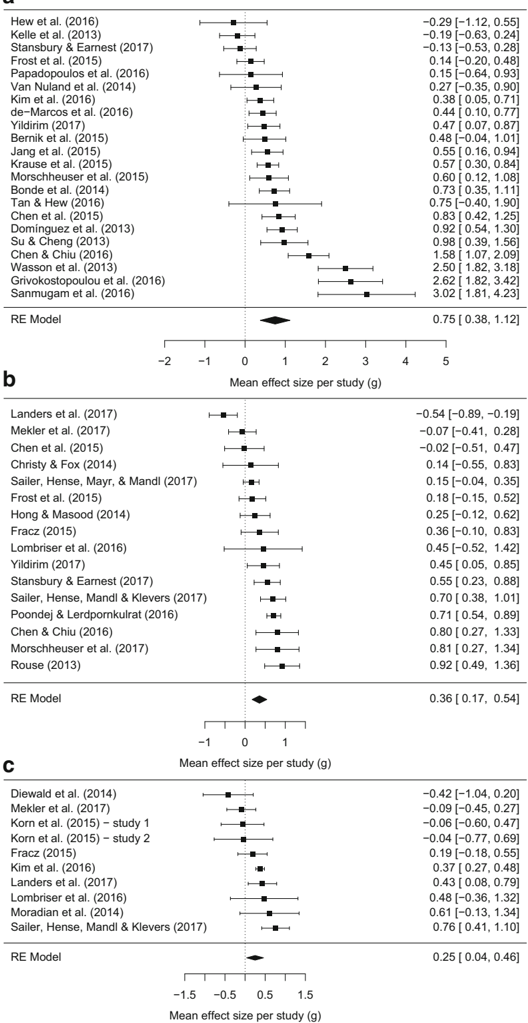
This meta-analysis was conducted to systematically synthesize research findings on effects of gamification on cognitive, motivational, and behavioral learning outcomes. Results from random effects models showed significant small effects of gamification on cognitive ( g = .49, 95% CI [0.30, 0.69], k = 19, N = 1686), motivational ( g = .36, 95% CI [0.18, 0.54], k = 16, N = 2246), and behavioral learning outcomes ( g = .25, 95% CI [0.04, 0.46], k = 9, N = 951). Whereas the effect of gamification on cognitive learning outcomes was stable in a subsplit analysis of studies employing high methodological rigor, effects on motivational and behavioral outcomes were less stable. Given the heterogeneity of effect sizes, moderator analyses were conducted to examine inclusion of game fiction , social interaction , learning arrangement of the comparison group , as well as situational, contextual, and methodological moderators, namely, period of time , research context , randomization , design , and instruments . Inclusion of game fiction and social interaction were significant moderators of the effect of gamification on behavioral learning outcomes. Inclusion of game fiction and combining competition with collaboration were particularly effective within gamification for fostering behavioral learning outcomes. Results of the subsplit analysis indicated that effects of competition augmented with collaboration might also be valid for motivational learning outcomes. The results suggest that gamification as it is currently operationalized in empirical studies is an effective method for instruction, even though factors contributing to successful gamification are still somewhat unresolved, especially for cognitive learning outcomes.
Overview
CoChat Summary
TL;DR
This meta-analysis synthesizes 38 publications/40 experiments on gamification in learning and finds significant small positive effects on cognitive, motivational, and behavioral learning outcomes. Effects on cognitive outcomes were stable in high-rigor subsplits, whereas motivational and behavioral effects were less stable and depended partly on social interaction and game fiction.
Key findings
- Random effects models showed significant small effects of gamification on cognitive learning outcomes (g = .49, 95% CI [0.30, 0.69], k = 19, N = 1686), motivational outcomes (g = .36, 95% CI [0.18, 0.54], k = 16, N = 2246), and behavioral outcomes (g = .25, 95% CI [0.04, 0.46], k = 9, N = 951).
- In subsplits including only high-methodological-rigor studies, the cognitive effect remained significant (g = .42, 95% CI [0.14, 0.68], k = 9, N = 686), but motivational (g = .22, 95% CI [-0.11, 0.56], k = 7, N = 1063) and behavioral effects (g = .27, 95% CI [-0.16, 0.70], k = 5, N = 667) were not significant.
- Inclusion of game fiction significantly moderated behavioral learning outcomes (Q(1) = 5.45, p < .05), and social interaction significantly moderated behavioral outcomes (Q(2) = 12.80, p < .01), with competitive-collaborative gamification outperforming no social interaction.
- In the high-rigor subsplit for motivational outcomes, social interaction was significant (Q(2) = 7.20, p < .05), with competitive-collaborative gamification outperforming mere competition.
Methods
- Meta-analysis of quantitative between-subject primary studies comparing at least one gamification condition with another instructional approach; final sample comprised 38 publications reporting 40 experiments, with separate samples for cognitive (19 studies, N = 1686), motivational (16 studies, N = 2246), and behavioral outcomes (9 studies/10 experiments, N = 951).
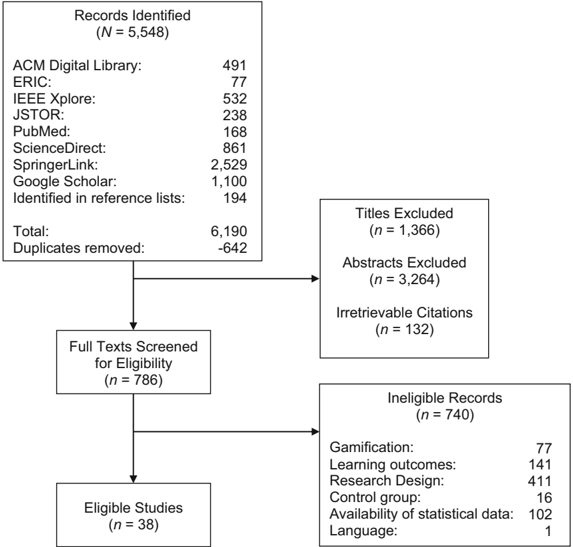
- Literature search conducted March 3, 2017, in ACM Digital Library, ERIC, IEEE Xplore, JSTOR, PubMed, ScienceDirect, SpringerLink, Google Scholar, and reference lists; inclusion required English publication, at least one learning outcome, and sufficient statistical data.
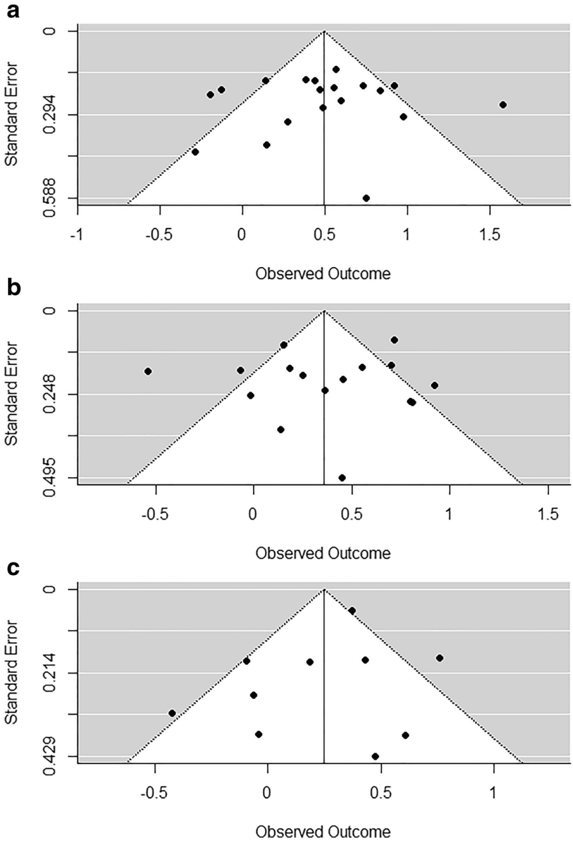
- Effect sizes used Hedges’ g under random effects models, with moderator analyses via mixed effects meta-regressions, publication-bias checks (funnel plots, selection model, fail-safe N), and subsplit analyses restricted to experimental or quasi-experimental pre–post studies.
Limitations
- The paper states that sample sizes were small, especially for behavioral outcomes and all subsplit analyses, limiting generalizability and statistical power; nonsignificant results may reflect low power rather than absence of effects.
- The paper notes that meta-analysis combines heterogeneous studies, that the moderator set was not exhaustive, and that primary studies often lacked methodological rigor, with quasi-experimental studies showing larger motivational and behavioral effects than experimental studies.
- Evident from the text: behavioral learning outcomes were almost exclusively measured during interventions, potentially confounding gamification effects with assessment; many moderator subgroups were too small to analyze, and only one study reported a delayed posttest.
Model-written summary. Check it against the paper before relying on it.
Integrity signals
Registry
Cites
Statistics
Figures
Verification
Claims the paper makes
10 Valid · 1 Not valid · 51 Not checked · 278 Own results and interpretations
The cited sources support only part of this claim — read each source’s verdict below.
In the paper
“The large numbers of inconclusive studies in these reviews point toward a general problem: Gamification research lacks methodological rigor.”
§ The Gamification of Learning: a Meta-analysis > Effects of Gamification on Learning
What the sources say
- Not matchedcites Dicheva and Dichev 2015
An author–year citation the paper’s reference list doesn’t settle. We don’t search these by name.
- Supportedcites Dichev and Dicheva 2017 matched to “Gamifying education: what is known, what is believed and what remains uncertain: a critical review” (2017) source
In “How conclusive are the reported results?” (pp. 18, 21), the review identifies methodological inadequacies in educational gamification studies and says too little empirical work investigates the topic rigorously. Its call to strengthen the methodical base supports the citing sentence’s characterization. (LLM, conf=0.90)
plain- Asserted: passes — The authors put it forward as true.
- Checkable: passes — It can be checked against evidence.
- Load-bearing: passes — The paper’s conclusions depend on it.
- Based: passes — The paper gives a reason why it holds.
- Not matched
The cited sources support only part of this claim — read each source’s verdict below.
In the paper
“Even though considerable research efforts have been made in this field (Hamari et al. 2014;Seaborn and Fels 2015), conclusive meta-analytic evidence on the effectiveness of gamification in the context of learning and education has yet to be provided.”
§ The Gamification of Learning: a Meta-analysis > Abstract
What the sources say
- Partly supportedcites Hamari et al. 2014 matched to “Does Gamification Work? -- A Literature Review of Empirical Studies on Gamification” (2014) sourceExperimental — accuracy not yet measured
Section 5.3 says the review could not conduct a formal meta-analysis because the studies varied greatly in outcomes and methods. The paper includes education and learning studies, but it does not establish that no conclusive meta-analytic evidence had been provided elsewhere specifically for that context. (LLM, conf=0.82)
- Not checked — no full text of the sourcecites Seaborn and Fels 2015 matched to “Gamification in theory and action: a survey” (2015) source
plain- Asserted: passes — The authors put it forward as true.
- Checkable: passes — It can be checked against evidence.
- Load-bearing: passes — The paper’s conclusions depend on it.
- Based: passes — The paper gives a reason why it holds.
- Partly supported
The sources with a verdict support this claim; the rest weren’t checked yet, have no full text we could read, or their verdicts aren’t rated yet.
In the paper
“Furthermore, the studies by de-Marcos et al. (2014) and Su and Cheng (2014) plus the first of two studies reported by Hew et al. (2016) were excluded from the analysis because they reported the same experiments as previously published or more extensive studies included in this sample.”
§ The Gamification of Learning: a Meta-analysis > Final Sample
What the sources say
- Supportedcites de-Marcos et al. (2014) matched to “An empirical study comparing gamification and social networking on e-learning” (2014) source
The Abstract identifies this paper as an experimental comparison of gamification and social networking in an undergraduate course, confirming that it is the study the citing authors name. Exclusion from the analysis, and the reason for it, are the citing authors’ own assessment rather than findings attributed to this source. (LLM, conf=0.88)
- Not checked — no full text of the sourcecites Su and Cheng (2014) matched to “A mobile gamification learning system for improving the learning motivation and achievements” (2015) source
- Not checked — no full text of the sourcecites Hew et al. (2016) matched to “Engaging Asian students through game mechanics: Findings from two experiment studies” (2016) source
plain- Asserted: passes — The authors put it forward as true.
- Checkable: passes — It can be checked against evidence.
- Load-bearing: passes — The paper’s conclusions depend on it.
- Based: passes — The paper gives a reason why it holds.
- Supported
The cited sources support only part of this claim — read each source’s verdict below.
In the paper
“In addition, the results of the summary effect analyses were similar to results from meta-analyses conducted in the context of games (see Clark et al. 2016;Wouters et al. 2013), indicating that the power of games can be transferred to non-game contexts by using game design elements.”
§ The Gamification of Learning: a Meta-analysis > Discussion
What the sources say
- Partly supportedcites Clark et al. 2016 matched to “Digital Games, Design, and Learning: A Systematic Review and Meta-Analysis” (2016) sourceExperimental — accuracy not yet measured
The Results, under “Sophistication of Mechanics,” report improved learning outcomes for schoollike tasks with points or badges added, and the Discussion says simple gamification can improve certain types of learning outcomes. This supports transferring some benefits of game design to academic tasks, but not the broader claim about the power of games in non-game contexts generally. (LLM, conf=0.82)
- Not checked yetcites Wouters et al. 2013 matched to “A meta-analysis of the cognitive and motivational effects of serious games.” (2013) source
Checked before — its earlier verdict is held back until a new check runs.
hedgedstates a cause- Asserted: passes — The authors put it forward as true.
- Checkable: passes — It can be checked against evidence.
- Load-bearing: passes — The paper’s conclusions depend on it.
- Based: passes — The paper gives a reason why it holds.
- Partly supported
The sources with a verdict support this claim; the rest weren’t checked yet, have no full text we could read, or their verdicts aren’t rated yet.
In the paper
“The results of this meta-analysis can weaken the fear that effects of gamification might not persist in the long run and might thus contradict the interpretations presented in reviews (see Hamari et al. 2014;Seaborn and Fels 2015).”
§ The Gamification of Learning: a Meta-analysis > Moderators of the Effectiveness of Learning with Gamification
What the sources say
- Supportedcites Hamari et al. 2014 matched to “Does Gamification Work? -- A Literature Review of Empirical Studies on Gamification” (2014) source
Section 4.3 reports that some studies found gamification effects may not be long-term and could reflect a novelty effect. Section 5.1 likewise notes that short experiment timeframes may have skewed results. These passages support attributing the concern about persistence to this review; the citing authors’ claim about their own meta-analysis is not attributed to Hamari et al. (LLM, conf=0.92)
- Not checked — no full text of the sourcecites Seaborn and Fels 2015 matched to “Gamification in theory and action: a survey” (2015) source
hedgedstates a possible cause- Asserted: passes — The authors put it forward as true.
- Checkable: passes — It can be checked against evidence.
- Load-bearing: passes — The paper’s conclusions depend on it.
- Based: passes — The paper gives a reason why it holds.
- Supported
224 more claims · 1 with their cited sources checked
Create a free account to see all 340 claims and to verify the 14 references still open.
- It may state two separate claims as one. 59
- Probably not a substantial claim. 52
- The quote only partly states this claim. 11
Claims other papers make about this one
Each is checked against this paper’s own text: does it say what the citing paper says it does?
The source backs part of the claim, not all of it — or backs it for a different population, condition or comparison.
In the citing paper
“In mathematics, incorporating game elements into the curriculum can create more dynamic and interactive experiences, motivating students to participate more actively (Sailer & Homner, 2020;Subhash & Cudney, 2018).”
From Gamification on Mathematics Engagement and Motivation in Secondary School and Higher Education: A Systematic Review and Meta-Analysis (2026) · cites this paper as Sailer & Homner, 2020
Experimental — accuracy not yet measuredThe source backs part of the claim, not all of it — or backs it for a different population, condition or comparison.
In the citing paper
“Studies and reviews report that gamification, and the use of serious games, can raise student motivation and can improve learning outcomes in various levels of and disciplines within higher education (45–50).”
From Global Health Trade Summit: an AI-enhanced simulation of international trade and global health for undergraduate public health education (2025) · cites this paper as [45]
Experimental — accuracy not yet measuredThe cited source says what the claim attributes to it.
In the citing paper
“While some studies show positive outcomes (e.g., Sailer & Homner, 2020), others report declines in motivation due to competition, poor design, or reduced novelty (e.g., Hanus & Fox, 2015;Santhanam et al., 2016).”
From Gamification on Mathematics Engagement and Motivation in Secondary School and Higher Education: A Systematic Review and Meta-Analysis (2026) · cites this paper as Sailer & Homner, 2020
The cited source says what the claim attributes to it.
In the citing paper
“The meta-analysis of eleven studies revealed a small-to-moderate positive effect on motivation (g = 0.383), consistent with previous meta-analyses in general education contexts (Li et al., 2024;Sailer & Homner, 2020).”
From Gamification on Mathematics Engagement and Motivation in Secondary School and Higher Education: A Systematic Review and Meta-Analysis (2026) · cites this paper as Sailer & Homner, 2020
The cited source says what the claim attributes to it.
In the citing paper
“These find shows the overall significant, small positive effects of gamification on cognitive, motivational, and behavioral learning outcomes in a general learning environment [16].”
From Effects of Gamification on Behavioral Change in Education: A Meta-Analysis (2021) · cites this paper as [16]
10 more claims about this paper
Create a free account to see every claim other papers make about this one.
Statistics recomputed
Every reported test result, recomputed from its test statistic and degrees of freedom. A result shows as not adding up only once an independent check has confirmed it.
- Consistentχ²(1) = 0.45reported p = .5 · recomputed p = .502
“χ 2 (1) = .45,p = .50”
- Consistentχ²(1) = 1.04reported p = .31 · recomputed p = .308
“χ 2 (1) = 1.04, p = .31”
- Consistentχ²(1) = 0.44reported p = .5 · recomputed p = .507
“χ 2 (1) = .44,p = .50”
- ConsistentQ(18) = 57.97reported p < .01 · recomputed p < .001
“Q(18) = 57.97,p < .01”
- ConsistentQ(15) = 73.54reported p < .01 · recomputed p < .001
“Q(15) = 73.54,p < .01”
24 more recomputed tests
Create a free account to see every test the Stats check recomputed.
Self-check
Percentages, sums and reported differences re-computed from the paper’s own numbers.
Each contradiction between two passages listed here was confirmed by an independent check.
Rated major: it would touch a result — a value a result rests on, reported and recomputed p-values on opposite sides of the significance level, two passages that conflict with no sign which is right, or a cited work retracted before this paper was published.
In the paper
§ The Gamification of Learning: a Meta-analysis > Moderators of the Effectiveness of Learning with Gamification
“For both outcomes, effect sizes for quasi-experimental studies were significantly larger than for experimental studies.”
§ The Gamification of Learning: a Meta-analysis > Period of Time
“Randomization Results from the mixed effects analyses showed no significant difference between experimental and quasi-experimental studies regarding cognitive, Q(1) = 1.18, p = .28,or behavioral learning outcomes, Q(1) = 1.63, p = .20.”
Rated minor: it would not touch a result — a value no result rests on, a p-value that stays on the same side of the significance level, or a conflict that is clerical, resolved elsewhere in the paper, or outside its own findings.
In the paper
“| Mixed instruction | .49** [0.32, 0.46] | 10 941 13.45** 9 36.62 141* |”
§ The Gamification of Learning: a Meta-analysis > Conclusion
Reported 0.49 · recomputed 0.39
Rated minor: it would not touch a result — a value no result rests on, a p-value that stays on the same side of the significance level, or a conflict that is clerical, resolved elsewhere in the paper, or outside its own findings.
In the paper
§ The Gamification of Learning: a Meta-analysis > Period of Time
“There was no significant difference between interventions with different durations for cognitive, Q(2) = 0.17, p = .92,or behavioral learning outcomes, Q(1) = 0.28, p = .59.”
§ The Gamification of Learning: a Meta-analysis > Conclusion
“| 1 day or less | | .20 | [-0.07, 0.47] 8 | 800 20.27** 7 62.45 - | | | | | | 1 week or less a | | - | - | - | - | - | -- | - | | 1 month or less a | | - | - | - | - | - | -- | - | | Half a year of less a | | .37** [0.27, 0.48] | 1 | 140 - | -- | - | | | | More than half a year a | | - | - | - | - | - | -- | - |”
Citations
Cites
Intrinsic and Extrinsic Motivations: Classic Definitions and New Directions
Ryan, R. M., & Deci, E. L. (2000) · Contemporary Educational Psychology · doi:10.1006/ceps.1999.1020 · Cited by 18,666
Borenstein, M., Hedges, L. V., Higgins, J. P. T., & Rothstein, H. R. (2009) · doi:10.1002/9780470743386 · Cited by 14,225
Hattie, J., & Timperley, H. (2007) · Review of Educational Research · doi:10.3102/003465430298487 · Cited by 12,905
Borenstein, M., Hedges, L. V., Higgins, J. P. T., & Rothstein, H. R. (2021) · doi:10.1002/9781119558378 · Cited by 9,799
From game design elements to gamefulness: defining "gamification"
Deterding, S., Dixon, D., Khaled, R., & Nacke, L. (2011) · Proceedings of the 15th International Academic MindTrek Conference: Envisioning Future Media Environments · doi:10.1145/2181037.2181040 · Cited by 8,402
Does Active Learning Work? A Review of the Research
Prince, M. (2004) · Journal of Engineering Education · doi:10.1002/j.2168-9830.2004.tb00809.x · Cited by 7,334 · cited 1×
“The term collaboration in this meta-analysis subsumes both collaborative and cooperative learning arrangements (i.e., situations in which learners work together in groups to achieve a shared goal), while being assessed either as a group (collaborative) or individually (cooperative; Prince 2004).”
BackgroundDistribution Theory for Glass's Estimator of Effect Size and Related Estimators
Hedges, L. V. (1981) · Journal of Educational Statistics · doi:10.2307/1164588 · Cited by 5,695 · cited 1×
“To correct for possible bias caused by small samples, Cohen’s d was then used to calculate Hedges’ g (Hedges 1981).”
MethodDoes Gamification Work? -- A Literature Review of Empirical Studies on Gamification
Hamari, J., Koivisto, J., & Sarsa, H. (2014) · 2014 47th Hawaii International Conference on System Sciences · doi:10.1109/hicss.2014.377 · Cited by 5,201
-Handbook of Self-Determination Research by Edward L. Deci and Richard M. Ryan (Editors)
Paulson, D. S. (2002) · The Journal of mind and behavior · Cited by 5,169
Meta-Analytic Procedures for Social Research
Rosenthal, R. (1991) · doi:10.4135/9781412984997 · Cited by 4,635 · cited 1×
“The fail-safe number can be considered robust when it is greater than 5n + 10, with n standing for the number of primary studies (Rosenthal 1991).”
Background
Research works printed but not linked: 2
- Dicheva, D., & Dichev, C. (2015). Gamification in education: where are we in 2015? In C. Ho & G. Lin (Eds.), Proceedings of E-Learn: World Conference on E-Learning in Corporate, Government, Healthcare, and Higher Education (pp. 1445-1454). Waynesville: Association for the Advancement of Computing in Education.
- Rouse, K. E. (2013). Gamification in science education: the relationship of educational games to motivation and achievement (Doctoral dissertation). The University of Southern Mississippi, Hattiesburg, MS.
Cited by
Items 1,001–1,100 of 1,462
Dane, Z. R. (2024) · Digital Repository Service (Northeastern University) · doi:10.17760/d20649839 · Cited by 3
Examining the Role of Personality Traits in Leaderboard-Based Gamified LearningPreprint
Gao, F., Liu, J., Rogers, K. C., & Liu, R. (2024) · SSRN Electronic Journal · doi:10.2139/ssrn.4831537
Two decades of research synthesis on digital cultural education: A tertiary review_PostprintPreprint
Christ, A., Penthin, M., & Kröner, S. (2024) · doi:10.31219/osf.io/b92eg
Göritz, A. S., Bührle, R., & Wimmer, J. (2024) · Datenschutz und Datensicherheit - DuD · doi:10.1007/s11623-024-1924-z · Cited by 2
“Sie haben den Vorteil, dass zeitgleich mehr Menschen teilnehmen können, der zeitliche Ablauf an individuelle zeitliche Bedarfe an-gepasst werden kann (z.B. Schichtpläne), sie gut skalierbar sind und Möglichkeiten zur Gamifizierung bieten (Sailer & Homner, 2020).”
Learning Programming without Teachers: An Ongoing Ethnographic Study at 42
Pollini, N., Maggi, K., Verdecchia, R., & Vicario, E. (2024) · International Conference on Evaluation and Assessment in Software Engineering (EASE) · doi:10.1145/3661167.3661275
“Furthermore, the academic community made significant efforts towards identifying and investigating innovative teaching methodologies capable of keeping pace with scientific progress and student needs [15, 16].”
BackgroundNeena, P. C., & Sevukamoorthy, L. (2024) · Advances in human resources management and organizational development book series · doi:10.4018/979-8-3693-1858-4.ch006
Trask, S., Thornley, S., & Sundborn, G. (2024) · Health Education Research · doi:10.1093/her/cyae020
“(ii) Gamification: Gamified elements were incorporated to enhance student engagement and learning [34], e.g. competition, points, rewards, challenges, inclusion of choice and autonomy in learning, opportunity for collaboration and social interaction.”
BackgroundSammet, J., & Sammet, J. (2024) · Springer eBooks · doi:10.1007/978-3-662-68512-9_2
“Healthy Points” Gaming to Teach Social Determinants of Health
Campbell, S. (2024) · Nursing Education Perspectives · doi:10.1097/01.nep.0000000000001292 · Cited by 1
Grünkorn, J., & Verhovnik-Heinze, M. (2024) · Springer eBooks · doi:10.1007/978-3-658-44317-7_8
Break Out of Your Routine with Escape Rooms
Watkins, J. D., Gatza, A. M., & Harris, M. E. (2024) · Mathematics Teacher Learning and Teaching PK-12 · doi:10.5951/mtlt.2023.0346
Biomolecules Scavenger Hunt: Gamification and 3D Printing as a Biochemistry Learning Strategy
García-Amezquita, L. E., López, A. L. S., Tejada-Ortigoza, V. A., et al. (2024) · IEEE Global Engineering Education Conference (EDUCON) · doi:10.1109/educon60312.2024.10578621
“This methodology applications are extensive, but there are game design elements that can result in different possibilities for learners, types of social interactions, and learning styles [4] .”
BackgroundInfluentialBehavioral Analysis Using Gamification—A Comprehensive Analysis
Garg, G., Siddiqui, H. N., Jain, N., & Tyagi, S. (2024) · Lecture notes in networks and systems · doi:10.1007/978-981-97-1724-8_35
Frigolé, N., Gesa, F., & Suárez, M. D. M. (2024) · Lenguaje y Textos · doi:10.4995/lyt.2024.19468
Sarkity, D., & Pratama, Y. (2024) · Jurnal Ilmiah Profesi Pendidikan · doi:10.29303/jipp.v9i3.2334
“Not only developing 21st-century skills, an appropriate model will also improve students' cognitive competence (Sailer & Homner, 2020; Supena et al., 2021).”
BackgroundBoard 61: Work in Progress: Teaching Logic Design with Interactive Computer Games
Ketineni, A., Ketineni, H., Liu, K., & Perkowski, M. A. (2024) · ASEE Annual Conference & Exposition · doi:10.18260/1-2--47059
Gamification in CAD learning: A methodological approach for engineering curriculum
Alexander, C. H. C., Sivakumar, S., & Kumar, S. (2024) · AIP conference proceedings · doi:10.1063/5.0229644 · Cited by 2
Gamification: Spielerisch gegen die Klimakrise
Lenk-Ostendorf, B. (2024) · SDG - Forschung, Konzepte, Lösungsansätze zur Nachhaltigkeit · doi:10.1007/978-3-658-43586-8_24
Cosme‐Trindade, D. C., Muniz, Í. D. A. F., Campos, D. E. S., Meira, I. A., & Perez, L. E. D. C. (2024) · Revista da ABENO · doi:10.30979/revabeno.v24i1.1915
Gamified Exercise for the Appropriation of Concepts in Occupational Health and Safety
García, J. C. G., Cárdenas, P. A. L., Flórez, M. M. C., & Torres-Barreto, M. L. (2024) · Gamification and Augmented Reality. · doi:10.56294/gr2024.74
Developing a Group-Based Literacy Screening for German Pre-Readers: A Digital, Game-Based Approach
Holz, H., Beuttler, B., Löfflad, D., & Ninaus, M. (2024) · Proceedings of the ACM on Human-Computer Interaction · doi:10.1145/3676496
“To further increase motivation, engagement and fun [45, 84], additional game elements were implemented, amplifying the game-based approach of the screening.”
Siddiqui, N. N. (2024) · Advances in human resources management and organizational development book series · doi:10.4018/979-8-3693-6402-4.ch005
Γαρούφος, Α., & Γαβριηλίδου, Ζ. (2024) · Έρευνα στην Εκπαίδευση · doi:10.12681/hjre.37498
Primenenie sredstv STEAM-obucheniia v shkole
Конюшенко, С. М., Komissarova, M. O., & Khisametdinova, Z. N. (2024) · Publishing house Sreda eBooks · doi:10.31483/r-112991
Transforming Higher Education: The Power of Educational Breakouts
Romero, C. N. (2024) · European Public & Social Innovation Review · doi:10.31637/epsir-2024-961 · Cited by 2
“This aligns with multiple studies that report gamified learning environments enhance student motivation and engagement by incorporating game elements that make learning more interactive and enjoyable (Sailer & Homner, 2020; Dicheva et al., 2015; Whitton & Langan, 2019).”
BackgroundApplying a Gamification Technique for Learning Sustainable Finance
Gómez, N. E. G., Carles, P. G., de la Cruz, E. M., Cañete, A. R. M., Aguilar, I. P.-S., & Sánchez, R. S. (2024) · Springer eBooks · doi:10.1007/978-3-031-72549-4_24
MetaNODES: A Virtual Reality-Based Approach to Intelligent Neuro-Ophthalmology Education
Yang, T., Tam, V. W. L., Lam, E. Y. M., Kan, A. H. S., Aung, K. N., & Lee, A. (2024) · IEEE Digital Education and MOOCS Conference (DEMOcon) · doi:10.1109/democon63027.2024.10747920
Digital Education for Health Care Providers: An Advanced Cardiac Life Support Resource
Narayan, D., Rogers, S., Simone, A. D., Sinapi, A., Heney, M., Rix, M., Blommestyn-Perez, A., Jin, K., Sheth, S., Murray, M. P., et al. (2024) · Qapsule Queen s Undergraduate Health Sciences Journal · doi:10.24908/qap.v1i2.17345
Rodrigues, L., Aranha, R. V., da Costa, N. T., Ribeiro, L. D. A., Santos, H. F. S., & Júnior, C. X. P. (2024) · Anais do ... Simpósio Brasileiro de Informática na Educação/Anais do Simpósio Brasileiro de Informática na Educação · doi:10.5753/sbie.2024.244949
“Gamification provides a well-established impact on learning outcomes by increasing engagement, motivation, and retention through game-like elements such as points, badges, and leaderboards [Sailer and Homner 2020].”
Kager, K., Bolli, S., Bucher, J., et al. (2024) · International Journal for Lesson and Learning Studies · doi:10.1108/ijlls-02-2024-0043
La gamificación en el aprendizaje cooperativo en preescolares de 4-5 años
Quinteros, D. A. M., & Garzòn, G. A. V. (2024) · LATAM Revista Latinoamericana de Ciencias Sociales y Humanidades · doi:10.56712/latam.v5i6.3099 · Cited by 5
Gami|cation: Gamification Within (Higher) Education
Friedrich, L. C., Heinz, M., Müller, J., & Pippig, M. (2024) · Lecture notes in networks and systems · doi:10.1007/978-3-031-71530-3_25
On the Design of Gamified Learning Analytics for Immersive Virtual Reality Games
Papamitsiou, Z. K., Petersen, S. A., Psyllaki, C., Lamvik, G. M., & Torvatn, H. (2024) · Lecture notes in computer science · doi:10.1007/978-3-031-78269-5_11
Sotos-Martínez, V. J., Baena‐Morales, S., & Férriz-Valero, A. (2024) · Magister: Revista de Formación del Profesorado e Investigación Educativa · doi:10.17811/msg.36.1.2024.25-31 · Cited by 6
GAMIFICATION AS A EDUCATIONAL TECHNOLOGY FOR PROFESSIONAL TRAINING
Павлова, Н., Shrol, T., & Poliukhovych, N. (2024) · Мiждисциплiнарнi дослiдження складних систем · doi:10.31392/iscs.2024.24.146 · Cited by 6
Mazarakis, A., Bräuer, P., & Dorsch, I. (2025) · Scientometrics · doi:10.1007/s11192-024-05226-6 · Cited by 1
Carstensen, B., Asbury, K., Benckwitz, L., Hilz, A., & Guill, K. (2025) · SSRN Electronic Journal · doi:10.2139/ssrn.5092847 · Cited by 1
Enhancing engagement in nursing education: The impact of gamification on elearning modules
David, S., & Elizabeth, G. (2024) · i-manager’s Journal on Nursing · doi:10.26634/jnur.14.3.21229
Ebert, S., Harbers, C., Poxleitner, E., Schätz, R., Schnepper, T., & Waldner, K. (2024) · Springer eBooks · doi:10.1007/978-3-658-46481-3_16
Case Article—Optimizing Food Donation Delivery for the Nonprofit Company Logica&Co
Croella, A. L., & Gregori, M. (2025) · INFORMS Transactions on Education · doi:10.1287/ited.2023.0042ca · Cited by 1
The Use of Gamification in Time Management
Ticina, E., & Chebeň, J. (2025) · Studies in systems, decision and control · doi:10.1007/978-3-031-80935-4_28
Bhatia, R., Kour, J., & Attri, D. (2025) · IGI Global eBooks · doi:10.4018/979-8-3693-8593-7.ch014
Gamification in the Formation of Legal Knowledge in Students in the Legal Educational Discourse
ZHELTUKHINA, M. R., Slyshkin, G. G., Sergeeva, O. V., et al. (2025) · Studies in big data · doi:10.1007/978-3-031-78686-0_31
Let’s Play! Engaging College Students in Mini Play Sessions, Perspectives, and Reflections
Winter, M. K. (2025) · Teaching & Learning Inquiry The ISSOTL Journal · doi:10.20343/teachlearninqu.13.15
ZHYHALKO, S. Е. (2024) · Problems of engineer-pedagogical education · doi:10.26565/2074-8922-2024-83-20
Effectiveness of gamification strategies in teaching botany among higher secondary school students
Shanthami, P. M. (2025) · i-manager’s Journal on Educational Psychology · doi:10.26634/jet.21.4.21421
Level up no ensino de turismo: Desvendando conhecimentos com uso games QuizTour e Turismo em Forca
Silva, A. M. M. C., Costa, T. V. D. M., de Guimarães, J. C. F., & Borba, C. S. (2024) · Revista Inteligência Competitiva · doi:10.24883/eaglesustainable.v14i.468 · Cited by 1
Siradj, Y., Liew, T. W., Roedavan, R., Tan, S.-M., Pudjoatmodjo, B., & Khan, M. T. I. (2025) · International Conference on Educational and Information Technology · doi:10.1109/iceit64364.2025.10976189 · Cited by 1
“Digital Game-Based Learning (DGBL) frames educational content and instructional objectives within computer gaming elements such as rewards, progress tracking, leaderboards, and immersive storylines [1, 2].”
Havenga, M. (2023) · NWU self-directed learning series · doi:10.4102/aosis.2023.bk409.0f
Gamifying Electronic Trading Through a Minecraft Commodities Exchange
Arthô, P., & Arruda, L. F. M. (2025) · Anais do Computer on the Beach · doi:10.14210/cotb.v16.p344-351
“It is widely used in educational settings to gamify learning, enhancing student engagement through interactive and immersive play [11, 12].”
Mutiara, M., Safitri, E. R., & Raharjo, M. (2025) · Journal of Innovation and Research in Primary Education · doi:10.56916/jirpe.v4i2.1240
“Previous research has shown that digital game-based learning positively impacts student engagement and achievement (Hamari et al., 2019; Sailer & Homner, 2020).”
Hernández, Á. J. V., Racero-López, V., Ríos, A. A., & Hernández-Pérez, L. F. (2025) · PROSPECTIVA Revista de Trabajo Social e intervención social · doi:10.25100/prts.v0i40.14601
Fuentes-Plata, H., Bolaños-Chang, A. J., Bedolla, L. I. M., Rio-Murillo, X. I. D., Parra-Cárdenas, M., Barreras, V. C., Castro-Gamboa, S., & Guzmán-Brambila, C. (2025) · College Teaching · doi:10.1080/87567555.2025.2507618
Prihationo, K., & Sobandi, A. (2025) · Eduvest - Journal Of Universal Studies · doi:10.59188/eduvest.v5i6.50124
“…enhance learner motivation and engagement, making it a potential solution to the challenges faced by DTS (Allen et al., 2018; Chen et al., 2021; MacCann et al., 2020; Sailer & Homner, 2020 Recent studies have explored the role of gamification in improving learner engagement and knowledge retention.”
Bernardo, J. R. S., Frota, J., Pessoa, T., Pessoa, M., Gadelha, B., & Conte, T. U. (2025) · IEEE International Conference on Software Engineering Education and Training (CSEE&T) · doi:10.1109/cseet66350.2025.00035 · Cited by 1
“Elements like points, leaderboards, and badges are often used to create a more dynamic and interactive learning environment [19, 26, 28, 29].”
InfluentialPickal, A. J., Stadler, M. J., Bai, S., et al. (2025) · Proceedings. · doi:10.22318/icls2025.205454
Self-citationSevilla-Campoverde, G., Miranda, P., & Pacheco-Chérrez, J. (2025) · Institute for the Future of Education Conference (IFE) · doi:10.1109/ife63672.2025.11024671
“In the context of higher education, Sailer and Homner [19] demonstrated that gamification can transform the way students engage with and interact with class content, promoting greater engagement and satisfaction.”
Gamified Video Conferencing for Young Learners: System and Evaluation
Alam, A. (2025) · International Journal for Research in Applied Science and Engineering Technology · doi:10.22214/ijraset.2025.72530
Game—The Competitive Car Production Game: Teaching Theory of Constraints and Linear Programming
den Broeke, M. M. V., & Mlinar, T. (2025) · INFORMS Transactions on Education · doi:10.1287/ited.2024.0125 · Cited by 1
Ochsendorf, F. R., Sennekamp, M., & Kollewe, T. (2025) · Springer eBooks · doi:10.1007/978-3-662-70777-7_4
Vauderwange, O., Hämmerle, S., Gampe, S., Korn, O., & Curticapean, D. (2025) · Education and Training in Optics and Photonics · doi:10.1109/etop64842.2025.11030639
“Restrictions apply. balancing of these factors, along with continuous adaptation to the specific needs of learners and institutions, is essential [2], [14], [15], [18], [19].”
Primandhika, R. B., Hikmat, A., Safi’i, I., et al. (2025) · KEMBARA Journal of Scientific Language Literature and Teaching · doi:10.22219/kembara.v11i1.39378
Margheri, V., Frascari, A., Baiocchini, G., Scalambra, D., Tambaro, C., & Pecini, C. (2025) · Reading and Writing · doi:10.1007/s11145-025-10667-3 · Cited by 2
The Perceptions of Teachers in Using Game-Based Strategy in Teaching English
Sarias, C. A., Sajulan, E. M., & Pukunum, S. (2025) · doi:10.38124/ijisrt/25jun692 · Cited by 2
“Similarly, Sailer and Homner (2020) noted that visible rewards such as badges, awards, cumulative points, and competitive scoring serve as effective incentives, encouraging students to exhibit the desired behaviors within an academic setting.”
Chakraborty, M. (2025) · International Journal For Multidisciplinary Research · doi:10.36948/ijfmr.2025.v07i03.49215
Orozco, M. T. V., & Crosetti, B. D. B. (2025) · Journal of language and Education · doi:10.17323/jle.2025.24798 · Cited by 2
A Qualitative Exploration of EMG Visual Feedback for Spinal Cord Injury Rehabilitation
Aikens, J., Tabor, A., Englehart, K. B., & Scheme, E. (2025) · International Conference on Rehabilitation Robotics · doi:10.1109/icorr66766.2025.11063187
“This type of feedback could foster motivation during early rehabilitation and support motor learning [6], [26], [35].”
Téllez, E. S. M., & Mendoza, W. P. (2025) · DIALÉCTICA · doi:10.56219/dialctica.v2i25.4010
Gamification effects on learning outcomes: A meta-analysis
Putra, I. G. N. D., & Redhana, I. W. (2025) · AIP conference proceedings · doi:10.1063/5.0259398 · Cited by 5
Zainuddin, Z., Churiyah, M., Mohsin, N. B., Basuki, A., & Dharma, B. A. (2025) · Sustainable development goals series · doi:10.1007/978-981-96-4971-6_8
Guo, F., Wang, Z., & Sun, J. (2025) · International Conference on Computer Science and Technologies in Education (CSTE) · doi:10.1109/cste64638.2025.11092148
“Research in gamified learning has shown [9] that embedding assessments in contextualized tasks can help improve student engagement and assessment effectiveness.”
Piece by Piece: A Puzzle-Based Serious Game for Engaging Children with ADHD (Preprint)Preprint
Malekshahi, S., Doost, M. T. K., Rostami, R., & Soltanian-Zadeh, H. (2025) · doi:10.2196/preprints.81496
Rodrigues, L., Zambrano, A. F., Pankiewicz, M., Barany, A., & Baker, R. S. (2025) · Lecture notes in computer science · doi:10.1007/978-3-031-98465-5_13
孟, 媛. (2025) · Advances in Education · doi:10.12677/ae.2025.1581472
Chong, M. M., Ting, M., Subramanian, P., Ramachandiran, C. R., Lau, J. Y., & Yap, J. Y. (2025) · International Symposium on Educational Technology · doi:10.1109/iset65607.2025.00060
“A gamification framework in computing subject refers to the structured approach that integrates game design elements into the learning process to enhance student performance [5], [6], [7].”
Subphachaisirikul, N. (2025) · International STEM Education Conference (iSTEM-Ed) · doi:10.1109/istem-ed65612.2025.11129347
“In a 2019 meta-analysis of past gamification attempts [7], gamification was shown to have a significant, small positive correlation with cognitive learning outcomes, although the factors involved in a successful gamification were not yet able to be fully identified.”
Peña, K. G. S., Párraga, A. M. C., García, J. C. B., Montalván, M. S. M., Vélez, D. N. O., & Montaleza, N. P. M. (2025) · Revista Científica Multidisciplinaria OGMA. · doi:10.69516/hpaxqv50
Integration of Contemporary Teaching and Digital Literacy Among Grade 12 ICT Students
Villanueva, P., & Cuenca, Z. M. (2025) · Psychology and Education A Multidisciplinary Journal · doi:10.70838/pemj.460202 · Cited by 1
Is More Gamification Better? Evaluating Playful Interactions and Narratives for Algebra Learning
Borchers, C., Nagashima, T., Liu, P., Alibali, M. W., & Aleven, V. A. W. M. M. (2025) · Lecture notes in computer science · doi:10.1007/978-3-032-03870-8_6 · Cited by 1
User Evaluation of the Digital Algebra Game (DAG) “Algebra Adventure: Learning Through Storytelling”
Ustuner, K. K., Law, E. L., Li, F. W. B., & Ozer, N. (2025) · Lecture notes in computer science · doi:10.1007/978-3-032-05005-2_9
Teaching System Concepts With Virtual Reality Games in Higher Education
Chuang, M.-J., Loh, P. Y., & Ting, Y.-L. (2025) · International Journal of Online Pedagogy and Course Design · doi:10.4018/ijopcd.388711
Guachichullca, D. E. P., & Granados, M. S. (2025) · Arandu-UTIC. · doi:10.69639/arandu.v12i3.1421
Zhi, O. Z., Rana, M. E., & Hameed, V. A. (2025) · International Conference on Advancements in Smart, Secure and Intelligent Computing (ASSIC) · doi:10.1109/assic64892.2025.11158191
“According to Siler and Hommer, gamification in sports has been proven to improve students’ motivation in learning tennis [13].”
The Impact of Using Gamified Auxiliary Learning Tools
Chen, Z., & Zhu, K. (2025) · SHS Web of Conferences · doi:10.1051/shsconf/202522201026
Online Perchance: Embracing the Evolving Educational Platform
Cornish, D. S. (2025) · Emerald Group Publishing Limited eBooks · doi:10.1108/978-1-83549-506-320251005
Orozco, F. M. V., & Acosta, I. D. P. (2025) · ASCE MAGAZINE · doi:10.70577/asce/2656.2672/2025
Boghian, I., Mareș, G., Cojocariu, V.-M., & Popescu, C.-V. (2025) · Inclusive learning and educational equity · doi:10.1007/978-3-031-98390-0_11 · Cited by 1
NapQuest: A Gamified Mobile App to Promote Power Napping Among University Students
Tan, J., Sykes, E. R., & Zhao, Z. (2025) · Annual Symposium on Computer-Human Interaction in Play · doi:10.1145/3744736.3749362
“However, research reveals mixed results: well-designed gamified systems sustain engagement [39], while poorly implemented gamification can decrease motivation through over-justification effects [18, 32].”
THE IMPACT OF GAMIFICATION ON VOCABULARY LEARNING THROUGH MOBILE APPLICATIONS AND ONLINE PLATFORMS
Bolatbek, S., Aliakbarovа, A. T., & Tankibayeva, M. K. (2025) · Журнал серии «Педагогические науки» · doi:10.48371/peds.2025.78.3.025
Effect of Reward Types on Motivation and Recall in a Geology Game
Darmansjah, A., & Türkay, S. (2025) · Proceedings of the ACM on Human-Computer Interaction · doi:10.1145/3748618 · Cited by 1
“…back to learning outcomes has not gone unnoticed, with many literature reviews and meta-analyses conducted over the past decade consistently flagging the issue, as well as the lack of a theoretical foundation that links game mechanics with learning principles [4, 12, 14, 17, 21, 22, 37, 39].”
Rizakhojayeva, G. (2025) · National Center for Higher Education Development · doi:10.59787/2413-5488-2025-51-3-131-142 · Cited by 2
Fostering playful learning: Accessibility in educational games for older adults
Forssell, M., Turunen, M., Hassan, L., & Aura, I. (2025) · Human Technology · doi:10.14254/1795-6889.2025.21-2.1
“Sailer and Homner (2019) highlight that while gamification can enhance motivation, it may also produce mixed results, particularly in terms of sustained engagement.”
InfluentialCard games are effective tools to enhance foundation year health and safety inductions
Rafiq, R., Matthews, H., Abedalreza, D., Yahya, F., & Jones, M. A. (2025) · FEBS Open Bio · doi:10.1002/2211-5463.70140 · Cited by 2
Moullou, D., & Carè, B. (2025) · ICGA Journal · doi:10.1177/13896911251384620
Grubješić, I., Ivanjko, T., & Juričić, V. (2025) · Lecture notes in networks and systems · doi:10.1007/978-3-032-07995-4_44
Serious Games for Preventing Musculoskeletal Disorders in Occupational Settings: Scoping Review
Rivière, T., Hulin, T., Sasangohar, F., & Zare, M. (2025) · JMIR Serious Games · doi:10.2196/66913
“In particular, extrinsic motivation mechanisms can sometimes overshadow intrinsic engagement, reducing overall effectiveness [31].”
A Gamified Learning Approach for a Better Educational Experience: A Case Study in the Middle East
Mattar, C., Oueida, S., Awad, P., Militaru, G., & Baalbaki, H. E. (2025) · International Journal of Game-Based Learning · doi:10.4018/ijgbl.391349 · Cited by 3
Disruption in Teaching and Learning Through Gamification
Rico-Bautista, D. W., Rojas, L. A. C., Medina-Cárdenas, Y., Areniz-Arévalo, Y., & Jose, S. (2025) · Lecture notes in networks and systems · doi:10.1007/978-3-031-97015-3_4 · Cited by 1
Metadata
- Authors
- Sailer, M., & Homner, L.
- Affiliations
- Ludwig-Maximilians-Universität München (DE)
- Corresponding author
- Sailer, Michael
- ORCID
- Sailer, Michael
- Venue
- Educational Psychology Review
- Published
- 2019-08-15
- Volume
- 32
- Issue
- 1
- Pages
- 77-112
- ISSN
- 1040-726X (ISSN-L)
- 1573-336X
- OpenAlex
- W2968628489
- Semantic Scholar
- be6769b967370c9852210e2fb7a34e499902f814
- Cited by
- 2,594
- References
- 85
- Citations by year
- 2026: 1073 · 2025: 560 · 2024: 338 · 2023: 292 · 2022: 171 · 2021: 105 · 2020: 50 · 2019: 2
- FWCI
- 14.08
- Type
- journal article
- Language
- en
- Open access
- hybrid
- doi.org
- Licence
- cc-by
- creativecommons.org/licenses/by/4.0 (tdm)
- creativecommons.org/licenses/by/4.0 (vor)
- Locations
- Educational Psychology Review (publishedVersion, cc-by)
- OPUS (Augsburg University) (submittedVersion, cc-by)
- Topics
- Social Sciences › Psychology › Developmental and Educational Psychology › Educational Games and Gamification
- Social Sciences › Sociology and Political Science › Digital Games and Media
- Social Sciences › Psychology › Developmental and Educational Psychology › Innovative Teaching and Learning Methods
- Keywords
- gamification, game-based learning, cognitive learning outcomes, social interaction, competition and collaboration, effect size heterogeneity, moderators of effect size
About these checks
Registry, retraction, Cites and statistics results are computed, not judged, with one exception: a printed reference that no index lists is read once by a model before it counts as a citation error. Claims are extracted by a model and kept only when their quote appears verbatim in the text; each cited source is then checked, with a model’s help, for whether it says what the claim relies on. Those verdicts can be wrong — read the claim’s quote and the cited source before relying on one.
The claim verdicts this report counts are experimental: their accuracy is not yet measured.
A language model drew the claims from the paper on 2026-10-07, under version 3 of the claim definition (model deepseek-v4.1-flash, prompt extract-v3).
A second model labelled each claim on 2026-10-07 (model jev-1.13-20260917, definition revision gold-guideline-v0.2).
Cited sources are checked with a language model’s help (gpt-6-sol).
Statistics and arithmetic are recomputed, not judged.
Confidence bands are shown only for fields calibrated on our annotated test set. None is calibrated yet, so no band is shown.
What counts as a claim ›How we measure confidence ›How we check this ›
Are you an author, or do you see a problem with this page? Request a review
Data sources
Bibliographic data: Semantic Scholar, OpenAlex, Crossref.
Contains information from the Semantic Scholar Academic Graph Datasets, made available under the ODC Attribution License (ODC-BY 1.0).
Semantic Scholar’s data is described in: Kinney, R., et al. (2023). The Semantic Scholar Open Data Platform. arXiv:2301.10140.
