

The Gamification of Learning: a Meta-analysis
Open accessThe DOI matches its Crossref record; 82 of the 85 references it cites were found in a registry or an index; 10 of the 79 sources its claims cite were checked for support.
Abstract
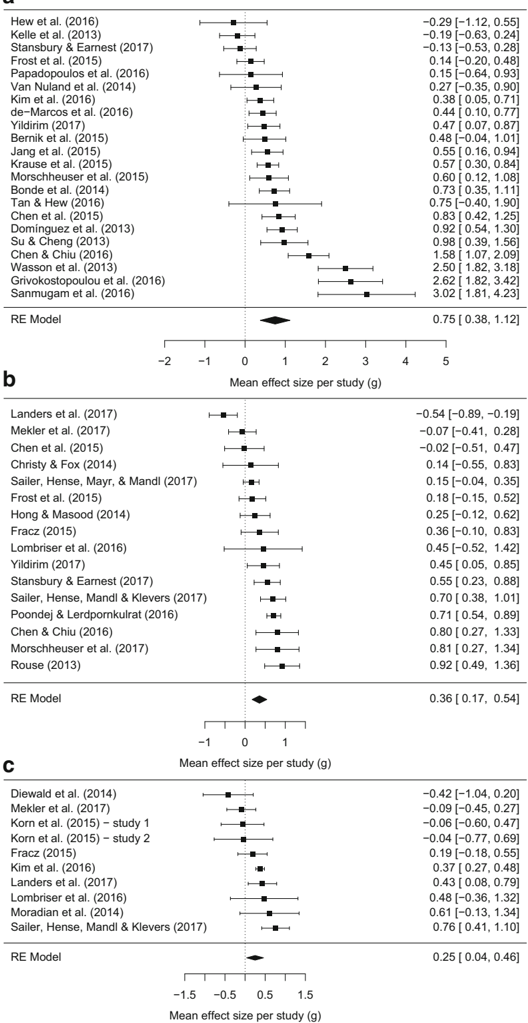
This meta-analysis was conducted to systematically synthesize research findings on effects of gamification on cognitive, motivational, and behavioral learning outcomes. Results from random effects models showed significant small effects of gamification on cognitive ( g = .49, 95% CI [0.30, 0.69], k = 19, N = 1686), motivational ( g = .36, 95% CI [0.18, 0.54], k = 16, N = 2246), and behavioral learning outcomes ( g = .25, 95% CI [0.04, 0.46], k = 9, N = 951). Whereas the effect of gamification on cognitive learning outcomes was stable in a subsplit analysis of studies employing high methodological rigor, effects on motivational and behavioral outcomes were less stable. Given the heterogeneity of effect sizes, moderator analyses were conducted to examine inclusion of game fiction , social interaction , learning arrangement of the comparison group , as well as situational, contextual, and methodological moderators, namely, period of time , research context , randomization , design , and instruments . Inclusion of game fiction and social interaction were significant moderators of the effect of gamification on behavioral learning outcomes. Inclusion of game fiction and combining competition with collaboration were particularly effective within gamification for fostering behavioral learning outcomes. Results of the subsplit analysis indicated that effects of competition augmented with collaboration might also be valid for motivational learning outcomes. The results suggest that gamification as it is currently operationalized in empirical studies is an effective method for instruction, even though factors contributing to successful gamification are still somewhat unresolved, especially for cognitive learning outcomes.
Overview
CoChat Summary
TL;DR
This meta-analysis synthesizes 38 publications/40 experiments on gamification in learning and finds significant small positive effects on cognitive, motivational, and behavioral learning outcomes. Effects on cognitive outcomes were stable in high-rigor subsplits, whereas motivational and behavioral effects were less stable and depended partly on social interaction and game fiction.
Key findings
- Random effects models showed significant small effects of gamification on cognitive learning outcomes (g = .49, 95% CI [0.30, 0.69], k = 19, N = 1686), motivational outcomes (g = .36, 95% CI [0.18, 0.54], k = 16, N = 2246), and behavioral outcomes (g = .25, 95% CI [0.04, 0.46], k = 9, N = 951).
- In subsplits including only high-methodological-rigor studies, the cognitive effect remained significant (g = .42, 95% CI [0.14, 0.68], k = 9, N = 686), but motivational (g = .22, 95% CI [-0.11, 0.56], k = 7, N = 1063) and behavioral effects (g = .27, 95% CI [-0.16, 0.70], k = 5, N = 667) were not significant.
- Inclusion of game fiction significantly moderated behavioral learning outcomes (Q(1) = 5.45, p < .05), and social interaction significantly moderated behavioral outcomes (Q(2) = 12.80, p < .01), with competitive-collaborative gamification outperforming no social interaction.
- In the high-rigor subsplit for motivational outcomes, social interaction was significant (Q(2) = 7.20, p < .05), with competitive-collaborative gamification outperforming mere competition.
Methods
- Meta-analysis of quantitative between-subject primary studies comparing at least one gamification condition with another instructional approach; final sample comprised 38 publications reporting 40 experiments, with separate samples for cognitive (19 studies, N = 1686), motivational (16 studies, N = 2246), and behavioral outcomes (9 studies/10 experiments, N = 951).
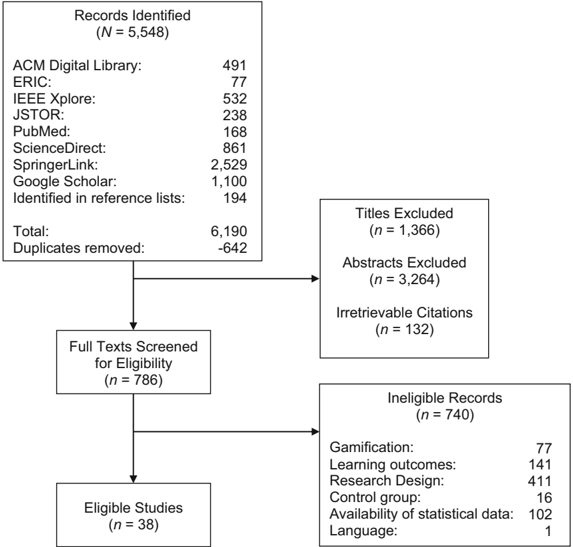
- Literature search conducted March 3, 2017, in ACM Digital Library, ERIC, IEEE Xplore, JSTOR, PubMed, ScienceDirect, SpringerLink, Google Scholar, and reference lists; inclusion required English publication, at least one learning outcome, and sufficient statistical data.
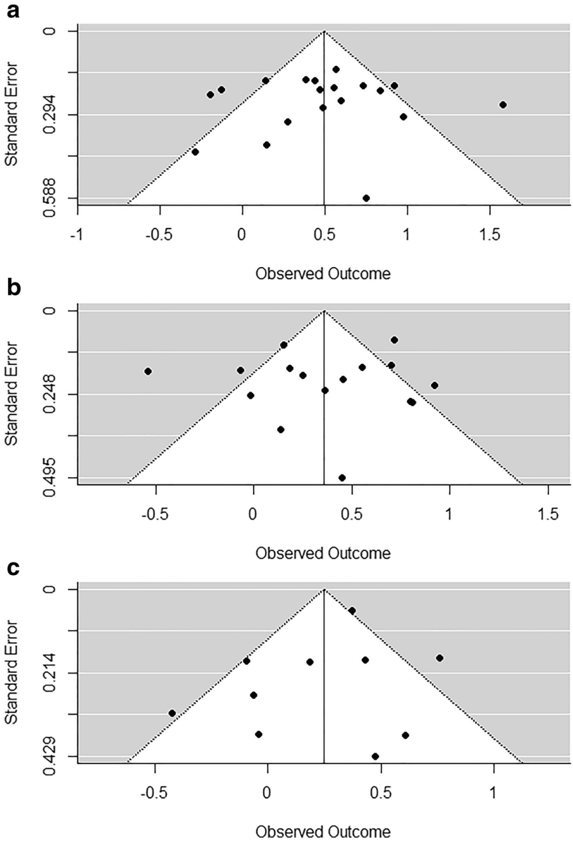
- Effect sizes used Hedges’ g under random effects models, with moderator analyses via mixed effects meta-regressions, publication-bias checks (funnel plots, selection model, fail-safe N), and subsplit analyses restricted to experimental or quasi-experimental pre–post studies.
Limitations
- The paper states that sample sizes were small, especially for behavioral outcomes and all subsplit analyses, limiting generalizability and statistical power; nonsignificant results may reflect low power rather than absence of effects.
- The paper notes that meta-analysis combines heterogeneous studies, that the moderator set was not exhaustive, and that primary studies often lacked methodological rigor, with quasi-experimental studies showing larger motivational and behavioral effects than experimental studies.
- Evident from the text: behavioral learning outcomes were almost exclusively measured during interventions, potentially confounding gamification effects with assessment; many moderator subgroups were too small to analyze, and only one study reported a delayed posttest.
Model-written summary. Check it against the paper before relying on it.
Integrity signals
Registry
Cites
Statistics
Figures
Verification
Claims the paper makes
10 Valid · 1 Not valid · 51 Not checked · 278 Own results and interpretations
The cited sources support only part of this claim — read each source’s verdict below.
In the paper
“The large numbers of inconclusive studies in these reviews point toward a general problem: Gamification research lacks methodological rigor.”
§ The Gamification of Learning: a Meta-analysis > Effects of Gamification on Learning
What the sources say
- Not matchedcites Dicheva and Dichev 2015
An author–year citation the paper’s reference list doesn’t settle. We don’t search these by name.
- Supportedcites Dichev and Dicheva 2017 matched to “Gamifying education: what is known, what is believed and what remains uncertain: a critical review” (2017) source
In “How conclusive are the reported results?” (pp. 18, 21), the review identifies methodological inadequacies in educational gamification studies and says too little empirical work investigates the topic rigorously. Its call to strengthen the methodical base supports the citing sentence’s characterization. (LLM, conf=0.90)
plain- Asserted: passes — The authors put it forward as true.
- Checkable: passes — It can be checked against evidence.
- Load-bearing: passes — The paper’s conclusions depend on it.
- Based: passes — The paper gives a reason why it holds.
- Not matched
The cited sources support only part of this claim — read each source’s verdict below.
In the paper
“Even though considerable research efforts have been made in this field (Hamari et al. 2014;Seaborn and Fels 2015), conclusive meta-analytic evidence on the effectiveness of gamification in the context of learning and education has yet to be provided.”
§ The Gamification of Learning: a Meta-analysis > Abstract
What the sources say
- Partly supportedcites Hamari et al. 2014 matched to “Does Gamification Work? -- A Literature Review of Empirical Studies on Gamification” (2014) sourceExperimental — accuracy not yet measured
Section 5.3 says the review could not conduct a formal meta-analysis because the studies varied greatly in outcomes and methods. The paper includes education and learning studies, but it does not establish that no conclusive meta-analytic evidence had been provided elsewhere specifically for that context. (LLM, conf=0.82)
- Not checked — no full text of the sourcecites Seaborn and Fels 2015 matched to “Gamification in theory and action: a survey” (2015) source
plain- Asserted: passes — The authors put it forward as true.
- Checkable: passes — It can be checked against evidence.
- Load-bearing: passes — The paper’s conclusions depend on it.
- Based: passes — The paper gives a reason why it holds.
- Partly supported
The sources with a verdict support this claim; the rest weren’t checked yet, have no full text we could read, or their verdicts aren’t rated yet.
In the paper
“Furthermore, the studies by de-Marcos et al. (2014) and Su and Cheng (2014) plus the first of two studies reported by Hew et al. (2016) were excluded from the analysis because they reported the same experiments as previously published or more extensive studies included in this sample.”
§ The Gamification of Learning: a Meta-analysis > Final Sample
What the sources say
- Supportedcites de-Marcos et al. (2014) matched to “An empirical study comparing gamification and social networking on e-learning” (2014) source
The Abstract identifies this paper as an experimental comparison of gamification and social networking in an undergraduate course, confirming that it is the study the citing authors name. Exclusion from the analysis, and the reason for it, are the citing authors’ own assessment rather than findings attributed to this source. (LLM, conf=0.88)
- Not checked — no full text of the sourcecites Su and Cheng (2014) matched to “A mobile gamification learning system for improving the learning motivation and achievements” (2015) source
- Not checked — no full text of the sourcecites Hew et al. (2016) matched to “Engaging Asian students through game mechanics: Findings from two experiment studies” (2016) source
plain- Asserted: passes — The authors put it forward as true.
- Checkable: passes — It can be checked against evidence.
- Load-bearing: passes — The paper’s conclusions depend on it.
- Based: passes — The paper gives a reason why it holds.
- Supported
The cited sources support only part of this claim — read each source’s verdict below.
In the paper
“In addition, the results of the summary effect analyses were similar to results from meta-analyses conducted in the context of games (see Clark et al. 2016;Wouters et al. 2013), indicating that the power of games can be transferred to non-game contexts by using game design elements.”
§ The Gamification of Learning: a Meta-analysis > Discussion
What the sources say
- Partly supportedcites Clark et al. 2016 matched to “Digital Games, Design, and Learning: A Systematic Review and Meta-Analysis” (2016) sourceExperimental — accuracy not yet measured
The Results, under “Sophistication of Mechanics,” report improved learning outcomes for schoollike tasks with points or badges added, and the Discussion says simple gamification can improve certain types of learning outcomes. This supports transferring some benefits of game design to academic tasks, but not the broader claim about the power of games in non-game contexts generally. (LLM, conf=0.82)
- Not checked yetcites Wouters et al. 2013 matched to “A meta-analysis of the cognitive and motivational effects of serious games.” (2013) source
Checked before — its earlier verdict is held back until a new check runs.
hedgedstates a cause- Asserted: passes — The authors put it forward as true.
- Checkable: passes — It can be checked against evidence.
- Load-bearing: passes — The paper’s conclusions depend on it.
- Based: passes — The paper gives a reason why it holds.
- Partly supported
The sources with a verdict support this claim; the rest weren’t checked yet, have no full text we could read, or their verdicts aren’t rated yet.
In the paper
“The results of this meta-analysis can weaken the fear that effects of gamification might not persist in the long run and might thus contradict the interpretations presented in reviews (see Hamari et al. 2014;Seaborn and Fels 2015).”
§ The Gamification of Learning: a Meta-analysis > Moderators of the Effectiveness of Learning with Gamification
What the sources say
- Supportedcites Hamari et al. 2014 matched to “Does Gamification Work? -- A Literature Review of Empirical Studies on Gamification” (2014) source
Section 4.3 reports that some studies found gamification effects may not be long-term and could reflect a novelty effect. Section 5.1 likewise notes that short experiment timeframes may have skewed results. These passages support attributing the concern about persistence to this review; the citing authors’ claim about their own meta-analysis is not attributed to Hamari et al. (LLM, conf=0.92)
- Not checked — no full text of the sourcecites Seaborn and Fels 2015 matched to “Gamification in theory and action: a survey” (2015) source
hedgedstates a possible cause- Asserted: passes — The authors put it forward as true.
- Checkable: passes — It can be checked against evidence.
- Load-bearing: passes — The paper’s conclusions depend on it.
- Based: passes — The paper gives a reason why it holds.
- Supported
224 more claims · 1 with their cited sources checked
Create a free account to see all 340 claims and to verify the 14 references still open.
- It may state two separate claims as one. 59
- Probably not a substantial claim. 52
- The quote only partly states this claim. 11
Claims other papers make about this one
Each is checked against this paper’s own text: does it say what the citing paper says it does?
The source backs part of the claim, not all of it — or backs it for a different population, condition or comparison.
In the citing paper
“In mathematics, incorporating game elements into the curriculum can create more dynamic and interactive experiences, motivating students to participate more actively (Sailer & Homner, 2020;Subhash & Cudney, 2018).”
From Gamification on Mathematics Engagement and Motivation in Secondary School and Higher Education: A Systematic Review and Meta-Analysis (2026) · cites this paper as Sailer & Homner, 2020
Experimental — accuracy not yet measuredThe source backs part of the claim, not all of it — or backs it for a different population, condition or comparison.
In the citing paper
“Studies and reviews report that gamification, and the use of serious games, can raise student motivation and can improve learning outcomes in various levels of and disciplines within higher education (45–50).”
From Global Health Trade Summit: an AI-enhanced simulation of international trade and global health for undergraduate public health education (2025) · cites this paper as [45]
Experimental — accuracy not yet measuredThe cited source says what the claim attributes to it.
In the citing paper
“While some studies show positive outcomes (e.g., Sailer & Homner, 2020), others report declines in motivation due to competition, poor design, or reduced novelty (e.g., Hanus & Fox, 2015;Santhanam et al., 2016).”
From Gamification on Mathematics Engagement and Motivation in Secondary School and Higher Education: A Systematic Review and Meta-Analysis (2026) · cites this paper as Sailer & Homner, 2020
The cited source says what the claim attributes to it.
In the citing paper
“The meta-analysis of eleven studies revealed a small-to-moderate positive effect on motivation (g = 0.383), consistent with previous meta-analyses in general education contexts (Li et al., 2024;Sailer & Homner, 2020).”
From Gamification on Mathematics Engagement and Motivation in Secondary School and Higher Education: A Systematic Review and Meta-Analysis (2026) · cites this paper as Sailer & Homner, 2020
The cited source says what the claim attributes to it.
In the citing paper
“These find shows the overall significant, small positive effects of gamification on cognitive, motivational, and behavioral learning outcomes in a general learning environment [16].”
From Effects of Gamification on Behavioral Change in Education: A Meta-Analysis (2021) · cites this paper as [16]
10 more claims about this paper
Create a free account to see every claim other papers make about this one.
Statistics recomputed
Every reported test result, recomputed from its test statistic and degrees of freedom. A result shows as not adding up only once an independent check has confirmed it.
- Consistentχ²(1) = 0.45reported p = .5 · recomputed p = .502
“χ 2 (1) = .45,p = .50”
- Consistentχ²(1) = 1.04reported p = .31 · recomputed p = .308
“χ 2 (1) = 1.04, p = .31”
- Consistentχ²(1) = 0.44reported p = .5 · recomputed p = .507
“χ 2 (1) = .44,p = .50”
- ConsistentQ(18) = 57.97reported p < .01 · recomputed p < .001
“Q(18) = 57.97,p < .01”
- ConsistentQ(15) = 73.54reported p < .01 · recomputed p < .001
“Q(15) = 73.54,p < .01”
24 more recomputed tests
Create a free account to see every test the Stats check recomputed.
Self-check
Percentages, sums and reported differences re-computed from the paper’s own numbers.
Each contradiction between two passages listed here was confirmed by an independent check.
Rated major: it would touch a result — a value a result rests on, reported and recomputed p-values on opposite sides of the significance level, two passages that conflict with no sign which is right, or a cited work retracted before this paper was published.
In the paper
§ The Gamification of Learning: a Meta-analysis > Moderators of the Effectiveness of Learning with Gamification
“For both outcomes, effect sizes for quasi-experimental studies were significantly larger than for experimental studies.”
§ The Gamification of Learning: a Meta-analysis > Period of Time
“Randomization Results from the mixed effects analyses showed no significant difference between experimental and quasi-experimental studies regarding cognitive, Q(1) = 1.18, p = .28,or behavioral learning outcomes, Q(1) = 1.63, p = .20.”
Rated minor: it would not touch a result — a value no result rests on, a p-value that stays on the same side of the significance level, or a conflict that is clerical, resolved elsewhere in the paper, or outside its own findings.
In the paper
“| Mixed instruction | .49** [0.32, 0.46] | 10 941 13.45** 9 36.62 141* |”
§ The Gamification of Learning: a Meta-analysis > Conclusion
Reported 0.49 · recomputed 0.39
Rated minor: it would not touch a result — a value no result rests on, a p-value that stays on the same side of the significance level, or a conflict that is clerical, resolved elsewhere in the paper, or outside its own findings.
In the paper
§ The Gamification of Learning: a Meta-analysis > Period of Time
“There was no significant difference between interventions with different durations for cognitive, Q(2) = 0.17, p = .92,or behavioral learning outcomes, Q(1) = 0.28, p = .59.”
§ The Gamification of Learning: a Meta-analysis > Conclusion
“| 1 day or less | | .20 | [-0.07, 0.47] 8 | 800 20.27** 7 62.45 - | | | | | | 1 week or less a | | - | - | - | - | - | -- | - | | 1 month or less a | | - | - | - | - | - | -- | - | | Half a year of less a | | .37** [0.27, 0.48] | 1 | 140 - | -- | - | | | | More than half a year a | | - | - | - | - | - | -- | - |”
Citations
Cites
Intrinsic and Extrinsic Motivations: Classic Definitions and New Directions
Ryan, R. M., & Deci, E. L. (2000) · Contemporary Educational Psychology · doi:10.1006/ceps.1999.1020 · Cited by 18,666
Borenstein, M., Hedges, L. V., Higgins, J. P. T., & Rothstein, H. R. (2009) · doi:10.1002/9780470743386 · Cited by 14,225
Hattie, J., & Timperley, H. (2007) · Review of Educational Research · doi:10.3102/003465430298487 · Cited by 12,905
Borenstein, M., Hedges, L. V., Higgins, J. P. T., & Rothstein, H. R. (2021) · doi:10.1002/9781119558378 · Cited by 9,799
From game design elements to gamefulness: defining "gamification"
Deterding, S., Dixon, D., Khaled, R., & Nacke, L. (2011) · Proceedings of the 15th International Academic MindTrek Conference: Envisioning Future Media Environments · doi:10.1145/2181037.2181040 · Cited by 8,402
Does Active Learning Work? A Review of the Research
Prince, M. (2004) · Journal of Engineering Education · doi:10.1002/j.2168-9830.2004.tb00809.x · Cited by 7,334 · cited 1×
“The term collaboration in this meta-analysis subsumes both collaborative and cooperative learning arrangements (i.e., situations in which learners work together in groups to achieve a shared goal), while being assessed either as a group (collaborative) or individually (cooperative; Prince 2004).”
BackgroundDistribution Theory for Glass's Estimator of Effect Size and Related Estimators
Hedges, L. V. (1981) · Journal of Educational Statistics · doi:10.2307/1164588 · Cited by 5,695 · cited 1×
“To correct for possible bias caused by small samples, Cohen’s d was then used to calculate Hedges’ g (Hedges 1981).”
MethodDoes Gamification Work? -- A Literature Review of Empirical Studies on Gamification
Hamari, J., Koivisto, J., & Sarsa, H. (2014) · 2014 47th Hawaii International Conference on System Sciences · doi:10.1109/hicss.2014.377 · Cited by 5,201
-Handbook of Self-Determination Research by Edward L. Deci and Richard M. Ryan (Editors)
Paulson, D. S. (2002) · The Journal of mind and behavior · Cited by 5,169
Meta-Analytic Procedures for Social Research
Rosenthal, R. (1991) · doi:10.4135/9781412984997 · Cited by 4,635 · cited 1×
“The fail-safe number can be considered robust when it is greater than 5n + 10, with n standing for the number of primary studies (Rosenthal 1991).”
Background
Research works printed but not linked: 2
- Dicheva, D., & Dichev, C. (2015). Gamification in education: where are we in 2015? In C. Ho & G. Lin (Eds.), Proceedings of E-Learn: World Conference on E-Learning in Corporate, Government, Healthcare, and Higher Education (pp. 1445-1454). Waynesville: Association for the Advancement of Computing in Education.
- Rouse, K. E. (2013). Gamification in science education: the relationship of educational games to motivation and achievement (Doctoral dissertation). The University of Southern Mississippi, Hattiesburg, MS.
Cited by
Items 1,401–1,462 of 1,462
Berd-Gómez, R., Candel, E. C., Medina, C. E. G., González, R. R., & González-Martín, A. M. (2026) · Discover Education · doi:10.1007/s44217-026-02121-5
“This interpretation is consistent with research indicating that the value of gamification depends substantially on the alignment of game mechanics with learning objectives, instructional content and learners’ characteristics [26, 54].”
InfluentialAchua, J. K., & MANDO, P. N. (2026) · SN Social Sciences · doi:10.1007/s43545-026-01708-x
“…that gamification is most likely to be educationally useful when points, badges, feedback, challenges, and other mechanics are deliberately aligned with learning objectives and embedded within coherent instructional designs (Hamari et al. 2014; Subhash and Cudney 2018; Sailer and Homner 2020).”
InfluentialAriza, V. S., Ecito, M. G. G. G., & Adrales, L. P. (2026) · doi:10.68050/jams.2026.214
Design and implementation of gamified web based active learning in corporate education
Lee, J. (2026) · Discover Education · doi:10.1007/s44217-026-02034-3
“A meta-analysis reported overall positive, though small, effects of gamification on learning [19], and studies have reported that gamification can enhance learner motivation, immersion, and participation [15, 51, 52].”
InfluentialRíos, M. P., González, V. F., Cervantes, A. B. O., López, C. A. L., Alcázar, J. T., López, M. M., Artero, P. M. A., Martínez, D. G., Greif, R., Fijačko, N., et al. (2026) · JMIR Serious Games · doi:10.2196/93141
“Specifically, the use of serious games allows for challenge-based learning in which students can practice high-stakes decision-making in a risk-free environment [16,17].”
The DX+ conceptual framework for AI-supported inclusive block programming in higher education
Маҳмудова, Д. (2026) · Frontiers in Education · doi:10.3389/feduc.2026.1902352
ARUWA, B. M., Sobowale, F. M., & Ejeh, S. K. (2026) · British Journal of Contemporary Research · doi:10.67693/bjcr-ihf7pbvl
Purba, D. C. S., & Savitri, A. N. (2026) · Language, Technology, and Social Media. · doi:10.70211/ltsm.3026-7196.642
“Reviews of MALL and gamified language learning show that such design differences can matter substantially [1], [4], [34], [35], [37].”
Supentri, S., Isjoni, I., Caska, C., & Erlinda, S. (2026) · F1000Research · doi:10.12688/f1000research.180069.3
Siriphunwaraphon, C., & Tongtep, N. (2026) · Array · doi:10.1016/j.array.2026.101218
Progress, Pressure, and Participation
Ameen, F. (2026) · International Journal of Game-Based Learning · doi:10.4018/ijgbl.422089
Gamifying a first-year calculus course: a structured framework for engagement and persistence
Xufre, P., Braga, M. J., & Matos, J. M. (2026) · International Journal of Mathematical Education in Science and Technology · doi:10.1080/0020739x.2026.2723182
Adirbekova, Z., Zhienbayeva, N., Serikbayeva, N., Zhanbyrbaevna, T. M., & Meiramova, S. (2026) · Frontiers in Education · doi:10.3389/feduc.2026.1947526
Quizhpe, L. G. Q., Salvatierra, L. A. B., Campoverde, R. A., Bustamante, L. P. M., & García, M. C. G. (2026) · Arandu-UTIC. · doi:10.69639/arandu.v13i3.2475
“…progresión escalonada y la superación de retos para guiar al estudiante hacia la consecución de competencias específicas, asegurando que la experiencia digital o analógica mantenga un vínculo intrínseco con los resultados de aprendizaje esperados (Landers & Armstrong, 2017; Sailer & Homner, 2020).”
Using Simulations, Games, and Apps to Support the Mental Health of First Responders
Englert, D. R., Sachau, D. A., & Lassiter, A. (2026) · Springer eBooks · doi:10.1007/978-3-032-27978-1_16
Galvis, M. N. (2026) · Educaf5-Berit · doi:10.66707/av9q8417
Rizki, R. K., & Adri, H. T. (2026) · Karimah Tauhid. · doi:10.30997/karimahtauhid.v5i4.23644
Dehghan, M. S., Birjandi, M., & Bagheri, M. (2026) · Nursing Research and Practice · doi:10.1155/nrp/5074543
Ackaradejruangsri, P., & Samarathunga, H. P. N. C. (2026) · SSRN Electronic Journal · doi:10.2139/ssrn.7478776
Ramos, R. F. B., Roque, E. R., & Saromo, H. J. M. (2026) · Revista Simón Rodríguez · doi:10.62319/simonrodriguez.v.6i12.220
Morawski, M., & Kubillus, L. (2026) · Education Sciences · doi:10.3390/educsci16091548
Omar, K., Fakhouri, H. N., & Hamad, F. F. (2026) · Advances in computational intelligence and robotics book series · doi:10.4018/979-8-3373-9599-9.ch012
Exploring customer experience in gamified milieu: a bibliometric review
Amrutia, P., & Anjum, S. (2026) · SN Business & Economics · doi:10.1007/s43546-026-01415-y
“The first theme of Gamification to enhance engagement and motivation is anchored in Self Determination Theory (Deci and Ryan 1985) and its extension into gamifica - tion by (Sailer and Homner 2020 ).”
Classroom management: Answering language quizzes in Delima Platform as reward
Rajoo, S. (2026) · Jurnal Pendidikan Bitara UPSI · doi:10.37134/bitara.vol19.1.17.2026
Alharbi, S. (2026) · International Medical Education · doi:10.3390/ime5040099
Wen-Ling, C. H. E. N., Winitchayothin, S., CHENG, C.-H., Tonapa, S. I., Chou, F., & Zimmerman, P.-A. (2026) · Journal of Nursing Research · doi:10.1097/jnr.0000000000000772
Instructional Practices for Transitioning Students from Block-Based to Text-Based Coding
Munusamy, P., & Sanmugam, M. (2026) · Jurnal Pendidikan Bitara UPSI · doi:10.37134/bitara.vol19.1.19.2026
Guerrero, M. T. J., Cox, M. L. P., Velasquez, A. L. M., & Torres, A. L. C. (2026) · Revista Científica Multidisciplinar G-nerando · doi:10.66473/rcmg.v7i2.1479
Medranda, R. D. B., Bolivar, M. R. R., Vargas, J. D. D., & Altafuya, A. M. S. (2026) · Revista Científica Multidisciplinar G-nerando · doi:10.66473/rcmg.v7i2.1466
“Estas características permiten generar ambientes donde los estudiantes desarrollan autonomía, competencia y colaboración, factores relacionados con una mayor motivación hacia el aprendizaje (Sailer & Homner, 2021).”
Rodríguez-Espinoza, C. R., & Rodríguez, C. V. L. (2026) · Erevna Research Reports · doi:10.70171/phvazj30
Gaurina, M., Weber, I., & Pavlin, J. (2026) · Eurasia Journal of Mathematics Science and Technology Education · doi:10.29333/ejmste/19401 · Cited by 1
“Previous research similarly emphasizes that game elements are more productive when they form part of a purposeful pedagogical design rather than function as isolated rewards (Hamari et al., 2014; Ortiz Rojas et al., 2025; Sailer & Homner, 2020).”
Nasaruddin, N., Syaputra, A. D., Rosdiana, R., Irma, T., & Arifanti, D. R. (2026) · Kognitif Jurnal Riset HOTS Pendidikan Matematika · doi:10.51574/kognitif.v6i3.5721
Changes in Vocabulary Performance Following a Kahoot!-Based Gamified Intervention among A1 Students
Hernandez-Bustos, R. J. (2025) · Buckingham English Center · doi:10.66836/linguatech.v2n1.rkjnhb1
“Meta-analytic evidence also indicates that gamification can produce positive effects on cognitive, motivational, and behavioral learning outcomes, although these effects depend on how game elements are integrated into the instructional context (Sailer & Homner, 2020).”
Game-Based Speaking Practice for Primary Learners Working Around CEFR A1: An Exploratory Study
López, J. S. C., & Tenesaca, J. R. B. (2025) · Buckingham English Center · doi:10.66836/linguatech.v2n1.udkpf1
Balci, S., & Morris, B. J. (2026) · Behaviour and Information Technology · doi:10.1080/0144929x.2026.2738364
Fun and Balanced Learning Experience: Students’ Perceptions of Serious Games in Higher Education
Merino-Cajaraville, A., & de Cózar, S. R. (2026) · Behavioral Sciences · doi:10.3390/bs16101766
Kucirkova, N. I., Vahey, P., Patterson, D., & Dockterman, D. (2026) · Educational Technology Research and Development · doi:10.1007/s11423-026-10732-w
Sutapa, I. N., Halim, S., Felecia, & Soetanto, D. P. (2026) · AAOU Journal/AAOU journal · doi:10.1108/aaouj-03-2026-0043 · Cited by 1
López, R. I. G., Lozoya, S. V. M., Armenta, J. A., Salazar, O. C., & Parra, E. D. H. (2026) · Ediciones Comunicación Científica eBooks · doi:10.52501/cc.433
Designing Interactive Storytelling Experiences for Gender Equality Awareness
Lundström, A., Lilja, E., Dona, C. K. I. W., et al. (2026) · Nordic Conference on Human-Computer Interaction · doi:10.1145/3821402.3830146
Enhancing Teaching Practices: Integrating Serious Games and ChatGPT in Teacher Training
Lombardi, D., & Traetta, L. (2026) · Communications in computer and information science · doi:10.1007/978-3-032-39067-7_1
Sercan, U. Z. U. N. (2026) · Journal of Educational Technology and Online Learning · doi:10.31681/jetol.1915276
Rangel, T. L., Hulett, B., Idsardi, R., Ryan, J., & Cain, C. (2026) · Nursing Forum · doi:10.1155/nuf/8522250
Rahman, D. H., & Ubaidah (2026) · International Conference on ICT for Smart Society (ICISS) · doi:10.1109/iciss71466.2026.11715211
“This finding reinforces previous research suggesting that effective gamified learning environments should balance engaging game mechanics with instructional strategies that explicitly support conceptual understanding and higher-order mathematical thinking [6], [8] .”
Do, C. T. K., Hertanti, N. S., Pradana, A. A., Nguyen, T. V., Li, Y.-F., & Chuang, Y. (2026) · Nurse Education Today · doi:10.1016/j.nedt.2026.107449
Intawong, K., Thongthip, P., Worragin, P., Ariya, P., & Puritat, K. (2026) · Computers & Education X Reality · doi:10.1016/j.cexr.2026.100185
Acceso tecnológico, participación y mejora de la comprensión lectora en estudiantes de bachillerato
Solorio, K. P., Pedraza, D. G., & Pulido, M. I. M. (2026) · Revista Multidisciplinar Epistemología de las Ciencias · doi:10.71112/tnw71643
Fetrati, H., Chan, G., & Orji, R. (2026) · Lecture notes in networks and systems · doi:10.1007/978-3-032-24998-2_14
Tytenko, S. V., Artymovych, S., Saniuk, V., et al. (2026) · Lecture notes in computer science · doi:10.1007/978-3-032-37982-5_38
Li, J., Wang, Z., Bai, O., Nachiangmai, S., & Luo, W. (2026) · Futurity Education · doi:10.57125/fed.2026.09.11
“Reviews across settings report the same general direction (Dichev & Dicheva, 2017; Majuri et al., 2018; Subhash & Cudney, 2018), and a meta-analysis of learning outcomes finds positive average effects (Sailer & Homner, 2019).”
Latha, R. H., & Shekhar, S. K. (2026) · Frontiers in Education · doi:10.3389/feduc.2026.1939666 · Cited by 1
Oh, S., Rim, H., Kim, S., & Lee, Y. O. (2026) · Heliyon · doi:10.1016/j.heliyon.2026.e45558
Pistono, A. M. A. D. A., & Baptista, R. (2026) · Communications in computer and information science · doi:10.1007/978-3-032-31642-4_4
Oliveira, A. F., Sousa, C., Silva, A. L., Regra, C., & Fernandes, V. (2026) · Communications in computer and information science · doi:10.1007/978-3-032-31642-4_2
The role of gameful learning in supporting learner autonomy: a scoping review
Smith, A., Galeote, D. F., Legaki, N.-Z., & Hamari, J. (2026) · Cogent Education · doi:10.1080/2331186x.2026.2727760
dos Santos, G. A., Rodrigues, W. K. D. F., da Cunha, R. M., Correa, V. E. P., Filho, P. H. S. R., & Veríssimo, A. D. O. L. (2026) · RECIMA21 - Revista Científica Multidisciplinar · doi:10.47820/recima21.v7i10.9124
Modelación matemática y gamificación para la resolución de problemas en básica secundaria
Aparicio, Y. M. P., & Palacio, L. F. C. (2026) · RICEd Revista de Investigación en Ciencias de la Educación · doi:10.53877/k9kq4x80
Pásztor-Horváth, D., & Bognár, J. (2026) · Frontiers in Education · doi:10.3389/feduc.2026.1924421
Nedzinskaitė, R., & Stasiūnaitienė, E. (2026) · Creativity Studies · doi:10.3846/cs.2026.22980
Saxena, J. (2026) · Advances in computational intelligence and robotics book series · doi:10.4018/979-8-2600-4649-4.ch002
Motivational theories in gamification design: a narrative review of constructs and game elements
Prats, G. M., Martínez, D. O., & Granados Mercado, N. L. (2023) · SAP Gamification and Augmented Reality · doi:10.62486/gr202317
Metadata
- Authors
- Sailer, M., & Homner, L.
- Affiliations
- Ludwig-Maximilians-Universität München (DE)
- Corresponding author
- Sailer, Michael
- ORCID
- Sailer, Michael
- Venue
- Educational Psychology Review
- Published
- 2019-08-15
- Volume
- 32
- Issue
- 1
- Pages
- 77-112
- ISSN
- 1040-726X (ISSN-L)
- 1573-336X
- OpenAlex
- W2968628489
- Semantic Scholar
- be6769b967370c9852210e2fb7a34e499902f814
- Cited by
- 2,594
- References
- 85
- Citations by year
- 2026: 1073 · 2025: 560 · 2024: 338 · 2023: 292 · 2022: 171 · 2021: 105 · 2020: 50 · 2019: 2
- FWCI
- 14.08
- Type
- journal article
- Language
- en
- Open access
- hybrid
- doi.org
- Licence
- cc-by
- creativecommons.org/licenses/by/4.0 (tdm)
- creativecommons.org/licenses/by/4.0 (vor)
- Locations
- Educational Psychology Review (publishedVersion, cc-by)
- OPUS (Augsburg University) (submittedVersion, cc-by)
- Topics
- Social Sciences › Psychology › Developmental and Educational Psychology › Educational Games and Gamification
- Social Sciences › Sociology and Political Science › Digital Games and Media
- Social Sciences › Psychology › Developmental and Educational Psychology › Innovative Teaching and Learning Methods
- Keywords
- gamification, game-based learning, cognitive learning outcomes, social interaction, competition and collaboration, effect size heterogeneity, moderators of effect size
About these checks
Registry, retraction, Cites and statistics results are computed, not judged, with one exception: a printed reference that no index lists is read once by a model before it counts as a citation error. Claims are extracted by a model and kept only when their quote appears verbatim in the text; each cited source is then checked, with a model’s help, for whether it says what the claim relies on. Those verdicts can be wrong — read the claim’s quote and the cited source before relying on one.
The claim verdicts this report counts are experimental: their accuracy is not yet measured.
A language model drew the claims from the paper on 2026-10-07, under version 3 of the claim definition (model deepseek-v4.1-flash, prompt extract-v3).
A second model labelled each claim on 2026-10-07 (model jev-1.13-20260917, definition revision gold-guideline-v0.2).
Cited sources are checked with a language model’s help (gpt-6-sol).
Statistics and arithmetic are recomputed, not judged.
Confidence bands are shown only for fields calibrated on our annotated test set. None is calibrated yet, so no band is shown.
What counts as a claim ›How we measure confidence ›How we check this ›
Are you an author, or do you see a problem with this page? Request a review
Data sources
Bibliographic data: Semantic Scholar, OpenAlex, Crossref.
Contains information from the Semantic Scholar Academic Graph Datasets, made available under the ODC Attribution License (ODC-BY 1.0).
Semantic Scholar’s data is described in: Kinney, R., et al. (2023). The Semantic Scholar Open Data Platform. arXiv:2301.10140.
