

The Cognitive Architecture of Digital Externalization
Open accessThe DOI matches its Crossref record; 103 of the 104 references it cites were found in a registry or an index; 25 of the 110 sources its claims cite were checked for support.
Abstract
This review is aimed at synthesizing current findings concerning technology-based cognitive offloading and the associated effects on learning and memory. While cognitive externalization (i.e., using the environment to outsource mental computation) is a highly useful technique in various problem-solving tasks, a growing body of research suggests that the offloading of information into the environment (and digital storage in particular) can have negative effects on learning... As a result, in many instances, only the gist of information (or its location) is retained, while learners often gain the illusion of having memorized that information.
Overview
CoChat Summary
TL;DR
This review argues that digital cognitive offloading is best understood through cognitive load theory: high intrinsic load, high extraneous load, low perceived/actual working memory capacity, and high perceived value of information shape when learners externalize information. It warns that digital externalization can help performance but also reduce memorization, create illusions of learning, and increase vulnerability to memory manipulation, with generative AI potentially amplifying these risks.
Key findings
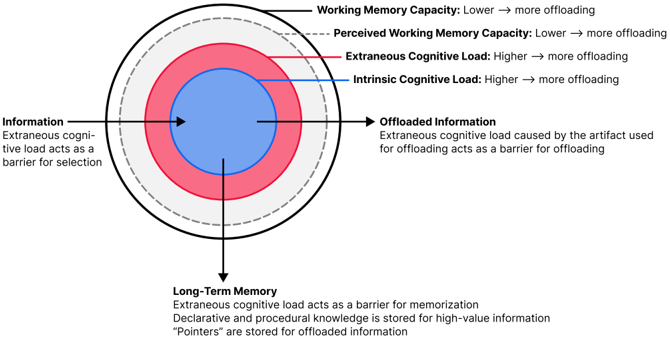
- The paper’s model treats intrinsic cognitive load and extraneous cognitive load as central to digital externalization, with extraneous load acting as a “triple barrier”: it can prevent information from entering working memory, inhibit storage in long-term memory, and prevent externalization through technology.
- Offloading is more likely when learners have lower actual or perceived working memory capacity, when extraneous load is higher, when intrinsic load is higher, and when the perceived value of information is higher.
- The review reports that offloading often improves task performance but can lower memory performance; for example, in the reviewed studies, 4- to 11-year-old children and 11-year-olds using laptops offloaded more difficult items, and offloading could improve recall for some tasks while harming memorization in others.
- The paper states that offloading can produce an illusion of having learned and can increase susceptibility to memory manipulation; it also notes that current generative AI may risk weakening acquisition of biologically secondary knowledge and essential skills.
Methods
- This is a review article synthesizing current research on technology-based cognitive offloading, learning, and memory, and it develops a conceptual model from the reviewed literature.
- The paper draws on studies of non-digital and digital offloading, including children’s offloading behavior, Internet/search use, smartphone-based retrieval, and AI-related externalization.
- The main analysis is theoretical synthesis: it integrates findings with cognitive load theory, biologically primary vs. secondary knowledge, metacognition, and value-based memory models to propose a “cognitive architecture of digital externalization.”
Limitations
- The paper does not report a new empirical dataset or original experiment; it is a review and model paper, so its conclusions depend on the studies it summarizes.
- The author explicitly notes that more research is necessary to determine the positive and negative effects of the Internet and AI on cognition and learning, and to test the proposed model and hypotheses.
- Evident from the text: several claims about generative AI, long-term developmental effects, and “biological pointers” are presented as hypotheses or future research directions, not established findings.
Model-written summary. Check it against the paper before relying on it.
Integrity signals
Registry
Cites
Statistics
Figures
Verification
Claims the paper makes
25 Valid · 1 Not valid · 70 Not checked · 39 Own results and interpretations
The cited sources support only part of this claim — read each source’s verdict below.
In the paper
“educational computer games ('serious games') often require learners to internalize the rules of such a game, thereby causing extraneous cognitive load”
What the sources say
- Partly supportedcites Skulmowski & Xu, 2022 matched to “Understanding Cognitive Load in Digital and Online Learning: a New Perspective on Extraneous Cognitive Load” (2022) sourceExperimental — accuracy not yet measured
In “Challenge 1: Interactive Learning Media” (page unavailable), the paper says that learning a serious game's rules can induce unnecessary cognitive load. It describes this as a potential drawback, however, rather than establishing that games often cause extraneous load in this way. (LLM, conf=0.84)
plainstates a cause- Asserted: passes — The authors put it forward as true.
- Checkable: passes — It can be checked against evidence.
- Load-bearing: passes — The paper’s conclusions depend on it.
- Based: passes — The paper gives a reason why it holds.
- Partly supported
The cited sources support only part of this claim — read each source’s verdict below.
In the paper
“with several studies on issues besides learning and memory often showing considerable advantages accrued using this strategy”
What the sources say
- Not matchedcites Armitage etal., 2020
An author–year citation the paper’s reference list doesn’t settle. We don’t search these by name.
- Partly supportedcites Dunn & Risko, 2016 matched to “Toward a Metacognitive Account of Cognitive Offloading” (2016) sourceExperimental — accuracy not yet measured
Section 4.3 reports faster and more accurate performance when participants were forced to physically rotate toward the text, supporting an advantage of non-digital offloading outside a learning-and-memory task. But Section 3.3 says spontaneous rotation showed no observable performance benefit, and the other favorable example in Section 1.2 uses an on-screen calculator. The paper therefore does not establish that several studies show considerable advantages from non-digital externalization. (LLM, conf=0.84)
plainstates a cause- Asserted: passes — The authors put it forward as true.
- Checkable: passes — It can be checked against evidence.
- Load-bearing: unclear — It is unclear whether the paper’s conclusions depend on it.
- Based: passes — The paper gives a reason why it holds.
- Not matched
Every source the paper cites for this claim was checked and supports it.
In the paper
“not receiving temporal costs for offloading also reduced memory performance.”
What the sources say
- Supportedcites Grinschgl, Papenmeier, and Meyerhoff (2021a) matched to “Consequences of cognitive offloading: Boosting performance but diminishing memory” (2021) source
In Experiment 1 > Results (page unavailable), participants in the no-lockout condition offloaded more and performed less accurately on the subsequent memory test than those facing a lockout. The paper interprets this as a negative effect of greater offloading on memory accuracy. (LLM, conf=0.93)
plainstates a cause- Asserted: passes — The authors put it forward as true.
- Checkable: passes — It can be checked against evidence.
- Load-bearing: passes — The paper’s conclusions depend on it.
- Based: passes — The paper gives a reason why it holds.
- Supported
The cited sources support only part of this claim — read each source’s verdict below.
In the paper
“research on non-digital forms of externalization is used to demonstrate how deeply embedded the tendency of offloading is in humans”
What the sources say
- Not matchedcites Armitage etal., 2020
An author–year citation the paper’s reference list doesn’t settle. We don’t search these by name.
- Supportedcites Dunn & Risko, 2016 matched to “Toward a Metacognitive Account of Cognitive Offloading” (2016) source
The Introduction describes cognitive offloading through physical actions and manipulation of external artifacts as prevalent. Section 1.2 says people readily engage spontaneously in external normalization, a non-digital form of offloading. Together, these support the citing sentence’s broad characterization. (LLM, conf=0.88)
boosted- Asserted: passes — The authors put it forward as true.
- Checkable: passes — It can be checked against evidence.
- Load-bearing: unclear — It is unclear whether the paper’s conclusions depend on it.
- Based: passes — The paper gives a reason why it holds.
- Not matched
Every source the paper cites for this claim was checked and supports it.
In the paper
“humans have a set of certain innate capabilities, such as being able to speak or to recognize faces, that do not require explicit instruction”
What the sources say
- Supportedcites Paas & Sweller, 2012 matched to “An Evolutionary Upgrade of Cognitive Load Theory: Using the Human Motor System and Collaboration to Support the Learning of Complex Cognitive Tasks” (2012) source
The Abstract identifies speaking and face recognition as abilities learned without explicit instruction. It also describes biologically primary knowledge as something humans have evolved to acquire. (LLM, conf=0.95)
plain- Asserted: passes — The authors put it forward as true.
- Checkable: passes — It can be checked against evidence.
- Load-bearing: passes — The paper’s conclusions depend on it.
- Based: passes — The paper gives a reason why it holds.
- Supported
89 more claims · 13 with their cited sources checked
Create a free account to see all 135 claims and to verify the 2 references still open.
- It may state two separate claims as one. 12
- Probably not a substantial claim. 32
Claims other papers make about this one
Each is checked against this paper’s own text: does it say what the citing paper says it does?
In the citing paper
“Therefore, cognitive of fl oading is sometimes necessary and bene fi cial 34,46,100 , but metacognitive of fl oading can often be detrimental to human learning in the AI era.”
From A Metacognitive Approach to Learning and Performance in Human-AI Interaction (2026) · cites this paper as [100]
Citations
Cites
Advances in Neural Information Processing Systems 19
(2007) · The MIT Press eBooks · doi:10.52202/085713 · Cited by 15,539
ChatGPT for good? On opportunities and challenges of large language models for education
Kasneci, E., Sessler, K., Küchemann, S., Bannert, M., Dementieva, D., Fischer, F., Gasser, U., Groh, G., Günnemann, S., Hüllermeier, E., et al. (2023) · Learning and Individual Differences · doi:10.1016/j.lindif.2023.102274 · Cited by 15,365 · cited 1×
“While there are many potentials for this technology in learning and instruction (for an overview, see Kasneci et al., 2023) and productivity in general (Noy & Zhang, 2023), the drastic change in everyday life these tools are likely to introduce can hardly be underestimated.”
BackgroundDenoising Diffusion Probabilistic Models
Ho, J., Jain, A., & Abbeel, P. (2020) · arXiv · doi:10.48550/arxiv.2006.11239 · Cited by 8,712
ChatGPT for Good? On Opportunities and Challenges of Large Language Models for Education
Kasneci, E., Seßler, K., Küchemann, S., Bannert, M., Dementieva, D., Fischer, F., Gasser, U., Groh, G., Günnemann, S., Hüllermeier, E., et al. (2023) · doi:10.35542/osf.io/5er8f · Cited by 7,552
Barsalou, L. W. (1999) · Behavioral and Brain Sciences · doi:10.1017/s0140525x99002149 · Cited by 6,887
Clark, A., & Chalmers, D. (1998) · Analysis · doi:10.1093/analys/58.1.7 · Cited by 6,333 · cited 3×
“Instead, the cognitive system is thought to include bodily resources as well as environmental artifacts (Clark & Chalmers, 1998; Hollnagel, 2001).”
BackgroundCognitive Architecture and Instructional Design
Sweller, J., van Merrienboer, J. J. G., & Paas, F. G. W. C. (1998) · Educational Psychology Review · doi:10.1023/a:1022193728205 · Cited by 6,023 · cited 6×
“One of the most influential theories of instruction is cognitive load theory (CLT; Sweller et al., 1998, 2019).”
InfluentialPhotorealistic Text-to-Image Diffusion Models with Deep Language Understanding
Saharia, C., Chan, W., Saxena, S., Li, L., Whang, J., Denton, E., Ghasemipour, S. K. S., Ayan, B. K., Mahdavi, S. S., Lopes, R. G., et al. (2022) · arXiv · doi:10.48550/arxiv.2205.11487 · Cited by 2,528 · cited 1×
“These two principles share striking similarities with generative AI starting with random spots that are refined using a model derived from training with large image datasets (e.g., Saharia et al., 2022).”
Cognitive Architecture and Instructional Design: 20 Years Later
Sweller, J., van Merriënboer, J. J. G., & Paas, F. (2019) · Educational Psychology Review · doi:10.1007/s10648-019-09465-5 · Cited by 2,337 · cited 6×
“One of the most influential theories of instruction is cognitive load theory (CLT; Sweller et al., 1998, 2019).”
BackgroundMethodInfluentialCarey, S. (2009) · doi:10.1093/acprof:oso/9780195367638.001.0001 · Cited by 2,322
Cited by
Gkintoni, E., Antonopoulou, H., Sortwell, A., & Halkiopoulos, C. (2025) · Brain Sciences · doi:10.3390/brainsci15020203 · Cited by 309
Chen, A., Xiang, M., Zhou, J., Jia, J., Shang, J., Li, X., Gašević, D., & Fan, Y. (2025) · Computers & Education · doi:10.1016/j.compedu.2024.105198 · Cited by 115
Cognitive offloading or cognitive overload? How AI alters the mental architecture of coping
Chirayath, G., Premamalini, K., & Joseph, J. (2025) · Frontiers in Psychology · doi:10.3389/fpsyg.2025.1699320 · Cited by 58
“On the other hand, the same tools may create cognitive overload: an erosion of introspection, over-reliance on algorithmic feedback, and anxiety induced by hyper-monitoring and optimization (Grinschgl et al., 2021; Skulmowski, 2023).”
Placebo or Assistant? Generative AI Between Externalization and Anthropomorphization
Skulmowski, A. (2024) · Educational Psychology Review · doi:10.1007/s10648-024-09894-x · Cited by 43
“While the aspect of whether users perceive AIs as human-like partners will be discussed in a later section, a cognitive explanation for not giving credit to AIs could be that humans perceive generative AIs merely as a tool to offload parts of their work (Skulmowski, 2023).”
InfluentialSelf-citationSkulmowski, A. (2024) · Educational Psychology Review · doi:10.1007/s10648-024-09869-y · Cited by 112
“…focusing on touchscreen activities and gestures) and using artificial intelligence to externalize demanding aspects of complex activities (e.g., Wahn et al., 2023; for an overview of digital externalization, see Skulmowski, 2023) to leave more cognitive resources for the actual learning process.”
Self-citationThe Memory Paradox: Why Our Brains Need Knowledge in an Age of AI
Oakley, B., Johnston, M., Chen, K., Jung, E., & Sejnowski, T. (2025) · doi:10.2139/ssrn.5250447 · Cited by 31
Qu, Y., & Wang, J. (2025) · Journal of Academic Ethics · doi:10.1007/s10805-025-09643-x · Cited by 29
“Specifically, when students offload complex tasks to GenAI systems, the boundaries between human and machine contributions become increasingly blurred, particularly as systems become more personalized and interaction methods more sophisticated (Draxler et al., 2023; Skulmowski, 2023).”
Development and validation of the conversational AI dependence scale for Chinese college students
Chen, Y., Wang, M., Yuan, S., & Zhao, Y. (2025) · Frontiers in Psychology · doi:10.3389/fpsyg.2025.1621540 · Cited by 42
“However, excessive dependence can lead to cognitive inertia, extending beyond traditional online content consumption (Skulmowski, 2023).”
Appealing, but misleading: a warning against a naive AI realism
Engel-Hermann, P., & Skulmowski, A. (2024) · AI and Ethics · doi:10.1007/s43681-024-00587-3 · Cited by 16
Self-citationHamamra, B., Khlaif, Z. N., & Mahamid, N. (2026) · International Journal of Educational Technology in Higher Education · doi:10.1186/s41239-026-00597-7 · Cited by 26
“…by framing AI integration as a matter of user acceptance rather than epistemic transformation, thereby leaving unexamined how authority, authorship, and intellectual labour are redistributed in AI-mediated environments (Abdul-Jabbar & Bhatt, 2025; Wise et al., 2024; Turner, 2022; Skulmowski, 2023).”
Wang, J. (2026) · Frontiers in Psychology · doi:10.3389/fpsyg.2026.1781101 · Cited by 10
“These frameworks argue that thinking is partially offloaded onto external systems, allowing individuals to manage complex tasks more efficiently by reallocating cognitive resources (Skulmowski, 2023).”
Wang, T., Li, S., Li, S., Zhang, J., & Gao, J. (2026) · British Journal of Educational Technology · doi:10.1111/bjet.70059 · Cited by 14
Guo, Y., & Ye, Q. (2026) · Humanities and Social Sciences Communications · doi:10.1057/s41599-026-06621-5 · Cited by 19
“Our focus on educational contexts speci fi cally addresses the growing concern that technology-enhanced learning environments may foster maladaptive of fl oading patterns without metacognitive guidance (Skulmowski, 2023).”
Look at me! Can a pedagogical agent facilitate orientation and support learning in VR?
Decker, D., & Merkt, M. (2025) · Educational Technology Research and Development · doi:10.1007/s11423-025-10531-9 · Cited by 6
“A recent review by Skulmowski (2023) emphasized that even though offloading behavior can be helpful in daily tasks, it might have negative effects on learning.”
Chatto, M. J., & Logronio, F. V. (2025) · Journal of Education and Learning Reviews · doi:10.60027/jelr.2025.2061 · Cited by 14
Liang, Y., Káldy, Z., & Blaser, E. (2025) · Cognitive Development · doi:10.1016/j.cogdev.2025.101542 · Cited by 7
Informed Consent in Educational AI Research Needs to Be Transparent, Flexible, and Dynamic
Skulmowski, A. (2025) · Mind Brain and Education · doi:10.1111/mbe.12435 · Cited by 7
Self-citationReduced relational and item-specific processing in cognitive offloading
Magen, H., & Tomer-Offen, M. (2025) · Cognitive Research Principles and Implications · doi:10.1186/s41235-025-00647-0 · Cited by 9
“…internal memory for the location of stored information (‘where’) could substitute internal memory for the content itself (‘what’) (Lu et al., 2022; Skulmowski, 2023; Sparrow & Chatman, 2013); this would allow individuals to easily locate the externally stored information, even if the information…”
Learning-to-learn in the age of generative AI: a scoping review and conceptual framework
Schorr, I., Bardach, L., Bühler, B., & Kasneci, E. (2026) · Computers and Education: Artificial Intelligence · doi:10.1016/j.caeai.2026.100575 · Cited by 3
Joers, J. M., & Luca, E. W. D. (2024) · Technology Knowledge and Learning · doi:10.1007/s10758-024-09805-7 · Cited by 2
“In a more recent contribution, the actual technological architecture is described as anti-learning at its core, i.e. technology creates barriers to learning instead of removing them (Skulmowski, 2023).”
Wu, M., Liu, G., Wang, B., & Ma, Z. (2026) · International Journal of Human-Computer Interaction · doi:10.1080/10447318.2026.2633738 · Cited by 3
Liu, Y., & Liu, Y. (2026) · Frontiers in Psychology · doi:10.3389/fpsyg.2026.1859317 · Cited by 9
“Under conditions of high convenience, high cognitive load, or high information value, such tool use may coincide with reduced deep processing and diminished investment in self-monitoring (Skulmowski, 2023).”
Artificial Intelligence Overload: A Multilevel Taxonomy and the Path Forward
Kazienko, P., Mieleszczenko-Kowszewicz, W., Kocoń, J., et al. (2026) · IEEE Intelligent Systems · doi:10.1109/mis.2026.3666685 · Cited by 2
Rafiq, T., Azam, M., Nisa, M. U., Sattar, M. M., Zafar, S., & Inam, H. (2024) · The Asian Bulletin of Big Data Management · doi:10.62019/abbdm.v4i02.136 · Cited by 7
“M o d e l S e l ec t i o n architectures are available as models for simulating human behavior in artificial systems, including ACT-R, OpenCog, and Soar (Goertzel et al., 2014; Skulmowski, 2023).”
MethodДмитриевич, В. Г. (2024) · Frontiers in artificial intelligence and applications · doi:10.3233/faia240218 · Cited by 2
Revisión de estudios sobre la inteligencia artificial adaptada en la educación
Quijije, M. Á. P. (2024) · REVISTA ODIGOS · doi:10.35290/ro.v5n2.2024.1250 · Cited by 3
Ouyang, Y., Gao, S., Wang, R., Zhu, H., Shao, Y., Gu, X., & Li, Q. (2026) · CHI Conference on Human Factors in Computing Systems · doi:10.1145/3772318.3790530 · Cited by 4
“By externalizing memory and reasoning processes, Comm-Sense alleviates the cognitive burden of “remembering information”, allowing users to focus on more strategic and complex aspects of their task, thereby making deep thinking more efficient [118].”
Yang, R., Zhen, F., & Wang, J. (2025) · Humanities and Social Sciences Communications · doi:10.1057/s41599-025-05870-0 · Cited by 1
“Of particular concern is the widespread tendency in research practice to treat AI as an “ externalized ” technology (Skulmowski 2023), seemingly divorced from the core academic values of human geography such as interpretivism, criticality, and contextualization.”
Huang, Z., Zhao, J., & Fu, X. (2026) · Journal of Intelligence · doi:10.3390/jintelligence14040065 · Cited by 6
“In environments where GenAI provides instant generation, multimodal presentation, and automated processes, learners’ experiences may involve different patterns of information processing and resource allocation (Skulmowski, 2023).”
Cognitive offloading in student–AI collaboration: A longitudinal analysis of prompting strategies
Misiejuk, K., López‐Pernas, S., Kaliisa, R., & Saqr, M. (2026) · Computers in Human Behavior Reports · doi:10.1016/j.chbr.2026.101130 · Cited by 20
The DIPS model: GenAI integration in digital information problem solving by experts and novices
Boetje, J., de Graaf, Z., Wopereis, I., van Ginkel, S. O., Smakman, M. H. J., Versendaal, J., & Barendsen, E. (2026) · Computers & Education · doi:10.1016/j.compedu.2026.105677 · Cited by 1
Oleas, D., Rodas, J. A., & Alarcon, D. (2026) · Frontiers in Digital Health · doi:10.3389/fdgth.2026.1882677 · Cited by 5
Lin, J., & Al‐Hada, N. M. (2026) · Frontiers in Psychology · doi:10.3389/fpsyg.2026.1906070 · Cited by 5
“…difficulties (Bjork and Bjork, 2011), cognitive load theory (Sweller et al., 2011) as extended by Load Reduction Instruction (Martin et al., 2025), and cognitive offloading research (Risko and Gilbert, 2016; Skulmowski, 2023)—to explain when product gains may diverge from durable learning.”
InfluentialAugmentation or Erosion? Regulating Cognitive Offloading in Generative AI-Supported STEM Learning
Nakamura, D. (2026) · Educational Psychology Review · doi:10.1007/s10648-026-10224-6 · Cited by 8
“…this journal has begun to systematize these dynamics, integrating digital externalization with cognitive load and memory in a common cognitive architecture and extending the analysis to GenAI’s distinctive combination of generative capability and anthropomorphic fluency (Skulmowski, 2023 , 2024 ).”
Riyanto, B. (2024) · Inovasi Kurikulum · doi:10.17509/jik.v21i3.72173
Bugs and drugs – what do pharmacists need to know and what’s the best way to learn it?
MacDougall, C., & Jeffres, M. N. (2024) · American Journal of Health-System Pharmacy · doi:10.1093/ajhp/zxae258 · Cited by 1
Experiencing mapping and maps: a human cognition perspective
Fairbairn, D., Gärtner, G., & Peterson, M. P. (2025) · International Journal of Cartography · doi:10.1080/23729333.2025.2533814 · Cited by 3
“…offloading, there is a distinct choice involved: ‘humans perform a meta-cognitive evaluation on whether to use internal (e.g. rely on the internal cognitive map) or external resources (e.g. create a map or other artefact) for a task, select a strategy, and subsequently apply it’ (Skulmowski, 2023).”
A metacognitive approach to learning and performance in human-AI interaction
Fan, Y., Yan, L., Molenaar, I., Greiff, S., & Gašević, D. (2026) · Communications Psychology · doi:10.1038/s44271-026-00548-y · Cited by 1
“Therefore, cognitive of fl oading is sometimes necessary and bene fi cial 34,46,100 , but metacognitive of fl oading can often be detrimental to human learning in the AI era.”
Martens, W., Su, H.-K., Pang, J. M., & Wu, S. C. (2024) · Qeios · doi:10.32388/q2oqk5 · Cited by 3
Martens, W., Su, H.-K., Pang, J. M., & Wu, S. C. (2024) · Qeios · doi:10.32388/q2oqk5.2
Akgün, M., & Toker, Ş. (2025) · SAGE Open · doi:10.1177/21582440251329736 · Cited by 1
Application of AI in education and its influence on students’ critical thinking
Zhang, R. (2025) · SHS Web of Conferences · doi:10.1051/shsconf/202522201010
In Tourism—Artificial Intelligence, Robot or Human Being? What Do I Prefer?
Au‐Yong‐Oliveira, M., Macedo, M., Moreira, A., et al. (2025) · Smart innovation, systems and technologies · doi:10.1007/978-981-96-5400-0_32
Hayes, S. J., Miles, G. E., & Evans, S.-A. (2025) · New Ideas in Psychology · doi:10.1016/j.newideapsych.2025.101215
How mindful and mindless online searching affects curiosity and information recall
Kim, J. A., Kim, J., Kim, S., & Bong, M. (2025) · Educational Technology Research and Development · doi:10.1007/s11423-025-10570-2 · Cited by 2
AI Literacy and Human Capital Formation: Evidence from Middle Schools in Rural IndiaPreprint
Sharma, M., Das, U., Mazumdar, R., & Sameera, S. (2026) · SSRN Electronic Journal · doi:10.2139/ssrn.6068110
Doctoral students as emerging educators: Learning in the AI age
Yamazaki, M., Zencirli, B. T., Millheim, N. C., & Mejia, C. (2026) · Journal of Hospitality Leisure Sport & Tourism Education · doi:10.1016/j.jhlste.2026.100599 · Cited by 1
Hynek, N., & Albert, D. (2026) · Frontiers in Psychology · doi:10.3389/fpsyg.2026.1684634
“…from internal memory onto external resources (e.g., technology or knowledge artifacts) can reduce memory and coordination demands by altering a task’s information-processing requirements (Patterson et al., 2014; Risko and Gilbert, 2016; Heersmink, 2021; Skulmowski, 2023; Gilbert et al., 2023).”
Integration of Augmented Reality in Hybrid Learning: Student Perceptions and Acceptance
Mantasia, Suryani, H., Suhaeb, S., Sukma, I., & Jaya, H. (2026) · International Journal of Online and Biomedical Engineering (iJOE) · doi:10.3991/ijoe.v22i03.58887 · Cited by 1
Günaydın, N., Cengiz, M. A., Şekerci, Y., & Dünder, E. (2026) · Frontiers in Psychology · doi:10.3389/fpsyg.2026.1775425 · Cited by 1
“…and learning shows that externalizing information to digital media often leads individuals to retain mainly the “gist” or the location of information, while deeper long-term encoding is reduced, which is conceptualized as a form of digital externalization and digital amnesia (Skulmowski, 2023).”
The nonlinear impact of human-AI interaction on employees’ creative ability
Chen, M.-J., Zhang, Y., & Xue, J. (2026) · Behaviour and Information Technology · doi:10.1080/0144929x.2026.2660224 · Cited by 1
The Memory Paradox: Why Our Brains Need Knowledge in an Age of AI
Oakley, B. A., Johnston, M. O., Chen, K.-Z., Jung, E., & B, T. J. S. A. (2026) · Springer eBooks · doi:10.1007/978-3-032-11814-1_22 · Cited by 10
Agüero, S. E. R., & Alvis, M. N. C. (2026) · Taikuere · doi:10.66218/taikuere.v2i1.14
Chiang, Y.-T., Hong, J., & Tu, Y.-T. (2026) · Frontiers in Psychology · doi:10.3389/fpsyg.2026.1838395
“Excessive cognitive burden can hinder learning by overloading learners’ working memory and reducing the cognitive resources available for information processing and schema construction (Skulmowski, 2023).”
Puri, S., Dubey, R., Pandey, S., & Saha, R. (2026) · Innovations in Education & Teaching International · doi:10.1080/14703297.2026.2709762
Beyond Dependency: Artificial Intelligence as Cognitive Redistribution in Education
Erden, N. S., & Altuntaş, G. (2026) · Advances in computational intelligence and robotics book series · doi:10.4018/979-8-3373-9484-8.ch006
Mishra, A. (2026) · Advances in computational intelligence and robotics book series · doi:10.4018/979-8-3373-9484-8.ch013
Doğru, M. C., & Kurtça, T. T. (2026) · International Journal of Human-Computer Interaction · doi:10.1080/10447318.2026.2712085 · Cited by 1
Britel, I., Moummou, H., Aghdou, Z., Bouzidi, H. E., & El‐Mansoury, B. (2026) · Advances in computational intelligence and robotics book series · doi:10.4018/979-8-3373-9484-8.ch011
Modelling Human Generative AI Interaction in Higher Education: Evaluation Among Ghanaian Students
Wahab, A. W., Asabere, T. M., & Chakurah, I. (2026) · Review of Artificial Intelligence in Education · doi:10.37497/rev.artif.intell.educ.v7ii.1381
Liao, J., Wei, X., Fang, X., Sun, X., Li, F., & Lei, L. (2026) · Education and Information Technologies · doi:10.1007/s10639-026-14116-8
AI Sabbatical: A conceptual framework for cognitive sustainability in AI-augmented knowledge work
Anthuvan, T., & Prabhuram, S. (2026) · Human Systems Management · doi:10.1177/01672533261484224
Guo, Y., Huang, T., Yue, S., Yu, J., Wei, M., & Chen, M. (2026) · Journal of Educational Computing Research · doi:10.1177/07356331261481381
Generative AI as the second wave of cognitive externalization
Сидорчук, Р. (2026) · MIR (Modernization Innovation Research) · doi:10.18184/2079-4665.2026.17.3.396-416
Klapproth, F. (2026) · Education Sciences · doi:10.3390/educsci16091507 · Cited by 4
Liu, C., Guo, J., Gao, R., Chen, X., Zhu, Q., & Chang, P. (2026) · Frontiers in Psychology · doi:10.3389/fpsyg.2026.1910545 · Cited by 3
“Within it, metamemory beliefs govern when people choose to offload (Hu et al., 2019), framing the same act as a gain or a loss shifts how much they rely on it (Froscher et al., 2022), and offloading reshapes the cognitive architecture of the task itself (Skulmowski, 2023).”
Crespo, J., Carballo, F., & Turnés, J. (2026) · doi:10.2196/preprints.112174
Fan, M., & Chang, P. (2026) · Behavioral Sciences · doi:10.3390/bs16091671 · Cited by 6
“…transfer of cognitive demand to an external resource—long predates generative AI and carries no fixed valence (Risko & Gilbert, 2016; Sparrow et al., 2011); its consequences depend on how the external resource is enrolled in the task (Grinschgl et al., 2023; Silva et al., 2026; Skulmowski, 2023).”
A scoping review of the negative effects of digital technology on cognition
Znidaric, U., Štrumbelj, E., & Machidon, O. (2026) · Computers in Human Behavior Reports · doi:10.1016/j.chbr.2026.101326 · Cited by 5
“…and hypertext reading can promote shallow processing and weaker comprehension than print due to higher cognitive load, nonlinear navigation demands, and less accurate metacognitive monitoring (Wylie et al., 2018; Lom-bina et al., 2019; Baron, 2021; Skulmowski, 2023; Chen and Yan, 2016).”
Fan, J.-J., Rao, J.-Y., Wei, L.-D., Li, G.-J., Yuan, J.-X., & Qi, Y. (2026) · Expert systems with applications · doi:10.1016/j.eswa.2026.134549
Rafsanjani, M. A., Kurniawan, R. Y., Wahyudi, H. D., & Srisuk, P. (2026) · The Journal of Behavioral Science · doi:10.69523/tjbs.2026.298843 · Cited by 1
Metadata
- Authors
- Skulmowski, A.
- Affiliations
- Karlsruhe University of Education (DE)
- Corresponding author
- Skulmowski, Alexander
- Venue
- Educational Psychology Review
- Published
- 2023-10-10
- Volume
- 35
- Issue
- 4
- ISSN
- 1040-726X (ISSN-L)
- 1573-336X
- OpenAlex
- W4387477515
- Semantic Scholar
- 32cba838e10c7e2b053d554298f376e500a4509e
- Cited by
- 76
- References
- 94
- Citations by year
- 2026: 46 · 2025: 18 · 2024: 12
- FWCI
- 19.59
- Type
- journal article
- Language
- en
- Open access
- hybrid
- doi.org
- Licence
- cc-by
- creativecommons.org/licenses/by/4.0 (tdm)
- creativecommons.org/licenses/by/4.0 (vor)
- Locations
- Educational Psychology Review (publishedVersion, cc-by)
- Funders
- Pädagogische Hochschule Karlsruhe
- Topics
- Social Sciences › Psychology › Experimental and Cognitive Psychology › Visual and Cognitive Learning Processes
- Social Sciences › Psychology › Developmental and Educational Psychology › Innovative Teaching and Learning Methods
- Life Sciences › Neuroscience › Cognitive Neuroscience › Memory Processes and Influences
- Keywords
- cognitive offloading, cognitive load, intrinsic cognitive load, extraneous cognitive load, working memory capacity, long-term memory, learning, memory manipulation, generative AI, technology-enhanced learning, value of information
About these checks
Registry, retraction, Cites and statistics results are computed, not judged, with one exception: a printed reference that no index lists is read once by a model before it counts as a citation error. Claims are extracted by a model and kept only when their quote appears verbatim in the text; each cited source is then checked, with a model’s help, for whether it says what the claim relies on. Those verdicts can be wrong — read the claim’s quote and the cited source before relying on one.
The claim verdicts this report counts are experimental: their accuracy is not yet measured.
A language model drew the claims from the paper on 2026-10-11, under version 3 of the claim definition (model deepseek-v4.1-flash, prompt extract-v3).
A second model labelled each claim on 2026-10-11 (model jev-1.13-20260917, definition revision gold-guideline-v0.2).
Cited sources are checked with a language model’s help (gpt-6-sol).
Statistics and arithmetic are recomputed, not judged.
Confidence bands are shown only for fields calibrated on our annotated test set. None is calibrated yet, so no band is shown.
What counts as a claim ›How we measure confidence ›How we check this ›
Are you an author, or do you see a problem with this page? Request a review
Data sources
Bibliographic data: Semantic Scholar, OpenAlex, Crossref.
Contains information from the Semantic Scholar Academic Graph Datasets, made available under the ODC Attribution License (ODC-BY 1.0).
Semantic Scholar’s data is described in: Kinney, R., et al. (2023). The Semantic Scholar Open Data Platform. arXiv:2301.10140.
