

The Cognitive Architecture of Digital Externalization
Open accessThe DOI matches its Crossref record; 103 of the 104 references it cites were found in a registry or an index; 25 of the 110 sources its claims cite were checked for support.
Abstract
This review is aimed at synthesizing current findings concerning technology-based cognitive offloading and the associated effects on learning and memory. While cognitive externalization (i.e., using the environment to outsource mental computation) is a highly useful technique in various problem-solving tasks, a growing body of research suggests that the offloading of information into the environment (and digital storage in particular) can have negative effects on learning... As a result, in many instances, only the gist of information (or its location) is retained, while learners often gain the illusion of having memorized that information.
Overview
CoChat Summary
TL;DR
This review argues that digital cognitive offloading is best understood through cognitive load theory: high intrinsic load, high extraneous load, low perceived/actual working memory capacity, and high perceived value of information shape when learners externalize information. It warns that digital externalization can help performance but also reduce memorization, create illusions of learning, and increase vulnerability to memory manipulation, with generative AI potentially amplifying these risks.
Key findings
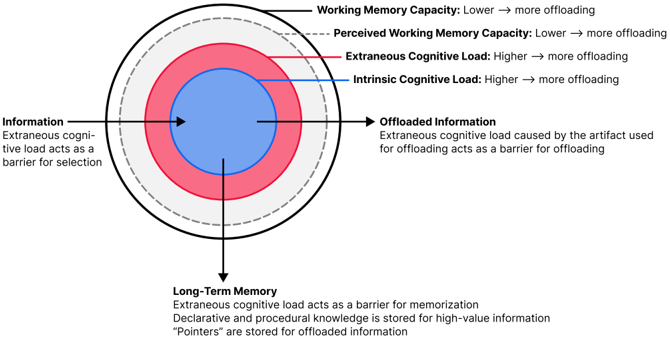
- The paper’s model treats intrinsic cognitive load and extraneous cognitive load as central to digital externalization, with extraneous load acting as a “triple barrier”: it can prevent information from entering working memory, inhibit storage in long-term memory, and prevent externalization through technology.
- Offloading is more likely when learners have lower actual or perceived working memory capacity, when extraneous load is higher, when intrinsic load is higher, and when the perceived value of information is higher.
- The review reports that offloading often improves task performance but can lower memory performance; for example, in the reviewed studies, 4- to 11-year-old children and 11-year-olds using laptops offloaded more difficult items, and offloading could improve recall for some tasks while harming memorization in others.
- The paper states that offloading can produce an illusion of having learned and can increase susceptibility to memory manipulation; it also notes that current generative AI may risk weakening acquisition of biologically secondary knowledge and essential skills.
Methods
- This is a review article synthesizing current research on technology-based cognitive offloading, learning, and memory, and it develops a conceptual model from the reviewed literature.
- The paper draws on studies of non-digital and digital offloading, including children’s offloading behavior, Internet/search use, smartphone-based retrieval, and AI-related externalization.
- The main analysis is theoretical synthesis: it integrates findings with cognitive load theory, biologically primary vs. secondary knowledge, metacognition, and value-based memory models to propose a “cognitive architecture of digital externalization.”
Limitations
- The paper does not report a new empirical dataset or original experiment; it is a review and model paper, so its conclusions depend on the studies it summarizes.
- The author explicitly notes that more research is necessary to determine the positive and negative effects of the Internet and AI on cognition and learning, and to test the proposed model and hypotheses.
- Evident from the text: several claims about generative AI, long-term developmental effects, and “biological pointers” are presented as hypotheses or future research directions, not established findings.
Model-written summary. Check it against the paper before relying on it.
Integrity signals
Registry
Cites
Statistics
Figures
Verification
Claims the paper makes
25 Valid · 1 Not valid · 70 Not checked · 39 Own results and interpretations
The cited sources support only part of this claim — read each source’s verdict below.
In the paper
“educational computer games ('serious games') often require learners to internalize the rules of such a game, thereby causing extraneous cognitive load”
What the sources say
- Partly supportedcites Skulmowski & Xu, 2022 matched to “Understanding Cognitive Load in Digital and Online Learning: a New Perspective on Extraneous Cognitive Load” (2022) sourceExperimental — accuracy not yet measured
In “Challenge 1: Interactive Learning Media” (page unavailable), the paper says that learning a serious game's rules can induce unnecessary cognitive load. It describes this as a potential drawback, however, rather than establishing that games often cause extraneous load in this way. (LLM, conf=0.84)
plainstates a cause- Asserted: passes — The authors put it forward as true.
- Checkable: passes — It can be checked against evidence.
- Load-bearing: passes — The paper’s conclusions depend on it.
- Based: passes — The paper gives a reason why it holds.
- Partly supported
The cited sources support only part of this claim — read each source’s verdict below.
In the paper
“with several studies on issues besides learning and memory often showing considerable advantages accrued using this strategy”
What the sources say
- Not matchedcites Armitage etal., 2020
An author–year citation the paper’s reference list doesn’t settle. We don’t search these by name.
- Partly supportedcites Dunn & Risko, 2016 matched to “Toward a Metacognitive Account of Cognitive Offloading” (2016) sourceExperimental — accuracy not yet measured
Section 4.3 reports faster and more accurate performance when participants were forced to physically rotate toward the text, supporting an advantage of non-digital offloading outside a learning-and-memory task. But Section 3.3 says spontaneous rotation showed no observable performance benefit, and the other favorable example in Section 1.2 uses an on-screen calculator. The paper therefore does not establish that several studies show considerable advantages from non-digital externalization. (LLM, conf=0.84)
plainstates a cause- Asserted: passes — The authors put it forward as true.
- Checkable: passes — It can be checked against evidence.
- Load-bearing: unclear — It is unclear whether the paper’s conclusions depend on it.
- Based: passes — The paper gives a reason why it holds.
- Not matched
Every source the paper cites for this claim was checked and supports it.
In the paper
“not receiving temporal costs for offloading also reduced memory performance.”
What the sources say
- Supportedcites Grinschgl, Papenmeier, and Meyerhoff (2021a) matched to “Consequences of cognitive offloading: Boosting performance but diminishing memory” (2021) source
In Experiment 1 > Results (page unavailable), participants in the no-lockout condition offloaded more and performed less accurately on the subsequent memory test than those facing a lockout. The paper interprets this as a negative effect of greater offloading on memory accuracy. (LLM, conf=0.93)
plainstates a cause- Asserted: passes — The authors put it forward as true.
- Checkable: passes — It can be checked against evidence.
- Load-bearing: passes — The paper’s conclusions depend on it.
- Based: passes — The paper gives a reason why it holds.
- Supported
The cited sources support only part of this claim — read each source’s verdict below.
In the paper
“research on non-digital forms of externalization is used to demonstrate how deeply embedded the tendency of offloading is in humans”
What the sources say
- Not matchedcites Armitage etal., 2020
An author–year citation the paper’s reference list doesn’t settle. We don’t search these by name.
- Supportedcites Dunn & Risko, 2016 matched to “Toward a Metacognitive Account of Cognitive Offloading” (2016) source
The Introduction describes cognitive offloading through physical actions and manipulation of external artifacts as prevalent. Section 1.2 says people readily engage spontaneously in external normalization, a non-digital form of offloading. Together, these support the citing sentence’s broad characterization. (LLM, conf=0.88)
boosted- Asserted: passes — The authors put it forward as true.
- Checkable: passes — It can be checked against evidence.
- Load-bearing: unclear — It is unclear whether the paper’s conclusions depend on it.
- Based: passes — The paper gives a reason why it holds.
- Not matched
Every source the paper cites for this claim was checked and supports it.
In the paper
“humans have a set of certain innate capabilities, such as being able to speak or to recognize faces, that do not require explicit instruction”
What the sources say
- Supportedcites Paas & Sweller, 2012 matched to “An Evolutionary Upgrade of Cognitive Load Theory: Using the Human Motor System and Collaboration to Support the Learning of Complex Cognitive Tasks” (2012) source
The Abstract identifies speaking and face recognition as abilities learned without explicit instruction. It also describes biologically primary knowledge as something humans have evolved to acquire. (LLM, conf=0.95)
plain- Asserted: passes — The authors put it forward as true.
- Checkable: passes — It can be checked against evidence.
- Load-bearing: passes — The paper’s conclusions depend on it.
- Based: passes — The paper gives a reason why it holds.
- Supported
89 more claims · 13 with their cited sources checked
Create a free account to see all 135 claims and to verify the 2 references still open.
- It may state two separate claims as one. 12
- Probably not a substantial claim. 32
Citations
Cites
Advances in Neural Information Processing Systems 19
(2007) · The MIT Press eBooks · doi:10.52202/085713 · Cited by 15,539
ChatGPT for good? On opportunities and challenges of large language models for education
Kasneci, E., Sessler, K., Küchemann, S., Bannert, M., Dementieva, D., Fischer, F., Gasser, U., Groh, G., Günnemann, S., Hüllermeier, E., et al. (2023) · Learning and Individual Differences · doi:10.1016/j.lindif.2023.102274 · Cited by 15,365 · cited 1×
“While there are many potentials for this technology in learning and instruction (for an overview, see Kasneci et al., 2023) and productivity in general (Noy & Zhang, 2023), the drastic change in everyday life these tools are likely to introduce can hardly be underestimated.”
BackgroundDenoising Diffusion Probabilistic Models
Ho, J., Jain, A., & Abbeel, P. (2020) · arXiv · doi:10.48550/arxiv.2006.11239 · Cited by 8,712
ChatGPT for Good? On Opportunities and Challenges of Large Language Models for Education
Kasneci, E., Seßler, K., Küchemann, S., Bannert, M., Dementieva, D., Fischer, F., Gasser, U., Groh, G., Günnemann, S., Hüllermeier, E., et al. (2023) · doi:10.35542/osf.io/5er8f · Cited by 7,552
Barsalou, L. W. (1999) · Behavioral and Brain Sciences · doi:10.1017/s0140525x99002149 · Cited by 6,887
Clark, A., & Chalmers, D. (1998) · Analysis · doi:10.1093/analys/58.1.7 · Cited by 6,333 · cited 3×
“Instead, the cognitive system is thought to include bodily resources as well as environmental artifacts (Clark & Chalmers, 1998; Hollnagel, 2001).”
BackgroundCognitive Architecture and Instructional Design
Sweller, J., van Merrienboer, J. J. G., & Paas, F. G. W. C. (1998) · Educational Psychology Review · doi:10.1023/a:1022193728205 · Cited by 6,023 · cited 6×
“One of the most influential theories of instruction is cognitive load theory (CLT; Sweller et al., 1998, 2019).”
InfluentialPhotorealistic Text-to-Image Diffusion Models with Deep Language Understanding
Saharia, C., Chan, W., Saxena, S., Li, L., Whang, J., Denton, E., Ghasemipour, S. K. S., Ayan, B. K., Mahdavi, S. S., Lopes, R. G., et al. (2022) · arXiv · doi:10.48550/arxiv.2205.11487 · Cited by 2,528 · cited 1×
“These two principles share striking similarities with generative AI starting with random spots that are refined using a model derived from training with large image datasets (e.g., Saharia et al., 2022).”
Cognitive Architecture and Instructional Design: 20 Years Later
Sweller, J., van Merriënboer, J. J. G., & Paas, F. (2019) · Educational Psychology Review · doi:10.1007/s10648-019-09465-5 · Cited by 2,337 · cited 6×
“One of the most influential theories of instruction is cognitive load theory (CLT; Sweller et al., 1998, 2019).”
BackgroundMethodInfluentialCarey, S. (2009) · doi:10.1093/acprof:oso/9780195367638.001.0001 · Cited by 2,322
The Origin of Concepts: (513702014-002)
Carey, S. (2013) · PsycEXTRA Dataset · doi:10.1037/e513702014-002 · Cited by 2,312
Experimental Evidence on the Productivity Effects of Generative Artificial Intelligence
Noy, S., & Zhang, W. (2023) · doi:10.2139/ssrn.4375283 · Cited by 2,157
Experimental evidence on the productivity effects of generative artificial intelligence
Noy, S., & Zhang, W. (2023) · Science · doi:10.1126/science.adh2586 · Cited by 2,150
Google Effects on Memory: Cognitive Consequences of Having Information at Our Fingertips
Sparrow, B., Liu, J., & Wegner, D. M. (2011) · Science · doi:10.1126/science.1207745 · Cited by 1,762 · cited 1×
“They cite research by Sparrow et al. (2011) indicates that Internet can lead to an increased recall performance regarding the location of information but lower recall performance of actual information.”
BackgroundOn Distinguishing Epistemic from Pragmatic Action
Kirsh, D., & Maglio, P. (1994) · Cognitive Science · doi:10.1207/s15516709cog1804_1 · Cited by 1,641
Risko, E. F., & Gilbert, S. J. (2016) · Trends in Cognitive Sciences · doi:10.1016/j.tics.2016.07.002 · Cited by 1,502 · cited 4×
“While Risko and Gilbert (2016) present several instances in which offloading is a crucial aspect that enhances cognition, their review already brings up the negative aspects that cognitive externalization may have, particularly on memory.”
BackgroundMethodInfluentialExamining Science Education in ChatGPT: An Exploratory Study of Generative Artificial Intelligence
Cooper, G. (2023) · Journal of Science Education and Technology · doi:10.1007/s10956-023-10039-y · Cited by 1,263 · cited 1×
“Currently, generative AI tools are mainstreaming the process of letting the computer create texts, images, and other content using short text–based instructions (Cooper, 2023; Hsu & Ching, 2023; Vartiainen & Tedre, 2023).”
BackgroundSoftware: Practice and Experience
(2006) · Software Practice and Experience · doi:10.1002/(issn)1097-024x · Cited by 1,218
How seductive details do their damage: A theory of cognitive interest in science learning.
Harp, S. F., & Mayer, R. E. (1998) · Journal of Educational Psychology · doi:10.1037/0022-0663.90.3.414 · Cited by 855 · cited 1×
“Just as extraneous cognitive load stemming from the design of digital instruction can prevent information from entering working memory (see, e.g., Harp & Mayer, 1998), extraneous cognitive load caused by the controls of digital artifacts can be an obstacle for offloading (see, e.g., Grinschgl et…”
BackgroundAdams, F., & Aizawa, K. (2001) · Philosophical Psychology · doi:10.1080/09515080120033571 · Cited by 763 · cited 1×
“…external objects can indeed be regarded as equally important constituents of the human cognitive system as the brain has been controversial (e.g., Adams & Aizawa, 2001; Ludwig, 2015), the notion that the cognitive system can extend over entities outside the cranium has found considerable…”
BackgroundCognitive Load Theory: How Many Types of Load Does It Really Need?
Kalyuga, S. (2011) · Educational Psychology Review · doi:10.1007/s10648-010-9150-7 · Cited by 725 · cited 1×
“After a controversial debate (e.g., Kalyuga, 2011), the current iteration of CLT no longer considers germane cognitive load as a component that can obstruct working memory capacity (Sweller et al., 2019).”
BackgroundJeon, J., & Lee, S. (2023) · Education and Information Technologies · doi:10.1007/s10639-023-11834-1 · Cited by 696 · cited 1×
“Results such as this one suggest that the dynamics of offloading enabled by generative AI may be complex, and some studies already revealed that the use of generative AI in educational contexts confers some tasks to the AI and others to human teachers (Jeon & Lee, 2023).”
BackgroundThe “online brain”: How the Internet may be changing our cognition
Firth, J., Torous, J., Stubbs, B., Firth, J. A., Steiner, G. Z., Smith, L., Alvarez‐Jimenez, M., Gleeson, J., Vancampfort, D., Armitage, C. J., et al. (2019) · World Psychiatry · doi:10.1002/wps.20617 · Cited by 694 · cited 4×
“Firth et al. (2019) describe the Internet as a “superstimulus.””
BackgroundInfluentialSkulmowski, A., & Xu, K. M. (2022) · Educational Psychology Review · doi:10.1007/s10648-021-09624-7 · Cited by 678 · cited 1×
“Other interpretations present germane processes as the motivational tendency of learners to invest their cognitive resources (Skulmowski & Xu, 2022, based on Whelan, 2007).”
BackgroundSelf-citationClark, A., & Chalmers, D. J. (1998) · Analysis · doi:10.1111/1467-8284.00096 · Cited by 672
From Cognitive Load Theory to Collaborative Cognitive Load Theory
Kirschner, P. A., Sweller, J., Kirschner, F., & Zambrano R., J. (2018) · International Journal of Computer-Supported Collaborative Learning · doi:10.1007/s11412-018-9277-y · Cited by 590 · cited 1×
“For instance, there has been a considerable amount of research on how to apply CLT to settings in which collaboration (Janssen & Kirschner, 2020; Kirschner et al., 2018; Paas & Sweller, 2012), bodily perception and action (Lindgren & Johnson-Glenberg, 2013; Sepp et al., 2019), and other methods…”
BackgroundPhotorealistic Text-To-Image Diffusion Models with Deep Language Understanding
Saharia, C., Chan, W., Saxena, S., Li, L., Whang, J., Denton, E., Ghasemipour, K., Lopes, R. G., Ayan, B. K., Salimans, T., et al. (2022) · Advances in Neural Information Processing Systems 35 · doi:10.52202/068431-2643 · Cited by 559
Emboldened by Embodiment: Six Precepts for Research on Embodied Learning and Mixed Reality
Lindgren, R., & Johnson-Glenberg, M. (2013) · Educational Researcher · doi:10.3102/0013189x13511661 · Cited by 520
Paas, F., & Sweller, J. (2012) · Educational Psychology Review · doi:10.1007/s10648-011-9179-2 · Cited by 502 · cited 5×
“Thus, one strategy that has been developed based on this distinction is that biologically primary knowledge should be relied on for learning biologically secondary knowledge (Paas & Sweller, 2012; Sweller et al., 2019).”
BackgroundInfluentialAn Evolutionarily Informed Education Science
GEARY, D. C. (2008) · Educational Psychologist · doi:10.1080/00461520802392133 · Cited by 324 · cited 2×
“…primary knowledge, humans can acquire biologically secondary knowledge, which encompasses all knowledge that must be explicitly learned, such as different languages, school subjects, and other knowledge that is neither innate nor acquired in an evolutionary automated fashion (Geary, 2008).”
BackgroundRadical Embodied Cognitive Science
Chemero, A. (2013) · Review of General Psychology · doi:10.1037/a0032923 · Cited by 283 · cited 1×
“…of these theoretical perspectives even go so far as to reject theoretical entities such as mental representations altogether (for overviews, see Chemero, 2013; Duijzer et al., 2019) that are central to computationalist views on cognition, CLT interest-ingly has managed to mostly avoid being…”
BackgroundActive Forgetting: Adaptation of Memory by Prefrontal Control
Anderson, M. C., & Hulbert, J. C. (2021) · Annual Review of Psychology · doi:10.1146/annurev-psych-072720-094140 · Cited by 279 · cited 1×
“A recent paper links offloading to intentional forgetting (Kelly & Risko, 2019a; for an overview of intentional forgetting, see Anderson & Hulbert, 2021).”
BackgroundUsing artificial intelligence in craft education: crafting with text-to-image generative models
Vartiainen, H., & Tedre, M. (2023) · Digital Creativity · doi:10.1080/14626268.2023.2174557 · Cited by 263 · cited 2×
“The potentials for externalization and people’s willingness to do so are currently being investigated (e.g., Vartiainen & Tedre, 2023), and it will be interesting to see how the relationship between humans and AI will develop in the future and whether it will be normalized to offload certain tasks…”
BackgroundAdversarial text-to-image synthesis: A review
Frolov, S., Hinz, T., Raue, F., Hees, J., & Dengel, A. (2021) · Neural Networks · doi:10.1016/j.neunet.2021.07.019 · Cited by 208 · cited 1×
“For instance, AI image generators that create images from text prompts can start off with random noise distributions which then get refined using training data (Frolov et al., 2021; Ho et al., 2020).”
BackgroundEnactive Metaphors: Learning Through Full-Body Engagement
Gallagher, S., & Lindgren, R. (2015) · Educational Psychology Review · doi:10.1007/s10648-015-9327-1 · Cited by 200 · cited 1×
“Indeed, the use of embodied metaphors (i.e., applying perceptually rich knowledge to process abstract knowledge) has been shown to be an effective instructional method (e.g., Bakker et al., 2012; for an overview, see Gallagher & Lindgren, 2015).”
BackgroundStoring information in-the-world: Metacognition and cognitive offloading in a short-term memory task
Risko, E. F., & Dunn, T. L. (2015) · Consciousness and Cognition · doi:10.1016/j.concog.2015.05.014 · Cited by 193 · cited 3×
“It was demonstrated that people with a lower working memory capacity choose to offload more information (Ball et al., 2022; Gilbert, 2015; Meyerhoff et al., 2021; Risko & Dunn, 2015; but see also Morrison & Richmond, 2020).”
BackgroundSweller, J. (2021) · Educational Psychology Review · doi:10.1007/s10648-021-09647-0 · Cited by 179 · cited 3×
“This process is similar to human problem-solving, often involving the generation of random attempts at solving a task that is evaluated and refined (randomness as genesis, Sweller, 2022).”
BackgroundInfluentialEmbodied metaphors in tangible interaction design
Bakker, S., Antle, A. N., & van den Hoven, E. (2012) · Personal and Ubiquitous Computing · doi:10.1007/s00779-011-0410-4 · Cited by 177 · cited 1×
“Indeed, the use of embodied metaphors (i.e., applying perceptually rich knowledge to process abstract knowledge) has been shown to be an effective instructional method (e.g., Bakker et al., 2012; for an overview, see Gallagher & Lindgren, 2015).”
BackgroundJanssen, J., & Kirschner, P. A. (2020) · Educational Technology Research and Development · doi:10.1007/s11423-019-09729-5 · Cited by 177 · cited 1×
“For instance, there has been a considerable amount of research on how to apply CLT to settings in which collaboration (Janssen & Kirschner, 2020; Kirschner et al., 2018; Paas & Sweller, 2012), bodily perception and action (Lindgren & Johnson-Glenberg, 2013; Sepp et al., 2019), and other methods…”
BackgroundCognitive Load Theory and Human Movement: Towards an Integrated Model of Working Memory
Sepp, S., Howard, S. J., Tindall-Ford, S., Agostinho, S., & Paas, F. (2019) · Educational Psychology Review · doi:10.1007/s10648-019-09461-9 · Cited by 174 · cited 1×
“…has been a considerable amount of research on how to apply CLT to settings in which collaboration (Janssen & Kirschner, 2020; Kirschner et al., 2018; Paas & Sweller, 2012), bodily perception and action (Lindgren & Johnson-Glenberg, 2013; Sepp et al., 2019), and other methods play a major role.”
BackgroundNeuroimaging of cognitive load in instructional multimedia
Whelan, R. R. (2007) · Educational Research Review · doi:10.1016/j.edurev.2006.11.001 · Cited by 165 · cited 2×
“Other interpretations present germane processes as the motivational tendency of learners to invest their cognitive resources (Skulmowski & Xu, 2022, based on Whelan, 2007).”
BackgroundStrategic offloading of delayed intentions into the external environment
Gilbert, S. J. (2015) · Quarterly Journal of Experimental Psychology · doi:10.1080/17470218.2014.972963 · Cited by 164 · cited 1×
“It was demonstrated that people with a lower working memory capacity choose to offload more information (Ball et al., 2022; Gilbert, 2015; Meyerhoff et al., 2021; Risko & Dunn, 2015; but see also Morrison & Richmond, 2020).”
BackgroundPrinciples of evolutionary educational psychology
Geary, D. C. (2002) · Learning and Individual Differences · doi:10.1016/s1041-6080(02)00046-8 · Cited by 163
Consequences of cognitive offloading: Boosting performance but diminishing memory
Grinschgl, S., Papenmeier, F., & Meyerhoff, H. S. (2021) · Quarterly Journal of Experimental Psychology · doi:10.1177/17470218211008060 · Cited by 147 · cited 3×
“In a series of studies, Grinschgl, Papenmeier, and Meyerhoff (2021a) varied the costs of offloading and their participants’ awareness of their goal (i.e., a later test).”
BackgroundResultInfluentialStorm, B. C., Stone, S. M., & Benjamin, A. S. (2017) · Memory · doi:10.1080/09658211.2016.1210171 · Cited by 137
Toward a Metacognitive Account of Cognitive Offloading
Dunn, T. L., & Risko, E. F. (2016) · Cognitive Science · doi:10.1111/cogs.12273 · Cited by 122 · cited 2×
“Dunn and Risko (2016) found that externalization behavior does not necessarily align with actual benefits or costs, but rather people’s perceived benefits and costs of that behavior, therefore linking their choices to metacognition (though their studies did not investigate learning, but physical…”
BackgroundMethodGenerative Artificial Intelligence in Education, Part One: the Dynamic Frontier
Hsu, Y.-C., & Ching, Y.-H. (2023) · TechTrends · doi:10.1007/s11528-023-00863-9 · Cited by 118 · cited 1×
“Currently, generative AI tools are mainstreaming the process of letting the computer create texts, images, and other content using short text–based instructions (Cooper, 2023; Hsu & Ching, 2023; Vartiainen & Tedre, 2023).”
BackgroundLow-cost, Concurrent Checking of Pointer and Array Accesses in C Programs
Patil, H., & Fischer, C. N. (1997) · Software Practice and Experience · doi:10.1002/(sici)1097-024x(199701)27:1<87::aid-spe78>3.0.co;2-p · Cited by 115
Memory and Reward-Based Learning: A Value-Directed Remembering Perspective
Knowlton, B. J., & Castel, A. D. (2022) · Annual Review of Psychology · doi:10.1146/annurev-psych-032921-050951 · Cited by 115 · cited 2×
“Importantly, Knowlton and Castel (2022) stress that the awareness of one’s memory capacity limitations plays a crucial part in strategy selection.”
BackgroundEmbodied Learning Environments for Graphing Motion: a Systematic Literature Review
Duijzer, C. A. C. G., van den Heuvel‐Panhuizen, M., Veldhuis, M., Doorman, M., & Leseman, P. P. M. (2019) · Educational Psychology Review · doi:10.1007/s10648-019-09471-7 · Cited by 108 · cited 2×
“…perspectives even go so far as to reject theoretical entities such as mental representations altogether (for overviews, see Chemero, 2013; Duijzer et al., 2019) that are central to computationalist views on cognition, CLT interest-ingly has managed to mostly avoid being entangled in such…”
BackgroundConfidence guides spontaneous cognitive offloading
Boldt, A., & Gilbert, S. J. (2019) · Cognitive Research: Principles and Implications · doi:10.1186/s41235-019-0195-y · Cited by 105 · cited 1×
“Another study found that people tend to use offloading if they are less confident in their memory (Boldt & Gilbert, 2019).”
BackgroundCohen, M. S., Rissman, J., Suthana, N. A., Castel, A. D., & Knowlton, B. J. (2014) · Cognitive, Affective, & Behavioral Neuroscience · doi:10.3758/s13415-014-0275-x · Cited by 98 · cited 2×
“Furthermore, they cite neuroimaging studies investigating value-based learning in which the learning of high-value words led to stronger activation in certain areas of the brain associated with semantic processing (Cohen et al., 2014).”
BackgroundA role for metamemory in cognitive offloading
Hu, X., Luo, L., & Fleming, S. M. (2019) · Cognition · doi:10.1016/j.cognition.2019.104012 · Cited by 97 · cited 1×
“In addition, metacognition affects whether information is offloaded (Hu et al., 2019).”
BackgroundGiving Learning a Helping Hand: Finger Tracing of Temperature Graphs on an iPad
Agostinho, S., Tindall-Ford, S., Ginns, P., Howard, S. J., Leahy, W., & Paas, F. (2015) · Educational Psychology Review · doi:10.1007/s10648-015-9315-5 · Cited by 94 · cited 2×
“…utilized biologically primary knowledge in the form of intuitive actions, such as pointing gestures on tablets, with positive effects on learning (e.g., Agostinho et al., 2015; Ginns & King, 2021), confirming that the use of primary biological knowledge may indeed keep cognitive load at a minimum.”
BackgroundMorrison, A. B., & Richmond, L. L. (2020) · Cognitive Research: Principles and Implications · doi:10.1186/s41235-019-0201-4 · Cited by 87 · cited 1×
“It was demonstrated that people with a lower working memory capacity choose to offload more information (Ball et al., 2022; Gilbert, 2015; Meyerhoff et al., 2021; Risko & Dunn, 2015; but see also Morrison & Richmond, 2020).”
BackgroundExtended Cognition and the Internet: A Review of Current Issues and Controversies
Smart, P. R. (2017) · Philosophy & Technology · doi:10.1007/s13347-016-0250-2 · Cited by 70 · cited 2×
“The current developments in the field of AI suggest that we are approaching a state that Smart (2017) called “human-extended machine cognition.””
BackgroundInstructional Implications of David C. Geary's Evolutionary Educational Psychology
SWELLER, J. (2008) · Educational Psychologist · doi:10.1080/00461520802392208 · Cited by 69 · cited 1×
“Geary’s (2002, 2008) evolutionary approach of distinguishing between biologically primary and biologically secondary knowledge has been a major influence on cognitive load theory in recent years (Paas & Sweller, 2012; Sweller, 2008).”
BackgroundMemSafe: ensuring the spatial and temporal memory safety of C at runtime
Simpson, M. S., & Barua, R. K. (2012) · Software Practice and Experience · doi:10.1002/spe.2105 · Cited by 67
Offloading memory: Serial position effects
Kelly, M. O., & Risko, E. F. (2019) · Psychonomic Bulletin & Review · doi:10.3758/s13423-019-01615-8 · Cited by 66 · cited 2×
“A recent paper links offloading to intentional forgetting (Kelly & Risko, 2019a; for an overview of intentional forgetting, see Anderson & Hulbert, 2021).”
BackgroundIntentional forgetting: Note-taking as a naturalistic example
Eskritt, M., & Ma, S. (2014) · Memory & Cognition · doi:10.3758/s13421-013-0362-1 · Cited by 64 · cited 1×
“In another study, the effect of note-taking was compared to intentionally forgetting certain types of information (Eskritt & Ma, 2014).”
ResultInterface and interaction design: How mobile touch devices foster cognitive offloading
Grinschgl, S., Meyerhoff, H. S., & Papenmeier, F. (2020) · Computers in Human Behavior · doi:10.1016/j.chb.2020.106317 · Cited by 61 · cited 2×
“…load stemming from the design of digital instruction can prevent information from entering working memory (see, e.g., Harp & Mayer, 1998), extraneous cognitive load caused by the controls of digital artifacts can be an obstacle for offloading (see, e.g., Grinschgl et al., 2020; Jin et al., 2022).”
BackgroundExtended cognition and the future of ergonomics
Hollnagel, E. (2001) · Theoretical Issues in Ergonomics Science · doi:10.1080/14639220110104934 · Cited by 58 · cited 1×
“Instead, the cognitive system is thought to include bodily resources as well as environmental artifacts (Clark & Chalmers, 1998; Hollnagel, 2001).”
BackgroundGilbert, S. (2023) · doi:10.31234/osf.io/5e8mg · Cited by 58
The Overuse of Digital Technologies: Human Weaknesses, Design Strategies and Ethical Concerns
Fasoli, M. (2021) · Philosophy & Technology · doi:10.1007/s13347-021-00463-6 · Cited by 55 · cited 1×
“At the same time, the habitual reliance on external (digital) memory stores is considered to be a potential problem for the development and health of the human brain (Fasoli, 2021; Firth et al., 2019).”
BackgroundChildren Devise and Selectively Use Tools to Offload Cognition
Bulley, A., McCarthy, T., Gilbert, S. J., Suddendorf, T., & Redshaw, J. (2020) · Current Biology · doi:10.1016/j.cub.2020.06.035 · Cited by 54 · cited 1×
“Two related studies showed that children aged 4 to 11 years used offloading in a non-digital memory task, but only older children were able to arrive at their own offloading strategy without being prompted to do so (Bulley et al., 2020).”
BackgroundGilbert, S. J. (2024) · Cognition · doi:10.1016/j.cognition.2024.105783 · Cited by 54
Villa, S., Kosch, T., Grelka, F., Schmidt, A., & Welsch, R. (2023) · Computers in Human Behavior · doi:10.1016/j.chb.2023.107787 · Cited by 53 · cited 2×
“In the study, the participants wore a brain-computer interface, with the placebo group being told that the system would play inaudible sounds to enhance their cognitive ability during a task, based on their brain activity (Villa et al., 2023).”
BackgroundDevelopmental origins of cognitive offloading
Armitage, K. L., Bulley, A., & Redshaw, J. (2020) · Proceedings of the Royal Society B: Biological Sciences · doi:10.1098/rspb.2019.2927 · Cited by 51 · cited 4×
“…on non-digital forms of externalization is used to demonstrate how deeply embedded the tendency of offloading is in humans, with several studies on issues besides learning and memory often showing considerable advantages accrued using this strategy (e.g., Armitage et al., 2020; Dunn & Risko, 2016).”
BackgroundMethodInfluentialResponsible remembering and forgetting as contributors to memory for important information
Murphy, D. H., & Castel, A. D. (2021) · Memory & Cognition · doi:10.3758/s13421-021-01139-4 · Cited by 51 · cited 1×
“Related selective strategies in which people prioritize the memorization of important information to avoid negative consequences have been called “responsible remembering” (Murphy & Castel, 2021b) and “responsible forgetting” (Murphy & Castel, 2021a, 2021b).”
BackgroundWahn, B., Schmitz, L., Gerster, F. N., & Weiss, M. (2023) · PLOS ONE · doi:10.1371/journal.pone.0286102 · Cited by 49 · cited 1×
“Current research demonstrates people’s willingness to offload (parts of) a task to an algorithm-based partner in case a high level of cognitive load is involved in a task (Wahn et al., 2023).”
BackgroundExtended cognition and the explosion of knowledge
Ludwig, D. (2015) · Philosophical Psychology · doi:10.1080/09515089.2013.867319 · Cited by 47 · cited 1×
“…indeed be regarded as equally important constituents of the human cognitive system as the brain has been controversial (e.g., Adams & Aizawa, 2001; Ludwig, 2015), the notion that the cognitive system can extend over entities outside the cranium has found considerable appreciation in many fields…”
BackgroundInformation without knowledge: the effects of Internet search on learning
Fisher, M., Smiley, A. H., & Grillo, T. L. H. (2022) · Memory · doi:10.1080/09658211.2021.1882501 · Cited by 47 · cited 1×
“Searching the Internet leads to less memori-zation and gives learners the impression of having learned that information (Fisher et al., 2022).”
BackgroundBall, H., Peper, P., Alakbarova, D., Brewer, G. A., & Gilbert, S. J. (2021) · Memory · doi:10.1080/09658211.2021.1991380 · Cited by 47 · cited 2×
“It was demonstrated that people with a lower working memory capacity choose to offload more information (Ball et al., 2022; Gilbert, 2015; Meyerhoff et al., 2021; Risko & Dunn, 2015; but see also Morrison & Richmond, 2020).”
BackgroundExponential Growth and the Shifting Global Center of Gravity of Science Production, 1900–2011
Zhang, L., Powell, J. J. W., & Baker, D. P. (2015) · Change The Magazine of Higher Learning · doi:10.1080/00091383.2015.1053777 · Cited by 43 · cited 1×
“This trend complements the exponential growth of knowledge (Zhang et al., 2015) which challenges traditional norms concerning what constitutes general knowledge and casts doubt on whether humans will ever be able to store all “relevant” knowledge.”
BackgroundBerry, E. D. J., Allen, R. J., Mon‐Williams, M., & Waterman, A. H. (2019) · Cognitive Science · doi:10.1111/cogs.12770 · Cited by 43 · cited 1×
“In addition to performing one’s own off-loading behavior, being presented with a more structured physical environment that removes the need for internal rearrangement can be useful for children, in particular, for those with lower working memory capacities (Berry et al., 2019).”
BackgroundOffloading information to an external store increases false recall
Lu, X., Kelly, M. O., & Risko, E. F. (2020) · Cognition · doi:10.1016/j.cognition.2020.104428 · Cited by 42 · cited 1×
“Lu et al. (2020) investigated cognitive externalization using written lists in a word memorization task.”
MethodOffloading memory leaves us vulnerable to memory manipulation
Risko, E. F., Kelly, M. O., Patel, P., & Gaspar, C. (2019) · Cognition · doi:10.1016/j.cognition.2019.04.023 · Cited by 37 · cited 3×
“Risko et al. (2019) conducted a study in which they let participants offload information to a digital external store.”
BackgroundInfluentialRunge, Y., Frings, C., & Tempel, T. (2019) · Memory · doi:10.1080/09658211.2019.1654520 · Cited by 37 · cited 2×
“Runge et al. (2019) conducted a study in which the effects of offloading items from a to-be-learned word list on solving arithmetic problems were investigated.”
BackgroundMeyerhoff, H. S., Grinschgl, S., Papenmeier, F., & Gilbert, S. J. (2021) · Cognitive Research: Principles and Implications · doi:10.1186/s41235-021-00298-x · Cited by 37 · cited 2×
“It was demonstrated that people with a lower working memory capacity choose to offload more information (Ball et al., 2022; Gilbert, 2015; Meyerhoff et al., 2021; Risko & Dunn, 2015; but see also Morrison & Richmond, 2020).”
BackgroundThe isolation effect when offloading memory.
Kelly, M. O., & Risko, E. F. (2019) · Journal of Applied Research in Memory and Cognition · doi:10.1016/j.jarmac.2019.10.001 · Cited by 31 · cited 2×
“A recent paper links offloading to intentional forgetting (Kelly & Risko, 2019a; for an overview of intentional forgetting, see Anderson & Hulbert, 2021).”
BackgroundHarder Than You Think: How Outside Assistance Leads to Overconfidence
Fisher, M., & Oppenheimer, D. M. (2021) · Psychological Science · doi:10.1177/0956797620975779 · Cited by 31 · cited 1×
“Similarly, Flanagin and Lew (2023) found that people overestimate their task performance if web-based information is available (see also Fisher & Oppenheimer, 2021).”
BackgroundMetamemory that matters: judgments of importance can engage responsible remembering
Murphy, D. H., & Castel, A. D. (2021) · Memory · doi:10.1080/09658211.2021.1887895 · Cited by 31 · cited 1×
“Related selective strategies in which people prioritize the memorization of important information to avoid negative consequences have been called “responsible remembering” (Murphy & Castel, 2021b) and “responsible forgetting” (Murphy & Castel, 2021a, 2021b).”
BackgroundPointing and tracing enhance computer-based learning
Ginns, P., & King, V. (2021) · Educational Technology Research and Development · doi:10.1007/s11423-021-09997-0 · Cited by 31 · cited 1×
“…utilized biologically primary knowledge in the form of intuitive actions, such as pointing gestures on tablets, with positive effects on learning (e.g., Agostinho et al., 2015; Ginns & King, 2021), confirming that the use of primary biological knowledge may indeed keep cognitive load at a minimum.”
BackgroundSearch fluency as a misleading measure of memory.
Stone, S. M., & Storm, B. C. (2021) · Journal of Experimental Psychology: Learning, Memory, and Cognition · doi:10.1037/xlm0000806 · Cited by 29 · cited 2×
“A related study demonstrated that search fluency (i.e., how long it takes to find information online) is wrongfully taken as a cue of how well one will be able to remember information (Stone & Storm, 2021).”
BackgroundGrinschgl, S., Meyerhoff, H. S., Schwan, S., & Papenmeier, F. (2021) · Psychological Research · doi:10.1007/s00426-020-01435-9 · Cited by 29 · cited 3×
“…load stemming from the design of digital instruction can prevent information from entering working memory (see, e.g., Harp & Mayer, 1998), extraneous cognitive load caused by the controls of digital artifacts can be an obstacle for offloading (see, e.g., Grinschgl et al., 2020; Jin et al., 2022).”
BackgroundCognitive Offloading Does Not Prevent but Rather Promotes Cognitive Development
Carvalho, J. T., & Nolfi, S. (2016) · PLoS ONE · doi:10.1371/journal.pone.0160679 · Cited by 26 · cited 1×
“Yet it should also be considered that research conducted in the field of robotics has shown that there may be a symbiotic relationship between offloading and development (Carvalho & Nolfi, 2016), underlining the need for more research on the long-term effects of human offloading on development.”
BackgroundSchooler, J. N., & Storm, B. C. (2021) · Memory · doi:10.1080/09658211.2021.1962356 · Cited by 25 · cited 1×
“Beyond these results concerning controls of devices, Schooler and Storm (2021) found that the reliability of the external store affects whether people offload (and consequently forget) information.”
BackgroundThe effect of external store reliance on actual and predicted value-directed remembering
Park, J. S., Kelly, M. O., Hargis, M. B., & Risko, E. F. (2022) · Psychonomic Bulletin & Review · doi:10.3758/s13423-022-02064-6 · Cited by 24 · cited 2×
“It needs to be noted that the effect of value has been shown to degrade when people are told that they can externalize information (Park et al., 2022).”
BackgroundConfidence Guides Spontaneous Cognitive OffloadingPreprint
Boldt, A., & Gilbert, S. J. (2019) · PsyArXiv (OSF Preprints) · doi:10.31234/osf.io/ct52k · Cited by 23
Aldridge, M. D., & McQuagge, E. (2021) · Teaching and learning in nursing · doi:10.1016/j.teln.2021.07.002 · Cited by 22 · cited 1×
“Some authors even utilize CLT alongside approaches such as phenomenological analyses (Aldridge & McQuagge, 2021).”
MethodFinley, J. R., & Naaz, F. (2023) · Memory · doi:10.1080/09658211.2022.2126858 · Cited by 21 · cited 1×
“Turning to everyday examples of cognitive externalization, Finley and Naaz (2023) analyzed for which purposes people prefer to use offloading techniques.”
BackgroundDid you look that up? How retrieving from smartphones affects memory for source
Siler, J., Hamilton, K. A., & Benjamin, A. S. (2022) · Applied Cognitive Psychology · doi:10.1002/acp.3957 · Cited by 19 · cited 1×
“A recent study revealed that people tend to keep less information memorized after having been able to retrieve this information from a smartphone (Siler et al., 2022).”
BackgroundThe gist of it: offloading memory does not reduce the benefit of list categorisation
Lu, X., Kelly, M. O., & Risko, E. F. (2021) · Memory · doi:10.1080/09658211.2021.1989465 · Cited by 18 · cited 2×
“It should be noted that gist memory may be less affected by offloading (Lu et al., 2022).”
BackgroundEffects of learning item difficulty and value on cognitive offloading during middle childhood
Dong, X., Liu, Y., & Lu, H. J. (2022) · Metacognition and Learning · doi:10.1007/s11409-022-09309-8 · Cited by 17 · cited 5×
“In another series of studies, the determining factors of offloading behavior in 11-year-old children using laptops were investigated (Dong et al., 2022).”
BackgroundInfluentialPereira, A. E., Kelly, M. O., Lu, X., & Risko, E. F. (2021) · Memory · doi:10.1080/09658211.2021.1990347 · Cited by 16 · cited 1×
“However, findings by Pereira et al. (2022) suggest that people become less easily manipulable by the falsification of their (digitally) externalized memories if they are made aware of previous manipulations and the low reliability of the external storage.”
BackgroundKhenissi, M. A., Essalmi, F., Jemni, M., Kinshuk, K., Chang, T., & Chen, N. (2016) · British Journal of Educational Technology · doi:10.1111/bjet.12445 · Cited by 14
Neuromedia, cognitive offloading, and intellectual perseverance
Turner, C. (2022) · Synthese · doi:10.1007/s11229-022-03472-w · Cited by 13 · cited 1×
“Turner (2022) reviews the potentials of brain-computer interfaces to remedy motoric and linguistic deficits.”
BackgroundJin, T., He, J., Wang, W., Wu, Z., & Gu, H. (2024) · International Journal of Human–Computer Interaction · doi:10.1080/10447318.2022.2148859 · Cited by 13 · cited 4×
“…load stemming from the design of digital instruction can prevent information from entering working memory (see, e.g., Harp & Mayer, 1998), extraneous cognitive load caused by the controls of digital artifacts can be an obstacle for offloading (see, e.g., Grinschgl et al., 2020; Jin et al., 2022).”
BackgroundInfluentialFlanagin, A. J., & Lew, Z. (2023) · Media Psychology · doi:10.1080/15213269.2022.2085116 · Cited by 12 · cited 1×
“Similarly, Flanagin and Lew (2023) found that people overestimate their task performance if web-based information is available (see also Fisher & Oppenheimer, 2021).”
BackgroundThinking first versus googling first: Preferences and consequences.
Giebl, S., Mena, S., Sandberg, R., Bjork, E. L., & Bjork, R. A. (2023) · Journal of Applied Research in Memory and Cognition · doi:10.1037/mac0000072 · Cited by 9 · cited 16×
“However, conceptualizations describing the Internet or technology in general mainly as a passive storage system that merely supports human performance and memory may already be outdated due to the rise of generative AI.”
BackgroundInfluentialConsequences of Cognitive Offloading: Boosting Performance But Diminishing MemoryPreprint
Grinschgl, S., Papenmeier, F., & Meyerhoff, H. S. (2020) · PsyArXiv (OSF Preprints) · doi:10.31234/osf.io/s7wbg · Cited by 5
Meyerhoff, H. S., Grinschgl, S., Papenmeier, F., et al. (2020) · doi:10.31234/osf.io/du7bz · Cited by 1
Pereira, A. E., Kelly, M. O., Lu, X., et al. (2022) · Routledge eBooks · doi:10.4324/9781003357360-5
Storing Information in-the-World: Investigating Cognitive Offloading in a Short-Term Memory Task
Risko, E., Dunn, T. L., & Medimorec, S. (2014) · PsycEXTRA Dataset · doi:10.1037/e524912015-152
Cited by
Gkintoni, E., Antonopoulou, H., Sortwell, A., & Halkiopoulos, C. (2025) · Brain Sciences · doi:10.3390/brainsci15020203 · Cited by 309
Chen, A., Xiang, M., Zhou, J., Jia, J., Shang, J., Li, X., Gašević, D., & Fan, Y. (2025) · Computers & Education · doi:10.1016/j.compedu.2024.105198 · Cited by 115
Cognitive offloading or cognitive overload? How AI alters the mental architecture of coping
Chirayath, G., Premamalini, K., & Joseph, J. (2025) · Frontiers in Psychology · doi:10.3389/fpsyg.2025.1699320 · Cited by 58
“On the other hand, the same tools may create cognitive overload: an erosion of introspection, over-reliance on algorithmic feedback, and anxiety induced by hyper-monitoring and optimization (Grinschgl et al., 2021; Skulmowski, 2023).”
Placebo or Assistant? Generative AI Between Externalization and Anthropomorphization
Skulmowski, A. (2024) · Educational Psychology Review · doi:10.1007/s10648-024-09894-x · Cited by 43
“While the aspect of whether users perceive AIs as human-like partners will be discussed in a later section, a cognitive explanation for not giving credit to AIs could be that humans perceive generative AIs merely as a tool to offload parts of their work (Skulmowski, 2023).”
InfluentialSelf-citationSkulmowski, A. (2024) · Educational Psychology Review · doi:10.1007/s10648-024-09869-y · Cited by 112
“…focusing on touchscreen activities and gestures) and using artificial intelligence to externalize demanding aspects of complex activities (e.g., Wahn et al., 2023; for an overview of digital externalization, see Skulmowski, 2023) to leave more cognitive resources for the actual learning process.”
Self-citation
Metadata
- Authors
- Skulmowski, A.
- Affiliations
- Karlsruhe University of Education (DE)
- Corresponding author
- Skulmowski, Alexander
- Venue
- Educational Psychology Review
- Published
- 2023-10-10
- Volume
- 35
- Issue
- 4
- ISSN
- 1040-726X (ISSN-L)
- 1573-336X
- OpenAlex
- W4387477515
- Cited by
- 76
- References
- 94
- Citations by year
- 2026: 46 · 2025: 18 · 2024: 12
- FWCI
- 19.59
- Type
- journal article
- Language
- en
- Open access
- hybrid
- doi.org
- Licence
- cc-by
- creativecommons.org/licenses/by/4.0 (tdm)
- creativecommons.org/licenses/by/4.0 (vor)
- Locations
- Educational Psychology Review (publishedVersion, cc-by)
- Funders
- Pädagogische Hochschule Karlsruhe
- Topics
- Social Sciences › Psychology › Experimental and Cognitive Psychology › Visual and Cognitive Learning Processes
- Social Sciences › Psychology › Developmental and Educational Psychology › Innovative Teaching and Learning Methods
- Life Sciences › Neuroscience › Cognitive Neuroscience › Memory Processes and Influences
- Keywords
- cognitive offloading, cognitive load, intrinsic cognitive load, extraneous cognitive load, working memory capacity, long-term memory, learning, memory manipulation, generative AI, technology-enhanced learning, value of information
About these checks
Registry, retraction, Cites and statistics results are computed, not judged, with one exception: a printed reference that no index lists is read once by a model before it counts as a citation error. Claims are extracted by a model and kept only when their quote appears verbatim in the text; each cited source is then checked, with a model’s help, for whether it says what the claim relies on. Those verdicts can be wrong — read the claim’s quote and the cited source before relying on one.
The claim verdicts this report counts are experimental: their accuracy is not yet measured.
A language model drew the claims from the paper on 2026-10-11, under version 3 of the claim definition (model deepseek-v4.1-flash, prompt extract-v3).
A second model labelled each claim on 2026-10-11 (model jev-1.13-20260917, definition revision gold-guideline-v0.2).
Cited sources are checked with a language model’s help (gpt-6-sol).
Statistics and arithmetic are recomputed, not judged.
Confidence bands are shown only for fields calibrated on our annotated test set. None is calibrated yet, so no band is shown.
What counts as a claim ›How we measure confidence ›How we check this ›
Are you an author, or do you see a problem with this page? Request a review
Data sources
Bibliographic data: Semantic Scholar, OpenAlex, Crossref.
Contains information from the Semantic Scholar Academic Graph Datasets, made available under the ODC Attribution License (ODC-BY 1.0).
Semantic Scholar’s data is described in: Kinney, R., et al. (2023). The Semantic Scholar Open Data Platform. arXiv:2301.10140.
