

Screening Smarter, Not Harder: A Comparative Analysis of Machine Learning Screening Algorithms and Heuristic Stopping Criteria for Systematic Reviews in Educational Research
Open accessThe DOI matches its Crossref record; 91 of the 93 references it cites were found in a registry or an index, and 1 are not checked yet; 37 of the 49 sources its claims cite were checked for support.
Abstract
Abstract Systematic reviews and meta-analyses are crucial for advancing research, yet they are time-consuming and resource-demanding. Although machine learning and natural language processing algorithms may reduce this time and these resources, their performance has not been tested in education and educational psychology, and there is a lack of clear information on when researchers should stop the reviewing process. In this study, we conducted a retrospective screening simulation using 27 systematic reviews in education and educational psychology. We evaluated the sensitivity, specificity, and estimated time savings of several learning algorithms and heuristic stopping criteria. The results showed, on average, a 58% ( SD = 19%) reduction in the screening workload of irrelevant records when using learning algorithms for abstract screening and an estimated time savings of 1.66 days ( SD = 1.80). The learning algorithm random forests with sentence bidirectional encoder representations from transformers outperformed other algorithms. This finding emphasizes the importance of incorporating semantic and contextual information during feature extraction and modeling in the screening process. Furthermore, we found that 95% of all relevant abstracts within a given dataset can be retrieved using heuristic stopping rules. Specifically, an approach that stops the screening process after classifying 20% of records and consecutively classifying 5% of irrelevant papers yielded the most significant gains in terms of specificity ( M = 42%, SD = 28%). However, the performance of the heuristic stopping criteria depended on the learning algorithm used and the length and proportion of relevant papers in an abstract collection. Our study provides empirical evidence on the performance of machine learning screening algorithms for abstract screening in systematic reviews in education and educational psychology.
Verified 2026-11-22 · 1 reference not checked yet
Overview
CoChat Summary
TL;DR
This retrospective simulation of 27 education and educational psychology systematic reviews evaluated machine-learning screening algorithms and heuristic stopping criteria in ASReview. It found active learning reduced irrelevant-record screening and that heuristic rules could retrieve 95% of relevant abstracts, but performance depended on algorithm and dataset characteristics.
Key findings
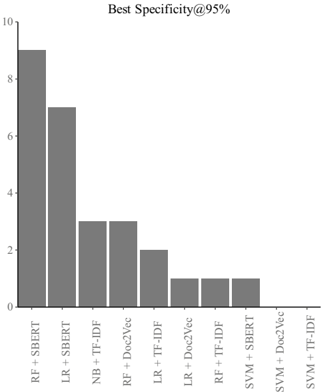
- Across algorithms, abstract screening with learning algorithms reduced screening workload of irrelevant records by 58% (SD = 19%) on average and saved an estimated 1.66 days (SD = 1.80); the abstract reports RF+SBERT outperformed other algorithms, while the results table shows LR+SBERT had the highest mean specificity@95% (65%, SD = 18%) and ETS@95% (1.80 days, SD = 1.94).
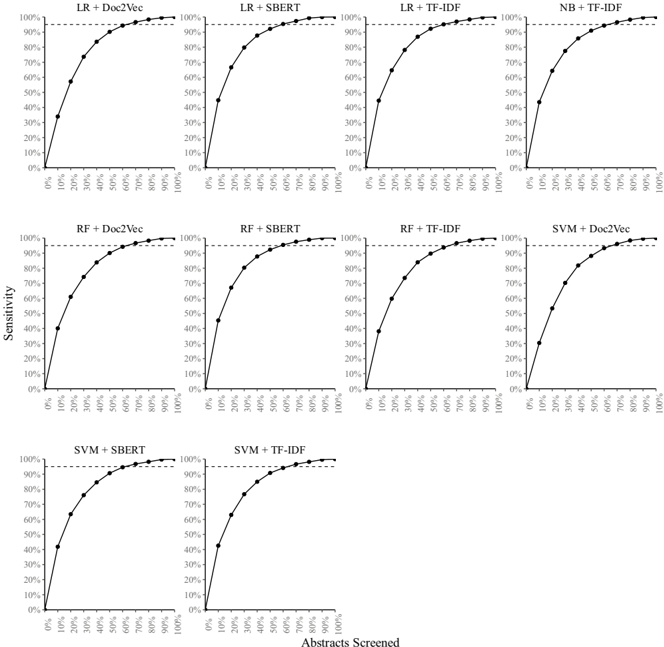
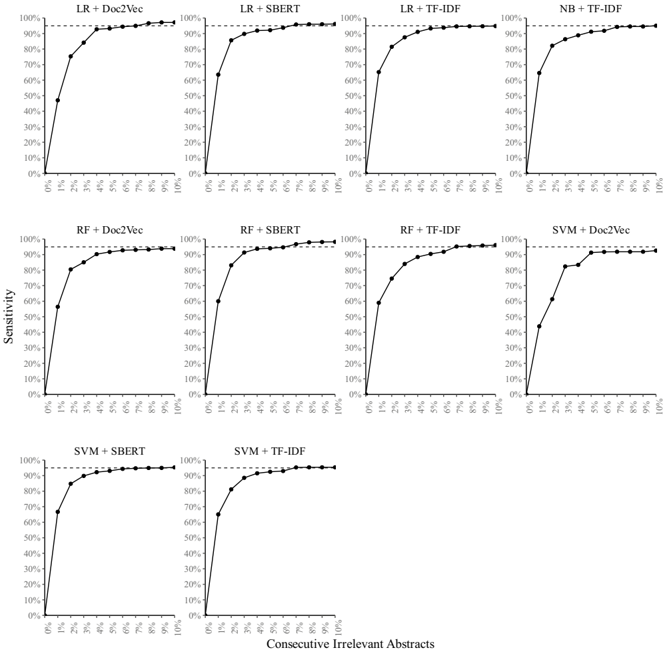
- For heuristic stopping, 95% of relevant abstracts could be retrieved: time-based screening required reviewing an average of 70% of abstracts (saving 0.86 days, SD = 0.73; avoiding 36%, SD = 6%, of irrelevant abstracts); data-driven stopping required classifying an average of 7% consecutive irrelevant abstracts (saving 1.04 days, SD = 1.47; avoiding 38%, SD = 27%, of irrelevant abstracts).
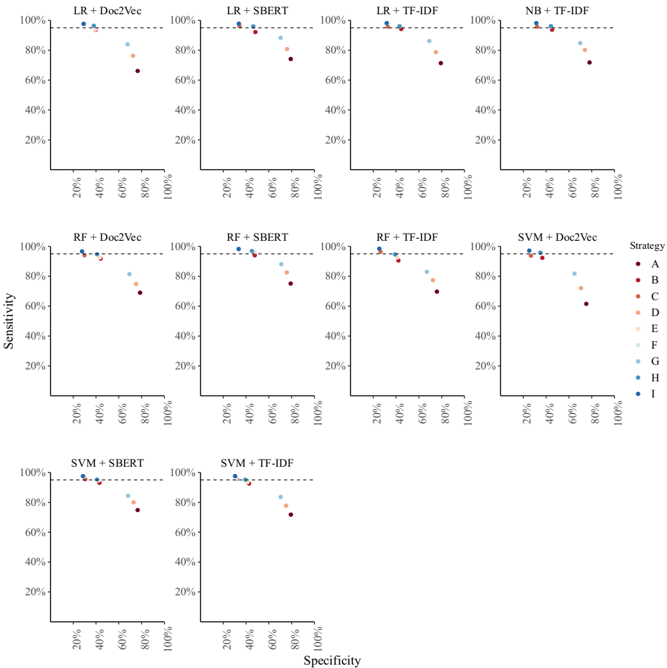
- The mixed rule stopping after 20% of records screened and 5% consecutive irrelevant records (group E) yielded the highest specificity among mixed rules (M = 42%, SD = 28%) while maintaining ≥95% sensitivity; RF+SBERT had highest average sensitivity (92%, SD = 8%) and specificity (52%, SD = 19%) across mixed strategies, and SVM+Doc2Vec lowest (87%, SD = 13%; 44%, SD = 20%).
- Exploratory correlations: database length positively correlated with model specificity (ρ = .35, 95% CI [0.22, 0.48]); proportion of relevant studies negatively correlated with specificity (ρ = −.65, 95% CI [−0.72, −0.58]).
Methods
- Retrospective screening simulation using 27 abstract collections from systematic reviews/meta-analyses in education and educational psychology; datasets averaged 2,738 studies (SD = 2,382), with 18.75% (SD = 15.89%) selected for full-text screening.
- Used ASReview simulation mode with 10 learning algorithms combining feature extraction (Doc2Vec, SBERT, TF-IDF) and classifiers (NB, LR, RF, SVM), default dynamic resampling and certainty-based sampling, yielding 270 simulation runs; initial training set was one randomly selected included and one excluded study, held constant.
- Evaluated sensitivity, specificity, and estimated time savings at 95% sensitivity for algorithms, and for time-based (10–100% screening intervals), data-driven (1–10% consecutive irrelevant), and mixed heuristic stopping criteria; analyses used R 4.2.3 and ASReview Makita.
Limitations
- Stated: the sample was heterogeneous but neither exhaustive nor representative; many included reviews were unpublished/not peer reviewed, so caution is needed in extrapolating to all education/educational psychology systematic reviews.
- Stated: the initial training set was randomly selected and held constant across simulation conditions; future work should vary/expand it, and the study should be extended to other algorithms and statistical stopping criteria.
- Stated/evident: heuristic stopping rules were developed with knowledge of true relevant records and their performance depended on database size, proportion of relevant papers, topic complexity, and algorithm, so they should not be generalized to databases where the number of relevant records is unknown.
Model-written summary. Check it against the paper before relying on it.
Integrity signals
Registry
Cites
Statistics
Figures



Verification
Claims the paper makes
26 Valid · 3 Not valid · 6 Not checked · 88 Own results and interpretations
Some cited sources support this claim and some don’t — read each source’s verdict below.
In the paper
“The former estimates the stopping criteria based on the derivation of an estimate of the total number of relevant papers within an initial training set and is considered more reliable than the latter (Cormack & Grossman, 2016; van Haastrecht et al., 2021).”
What the sources say
- Disputedcites Cormack & Grossman, 2016 matched to “Engineering Quality and Reliability in Technology-Assisted Review” (2016) sourceExperimental — accuracy not yet measured
The Introduction describes the statistical target method as provably reliable, but says the geometric knee method has similar empirical reliability and the budget method has superior empirical reliability. The Discussion likewise reports that the budget method was more reliable than the target method on the test collections. The paper therefore does not support a general ranking of statistical stopping criteria above heuristic ones. (LLM, conf=0.88)
Checked by a reasoning model — may be wrong.
- Supportedcites van Haastrecht et al., 2021 matched to “SYMBALS: A Systematic Review Methodology Blending Active Learning and Snowballing” (2021) source
Section 3.3 describes stopping criteria based on estimating the total number of relevant papers in the starting set. It says these criteria solve issues with simpler criteria, which it does not consider best practice, and recommends investigating more mathematically grounded approaches. (LLM, conf=0.90)
plainstates an association- Asserted: passes — The authors put it forward as true.
- Checkable: passes — It can be checked against evidence.
- Load-bearing: unclear — It is unclear whether the paper’s conclusions depend on it.
- Based: passes — The paper gives a reason why it holds.
- Disputed
Some cited sources support this claim and some don’t — read each source’s verdict below.
In the paper
“as their development depends on knowledge of the true relevant records (Callaghan & Müller-Hansen, 2020; Hamel et al., 2021).”
What the sources say
- Partly supportedcites Callaghan & Müller-Hansen, 2020 matched to “Statistical stopping criteria for automated screening in systematic reviews” (2020) sourceExperimental — accuracy not yet measured
In the Methods review (page not available), the paper says that developing one pragmatic stopping criterion—stopping after half the documents have been screened—depended on knowing the true relevance values. It describes heuristic criteria separately as stopping after a specified run of irrelevant records, so it does not support the claim that heuristic stopping rules generally depend on that knowledge. (LLM, conf=0.87)
- Disputedcites Hamel et al., 2021 matched to “Guidance for using artificial intelligence for title and abstract screening while conducting knowledge syntheses” (2021) sourceExperimental — accuracy not yet measured
Step 7, “Truncation of screening” (page not provided), describes a heuristic stopping rule based on a run of consecutively reviewed irrelevant records, not knowledge of all truly relevant records. It discusses unknown true recall separately in connection with a more complex, estimated-recall stopping decision. (LLM, conf=0.85)
Checked by a reasoning model — may be wrong.
plainstates a cause- Asserted: passes — The authors put it forward as true.
- Checkable: passes — It can be checked against evidence.
- Load-bearing: passes — The paper’s conclusions depend on it.
- Based: passes — The paper gives a reason why it holds.
- Partly supported
The sources with a verdict support this claim; the rest weren’t checked yet, have no full text we could read, or their verdicts aren’t rated yet.
In the paper
“In contrast, the conceptual clarity of constructs commonly used in education and educational psychology has been recently criticized (Bringmann et al., 2022; Flake & Fried, 2020; Marsh et al., 2019).”
What the sources say
- Not checked yetcites Bringmann et al., 2022 matched to “Back to Basics: The Importance of Conceptual Clarification in Psychological Science” (2022) source
Checked before — its earlier verdict is held back until a new check runs.
- Not checked — no full text of the sourcecites Flake & Fried, 2020 matched to “Measurement Schmeasurement: Questionable Measurement Practices and How to Avoid Them” (2020) source
- Supportedcites Marsh et al., 2019 matched to “The murky distinction between self-concept and self-efficacy: Beware of lurking jingle-jangle fallacies.” (2019) source
In “Generalizability of Conclusions: Limitations and Directions for Further Research” (page not provided), the paper describes a lack of clarity in key constructs underpinning educational psychology research. This directly supports the cited claim. (LLM, conf=0.94)
plain- Asserted: passes — The authors put it forward as true.
- Checkable: passes — It can be checked against evidence.
- Load-bearing: passes — The paper’s conclusions depend on it.
- Based: passes — The paper gives a reason why it holds.
- Not checked yet
The cited sources support only part of this claim — read each source’s verdict below.
In the paper
“In contrast, Callaghan and Müller-Hansen (2020) found that data-driven approaches could not find 95% of all relevant records in 39% of the 20 systematic reviews analyzed.”
What the sources say
- Partly supportedcites Callaghan and Müller-Hansen (2020) matched to “Statistical stopping criteria for automated screening in systematic reviews” (2020) sourceExperimental — accuracy not yet measured
The Results report that the baseline sampling stopping criterion missed the 95% recall target in 39.67% of cases. The Methods (Evaluation) say each criterion was tested over 100 iterations per dataset, so this is not a finding that 39% of 20 reviews failed. The Results also report that the paper’s random and ranked sampling criteria achieved the target in more than 95% of cases; the claim overgeneralizes the baseline result to data-driven approaches as a whole. (LLM, conf=0.90)
plain- Asserted: passes — The authors put it forward as true.
- Checkable: passes — It can be checked against evidence.
- Load-bearing: passes — The paper’s conclusions depend on it.
- Based: passes — The paper gives a reason why it holds.
- Partly supported
The cited sources support only part of this claim — read each source’s verdict below.
In the paper
“Second, existing tools lack the flexibility to handle the wide range of classifiers and feature extraction techniques that can be implemented in ML screening tools effectively(van de Schoot et al., 2021).”
What the sources say
- Partly supportedcites van de Schoot et al., 2021 matched to “An open source machine learning framework for efficient and transparent systematic reviews” (2021) sourceExperimental — accuracy not yet measured
In the passage labelled “Not available” (page unavailable), the paper says that, to its knowledge, existing tools lack flexibility for the range of concepts encountered in screening and that successful systems need a wide range of classifier types. The “Software implementation for ASReview” section lists multiple feature-extraction techniques in ASReview, but does not establish that existing tools lack flexibility specifically for those techniques. (LLM, conf=0.84)
plain- Asserted: passes — The authors put it forward as true.
- Checkable: passes — It can be checked against evidence.
- Load-bearing: passes — The paper’s conclusions depend on it.
- Based: passes — The paper gives a reason why it holds.
- Partly supported
74 more claims · 10 with their cited sources checked
Create a free account to see all 123 claims and to verify the 5 references still open.
- Probably not a substantial claim. 26
- It may state two separate claims as one. 27
- The quote only partly states this claim. 1
Self-check
Percentages, sums and reported differences re-computed from the paper’s own numbers.
Each contradiction between two passages listed here was confirmed by an independent check.
Rated minor: it would not touch a result — a value no result rests on, a p-value that stays on the same side of the significance level, or a conflict that is clerical, resolved elsewhere in the paper, or outside its own findings.
In the paper
§ Mixed Strategy
“a positive correlation between the sensitivity achieved by the mixed-based heuristic stopping criteria and the number of relevant studies in an abstract collection in groups C, F, I, and G”
§ Mixed Strategy
“ρ = - 0.50, 95% CI [- 0.77, - 0.09]”
Rated minor: it would not touch a result — a value no result rests on, a p-value that stays on the same side of the significance level, or a conflict that is clerical, resolved elsewhere in the paper, or outside its own findings.
In the paper
§ Time Strategy
“| 100% | 100% | 100% | 0% | 0% | 0% | 1% | 0 | 0 | 0 |”
§ Data Analysis
“Specificity (true negative rate): The proportion of studies in an abstract collection that would not require screening by reviewers when using learning algorithms out of the total deemed irrelevant by the authors of the systematic review”
Citations
Cites
Efficient Estimation of Word Representations in Vector Space
Mikolov, T., Chen, K., Corrado, G., & Dean, J. (2013) · arXiv · doi:10.48550/arxiv.1301.3781 · Cited by 26,568
Distributed Representations of Words and Phrases and their Compositionality
Mikolov, T., Sutskever, I., Chen, K., Corrado, G., & Dean, J. (2013) · arXiv · doi:10.48550/arxiv.1310.4546 · Cited by 24,533 · cited 2×
“In contrast, word embed-dings capture the semantic meaning of words by representing them as dense vectors in a continuous space, trained on large text corpora (Mikolov, Chen, et al., 2013; Mikolov, Sutskever, et al., 2013).”
Book Review: Pattern Recognition and Machine Learning
Nasrabadi, N. M. (2007) · Journal of Electronic Imaging · doi:10.1117/1.2819119 · Cited by 22,066
Hosmer, D. W., Lemeshow, S., & Sturdivant, R. X. (2013) · Wiley Series in Probability and Statistics · doi:10.1002/9781118548387 · Cited by 13,861
Sentence-BERT: Sentence Embeddings using Siamese BERT-Networks
Reimers, N., & Gurevych, I. (2019) · Proceedings of the 2019 Conference on Empirical Methods in Natural Language Processing and the 9th International Joint Conference on Natural Language Processing (EMNLP-IJCNLP) · doi:10.18653/v1/d19-1410 · Cited by 12,778 · cited 12×
“Conversely, the RF+SBERT model had a higher frequency of producing the highest specificity values.”
InfluentialClassification And Regression Trees
Breiman, L., Friedman, J. H., Olshen, R. A., & Stone, C. J. (2017) · doi:10.1201/9781315139470 · Cited by 11,417
Pattern Recognition and Machine Learning
(2006) · doi:10.1007/978-0-387-45528-0 · Cited by 9,824
Term-weighting approaches in automatic text retrieval
Salton, G., & Buckley, C. (1988) · Information Processing & Management · doi:10.1016/0306-4573(88)90021-0 · Cited by 9,740 · cited 1×
“BoW and TF-IDF are conventional approaches representing text data as a vector of word or term frequencies, respectively (Harris, 1954; Salton & Buckley, 1988).”
Probabilistic Outputs for Support vector Machines and Comparisons to Regularized Likelihood Methods
Platt, J. C. (1999) · Cited by 6,472
Machine learning: Algorithms, real-world applications and research directions
Sarker, I. H. (2021) · SN Computer Science · doi:10.1007/s42979-021-00592-x · Cited by 5,583
Research works printed but not linked: 3
- Fütterer, T., Tschönhens, F., Scherer, R., Dickhäuser, O., & Ruiz-Primo, M. A. (2023). Teachers' selfassessment ability-A systematic literature review and meta-analysis . [Manuscript in preparation]. Faculty of Economic and Social Sciences. University of Tübingen.
- Veletić, J., Rodriguez-Mejia, A. M., & Olsen, R. V. (2023). A systematic literature review of the Teaching and Learning International Survey (TALIS) research . Faculty of Educational Sciences. University of Oslo
- World Health Organization. (2019). The ICD-10 classification of mental and behavioural disorders: Diagnostic criteria for research . World Health Organization.
Cited by
Enhancing peer assessment with artificial intelligence
Topping, K. J., Gehringer, E. F., Khosravi, H., Gudipati, S., Jadhav, K., & Susarla, S. (2025) · International Journal of Educational Technology in Higher Education · doi:10.1186/s41239-024-00501-1 · Cited by 106
Bourke, M., Wang, H., McNaughton, S. A., Thomas, G., Firth, J., Trott, M., & Cairney, J. (2025) · Clinical Psychology Review · doi:10.1016/j.cpr.2025.102585 · Cited by 78
The AI risk repository: A meta-review, database, and taxonomy of risks from artificial intelligence
Slattery, P., Saeri, A. K., Grundy, E. A. C., Graham, J., Noetel, M., Uuk, R., Dao, J., Pour, S., Casper, S., & Thompson, N. (2024) · arXiv · doi:10.48550/arxiv.2408.12622 · Cited by 51
The AI risk repository: A meta-review, database, and taxonomy of risks from artificial intelligence
Slattery, P., Saeri, A. K., Grundy, E. A. C., Graham, J., Noetel, M., Uuk, R., Dao, J., Pour, S., Casper, S., & Thompson, N. (2026) · Patterns · doi:10.1016/j.patter.2026.101517 · Cited by 260
“Based on a review of relevant literature (van de Schoot et al 42 ; e.g., Campos et al. 44 ), we use the Oracle model with the following setup: a fully connected neural network (two hidden layers) model as the classifier and sBert as the feature extractor, maximum as the query strategy, and dynamic resampling (double)…”
InfluentialKönig, L., Zitzmann, S., Fütterer, T., Campos, D., Scherer, R., & Hecht, M. (2023) · doi:10.31234/osf.io/ybu3w · Cited by 33
Self-citationKönig, L., Zitzmann, S., Fütterer, T., Campos, D., Scherer, R., & Hecht, M. (2024) · Research Synthesis Methods · doi:10.1002/jrsm.1762 · Cited by 40
“16,19,26,38,39 Consequently, performance variations may arise when using AI-AS for abstract collections from other research domains.”
InfluentialSelf-citationASReview LAB v.2: Open-source text screening with multiple agents and a crowd of experts
de Bruin, J., Lombaers, P., Kaandorp, C., Teijema, J., van der Kuil, T., Yazan, B., Dong, A., & van de Schoot, R. (2025) · Patterns · doi:10.1016/j.patter.2025.101318 · Cited by 27
“32,39,43 There is also the global stopping condition next to the cycle’s stopping condition, for example, when the end of data is reached or if no more agents are available.”
Machine learning to optimize literature screening in medical guideline development
Harmsen, W., de Groot, J., Harkema, A., van Dusseldorp, I., de Bruin, J., van den Brand, S., & van de Schoot, R. (2024) · Systematic Reviews · doi:10.1186/s13643-024-02590-5 · Cited by 21
Visser, M., Sääksjärvi, K., Burchell, G. L., & Schaap, L. S. (2025) · European Geriatric Medicine · doi:10.1007/s41999-025-01230-y · Cited by 31
“A data-driven approach was used in which the screening process was stopped after screening 20% of the total number of papers, combined with subsequent 5% classification of irrelevant papers [19].”
Eppe, P. S., Niehoff, E., Albers, C. J., & Bouman, T. (2025) · Energy Research & Social Science · doi:10.1016/j.erss.2025.104152 · Cited by 29
Using machine learning for continuous updating of meta-analysis in educational context
Chernikova, O., Stadler, M. J., Melev, I., & Fischer, F. (2024) · Computers in Human Behavior · doi:10.1016/j.chb.2024.108215 · Cited by 22
Fütterer, T., Goldberg, P., Bühler, B., Sikimić, V., Trautwein, U., Gerjets, P. H., Stürmer, K., & Kasneci, E. (2025) · Computers and Education Artificial Intelligence · doi:10.1016/j.caeai.2025.100483 · Cited by 47
Self-citationDo Pedagogical Agents Enhance Student Motivation? Unraveling the Evidence Through Meta-Analysis
Gladstone, J. R., Schroeder, N. L., Heidig, S., Zhang, S., Palaguachi, C., & Pitera, M. (2025) · Educational Psychology Review · doi:10.1007/s10648-025-10050-2 · Cited by 19
“We used ASReview to help with title and abstract screening based on the results of a recent paper (Campos et al., 2024).”
Optimal large language models to screen citations for systematic reviews
Oami, T., Okada, Y., & Nakada, T. (2025) · Research Synthesis Methods · doi:10.1017/rsm.2025.10014 · Cited by 29
“15,17 While machine learning methods for citation screening offer usability advantages, the variability in performance metrics implicates the need for optimizing their implementation.”
Bühler, B., Fütterer, T., von Keyserlingk, L., Bozkir, E., Kasneci, E., Gerjets, P. H., & Trautwein, U. (2025) · Educational Psychology Review · doi:10.1007/s10648-025-10041-3 · Cited by 18
Self-citationMilella, F., & Bandini, S. (2024) · Intelligenza Artificiale · doi:10.3233/ia-240028 · Cited by 17
“Systematic reviews are essential for progressing research, but they need a significant amount of time and resources [14].”
InfluentialBourke, M., Maddren, C. I., Sippel, F., & Thomas, G. (2026) · Archives of Pediatrics and Adolescent Medicine · doi:10.1001/jamapediatrics.2025.6490 · Cited by 25
How to Write Effective Prompts for Screening Biomedical Literature Using Large Language Models
Colangelo, M. T., Guizzardi, S., Meleti, M., Calciolari, E., & Galli, C. (2025) · BioMedInformatics · doi:10.3390/biomedinformatics5010015 · Cited by 14
“Using LLMs to screen the biomedical literature is a promising approach, with the potential of dramatically reducing the burden currently carried by the investigators [21,22,55].”
Wang, X., & Luo, G. (2024) · EdArXiv (OSF Preprints) · doi:10.35542/osf.io/wn3cd · Cited by 12
Romanov, S., Siqueira, A. S., de Bruin, J., Teijema, J., Hofstee, L., & van de Schoot, R. (2024) · Data Intelligence · doi:10.1162/dint_a_00244 · Cited by 7
“For instance, it could imply an examination of the impact of different training datasets [13–15], tests of ML models [16,17,11], or evaluation of multiple datasets [18].”
BackgroundSoong, Y. F., Hollman, H., & Rhodes, R. E. (2025) · International Journal of Behavioral Nutrition and Physical Activity · doi:10.1186/s12966-025-01782-z · Cited by 11
“A data-driven screening strategy can achieve 95% sensitivity, making it a practical stopping criterion [53].”
Beamish, J., Drijver, A. J., & Partanen, M. (2025) · EJC Paediatric Oncology · doi:10.1016/j.ejcped.2025.100237 · Cited by 11
Pedagogical agents in K-12 education: a scoping review
Zhang, S., Jaldi, C. D., Schroeder, N. L., & Gladstone, J. R. (2024) · Journal of Research on Technology in Education · doi:10.1080/15391523.2024.2381229 · Cited by 9
“Specifically, in Campos et al. (2024) published manuscript they note that LR + SBERT achieved 95% sensitivity after screening 60% of the studies (rather than 45% in the pre-print).”
Teijema, J. J., van de Schoot, R., Ferdinands, G., Lombaers, P., & de Bruin, J. (2024) · Software Impacts · doi:10.1016/j.simpa.2024.100663 · Cited by 7
Rumsa, S., Afsharnejad, B., Lee, E. A. L., Bölte, S., Tan, T., & Girdler, S. J. (2025) · Autism · doi:10.1177/13623613251346336 · Cited by 8
“In the present review, a data-driven stopping criterion was applied, where screening continued until 7% of the sample uploaded to the screener was consecutively classified as irrelevant, thereby satisfying the threshold for stopping (Campos et al., 2024).”
Christie, A. P., Martin, P. A., & Taylor, N. G. (2025) · PLoS ONE · doi:10.1371/journal.pone.0326521 · Cited by 6
Ali, F., Tan, A. S.-C., & Wang, S. J.-W. (2025) · Research Synthesis Methods · doi:10.1017/rsm.2024.16 · Cited by 9
“…to learn well from unlike, for example, in medicine where there are highly standardized taxonomies of terms, conditions, symptoms, and so forth 22 Moreover, inclusion and exclusion criteria can be complex and lacking consistency in terms, phrases and constructs, further questioning whether ML…”
InfluentialRepke, T., Tinsdeall, F., Danilenko, D., Graziosi, S., Müller-Hansen, F., Schmidt, L., Thomas, J., & van Valkenhoef, G. (2026) · Cochrane Evidence Synthesis and Methods · doi:10.1002/cesm.70068 · Cited by 11
Cimenti, C., Thøgersen‐Ntoumani, C., Pfeffer, K., Krustrup, P., Schenk, P. M., & Ntoumanis, N. (2025) · International Review of Sport and Exercise Psychology · doi:10.1080/1750984x.2025.2597932 · Cited by 7
Do robots boost productivity? A quantitative meta‐study
Schneider, F. (2025) · Journal of Economic Surveys · doi:10.1111/joes.70042 · Cited by 12
Sparks, J. R., Lehman, B. A., Gladstone, J. R., Zhang, S., Schroeder, N. L., & Israel, M. (2025) · Frontiers in Education · doi:10.3389/feduc.2025.1673500 · Cited by 14
Rajit, D., McDonald, S. J., Du, L., Teede, H. J., & Enticott, J. (2026) · Journal of Clinical Epidemiology · doi:10.1016/j.jclinepi.2026.112349 · Cited by 2
Fortnum, K., Erskine, N., Cairney, J., KWAN, M. Y. W., & Bourke, M. (2026) · Child and Adolescent Mental Health · doi:10.1111/camh.70093 · Cited by 6
König, L., Zitzmann, S., & Hecht, M. (2025) · Research Synthesis Methods · doi:10.1017/rsm.2025.10053 · Cited by 5
“22 However, this decline may be attributed to the relative increase in relevant abstracts, which naturally extends screening time due to the greater number of relevant articles in the dataset.”
InfluentialSelf-citationLousen, I., Johnstone, A., Schipperijn, J., Traynor, O., McCrorie, P., & Pawlowski, C. S. (2025) · Mental Health & Prevention · doi:10.1016/j.mhp.2025.200460 · Cited by 6
Open Schooling in Science Education: A Systematic Literature Review
Cruz-Lorite, I. M., Nikolaou, M., Nisiforou, E. A., & Evagorou, M. (2025) · European Journal of Educational Research · doi:10.12973/eu-jer.14.4.1063 · Cited by 3
Arnette, S. A. (2025) · Equity in Education & Society · doi:10.1177/27526461251360429 · Cited by 4
Semi-automating the Scoping Review Process: Is it Worthwhile? A Methodological Evaluation
Zhang, S., Palaguachi, C., Pitera, M., Jaldi, C. D., Schroeder, N. L., Botelho, A. F., & Gladstone, J. R. (2024) · Educational Psychology Review · doi:10.1007/s10648-024-09972-0 · Cited by 5
“For example, Campos et al. (2024) examined the efficacy of a natural language processing screening tool during the title and abstract screening process.”
InfluentialChernikova, O., Jansen, T., Sailer, M., & Greiff, S. (2024) · Learning and Individual Differences · doi:10.1016/j.lindif.2024.102468 · Cited by 3
Wartenberg, G., Aldrup, K., Grund, S., & Klusmann, U. (2026) · Review of Educational Research · doi:10.3102/00346543261455273 · Cited by 2
Alami, A., Lewis, M., El‐Chaâr, D., Walker, M. C., Wen, S. W., & Krewski, D. R. (2026) · Vaccine · doi:10.1016/j.vaccine.2026.129070 · Cited by 1
de Oliveira, J. M. D., Mello, A. T., Scandolara, D. H., Celuppi, I. C., Rampinelli, V. P. C., Wazlawick, R. S., & Dalmarco, E. M. (2026) · International Journal of Medical Informatics · doi:10.1016/j.ijmedinf.2026.106516 · Cited by 1
Kritz, M., Riddell, H., Olsen, D., Harden, S. M., Burke, S. M., Ntoumanis, N., & Thøgersen‐Ntoumani, C. (2026) · Nature Human Behaviour · doi:10.1038/s41562-026-02429-0 · Cited by 8
“The Research Screener software 53,54 , a validated machine learning tool 53 trained on eligible studies, was used to assist with the initial screening process by auto-mating the exclusion of irrelevant studies.”
Fütterer, T., König, L., Campos, D., Scherer, R., Zitzmann, S., & Hecht, M. (2026) · Advances in Methods and Practices in Psychological Science · doi:10.1177/25152459261442150 · Cited by 2
“…theoretical performance of various screening configurations and was instrumental in the large-scale simulation studies that informed the recommendations presented in this tutorial (Campos et al., 2024; de Bruin et al., 2025; König, Zitzmann, Fütterer, et al., 2024; König, Zitzmann, & Hecht, 2024).”
InfluentialSelf-citationMeasurement instruments in advance care planning: A systematic review of psychometric properties
Zhang, C., Barrios, M., Berrío, Á. I., & Guilera, G. (2026) · International Journal of Nursing Studies Advances · doi:10.1016/j.ijnsa.2026.100518 · Cited by 1
“Screening was stopped after reviewing 20 % of records ( n = 954) and reaching a 5 % threshold of consecutively irrelevant articles ( n = 239), following the stopping rule described by Campos et al. (2024).”
Giannakis, P., Memtsoudis, S. G., Liu, J., Soffin, E. M., Rowe, J., Hargett, M. J., Poeran, J., & Cozowicz, C. (2026) · Regional Anesthesia & Pain Medicine · doi:10.1136/rapm-2025-107451 · Cited by 1
Afamefuna, K., Schweiker, M., & Harmsen, J. (2026) · European Review of Applied Psychology · doi:10.1016/j.erap.2025.101140 · Cited by 4
ASReview Dory: Bringing new and exciting models to ASReview LAB
van der Kuil, T., Teijema, J. J., Bruin, J. D., & van de Schoot, R. (2026) · Software Impacts · doi:10.1016/j.simpa.2025.100809 · Cited by 2
Simulation-based active learning for systematic reviews: A scoping review of literature
Teijema, J. J., Ribeiro, G., Seuren, S., Anadria, D., Bagheri, A., & van de Schoot, R. (2025) · Journal of Information Science · doi:10.1177/01655515251379058 · Cited by 1
Doolan, M., Cox, K. M., & Sarma, K. M. (2025) · Campbell Systematic Reviews · doi:10.1002/cl2.70076 · Cited by 1
“The DistillerSR AML includes a predictive reporting tool, which estimates the number of relevant records identified, and allows reviewers to set a ‘ stop screening ’ rule, which is typically set at 95% recall (Campos et al. 2024; Hamel et al. 2021).”
Peer Intervention in Obesity and Physical Activity: Effectiveness and Implementation
Topping, K. J. (2025) · Current Obesity Reports · doi:10.1007/s13679-025-00625-z · Cited by 4
“Campos, et al. [3] found that 95% of all relevant abstracts within a given dataset could be retrieved using heuristic rules such as stopping the screening process after classifying 20% of records.”
Rigo, D., Fehring, L., Mortsiefer, A., & Meister, S. (2025) · JMIR Formative Research · doi:10.2196/68276 · Cited by 8
PASHA, M., & Shaikᵇ, M. A. (2026) · Research Square · doi:10.21203/rs.3.rs-10938971/v1
Li, W., An, X., Zhang, Y., Liu, W., & Zhao, H. (2026) · Maturitas · doi:10.1016/j.maturitas.2026.109109
Steijger, D. J. M., Thissen, S., Aarts, S., Verbeek, H., de Vugt, M. E., & Christie, H. L. (2026) · JMIR Formative Research · doi:10.2196/84989
“However, a lack of dataset availability can hinder reproducibility [23,33].”
Barragán, A. M., Bonett, S. E. O., Rodríguez-Grande, E.-I., Orjuela-Cañón, Á. D., Perdómo, O., & Sánchez, G. (2026) · Cochrane Evidence Synthesis and Methods · doi:10.1002/cesm.70098
“…using classical review techniques ( n = 91) [8, 9, 16, 18, 29, 30, 32–36, 38, 39, 41, 43, 46, 47, 49–52, 54–56, 61, 64, 67–69, 72–74, 77, 80–90, 97, 100–102, 106, 107, 110–112, 114–117, 121, 123, 125, 127, 129, 131–136, 138, 140, 142–144, 147, 151, 153, 154, 156–159, 162, 165–168, 170–173, 175].”
Flegr, S., Fabian, A., & Fütterer, T. (2026) · Learning and Individual Differences · doi:10.1016/j.lindif.2026.102955 · Cited by 1
Self-citationLi, X., Alexandrov, N., Veltman, Y., van Walsum, T., Bos, D., Majoie, C. B. L. M., van Zwam, W. H., Dippel, D. W. J., Roozenbeek, B., Lingsma, H. F., et al. (2026) · Journal of NeuroInterventional Surgery · doi:10.1136/jnis-2026-025297
Shankar, R., Goh, Z., & Xu, Q. (2026) · Campbell Systematic Reviews · doi:10.1177/18911803261469813
“Studies with smaller training sets (Bravo et al., 2021) or imbalanced class distributions (Campos et al., 2024) reported lower performance metrics compared to those with larger and more balanced datasets.”
Influentialvan der Kleij, R., Spinnler, O., Broderick-Hale, J., Hendriks, K., Drenth, A., & van Wijgerden, J. (2026) · Computers in Human Behavior · doi:10.1016/j.chb.2026.109127
Müller-Eberstein, R., & Barnes, B. (2026) · Research Square · doi:10.21203/rs.3.rs-9789751/v1
Chow, J. C., & Martinez, R. G. (2026) · Educational Psychology Review · doi:10.1007/s10648-026-10152-5
“For example, Educational Psychology Review published a paper demonstrating comparative meth-ods for abstract screening using machine learning by testing the sensitive, specificity, and the estimated time savings based on a series of stopping criteria (see Campos et al., 2024 ).”
Qin, W., Xu, F., Gu, C., Xiaomeng, Y. A. N. G., Yu, Y., Peng, J., Li, J., & Hu, B. Y. (2026) · Thinking Skills and Creativity · doi:10.1016/j.tsc.2026.102215 · Cited by 1
KI-assisterte systematiske kunnskapsoppsummeringer i økonomi- og ledelsesforskning
Karlstrøm, H., & Wollscheid, S. (2026) · Praktisk økonomi & ledelse · doi:10.18261/pol.42.1.6
Rajit, D., McDonald, S. J., Mousa, A., Tay, C. T., Du, L., Teede, H. J., & Enticott, J. (2026) · Journal of Clinical Epidemiology · doi:10.1016/j.jclinepi.2026.112228
Thomas, G., Alley, S., Browne, M., Baumann, H., Duncan, M. J., Vandelanotte, C., & Gilson, N. D. (2026) · Digital Health · doi:10.1177/20552076261455158
“…heuristic rules such as time-based thresholds or consecutive-irrelevant counts have been shown to capture most relevant studies with reduced workload, 18 while simulation studies emphasise that effectiveness depends strongly on dataset prevalence rather than the choice of learning algorithm.”
Bourke, M., Harrison, Z., Staton, S., Rossa, K. R., & Smith, S. S. (2026) · Sleep Medicine Reviews · doi:10.1016/j.smrv.2026.102232 · Cited by 5
Editorial: Reviews in educational psychology
Díaz-Burgos, A., Sánchez, J. N. G., Álvarez-Fernández, M.-L., de la Fuente, J., Kauffman, D. F., & Hsu, T. (2025) · Frontiers in Psychology · doi:10.3389/fpsyg.2025.1647910
Simpamba, M. M., Chiluba, B. C., Colgrove, Y., Wamunyima, M., & Munalula‐Nkandu, E. (2025) · PLoS ONE · doi:10.1371/journal.pone.0312969
“While statistical approaches involve estimating the stopping criteria based on the total number of relevant abstracts in the data set, the heuristic approaches consist of two methods namely time-based and data-driven approaches [34].”
Facilitating meta-analysis inclusion decisions with Elicit AI
Iselin, A.-M. R., DeCoster, J., & Xu, X. (2025) · Current Psychology · doi:10.1007/s12144-025-08239-3
“AI can enhance and expedite several stages in a meta-analysis (Campos et al., 2024; Chernikova et al., 2024; Marshall et al., 2020), but evaluations of whether it is useful for reviewing full texts for inclusion are needed (Blaizot et al., 2022).”
ASReview LAB v2: Open-Source Text Screening with Multiple Agents and OraclesPreprint
Bruin, J. D., Lombaers, P., Kaandorp, C., Teijema, J. J., van der Kuil, T., Yazan, B., Dong, A., & van de Schoot, R. (2025) · SSRN Electronic Journal · doi:10.2139/ssrn.5136987
Conversational Agents in the Legal Domain: A Systematic Review of the Literature
Magni, M., & Milella, F. (2025) · Lecture notes in networks and systems · doi:10.1007/978-3-031-84460-7_12 · Cited by 1
van der Kleij, R., Spinnler, O., Broderick-Hale, J., Hendriks, K., Drenth, A., & van Wijgerden, J. (2025) · SSRN Electronic Journal · doi:10.2139/ssrn.5634456
Metadata
- Authors
- Campos, D. G., Fütterer, T., Gfrörer, T., Lavelle-Hill, R., Murayama, K., König, L., Hecht, M., Zitzmann, S., & Scherer, R.
- Affiliations
- University of Oslo (NO)
- University of Tübingen (DE)
- University of Copenhagen (DK)
- Helmut Schmidt University (DE)
- Corresponding author
- Campos, Diego G.
- ORCID
- Venue
- Educational Psychology Review
- Published
- 2024-02-08
- Volume
- 36
- Issue
- 1
- ISSN
- 1040-726X (ISSN-L)
- 1573-336X
- OpenAlex
- W4391653771
- Cited by
- 75
- References
- 74
- Citations by year
- 2026: 33 · 2025: 32 · 2024: 10
- FWCI
- 9.43
- Type
- journal article
- Language
- en
- Open access
- hybrid
- doi.org
- Licence
- cc-by
- creativecommons.org/licenses/by/4.0 (tdm)
- creativecommons.org/licenses/by/4.0 (vor)
- Locations
- Educational Psychology Review (publishedVersion, cc-by)
- Research at the University of Copenhagen (University of Copenhagen) (publishedVersion, cc-by)
- NORA - Norwegian Open Research Archives (submittedVersion, cc-by)
- Funders
- University of Oslo
- Topics
- Social Sciences › Decision Sciences › Statistics, Probability and Uncertainty › Meta-analysis and systematic reviews
- Physical Sciences › Computer Science › Information Systems › Information Retrieval and Search Behavior
- Social Sciences › General Social Sciences › Computational and Text Analysis Methods
- Keywords
- systematic review screening, abstract screening, random forest, BERT, educational research, educational psychology, sensitivity and specificity, time savings
About these checks
Registry, retraction, Cites and statistics results are computed, not judged, with one exception: a printed reference that no index lists is read once by a model before it counts as a citation error. Claims are extracted by a model and kept only when their quote appears verbatim in the text; each cited source is then checked, with a model’s help, for whether it says what the claim relies on. Those verdicts can be wrong — read the claim’s quote and the cited source before relying on one.
The claim verdicts this report counts are experimental: their accuracy is not yet measured.
A language model drew the claims from the paper on 2026-09-29, under version 3 of the claim definition (model deepseek-v4.1-flash, prompt extract-v3).
A second model labelled each claim on 2026-09-29 (model jev-1.13-20260917, definition revision gold-guideline-v0.2).
Cited sources are checked with a language model’s help (gpt-6-sol).
Statistics and arithmetic are recomputed, not judged.
Confidence bands are shown only for fields calibrated on our annotated test set. None is calibrated yet, so no band is shown.
What counts as a claim ›How we measure confidence ›How we check this ›
Are you an author, or do you see a problem with this page? Request a review
Data sources
Bibliographic data: Semantic Scholar, OpenAlex, Crossref.
Contains information from the Semantic Scholar Academic Graph Datasets, made available under the ODC Attribution License (ODC-BY 1.0).
Semantic Scholar’s data is described in: Kinney, R., et al. (2023). The Semantic Scholar Open Data Platform. arXiv:2301.10140.
