

Cybervetting job applicants on social media: the new normal?
Open accessPublished version of a preprint
The DOI matches its Crossref record; 121 of the 130 references it cites were found in a registry or an index; 7 of the 48 sources its claims cite were checked for support.
Abstract
Abstract With the introduction of new information communication technologies, employers are increasingly engaging in social media screening, also known as cybervetting, as part of their hiring process. Our research, using an online survey with 482 participants, investigates young people’s concerns with their publicly available social media data being used in the context of job hiring. Grounded in stakeholder theory, we analyze the relationship between young people’s concerns with social media screening and their gender, job seeking status, privacy concerns, and social media use. We find that young people are generally not comfortable with social media screening. A key finding of this research is that concern for privacy for public information on social media cannot be fully explained by some “traditional” variables in privacy research. The research extends stakeholder theory to identify how social media data ethics should be inextricably linked to organizational practices. The findings have theoretical implications for a rich conceptualization of stakeholders in an age of social media and practical implications for organizations engaging in cybervetting.
Overview
CoChat Summary
TL;DR
Using an online survey of 482 undergraduate students at a Canadian university, this study examines young people’s comfort with employers’ cybervetting of publicly available social media data through stakeholder theory. It finds about half were uncomfortable, and most traditional predictors—gender, job-seeking status, number of public accounts, and privacy-setting knowledge—did not explain comfort; only collection concerns and prior privacy invasion did.
Key findings
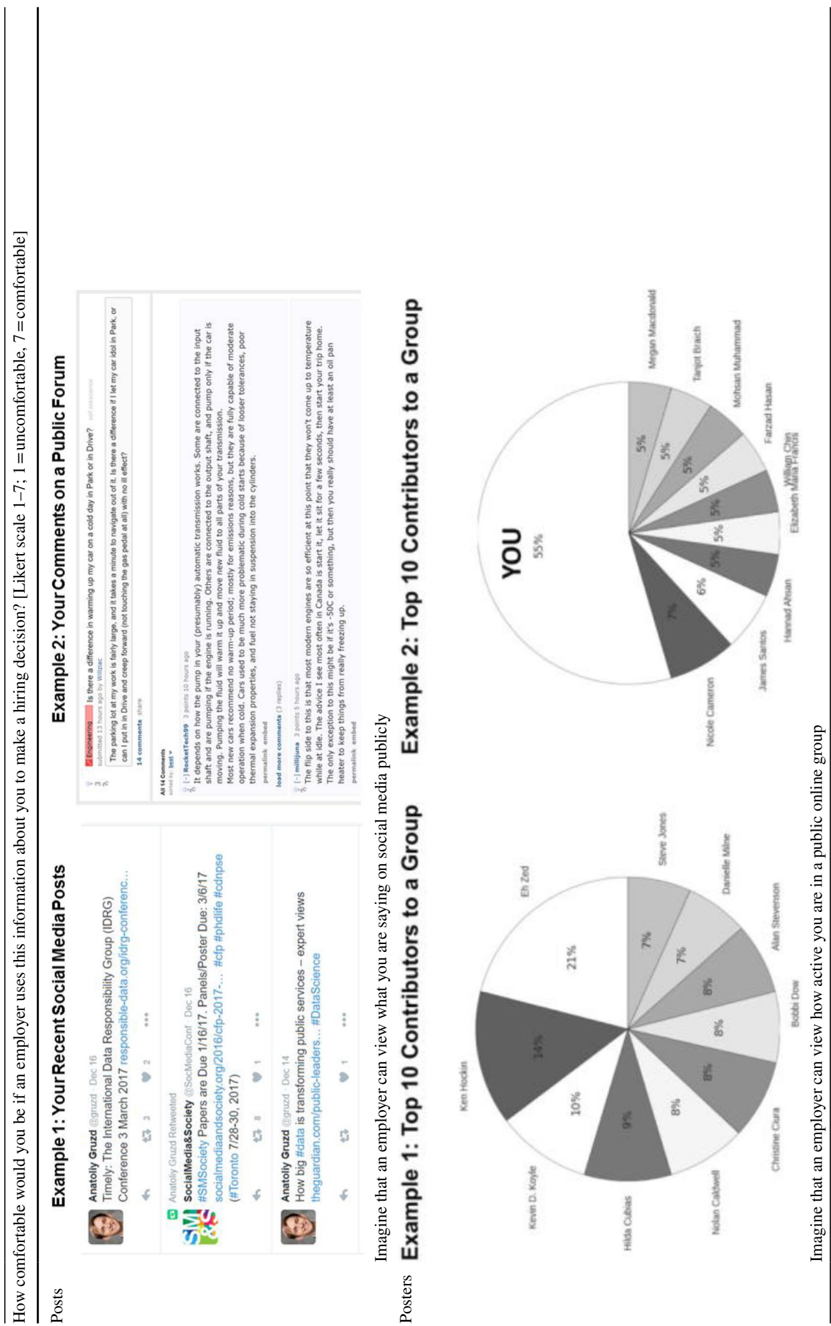
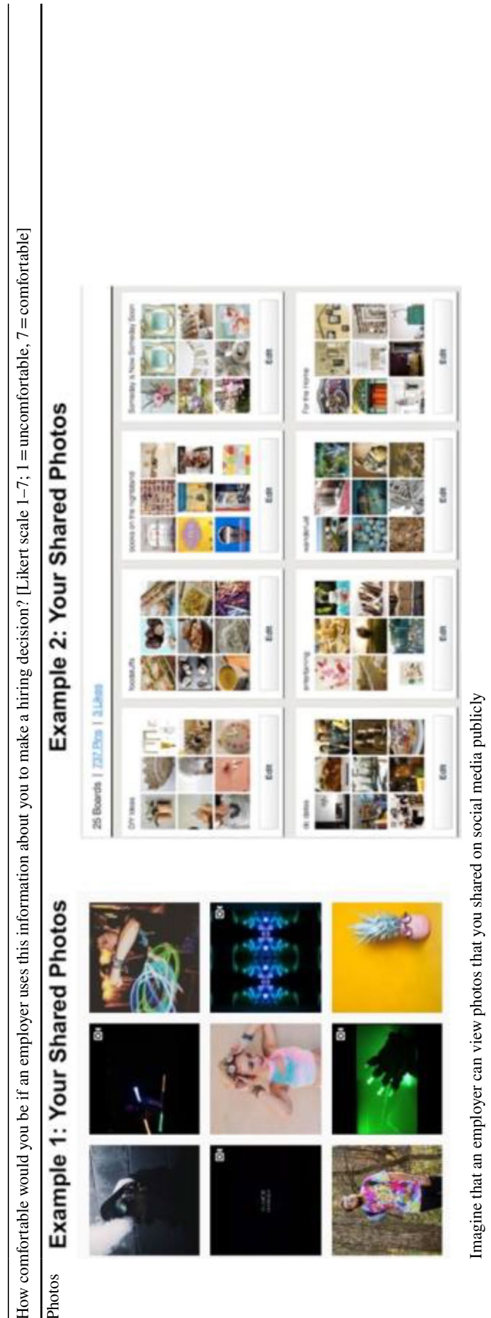
- About half of participants were uncomfortable with social media screening: 49.6% for public posts, 53.1% for photos, and 41.7% for top posters; mean comfort was 3.60 for posts, 3.88 for posters, and 3.44 for photos on a 1–7 scale.
- The regression model explained only 4.3% of the variance in comfort (adjusted R² = 0.043). The study rejected H1 (gender), H2 (job-seeking status), H3 (number of public accounts), and H6 (knowledge of privacy settings); it accepted H4 only partially (Collection concern was significant and negative, Error was not) and accepted H5 (prior privacy invasion was significant and negative).
- 26.3% of participants did not know the privacy setting on at least one social media account; participants had a presence on an average of six platforms, with three primarily public and three primarily private.
- 28.4% reported having experienced an invasion of privacy on social media, while 71.6% had not.
Methods
- Online survey open January 21–April 11, 2017, drawn from an undergraduate student research participant pool at a Canadian university; 556 responses were cleaned to 482 after removing duplicates, failed attention checks, and completions under 3 minutes.
- The dependent variable (HRComf) was the mean comfort rating for three publicly available data types—top posters, posts, and photos—using a 7-point scale (1 = uncomfortable, 7 = comfortable). Independent variables included gender, employment-seeking status, number of public accounts, Concern for Social Media Information Privacy dimensions (Collection and Errors), prior privacy invasion, and number of “unsure” privacy-setting accounts.
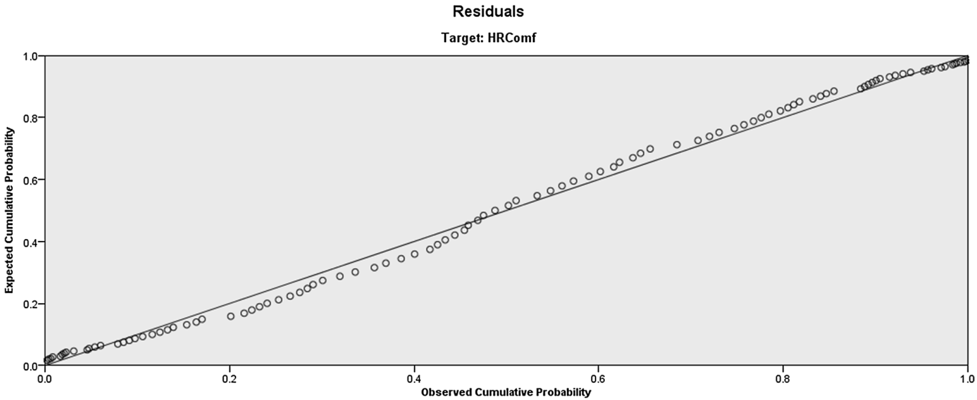
- Analysis used SPSS Version 24 Automatic Linear Modeling with best subsets and adjusted R²; residual normality was checked with a P-P plot, and multicollinearity was acceptable (all VIFs < 1.15).
Limitations
- Stated in the paper: the sample of 482 students at one Canadian university limits generalizability; quantitative data cannot explain why people are comfortable or uncomfortable; the survey did not use participants’ own data, which may have produced different results.
- Evident from the text: the sample is young (92.9% under 25), predominantly Canadian (90%), and undergraduate, so findings may not extend to other age groups or populations; the model’s very low explanatory power suggests unmeasured factors; and the two participants who identified as trans*, non-binary, two-spirit, genderqueer, or other were excluded from the statistical model due to small sample size.
Model-written summary. Check it against the paper before relying on it.
Integrity signals
Registry
Cites
Statistics
Figures




Verification
Claims the paper makes
7 Valid · 0 Not valid · 29 Not checked · 86 Own results and interpretations
The sources with a verdict support this claim; the rest weren’t checked yet, have no full text we could read, or their verdicts aren’t rated yet.
In the paper
“Although Cronbach's Alpha, rho A, and Composite Reliability were within the acceptable thresholds for all dimensions (Henseler et al. 2016; Hair et al. 2017)”
What the sources say
- Supportedcites Henseler et al. 2016 matched to “Using pls path modeling in new technology research: updated guidelines” (2016) source
Table I (p. 12) gives an acceptable internal-consistency threshold of 0.7 for ρA, composite reliability (ρc), and Cronbach’s α. The cited paper supports the thresholds; the statement that the citing study’s dimensions met them is the citing authors’ own result. (LLM, conf=0.90)
- Not checked — no full text of the sourcecites Hair et al. 2017 matched to “An updated and expanded assessment of PLS-SEM in information systems research” (2017) source
plain- Asserted: passes — The authors put it forward as true.
- Checkable: passes — It can be checked against evidence.
- Load-bearing: passes — The paper’s conclusions depend on it.
- Based: passes — The paper gives a reason why it holds.
- Supported
Every source the paper cites for this claim was checked and supports it.
In the paper
“previous research confirms that young people have high awareness of employers' use of social media for screening (Hurrell et al. 2017)”
What the sources say
- Supportedcites Hurrell et al. 2017 matched to “‘The kids are alert’: Generation Y responses to employer use and monitoring of social networking sites” (2017) source
The Conclusions state 'The high levels of awareness shown within this study suggest that many Generation Y employees and job applicants are attuned to the potential for employer misuse of their data and take appropriate action,' and that 'Many of this young sample, displayed alertness to the potential for employers to blur the work-life boundary via SNSs.' The Discussion (RQ1/RQ3b) reports widespread respondent-reported employer SNS use for recruitment (32%) and screening job applicants (21%), with over half managing their online profiles with employers in mind, i.e. alert to employer access. The paper's awareness finding is framed around employer use/monitoring of SNS data generally (screening included); the separate point that under a third of respondents said applicants were explicitly informed of screening concerns employer disclosure, not young people's awareness, so it does not undercut the claim. (LLM, conf=0.82)
boosted- Asserted: passes — The authors put it forward as true.
- Checkable: passes — It can be checked against evidence.
- Load-bearing: unclear — It is unclear whether the paper’s conclusions depend on it.
- Based: passes — The paper gives a reason why it holds.
- Supported
The sources with a verdict support this claim; the rest weren’t checked yet, have no full text we could read, or their verdicts aren’t rated yet.
In the paper
“prior research on potential job applicants has analyzed organizational attractiveness (Greening and Turban 2000; Tsai and Yang 2010; Turban and Greening 1997), but has largely neglected the perspectives on the hiring process itself.”
What the sources say
- Supportedcites Greening and Turban 2000 matched to “Corporate Social Performance As a Competitive Advantage in Attracting a Quality Workforce” (2000) source
The citation is attached to the statement that prior research on potential job applicants analyzed organizational attractiveness. The Discussion reports that this study investigated prospective applicants’ attraction to firms and found that firms with higher CSP were perceived as more attractive employers. The subsequent claim about neglect of the hiring process is the citing authors’ framing, not the part directly attributed to this paper. (LLM, conf=0.93)
- Not checked — no full text of the sourcecites Tsai and Yang 2010 matched to “Does Image Matter to Different Job Applicants? The influences of corporate image and applicant individual differences on organizational attractiveness” (2010) source
- Not checked — no full text of the sourcecites Turban and Greening 1997 matched to “CORPORATE SOCIAL PERFORMANCE AND ORGANIZATIONAL ATTRACTIVENESS TO PROSPECTIVE EMPLOYEES.” (1997) source
plain- Asserted: passes — The authors put it forward as true.
- Checkable: passes — It can be checked against evidence.
- Load-bearing: passes — The paper’s conclusions depend on it.
- Based: passes — The paper gives a reason why it holds.
- Supported
A result the paper reports from its own data — it cites no other source for it, so there is none to check. The quote shows it is in the paper.
In the paper
“We find that young people are generally not comfortable with social media screening.”
plainn = 482- Asserted: passes — The authors put it forward as true.
- Checkable: passes — It can be checked against evidence.
- Load-bearing: passes — The paper’s conclusions depend on it.
- Based: passes — The paper gives a reason why it holds.
A result the paper reports from its own data — it cites no other source for it, so there is none to check. The quote shows it is in the paper.
In the paper
“A key finding of this research is that concern for privacy for public information on social media cannot be fully explained by some 'traditional' variables in privacy research.”
plainn = 482- Asserted: passes — The authors put it forward as true.
- Checkable: passes — It can be checked against evidence.
- Load-bearing: passes — The paper’s conclusions depend on it.
- Based: passes — The paper gives a reason why it holds.
52 more claims
Create a free account to see all 122 claims and to verify the 6 references still open.
- Probably not a substantial claim. 53
- It may state two separate claims as one. 28
- The quote only partly states this claim. 2
Citations
Cites
The Presentation of Self in Everyday Life.
Naegele, K. D., & Goffman, E. (1956) · American Sociological Review · doi:10.2307/2089106 · Cited by 25,991
(2010) · Cited by 24,023
The Presentation of Self in Everyday Life
Goffman, E. (2023) · Social Theory Re-Wired · doi:10.4324/9781003320609-59 · Cited by 17,562
Ellison, N. B., Steinfield, C., & Lampe, C. (2007) · Journal of Computer-Mediated Communication · doi:10.1111/j.1083-6101.2007.00367.x · Cited by 9,939 · cited 1×
“The benefits of using and engaging on social media have been well observed and include using the platforms for entertainment, social relationship building and maintenance, information seeking, and self-presentation (Ellison et al. 2007; Quan-Haase and Young 2010; Whiting and Williams 2013).”
BackgroundA Stakeholder Framework for Analyzing and Evaluating Corporate Social Performance
Clarkson, M. B. E. (1995) · The Academy of Management Review · doi:10.2307/258888 · Cited by 7,838
Using pls path modeling in new technology research: updated guidelines
Henseler, J., Hubona, G., & Ray, P. A. (2016) · Industrial Management & Data Systems · doi:10.1108/imds-09-2015-0382 · Cited by 7,173
The Stakeholder Theory of the Corporation: Concepts, Evidence, and Implications
Donaldson, T., & Preston, L. E. (1995) · The Academy of Management Review · doi:10.2307/258887 · Cited by 5,846 · cited 1×
“Donaldson and Preston (1995) explicitly recognize job applicants as stakeholders—as demonstrated in their declaration that “potential job applicants, unknown to the firm, nevertheless have a stake in being considered for a job (but not necessarily to get a job)” (p. 85).”
Backgroundboyd, D., & Crawford, K. (2012) · Information, Communication & Society · doi:10.1080/1369118x.2012.678878 · Cited by 5,479
An updated and expanded assessment of PLS-SEM in information systems research
Hair, J., Hollingsworth, C. L., Randolph, A. B., & Chong, A. Y. L. (2017) · Industrial Management & Data Systems · doi:10.1108/imds-04-2016-0130 · Cited by 4,043
Impression management: A literature review and two-component model.
Leary, M. R., & Kowalski, R. M. (1990) · Psychological Bulletin · doi:10.1037/0033-2909.107.1.34 · Cited by 3,334 · cited 1×
“Furthermore, those who have a higher number of public accounts may be engaged in strategic impression management and self-presentation (Goffman 1959; Leary and Kowalski 1990).”
Background
Research works printed but not linked: 7
- Bailey, J., & Steeves, V. (Eds.). (2015). eGirls, eCitizens . Ottawa, ON: University of Ottawa Press.
- CareerBuilder. (2014). Number of employers passing on applicants due to social media posts continues to rise, according to New CareerBuilder Survey - CareerBuilder [WWW Document]. Retrieved June 10, 2017, from https ://www.caree rbuil der.ca/share /about us/press relea sesde tail.aspx?sd=6%2F26%2F201 4&id=pr829 &ed=12%2F31%2F201 4.
- CareerBuilder. (2018). More than half of employers have found content on social media that caused them not to hire a candidate, according to recent CareerBuilder Survey. http://press .caree rbuil der. com/2018-08-09-More-Than-Half-of-Emplo yers-Have-Found -Conte nt-on-Socia l-Media -That-Cause d-Them-NOT-to-Hire-aCandi date-Accor ding-to-Recen t-Caree rBuil der-Surve y. http://press.careerbuilder.com/2018-08-09-More-Than-Half-of-Employers-Have-Found-Content-on-Social-Media-That-Caused-Them-NOT-to-Hire-a-Candidate-According-to-Recent-CareerBuilder-Survey
- Marwick, A. E., Murgia-Diaz, D., & Palfrey, J. G. (2010). Youth, privacy and reputation (literature review) (SSRN Scholarly Paper No. ID 1588163) . Rochester, NY: Social Science Research Network.
- Rosenberg, M., & Dance, G. J. X. (2018). 'You are the product': Targeted by Cambridge Analytica on Facebook . New York: New York Times.
- Visser, W., Matten, D., Pohl, M., & Tolhurst, N. (2010). The A to Z of corporate social responsibility . West Sussex, UK: Wiley.
- Westin, A. F. (2000). Intrusions. Public Perspective , 11 (6), 8-11.
Cited by
Irawan, A. (2020) · TIJAB (The International Journal of Applied Business) · doi:10.20473/tijab.v4.i2.2020.79-89 · Cited by 40
Cybervetting and the Public Life of Social Media Data
Gruzd, A. A., Jacobson, J., & Dubois, E. (2020) · Social Media + Society · doi:10.1177/2056305120915618 · Cited by 47
Self-citationOuytsel, J. V., Walrave, M., Ojeda, M., Rey, R. D., & Ponnet, K. S. (2020) · International Journal of Environmental Research and Public Health · doi:10.3390/ijerph17218106 · Cited by 40
Reed, A. (2023) · International Journal of Information and Learning Technology · doi:10.1108/ijilt-12-2022-0228 · Cited by 38
Predictors of fairness assessment for social media screening in employee selection
Balcerak, A., Woźniak, J., & Zbuchea, A. (2023) · Journal of Entrepreneurship Management and Innovation · doi:10.7341/20231923 · Cited by 15
Metadata
- Authors
- Jacobson, J., & Gruzd, A.
- Affiliations
- Toronto Metropolitan University (CA)
- Corresponding author
- Jacobson, Jenna
- Venue
- Ethics and Information Technology
- Published
- 2020-03-02
- Volume
- 22
- Issue
- 2
- Pages
- 175-195
- ISSN
- 1388-1957 (ISSN-L)
- 1572-8439
- OpenAlex
- W3009745509
- Cited by
- 44
- References
- 130
- Citations by year
- 2026: 4 · 2025: 5 · 2024: 7 · 2023: 12 · 2022: 8 · 2021: 1 · 2020: 7
- FWCI
- 7.56
- Type
- journal article
- Language
- en
- Open access
- hybrid
- doi.org
- Licence
- cc-by
- creativecommons.org/licenses/by/4.0 (tdm)
- creativecommons.org/licenses/by/4.0 (vor)
- Locations
- Ethics and Information Technology (publishedVersion, cc-by)
- Funders
- Canada Excellence Research Chairs, Government of Canada
- Topics
- Social Sciences › Business, Management and Accounting › Organizational Behavior and Human Resource Management › Employer Branding and e-HRM
- Social Sciences › Sociology and Political Science › Privacy, Security, and Data Protection
- Social Sciences › Business, Management and Accounting › Organizational Behavior and Human Resource Management › AI and HR Technologies
- Keywords
- cybervetting, social media screening, job applicants, privacy concerns, youth, stakeholder theory, hiring practices, gender differences, social media use
About these checks
Registry, retraction, Cites and statistics results are computed, not judged, with one exception: a printed reference that no index lists is read once by a model before it counts as a citation error. Claims are extracted by a model and kept only when their quote appears verbatim in the text; each cited source is then checked, with a model’s help, for whether it says what the claim relies on. Those verdicts can be wrong — read the claim’s quote and the cited source before relying on one.
The claim verdicts this report counts are experimental: their accuracy is not yet measured.
A language model drew the claims from the paper on 2026-10-10, under version 3 of the claim definition (model deepseek-v4.1-flash, prompt extract-v3).
A second model labelled each claim on 2026-10-10 (model jev-1.13-20260917, definition revision gold-guideline-v0.2).
Cited sources are checked with a language model’s help (gpt-6-sol and qwen3.8-omni-flash).
Statistics and arithmetic are recomputed, not judged.
Confidence bands are shown only for fields calibrated on our annotated test set. None is calibrated yet, so no band is shown.
What counts as a claim ›How we measure confidence ›How we check this ›
Are you an author, or do you see a problem with this page? Request a review
Data sources
Bibliographic data: Semantic Scholar, OpenAlex, Crossref.
Contains information from the Semantic Scholar Academic Graph Datasets, made available under the ODC Attribution License (ODC-BY 1.0).
Semantic Scholar’s data is described in: Kinney, R., et al. (2023). The Semantic Scholar Open Data Platform. arXiv:2301.10140.
