

Cybervetting job applicants on social media: the new normal?
Open accessPublished version of a preprint
The DOI matches its Crossref record; 121 of the 130 references it cites were found in a registry or an index; 7 of the 48 sources its claims cite were checked for support.
Abstract
Abstract With the introduction of new information communication technologies, employers are increasingly engaging in social media screening, also known as cybervetting, as part of their hiring process. Our research, using an online survey with 482 participants, investigates young people’s concerns with their publicly available social media data being used in the context of job hiring. Grounded in stakeholder theory, we analyze the relationship between young people’s concerns with social media screening and their gender, job seeking status, privacy concerns, and social media use. We find that young people are generally not comfortable with social media screening. A key finding of this research is that concern for privacy for public information on social media cannot be fully explained by some “traditional” variables in privacy research. The research extends stakeholder theory to identify how social media data ethics should be inextricably linked to organizational practices. The findings have theoretical implications for a rich conceptualization of stakeholders in an age of social media and practical implications for organizations engaging in cybervetting.
Overview
CoChat Summary
TL;DR
Using an online survey of 482 undergraduate students at a Canadian university, this study examines young people’s comfort with employers’ cybervetting of publicly available social media data through stakeholder theory. It finds about half were uncomfortable, and most traditional predictors—gender, job-seeking status, number of public accounts, and privacy-setting knowledge—did not explain comfort; only collection concerns and prior privacy invasion did.
Key findings
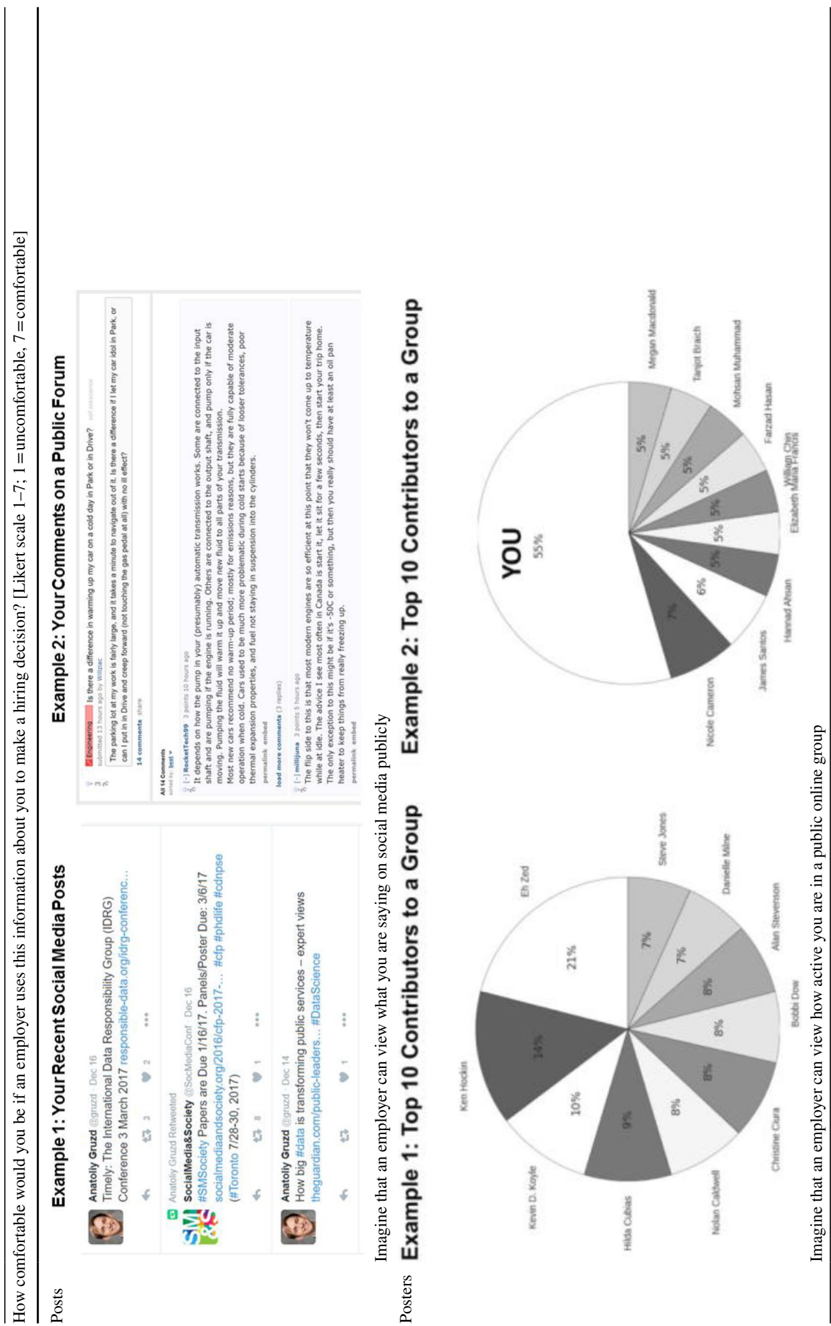
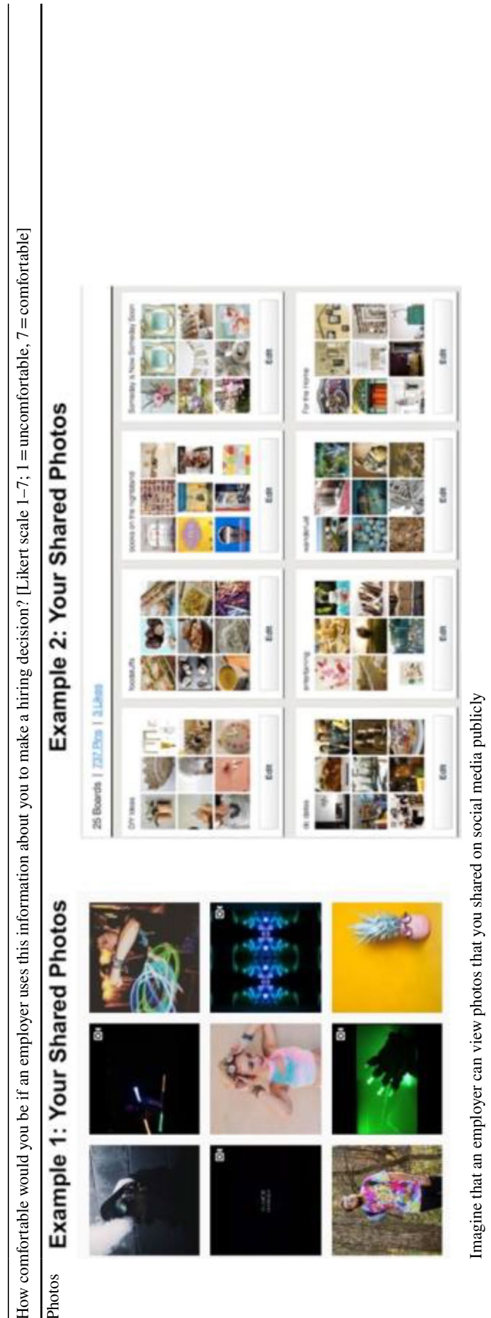
- About half of participants were uncomfortable with social media screening: 49.6% for public posts, 53.1% for photos, and 41.7% for top posters; mean comfort was 3.60 for posts, 3.88 for posters, and 3.44 for photos on a 1–7 scale.
- The regression model explained only 4.3% of the variance in comfort (adjusted R² = 0.043). The study rejected H1 (gender), H2 (job-seeking status), H3 (number of public accounts), and H6 (knowledge of privacy settings); it accepted H4 only partially (Collection concern was significant and negative, Error was not) and accepted H5 (prior privacy invasion was significant and negative).
- 26.3% of participants did not know the privacy setting on at least one social media account; participants had a presence on an average of six platforms, with three primarily public and three primarily private.
- 28.4% reported having experienced an invasion of privacy on social media, while 71.6% had not.
Methods
- Online survey open January 21–April 11, 2017, drawn from an undergraduate student research participant pool at a Canadian university; 556 responses were cleaned to 482 after removing duplicates, failed attention checks, and completions under 3 minutes.
- The dependent variable (HRComf) was the mean comfort rating for three publicly available data types—top posters, posts, and photos—using a 7-point scale (1 = uncomfortable, 7 = comfortable). Independent variables included gender, employment-seeking status, number of public accounts, Concern for Social Media Information Privacy dimensions (Collection and Errors), prior privacy invasion, and number of “unsure” privacy-setting accounts.
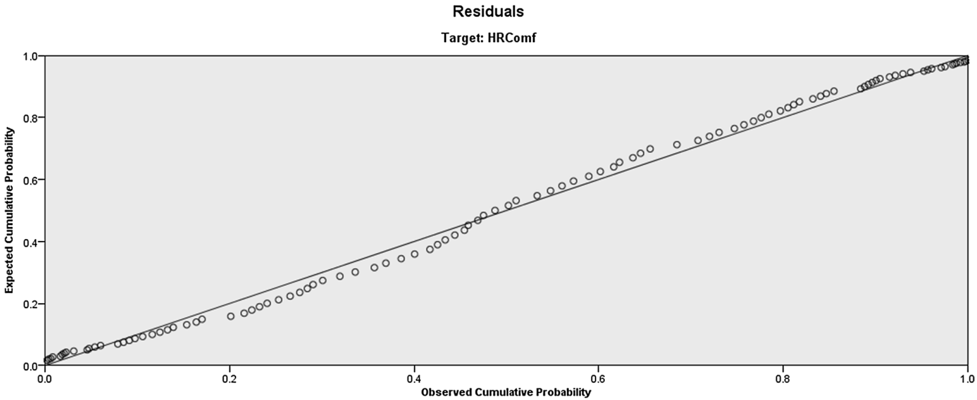
- Analysis used SPSS Version 24 Automatic Linear Modeling with best subsets and adjusted R²; residual normality was checked with a P-P plot, and multicollinearity was acceptable (all VIFs < 1.15).
Limitations
- Stated in the paper: the sample of 482 students at one Canadian university limits generalizability; quantitative data cannot explain why people are comfortable or uncomfortable; the survey did not use participants’ own data, which may have produced different results.
- Evident from the text: the sample is young (92.9% under 25), predominantly Canadian (90%), and undergraduate, so findings may not extend to other age groups or populations; the model’s very low explanatory power suggests unmeasured factors; and the two participants who identified as trans*, non-binary, two-spirit, genderqueer, or other were excluded from the statistical model due to small sample size.
Model-written summary. Check it against the paper before relying on it.
Integrity signals
Registry
Cites
Statistics
Figures




Verification
Claims the paper makes
7 Valid · 0 Not valid · 29 Not checked · 86 Own results and interpretations
The sources with a verdict support this claim; the rest weren’t checked yet, have no full text we could read, or their verdicts aren’t rated yet.
In the paper
“Although Cronbach's Alpha, rho A, and Composite Reliability were within the acceptable thresholds for all dimensions (Henseler et al. 2016; Hair et al. 2017)”
What the sources say
- Supportedcites Henseler et al. 2016 matched to “Using pls path modeling in new technology research: updated guidelines” (2016) source
Table I (p. 12) gives an acceptable internal-consistency threshold of 0.7 for ρA, composite reliability (ρc), and Cronbach’s α. The cited paper supports the thresholds; the statement that the citing study’s dimensions met them is the citing authors’ own result. (LLM, conf=0.90)
- Not checked — no full text of the sourcecites Hair et al. 2017 matched to “An updated and expanded assessment of PLS-SEM in information systems research” (2017) source
plain- Asserted: passes — The authors put it forward as true.
- Checkable: passes — It can be checked against evidence.
- Load-bearing: passes — The paper’s conclusions depend on it.
- Based: passes — The paper gives a reason why it holds.
- Supported
Every source the paper cites for this claim was checked and supports it.
In the paper
“previous research confirms that young people have high awareness of employers' use of social media for screening (Hurrell et al. 2017)”
What the sources say
- Supportedcites Hurrell et al. 2017 matched to “‘The kids are alert’: Generation Y responses to employer use and monitoring of social networking sites” (2017) source
The Conclusions state 'The high levels of awareness shown within this study suggest that many Generation Y employees and job applicants are attuned to the potential for employer misuse of their data and take appropriate action,' and that 'Many of this young sample, displayed alertness to the potential for employers to blur the work-life boundary via SNSs.' The Discussion (RQ1/RQ3b) reports widespread respondent-reported employer SNS use for recruitment (32%) and screening job applicants (21%), with over half managing their online profiles with employers in mind, i.e. alert to employer access. The paper's awareness finding is framed around employer use/monitoring of SNS data generally (screening included); the separate point that under a third of respondents said applicants were explicitly informed of screening concerns employer disclosure, not young people's awareness, so it does not undercut the claim. (LLM, conf=0.82)
boosted- Asserted: passes — The authors put it forward as true.
- Checkable: passes — It can be checked against evidence.
- Load-bearing: unclear — It is unclear whether the paper’s conclusions depend on it.
- Based: passes — The paper gives a reason why it holds.
- Supported
The sources with a verdict support this claim; the rest weren’t checked yet, have no full text we could read, or their verdicts aren’t rated yet.
In the paper
“prior research on potential job applicants has analyzed organizational attractiveness (Greening and Turban 2000; Tsai and Yang 2010; Turban and Greening 1997), but has largely neglected the perspectives on the hiring process itself.”
What the sources say
- Supportedcites Greening and Turban 2000 matched to “Corporate Social Performance As a Competitive Advantage in Attracting a Quality Workforce” (2000) source
The citation is attached to the statement that prior research on potential job applicants analyzed organizational attractiveness. The Discussion reports that this study investigated prospective applicants’ attraction to firms and found that firms with higher CSP were perceived as more attractive employers. The subsequent claim about neglect of the hiring process is the citing authors’ framing, not the part directly attributed to this paper. (LLM, conf=0.93)
- Not checked — no full text of the sourcecites Tsai and Yang 2010 matched to “Does Image Matter to Different Job Applicants? The influences of corporate image and applicant individual differences on organizational attractiveness” (2010) source
- Not checked — no full text of the sourcecites Turban and Greening 1997 matched to “CORPORATE SOCIAL PERFORMANCE AND ORGANIZATIONAL ATTRACTIVENESS TO PROSPECTIVE EMPLOYEES.” (1997) source
plain- Asserted: passes — The authors put it forward as true.
- Checkable: passes — It can be checked against evidence.
- Load-bearing: passes — The paper’s conclusions depend on it.
- Based: passes — The paper gives a reason why it holds.
- Supported
A result the paper reports from its own data — it cites no other source for it, so there is none to check. The quote shows it is in the paper.
In the paper
“We find that young people are generally not comfortable with social media screening.”
plainn = 482- Asserted: passes — The authors put it forward as true.
- Checkable: passes — It can be checked against evidence.
- Load-bearing: passes — The paper’s conclusions depend on it.
- Based: passes — The paper gives a reason why it holds.
A result the paper reports from its own data — it cites no other source for it, so there is none to check. The quote shows it is in the paper.
In the paper
“A key finding of this research is that concern for privacy for public information on social media cannot be fully explained by some 'traditional' variables in privacy research.”
plainn = 482- Asserted: passes — The authors put it forward as true.
- Checkable: passes — It can be checked against evidence.
- Load-bearing: passes — The paper’s conclusions depend on it.
- Based: passes — The paper gives a reason why it holds.
52 more claims
Create a free account to see all 122 claims and to verify the 6 references still open.
- Probably not a substantial claim. 53
- It may state two separate claims as one. 28
- The quote only partly states this claim. 2
Citations
Cites
The Presentation of Self in Everyday Life.
Naegele, K. D., & Goffman, E. (1956) · American Sociological Review · doi:10.2307/2089106 · Cited by 25,991
(2010) · Cited by 24,023
The Presentation of Self in Everyday Life
Goffman, E. (2023) · Social Theory Re-Wired · doi:10.4324/9781003320609-59 · Cited by 17,562
Ellison, N. B., Steinfield, C., & Lampe, C. (2007) · Journal of Computer-Mediated Communication · doi:10.1111/j.1083-6101.2007.00367.x · Cited by 9,939 · cited 1×
“The benefits of using and engaging on social media have been well observed and include using the platforms for entertainment, social relationship building and maintenance, information seeking, and self-presentation (Ellison et al. 2007; Quan-Haase and Young 2010; Whiting and Williams 2013).”
BackgroundA Stakeholder Framework for Analyzing and Evaluating Corporate Social Performance
Clarkson, M. B. E. (1995) · The Academy of Management Review · doi:10.2307/258888 · Cited by 7,838
Using pls path modeling in new technology research: updated guidelines
Henseler, J., Hubona, G., & Ray, P. A. (2016) · Industrial Management & Data Systems · doi:10.1108/imds-09-2015-0382 · Cited by 7,173
The Stakeholder Theory of the Corporation: Concepts, Evidence, and Implications
Donaldson, T., & Preston, L. E. (1995) · The Academy of Management Review · doi:10.2307/258887 · Cited by 5,846 · cited 1×
“Donaldson and Preston (1995) explicitly recognize job applicants as stakeholders—as demonstrated in their declaration that “potential job applicants, unknown to the firm, nevertheless have a stake in being considered for a job (but not necessarily to get a job)” (p. 85).”
Backgroundboyd, D., & Crawford, K. (2012) · Information, Communication & Society · doi:10.1080/1369118x.2012.678878 · Cited by 5,479
An updated and expanded assessment of PLS-SEM in information systems research
Hair, J., Hollingsworth, C. L., Randolph, A. B., & Chong, A. Y. L. (2017) · Industrial Management & Data Systems · doi:10.1108/imds-04-2016-0130 · Cited by 4,043
Impression management: A literature review and two-component model.
Leary, M. R., & Kowalski, R. M. (1990) · Psychological Bulletin · doi:10.1037/0033-2909.107.1.34 · Cited by 3,334 · cited 1×
“Furthermore, those who have a higher number of public accounts may be engaged in strategic impression management and self-presentation (Goffman 1959; Leary and Kowalski 1990).”
BackgroundCORPORATE SOCIAL PERFORMANCE AND ORGANIZATIONAL ATTRACTIVENESS TO PROSPECTIVE EMPLOYEES.
TURBAN, D. B., & GREENING, D. W. (1997) · Academy of Management Journal · doi:10.2307/257057 · Cited by 3,149 · cited 1×
“However, prior research on potential 1 3 job applicants has analyzed organizational attractiveness (Greening and Turban 2000; Tsai and Yang 2010; Turban and Greening 1997), but has largely neglected the perspectives on the hiring process itself.”
BackgroundStakeholder Theory: The State of the Art
Parmar, B. L., Freeman, R. E., Harrison, J. S., Wicks, A. C., Purnell, L., & de Colle, S. (2010) · Academy of Management Annals · doi:10.5465/19416520.2010.495581 · Cited by 2,755 · cited 1×
“Rather than serving a single purpose, stakeholder theory provides a framework that serves a range of purposes (Freeman et al. 2010): “Unlike economic theory which aims at prediction, stakeholder theory aims to guide managerial action” (Visser et al.”
BackgroundAn Extended Privacy Calculus Model for E-Commerce Transactions
Dinev, T., & Hart, P. (2006) · Information Systems Research · doi:10.1287/isre.1060.0080 · Cited by 2,640 · cited 1×
“According to the privacy calculus theory (Dinev and Hart 2006), people engage in a decision-making process to identify the costs of disclosing information versus the risks.”
BackgroundStakeholder Theory: The State of the Art
Freeman, R. E., Harrison, J. S., Wicks, A. C., Parmar, B. L., & de Colle, S. (2010) · doi:10.1017/cbo9780511815768 · Cited by 2,634
Corporate Social Performance As a Competitive Advantage in Attracting a Quality Workforce
Greening, D. W., & Turban, D. B. (2000) · Business & Society · doi:10.1177/000765030003900302 · Cited by 2,077
Born digital: understanding the first generation of digital natives
(2009) · Choice Reviews Online · doi:10.5860/choice.46-7115 · Cited by 2,001
Why people use social media: a uses and gratifications approach
Whiting, A., & Williams, D. (2013) · Qualitative Market Research: An International Journal · doi:10.1108/qmr-06-2013-0041 · Cited by 1,810
Jones, T. M., & Wicks, A. C. (1999) · The Academy of Management Review · doi:10.2307/259075 · Cited by 1,595
Digital Na(t)ives? Variation in Internet Skills and Uses among Members of the “Net Generation”
Hargittai, E. (2010) · Sociological Inquiry · doi:10.1111/j.1475-682x.2009.00317.x · Cited by 1,564 · cited 2×
“Young people are widely recognized as being heavy users of social media (Chen and Cheung 2018; Hargittai 2010; Williams et al.”
BackgroundConsumer patronage and risk perceptions in Internet shopping
Forsythe, S. M., & Shi, B. (2003) · Journal of Business Research · doi:10.1016/s0148-2963(01)00273-9 · Cited by 1,433 · cited 2×
“2000; Forsythe and Shi 2003) and have higher privacy concerns in both online and offline spaces (Garbarino and Strahilevitz 2004).”
BackgroundConnection strategies: Social capital implications of Facebook-enabled communication practices
Ellison, N. B., Steinfield, C., & Lampe, C. (2011) · New Media & Society · doi:10.1177/1461444810385389 · Cited by 1,349 · cited 2×
“People who are unsure of their privacy setting may have low digital literacy (Ellison et al. 2011).”
BackgroundFacebook and Online Privacy: Attitudes, Behaviors, and Unintended Consequences
Debatin, B., Lovejoy, J. P., Horn, A.-K., & Hughes, B. N. (2009) · Journal of Computer-Mediated Communication · doi:10.1111/j.1083-6101.2009.01494.x · Cited by 1,271
Uses and gratifications of social media: A comparison of Facebook and instant messaging
Quan-Haase, A., & Young, A. L. (2010) · Bulletin of Science, Technology & Society · doi:10.1177/0270467610380009 · Cited by 1,205 · cited 2×
“2007; Quan-Haase and Young 2010; Whiting and Williams 2013).”
BackgroundToward a Descriptive Stakeholder Theory: An Organizational Life Cycle Approach
Jawahar, I. M., & McLaughlin, G. L. (2001) · The Academy of Management Review · doi:10.2307/259184 · Cited by 1,205
Privacy and rationality in individual decision making
Acquisti, A., & Grossklags, J. (2005) · IEEE Security and Privacy Magazine · doi:10.1109/msp.2005.22 · Cited by 1,123 · cited 1×
“While the traditional approach to privacy assumes a logical decision-making process or “privacy calculus,” an understanding of the true costs and benefits of the decision are not only complex, but also context specific (Acquisti and Grossklags 2005; Litt 2012; Loh 2018).”
BackgroundMedia Literacy and the Challenge of New Information and Communication Technologies
LIVINGSTONE, S. (2004) · The Communication Review · doi:10.1080/10714420490280152 · Cited by 1,115 · cited 1×
“Increased use of digital media increases one’s media literacy (Livingstone 2004), which means an individual may modify their social media behaviour to limit their risks, resulting in higher comfort with the practice (Couldry and Powell 2014).”
BackgroundGender, race, and perceived risk: The 'white male' effect
Finucane, M. L., Slovic, P., Mertz, C. K., Flynn, J., & Satterfield, T. A. (2000) · Health, Risk & Society · doi:10.1080/713670162 · Cited by 1,092
Internet social network communities: Risk taking, trust, and privacy concerns
Fogel, J., & Nehmad, E. (2009) · Computers in Human Behavior · doi:10.1016/j.chb.2008.08.006 · Cited by 987 · cited 3×
“2017), social media use (Fogel and Nehmad 2009), and privacy concerns (Osatuyi 2015; Ellison et al.”
BackgroundGarbarino, E., & Strahilevitz, M. (2004) · Journal of Business Research · doi:10.1016/s0148-2963(02)00363-6 · Cited by 954 · cited 1×
“2000; Forsythe and Shi 2003) and have higher privacy concerns in both online and offline spaces (Garbarino and Strahilevitz 2004).”
BackgroundAn Empirical Examination of the Concern for Information Privacy Instrument
Stewart, K. A., & Segars, A. H. (2002) · Information Systems Research · doi:10.1287/isre.13.1.36.97 · Cited by 734 · cited 1×
“We relied on a 14-question construct of Concern for Social Media Information Privacy (CFSMIP) (Osatuyi 2015), which was built by adapting Stewart and Segars’ (2002) widely accepted construct of Concern for Information Privacy (CFIP) to the context of social media use.”
MethodA Contextual Approach to Privacy Online
Nissenbaum, H. (2011) · Daedalus · doi:10.1162/daed_a_00113 · Cited by 649 · cited 1×
“We embrace a contextual understanding of privacy (Nissenbaum 2011) by specifying the job hiring context and further considering different types of publicly available user data from social media that can be used for cybervetting.”
MethodKnock, Knock . Who's There? The Imagined Audience
Litt, E. (2012) · Journal of Broadcasting & Electronic Media · doi:10.1080/08838151.2012.705195 · Cited by 629 · cited 1×
“While the traditional approach to privacy assumes a logical decision-making process or “privacy calculus,” an understanding of the true costs and benefits of the decision are not only complex, but also context specific (Acquisti and Grossklags 2005; Litt 2012; Loh 2018).”
BackgroundBazarova, N. N., & Choi, Y. H. (2014) · Journal of Communication · doi:10.1111/jcom.12106 · Cited by 627
Entrapped by the ‘electronic panopticon’? Worker resistance in the call centre
Bain, P., & Taylor, P. (2000) · New Technology, Work and Employment · doi:10.1111/1468-005x.00061 · Cited by 546
The Moral Basis of Stakeholder Theory
Gibson, K. (2000) · Journal of Business Ethics · doi:10.1023/a:1006110106408 · Cited by 515
Lin (2012) · doi:10.1145/2370216.2370290 · Cited by 451
A Contextual Approach to Privacy Online
Helen, N. (2012) · Digital Enlightenment Yearbook 2012 · doi:10.3233/978-1-61499-057-4-219 · Cited by 445
Gender Differences in Privacy-Related Measures for Young Adult Facebook Users
Hoy, M. G., & Milne, G. (2010) · Journal of Interactive Advertising · doi:10.1080/15252019.2010.10722168 · Cited by 443 · cited 3×
“Aligned with Bergström’s (2015) finding that there was no significant difference for privacy concerns amongst men and women in Sweden, this may suggest that women are engaging in pre-emptive privacy protection behaviours (Hoy and Milne 2010), or are managing their privacy for employment-related audiences”
BackgroundInfluential(2022) · Public Affairs Quarterly · doi:10.5406/21520542.36.4.05 · Cited by 437
ARTICLE 29 Data Protection Working Party
Sotiropoulos, D. M. (2013) · Cited by 434
Advances in Social Science Methodology
Thompson, B. (1994) · Cited by 423
Depression Detection via Harvesting Social Media: A Multimodal Dictionary Learning Solution
Shen, G., Jia, J., Nie, L., Feng, F., Zhang, C., Hu, T., Chua, T.-S., & Zhu, W. (2017) · Proceedings of the Twenty-Sixth International Joint Conference on Artificial Intelligence · doi:10.24963/ijcai.2017/536 · Cited by 383
Beyond Concern: Understanding Net Users' Attitudes about Online Privacy
Cranor, L. F., Reagle, J., & Ackerman, M. S. (2000) · The Internet Upheaval · doi:10.7551/mitpress/3874.003.0008 · Cited by 381
Toward a Typology of Internet Users and Online Privacy Concerns
Sheehan, K. B. (2002) · The Information Society · doi:10.1080/01972240252818207 · Cited by 356
Beyond Concern: Understanding Net Users' Attitudes About Online PrivacyPreprint
Cranor, L. F., Reagle, J., & Ackerman, M. S. (1999) · arXiv (Cornell University) · doi:10.48550/arxiv.cs/9904010 · Cited by 337
The role of automatic obesity stereotypes in real hiring discrimination.
Agerström, J., & Rooth, D.-O. (2011) · Journal of Applied Psychology · doi:10.1037/a0021594 · Cited by 331 · cited 1×
“Hiring is not a value-free and neutral process whereby the “best” applicant is offered the job; hiring discrimination has been well documented based on gender (Petit 2007), sexual orientation (Horvath and Ryan 2003), weight (Agerström and Rooth 2011), ethnic and racial identity (Derous et al.”
BackgroundConsumer Privacy Concerns and Preference for Degree of Regulatory Control
Okazaki, S., Li, H., & Hirose, M. (2009) · Journal of Advertising · doi:10.2753/joa0091-3367380405 · Cited by 297 · cited 1×
“For example, people with higher privacy concerns are less likely to use social media platforms (Osatuyi 2015); they are less trusting of mobile advertising (Okazaki et al. 2009); and they share less online (Chennamaneni and Taneja 2015).”
BackgroundPetit, P. (2007) · Labour Economics · doi:10.1016/j.labeco.2006.01.006 · Cited by 295
ประจักษ์เนตร, พ. (n.d.) · Journal of communication and innovation NIDA · doi:10.14456/jcin.2015.9 · Cited by 293
Regan, P. M., & Jesse, J. (2019) · Ethics and Information Technology · doi:10.1007/s10676-018-9492-2 · Cited by 286 · cited 1×
“However, some scholarly research points to young people having significant and nuanced privacy concerns on social media (Bailey and Steeves 2015; Marwick et al. 2010; Regan and Jesse 2018).”
BackgroundUnderstanding privacy settings in facebook with an audience view
Lipford, H. R., Besmer, A., & Watson, J. (2008) · Cited by 282
Doolin, B., Dillon, S., Thompson, F., & Corner, J. L. (2005) · Journal of Global Information Management · doi:10.4018/jgim.2005040104 · Cited by 274
Peluchette, J., & Karl, K. (2008) · CyberPsychology & Behavior · doi:10.1089/cpb.2007.9927 · Cited by 268
Employer’s Use of Social Networking Sites: A Socially Irresponsible Practice
Clark, L. A., & Roberts, S. J. (2010) · Journal of Business Ethics · doi:10.1007/s10551-010-0436-y · Cited by 254 · cited 1×
“Clark and Roberts (2010) have argued that “online character checks” harm society (p. 514) and conclude, “Rather than expecting users of SNSs [Social Networking Sites] to change their behavior by not posting anything they do not want an employer to view, we argue that it is better for society for…”
BackgroundUnderstanding the stigma of mental illness in employment
Krupa, T., Kirsh, B., Cockburn, L., & Gewurtz, R. (2009) · WORK: A Journal of Prevention, Assessment & Rehabilitation · doi:10.3233/wor-2009-0890 · Cited by 241
Ifeoma Ajunwa, K. C. (2017) · California Law Review · doi:10.15779/z38br8mf94 · Cited by 241 · cited 2×
“As one of the organizational responses to chronic under-resourcing (Berkelaar 2010) and technological advancements that have expanded the ability of employers to engage in employee surveillance (Ajunwa et al. 2017), businesses engage in so-called cybervetting as part of the hiring process.”
BackgroundCouldry, N., & Powell, A. (2014) · Big Data & Society · doi:10.1177/2053951714539277 · Cited by 213 · cited 1×
“Increased use of digital media increases one’s media literacy (Livingstone 2004), which means an individual may modify their social media behaviour to limit their risks, resulting in higher comfort with the practice (Couldry and Powell 2014).”
BackgroundConsumer Comfort in Service Relationships: Measurement and Importance
Spake, D. F., Beatty, S. E., Brockman, B. K., & Crutchfield, T. N. (2003) · Journal of Service Research · doi:10.1177/1094670503005004004 · Cited by 208
"What Can I Really Do?" : Explaining the Privacy Paradox with Online Apathy
Hargittai, E., & Marwick, A. (2016) · University of Southern California · doi:10.5167/uzh-148157 · Cited by 202 · cited 1×
“Similarly, Hargittai and Marwick (2016) found that young adults feel that they have little control over personal information that is posted online.”
BackgroundThe use of social media: an exploratory study of usage among digital natives
Williams, D. L., Crittenden, V. L., Keo, T., & McCarty, P. (2012) · Journal of Public Affairs · doi:10.1002/pa.1414 · Cited by 198 · cited 1×
“Young people are widely recognized as being heavy users of social media (Chen and Cheung 2018; Hargittai 2010; Williams et al. 2012).”
BackgroundThe International Encyclopedia of Organizational Communication
(2017) · Wiley eBooks · doi:10.1002/9781118955567 · Cited by 195
Big data privacy: The datafication of personal information
Mai, J.-E. (2016) · The Information Society · doi:10.1080/01972243.2016.1153010 · Cited by 192 · cited 1×
“Given the spread of big data analytics, there is a need to think differently about privacy (Mai 2016) as it is impossible, or extremely difficult, for people to fully comprehend, or imagine, how the data is going to be used or could be used in the future.”
BackgroundVisiting theories that predict college students’ self-disclosure on Facebook
Chang, C.-W., & Heo, J. (2013) · Computers in Human Behavior · doi:10.1016/j.chb.2013.07.059 · Cited by 189
‘Let’s Get Them Involved’ . . . to Some Extent: Analyzing Online News Participation
Almgren, S. M., & Olsson, T. (2015) · Social Media + Society · doi:10.1177/2056305115621934 · Cited by 185
Bergström, A. (2015) · Computers in Human Behavior · doi:10.1016/j.chb.2015.07.025 · Cited by 167
(2012) · Wiley eBooks · doi:10.1002/9781119206279 · Cited by 164
Managerial ethics: moral management of people and processes
(1999) · Choice Reviews Online · doi:10.5860/choice.37-0408 · Cited by 158
The Impact of Semantic Web Technologies on Job Recruitment Processes
Bizer, C., Heese, R., Mochól, M., et al. (2005) · Physica-Verlag eBooks · doi:10.1007/3-7908-1624-8_72 · Cited by 147
Privacy, Risk Perception, and Expert Online Behavior: An Exploratory Study of Household End Users
Drennan, J., Sullivan, G., & Previte, J. (2006) · Journal of Organizational and End User Computing · doi:10.4018/joeuc.2006010101 · Cited by 146
Gender and Online Privacy among Teens: Risk Perception, Privacy Concerns, and Protection Behaviors
Youn, S., & Hall, K. (2008) · CyberPsychology & Behavior · doi:10.1089/cpb.2007.0240 · Cited by 143
Monitoring what and how: psychological implications of electronic performance monitoring
Jeske, D., & Santuzzi, A. M. (2015) · New Technology, Work and Employment · doi:10.1111/ntwe.12039 · Cited by 138
Yang, H. (2013) · General Linear Model Journal · Cited by 134
Horvath, M., & Ryan, A. M. (2003) · Sex Roles · doi:10.1023/a:1022499121222 · Cited by 131
Gouvier, W. D., Jordan, S. S., & Mayville, S. B. (2003) · Rehabilitation Psychology · doi:10.1037/0090-5550.48.3.175 · Cited by 125
Marwick, A. E., & Hargittai, E. (2018) · Information Communication & Society · doi:10.1080/1369118x.2018.1450432 · Cited by 111
Tsai, W., & Yang, I. W. (2010) · International Journal of Selection and Assessment · doi:10.1111/j.1468-2389.2010.00488.x · Cited by 108 · cited 1×
“However, prior research on potential 1 3 job applicants has analyzed organizational attractiveness (Greening and Turban 2000; Tsai and Yang 2010; Turban and Greening 1997), but has largely neglected the perspectives on the hiring process itself.”
BackgroundElectronic monitoring and surveillance in call centres: a framework for investigation
Ball, K. S., & Margulis, S. T. (2011) · New Technology, Work and Employment · doi:10.1111/j.1468-005x.2011.00263.x · Cited by 102 · cited 1×
“These organizational practices can be met by worker resistance (Bain and Taylor 2000) and negative reactions by employees (Ball and Margulis 2011; Jeske and Santuzzi 2015).”
BackgroundBorn Digital: Understanding the First Generation of Digital Natives
Carson, N. J. (2010) · Journal of the American Academy of Child & Adolescent Psychiatry · doi:10.1097/00004583-201007000-00013 · Cited by 92
Derous, E., Nguyen, H.-H., & Ryan, A. M. (2009) · Human Performance · doi:10.1080/08959280903120261 · Cited by 91
Draper, N. A. (2016) · Policy & Internet · doi:10.1002/poi3.142 · Cited by 90
Journalists’ Use of Social Media to Infer Public Opinion: The Citizens’ Perspective
Dubois, E., Gruzd, A., & Jacobson, J. (2020) · Social Science Computer Review · doi:10.1177/0894439318791527 · Cited by 84
Self-citationHargittai, E., & Litt, E. (2013) · IEEE Security & Privacy · doi:10.1109/msp.2013.64 · Cited by 79 · cited 2×
“…for privacy concerns amongst men and women in Sweden, this may suggest that women are engaging in pre-emptive privacy protection behaviours (Hoy and Milne 2010), or are managing their privacy for employment-related audiences (Hargittai and Litt 2013) and, as such, do not have higher concerns.”
Background‘Plus ca change, plus la meme chose?'—researching and theorising the ‘new’ new technologies
Howcroft, D., & Taylor, P. (2014) · New Technology, Work and Employment · doi:10.1111/ntwe.12026 · Cited by 74 · cited 1×
“The use of digital technologies in the workplace reconfigures work and employment (Howcroft and Taylor 2014), which introduces both opportunities and risks for employers and employees (Archer-Brown et al.”
BackgroundFrye, N. E., & Dornisch, M. M. (2010) · Computers in Human Behavior · doi:10.1016/j.chb.2010.03.016 · Cited by 74 · cited 1×
“Frye and Dornisch (2010) asked participants to rate their comfort disclosing information on various communication tools (e.g., email and instant messenger) and found that people were least comfortable disclosing information on public blogs and pages; Cranor et al.”
BackgroundLutz, C., & Strathoff, P. (2014) · SSRN Electronic Journal · doi:10.2139/ssrn.2425132 · Cited by 73
(2015) · Cited by 73
Kennedy, H. (2016) · doi:10.1057/978-1-137-35398-6 · Cited by 71 · cited 2×
“The value of social media data is not merely in analyzing the posts or photos, but in how the data is used and processed by third parties (Kennedy 2016), such as prospective employers.”
BackgroundMethodTwice Penalized: Employment Discrimination Against Women with Disabilities
O'Hara, B. (2004) · Journal of Disability Policy Studies · doi:10.1177/10442073040150010501 · Cited by 70 · cited 1×
“Hiring discrimination is further compounded with people’s intersectional identities, such as being a woman with a disability (O’Hara 2004).”
BackgroundThe emotional context of information privacy
Stark, L. (2016) · The Information Society · doi:10.1080/01972243.2015.1107167 · Cited by 68
The Perils and Promises of Self-Disclosure on Social Media
Richey, M., Gonibeed, A., & Ravishankar, M. N. (2018) · Information Systems Frontiers · doi:10.1007/s10796-017-9806-7 · Cited by 66 · cited 2×
“In particular, with the focus on the individual response, we follow prior research that suggests there may be a relationship between an individual’s comfort with this growing practice and their gender (Peluchette and Karl 2008), job seeking status (Richey et al. 2017), social media use (Fogel and Nehmad 2009), and pri…”
BackgroundPrivacy perception and protection on Chinese social media: a case study of WeChat
Chen, Z. T., & Cheung, M. (2018) · Ethics and Information Technology · doi:10.1007/s10676-018-9480-6 · Cited by 66 · cited 2×
“Young people are widely recognized as being heavy users of social media (Chen and Cheung 2018; Hargittai 2010; Williams et al.”
BackgroundIn search of employment: online technologies and P olish migrants
Janta, H., & Ladkin, A. (2013) · New Technology Work and Employment · doi:10.1111/ntwe.12018 · Cited by 62
Hybrid social media: employees’ use of a boundary‐spanning technology
Archer‐Brown, C., Marder, B. L., Calvard, T. S., & Kowalski, T. (2018) · New Technology Work and Employment · doi:10.1111/ntwe.12103 · Cited by 60
The State of Social Media in Canada 2017Preprint
Gruzd, A. A., Jacobson, J., Mai, P., & Dubois, E. (2018) · SSRN Electronic Journal · doi:10.2139/ssrn.3158771 · Cited by 55
Self-citationSchrodt, P. (2013) · Communication Education · doi:10.1080/03634523.2013.807348 · Cited by 51 · cited 2×
“The use of a 7-point comfort scale has been commonly and successfully adopted in privacy research (Lin et al. 2012; Lipford et al. n.d.; Schrodt 2013).”
MethodHurrell, S. A., Scholarios, D., & Richards, J. (2017) · New Technology, Work and Employment · doi:10.1111/ntwe.12085 · Cited by 48 · cited 2×
“For example, even though previous research confirms that young people have high awareness of employers’ use of social media for screening (Hurrell et al. 2017), another study shows that only 2% of social media users think that their social media posts have caused them to get fired or not be hired (Smith 2015).”
BackgroundResultStakeholder Theory: Seeing the Field Through the Forest
Berman, S. L., & Johnson-Cramer, M. E. (2019) · Business & Society · doi:10.1177/0007650316680039 · Cited by 46 · cited 1×
“Stakeholder theory suggests that corporate governance of organizations has a responsibility towards a broad spectrum of stakeholders, and corporations need to understand the context of their various stakeholder relationships (Berman and Johnson-Cramer 2016; Freeman 1984).”
BackgroundThe Ethical Business: Challenges and Controversies
Mellahi, K., Morrell, K., & Wood, G. (2002) · Cited by 44
Weber, J. (2019) · Business & Society · doi:10.1177/0007650317726985 · Cited by 42 · cited 1×
“1 3 organizations’ ethics with young people’s expectations: organizations will be able to attract and keep these young employees (Weber 2017).”
BackgroundThe State of Social Media in Canada 2017
Gruzd, A. A., Jacobson, J., Mai, P., & Dubois, E. (2021) · doi:10.32920/14636136.v1 · Cited by 38
Self-citationExperience, comfort, and privacy concerns: antecedents of online spending
Spake, D. F., Finney, R. Z., & Joseph, M. (2011) · Journal of Research in Interactive Marketing · doi:10.1108/17505931111121507 · Cited by 34
Mellahi, K., Morrell, K., & Wood, G. (2010) · doi:10.1007/978-0-230-31359-0 · Cited by 33
Empirical Examination of Information Privacy Concerns Instrument in the Social Media Context
University of Texas Rio Grande Valley, & Osatuyi, B. (2015) · AIS Transactions on Replication Research · doi:10.17705/1atrr.00003 · Cited by 32
(1998) · doi:10.4324/9781410604231-9 · Cited by 30
University of South Alabama, Howard, M. C., Hair, J. F., & University of South Alabama (2023) · AIS Transactions on Human-Computer Interaction · doi:10.17705/1thci.00084 · Cited by 27
Display and control in online social spaces: Towards a typology of users
Fortier, A., & Burkell, J. (2016) · New Media & Society · doi:10.1177/1461444816675184 · Cited by 26
(2015) · Journal of the Association for Information Systems · Cited by 24
Social Recruiting: Control and Surveillance in a Digitised Job Market
Gandini, A., & Pais, I. (2017) · Springer eBooks · doi:10.1007/978-3-319-58232-0_6 · Cited by 23
Cybervetting and the Public Life of Social Media Data
Gruzd, A., Jacobson, J., & Dubois, E. (2020) · Social Media + Society · doi:10.1177/2056305120915618 · Cited by 21
Self-citationJob Applicants' Information Privacy Protection Responses: Using Socia Media for Candidate Screening
Drake, J. R., Hall, D. J., Becton, J. B., & Posey, C. (2016) · Aquila Digital Community (University of Southern Mississippi) · Cited by 20
Treating sensitive topics online: a privacy dilemma
Helm, P. (2018) · Ethics and Information Technology · doi:10.1007/s10676-018-9482-4 · Cited by 19
Privacy Management on Facebook: Do Device Type and Location of Posting Matter?
Suh, J. J., & Hargittai, E. (2015) · Social Media + Society · doi:10.1177/2056305115612783 · Cited by 18 · cited 1×
“Despite an individual’s confidence in their ability to manage their privacy online, Suh and Hargittai (2015) found that there is a considerable lack of effectiveness in users’ online privacy management as people often mistakenly share posts publicly.”
BackgroundYou're hired: examining acceptance of social media screening of job applicants
Gruzd, A. A., Jacobson, J., & Dubois, E. (2024) · doi:10.32920/ryerson.14636181.v1 · Cited by 14
Self-citationA practice–theoretical account of privacy
Loh, W. (2018) · Ethics and Information Technology · doi:10.1007/s10676-018-9469-1 · Cited by 13
The impact of the cessation of blogs within the UK police blogosphere
Pedersen, S., Burnett, S., Smith, R. A., & Grinnall, A. (2014) · New Technology Work and Employment · doi:10.1111/ntwe.12028 · Cited by 13
Berkelaar, B. L. (2010) · Purdue e-Pubs (Purdue University System) · Cited by 12
All Possible Regressions Using IBM SPSS: A Practitioner’s Guide to Automatic Linear Modeling
Oshima, T. C., & Dell-Ross, T. L. (2016) · Cited by 12
Berkelaar, B. L., & Harrison, M. A. (2016) · The International Encyclopedia of Organizational Communication · doi:10.1002/9781118955567.wbieoc054 · Cited by 12
McEwan, B. L., & Flood, M. (2017) · New Media & Society · doi:10.1177/1461444817706073 · Cited by 11
Young people as company stakeholders? Moving beyond CSR…
de La Ville, V.-I. (2014) · Young Consumers · doi:10.1108/yc-03-2013-00363 · Cited by 10 · cited 1×
“Young people have generally been neglected and overlooked in stakeholder theory (Ville 2014).”
Background(2014) · Cited by 9
Employers’ Use of Young People’s Social Media: Extending Stakeholder Theory to Social Media Data
Jacobson, J., & Gruzd, A. (2018) · Academy of Management Proceedings · doi:10.5465/ambpp.2018.18217abstract · Cited by 3
Self-citation
Research works printed but not linked: 7
- Bailey, J., & Steeves, V. (Eds.). (2015). eGirls, eCitizens . Ottawa, ON: University of Ottawa Press.
- CareerBuilder. (2014). Number of employers passing on applicants due to social media posts continues to rise, according to New CareerBuilder Survey - CareerBuilder [WWW Document]. Retrieved June 10, 2017, from https ://www.caree rbuil der.ca/share /about us/press relea sesde tail.aspx?sd=6%2F26%2F201 4&id=pr829 &ed=12%2F31%2F201 4.
- CareerBuilder. (2018). More than half of employers have found content on social media that caused them not to hire a candidate, according to recent CareerBuilder Survey. http://press .caree rbuil der. com/2018-08-09-More-Than-Half-of-Emplo yers-Have-Found -Conte nt-on-Socia l-Media -That-Cause d-Them-NOT-to-Hire-aCandi date-Accor ding-to-Recen t-Caree rBuil der-Surve y. http://press.careerbuilder.com/2018-08-09-More-Than-Half-of-Employers-Have-Found-Content-on-Social-Media-That-Caused-Them-NOT-to-Hire-a-Candidate-According-to-Recent-CareerBuilder-Survey
- Marwick, A. E., Murgia-Diaz, D., & Palfrey, J. G. (2010). Youth, privacy and reputation (literature review) (SSRN Scholarly Paper No. ID 1588163) . Rochester, NY: Social Science Research Network.
- Rosenberg, M., & Dance, G. J. X. (2018). 'You are the product': Targeted by Cambridge Analytica on Facebook . New York: New York Times.
- Visser, W., Matten, D., Pohl, M., & Tolhurst, N. (2010). The A to Z of corporate social responsibility . West Sussex, UK: Wiley.
- Westin, A. F. (2000). Intrusions. Public Perspective , 11 (6), 8-11.
Cited by
Irawan, A. (2020) · TIJAB (The International Journal of Applied Business) · doi:10.20473/tijab.v4.i2.2020.79-89 · Cited by 40
Cybervetting and the Public Life of Social Media Data
Gruzd, A., Jacobson, J., & Dubois, E. (2020) · Social Media + Society · doi:10.1177/2056305120915618 · Cited by 21
Self-citationOuytsel, J. V., Walrave, M., Ojeda, M., Rey, R. D., & Ponnet, K. S. (2020) · International Journal of Environmental Research and Public Health · doi:10.3390/ijerph17218106 · Cited by 40
Reed, A. (2023) · International Journal of Information and Learning Technology · doi:10.1108/ijilt-12-2022-0228 · Cited by 38
Predictors of fairness assessment for social media screening in employee selection
Balcerak, A., Woźniak, J., & Zbuchea, A. (2023) · Journal of Entrepreneurship Management and Innovation · doi:10.7341/20231923 · Cited by 15
Metadata
- Authors
- Jacobson, J., & Gruzd, A.
- Affiliations
- Toronto Metropolitan University (CA)
- Corresponding author
- Jacobson, Jenna
- Venue
- Ethics and Information Technology
- Published
- 2020-03-02
- Volume
- 22
- Issue
- 2
- Pages
- 175-195
- ISSN
- 1388-1957 (ISSN-L)
- 1572-8439
- OpenAlex
- W3009745509
- Cited by
- 44
- References
- 130
- Citations by year
- 2026: 4 · 2025: 5 · 2024: 7 · 2023: 12 · 2022: 8 · 2021: 1 · 2020: 7
- FWCI
- 7.56
- Type
- journal article
- Language
- en
- Open access
- hybrid
- doi.org
- Licence
- cc-by
- creativecommons.org/licenses/by/4.0 (tdm)
- creativecommons.org/licenses/by/4.0 (vor)
- Locations
- Ethics and Information Technology (publishedVersion, cc-by)
- Funders
- Canada Excellence Research Chairs, Government of Canada
- Topics
- Social Sciences › Business, Management and Accounting › Organizational Behavior and Human Resource Management › Employer Branding and e-HRM
- Social Sciences › Sociology and Political Science › Privacy, Security, and Data Protection
- Social Sciences › Business, Management and Accounting › Organizational Behavior and Human Resource Management › AI and HR Technologies
- Keywords
- cybervetting, social media screening, job applicants, privacy concerns, youth, stakeholder theory, hiring practices, gender differences, social media use
About these checks
Registry, retraction, Cites and statistics results are computed, not judged, with one exception: a printed reference that no index lists is read once by a model before it counts as a citation error. Claims are extracted by a model and kept only when their quote appears verbatim in the text; each cited source is then checked, with a model’s help, for whether it says what the claim relies on. Those verdicts can be wrong — read the claim’s quote and the cited source before relying on one.
The claim verdicts this report counts are experimental: their accuracy is not yet measured.
A language model drew the claims from the paper on 2026-10-10, under version 3 of the claim definition (model deepseek-v4.1-flash, prompt extract-v3).
A second model labelled each claim on 2026-10-10 (model jev-1.13-20260917, definition revision gold-guideline-v0.2).
Cited sources are checked with a language model’s help (gpt-6-sol and qwen3.8-omni-flash).
Statistics and arithmetic are recomputed, not judged.
Confidence bands are shown only for fields calibrated on our annotated test set. None is calibrated yet, so no band is shown.
What counts as a claim ›How we measure confidence ›How we check this ›
Are you an author, or do you see a problem with this page? Request a review
Data sources
Bibliographic data: Semantic Scholar, OpenAlex, Crossref.
Contains information from the Semantic Scholar Academic Graph Datasets, made available under the ODC Attribution License (ODC-BY 1.0).
Semantic Scholar’s data is described in: Kinney, R., et al. (2023). The Semantic Scholar Open Data Platform. arXiv:2301.10140.
