

The Great Recession and Fertility in Europe: A Sub-national Analysis
Open accessThe DOI matches its Crossref record; 69 of the 70 references it cites were found in a registry or an index.
Abstract
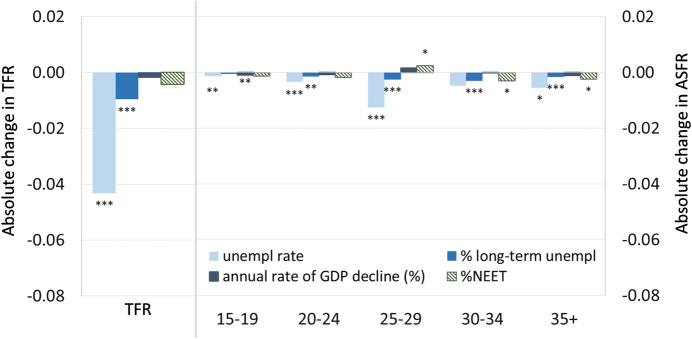
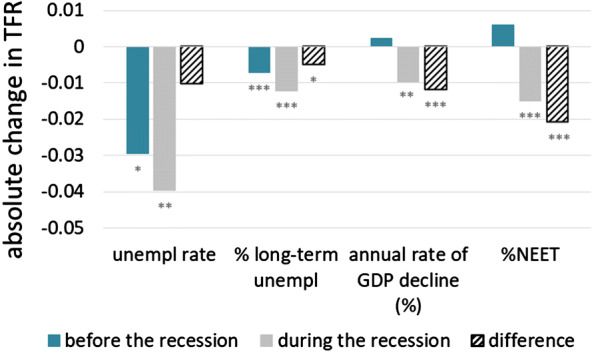
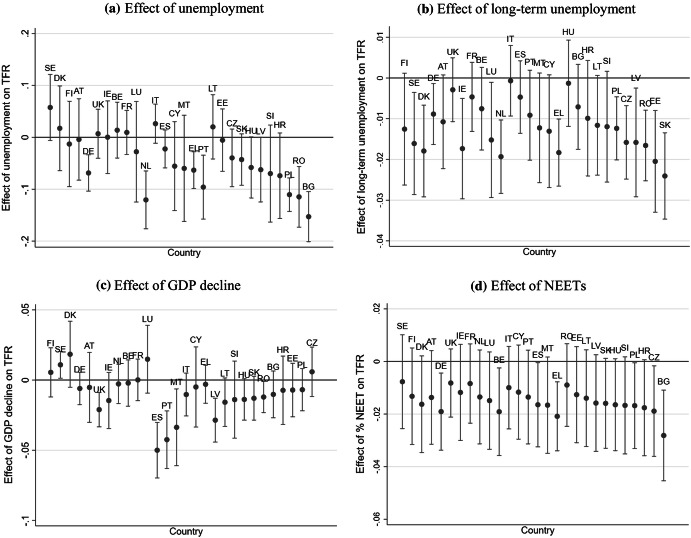
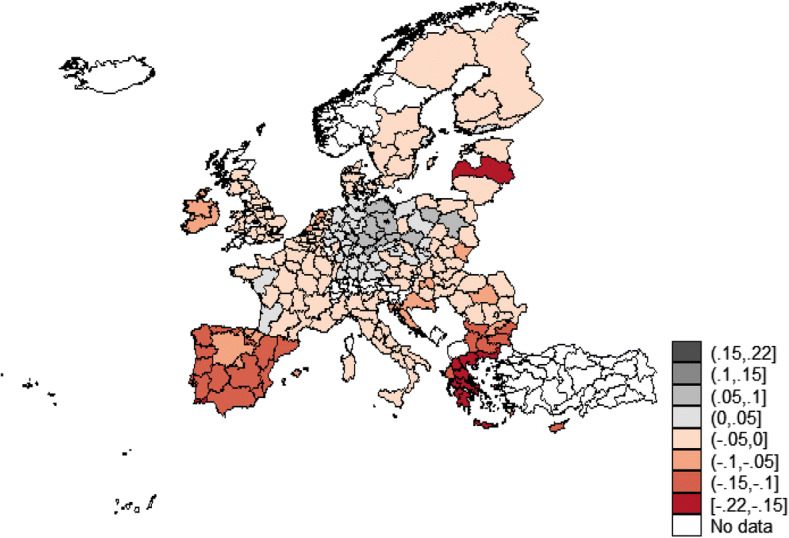
This study investigates how the changes in labour market conditions and economic growth were associated with fertility before and during the Great Recession in Europe in 2002–2014. In contrast to previous studies, which largely concentrated at the country level, we use data for 251 European regions in 28 European Union (EU) member states prior to the withdrawal of the United Kingdom in January 2020. We apply three-level growth-curve model which allows for a great deal of flexibility in modelling temporal change while controlling for variation in economic conditions across regions and countries. Our findings show that fertility decline was strongly related to unemployment increase; this relationship was significant at different reproductive ages. Deteriorating economic conditions were associated with a stronger decline in fertility during the economic recession as compared with the pre-recession period. This evidence suggests the salience of factors such as broader perception of uncertainty that we could not capture in our models and which rose to prominence during the Great Recession. Furthermore, strongest fertility declines were observed in Southern Europe, Ireland and parts of Central and Eastern Europe, i.e. countries and regions where labour market conditions deteriorated most during the recession period. In Western Europe, and especially in the Nordic countries, fertility rates were not closely associated with the recession indicators.
Overview
The claims and statistics of this paper haven’t been checked yet.
Free: it reads the open-access text and checks the first 5 claims that cite a source we can check. Create a free account to check every claim.
Integrity signals
Registry
Cites
Statistics
Figures
Verification
Claims the paper makes
The claims and statistics of this paper haven’t been checked yet.
Free: it reads the open-access text and checks the first 5 claims that cite a source we can check. Create a free account to check every claim.
Claims other papers make about this one
Each is checked against this paper’s own text: does it say what the citing paper says it does?
The source backs part of the claim, not all of it — or backs it for a different population, condition or comparison.
In the citing paper
“Matysiak et al. (2021) find that the Great Recession has strengthened the decline in fertility for most European countries. The impact was most pronounced in Southern and Eastern Europe and muted in Western and, especially, Northern Europe.”
From Fertility in High-Income Countries: Trends, Patterns, Determinants, and Consequences (2024) · cites this paper as Matysiak et al. 2021
Experimental — accuracy not yet measured
Self-check
Percentages, sums and reported differences re-computed from the paper’s own numbers.
The self-check needs the paper’s full text.
Citations
Cites
Social Foundations of Postindustrial Economies
Esping-Andersen, G. (1999) · doi:10.1093/0198742002.001.0001 · Cited by 6,253
8 The Precariat The New Dangerous Class?
(2025) · Precarity in Western European Cinema · doi:10.1515/9789048560660-009 · Cited by 2,105
The precariat: the new dangerous class
Allen, M., & Ainley, P. (2011) · International Studies in Sociology of Education · doi:10.1080/09620214.2011.616348 · Cited by 1,814
The Emergence of Lowest‐Low Fertility in Europe During the 1990s
Kohler, H., Billari, F. C., & Ortega, J. A. (2002) · Population and Development Review · doi:10.1111/j.1728-4457.2002.00641.x · Cited by 1,451
Economic Recession and Fertility in the Developed World
Sobotka, T., Skirbekk, V., & Philipov, D. (2011) · Population and Development Review · doi:10.1111/j.1728-4457.2011.00411.x · Cited by 863
Self-citationGlobalization, Uncertainty and Youth in Society: The Losers in a Globalizing World
(2006) · Routledge eBooks · doi:10.4324/9780203003206 · Cited by 718
Family Policies in OECD Countries: A Comparative Analysis
Thévenon, O. (2011) · Population and Development Review · doi:10.1111/j.1728-4457.2011.00390.x · Cited by 663
Birth and Fortune. The Impact of Numbers on Personal Welfare
L., H., & Easterlin, R. A. (1981) · Population (French Edition) · doi:10.2307/1532629 · Cited by 622
Changing fertility rates in developed countries. The impact of labor market institutions
Adser�, A. (2004) · Journal of Population Economics · doi:10.1007/s00148-003-0166-x · Cited by 596 · cited 1×
“At the same time, these two countries are characterised by highly flexible labour markets with relatively short unemployment spells and low temporary employment (Adserà 2004; Caroleo and Pastore 2007).”
BackgroundA Theory of the Value of Children
Friedman, D., Hechter, M., & Kanazawa, S. (1994) · Demography · doi:10.2307/2061749 · Cited by 409
Research works printed but not linked: 8
- Aaberge, R., Colombino, U., Del Boca, D., Ermisch, J., Francesconi, M., Pasqua, S., & Strøm, S. (2005). Labor supply and fertility in Europe and the U.S. In: T. Boeri, D. Del Boca and C. Pissarides (Eds.), Women at work: An economic perspective (pp. 125-153). Oxford: Oxford University Press.
- Berkowitz King, R. (2005). The case of the American women. Globalization and the transition to adulthood in an individualistic regime. In: H-P. Blossfeld, Klizing, M.Mills, and K. Kurz (Eds.), Globalization, Uncertainty and Youth in Society (pp. 305-326). London and New York: Routledge.
- Lanzieri G Towards a ‘baby recession’ in Europe? Differential fertility trends during the economic crisis. Statistics in Focus 2013 Luxembourg Eurostat
- Malthus, T.R. [1798] (2008). An Essay on the Principle of Population. Reprinted, Oxford, UK: Oxford University Press.
- Matysiak, A., Sobotka, T., Vignoli, D. (2018). The great recession and fertility in Europe: A sub-national analysis. VID Working Papers 1805, Vienna Institute of Demography (VID) of the Austrian Academy of Sciences in Vienna. PMC7864853 33597835
- Rabe-Hesketh S Skrondal A Multilevel and Longitudinal Modelling Using Stata. Vol. I: Continuous Responses 2012 College Station Texas Stata Press
- Simó Noguera C Castro Martin T Soro Bonmatì A Blossfeld H-P Klijzing E Mills M Kurz K The Spanish case: The effects of the globalization process on the transition to adulthood Globalization, uncertainty and youth in society 2005 London Routledge 375 402
- UN Youth employment: Youth perspectives on the pursuit of decent work in changing times 2011 United Nations World Youth Report
Cited by
Items 301–308 of 308
Alexandrescu, A. (2026) · Proceeding Papers · doi:10.24818/basiq/2026/12/038
Commonalities and Differences in Lowest‐Low Fertility Patterns
Zuanna, G. D., & Leone, T. (2026) · Population and Development Review · doi:10.1111/padr.70098
Social Stratification, Life Course, and Political Inequality
Azzollini, L. (n.d.) · Archivio istituzionale della Ricerca - Bocconi
Essays on Family Transitions and Income Dynamics: Cross-National Evidence from Survey Data
Marseglia, E. (n.d.) · Archivio istituzionale della Ricerca - Bocconi
Sladká, D., & Matysiak, A. (2026) · Journal of Family Research · doi:10.20377/jfr-1363
Self-citationGüzel, A. E. (2026) · International Journal of Empirical Economics · doi:10.1142/s2810943026500174
Work Autonomy, Gender, and Fertility: Labour-Market Differences and Household Behaviour in Europe
Yang, Z. (2026) · Societies · doi:10.3390/soc16100362
Uhljár, P. (2026) · CUB Ph.D. Dissertations (Corvinus University of Budapest)
Metadata
- Authors
- Matysiak, A., Sobotka, T., & Vignoli, D.
- Affiliations
- University of Warsaw (PL)
- Austrian Academy of Sciences (AT)
- University of Florence (IT)
- Corresponding author
- Matysiak, Anna
- Venue
- European Journal of Population
- Published
- 2020-04-03
- Volume
- 37
- Issue
- 1
- Pages
- 29-64
- ISSN
- 0168-6577 (ISSN-L)
- 1572-9885
- PMC
- PMC7864853
- OpenAlex
- W2794717344
- Cited by
- 242
- References
- 70
- Citations by year
- 2026: 33 · 2025: 30 · 2024: 42 · 2023: 30 · 2022: 40 · 2021: 44 · 2020: 16
- FWCI
- 48.90
- Type
- journal article
- Language
- en
- Open access
- hybrid
- doi.org
- Licence
- cc-by
- creativecommons.org/licenses/by/4.0 (tdm)
- creativecommons.org/licenses/by/4.0 (vor)
- Locations
- European Journal of Population / Revue européenne de Démographie (publishedVersion, cc-by)
- PubMed Central (publishedVersion, cc-by)
- PubMed (publishedVersion)
- RePEc: Research Papers in Economics (submittedVersion)
- Florence Research (University of Florence) (submittedVersion, cc-by)
- Funders
- European Research Council (ERC 284238, ERC 725961)
- Topics
- Social Sciences › Demography › Family Dynamics and Relationships
- Health Sciences › Medicine › Reproductive Medicine › Reproductive Health and Technologies
- Social Sciences › Gender Studies › Gender, Labor, and Family Dynamics
- Keywords
- Great Recession, fertility decline, unemployment, economic uncertainty, subnational analysis, European regions, labor market conditions, reproductive age, regional fertility variation, Southern Europe, Nordic countries
About these checks
Registry, retraction, Cites and statistics results are computed, not judged, with one exception: a printed reference that no index lists is read once by a model before it counts as a citation error. Claims are extracted by a model and kept only when their quote appears verbatim in the text; each cited source is then checked, with a model’s help, for whether it says what the claim relies on. Those verdicts can be wrong — read the claim’s quote and the cited source before relying on one.
Statistics and arithmetic are recomputed, not judged.
Confidence bands are shown only for fields calibrated on our annotated test set. None is calibrated yet, so no band is shown.
What counts as a claim ›How we measure confidence ›How we check this ›
Are you an author, or do you see a problem with this page? Request a review
Data sources
Bibliographic data: Semantic Scholar, OpenAlex, Crossref.
Contains information from the Semantic Scholar Academic Graph Datasets, made available under the ODC Attribution License (ODC-BY 1.0).
Semantic Scholar’s data is described in: Kinney, R., et al. (2023). The Semantic Scholar Open Data Platform. arXiv:2301.10140.
