

The Great Recession and Fertility in Europe: A Sub-national Analysis
Open accessThe DOI matches its Crossref record; 69 of the 70 references it cites were found in a registry or an index.
Abstract
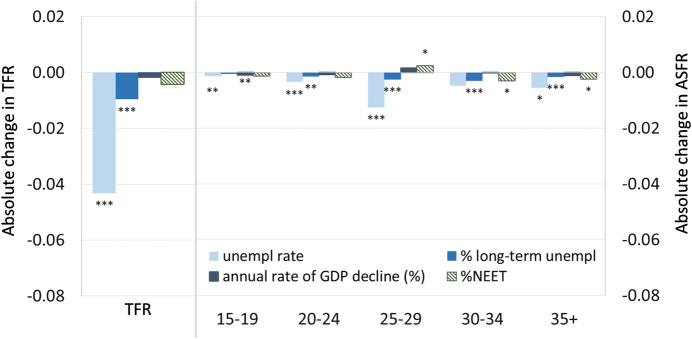
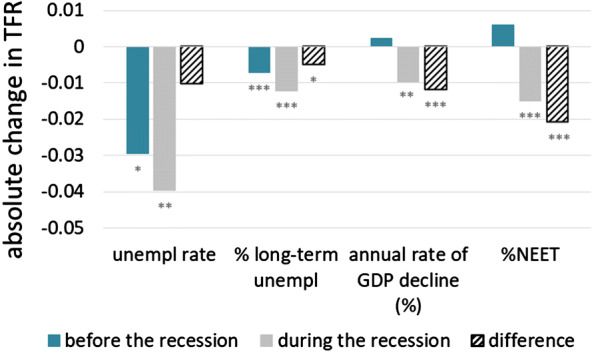
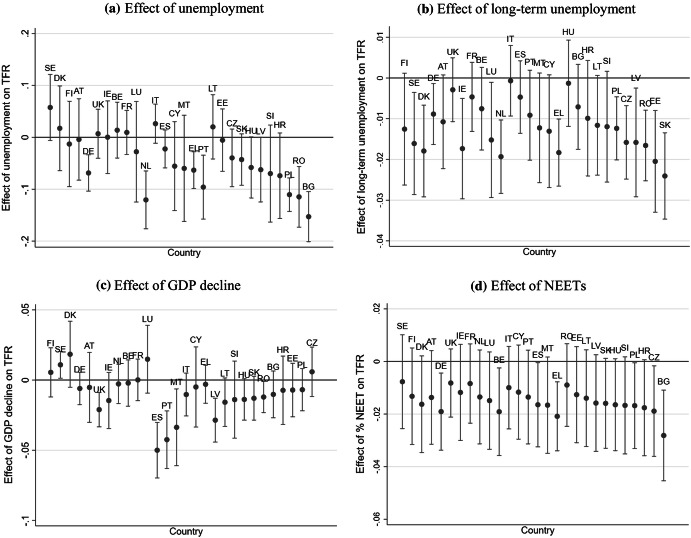
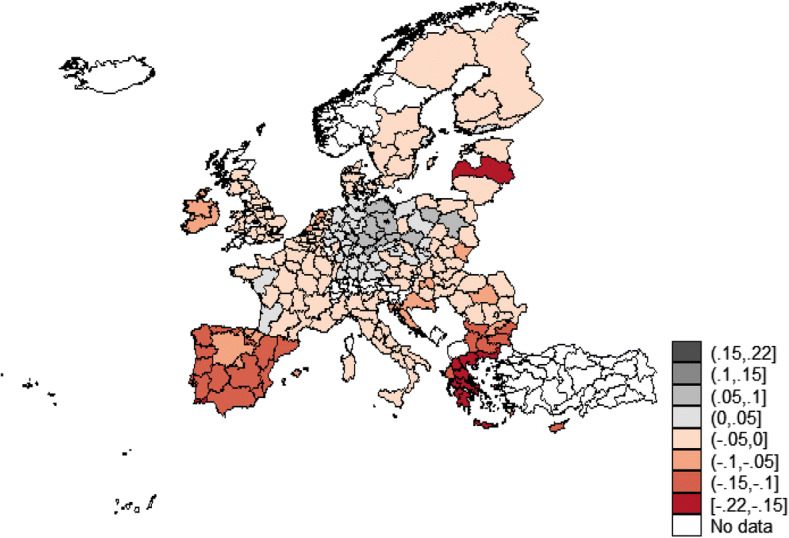
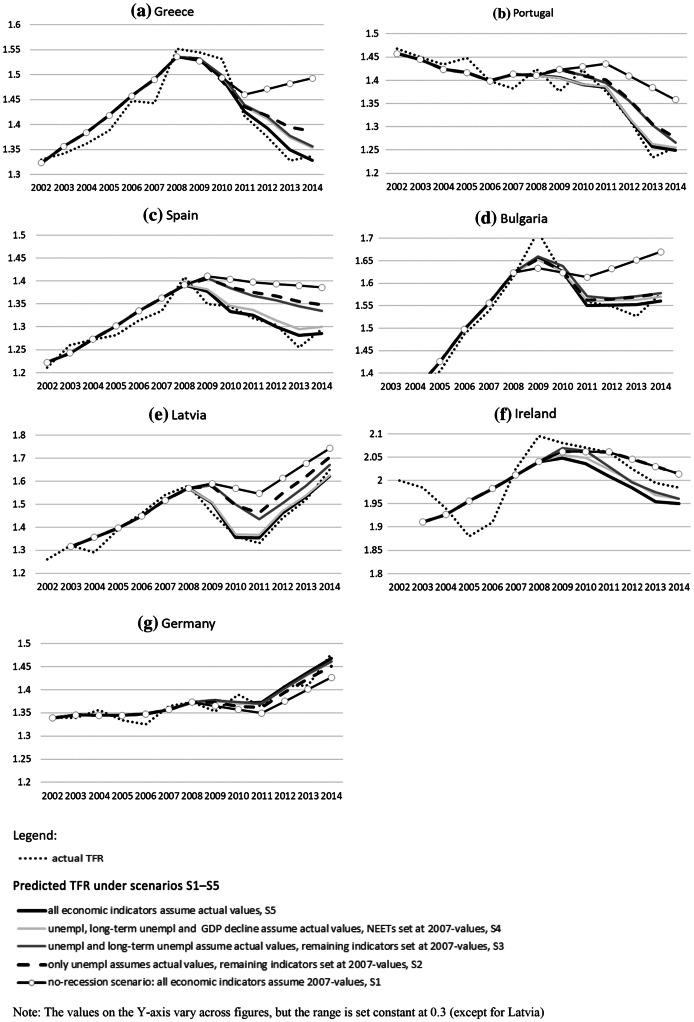
This study investigates how the changes in labour market conditions and economic growth were associated with fertility before and during the Great Recession in Europe in 2002–2014. In contrast to previous studies, which largely concentrated at the country level, we use data for 251 European regions in 28 European Union (EU) member states prior to the withdrawal of the United Kingdom in January 2020. We apply three-level growth-curve model which allows for a great deal of flexibility in modelling temporal change while controlling for variation in economic conditions across regions and countries. Our findings show that fertility decline was strongly related to unemployment increase; this relationship was significant at different reproductive ages. Deteriorating economic conditions were associated with a stronger decline in fertility during the economic recession as compared with the pre-recession period. This evidence suggests the salience of factors such as broader perception of uncertainty that we could not capture in our models and which rose to prominence during the Great Recession. Furthermore, strongest fertility declines were observed in Southern Europe, Ireland and parts of Central and Eastern Europe, i.e. countries and regions where labour market conditions deteriorated most during the recession period. In Western Europe, and especially in the Nordic countries, fertility rates were not closely associated with the recession indicators.
Overview
The claims and statistics of this paper haven’t been checked yet.
Free: it reads the open-access text and checks the first 5 claims that cite a source we can check. Create a free account to check every claim.
Integrity signals
Registry
Cites
Statistics
Figures
Verification
Claims the paper makes
The claims and statistics of this paper haven’t been checked yet.
Free: it reads the open-access text and checks the first 5 claims that cite a source we can check. Create a free account to check every claim.
Claims other papers make about this one
Each is checked against this paper’s own text: does it say what the citing paper says it does?
The source backs part of the claim, not all of it — or backs it for a different population, condition or comparison.
In the citing paper
“Matysiak et al. (2021) find that the Great Recession has strengthened the decline in fertility for most European countries. The impact was most pronounced in Southern and Eastern Europe and muted in Western and, especially, Northern Europe.”
From Fertility in High-Income Countries: Trends, Patterns, Determinants, and Consequences (2024) · cites this paper as Matysiak et al. 2021
Experimental — accuracy not yet measured
Self-check
Percentages, sums and reported differences re-computed from the paper’s own numbers.
The self-check needs the paper’s full text.
Citations
Cites
Social Foundations of Postindustrial Economies
Esping-Andersen, G. (1999) · doi:10.1093/0198742002.001.0001 · Cited by 6,253
8 The Precariat The New Dangerous Class?
(2025) · Precarity in Western European Cinema · doi:10.1515/9789048560660-009 · Cited by 2,105
The precariat: the new dangerous class
Allen, M., & Ainley, P. (2011) · International Studies in Sociology of Education · doi:10.1080/09620214.2011.616348 · Cited by 1,814
The Emergence of Lowest‐Low Fertility in Europe During the 1990s
Kohler, H., Billari, F. C., & Ortega, J. A. (2002) · Population and Development Review · doi:10.1111/j.1728-4457.2002.00641.x · Cited by 1,451
Economic Recession and Fertility in the Developed World
Sobotka, T., Skirbekk, V., & Philipov, D. (2011) · Population and Development Review · doi:10.1111/j.1728-4457.2011.00411.x · Cited by 863
Self-citationGlobalization, Uncertainty and Youth in Society: The Losers in a Globalizing World
(2006) · Routledge eBooks · doi:10.4324/9780203003206 · Cited by 718
Family Policies in OECD Countries: A Comparative Analysis
Thévenon, O. (2011) · Population and Development Review · doi:10.1111/j.1728-4457.2011.00390.x · Cited by 663
Birth and Fortune. The Impact of Numbers on Personal Welfare
L., H., & Easterlin, R. A. (1981) · Population (French Edition) · doi:10.2307/1532629 · Cited by 622
Changing fertility rates in developed countries. The impact of labor market institutions
Adser�, A. (2004) · Journal of Population Economics · doi:10.1007/s00148-003-0166-x · Cited by 596 · cited 1×
“At the same time, these two countries are characterised by highly flexible labour markets with relatively short unemployment spells and low temporary employment (Adserà 2004; Caroleo and Pastore 2007).”
BackgroundA Theory of the Value of Children
Friedman, D., Hechter, M., & Kanazawa, S. (1994) · Demography · doi:10.2307/2061749 · Cited by 409
Research works printed but not linked: 8
- Aaberge, R., Colombino, U., Del Boca, D., Ermisch, J., Francesconi, M., Pasqua, S., & Strøm, S. (2005). Labor supply and fertility in Europe and the U.S. In: T. Boeri, D. Del Boca and C. Pissarides (Eds.), Women at work: An economic perspective (pp. 125-153). Oxford: Oxford University Press.
- Berkowitz King, R. (2005). The case of the American women. Globalization and the transition to adulthood in an individualistic regime. In: H-P. Blossfeld, Klizing, M.Mills, and K. Kurz (Eds.), Globalization, Uncertainty and Youth in Society (pp. 305-326). London and New York: Routledge.
- Lanzieri G Towards a ‘baby recession’ in Europe? Differential fertility trends during the economic crisis. Statistics in Focus 2013 Luxembourg Eurostat
- Malthus, T.R. [1798] (2008). An Essay on the Principle of Population. Reprinted, Oxford, UK: Oxford University Press.
- Matysiak, A., Sobotka, T., Vignoli, D. (2018). The great recession and fertility in Europe: A sub-national analysis. VID Working Papers 1805, Vienna Institute of Demography (VID) of the Austrian Academy of Sciences in Vienna. PMC7864853 33597835
- Rabe-Hesketh S Skrondal A Multilevel and Longitudinal Modelling Using Stata. Vol. I: Continuous Responses 2012 College Station Texas Stata Press
- Simó Noguera C Castro Martin T Soro Bonmatì A Blossfeld H-P Klijzing E Mills M Kurz K The Spanish case: The effects of the globalization process on the transition to adulthood Globalization, uncertainty and youth in society 2005 London Routledge 375 402
- UN Youth employment: Youth perspectives on the pursuit of decent work in changing times 2011 United Nations World Youth Report
Cited by
A reflection on economic uncertainty and fertility in Europe: The Narrative Framework
Vignoli, D., Guetto, R., Bazzani, G., Pirani, E., & Minello, A. (2020) · Genus · doi:10.1186/s41118-020-00094-3 · Cited by 332
Self-citationBeyond the Economic Gaze: Childbearing During and After Recessions in the Nordic Countries
Comolli, C. L., Neyer, G., Andersson, G., Dommermuth, L., Fallesen, P., Jalovaara, M., Jónsson, A. K., Kolk, M., & Lappegård, T. (2021) · European Journal of Population · doi:10.1007/s10680-020-09570-0 · Cited by 246
Seltzer, N. (2019) · Demography · doi:10.1007/s13524-019-00790-6 · Cited by 196
Narratives of the Future Affect Fertility: Evidence from a Laboratory Experiment
Vignoli, D., Minello, A., Bazzani, G., Matera, C., & Rapallini, C. (2022) · European Journal of Population / Revue européenne de Démographie · doi:10.1007/s10680-021-09602-3 · Cited by 197
Self-citationThe impact of COVID-19 on fertility plans in Italy, Germany, France, Spain, and the United Kingdom
Luppi, F., Arpino, B., & Rosina, A. (2020) · Demographic Research · doi:10.4054/demres.2020.43.47 · Cited by 188
Spreading Uncertainty, Shrinking Birth Rates: A Natural Experiment for Italy
Comolli, C. L., & Vignoli, D. (2021) · European Sociological Review · doi:10.1093/esr/jcab001 · Cited by 172
Self-citationPandemic Roller‐Coaster? Birth Trends in Higher‐Income Countries During the COVID‐19 Pandemic
Sobotka, T., Zeman, K., Jasilioniene, A., Winkler‐Dworak, M., Brzozowska, Z., Alustiza‐Galarza, A., Németh, L., & Jdanov, D. (2024) · Population and Development Review · doi:10.1111/padr.12544 · Cited by 171
Self-citationUncertainty and Narratives of the Future: A Theoretical Framework for Contemporary Fertility
Vignoli, D., Bazzani, G., Guetto, R., Minello, A., & Pirani, E. (2020) · The Springer Series on Demographic Methods and Population Analysis · doi:10.1007/978-3-030-48519-1_3 · Cited by 166
Self-citationSocietal Pessimism and the Transition to Parenthood: A Future Too Bleak to Have Children?
Ivanova, K., & Balbo, N. (2024) · Population and Development Review · doi:10.1111/padr.12620 · Cited by 142
Is the effect of job uncertainty on fertility intentions channeled by subjective well-being?
Vignoli, D., Mencarini, L., & Alderotti, G. (2020) · Advances in Life Course Research · doi:10.1016/j.alcr.2020.100343 · Cited by 107
Self-citationRobots, Marriageable Men, Family, and Fertility
Anelli, M., Giuntella, O., & Stella, L. (2021) · The Journal of Human Resources · doi:10.3368/jhr.1020-11223r1 · Cited by 100
Persistent joblessness and fertility intentions
Busetta, A., Mendola, D., & Vignoli, D. (2019) · Demographic Research · doi:10.4054/demres.2019.40.8 · Cited by 95
Self-citationGuetto, R., Bazzani, G., & Vignoli, D. (2022) · Vienna Yearbook of Population Research · doi:10.1553/populationyearbook2022.res1.6 · Cited by 70
Self-citationFertility in High-Income Countries: Trends, Patterns, Determinants, and Consequences
Bloom, D. E., Kuhn, M., & Prettner, K. (2024) · Annual Review of Economics · doi:10.1146/annurev-economics-081523-013750 · Cited by 64
Perceived consequences of the COVID-19 pandemic and childbearing intentions in Poland
Malicka, I., Mynarska, M. A., & Świderska, J. (2021) · Journal of Family Research · doi:10.20377/jfr-666 · Cited by 62
Vinci, S., Vardopoulos, I., & Salvati, L. (2022) · Cities · doi:10.1016/j.cities.2022.104089 · Cited by 62
Disentangling the Swedish fertility decline of the 2010s
Ohlsson‐Wijk, S., & Andersson, G. (2022) · Demographic Research · doi:10.4054/demres.2022.47.12 · Cited by 57
Scenario‐based fertility projections incorporating impacts of COVID‐19
Berrington, A. M., Ellison, J., Kuang, B., Vasireddy, S., & Kulu, H. (2021) · Population Space and Place · doi:10.1002/psp.2546 · Cited by 53
How can China tackle its declining fertility rate?
Wang, Y., Kong, F., Fu, Y., & Qiao, J. (2024) · BMJ · doi:10.1136/bmj-2023-078635 · Cited by 51
Fast Track intervention effects on family formation.
Lansford, J. E., Godwin, J. W., Copeland, W., Dodge, K. A., Odgers, C. L., Rothenberg, W. A., & Rybińska, A. (2022) · Journal of Family Psychology · doi:10.1037/fam0001039 · Cited by 50
Sabater, A., & Graham, E. (2018) · Applied Spatial Analysis and Policy · doi:10.1007/s12061-018-9255-9 · Cited by 50
European countries with delayed childbearing are not those with lower fertility
Beaujouan, É., & Toulemon, L. (2021) · Genus · doi:10.1186/s41118-020-00108-0 · Cited by 45
“who may be in an advanced stage of their careers after age 30 and lies at the heart of fertility trends (Matysiak et al., 2018).”
BackgroundDevelopments in Demographic Forecasting
Mazzuco, S., & Keilman, N. (2020) · The Springer series on demographic methods and population analysis · doi:10.1007/978-3-030-42472-5 · Cited by 45
Bujard, M., & Andersson, G. (2024) · European Journal of Population / Revue européenne de Démographie · doi:10.1007/s10680-023-09689-w · Cited by 44
Imai, Y., Endo, M., Kuroda, K., Tomooka, K., Ikemoto, Y., Sato, S., Mitsui, K., Ueda, Y., Deshpande, G. A., Tanaka, A., et al. (2020) · Occupational and Environmental Medicine · doi:10.1136/oemed-2020-106745 · Cited by 42
Winkler‐Dworak, M., Zeman, K., & Sobotka, T. (2024) · Human Reproduction Open · doi:10.1093/hropen/hoae052 · Cited by 41
Self-citationBueno, X., & Brinton, M. C. (2019) · Population Studies · doi:10.1080/00324728.2019.1604979 · Cited by 40
The Demographic Causes of European Sub-National Population Declines
Newsham, N., & Rowe, F. (2025) · European Journal of Population / Revue européenne de Démographie · doi:10.1007/s10680-025-09730-0 · Cited by 36
Economic complexity and fertility: insights from a low fertility country
Innocenti, N., Vignoli, D., & Lazzeretti, L. (2021) · Regional Studies · doi:10.1080/00343404.2021.1896695 · Cited by 36
Self-citationDemographic and social issues of the pandemic
Kalabikhina, I. E. (2020) · Population and Economics · doi:10.3897/popecon.4.e53891 · Cited by 35
Trimarchi, A., & Bavel, J. V. (2019) · European Journal of Population / Revue européenne de Démographie · doi:10.1007/s10680-019-09537-w · Cited by 34
From bust to boom? Birth and fertility responses to the COVID-19 pandemicPreprint
Sobotka, T., Jasilioniene, A., Zeman, K., Winkler‐Dworak, M., Brzozowska, Z., Galarza, A. A., Németh, L., & Jdanov, D. A. (2022) · SocArXiv (OSF Preprints) · doi:10.31235/osf.io/87acb · Cited by 33
Self-citationMatysiak, A., & Vignoli, D. (2024) · European Journal of Population / Revue européenne de Démographie · doi:10.1007/s10680-024-09701-x · Cited by 33
Self-citationBuh, B. (2023) · Genus · doi:10.1186/s41118-023-00185-x · Cited by 30
Industrial Robots and Regional Fertility in European Countries
Matysiak, A., Bellani, D., & Bogusz, H. (2023) · European Journal of Population · doi:10.1007/s10680-023-09657-4 · Cited by 29
“A large body of the literature has provided evidence that weakening employment prospects, increase in unemployment and economic uncertainty lead to postponement of fertility or even lower fertility rates (Adsera, 2004; Comolli, 2017; Matysiak et al., 2021; Schneider, 2015).”
BackgroundSelf-citationAlderotti, G., Mussino, E., & Comolli, C. L. (2022) · European Societies · doi:10.1080/14616696.2022.2153302 · Cited by 29
Fertility and Media Narratives of the Economy: Evidence From Italian News Coverage
Guetto, R., Morabito, M. F., Vollbracht, M., & Vignoli, D. (2023) · Demography · doi:10.1215/00703370-10607928 · Cited by 29
Self-citationCampisi, N., Kulu, H., Mikolai, J., Klüsener, S., & Myrskylä, M. (2023) · Applied Spatial Analysis and Policy · doi:10.1007/s12061-022-09467-x · Cited by 28
“Existing research has either proposed economic factors, such as unemployment (Comolli et al., 2019; Goldstein et al., 2013; Matysiak et al., 2020), or social factors, such as societal expectations (Lappegård et al.”
BackgroundHow will COVID-19 impact Australia's future population? A scenario approach
Charles‐Edwards, E., Wilson, T., Bernard, A., & Wohland, P. (2021) · Applied Geography · doi:10.1016/j.apgeog.2021.102506 · Cited by 28
Health status and fertility intentions among migrants
Alderotti, G., & Trappolini, E. (2021) · International Migration · doi:10.1111/imig.12921 · Cited by 27
Labor Market Policy and Subjective Well-Being During the Great Recession
Morgan, R., & O’Connor, K. J. (2021) · Journal of Happiness Studies · doi:10.1007/s10902-021-00403-3 · Cited by 28
Robots, Labor Markets, and Family BehaviorPreprint
Anelli, M., Giuntella, O., & Stella, L. (2019) · SSRN Electronic Journal · doi:10.2139/ssrn.3503770 · Cited by 26
Jurić, T. (2021) · Athens Journal of Mediterranean Studies · doi:10.30958/ajms.8-1-4 · Cited by 25
Immigration and the prospects for long-run population decreases in European countries
Parr, N. (2022) · Vienna Yearbook of Population Research · doi:10.1553/p-8jf5-7cdc · Cited by 24
Second Birth Fertility in Germany: Social Class, Gender, and the Role of Economic Uncertainty
Kreyenfeld, M. R., Konietzka, D., Lambert, P., & Ramos, V. J. (2023) · European Journal of Population / Revue européenne de Démographie · doi:10.1007/s10680-023-09656-5 · Cited by 24
Perelli‐Harris, B., Gerber, T. P., & Hilevych, Y. (2024) · European Journal of Population / Revue européenne de Démographie · doi:10.1007/s10680-024-09713-7 · Cited by 24
The Motherhood Wage Penalty: A Meta-Analysis
Cukrowska‐Torzewska, E., & Matysiak, A. (2021) · doi:10.1553/0x003ccd38 · Cited by 24
Self-citationLuppi, F., Arpino, B., & Rosina, A. (2022) · PLoS ONE · doi:10.1371/journal.pone.0271384 · Cited by 23
Brzozowska, Z. (2021) · Demographic Research · doi:10.4054/demres.2021.44.46 · Cited by 23
Contribution of Education to Infant and Under-Five Mortality Disparities among Caste Groups in India
Bora, J. K., Raushan, R., & Lutz, W. (2021) · doi:10.1553/0x003ccd42 · Cited by 22
Household Earnings and Income Volatility in the UK, 2009–2017
Avram, S., Brewer, M., Fisher, P. G., & Fumagalli, L. (2021) · The Journal of Economic Inequality · doi:10.1007/s10888-021-09517-3 · Cited by 22
Age-Specific Income Trends in Europe: The Role of Employment, Wages, and Social Transfers
Hammer, B., Spitzer, S., & Prskawetz, A. (2021) · Social Indicators Research · doi:10.1007/s11205-021-02838-w · Cited by 22
Theory and explanation in demography: The case of low fertility in Europe
Graham, E. (2021) · Population Studies · doi:10.1080/00324728.2021.1971742 · Cited by 22
González‐Leonardo, M., & Spijker, J. (2022) · Boletín de la Asociación de Geógrafos Españoles · doi:10.21138/bage.3201 · Cited by 22
Delayed Fertility as a Driver of Fertility Decline?
Beaujouan, E. (2023) · The Springer Series on Demographic Methods and Population Analysis · doi:10.1007/978-3-031-29666-6_4 · Cited by 21
Cash transfers and fertility: Evidence from Poland’s Family 500+ Policy
Bokun, A. (2024) · Demographic Research · doi:10.4054/demres.2024.51.28 · Cited by 22
Lazzari, E., Reimondos, A., & Gray, E. (2023) · Population and Development Review · doi:10.1111/padr.12549 · Cited by 21
Economic Uncertainty, Cultural and Ideational Transition, and Low Fertility
Wang, S., & Zhong, S. (2022) · Sustainability · doi:10.3390/su14148344 · Cited by 20
Will the COVID-19 pandemic affect population ageing in Australia?
Wilson, T., Temple, J., & Charles‐Edwards, E. (2021) · Journal of Population Research · doi:10.1007/s12546-021-09255-3 · Cited by 20
Effects of pandemics uncertainty on fertility
Wang, Y., Gözgör, G., & Lau, C. K. M. (2022) · Frontiers in Public Health · doi:10.3389/fpubh.2022.854771 · Cited by 20
How much his or her job loss influences fertility: A couple approach
Nallo, A. D., & Lipps, O. (2023) · Journal of Marriage and the Family · doi:10.1111/jomf.12907 · Cited by 21
The Part-Time Revolution: Changes in the Parenthood Effect on Women’s Employment in Austria
Berghammer, C. (2021) · doi:10.1553/0x003ccd40 · Cited by 18
Policies and Fertility: Pronatalist vs. Structural Approaches
Vignoli, D., & Guetto, R. (2025) · The Springer series on demographic methods and population analysis · doi:10.1007/978-3-031-89737-5_3 · Cited by 18
Self-citationThe impact of Covid-19 on demographic components in Spain, 2020–31: A scenario approach
González‐Leonardo, M., & Spijker, J. (2022) · Population Studies · doi:10.1080/00324728.2022.2138521 · Cited by 18
Arpino, B., Luppi, F., & Rosina, A. (2021) · SocArXiv (OSF Preprints) · doi:10.31235/osf.io/4sjvm · Cited by 18
Employment Protection Legislation, Labour Market Dualism, and Fertility in Europe
Bastianelli, E., Guetto, R., & Vignoli, D. (2023) · European Journal of Population / Revue européenne de Démographie · doi:10.1007/s10680-023-09662-7 · Cited by 19
Self-citationMahasneh, I. A., & Ebrahim, F. (2024) · Middle East Fertility Society Journal · doi:10.1186/s43043-024-00205-6 · Cited by 17
Buber‐Ennser, I., Setz, I., & Riederer, B. E. (2023) · Population and Development Review · doi:10.1111/padr.12555 · Cited by 17
Tracing Time Trends of Births in Greece
Vlachadis, N., Siori, M., Πετράκος, Γ., Panagopoulos, P., Kornarou, E., Barbouni, A., Antonakopoulos, N., Τίγκα, Μ., Lykeridou, A., & Vrachnis, N. (2023) · Cureus · doi:10.7759/cureus.34040 · Cited by 16
Deimantas, V. J., Şanlıtürk, A. E., Azzollini, L., & Köksal, S. (2024) · Population Research and Policy Review · doi:10.1007/s11113-024-09871-w · Cited by 16
Cross-Sectional Average Length of Life Childless
Mogi, R., Nisén, J., & Canudas‐Romo, V. (2021) · Demography · doi:10.1215/00703370-8937427 · Cited by 16
All-time low period fertility in Finland: drivers, tempo effects, and cohort implications
Hellstrand, J., Nisén, J., & Myrskylä, M. (2019) · doi:10.4054/mpidr-wp-2019-006 · Cited by 17
COVID-19 and Fertility in Canada: a Commentary
Fostik, A. L. (2021) · Canadian Studies in Population · doi:10.1007/s42650-021-00054-y · Cited by 16
Partnership dynamics and the fertility gap between Sweden and Spain
Nishikido, M., Cui, Q., & Esteve, A. (2022) · Genus · doi:10.1186/s41118-022-00170-w · Cited by 15
“Kaa, 1987), economic (Alderotti et al., 2021; Matysiak et al., 2021; Vignoli et al., 2020), and gender-related (Esping-Andersen & Billari, 2015; Goldscheider et al.”
Late Fertility Intentions and Fertility in Austria
Beaujouan, É. (2021) · doi:10.1553/0x003ccd3c · Cited by 15
Xie, Y., Guo, J., & Ma, X. (2024) · International Review of Economics & Finance · doi:10.1016/j.iref.2024.103747 · Cited by 15
Three Decades of Lowest-low Fertility in Spain, 1991 – 2018Preprint
Esteve, A., Lozano, M., Boertien, D., Mogi, R., & Cui, Q. (2021) · SocArXiv (OSF Preprints) · doi:10.31235/osf.io/45j23 · Cited by 15
Nitsche, N., & Brückner, H. (2021) · doi:10.1553/0x003ccd3a · Cited by 14
Badolato, L., Hayford, S. R., & Guzzo, K. B. (2025) · Genus · doi:10.1186/s41118-025-00251-6 · Cited by 14
Igualdad de género en el mercado laboral: Retos y cambio institucional
Cabrera, A. M. G., & Cedres-Hernández, Y. (2024) · doi:10.31876/rcs.v30i1.41639 · Cited by 14
Recent demographic trends in France: Situations and behaviours of minors
Breton, D., Barbiéri, M., Belliot, N., d’Albis, H., Mazuy, M., & Dutreuilh, C. (2021) · Population (English Edition) · doi:10.3917/popu.2004.0467 · Cited by 14
Brzozowska, Z., Buber‐Ennser, I., Riederer, B. E., & Potančoková, M. (2021) · doi:10.1553/0x003ccd3e · Cited by 13
Robots, gender economic opportunities and household adjustment: Evidence from China
Yu, S., Zhang, J., & Yan, X. (2024) · Structural Change and Economic Dynamics · doi:10.1016/j.strueco.2024.06.007 · Cited by 13
Bazzani, G., Dommermuth, L., Lappegård, T., & Vignoli, D. (2025) · Acta Sociologica · doi:10.1177/00016993241300434 · Cited by 13
Self-citationIntentions and Childbearing in a Cross-Domain Life Course Approach: The Case of Australia
Testa, M. R., & Bolano, D. (2021) · doi:10.1553/0x003cb436 · Cited by 13
Spillovers from gender equality onto economic equality: Evidence from 162 nations
Nelson, M. A., & Goel, R. K. (2022) · Journal of International Development · doi:10.1002/jid.3731 · Cited by 13
Turnbull-Dugarte, S. J. (2022) · Journal of European Public Policy · doi:10.1080/13501763.2022.2154823 · Cited by 13
Impact of the COVID-19 pandemic on pregnancy postponement – evidence from Japan
Matsushima, M., Yamada, H., Kondo, N., Arakawa, Y., & Tabuchi, T. (2023) · Journal of Biosocial Science · doi:10.1017/s0021932022000451 · Cited by 13
Nitsche, N., & Hayford, S. R. (2021) · doi:10.1553/0x003ccd34 · Cited by 12
Experts’ Expectations of Future Vulnerability at the Peak of the “Refugee Crisis”
Riederer, B. E. (2021) · doi:10.1553/0x003ccd36 · Cited by 12
Kwag, H., Baek, S., & Kang, M. (2024) · International Journal of Urban Sciences · doi:10.1080/12265934.2024.2320905 · Cited by 12
Coutinho, R. Z., & Souza, I. V. (2024) · Revista Brasileira de Estudos de População · doi:10.20947/s0102-3098a0283 · Cited by 12
Tempting Luck: Temporalities and Risk Anticipation among Egg Donors in Spain
Molas, A., & Whittaker, A. M. (2023) · Science Technology & Human Values · doi:10.1177/01622439231164666 · Cited by 12
Neels, K., Marynissen, L., & Wood, J. (2024) · European Journal of Population / Revue européenne de Démographie · doi:10.1007/s10680-024-09695-6 · Cited by 12
Neyer, G. R., Andersson, G., & Dahlberg, J. (2024) · Finnish Yearbook of Population Research · doi:10.23979/fypr.137453 · Cited by 12
Lazzari, E., & Beaujouan, É. (2025) · Demography · doi:10.1215/00703370-11873109 · Cited by 12
Not the right time for children: Unemployment, fertility, and abortion
Cavallini, F. (2024) · Labour Economics · doi:10.1016/j.labeco.2023.102492 · Cited by 11
The Diffusion of Late Fertility Across European Regions (2006–2018)
Setz, I., Compans, M., & Beaujouan, É. (2025) · Population Space and Place · doi:10.1002/psp.70031 · Cited by 11
Hincapié, V. G., & López, M. T. L. (2021) · Papers Revista de Sociologia · doi:10.5565/rev/papers.2735 · Cited by 11
Neden ve Etki Boyutlarıyla “Ne Eğitimde Ne İstihdamda Ne de Yetiştirmede (NEİY)” Olan Gençler
Ak, Y., Toktaş, D., Söylemez, S. Ş., & Polat, K. (2021) · Istanbul University Press eBooks · doi:10.26650/b/ss46.2021.014.01 · Cited by 11
Metadata
- Authors
- Matysiak, A., Sobotka, T., & Vignoli, D.
- Affiliations
- University of Warsaw (PL)
- Austrian Academy of Sciences (AT)
- University of Florence (IT)
- Corresponding author
- Matysiak, Anna
- Venue
- European Journal of Population
- Published
- 2020-04-03
- Volume
- 37
- Issue
- 1
- Pages
- 29-64
- ISSN
- 0168-6577 (ISSN-L)
- 1572-9885
- PMC
- PMC7864853
- OpenAlex
- W2794717344
- Cited by
- 242
- References
- 70
- Citations by year
- 2026: 33 · 2025: 30 · 2024: 42 · 2023: 30 · 2022: 40 · 2021: 44 · 2020: 16
- FWCI
- 48.90
- Type
- journal article
- Language
- en
- Open access
- hybrid
- doi.org
- Licence
- cc-by
- creativecommons.org/licenses/by/4.0 (tdm)
- creativecommons.org/licenses/by/4.0 (vor)
- Locations
- European Journal of Population / Revue européenne de Démographie (publishedVersion, cc-by)
- PubMed Central (publishedVersion, cc-by)
- PubMed (publishedVersion)
- RePEc: Research Papers in Economics (submittedVersion)
- Florence Research (University of Florence) (submittedVersion, cc-by)
- Funders
- European Research Council (ERC 284238, ERC 725961)
- Topics
- Social Sciences › Demography › Family Dynamics and Relationships
- Health Sciences › Medicine › Reproductive Medicine › Reproductive Health and Technologies
- Social Sciences › Gender Studies › Gender, Labor, and Family Dynamics
- Keywords
- Great Recession, fertility decline, unemployment, economic uncertainty, subnational analysis, European regions, labor market conditions, reproductive age, regional fertility variation, Southern Europe, Nordic countries
About these checks
Registry, retraction, Cites and statistics results are computed, not judged, with one exception: a printed reference that no index lists is read once by a model before it counts as a citation error. Claims are extracted by a model and kept only when their quote appears verbatim in the text; each cited source is then checked, with a model’s help, for whether it says what the claim relies on. Those verdicts can be wrong — read the claim’s quote and the cited source before relying on one.
Statistics and arithmetic are recomputed, not judged.
Confidence bands are shown only for fields calibrated on our annotated test set. None is calibrated yet, so no band is shown.
What counts as a claim ›How we measure confidence ›How we check this ›
Are you an author, or do you see a problem with this page? Request a review
Data sources
Bibliographic data: Semantic Scholar, OpenAlex, Crossref.
Contains information from the Semantic Scholar Academic Graph Datasets, made available under the ODC Attribution License (ODC-BY 1.0).
Semantic Scholar’s data is described in: Kinney, R., et al. (2023). The Semantic Scholar Open Data Platform. arXiv:2301.10140.
