

The Great Recession and Fertility in Europe: A Sub-national Analysis
Open accessThe DOI matches its Crossref record; 69 of the 70 references it cites were found in a registry or an index.
Abstract
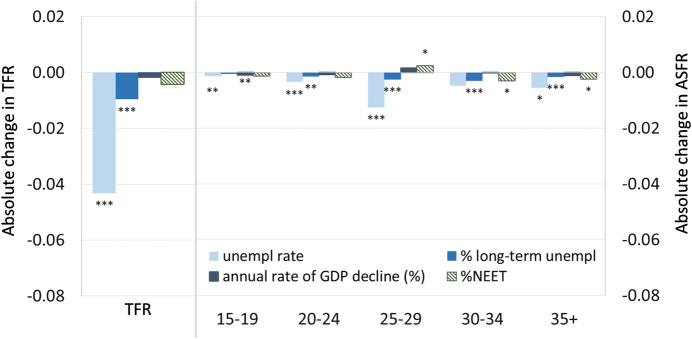
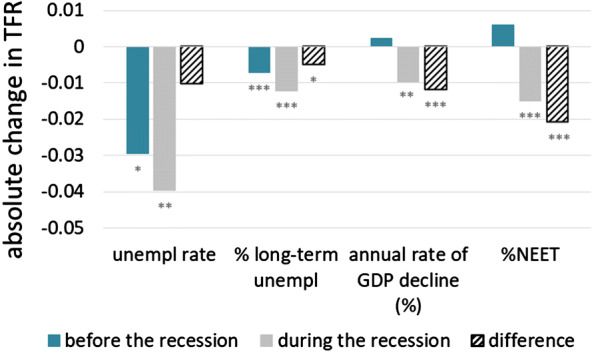
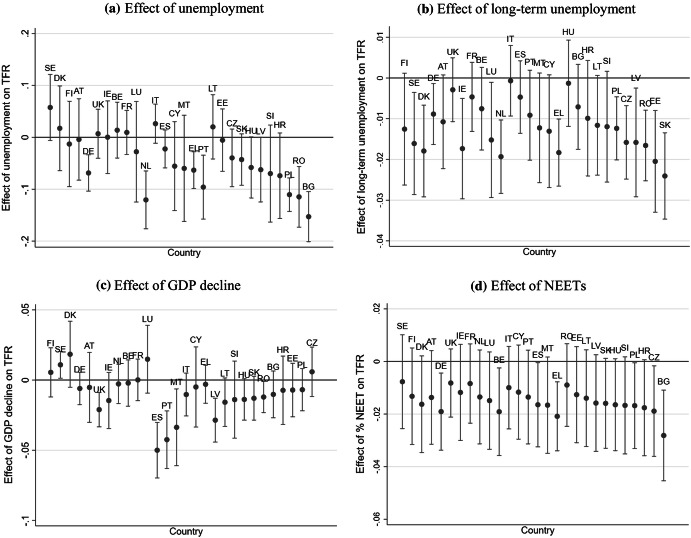
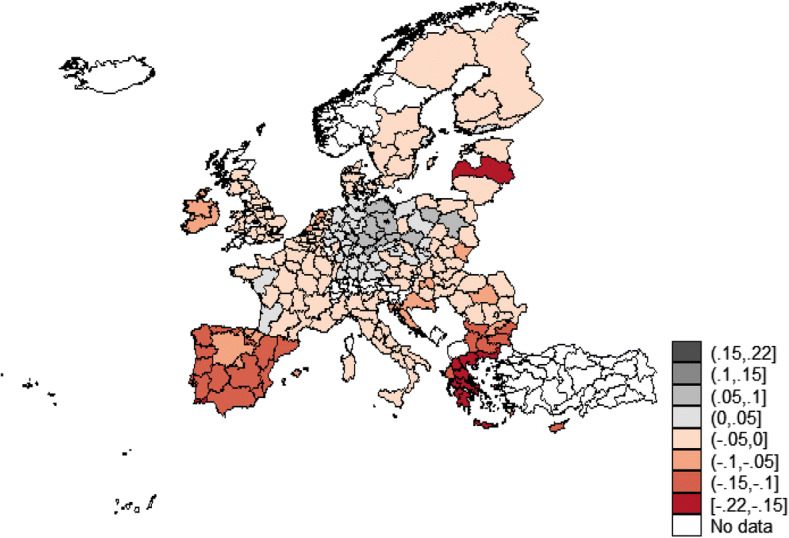
This study investigates how the changes in labour market conditions and economic growth were associated with fertility before and during the Great Recession in Europe in 2002–2014. In contrast to previous studies, which largely concentrated at the country level, we use data for 251 European regions in 28 European Union (EU) member states prior to the withdrawal of the United Kingdom in January 2020. We apply three-level growth-curve model which allows for a great deal of flexibility in modelling temporal change while controlling for variation in economic conditions across regions and countries. Our findings show that fertility decline was strongly related to unemployment increase; this relationship was significant at different reproductive ages. Deteriorating economic conditions were associated with a stronger decline in fertility during the economic recession as compared with the pre-recession period. This evidence suggests the salience of factors such as broader perception of uncertainty that we could not capture in our models and which rose to prominence during the Great Recession. Furthermore, strongest fertility declines were observed in Southern Europe, Ireland and parts of Central and Eastern Europe, i.e. countries and regions where labour market conditions deteriorated most during the recession period. In Western Europe, and especially in the Nordic countries, fertility rates were not closely associated with the recession indicators.
Overview
The claims and statistics of this paper haven’t been checked yet.
Free: it reads the open-access text and checks the first 5 claims that cite a source we can check. Create a free account to check every claim.
Integrity signals
Registry
Cites
Statistics
Figures
Verification
Claims the paper makes
The claims and statistics of this paper haven’t been checked yet.
Free: it reads the open-access text and checks the first 5 claims that cite a source we can check. Create a free account to check every claim.
Claims other papers make about this one
Each is checked against this paper’s own text: does it say what the citing paper says it does?
The source backs part of the claim, not all of it — or backs it for a different population, condition or comparison.
In the citing paper
“Matysiak et al. (2021) find that the Great Recession has strengthened the decline in fertility for most European countries. The impact was most pronounced in Southern and Eastern Europe and muted in Western and, especially, Northern Europe.”
From Fertility in High-Income Countries: Trends, Patterns, Determinants, and Consequences (2024) · cites this paper as Matysiak et al. 2021
Experimental — accuracy not yet measured
Self-check
Percentages, sums and reported differences re-computed from the paper’s own numbers.
The self-check needs the paper’s full text.
Citations
Cites
Social Foundations of Postindustrial Economies
Esping-Andersen, G. (1999) · doi:10.1093/0198742002.001.0001 · Cited by 6,253
8 The Precariat The New Dangerous Class?
(2025) · Precarity in Western European Cinema · doi:10.1515/9789048560660-009 · Cited by 2,105
The precariat: the new dangerous class
Allen, M., & Ainley, P. (2011) · International Studies in Sociology of Education · doi:10.1080/09620214.2011.616348 · Cited by 1,814
The Emergence of Lowest‐Low Fertility in Europe During the 1990s
Kohler, H., Billari, F. C., & Ortega, J. A. (2002) · Population and Development Review · doi:10.1111/j.1728-4457.2002.00641.x · Cited by 1,451
Economic Recession and Fertility in the Developed World
Sobotka, T., Skirbekk, V., & Philipov, D. (2011) · Population and Development Review · doi:10.1111/j.1728-4457.2011.00411.x · Cited by 863
Self-citationGlobalization, Uncertainty and Youth in Society: The Losers in a Globalizing World
(2006) · Routledge eBooks · doi:10.4324/9780203003206 · Cited by 718
Family Policies in OECD Countries: A Comparative Analysis
Thévenon, O. (2011) · Population and Development Review · doi:10.1111/j.1728-4457.2011.00390.x · Cited by 663
Birth and Fortune. The Impact of Numbers on Personal Welfare
L., H., & Easterlin, R. A. (1981) · Population (French Edition) · doi:10.2307/1532629 · Cited by 622
Changing fertility rates in developed countries. The impact of labor market institutions
Adser�, A. (2004) · Journal of Population Economics · doi:10.1007/s00148-003-0166-x · Cited by 596 · cited 1×
“At the same time, these two countries are characterised by highly flexible labour markets with relatively short unemployment spells and low temporary employment (Adserà 2004; Caroleo and Pastore 2007).”
BackgroundA Theory of the Value of Children
Friedman, D., Hechter, M., & Kanazawa, S. (1994) · Demography · doi:10.2307/2061749 · Cited by 409
Research works printed but not linked: 8
- Aaberge, R., Colombino, U., Del Boca, D., Ermisch, J., Francesconi, M., Pasqua, S., & Strøm, S. (2005). Labor supply and fertility in Europe and the U.S. In: T. Boeri, D. Del Boca and C. Pissarides (Eds.), Women at work: An economic perspective (pp. 125-153). Oxford: Oxford University Press.
- Berkowitz King, R. (2005). The case of the American women. Globalization and the transition to adulthood in an individualistic regime. In: H-P. Blossfeld, Klizing, M.Mills, and K. Kurz (Eds.), Globalization, Uncertainty and Youth in Society (pp. 305-326). London and New York: Routledge.
- Lanzieri G Towards a ‘baby recession’ in Europe? Differential fertility trends during the economic crisis. Statistics in Focus 2013 Luxembourg Eurostat
- Malthus, T.R. [1798] (2008). An Essay on the Principle of Population. Reprinted, Oxford, UK: Oxford University Press.
- Matysiak, A., Sobotka, T., Vignoli, D. (2018). The great recession and fertility in Europe: A sub-national analysis. VID Working Papers 1805, Vienna Institute of Demography (VID) of the Austrian Academy of Sciences in Vienna. PMC7864853 33597835
- Rabe-Hesketh S Skrondal A Multilevel and Longitudinal Modelling Using Stata. Vol. I: Continuous Responses 2012 College Station Texas Stata Press
- Simó Noguera C Castro Martin T Soro Bonmatì A Blossfeld H-P Klijzing E Mills M Kurz K The Spanish case: The effects of the globalization process on the transition to adulthood Globalization, uncertainty and youth in society 2005 London Routledge 375 402
- UN Youth employment: Youth perspectives on the pursuit of decent work in changing times 2011 United Nations World Youth Report
Cited by
Items 101–200 of 308
Notas sobre Familias y Pandemia. La restauración conservadora de la familia tradicional.
Bermúdez, M. S. D. M. (2022) · Trabajo Social · doi:10.15446/ts.v24n1.90377 · Cited by 11
Europe: Low Fertility, Aging, and Migration Policies
Ambrosetti, E. (2022) · International handbooks of population · doi:10.1007/978-3-031-02040-7_14 · Cited by 11
Tasneem, N., Haq, S. M. A., Ahmed, M. N. Q., & Ahmed, K. J. (2023) · SN Social Sciences · doi:10.1007/s43545-023-00729-0 · Cited by 11
Stepping Down from Life-long Posts: Layoffs, Fertility, and Educational Attainment in Urban China
Xie, J., Zhang, J., & Zhou, K. (2022) · Journal of Labor Economics · doi:10.1086/737991 · Cited by 11
Pandemic babies? Fertility in the aftermath of the first COVID-19 wave across European regions
Nitsche, N., Jasilioniene, A., Nisén, J., Li, P., Kniffka, M. S., Schöley, J., Andersson, G. B. J., Bagavos, C., Berrington, A. M., Čipin, I., et al. (2022) · doi:10.4054/mpidr-wp-2022-027 · Cited by 11
Self-citationReligious Affiliations in Austria at the Provincial Level: Estimates for Vorarlberg, 2001-2018
Goujon, A., Reiter, C., & Potančoková, M. (2021) · doi:10.1553/0x003ccd2e · Cited by 10
Breton, D., Belliot, N., Barbiéri, M., d’Albis, H., Mazuy, M., Dutreuilh, C., & Reeve, P. (2023) · Population (English Edition) · doi:10.3917/popu.2204.0535 · Cited by 10
Golub, R., Ivkov-Džigurski, A., & Simeunović, V. (2023) · Behavioral Sciences · doi:10.3390/bs13050417 · Cited by 10
García‐Pereiro, T., & Paterno, A. (2024) · Italian Economic Journal · doi:10.1007/s40797-024-00273-7 · Cited by 10
Rey, A. D., Grande, R., & García-Gómez, J. (2022) · Revista Española de Sociología · doi:10.22325/fes/res.2022.108 · Cited by 11
Fertility in High-Income Countries: Trends, Patterns, Determinants, and Consequences
Bloom, D. E., Kuhn, M., & Prettner, K. (2023) · doi:10.2139/ssrn.4597716 · Cited by 9
Parr, N. (2023) · Population and Development Review · doi:10.1111/padr.12559 · Cited by 9
Moscone, F., Madia, J. E., Nicodemo, C., An, J.-C., & Lee, C. (2024) · Research in Economics · doi:10.1016/j.rie.2024.100975 · Cited by 9
Gray, E., Evans, A., & Reimondos, A. (2022) · Australian Population Studies · doi:10.37970/aps.v6i1.101 · Cited by 9
Universal Transfers, Tax Breaks and Fertility: Evidence from a Regional Reform in Norway
Hart, R. K., & Galloway, T. A. (2023) · Population Research and Policy Review · doi:10.1007/s11113-023-09793-z · Cited by 8
“Over the last decade, Europe and the US have experienced a sharp fertility decline (Matysiak et al., 2020), and the proportion of European countries with polices aimed at increasing fertility has risen from 51 percent in 2005 to 67 percent in 2015 (United Nations, 2018).”
BackgroundNavigating parenthood in a climate change era: determinants of childbearing intentions in Iran
Alipour, Z., Ghaedrahmati, M., & Taghvi, S. (2025) · Scientific Reports · doi:10.1038/s41598-025-11708-1 · Cited by 8
Fertility Decline in Iceland, 2013-2022: Trends and Structures
Jónsson, A. K. (2024) · Comparative Population Studies · doi:10.12765/cpos-2024-07 · Cited by 8
Trends in fertility preferences among Italian young adults
Luppi, F., Bellani, D., & Rosina, A. (2025) · Population Studies · doi:10.1080/00324728.2025.2542833 · Cited by 8
Detecting economic insecurity in Italy: a latent transition modelling approach
Giambona, F., Grassini, L., & Vignoli, D. (2022) · Statistical Methods & Applications · doi:10.1007/s10260-021-00609-y · Cited by 8
Self-citationOláh, L. S., Richter, R., & Kotowska, I. E. (2023) · Demographic Research · doi:10.4054/demres.2023.48.29 · Cited by 8
Fertility Drain or Fertility Gain? Emigration and Fertility During the Great Recession in Italy
Anelli, M., & Balbo, N. (2021) · Demography · doi:10.1215/00703370-9001598 · Cited by 8
A brief guide to producing a national population projection
Wilson, T., & Rees, P. (2021) · Australian Population Studies · doi:10.37970/aps.v5i1.84 · Cited by 8
Kulu, H., Kuang, B., Christison, S., & Berrington, A. M. (2025) · Population Studies · doi:10.1080/00324728.2025.2491354 · Cited by 7
Tagai, G., & Lennert, J. (2023) · Repository of the Academy's Library (Library of the Hungarian Academy of Sciences) · Cited by 7
Kotzamanis, B. (2021) · Investigaciones Geográficas · doi:10.14198/ingeo.19061 · Cited by 7
Natives’ and immigrants’ fertility intentions in Europe: the role of employment
Alderotti, G., García‐Pereiro, T., Pace, R., & Paterno, A. (2022) · Espace populations sociétés · doi:10.4000/eps.13039 · Cited by 7
Németh, A. O., Németh, P., & Tőkés, L. (2025) · Journal of Population Research · doi:10.1007/s12546-025-09366-1 · Cited by 7
Batz, F., Lermer, E., Lech, S., O′Malley, G., zehni, A. Z., Zenz-Spitzweg, D., Mahner, S., Behr, J., Thaler, C., & Buspavanich, P. (2023) · BMC Public Health · doi:10.1186/s12889-023-15127-7 · Cited by 7
Campisi, N., Kulu, H., Mikolai, J., Klüsener, S., & Myrskylä, M. (2020) · doi:10.4054/mpidr-wp-2020-036 · Cited by 7
Global Decline in Fertility Rates: Trends, Influencing Factors, and Future Projections
Boodoo, C., & Hosein, P. A. (2024) · IEEE International Conference on Technology Management, Operations and Decisions (ICTMOD) · doi:10.1109/ictmod63116.2024.10878235 · Cited by 6
Pérez, L., & Muñiz, Á. (2024) · Journal of Demographic Economics · doi:10.1017/dem.2024.2 · Cited by 6
Grigoras, E., & Гагауз, О. Е. (2022) · ECONOMY AND SOCIOLOGY: Theoretical and Scientifical Journal · doi:10.36004/nier.es.2022.1-09 · Cited by 6
Vanella, P., Greil, A. L., & Deschermeier, P. (2023) · Comparative Population Studies · doi:10.12765/cpos-2023-02 · Cited by 6
Beyond the crisis: fertility variations and the family policies in the Portuguese municipalities
Pimentel, D., & Gomes, M. C. S. (2022) · Espace populations sociétés · doi:10.4000/eps.12990 · Cited by 6
The Transition of Fertility Rates in the World: Regime Switching Model
KOÇ, S., & Ertürk, S. (2023) · Karamanoğlu Mehmetbey Üniversitesi Sosyal Ve Ekonomik Araştırmalar Dergisi · Cited by 6
The Fracking Boom, Labor Structure, and Adolescent Fertility
Owen, A. L. (2022) · Population Research and Policy Review · doi:10.1007/s11113-022-09722-6 · Cited by 6
Szarfenberg, R., Kantowicz, E., Kotowska, I., Starosta, P., Nóżka, M., Miś, Ł., Warzywoda-Kruszyńska, W., Kruszyński, K., Ornacka, K., Szukalski, P., et al. (2022) · Wydawnictwo Uniwersytetu Łódzkiego eBooks · doi:10.18778/8220-767-5 · Cited by 6
Buelens, M. (2022) · Espace populations sociétés · doi:10.4000/eps.12255 · Cited by 6
Tres décadas de muy baja fecundidad en España, 1991 - 2018Preprint
Esteve, A., Lozano, M., Boertien, D., Mogi, R., & Cui, Q. (2021) · SocArXiv (OSF Preprints) · doi:10.31235/osf.io/kch5n · Cited by 6
Nitsche, N., & Lee, D. S. (2022) · doi:10.4054/mpidr-wp-2022-020 · Cited by 6
Abdullayev, S., & Puur, A. (2024) · Journal of Population Research · doi:10.1007/s12546-024-09342-1 · Cited by 5
The Subjective Cost of Young Children: A European Comparison
Spitzer, S., Greulich, A., & Hammer, B. (2021) · doi:10.1553/0x003ccd30 · Cited by 5
Debt relief of debtors de lege ferenda and the protection of the creditorʼs property rights
Adamus, R. (2023) · Naukovij vìsnik Nacìonalʹnoï akademìï vnutrìšnìh sprav · doi:10.56215/naia-herald/4.2023.09 · Cited by 5
Fertility Decline in Canada Since the Great Recession
Teng, Y., & Margolis, R. (2024) · Canadian Studies in Population · doi:10.1007/s42650-024-00085-1 · Cited by 5
Campisi, N., Kulu, H., Mikolai, J., Klüsener, S., & Myrskylä, M. (2024) · European Journal of Population / Revue européenne de Démographie · doi:10.1007/s10680-024-09725-3 · Cited by 5
Introduction: the relevance of studying fertility across time and space
Sobotka, T. (2020) · Vienna Yearbook of Population Research · doi:10.1553/populationyearbook2020.int01 · Cited by 6
Self-citationA globális népességnövekedés mozgatórugói és a várható jövőbeli folyamatok
Drabancz, Á. (2021) · Európai Tükör · doi:10.32559/et.2020.4.2 · Cited by 5
The types of fertility patterns in Europe
Majdzińska, A. (2021) · Journal of Geography Politics and Society · doi:10.26881/jpgs.2021.2.06 · Cited by 5
COVID-19 and fertility intentions: a qualitative study in six regions of Russia
Kazenin, K. I. (2022) · Population and Economics · doi:10.3897/popecon.6.e93480 · Cited by 5
Vanella, P., & Hassenstein, M. J. (2023) · Mathematics · doi:10.3390/math12010025 · Cited by 5
Bleha, B. (2020) · Applied Spatial Analysis and Policy · doi:10.1007/s12061-019-09330-6 · Cited by 5
Covid -19 and fertility in Serbia: Rough pandemic impact assessment
Vasić, P. M. (2021) · Demografija · doi:10.5937/demografija2118019v · Cited by 5
Aging workforce and labour market trends in the European Union: A bibliometric analysis
Filipas, A. M., Vretenar, N., & Antonić, J. J. (2025) · Zbornik radova Ekonomskog fakulteta u Rijeci · doi:10.18045/zbefri.2025.1.7 · Cited by 4
Korea on the edge: Demographic failure in a rich economy
Coleman, D. A. (2026) · The Japanese Political Economy · doi:10.1080/2329194x.2026.2629326 · Cited by 4
Miladinov, G. (2021) · Population and Economics · doi:10.3897/popecon.5.e69189 · Cited by 4
Growing Pains: Can Family Policies Revert the Decline of Fertility in Spain?
Miguel, B. E.-S., Gandasegui, V. D., & Sanz, M. T. (2023) · Social Inclusion · doi:10.17645/si.v11i1.6141 · Cited by 4
Mavropoulos, G. (2024) · Population Research and Policy Review · doi:10.1007/s11113-024-09919-x · Cited by 4
COVID-19 Pandemic and Fertility: What to Expect in the Future?
Maslauskaitė, A. (2021) · Filosofija Sociologija · doi:10.6001/fil-soc.v32i4.4621 · Cited by 4
Bujard, M., Milewski, N., & Passet-Wittig, J. (2022) · Springer eBooks · doi:10.1007/978-3-658-35215-8_14-1 · Cited by 4
Socioeconomic resources and family formation among young Finnish adults
Miettinen, A. (2023) · Finnish Yearbook of Population Research · doi:10.23979/fypr.130512 · Cited by 4
A gyermekvállalás térszerkezeti mintázatai és szélsőségei az Európai Unióban, 2010-2020
Uhljár, P. (2024) · Területi Statisztika · doi:10.15196/ts640403 · Cited by 4
Domnich, Y. (2024) · Regionalistica · doi:10.14530/reg.2024.3.5 · Cited by 4
Marcinkowska, U. M., Kasparek, K., Zabdyr–Jamróz, M., Kozłowska, M., & Nenko, I. (2025) · Frontiers in Public Health · doi:10.3389/fpubh.2025.1462215 · Cited by 4
Austerity as reproductive injustice: did local government spending cuts unequally impact births?
Sochas, L., & Chanfreau, J. (2025) · Social Forces · doi:10.1093/sf/soaf198 · Cited by 4
Lamonica, G. R., Polinesi, G., & Salvati, L. (2022) · Social Indicators Research · doi:10.1007/s11205-022-02992-9 · Cited by 4
Stochastic Population Forecasting: A Bayesian Approach Based on Evaluation by Experts
Graziani, R. (2020) · The Springer series on demographic methods and population analysis · doi:10.1007/978-3-030-42472-5_2 · Cited by 4
Fertility decline and tax revenues in South Korea
Madia, J. E., Moscone, F., Tabaghdehi, S. A. H., An, J.-C., & Lee, C. (2025) · Research in Economics · doi:10.1016/j.rie.2025.101025 · Cited by 3
Yang, Y., & Kao, G. (2025) · Demographic Research · doi:10.4054/demres.2025.53.3 · Cited by 3
Fertility and women unemployment: new evidence from Türkiye
Tanış, Z. S., Öztaşçı, D. D., & Özmen, İ. (2025) · Economic Change and Restructuring · doi:10.1007/s10644-025-09934-8 · Cited by 3
Kondo, A. (2026) · Asian Population Studies · doi:10.1080/17441730.2026.2628719 · Cited by 3
Beyond Usual Suspects: Revisiting Barriers to Childbearing Decisions in a Low Fertility Setting
Kurowská, A., Matysiak, A., & Grabowska, M. (2026) · Population and Development Review · doi:10.1111/padr.70046 · Cited by 3
Self-citationThe global fertility freefall: trends, drivers and uncertainties
Sobotka, T. (2026) · Reproductive BioMedicine Online · doi:10.1016/j.rbmo.2026.105831 · Cited by 3
Self-citationBut what of women? A look at some of the implications of men’s unequal outcomes
Fisher, M. L., Larsen, M., & Kennair, L. E. O. (2026) · Politics and the Life Sciences · doi:10.1017/pls.2026.10030 · Cited by 3
Nilsson, P. M., Sundquist, K., Sundquist, J., Crump, C., & Li, X. (2024) · European Journal of Epidemiology · doi:10.1007/s10654-024-01137-1 · Cited by 3
Arian, A. B., Nazary, M. N., Karimi, A. Z., & Obiad, M. (2025) · International Journal of Environmental Science and Technology · doi:10.1007/s13762-025-06371-y · Cited by 3
Female, male, two-sex fertility rates and their population projections
Li, N., Mi, H., & Liu, Z. (2025) · Humanities and Social Sciences Communications · doi:10.1057/s41599-025-04627-z · Cited by 3
Yamane, C., & Tsutsui, Y. (2025) · BMC Pregnancy and Childbirth · doi:10.1186/s12884-025-07477-4 · Cited by 3
Grande, R., Rey, A. D., & Stanek, M. (2022) · Revista Internacional de Sociología · doi:10.3989/ris.2022.80.1.20.121 · Cited by 3
Introduction: The Demography of Marriage and Family
Farris, D. N. (2020) · International handbooks of population · doi:10.1007/978-3-030-35079-6_1 · Cited by 3
Fiscal and redistributive impacts of the introduction of dynamic components in maternity benefits
Danková, D., Halásková, R., & Šebo, J. (2022) · Equilibrium Quarterly Journal of Economics and Economic Policy · doi:10.24136/eq.2022.005 · Cited by 3
Vienna Yearbook of Population Research 2020
Sobotka, T., Jasilioniene, A., Zeman, K., & Fariñas, D. R. (2020) · Vienna Yearbook of Population Research · doi:10.1553/populationyearbook2020 · Cited by 3
Self-citationFuture fertility scenarios in Finland: a computational forecasting approach
Ciganda, D., Hellstrand, J., & Myrskylä, M. (2023) · doi:10.4054/mpidr-wp-2023-010 · Cited by 3
A qualitative study exploring the experiences of unemployed youth in Chatsworth, South Africa.
Husain, M. (2023) · ResearchSpace (University of KwaZulu-Natal) · doi:10.29086/10413/22735 · Cited by 3
Migration and fertility as multiphasic responses to the 2011-2016 drought in Seridó Potiguar
Correia, I. A. (2023) · LA Referencia (Red Federada de Repositorios Institucionales de Publicaciones Científicas) · Cited by 4
Beyond Usual Suspects: Revisiting Barriers to Childbearing Decisions in a Low Fertility Setting
Kurowská, A., Matysiak, A., & Grabowska, M. (2025) · Working Papers. · doi:10.33138/2957-0506.2025.15.478 · Cited by 2
Self-citationKozal, Ö., Karaçuka, M., Haucap, J., & Erer, D. (2026) · Applied Spatial Analysis and Policy · doi:10.1007/s12061-026-09807-1 · Cited by 2
Popovych, A., Perelli‐Harris, B., & Gerber, T. P. (2026) · Population and Development Review · doi:10.1111/padr.70076 · Cited by 2
Parenthood decisions in uncertain times: Experimental evidence from four countries
Aassve, A., Mencarini, L., Peng, C., Plach, S., Amarales, A. R., & Tanturri, M. L. (2026) · Proceedings of the National Academy of Sciences · doi:10.1073/pnas.2601690123 · Cited by 2
Boissonneault, M., & de Beer, J. (2021) · Demography · doi:10.1215/00703370-9624050 · Cited by 2
Fertility intentions and perceived health status: A study of Polish migrants and non-migrants
Mondal, N. A. (2024) · Journal of Migration and Health · doi:10.1016/j.jmh.2024.100264 · Cited by 2
Luppi, F., Arpino, B., & Rosina, A. (2024) · Population (English Edition) · doi:10.3917/popu.2401.0143 · Cited by 2
Xu, W., Kong, C., & Zhao, F. (2025) · Ageing and Society · doi:10.1017/s0144686x25100287 · Cited by 2
THE IMPACT OF MACROECONOMIC FACTORS ON RECESSIONS: A COMPARATIVE ANALYSIS OF THE US AND UK
Gupta, R. (2024) · International Journal of Social Science and Economic Research · doi:10.46609/ijsser.2024.v09i01.006 · Cited by 2
Initial labor market conditions and subsequent fertility behavior
Ramos, V. J. (2024) · Genus · doi:10.1186/s41118-024-00233-0 · Cited by 2
Subjective Evaluations of Personal and Public Well-Being and Expected Future Childbearing
Guzzo, K. B., & Hayford, S. R. (2025) · Contemporary perspectives on family research · doi:10.1108/s1530-353520250000030006 · Cited by 2
The political economy of post-reproduction society
Cammack, P. (2025) · New Political Economy · doi:10.1080/13563467.2025.2555352 · Cited by 2
Berrington, A. M., Kuang, B., & Perelli‐Harris, B. (2024) · ePrints Soton (University of Southampton) · Cited by 2
Jatrana, S., Richardson, K., & Pasupuleti, S. S. R. (2021) · doi:10.1553/0x003ccd32 · Cited by 2
Measuring the Effect of Employment uncertainty on Fertility in Europe (A literature review)
Buh, B. (2021) · Institut für Demographie - VID · doi:10.1553/0x003cfe1f · Cited by 2
Mental disorders and having a first child among young adults in FinlandPreprint
Golovina, K., Niemi, R., Gutvilig, M., Jokela, M. M., Elovainio, M. J., & Hakulinen, C. A. (2024) · OSF Preprints (OSF Preprints) · doi:10.31219/osf.io/dsgjx · Cited by 2
Metadata
- Authors
- Matysiak, A., Sobotka, T., & Vignoli, D.
- Affiliations
- University of Warsaw (PL)
- Austrian Academy of Sciences (AT)
- University of Florence (IT)
- Corresponding author
- Matysiak, Anna
- Venue
- European Journal of Population
- Published
- 2020-04-03
- Volume
- 37
- Issue
- 1
- Pages
- 29-64
- ISSN
- 0168-6577 (ISSN-L)
- 1572-9885
- PMC
- PMC7864853
- OpenAlex
- W2794717344
- Cited by
- 242
- References
- 70
- Citations by year
- 2026: 33 · 2025: 30 · 2024: 42 · 2023: 30 · 2022: 40 · 2021: 44 · 2020: 16
- FWCI
- 48.90
- Type
- journal article
- Language
- en
- Open access
- hybrid
- doi.org
- Licence
- cc-by
- creativecommons.org/licenses/by/4.0 (tdm)
- creativecommons.org/licenses/by/4.0 (vor)
- Locations
- European Journal of Population / Revue européenne de Démographie (publishedVersion, cc-by)
- PubMed Central (publishedVersion, cc-by)
- PubMed (publishedVersion)
- RePEc: Research Papers in Economics (submittedVersion)
- Florence Research (University of Florence) (submittedVersion, cc-by)
- Funders
- European Research Council (ERC 284238, ERC 725961)
- Topics
- Social Sciences › Demography › Family Dynamics and Relationships
- Health Sciences › Medicine › Reproductive Medicine › Reproductive Health and Technologies
- Social Sciences › Gender Studies › Gender, Labor, and Family Dynamics
- Keywords
- Great Recession, fertility decline, unemployment, economic uncertainty, subnational analysis, European regions, labor market conditions, reproductive age, regional fertility variation, Southern Europe, Nordic countries
About these checks
Registry, retraction, Cites and statistics results are computed, not judged, with one exception: a printed reference that no index lists is read once by a model before it counts as a citation error. Claims are extracted by a model and kept only when their quote appears verbatim in the text; each cited source is then checked, with a model’s help, for whether it says what the claim relies on. Those verdicts can be wrong — read the claim’s quote and the cited source before relying on one.
Statistics and arithmetic are recomputed, not judged.
Confidence bands are shown only for fields calibrated on our annotated test set. None is calibrated yet, so no band is shown.
What counts as a claim ›How we measure confidence ›How we check this ›
Are you an author, or do you see a problem with this page? Request a review
Data sources
Bibliographic data: Semantic Scholar, OpenAlex, Crossref.
Contains information from the Semantic Scholar Academic Graph Datasets, made available under the ODC Attribution License (ODC-BY 1.0).
Semantic Scholar’s data is described in: Kinney, R., et al. (2023). The Semantic Scholar Open Data Platform. arXiv:2301.10140.
