

The Big Bang and its Dark-Matter Content: Whence, Whither, and Wherefore
Open accessThe DOI matches its Crossref record; 57 of the 60 references it cites were found in a registry or an index.
Abstract
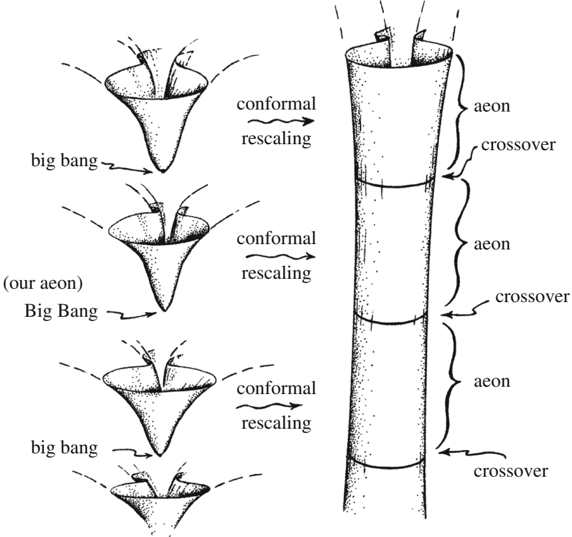
The singularity theorems of the 1960s showed that Lemaître’s initial symmetry assumptions were not essential for deriving a big-bang origin for a vast multitude of relativistic universe models. Yet the actual universe accords remarkably closely with models of Lemaître’s type. This is a mystery closely related to the form taken by the 2nd law of thermodynamics and is not explained by currently conventional inflationary cosmology. Conformal cyclic cosmology (CCC) provides another perspective on these issues, one consequence being the necessary initial presence of a dominant scalar material that interacts only gravitationally, but which must ultimately slowly decay away in a novel but perhaps detectable way. According to CCC, our current universe picture provides but one aeon of an unending succession of expanding aeons each having an initial big bang which is the conformal continuation of the remote exponential expansion of its previous aeon. The observational status of CCC is briefly discussed.
Overview
The claims and statistics of this paper haven’t been checked yet.
Free: it reads the open-access text and checks the first 5 claims that cite a source we can check. Create a free account to check every claim.
Integrity signals
Registry
Cites
Statistics
Figures
Verification
Claims the paper makes
The claims and statistics of this paper haven’t been checked yet.
Free: it reads the open-access text and checks the first 5 claims that cite a source we can check. Create a free account to check every claim.
Claims other papers make about this one
Each is checked against this paper’s own text: does it say what the citing paper says it does?
The cited source says what the claim attributes to it.
In the citing paper
“In Penrose's original proposal, a primordial form of dark matter emerges upon the transition to the next aeon from a”
From Conformal Cyclic Cosmology, gravitational entropy and quantum information (2023) · cites this paper as [90]
Self-check
Percentages, sums and reported differences re-computed from the paper’s own numbers.
The self-check needs the paper’s full text.
Citations
Cites
Bekenstein, J. D. (1973) · Physical Review D · doi:10.1103/physrevd.7.2333 · Cited by 7,555 · cited 1×
“Not only was the lowness in our universe’s initial entropy almost entirely in the suppression of gravitational degrees of freedom but it is in gravity that we see the very hugeness of the entropy that is potentially present in the universe, as is demonstrated by the Bekenstein–Hawking formula [17, 18] for the entropy…”
MethodGravitational Collapse and Space-Time Singularities
Penrose, R. (1965) · Physical Review Letters · doi:10.1103/physrevlett.14.57 · Cited by 2,977 · cited 1×
“In the first of these [1], I showed, by using techniques involving differential topology, that in gravitational collapse to what we now call a black hole, the assumptions of exact spherical symmetry and a pressure-less fluid (“dust”), that Oppenheimer and Snyder had made [2], in their picture of collapse to a black ho…”
BackgroundSelf-citationExact Solutions of Einstein's Field Equations
Stephani, H., Kramer, D., MacCallum, M., Hoenselaers, C., & Herlt, E. (2003) · doi:10.1017/cbo9780511535185 · Cited by 2,184
Penrose, R., & Rindler, W. (1984) · doi:10.1017/cbo9780511564048 · Cited by 2,172
Self-citationThe singularities of gravitational collapse and cosmology
Hawking, S. W., & Penrose, R. (1970) · Proceedings of the Royal Society of London. A. Mathematical and Physical Sciences · doi:10.1098/rspa.1970.0021 · Cited by 2,100 · cited 1×
“Finally, in 1970, a joint paper between Hawking and myself appeared in that journal [7], which generalized the results that had been obtained before in a very comprehensive result, showing, in particular, that a singularity-free “bounce”, of the nature of that illustrated in Fig.”
BackgroundSelf-citationOn Continued Gravitational Contraction
Oppenheimer, J. R., & Snyder, H. (1939) · Physical Review · doi:10.1103/physrev.56.455 · Cited by 2,008 · cited 1×
“In the first of these [1], I showed, by using techniques involving differential topology, that in gravitational collapse to what we now call a black hole, the assumptions of exact spherical symmetry and a pressure-less fluid (“dust”), that Oppenheimer and Snyder had made [2], in their picture of collapse to a black ho…”
BackgroundThe Emperor's New Mind: Concerning Computers, Minds, and The Laws of Physics
Penrose, R., & Gardner, M. (1989) · doi:10.1093/oso/9780198519737.001.0001 · Cited by 2,007
Self-citationOn gravity's role in quantum state reduction
Penrose, R. (1996) · General Relativity and Gravitation · doi:10.1007/bf02105068 · Cited by 1,872
Self-citationExact solutions of the Einstein's field equations
Krämer, D., Stephani, H., Maccalum, M., & Herlt, E. (1980) · CERN Document Server (European Organization for Nuclear Research) · Cited by 1,315
Black holes and thermodynamics
Hawking, S. W. (1976) · Physical Review D · doi:10.1103/physrevd.13.191 · Cited by 1,307 · cited 1×
“Not only was the lowness in our universe’s initial entropy almost entirely in the suppression of gravitational degrees of freedom but it is in gravity that we see the very hugeness of the entropy that is potentially present in the universe, as is demonstrated by the Bekenstein–Hawking formula [17, 18] for the entropy…”
MethodThe Emperor's New Mind: Concerning Computers, Minds, and the Laws of Physics
Penrose, R., & Landauer, R. (1990) · Physics Today · doi:10.1063/1.2810599 · Cited by 1,110
Self-citationThe road to reality: a complete guide to the laws of the universe
(2005) · Choice Reviews Online · doi:10.5860/choice.43-0377 · Cited by 1,108 · cited 1×
“[11, 12]) is replaced by Paul Tod’s proposal [23] that each aeon’s big bang can be smoothly conformally extended backwards into another space–time region.”
BackgroundPenrose, R., & Rindler, W. (1986) · Cambridge University Press eBooks · doi:10.1017/cbo9780511524486 · Cited by 920
Self-citationThe pre-big bang scenario in string cosmology
Gasperini, M., & Veneziano, G. (2003) · Physics Reports · doi:10.1016/s0370-1573(02)00389-7 · Cited by 872 · cited 1×
“In a sense, “inflation” of a sort does take place in CCC, but it occurs “before”, rather than after the Big Bang (echoing an earlier idea expressed by Veneziano and Gasperini [42]).”
BackgroundZero rest-mass fields including gravitation: asymptotic behaviour
Penrose, R. (1965) · Proceedings of the Royal Society of London. Series A. Mathematical and Physical Sciences · doi:10.1098/rspa.1965.0058 · Cited by 850
Self-citationAsymptotic Properties of Fields and Space-Times
Penrose, R. (1963) · Physical Review Letters · doi:10.1103/physrevlett.10.66 · Cited by 802
Self-citationA universal master equation for the gravitational violation of quantum mechanics
Diósi, L. (1987) · Physics Letters A · doi:10.1016/0375-9601(87)90681-5 · Cited by 538
Gravitation and quantum mechanics of macroscopic objects
Karolyhazy, F. (1966) · Il Nuovo Cimento A · doi:10.1007/bf02717926 · Cited by 530
Gravitation and quantum-mechanical localization of macro-objects
Diósi, L. (1984) · Physics Letters A · doi:10.1016/0375-9601(84)90397-9 · Cited by 379
The occurrence of singularities in cosmology. ɪɪɪ. Causality and singularities
Hawking, S. W. (1967) · Proceedings of the Royal Society of London. Series A. Mathematical and Physical Sciences · doi:10.1098/rspa.1967.0164 · Cited by 360
On the Gravitization of Quantum Mechanics 1: Quantum State Reduction
Penrose, R. (2014) · Foundations of Physics · doi:10.1007/s10701-013-9770-0 · Cited by 347
Self-citationSpinors and Space-Time, Volume 2: Spinor and Twistor Methods in Space-Time Geometry
Penrose, R., Rindler, W., & Goldberg, J. N. (1986) · Physics Today · doi:10.1063/1.2815249 · Cited by 333
Self-citationNew conservation laws for zero rest-mass fields in asymptotically flat space-time
Newman, E. T., & Penrose, R. (1968) · Proceedings of the Royal Society of London. Series A. Mathematical and Physical Sciences · doi:10.1098/rspa.1968.0112 · Cited by 330 · cited 1×
“which is trace-free and divergence-free [35], 2nd footnote on p.”
BackgroundSelf-citationSpinors and space-time. Vol. 1: Two-spinor calculus and relativistic fields.
Penrose, R., & Rindler, W. (1984) · Cited by 287
Self-citationThe occurrence of singularities in cosmology
Hawking, S. W. (1966) · Proceedings of the Royal Society of London. Series A. Mathematical and Physical Sciences · doi:10.1098/rspa.1966.0221 · Cited by 269
Fashion, Faith, and Fantasy in the New Physics of the Universe
Penrose, R. (2016) · Princeton University Press eBooks · doi:10.2307/j.ctvc775bn · Cited by 242
Self-citationCycles of time: an extraordinary new view of the universe
(2012) · Choice Reviews Online · doi:10.5860/choice.49-2636 · Cited by 204
An introduction to modern cosmology
(1999) · Choice Reviews Online · doi:10.5860/choice.37-0907 · Cited by 185
Difficulties with Inflationary Cosmology a
PENROSE, R. (1989) · Annals of the New York Academy of Sciences · doi:10.1111/j.1749-6632.1989.tb50513.x · Cited by 165 · cited 2×
“It may be seen, by considering a time-reversed collapsing universe that for a generic (non FLRW) Big Bang, the presence of an inflaton field is of no help whatever in smoothing out such an irregular initial singular expansion (see [14] for a more thorough explanation of this point).”
BackgroundSelf-citationOccurrence of Singularities in Open Universes
Hawking, S. W. (1965) · Physical Review Letters · doi:10.1103/physrevlett.15.689 · Cited by 159 · cited 1×
“Soon afterwards, Stephen Hawking showed [3] how my theorem could be used (in the reverse time direction) to obtain a singularity theorem that applied to the universe a whole.”
BackgroundTheoretical Principles in Astrophysics and Relativity
Lebovitz, N. R., Reid, W. H., & Vandervoort, P. O. (1978) · Medical Entomology and Zoology · Cited by 141
Entropy bounds, acceleration radiation, and the generalized second law
Unruh, W. G., & Wald, R. M. (1983) · Physical Review D · doi:10.1103/physrevd.27.2271 · Cited by 119
The occurrence of singularities in cosmology. II
Hawking, S. W. (1966) · Proceedings of the Royal Society of London. Series A. Mathematical and Physical Sciences · doi:10.1098/rspa.1966.0255 · Cited by 114
Phonon creation by gravitational waves
Sabín, C., Bruschi, D. E., Ahmadi, M., & Fuentes, I. (2014) · New Journal of Physics · doi:10.1088/1367-2630/16/8/085003 · Cited by 111 · cited 1×
“Perhaps, instead, erebon decay will need detectors of a different kind [51, 52] to see erebon decays in our aeon,”
BackgroundOn CCC-predicted concentric low-variance circles in the CMB sky
Gurzadyan, V. G., & Penrose, R. (2013) · The European Physical Journal Plus · doi:10.1140/epjp/i2013-13022-4 · Cited by 101 · cited 4×
“Such equations can be provided (see [22], Appendix A [34]), although there are still uncertainties, in some detailed choices for ensuring uniqueness of evolution, these will not concern us here.”
BackgroundResultInfluentialSelf-citationBefore the big bang: An outrageous new perspective and its implications for particle physics
Penrose, R. (2006) · Cited by 99
Self-citationFashion, Faith, and Fantasy in the New Physics of the Universe
Penrose, R. (2016) · Princeton University Press eBooks · doi:10.1515/9781400880287 · Cited by 88 · cited 2×
“in any reasonable units (see [12], Chap.”
BackgroundSelf-citationThe Geometric universe: science, geometry, and the work of Roger Penrose
(1999) · Choice Reviews Online · doi:10.5860/choice.36-3963 · Cited by 87
Quantum spacetime fluctuations and primary state diffusion
Percival, I. C. (1995) · Proceedings of the Royal Society of London. Series A: Mathematical and Physical Sciences · doi:10.1098/rspa.1995.0139 · Cited by 82
A positive Bondi-type mass in asymptotically de Sitter spacetimes
Szabados, L. B., & Tod, P. (2015) · Classical and Quantum Gravity · doi:10.1088/0264-9381/32/20/205011 · Cited by 52 · cited 6×
“Such equations can be provided (see [22], Appendix A [34]), although there are still uncertainties, in some detailed choices for ensuring uniqueness of evolution, these will not concern us here.”
BackgroundInfluentialIsotropic cosmological singularities: other matter models
Tod, K. P. (2003) · Classical and Quantum Gravity · doi:10.1088/0264-9381/20/3/309 · Cited by 51
Gravitation and quantum mechanics of macroscopic bodies
Károlyházy, F. (1974) · OSTI OAI (U.S. Department of Energy Office of Scientific and Technical Information) · Cited by 49
On the time lags of the LIGO signals
Creswell, J., von Hausegger, S., Jackson, A. D., Liu, H., & Naselsky, P. (2017) · Journal of Cosmology and Astroparticle Physics · doi:10.1088/1475-7516/2017/08/013 · Cited by 47
Isotropic cosmological singularities: other matter models
Tod, K. P. (2002) · CERN Document Server (European Organization for Nuclear Research) · Cited by 46
A positive Bondi-type mass in asymptotically de Sitter spacetimes
Szabados, L. B., & Tod, P. (2015) · Repository of the Academy's Library (Library of the Hungarian Academy of Sciences) · Cited by 39
High-frequency backreaction for the Einstein equations under polarized U(1)-symmetry
Huneau, C., & Luk, J. (2018) · Duke Mathematical Journal · doi:10.1215/00127094-2018-0035 · Cited by 35
Gurzadyan, V. G., & Penrose, R. (2016) · The European Physical Journal Plus · doi:10.1140/epjp/i2016-16011-1 · Cited by 34 · cited 1×
“been put forward that such signals are indeed seen in theWMAPdata [22, 38], compare [39], and also in the Planck data [40, 41].”
ResultSelf-citationEinstein’s Equation and Conformal Structure
Friedrich, H. (1998) · Oxford University Press eBooks · doi:10.1093/oso/9780198500599.003.0005 · Cited by 30
Structures in the microwave background radiation
Meissner, K. A., Nurowski, P., & Ruszczycki, B. (2013) · Proceedings of the Royal Society A Mathematical Physical and Engineering Sciences · doi:10.1098/rspa.2013.0116 · Cited by 25
GENERAL-RELATIVISTIC ENERGY FLUX AND ELEMENTARY OPTICS.
Penrose, R. (1967) · OSTI OAI (U.S. Department of Energy Office of Scientific and Technical Information) · Cited by 25
Self-citationThermal noise in BEC-phononic gravitational wave detectors
Sabín, C., Kohlrus, J., Bruschi, D. E., & Fuentes, I. (2016) · EPJ Quantum Technology · doi:10.1140/epjqt/s40507-016-0046-4 · Cited by 24
Causality, quantum theory and cosmology
Penrose, R. (2008) · Cambridge University Press eBooks · doi:10.1017/cbo9781139644259.004 · Cited by 22
Self-citationRing-type structures in the Planck map of the CMB
An, D., Meissner, K. A., & Nurowski, P. (2017) · Monthly Notices of the Royal Astronomical Society · doi:10.1093/mnras/stx2299 · Cited by 18 · cited 1×
“been put forward that such signals are indeed seen in theWMAPdata [22, 38], compare [39], and also in the Planck data [40, 41].”
ResultSearching for concentric low variance circles in the cosmic microwave background
DeAbreu, A., Contreras, D., & Scott, D. (2015) · Journal of Cosmology and Astroparticle Physics · doi:10.1088/1475-7516/2015/12/031 · Cited by 16 · cited 1×
“been put forward that such signals are indeed seen in theWMAPdata [22, 38], compare [39], and also in the Planck data [40, 41].”
ResultOn the role of conformal invariance in general relativity and the origins of mass
Bramson, B. (1974) · Physics Letters A · doi:10.1016/0375-9601(74)90562-3 · Cited by 13
Quantum State Reduction via Gravity, and Possible Tests Using Bose–Einstein Condensates
Shan, G. (2018) · Cambridge University Press eBooks · doi:10.1017/9781316995457.012 · Cited by 7
Causality, quantum theory and cosmology
Penrose, R. (2012) · Cambridge University Press eBooks · doi:10.1017/cbo9781139197069.004 · Cited by 4
Self-citationRing Type Structures in the Planck map of the CMBPreprint
An, D., Meissner, K. A., & Nurowski, P. (2015) · arXiv (Cornell University) · doi:10.48550/arxiv.1510.06537 · Cited by 1 · cited 1×
“been put forward that such signals are indeed seen in theWMAPdata [22, 38], compare [39], and also in the Planck data [40, 41].”
Result
Research works printed but not linked: 4
- 9. Penrose, R.: Singularities and Time-Asymmetry. In: Hawking, S.W., Israel, W. (eds.) General Relativiy: An Einstein Centenary. Cambridge University Press, Cambridge (1979)
- 14. Penrose, R.: Difficulties with inflationary cosmology. In: Fenves, E. (ed.) Proceedings of the 14th Texas Symposium on Relativistic Astrophysics. N.Y. Acad. Sci., New York (1990)
- 15. Schrödinger, E.: What is Life?' and 'Mind and Matter. Cambridge Univ. Press, Cambridge (1967)
- 25. Penrose, R.: Conformal approach to infinity. In: DeWitt, B.S., DeWitt, C.M. (eds.) Relativity, Groups and Topology: The 1963 Les Houches Lectures. Gordon and Breach, New York (1964)
Cited by
Apparent evidence for Hawking points in the CMB Sky★
An, D., Meissner, K. A., Nurowski, P., & Penrose, R. (2020) · Monthly Notices of the Royal Astronomical Society · doi:10.1093/mnras/staa1343 · Cited by 56
“Details will be published elsewhere, but for a preliminary discussion, see (Penrose 2018).”
BackgroundInfluentialSelf-citationHigh-frequency limits and null dust shell solutions in general relativityPreprint
Luk, J., & Rodnianski, I. (2020) · arXiv (Cornell University) · doi:10.48550/arxiv.2009.08968 · Cited by 29
“See also [49, 52] for other applications.”
$$\Lambda $$CDM: Much More Than We Expected, but Now Less Than What We Want
Turner, M. S. (2018) · Foundations of Physics · doi:10.1007/s10701-018-0178-8 · Cited by 29
“believe that these issues are telling us that inflation is not bold enough [18].”
BackgroundCosmological Redshift and Cosmic Time Dilation in the FLRW Metric
Vavryčuk, V. (2022) · Frontiers in Physics · doi:10.3389/fphy.2022.826188 · Cited by 26
The Weight of Possibility: Dark Matter as a Vibration of Context
Landry, F. (2026) · doi:10.67291/qfin9517 · Cited by 28
Metadata
- Authors
- Penrose, R.
- Affiliations
- University of Oxford (GB)
- Corresponding author
- Penrose, Roger
- Venue
- Foundations of Physics
- Published
- 2018-06-16
- Volume
- 48
- Issue
- 10
- Pages
- 1177-1190
- ISSN
- 0015-9018 (ISSN-L)
- 1572-9516
- OpenAlex
- W2808575063
- Semantic Scholar
- 26819bd46f22b9ca74f9a523058b50c16f74f092
- Cited by
- 26
- References
- 60
- Citations by year
- 2026: 1 · 2024: 5 · 2023: 5 · 2022: 4 · 2021: 4 · 2020: 5 · 2019: 1 · 2018: 1
- FWCI
- 1.48
- Type
- journal article
- Language
- en
- Open access
- hybrid
- doi.org
- Licence
- cc-by
- creativecommons.org/licenses/by/4.0 (tdm)
- Locations
- Foundations of Physics (publishedVersion, cc-by)
- Topics
- Physical Sciences › Physics and Astronomy › Astronomy and Astrophysics › Cosmology and Gravitation Theories
- Physical Sciences › Physics and Astronomy › Nuclear and High Energy Physics › Dark Matter and Cosmic Phenomena
- Physical Sciences › Physics and Astronomy › Nuclear and High Energy Physics › Noncommutative and Quantum Gravity Theories
- Keywords
- Big Bang, dark matter, singularity theorems, second law of thermodynamics, cosmic inflation, conformal cyclic cosmology, AEON, scalar field decay, initial singularity
About these checks
Registry, retraction, Cites and statistics results are computed, not judged, with one exception: a printed reference that no index lists is read once by a model before it counts as a citation error. Claims are extracted by a model and kept only when their quote appears verbatim in the text; each cited source is then checked, with a model’s help, for whether it says what the claim relies on. Those verdicts can be wrong — read the claim’s quote and the cited source before relying on one.
Statistics and arithmetic are recomputed, not judged.
Confidence bands are shown only for fields calibrated on our annotated test set. None is calibrated yet, so no band is shown.
What counts as a claim ›How we measure confidence ›How we check this ›
Are you an author, or do you see a problem with this page? Request a review
Data sources
Bibliographic data: Semantic Scholar, OpenAlex, Crossref.
Contains information from the Semantic Scholar Academic Graph Datasets, made available under the ODC Attribution License (ODC-BY 1.0).
Semantic Scholar’s data is described in: Kinney, R., et al. (2023). The Semantic Scholar Open Data Platform. arXiv:2301.10140.
