

The DOI matches its Crossref record; 100 of the 101 references it cites were found in a registry or an index; none of the 77 sources its claims cite is checked for support yet.
Approaches to Supporting and Measuring Mathematical Problem Posing: A Systematic Review of Interventions in Mathematics Education
Open accessAbstract
Mathematical problem posing, a form of authentic mathematical inquiry and creation, has been acknowledged as important by educators and curriculum frameworks internationally and has been the focus of several intervention studies with students and teachers. However, the intervention components and measured outcomes of these prior studies varied, highlighting the diverse approaches researchers have taken to support and measure mathematical problem-posing competence. In this systematic review, we examined 39 intervention studies published over the past three decades, all aimed at developing mathematical problem-posing competence, and we identified nine common intervention components suggested or utilized within these studies. Also, we derived clusters of measured outcomes related to mathematical problem-posing competence used in the interventions. Our findings deepen understanding of approaches to supporting and measuring mathematical problem-posing competence, thus casting light on what works, including methods for measuring progress, in problem-posing interventions. We discuss implications of our findings for future research and practice.
Overview
CoChat Summary
TL;DR
This systematic review synthesizes 39 intervention studies aimed at developing mathematical problem-posing competence and identifies nine common intervention components plus clusters of measured outcomes. It finds varied approaches to supporting and measuring problem posing, with engagement in problem-posing activities and interactive learning environments most frequent, and calls for more standardized and broader affective measurement.
Key findings
- Across 39 studies, nine intervention components were identified: overview of what problem posing is (7; 17.9%), discussion of what “good” problems are (4; 10.3%), engagement with problem posing activities (19; 48.7%), evaluation of posed problems (5; 12.8%), comprehension of the problem posing situation (4; 10.3%), use of strategies involved in problem posing (11; 28.2%), use of problem-posing examples (4; 10.3%), use of technology in problem posing (9; 23.1%), and creation of an interactive learning environment (15; 38.5%).
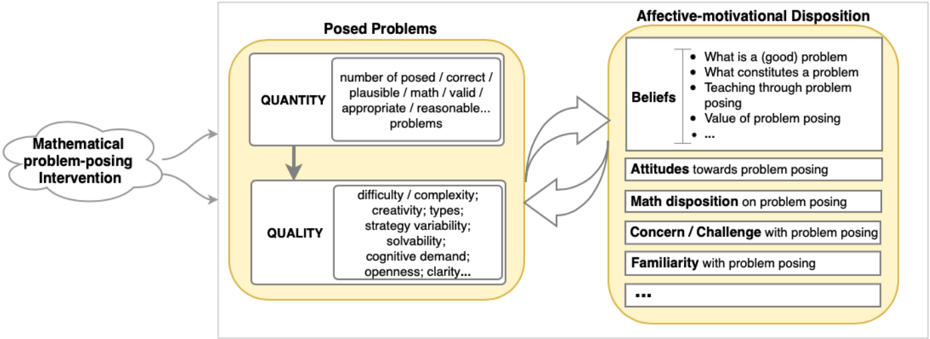
- Measured outcomes clustered into quantity of posed problems, quality of posed problems, and affective-motivational disposition. Quality criteria included difficulty/complexity (11 studies), type (12), strategy variability (9), creativity (9), solvability (3), cognitive demand (3), openness (3), clarity (2), and other (11); quantity included number of posed problems (10) and lesson episodes involving problem posing (2).
- Affective-motivational outcomes were examined in only 10 of 39 studies, with a substantial focus (9 of the 10 studies) placed singularly on beliefs about mathematical problem posing; 7 of these 10 were published after 2015, and methods were dominated by self-designed questionnaires containing only one or two questions.
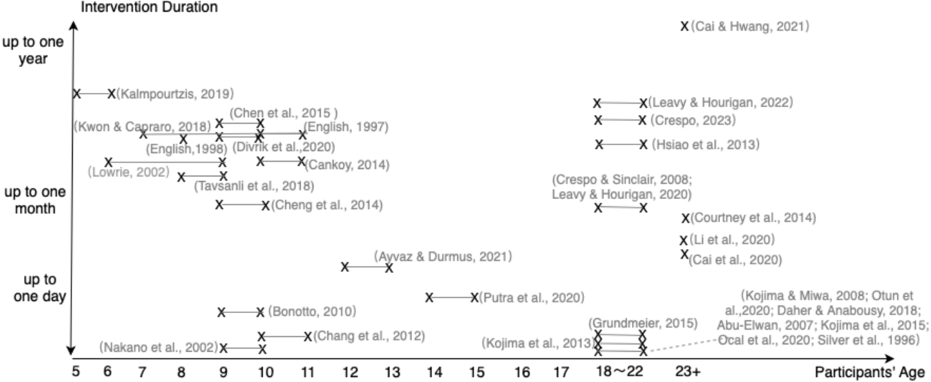
- Of 39 included studies, 5 suggested intervention components without empirical results; 34 reported experimental design/statistical data, but one lacked enough experimental detail; 33 were summarized in Figure 2. Participants included school students (15 studies, mostly ages 5–18), prospective teachers (14, mostly ages 18–22), and in-service teachers (4, mostly over 23); durations ranged from less than one day (13) to more than one month (12).
Methods
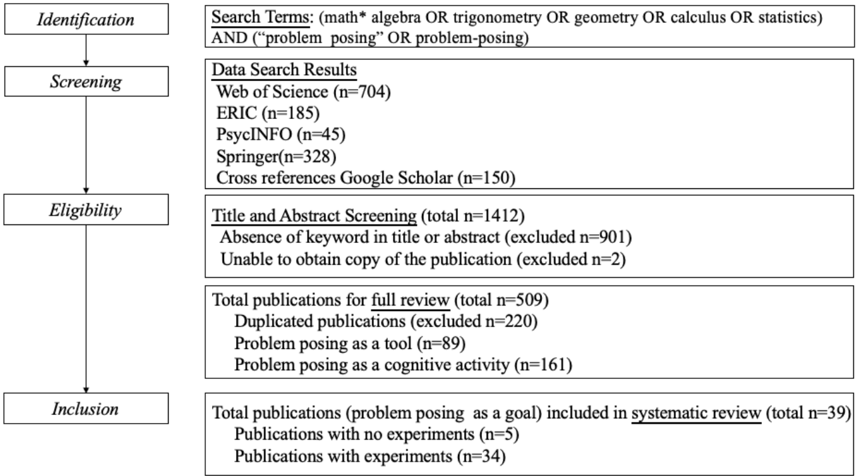
- PRISMA-guided systematic review. Searched Web of Science, ERIC, PsycINFO, and Springer in July 2021, plus the first 15 pages of Google Scholar, using Boolean search terms combining math/algebra/etc. with “problem posing” or problem-posing.
- Inclusion criteria: peer-reviewed journal articles or book chapters, English, published January 1990–June 2021, term in title and/or abstract/keywords, and report of at least one intervention component related to mathematical problem posing with case analysis or statistical evidence. From 1,412 publications, 509 were full-text reviewed and 39 met criteria.
- Data extraction/coding by two trained research assistants; interrater agreement was 100% for 30 randomly selected publications, and Cohen’s kappa was 0.9 across coding points for the 39 studies. Intervention components were coded using Bicer’s (2021) instructional practices and Boller et al.’s (2014) typology, with the constant comparative method.
Limitations
- The paper states that the review period does not extend to the present day, due to COVID-related logistical and financial constraints and delays in preparing the findings for publication.
- Evident from the text: only 39 studies were included, 5 provided no empirical results and one experimental study lacked sufficient detail; the field lacks a standardized test for mathematical problem-posing competence and consensus on what constitutes good problems and competent problem posers.
- Evident from the text: affective outcomes were measured in a minority of studies (10/39), mostly beliefs, often with narrow self-designed questionnaires, raising validity concerns.
Model-written summary. Check it against the paper before relying on it.
Integrity signals
Registry
Cites
Statistics
Figures

Verification
Claims the paper makes
0 Valid · 0 Not valid · 44 Not checked · 56 Own results and interpretations
A result the paper reports from its own data — it cites no other source for it, so there is none to check. The quote shows it is in the paper.
In the paper
“we derived clusters of measured outcomes related to mathematical problem-posing competence used in the interventions”
§ Approaches to Supporting and Measuring Mathematical Problem Posing: A Systematic Review of Interventions in Mathematics Education > Abstract
plain- Asserted: passes — The authors put it forward as true.
- Checkable: passes — It can be checked against evidence.
- Load-bearing: passes — The paper’s conclusions depend on it.
- Based: passes — The paper gives a reason why it holds.
A result the paper reports from its own data — it cites no other source for it, so there is none to check. The quote shows it is in the paper.
In the paper
“we identified nine common intervention components suggested or utilized within these studies”
§ Approaches to Supporting and Measuring Mathematical Problem Posing: A Systematic Review of Interventions in Mathematics Education > Abstract
plain- Asserted: passes — The authors put it forward as true.
- Checkable: passes — It can be checked against evidence.
- Load-bearing: passes — The paper’s conclusions depend on it.
- Based: passes — The paper gives a reason why it holds.
A result the paper reports from its own data — it cites no other source for it, so there is none to check. The quote shows it is in the paper.
In the paper
“Finally, a total of 39 publications met the inclusion criteria and were retained for systematic review.”
§ Approaches to Supporting and Measuring Mathematical Problem Posing: A Systematic Review of Interventions in Mathematics Education > Inclusion and exclusion criteria.
plain- Asserted: passes — The authors put it forward as true.
- Checkable: passes — It can be checked against evidence.
- Load-bearing: passes — The paper’s conclusions depend on it.
- Based: passes — The paper gives a reason why it holds.
A result the paper reports from its own data — it cites no other source for it, so there is none to check. The quote shows it is in the paper.
In the paper
“Evaluation of posed problems (EPP) 5 (12.8%)”
§ Approaches to Supporting and Measuring Mathematical Problem Posing: A Systematic Review of Interventions in Mathematics Education > Intervention components for enhancing mathematical problem-posing competence
plainn = 39- Asserted: passes — The authors put it forward as true.
- Checkable: passes — It can be checked against evidence.
- Load-bearing: unclear — It is unclear whether the paper’s conclusions depend on it.
- Based: passes — The paper gives a reason why it holds.
A result the paper reports from its own data — it cites no other source for it, so there is none to check. The quote shows it is in the paper.
In the paper
“Comprehension of the problem posing situation (CPPS) 4 (10.3%)”
§ Approaches to Supporting and Measuring Mathematical Problem Posing: A Systematic Review of Interventions in Mathematics Education > Intervention components for enhancing mathematical problem-posing competence
plainn = 39- Asserted: passes — The authors put it forward as true.
- Checkable: passes — It can be checked against evidence.
- Load-bearing: unclear — It is unclear whether the paper’s conclusions depend on it.
- Based: passes — The paper gives a reason why it holds.
45 more claims
Create a free account to see all 100 claims and to verify the 56 references still open.
- It may state two separate claims as one. 27
- Probably not a substantial claim. 28
- The quote only partly states this claim. 2
Self-check
Percentages, sums and reported differences re-computed from the paper’s own numbers.
Each contradiction between two passages listed here was confirmed by an independent check.
Rated minor: it would not touch a result — a value no result rests on, a p-value that stays on the same side of the significance level, or a conflict that is clerical, resolved elsewhere in the paper, or outside its own findings.
In the paper
§ Approaches to Supporting and Measuring Mathematical Problem Posing: A Systematic Review of Interventions in Mathematics Education > FIGURE 3 A possible overview organizational structure of the identified intervention components
“During all the interventions, participants were required to engage in particular activity-based practice including WPP, WGP, PPA, and EPP.”
§ Approaches to Supporting and Measuring Mathematical Problem Posing: A Systematic Review of Interventions in Mathematics Education > Intervention components for enhancing mathematical problem-posing competence
“TABLE 1 Frequency and proportion of publications from those included in the systematic review (N=39) that incorporated a particular category of intervention component Categories of Intervention Components No. Activity-based Practice Overview of what problem posing is (WPP) 7 (17.9%)Discussion of what 'good' problems are (WGP) 4 (10.3%)Engagement with problem posing activities (PPA) 19 (48.7%)Evaluation of posed problems (EPP) 5 (12.8%)”
Rated minor: it would not touch a result — a value no result rests on, a p-value that stays on the same side of the significance level, or a conflict that is clerical, resolved elsewhere in the paper, or outside its own findings.
In the paper
§ Approaches to Supporting and Measuring Mathematical Problem Posing: A Systematic Review of Interventions in Mathematics Education > ) Affectivemotivational disposition
“Beliefs about problem posing (11 studies)”
§ Approaches to Supporting and Measuring Mathematical Problem Posing: A Systematic Review of Interventions in Mathematics Education > FIGURE 4 An overview of measured criterion-behavior changes from interventions on enhancing mathematical problem-posing competence
“a relatively small number of the intervention studies we reviewed (10 out of 39) ventured into evaluating or considering the affective changes of mathematical problem-posing competence, with a substantial focus (9 of the 10 studies) placed singularly on beliefs about mathematical problem posing.”
Citations
Cites
Basics of Qualitative Research: Grounded Theory Procedures and Techniques.
Ellis, C., Strauss, A., & Corbin, J. (1992) · Contemporary Sociology · doi:10.2307/2074814 · Cited by 29,249
Page, M. J., Moher, D., Bossuyt, P. M., Boutron, I., Hoffmann, T. C., Mulrow, C. D., Shamseer, L., Tetzlaff, J. M., Akl, E. A., Brennan, S. E., et al. (2021) · BMJ · doi:10.1136/bmj.n160 · Cited by 13,262 · cited 1×
“Standardized guidelines for systematic reviews by Preferred Reporting Items for Systematic Reviews and Meta-analysis (PRISMA) (Page et al., 2021) were followed.”
Newell, A. (1972) · Cited by 6,222
Cohen, J. (1992) · Current Directions in Psychological Science · doi:10.1111/1467-8721.ep10768783 · Cited by 5,870
Design Experiments in Educational Research
Cobb, P., Confrey, J., diSessa, A., Lehrer, R., & Schauble, L. (2003) · Educational Researcher · doi:10.3102/0013189x032001009 · Cited by 3,548
Beyond Dichotomies: Competence Viewed as a Continuum
Blömeke, S., Gustafsson, J.-E., & Shavelson, R. J. (2015) · Zeitschrift für Psychologie · doi:10.1027/2151-2604/a000194 · Cited by 1,205
Mathematical Discovery, On Understanding, Learning, and Teaching Problem Solving.
Zuckerman, H. S., & Polya, G. (1966) · The American Mathematical Monthly · doi:10.2307/2315372 · Cited by 782
Moral imagination: implications of cognitive science for ethics
(1993) · Choice Reviews Online · doi:10.5860/choice.31-2048 · Cited by 739
Depaepe, F., Verschaffel, L., & Kelchtermans, G. (2013) · Teaching and Teacher Education · doi:10.1016/j.tate.2013.03.001 · Cited by 624
Methodological Issues in Combining Diverse Study Types in Systematic Reviews
Harden, A., & Thomas, J. (2005) · International Journal of Social Research Methodology · doi:10.1080/13645570500155078 · Cited by 371
Research works printed but not linked: 8
- *Ayvaz, U., & Durmus, S. (2021). Fostering mathematical creativity with problem posing activitie-s: An action research with gifted students. Thinking Skills and Creativity, 40, 100846. https://doi.org/10.1093/teamat/hrx005 · DOI · Paper page
- Bevan, D., Williams, A. M., & Capraro, M. M. (2019). Strike a pose: The impact of problem-posing on elementary students’ mathematical attitudes and achievement. In N. Jarmila & M. Hana (Eds.), International symposium elementary mathematics teaching (pp. 80–88). Prague.
- Brown, S. I., & Walter, M. I. (1993). Problem posing in mathematics education. In S. I. Brown & M. I. Walter (Eds.), Problem posing: Reflections and application (pp. 16–27). Erlbaum.
- Chinese Ministry of Education (2022). Quanrizhi yiwu jiaoyu shuxue kecheng biaozhun [Mathematics Curriculum Standard of compulsory education (2022 version)]. People’s Education Press.
- Enz, B. J., & Serafini, F. (1995). Assessment. Involving students in the assessment process. Teaching PreK-8, 25(5), 96–97.
- Hawkins, D. (2000). The roots of literacy. University Press of Colorado.
- Priest, D. J. (2009). A problem-posing intervention in the development of problem-solving competence of underachieving, middle-year students (Ph.D. thesis, Queensland University of Technology). https://eprints.qut.edu.au/31740/
- Stoyanova, E., & Ellerton, N. F. (1996). A framework for research into students’ problem posing in school mathematics. In P. Clarkson (Ed.), Technology in mathematics education (pp. 518–525). Mathematics Education Research Group of Australiasia.
Cited by
Ulusoy, F. (2025) · Journal of Mathematics Teacher Education · doi:10.1007/s10857-025-09697-z · Cited by 7
Krawitz, J., Meyer-Jenßen, L., Krausmüller, K., & Rakoczy, K. (2026) · ZDM · doi:10.1007/s11858-025-01762-4 · Cited by 5
Bokhove, C. (2025) · Asian Journal for Mathematics Education · doi:10.1177/27527263251346212 · Cited by 5
Investigating Authentic Nature of PISA Mathematics Items
İncikabı, S. (2025) · School Science and Mathematics · doi:10.1111/ssm.18402 · Cited by 4
Torregrosa, A., Albarracín, L., & Gorgorió, N. (2026) · The Journal of Mathematical Behavior · doi:10.1016/j.jmathb.2026.101348 · Cited by 3
Metadata
- Authors
- Zhang, L., Stylianides, A. J., & Stylianides, G. J.
- Affiliations
- Chengdu University (CN)
- University of Cambridge (GB)
- University of Oxford (GB)
- Corresponding author
- Zhang, Ling
- Venue
- International Journal of Science and Mathematics Education
- Published
- 2025-01-25
- Volume
- 23
- Issue
- 7
- Pages
- 2225-2254
- ISSN
- 1571-0068 (ISSN-L)
- 1573-1774
- OpenAlex
- W4406786598
- Semantic Scholar
- da49c7626aaadf6e9a1c1e9938fcb85f4355b6ce
- Cited by
- 17
- References
- 101
- Citations by year
- 2026: 13 · 2025: 4
- FWCI
- 1.74
- Type
- journal article
- Language
- en
- Open access
- green
- ora.ox.ac.uk
- Licence
- cc-by
- www.springernature.com/gp/researchers/text-and-data-mining (tdm)
- www.springernature.com/gp/researchers/text-and-data-mining (vor)
- Locations
- International Journal of Science and Mathematics Education (publishedVersion)
- Oxford University Research Archive (ORA) (University of Oxford) (submittedVersion, cc-by)
- Apollo (University of Cambridge) (submittedVersion, cc-by)
- Apollo (cc-by)
- Topics
- Social Sciences › Education › Mathematics Education and Pedagogy
- Social Sciences › Education › Mathematics Education and Teaching Techniques
- Social Sciences › Education › Problem and Project Based Learning
- Keywords
- mathematical problem posing, intervention components, mathematics education intervention
About these checks
Registry, retraction, Cites and statistics results are computed, not judged, with one exception: a printed reference that no index lists is read once by a model before it counts as a citation error. Claims are extracted by a model and kept only when their quote appears verbatim in the text; each cited source is then checked, with a model’s help, for whether it says what the claim relies on. Those verdicts can be wrong — read the claim’s quote and the cited source before relying on one.
A language model drew the claims from the paper on 2026-11-15, under version 3 of the claim definition (model deepseek-v4.1-flash, prompt extract-v3).
A second model labelled each claim on 2026-11-15 (model jev-1.13-20260917, definition revision gold-guideline-v0.2).
Statistics and arithmetic are recomputed, not judged.
Confidence bands are shown only for fields calibrated on our annotated test set. None is calibrated yet, so no band is shown.
What counts as a claim ›How we measure confidence ›How we check this ›
Are you an author, or do you see a problem with this page? Request a review
How to cite
Cite CoChat for the checks on this page, and the paper for its own findings.
- This page
- CoChat. (2026). Citation check: Approaches to Supporting and Measuring Mathematical Problem Posing: A Systematic Review of Interventions in Mathematics Education. https://app.cochat.ai/papers/10.1007/s10763-025-10542-1
- The paper
- Zhang, L., Stylianides, A. J., & Stylianides, G. J. (2025). Approaches to Supporting and Measuring Mathematical Problem Posing: A Systematic Review of Interventions in Mathematics Education. International Journal of Science and Mathematics Education. https://doi.org/10.1007/s10763-025-10542-1
Data sources
Bibliographic data: Semantic Scholar, OpenAlex, Crossref.
Contains information from the Semantic Scholar Academic Graph Datasets, made available under the ODC Attribution License (ODC-BY 1.0).
Semantic Scholar’s data is described in: Kinney, R., et al. (2023). The Semantic Scholar Open Data Platform. arXiv:2301.10140.
