

Approaches to Supporting and Measuring Mathematical Problem Posing: A Systematic Review of Interventions in Mathematics Education
Open accessThe DOI matches its Crossref record; 101 of the 103 references it cites were found in a registry or an index, and 1 are not checked yet; none of the 77 sources its claims cite is checked for support yet.
Abstract
Mathematical problem posing, a form of authentic mathematical inquiry and creation, has been acknowledged as important by educators and curriculum frameworks internationally and has been the focus of several intervention studies with students and teachers. However, the intervention components and measured outcomes of these prior studies varied, highlighting the diverse approaches researchers have taken to support and measure mathematical problem-posing competence. In this systematic review, we examined 39 intervention studies published over the past three decades, all aimed at developing mathematical problem-posing competence, and we identified nine common intervention components suggested or utilized within these studies. Also, we derived clusters of measured outcomes related to mathematical problem-posing competence used in the interventions. Our findings deepen understanding of approaches to supporting and measuring mathematical problem-posing competence, thus casting light on what works, including methods for measuring progress, in problem-posing interventions. We discuss implications of our findings for future research and practice.
Checked 2026-11-25 · 1 reference not checked yet
Overview
CoChat Summary
TL;DR
This systematic review synthesizes 39 intervention studies aimed at developing mathematical problem-posing competence and identifies nine common intervention components plus clusters of measured outcomes. It finds varied approaches to supporting and measuring problem posing, with engagement in problem-posing activities and interactive learning environments most frequent, and calls for more standardized and broader affective measurement.
Key findings
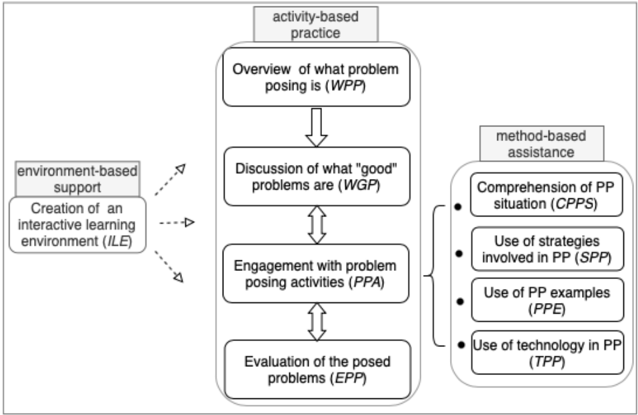
- Across 39 studies, nine intervention components were identified: overview of what problem posing is (7; 17.9%), discussion of what “good” problems are (4; 10.3%), engagement with problem posing activities (19; 48.7%), evaluation of posed problems (5; 12.8%), comprehension of the problem posing situation (4; 10.3%), use of strategies involved in problem posing (11; 28.2%), use of problem-posing examples (4; 10.3%), use of technology in problem posing (9; 23.1%), and creation of an interactive learning environment (15; 38.5%).
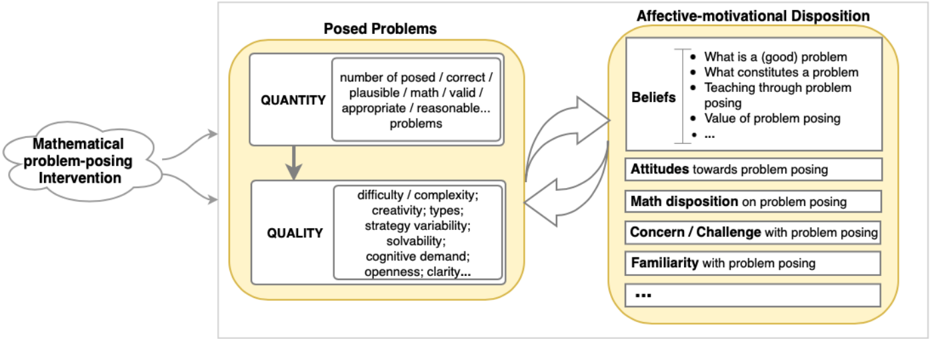
- Measured outcomes clustered into quantity of posed problems, quality of posed problems, and affective-motivational disposition. Quality criteria included difficulty/complexity (11 studies), type (12), strategy variability (9), creativity (9), solvability (3), cognitive demand (3), openness (3), clarity (2), and other (11); quantity included number of posed problems (10) and lesson episodes involving problem posing (2).
- Affective-motivational outcomes were examined in only 10 of 39 studies, with a substantial focus (9 of the 10 studies) placed singularly on beliefs about mathematical problem posing; 7 of these 10 were published after 2015, and methods were dominated by self-designed questionnaires containing only one or two questions.
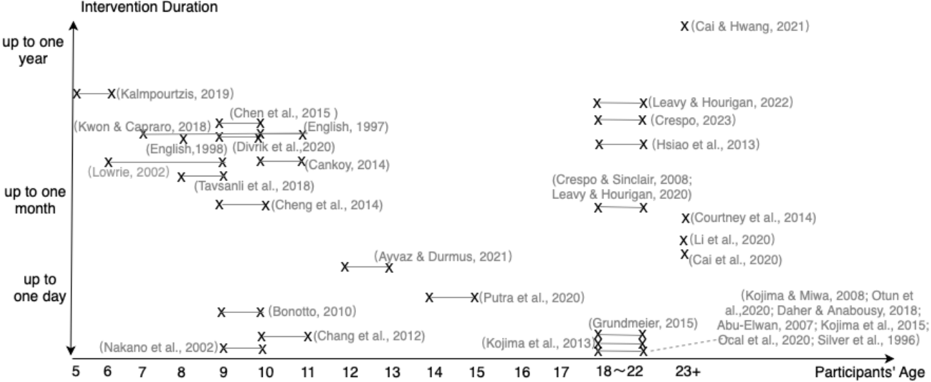
- Of 39 included studies, 5 suggested intervention components without empirical results; 34 reported experimental design/statistical data, but one lacked enough experimental detail; 33 were summarized in Figure 2. Participants included school students (15 studies, mostly ages 5–18), prospective teachers (14, mostly ages 18–22), and in-service teachers (4, mostly over 23); durations ranged from less than one day (13) to more than one month (12).
Methods
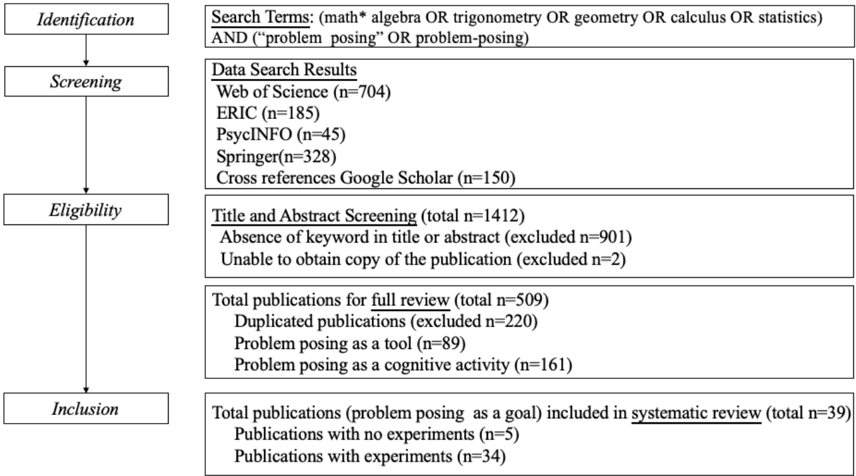
- PRISMA-guided systematic review. Searched Web of Science, ERIC, PsycINFO, and Springer in July 2021, plus the first 15 pages of Google Scholar, using Boolean search terms combining math/algebra/etc. with “problem posing” or problem-posing.
- Inclusion criteria: peer-reviewed journal articles or book chapters, English, published January 1990–June 2021, term in title and/or abstract/keywords, and report of at least one intervention component related to mathematical problem posing with case analysis or statistical evidence. From 1,412 publications, 509 were full-text reviewed and 39 met criteria.
- Data extraction/coding by two trained research assistants; interrater agreement was 100% for 30 randomly selected publications, and Cohen’s kappa was 0.9 across coding points for the 39 studies. Intervention components were coded using Bicer’s (2021) instructional practices and Boller et al.’s (2014) typology, with the constant comparative method.
Limitations
- The paper states that the review period does not extend to the present day, due to COVID-related logistical and financial constraints and delays in preparing the findings for publication.
- Evident from the text: only 39 studies were included, 5 provided no empirical results and one experimental study lacked sufficient detail; the field lacks a standardized test for mathematical problem-posing competence and consensus on what constitutes good problems and competent problem posers.
- Evident from the text: affective outcomes were measured in a minority of studies (10/39), mostly beliefs, often with narrow self-designed questionnaires, raising validity concerns.
Model-written summary. Check it against the paper before relying on it.
Integrity signals
Registry
Cites
Statistics
Figures
Verification
Claims the paper makes
0 Valid · 0 Not valid · 44 Not checked · 56 Own results and interpretations
A result the paper reports from its own data — it cites no other source for it, so there is none to check. The quote shows it is in the paper.
In the paper
“we derived clusters of measured outcomes related to mathematical problem-posing competence used in the interventions”
§ Approaches to Supporting and Measuring Mathematical Problem Posing: A Systematic Review of Interventions in Mathematics Education > Abstract
plain- Asserted: passes — The authors put it forward as true.
- Checkable: passes — It can be checked against evidence.
- Load-bearing: passes — The paper’s conclusions depend on it.
- Based: passes — The paper gives a reason why it holds.
A result the paper reports from its own data — it cites no other source for it, so there is none to check. The quote shows it is in the paper.
In the paper
“we identified nine common intervention components suggested or utilized within these studies”
§ Approaches to Supporting and Measuring Mathematical Problem Posing: A Systematic Review of Interventions in Mathematics Education > Abstract
plain- Asserted: passes — The authors put it forward as true.
- Checkable: passes — It can be checked against evidence.
- Load-bearing: passes — The paper’s conclusions depend on it.
- Based: passes — The paper gives a reason why it holds.
A result the paper reports from its own data — it cites no other source for it, so there is none to check. The quote shows it is in the paper.
In the paper
“Finally, a total of 39 publications met the inclusion criteria and were retained for systematic review.”
§ Approaches to Supporting and Measuring Mathematical Problem Posing: A Systematic Review of Interventions in Mathematics Education > Inclusion and exclusion criteria.
plain- Asserted: passes — The authors put it forward as true.
- Checkable: passes — It can be checked against evidence.
- Load-bearing: passes — The paper’s conclusions depend on it.
- Based: passes — The paper gives a reason why it holds.
A result the paper reports from its own data — it cites no other source for it, so there is none to check. The quote shows it is in the paper.
In the paper
“Evaluation of posed problems (EPP) 5 (12.8%)”
§ Approaches to Supporting and Measuring Mathematical Problem Posing: A Systematic Review of Interventions in Mathematics Education > Intervention components for enhancing mathematical problem-posing competence
plainn = 39- Asserted: passes — The authors put it forward as true.
- Checkable: passes — It can be checked against evidence.
- Load-bearing: unclear — It is unclear whether the paper’s conclusions depend on it.
- Based: passes — The paper gives a reason why it holds.
A result the paper reports from its own data — it cites no other source for it, so there is none to check. The quote shows it is in the paper.
In the paper
“Comprehension of the problem posing situation (CPPS) 4 (10.3%)”
§ Approaches to Supporting and Measuring Mathematical Problem Posing: A Systematic Review of Interventions in Mathematics Education > Intervention components for enhancing mathematical problem-posing competence
plainn = 39- Asserted: passes — The authors put it forward as true.
- Checkable: passes — It can be checked against evidence.
- Load-bearing: unclear — It is unclear whether the paper’s conclusions depend on it.
- Based: passes — The paper gives a reason why it holds.
45 more claims
Create a free account to see all 100 claims and to verify the 62 references still open.
- It may state two separate claims as one. 27
- Probably not a substantial claim. 28
- The quote only partly states this claim. 2
Self-check
Percentages, sums and reported differences re-computed from the paper’s own numbers.
Each contradiction between two passages listed here was confirmed by an independent check.
Rated minor: it would not touch a result — a value no result rests on, a p-value that stays on the same side of the significance level, or a conflict that is clerical, resolved elsewhere in the paper, or outside its own findings.
In the paper
§ Approaches to Supporting and Measuring Mathematical Problem Posing: A Systematic Review of Interventions in Mathematics Education > FIGURE 3 A possible overview organizational structure of the identified intervention components
“During all the interventions, participants were required to engage in particular activity-based practice including WPP, WGP, PPA, and EPP.”
§ Approaches to Supporting and Measuring Mathematical Problem Posing: A Systematic Review of Interventions in Mathematics Education > Intervention components for enhancing mathematical problem-posing competence
“TABLE 1 Frequency and proportion of publications from those included in the systematic review (N=39) that incorporated a particular category of intervention component Categories of Intervention Components No. Activity-based Practice Overview of what problem posing is (WPP) 7 (17.9%)Discussion of what 'good' problems are (WGP) 4 (10.3%)Engagement with problem posing activities (PPA) 19 (48.7%)Evaluation of posed problems (EPP) 5 (12.8%)”
Rated minor: it would not touch a result — a value no result rests on, a p-value that stays on the same side of the significance level, or a conflict that is clerical, resolved elsewhere in the paper, or outside its own findings.
In the paper
§ Approaches to Supporting and Measuring Mathematical Problem Posing: A Systematic Review of Interventions in Mathematics Education > ) Affectivemotivational disposition
“Beliefs about problem posing (11 studies)”
§ Approaches to Supporting and Measuring Mathematical Problem Posing: A Systematic Review of Interventions in Mathematics Education > FIGURE 4 An overview of measured criterion-behavior changes from interventions on enhancing mathematical problem-posing competence
“a relatively small number of the intervention studies we reviewed (10 out of 39) ventured into evaluating or considering the affective changes of mathematical problem-posing competence, with a substantial focus (9 of the 10 studies) placed singularly on beliefs about mathematical problem posing.”
Citations
Cites
Basics of Qualitative Research: Grounded Theory Procedures and Techniques.
Ellis, C., Strauss, A., & Corbin, J. (1992) · Contemporary Sociology · doi:10.2307/2074814 · Cited by 29,249
Page, M. J., Moher, D., Bossuyt, P. M., Boutron, I., Hoffmann, T. C., Mulrow, C. D., Shamseer, L., Tetzlaff, J. M., Akl, E. A., Brennan, S. E., et al. (2021) · BMJ · doi:10.1136/bmj.n160 · Cited by 13,262 · cited 1×
“Standardized guidelines for systematic reviews by Preferred Reporting Items for Systematic Reviews and Meta-analysis (PRISMA) (Page et al., 2021) were followed.”
Newell, A. (1972) · Cited by 6,222
Cohen, J. (1992) · Current Directions in Psychological Science · doi:10.1111/1467-8721.ep10768783 · Cited by 5,870
Design Experiments in Educational Research
Cobb, P., Confrey, J., diSessa, A., Lehrer, R., & Schauble, L. (2003) · Educational Researcher · doi:10.3102/0013189x032001009 · Cited by 3,548 · cited 1×
“…aimed to identify specific actions regarding intervention components so as not only to show that these components were (potentially) effective (they “worked” or “could work”), but also to shed light on the mechanisms underlying the interventions (Cobb et al., 2003; Stylianides & Stylianides, 2013).”
Beyond Dichotomies: Competence Viewed as a Continuum
Blömeke, S., Gustafsson, J.-E., & Shavelson, R. J. (2015) · Zeitschrift für Psychologie · doi:10.1027/2151-2604/a000194 · Cited by 1,205
Mathematical Discovery, On Understanding, Learning, and Teaching Problem Solving.
Zuckerman, H. S., & Polya, G. (1966) · The American Mathematical Monthly · doi:10.2307/2315372 · Cited by 782
Moral imagination: implications of cognitive science for ethics
(1993) · Choice Reviews Online · doi:10.5860/choice.31-2048 · Cited by 739
Depaepe, F., Verschaffel, L., & Kelchtermans, G. (2013) · Teaching and Teacher Education · doi:10.1016/j.tate.2013.03.001 · Cited by 624
Moral Imagination: Implications of Cognitive Science for Ethics
Johnson, M. (1993) · University of Chicago Press eBooks · doi:10.7208/chicago/9780226223230.001.0001 · Cited by 559
An Analysis of Arithmetic Problem Posing by Middle School Students
Silver, E. A., & Cai, J. (1996) · Journal for Research in Mathematics Education · doi:10.2307/749846 · Cited by 379
Methodological Issues in Combining Diverse Study Types in Systematic Reviews
Harden, A., & Thomas, J. (2005) · International Journal of Social Research Methodology · doi:10.1080/13645570500155078 · Cited by 371 · cited 2×
“According to Harden and Thomas (2005), analyzing the “ideas” for actions regarding the core components of an intervention to affect outcome “X” helps answer the “what works” question.”
Lo, C. K., Hew, K. F., & Chen, G. (2017) · Educational Research Review · doi:10.1016/j.edurev.2017.08.002 · Cited by 335
Cai, J., & Hwang, S. (2002) · The Journal of Mathematical Behavior · doi:10.1016/s0732-3123(02)00142-6 · Cited by 320
Problem-Posing Research in Mathematics Education: Some Answered and Unanswered Questions
Cai, J., Hwang, S., Jiang, C., & Silber, S. (2015) · Springer eBooks · doi:10.1007/978-1-4614-6258-3_1 · Cited by 315
Children's Problem Posing within Formal and Informal Contexts
English, L. D. (1998) · Journal for Research in Mathematics Education · doi:10.2307/749719 · Cited by 304
Learning to pose mathematical problems: Exploring changes in preservice teachers' practices
Crespo, S. (2003) · Educational Studies in Mathematics · doi:10.1023/a:1024364304664 · Cited by 269
Embedding game-based problem-solving phase into problem-posing system for mathematics learning
Chang, K.-E., Wu, L.-J., Weng, S.-E., & Sung, Y.-T. (2012) · Computers & Education · doi:10.1016/j.compedu.2011.10.002 · Cited by 253
Crespo, S., & Sinclair, N. (2008) · Journal of Mathematics Teacher Education · doi:10.1007/s10857-008-9081-0 · Cited by 225
Cai, J., & Hwang, S. (2020) · International Journal of Educational Research · doi:10.1016/j.ijer.2019.01.001 · Cited by 215
The Practices of Mathematicians: What do They Tell us About Coming to Know Mathematics?
Burton, L. (1998) · Educational Studies in Mathematics · doi:10.1023/a:1003697329618 · Cited by 179
The Development of Fifth-Grade Children's Problem-Posing Abilities
English, L. D. (1997) · Educational Studies in Mathematics · doi:10.1023/a:1002963618035 · Cited by 178
Language Factors in Mathematics Teaching and Learning
Ellerton, N. F., & Clarkson, P. C. (1996) · Springer eBooks · doi:10.1007/978-94-009-1465-0_30 · Cited by 175
Empirical research on problem solving and problem posing: a look at the state of the art
Liljedahl, P., & Cai, J. (2021) · ZDM – Mathematics Education · doi:10.1007/s11858-021-01291-w · Cited by 171 · cited 6×
“The most common criteria are from the perspective of the solver of the posed problem, such as whether the problem is solvable (Silver & Cai, 1996), difficult (Cai et al., 2020), complex (Zhang et al., 2022), or open (Guberman & Leikin, 2013; Leavy & Hourigan, 2022).”
InfluentialBiçer, A. (2021) · International Journal of Education in Mathematics Science and Technology · doi:10.46328/ijemst.1254 · Cited by 161
Guberman, R., & Лейкин, Р. (2012) · Journal of Mathematics Teacher Education · doi:10.1007/s10857-012-9210-7 · Cited by 132
Children's made-up mathematics problems ? a new perspective on talented mathematicians
Ellerton, N. F. (1986) · Educational Studies in Mathematics · doi:10.1007/bf00305073 · Cited by 131
Problem-posing research in mathematics education: looking back, looking around, and looking ahead
Silver, E. A. (2013) · Educational Studies in Mathematics · doi:10.1007/s10649-013-9477-3 · Cited by 130 · cited 1×
“…a problem that satisfies [certain] conditions” (Klinshtern et al., 2015, p. 463); as a cognitive activity, as a research or instructional tool, or as a learning goal (Cai & Leikin, 2020; Liljedahl & Cai, 2021); or as a phenomenon that “refers to all such manifestations” (Silver, 2013, p. 159).”
The state of educational intervention research as viewed through the lens of literacy intervention
Pressley, M., Graham, S., & Harris, K. (2006) · British Journal of Educational Psychology · doi:10.1348/000709905x66035 · Cited by 123
Cai, J., & Leikin, R. (2020) · Educational Studies in Mathematics · doi:10.1007/s10649-020-10008-x · Cited by 122
Danusso, L., Testa, I., & Vicentini, M. (2009) · International Journal of Science Education · doi:10.1080/09500690902833221 · Cited by 121
On the Relationship Between Problem Posing, Problem Solving, and Creativity in the Primary School
Bonotto, C., & Santo, L. D. (2015) · Springer eBooks · doi:10.1007/978-1-4614-6258-3_5 · Cited by 115
The Effects of Problem Posing on Student Mathematical Learning: A Meta-Analysis
Rosli, R., Capraro, M. M., & Capraro, R. M. (2014) · International Education Studies · doi:10.5539/ies.v7n13p227 · Cited by 106
Cai, J., Chen, T., Li, X., Xu, R., Zhang, S., Hu, Y., Zhang, L., & Song, N. (2020) · International Journal of Educational Research · doi:10.1016/j.ijer.2019.02.004 · Cited by 106
Self-citationStylianides, A. J., & Stylianides, G. J. (2013) · ZDM · doi:10.1007/s11858-013-0501-y · Cited by 102
Self-citationBerry, C. M., Clark, M. A., & McClure, T. K. (2011) · Journal of Applied Psychology · doi:10.1037/a0023222 · Cited by 99 · cited 1×
“4 An overview of measured criterion-behavior changes from interventions on enhancing mathematical problem-posing competence decisions, such as evaluating if certain competence levels have been achieved (Berry et al., 2011).”
Moral imagination: Implications of cognitive science for ethics
Nash, J. W. (1994) · History of European Ideas · doi:10.1016/0191-6599(94)90487-1 · Cited by 98
Bicer, A., Lee, Y., Perihan, C., Capraro, M. M., & Capraro, R. M. (2020) · Educational Studies in Mathematics · doi:10.1007/s10649-020-09995-8 · Cited by 96
Individual versus Group Feedback in Cooperative Groups
Archer-Kath, J., Johnson, D. W., & Johnson, R. T. (1994) · The Journal of Social Psychology · doi:10.1080/00224545.1994.9922999 · Cited by 92
Li, X., Song, N., Hwang, S., & Cai, J. (2020) · Educational Studies in Mathematics · doi:10.1007/s10649-020-09981-0 · Cited by 87
The Roles of the Aesthetic in Mathematical Inquiry
Sinclair, N. (2004) · Mathematical Thinking and Learning · doi:10.1207/s15327833mtl0603_1 · Cited by 79
Leavy, A., & Hourigan, M. (2020) · Journal of Mathematics Teacher Education · doi:10.1007/s10857-018-09425-w · Cited by 73
An Analysis of Arithmetic Problem Posing by Middle School Students
Silver, E. A., & Cai, J. (1996) · Journal for Research in Mathematics Education · doi:10.5951/jresematheduc.27.5.0521 · Cited by 72
The Psychology of Abilities, Competencies, and Expertise
(2003) · Cambridge University Press eBooks · doi:10.1017/cbo9780511615801 · Cited by 71
Cai, J., & Hwang, S. (2021) · ZDM – Mathematics Education · doi:10.1007/s11858-021-01252-3 · Cited by 68
Opening mathematical problems for posing open mathematical tasks: what do teachers do and feel?
Klein, S., & Лейкин, Р. (2020) · Educational Studies in Mathematics · doi:10.1007/s10649-020-09983-y · Cited by 66
Van Harpen, X. Y., & Presmeg, N. C. (2013) · Educational Studies in Mathematics · doi:10.1007/s10649-012-9456-0 · Cited by 65
Learning to pose collaborative mathematics problems with secondary prospective teachers
Crespo, S. M., & Harper, F. K. (2019) · International Journal of Educational Research · doi:10.1016/j.ijer.2019.05.003 · Cited by 65
Divrik, R., Pilten, P., & Taş, A. M. (2021) · lnternational Electronic Journal of Elementary Education · doi:10.26822/iejee.2021.191 · Cited by 61
Teaching mathematics through problem posing: insights from an analysis of teaching cases
Zhang, H., & Cai, J. (2021) · ZDM – Mathematics Education · doi:10.1007/s11858-021-01260-3 · Cited by 59
The effects of problem-posing intervention types on elementary students’ problem-solving
Kopparla, M., Bicer, A., Vela, K., Lee, Y., Bevan, D., Kwon, H., Caldwell, C., Capraro, M. M., & Capraro, R. M. (2019) · Educational Studies · doi:10.1080/03055698.2018.1509785 · Cited by 57
Realistic Mathematical Modeling and Problem Posing
Bonotto, C. (2009) · Springer eBooks · doi:10.1007/978-1-4419-0561-1_34 · Cited by 55
Problem posing via “what if not?” strategy in solid geometry — a case study
Lavy, I., & Bershadsky, I. (2003) · The Journal of Mathematical Behavior · doi:10.1016/j.jmathb.2003.09.007 · Cited by 55
Skedsmo, G., & Huber, S. G. (2019) · Educational Assessment Evaluation and Accountability · doi:10.1007/s11092-019-09294-8 · Cited by 55
Zhang, L., Cai, J., Song, N., Zhang, H., Chen, T., Zhang, Z., & Guo, F. (2022) · ZDM – Mathematics Education · doi:10.1007/s11858-021-01324-4 · Cited by 55
Self-citationWang, M., Walkington, C., & Rouse, A. (2022) · Investigations in Mathematics Learning · doi:10.1080/19477503.2022.2105104 · Cited by 55 · cited 3×
“For example, Rosli et al. (2014), Kul and Çelik (2020), and Wang et al. (2022) conducted a meta-analysis on the effects of engaging in problem posing activities on students’ learning of mathematics.”
Siegesmund, A. (2016) · Journal of Microbiology & Biology Education · doi:10.1128/jmbe.v17i2.954 · Cited by 54
Affective field during collaborative problem posing and problem solving: a case study
Schindler, M., & Bakker, A. (2020) · Educational Studies in Mathematics · doi:10.1007/s10649-020-09973-0 · Cited by 53
Enhancing mathematical problem posing competence: a meta-analysis of intervention studies
Zhang, L., Stylianides, G. J., & Stylianides, A. J. (2024) · International Journal of STEM Education · doi:10.1186/s40594-024-00507-1 · Cited by 51
Self-citationThe preparatory effects of problem solving versus problem posing on learning from instruction
Kapur, M. (2015) · Learning and Instruction · doi:10.1016/j.learninstruc.2015.05.004 · Cited by 50
Leavy, A., & Hourigan, M. (2021) · Journal of Mathematics Teacher Education · doi:10.1007/s10857-021-09490-8 · Cited by 50
Vacc, N. N. (1993) · The Arithmetic Teacher · doi:10.5951/at.41.2.0088 · Cited by 45
Science Teachers’ Awareness of Findings from Education Research
Costa, N., Marques, L., & Kempa, R. F. (2000) · Research in Science & Technological Education · doi:10.1080/713694955 · Cited by 45
AYVAZ, Ü., & Durmuş, S. (2021) · Thinking Skills and Creativity · doi:10.1016/j.tsc.2021.100846 · Cited by 45
Lowrie, T. (2002) · Mathematics Education Research Journal · doi:10.1007/bf03217355 · Cited by 42
Top‐down management: an effective tool in higher education?
Tsai, Y., & Beverton, S. (2007) · International Journal of Educational Management · doi:10.1108/09513540710716786 · Cited by 37
Conceptualizing Problem Posing via Transformation
Milinković, Ј. (2015) · Springer eBooks · doi:10.1007/978-1-4614-6258-3_3 · Cited by 35
The Use of Webquest to Enhance The Mathematical Problem-Posing Skills of Pre-Service Teachers.
Elwan, R. A. (2007) · International Journal for Technology in Mathematics Education · Cited by 33
INTERLOCKED PROBLEM POSING AND CHILDREN’S PROBLEM POSING PERFORMANCE IN FREE STRUCTURED SITUATIONS
Cankoy, O. (2014) · International Journal of Science and Mathematics Education · doi:10.1007/s10763-013-9433-9 · Cited by 33
Kersting, N. B., Sutton, T., Kalinec-Craig, C., Stoehr, K. J., Heshmati, S., Lozano, G., & Stigler, J. W. (2016) · ZDM · doi:10.1007/s11858-015-0733-0 · Cited by 33
Chen, L., Van Dooren, W., & Verschaffel, L. (2015) · Mathematical Problem Posing · doi:10.1007/978-1-4614-6258-3_15 · Cited by 32
A CASE STUDY OF AN EXPERT PROBLEM POSER FOR MATHEMATICS COMPETITIONS
Kontorovich, I., & Koichu, B. (2014) · International Journal of Science and Mathematics Education · doi:10.1007/s10763-013-9467-z · Cited by 32
Problem-posing triggers or where do mathematics competition problems come from?
Kontorovich, I. (2020) · Educational Studies in Mathematics · doi:10.1007/s10649-020-09964-1 · Cited by 32
A Meta-Analysis of the Impact of Problem Posing Strategies on Students’ Learning of Mathematics
KUL, Ü., & ÇELİK, S. (2020) · Revista Romaneasca pentru Educatie Multidimensionala · doi:10.18662/rrem/12.3/325 · Cited by 31
What Do High School Teachers Mean by Saying “I Pose My Own Problems”?
Klinshtern, M., Koichu, B., & Berman, A. (2015) · Springer eBooks · doi:10.1007/978-1-4614-6258-3_22 · Cited by 29
Research Status of Mathematical Problem Posing in Mathematics Education Journals
Lee, S.-Y. (2021) · International Journal of Science and Mathematics Education · doi:10.1007/s10763-020-10128-z · Cited by 29
IKIP Siliwangi, C., Putra, H. D., Herman, T., Universitas Pendidikan Indonesia, B., Sumarmo, U., & Universitas Pendidikan Indonesia, B. (2020) · International Journal of Instruction · doi:10.29333/iji.2020.13143a · Cited by 28
Posing Mathematical Problems: An Exploratory Study
Silver, E. A., Mamona-Downs, J., Leung, S. S., & Kenney, P. A. (1996) · Journal for Research in Mathematics Education · doi:10.5951/jresematheduc.27.3.0293 · Cited by 25
Singer, F. M., & Voica, C. (2016) · Advances in mathematics education · doi:10.1007/978-3-319-38840-3_6 · Cited by 25
Connecting game design with problem posing skills in early childhood
Kalmpourtzis, G. (2019) · British Journal of Educational Technology · doi:10.1111/bjet.12607 · Cited by 25
Integrating worked examples into problem posing in a web-based learning environment
Hsiao, J. Y., Hung, C.-L., Lan, Y.-F., & Jeng, Y. C. (2013) · The Turkish Online Journal of Educational Technology · Cited by 24
Experimental study of learning support through examples in mathematical problem posing
Kojima, K., Miwa, K., & Matsui, T. (2015) · Research and Practice in Technology Enhanced Learning · doi:10.1007/s41039-015-0001-5 · Cited by 23
Developing the Problem-Posing Abilities of Prospective Elementary and Middle School Teachers
Grundmeier, T. A. (2015) · Mathematical Problem Posing · doi:10.1007/978-1-4614-6258-3_20 · Cited by 22
TAVŞANLI, Ö. F., Ülger, T. K., & Kaldırım, A. (2018) · Pegem Journal of Education and Instruction · doi:10.14527/pegegog.2018.016 · Cited by 16
Investigating the Impact of Field Trips on Teachers’ Mathematical Problem Posing
Courtney, S. A., Caniglia, J. C., & Singh, R. (2013) · Journal of Experiential Education · doi:10.1177/1053825913498369 · Cited by 14
Using Digital Technology for Mathematical Problem Posing
Abramovich, S., & Cho, E. K. (2015) · Mathematical Problem Posing · doi:10.1007/978-1-4614-6258-3_4 · Cited by 13
(2018) · Journal of Mathematics Education · doi:10.26711/007577152790026 · Cited by 13
Xia, X., Lü, C., Wang, B., & Song, Y. (2007) · Frontiers of Education in China · doi:10.1007/s11516-007-0030-y · Cited by 11
Arnold-Berkovits, I., Kurz, A., & Reddy, L. A. (2018) · Educational Assessment Evaluation and Accountability · doi:10.1007/s11092-018-9288-2 · Cited by 9
Öçal, M. F., Kar, T., Güler, G., & İpek, A. S. (2020) · Journal of Research in Mathematics Education · doi:10.17583/redimat.2020.3879 · Cited by 9
Identifying competent problem posers and exploring their characteristics
Zhang, L., Stylianides, A. J., & Stylianides, G. J. (2023) · The Journal of Mathematical Behavior · doi:10.1016/j.jmathb.2023.101086 · Cited by 8
Self-citationAn Evaluation of Intelligent Learning Environment for Problem Posing
Nakano, A., Hirashima, T., & Takeuchi, A. (2002) · Lecture Notes in Computer Science · doi:10.1007/3-540-47987-2_86 · Cited by 7
Why Do Experts Pose Problems for Mathematics Competitions?
Kontorovich, I. (2015) · Freiburger empirische Forschung in der Mathematikdidaktik · doi:10.1007/978-3-658-09614-4_14 · Cited by 6
Computer-supported problem posing by annotated expressions: content-first design and evaluation
Cheng, H. N. H., Weng, Y.-L., & Chan, T.-W. (2014) · Journal of Computers in Education · doi:10.1007/s40692-014-0019-5 · Cited by 6
A System that Facilitates Diverse Thinking in Problem Posing
Kojima, K., & Miwa, K. (2008) · International Journal of Artificial Intelligence in Education · doi:10.3233/irg-2008-18(3)03 · Cited by 5
Kojima, K., Miwa, K., & Matsui, T. (2013) · International Journal of Artificial Intelligence in Education · doi:10.3233/jai-130035 · Cited by 5
Flexibility of Pre-services Teachers in Problem Posing in Different Environments
Daher, W., & Anabousy, A. (2018) · ICME-13 Monographs · doi:10.1007/978-3-319-73156-8_9 · Cited by 5
Otun, W. I., & Njoku, O. G. (2020) · Journal of Educational Research in Developing Areas · doi:10.47434/jereda/1.2.2020.140 · Cited by 5
Encouraging students’ problem posing through importing visual images into mathematical software
Aydin, H., & Monaghan, J. (2018) · Teaching Mathematics and its Applications: An International Journal of the IMA · doi:10.1093/teamat/hrx005 · Cited by 4
Kar, T., Öztürk, F., Öçal, M. F., & Özkaya, M. (2025) · International Journal of Science and Mathematics Education · doi:10.1007/s10763-024-10507-w · Cited by 4
Dahlan, T., Darhim, D., Juandi, D., Gardenia, N., & Kandaga, T. (2021) · Kalamatika: Jurnal Pendidikan Matematika · doi:10.22236/kalamatika.vol6no2.2021pp171-180 · Cited by 2
Contreras, J. (2015) · THE MATHEMATICS EDUCATOR · doi:10.63301/tme.v17i2.1914 · Cited by 1
Research works printed but not linked: 7
- Brown, S. I., & Walter, M. I. (1993). Problem posing in mathematics education. In S. I. Brown & M. I. Walter (Eds.), Problem posing: Reflections and application (pp. 16-27). Hillsdale, NJ: Erlbaum.
- Chinese Ministry of Education. (2022). Quanrizhi yiwu jiaoyu shuxue kecheng biaozhun [Mathematics Curriculum Standard of compulsory education (2022 version)]. Beijing, China: People's Education Press.
- Enz, B. J., & Serafini, F. (1995). Assessment. Involving students in the assessment process. Teaching PreK-8, 25(5), 96-97.
- Hawkins, D. (2000). The roots of literacy. Boulder: University Press of Colorado.
- Leikin, R., & Elgrably, H. (2020). Problem posing through investigations for the development and evaluation of proof-related skills and creativity skills of prospective high school mathematics teachers. International Journal of Educational Research, 102, 101424.
- Priest, D. J. (2009). A problem-posing intervention in the development of problem-solving competence of underachieving, middle-year students (Ph.D. thesis, Queensland University of Technology). https://eprints.qut.edu.au/31740/
- Stoyanova, E., & Ellerton, N. F. (1996). A framework for research into students' problem posing in school mathematics. In P. Clarkson (Ed.), Technology in Mathematics Education (pp. 518- 525). Melbourne: Mathematics Education Research Group of Australiasia.
Cited by
Ulusoy, F. (2025) · Journal of Mathematics Teacher Education · doi:10.1007/s10857-025-09697-z · Cited by 9
Krawitz, J., Meyer-Jenßen, L., Krausmüller, K., & Rakoczy, K. (2026) · ZDM · doi:10.1007/s11858-025-01762-4 · Cited by 5
Bokhove, C. (2025) · Asian Journal for Mathematics Education · doi:10.1177/27527263251346212 · Cited by 7
Investigating Authentic Nature of PISA Mathematics Items
İncikabı, S. (2025) · School Science and Mathematics · doi:10.1111/ssm.18402 · Cited by 4
Torregrosa, A., Albarracín, L., & Gorgorió, N. (2026) · The Journal of Mathematical Behavior · doi:10.1016/j.jmathb.2026.101348 · Cited by 3
Metadata
- Authors
- Zhang, L., Stylianides, A. J., & Stylianides, G. J.
- Affiliations
- Chengdu University (CN)
- University of Cambridge (GB)
- University of Oxford (GB)
- Corresponding author
- Zhang, Ling
- Venue
- International Journal of Science and Mathematics Education
- Published
- 2025-01-25
- Volume
- 23
- Issue
- 7
- Pages
- 2225-2254
- ISSN
- 1571-0068 (ISSN-L)
- 1573-1774
- OpenAlex
- W4406786598
- Semantic Scholar
- da49c7626aaadf6e9a1c1e9938fcb85f4355b6ce
- Cited by
- 17
- References
- 101
- Citations by year
- 2026: 13 · 2025: 4
- FWCI
- 1.74
- Type
- journal article
- Language
- en
- Open access
- green
- ora.ox.ac.uk
- Licence
- cc-by
- www.springernature.com/gp/researchers/text-and-data-mining (tdm)
- www.springernature.com/gp/researchers/text-and-data-mining (vor)
- Locations
- International Journal of Science and Mathematics Education (publishedVersion)
- Oxford University Research Archive (ORA) (University of Oxford) (submittedVersion, cc-by)
- Apollo (University of Cambridge) (submittedVersion, cc-by)
- Apollo (cc-by)
- Topics
- Social Sciences › Education › Mathematics Education and Pedagogy
- Social Sciences › Education › Mathematics Education and Teaching Techniques
- Social Sciences › Education › Problem and Project Based Learning
- Keywords
- mathematical problem posing, intervention components, mathematics education intervention
About these checks
Registry, retraction, Cites and statistics results are computed, not judged, with one exception: a printed reference that no index lists is read once by a model before it counts as a citation error. Claims are extracted by a model and kept only when their quote appears verbatim in the text; each cited source is then checked, with a model’s help, for whether it says what the claim relies on. Those verdicts can be wrong — read the claim’s quote and the cited source before relying on one.
A language model drew the claims from the paper on 2026-11-15, under version 3 of the claim definition (model deepseek-v4.1-flash, prompt extract-v3).
A second model labelled each claim on 2026-11-15 (model jev-1.13-20260917, definition revision gold-guideline-v0.2).
Statistics and arithmetic are recomputed, not judged.
Confidence bands are shown only for fields calibrated on our annotated test set. None is calibrated yet, so no band is shown.
What counts as a claim ›How we measure confidence ›How we check this ›
Are you an author, or do you see a problem with this page? Request a review
Data sources
Bibliographic data: Semantic Scholar, OpenAlex, Crossref.
Contains information from the Semantic Scholar Academic Graph Datasets, made available under the ODC Attribution License (ODC-BY 1.0).
Semantic Scholar’s data is described in: Kinney, R., et al. (2023). The Semantic Scholar Open Data Platform. arXiv:2301.10140.
