

The DOI matches its Crossref record; 124 of the 125 references it cites were found in a registry or an index; 2 of the 43 sources its claims cite were checked for support.
Enhancing mathematical problem posing competence: a meta-analysis of intervention studies
Open accessAbstract
Mathematical problem posing, generally defined as the process of interpreting given situations and formulating meaningful mathematical problems, is academically important, and thus several interventions have been used to enhance this competence among students and teachers. Yet little is known about the interventions’ various components and their relative or combined effectiveness. In this meta-analysis of 26 intervention studies in mathematics, we identified nine intervention components and found that the interventions had a medium, positive, and significant mean weighted effect size. A stepwise meta-regression analysis revealed that intervention efficacy varied by moderators relevant to the research design, sample characteristics, and intervention characteristics. The findings obtained from this meta-analysis are expected to serve as a foundation for future efforts to design and implement (more) effective interventions to improve mathematical problem posing competence.
Overview
CoChat Summary
TL;DR
This meta-analysis of 26 intervention studies found that interventions to enhance mathematical problem posing competence had a medium, positive, significant overall effect (g = 0.72, 95% CI [0.53, 0.90], p < .001). Effects varied by research design, sample level, sample size, and intervention component number/mode/type, while intervention duration was not a significant moderator.
Key findings
- Nine intervention components were identified under activity-based practice, method-based assistance, and environment-based support; the most common were engagement with problem posing activities (65.4%, n = 17) and creation of an interactive learning environment (46.2%, n = 12).
- The overall treatment effect was medium, positive, and significant (g = 0.72, 95% CI [0.53, 0.90], p < 0.001). Cluster effects were 0.73 for quality of posed problems, 0.60 for quantity of posed problems, and 0.79 for noncognitive outcomes, with no significant between-cluster variance (p = 0.88).
- Moderators: K-12 students showed 89% and 96% higher effect sizes than prospective teachers (p < 0.001) and in-service teachers (p < 0.01); small groups (< 25) showed 72% higher effects than large groups (> 50) (p < 0.1); interventions with more than one component showed 63% higher effects than single-component interventions (p < 0.05); one-based support showed 64% and 186% higher effects than two-based (p < 0.05) and mixed-based support (p < 0.01); method-based assistance showed 84% higher effects (p < 0.1) and environment-based support 83% higher effects (p < 0.05). Pre-post design showed 58% higher effects than pre-post-control (p < 0.1). Duration was not a significant moderator.
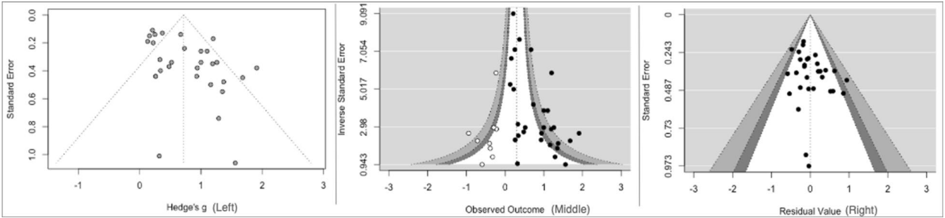
- Publication bias: Egger’s test was significant (p < 0.05); trim-and-fill imputed nine missing negative studies and reduced the point estimate to r = 0.5109 (95% CI [0.304, 0.715]); mixed-effects meta-regression for funnel plot asymmetry was not significant (z = 1.719, p > 0.05), so the authors concluded there was not enough evidence of publication bias.
Methods
- PRISMA systematic search in July 2021 across Web of Science, ERIC, PsycINFO, and Springer, plus the first 15 pages of Google Scholar; inclusion required peer-reviewed journal articles or book chapters, English, publication between January 1990 and June 2021, problem posing as a goal, and quantitative data sufficient for effect size calculation. From 1,412 records, 509 underwent full review, 39 were retained, and 26 were included in the meta-analysis.
- Two trained research assistants extracted and coded data; inter-rater reliability was Cohen’s kappa = 0.9. Intervention components were categorized using the constant comparative method into activity-based practice, method-based assistance, and environment-based support.
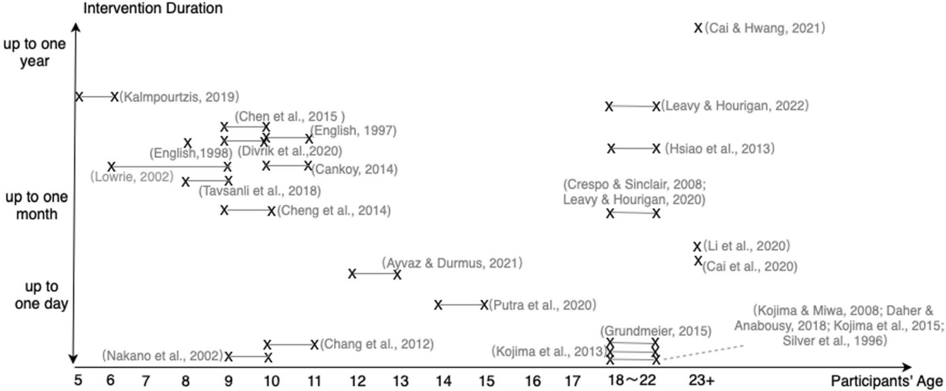
- Random-effects meta-analysis used Hedge’s g; change-score effect sizes were transformed to a raw-score metric. A stepwise meta-regression tested moderators; one outlier (Kalmpourtzis, 2019, g = 3.32) was removed. Publication bias was assessed with Egger’s test, trim-and-fill, and mixed-effects meta-regression.
Limitations
- Paper-stated: the authors could not access several potential studies; they excluded conference publications; publication bias may still have influenced findings despite statistical tests; considerable between-study heterogeneity suggests unaccounted moderators; intervention duration was measured as the time over which an intervention was spread rather than actual treatment time, possibly diluting effects; some moderator findings used p < 0.10 and are less robust.
- Paper-stated: future meta-analyses should explore additional moderators such as dependent measure type (researcher-developed vs. standardized measures) and study quality rating.
- Evident from the text: only 26 studies were included, many moderator categories likely contained few studies; residual heterogeneity remained high (I² = 75.3% with the outlier; 69.2% without it); only English-language peer-reviewed publications were included; and most studies (19/26) were published after 2010.
Model-written summary. Check it against the paper before relying on it.
Integrity signals
Registry
Cites
Statistics
Figures



Verification
Claims the paper makes
1 Valid · 0 Not valid · 35 Not checked · 57 Own results and interpretations
The cited sources support only part of this claim — read each source’s verdict below.
In the paper
“While these reviews occasionally ventured into a few studies examining the effect of engaging in problem posing activities on the development of problem posing, their primary focus remained on demonstrating the merit of problem posing as a tool on a broad-based impact for learning mathematics as opposed to examining problem posing as a goal.”
§ Enhancing mathematical problem posing competence: a meta-analysis of intervention studies > Interventions to enhance mathematical problem posing competence
What the sources say
- Partly supportedcites Rosli et al., 2014 sourceExperimental — accuracy not yet measured
Our copy supports the 'as a tool / broad-based impact' half: Section 3 ('The Need for a Meta-Analytic Review') frames the synthesis as concerned with 'problem posing as an effective classroom interventional tool for the teaching and learning of mathematics', and the Discussion/Conclusion report 'broad potential benefits on students' mathematics achievement, problem solving skills, levels of problems posed, and attitudes toward mathematics'. However, the same section states that 'to date, there is only one review of the literature available' (Silver, 1994, summarizing the nature, processes and perspectives of problem posing), so the claim's plural 'prior reviews' overstates what the source says, and no passage in our copy draws the tool-versus-goal distinction or says prior reviews only occasionally ventured into studies on the development of problem posing itself (searched: 'problem posing as a goal', 'development of problem posing ability', 'previous reviews focused on broad impact'). (LLM, conf=0.68)
- Partly supportedcites Kul & Çelik, 2020 sourceExperimental — accuracy not yet measured
The Introduction (p. 1, 'only two meta-analysis studies... directly address and measure the effectiveness of problem-posing'; Cantürk-Günhan, Geçici & Günkaya 2019 'only concentrated on the effectiveness of problem posing method on student academic success') and the Discussion (p. 4) do support the 'broad-based impact on learning mathematics' half of the claim, and the paper elsewhere notes the community sees problem posing 'as a tool' (citing Cai et al., 2015). But our copy never frames prior reviews as 'tool rather than goal'; indeed it records that Rosli, Capraro & Capraro (2014) computed a separate effect size for 'level of problems posed' (0.77, Introduction and Discussion), i.e. problem posing as an outcome itself, so the 'as opposed to examining problem posing as a goal' characterisation is the citing authors' framing rather than this paper's. (LLM, conf=0.70)
- Not checked yetcites Wang et al., 2022 source
plain- Asserted: passes — The authors put it forward as true.
- Checkable: passes — It can be checked against evidence.
- Load-bearing: passes — The paper’s conclusions depend on it.
- Based: passes — The paper gives a reason why it holds.
- Partly supported
A result the paper reports from its own data — it cites no other source for it, so there is none to check. The quote shows it is in the paper.
In the paper
“A stepwise meta-regression analysis revealed that intervention efficacy varied by moderators relevant to the research design, sample characteristics, and intervention characteristics.”
§ Enhancing mathematical problem posing competence: a meta-analysis of intervention studies > Abstract
plainstates an association- Asserted: passes — The authors put it forward as true.
- Checkable: passes — It can be checked against evidence.
- Load-bearing: passes — The paper’s conclusions depend on it.
- Based: passes — The paper gives a reason why it holds.
A result the paper reports from its own data — it cites no other source for it, so there is none to check. The quote shows it is in the paper.
In the paper
““overview of what problem posing is” in 26.9% of the reviewed studies (WPP, n = 7)”
§ Enhancing mathematical problem posing competence: a meta-analysis of intervention studies > Intervention components incorporated in studies
plainn = 7- Asserted: passes — The authors put it forward as true.
- Checkable: passes — It can be checked against evidence.
- Load-bearing: unclear — It is unclear whether the paper’s conclusions depend on it.
- Based: passes — The paper gives a reason why it holds.
A result the paper reports from its own data — it cites no other source for it, so there is none to check. The quote shows it is in the paper.
In the paper
““evaluation of posed problems” in 19.2% of the reviewed studies (EPP, n = 5)”
§ Enhancing mathematical problem posing competence: a meta-analysis of intervention studies > Intervention components incorporated in studies
plainn = 5- Asserted: passes — The authors put it forward as true.
- Checkable: passes — It can be checked against evidence.
- Load-bearing: unclear — It is unclear whether the paper’s conclusions depend on it.
- Based: passes — The paper gives a reason why it holds.
A result the paper reports from its own data — it cites no other source for it, so there is none to check. The quote shows it is in the paper.
In the paper
“Regarding the sample size, interventions implemented with a small group of students (less than 25) produced an average of 72% higher effect size than those implemented with a large group (t = -1.973,p < 0.1).”
§ Enhancing mathematical problem posing competence: a meta-analysis of intervention studies > The moderators of treatment efficacy
plainstates an association- Asserted: passes — The authors put it forward as true.
- Checkable: passes — It can be checked against evidence.
- Load-bearing: unclear — It is unclear whether the paper’s conclusions depend on it.
- Based: passes — The paper gives a reason why it holds.
40 more claims
Create a free account to see all 93 claims and to verify the 28 references still open.
- It may state two separate claims as one. 26
- Probably not a substantial claim. 25
- The quote only partly states this claim. 1
Claims other papers make about this one
Each is checked against this paper’s own text: does it say what the citing paper says it does?
In the citing paper
“In our recent meta-analysis (Zhang et al., 2024), we summarized various intervention components aimed at fostering mathematical problem-posing competence and we examined overall intervention efficacy as well as the effects of moderators.”
From Approaches to Supporting and Measuring Mathematical Problem Posing: A Systematic Review of Interventions in Mathematics Education (2025) · cites this paper as Zhang et al., 2024
Statistics recomputed
Every reported test result, recomputed from its test statistic and degrees of freedom. A result shows as not adding up only once an independent check has confirmed it.
- ConsistentF(11, 18) = 3.474reported p < .01 · recomputed p = .009
“F(11,18) = 3.474, p < .01”
- ConsistentQ(38) = 150.5reported p < .05 · recomputed p < .001
“Q (38) = 150.5,p < .05”
- Consistentz = 1.719reported p > .05 · recomputed p = .086
“(z = 1.719, p > .05”
Self-check
Percentages, sums and reported differences re-computed from the paper’s own numbers.
Each contradiction between two passages listed here was confirmed by an independent check.
Rated minor: it would not touch a result — a value no result rests on, a p-value that stays on the same side of the significance level, or a conflict that is clerical, resolved elsewhere in the paper, or outside its own findings.
In the paper
§ Enhancing mathematical problem posing competence: a meta-analysis of intervention studies > Description of selected studies
“The studies were conducted in ten different countries/districts (Australia, China, Cyprus, Greece, Indonesia, Ireland, Israel, Japan, Turkey, USA)”
§ Enhancing mathematical problem posing competence: a meta-analysis of intervention studies > Conclusions
“| Cheng et al. (2014) | J. Comput. Educ | Taiwan | -Experimental | 3 weeks | 29 fourth graders | PPA |”
Rated minor: it would not touch a result — a value no result rests on, a p-value that stays on the same side of the significance level, or a conflict that is clerical, resolved elsewhere in the paper, or outside its own findings.
In the paper
§ Enhancing mathematical problem posing competence: a meta-analysis of intervention studies > Risk of publication bias
“we used a symmetric distribution of effect size as indicated by a statistically significant Egger's test”
§ Enhancing mathematical problem posing competence: a meta-analysis of intervention studies > Publication bias
“Results of the Egger's test showed the coefficient for the modified effect standard deviation was significant for the models (p < 0.05), indicating that the effect size distribution was asymmetric”
Rated minor: it would not touch a result — a value no result rests on, a p-value that stays on the same side of the significance level, or a conflict that is clerical, resolved elsewhere in the paper, or outside its own findings.
In the paper
§ Enhancing mathematical problem posing competence: a meta-analysis of intervention studies > Conclusions
“| Chen et al. (2015) | Chapter | China | -Explore the concept | 11 units, 90 min | 69 fourth graders | WPP |”
§ Enhancing mathematical problem posing competence: a meta-analysis of intervention studies > References
“Enhancing the development of Chinese fifth-graders' problem-posing and problem-solving abilities, beliefs, and attitudes: A design experiment.”
Rated minor: it would not touch a result — a value no result rests on, a p-value that stays on the same side of the significance level, or a conflict that is clerical, resolved elsewhere in the paper, or outside its own findings.
In the paper
§ Enhancing mathematical problem posing competence: a meta-analysis of intervention studies > The treatment effect on mathematical problem posing competence
“For the model without outliers that included 31 effect sizes from all 26 studies”
§ Enhancing mathematical problem posing competence: a meta-analysis of intervention studies > The treatment effect on mathematical problem posing competence
“the mean effect across 30 effect sizes from the 25 studies that included no outliers”
Citations
Cites
Statistical Power Analysis for the Behavioral Sciences
Muller, K. (1989) · Technometrics · doi:10.1080/00401706.1989.10488618 · Cited by 99,167
Basics of Qualitative Research: Grounded Theory Procedures and Techniques
Long, D. R., Strauss, A., & Corbin, J. (1993) · The Modern Language Journal · doi:10.2307/328955 · Cited by 17,576
Duval, S., & Tweedie, R. (2000) · Biometrics · doi:10.1111/j.0006-341x.2000.00455.x · Cited by 14,099
Page, M. J., Moher, D., Bossuyt, P. M., Boutron, I., Hoffmann, T. C., Mulrow, C. D., Shamseer, L., Tetzlaff, J. M., Akl, E. A., Brennan, S. E., et al. (2021) · BMJ · doi:10.1136/bmj.n160 · Cited by 13,262 · cited 1×
“We followed standardized guidelines for systematic reviews by Preferred Reporting Items for Systematic Reviews and Meta-analysis (PRISMA) (Page et al., 2021).”
MethodToward an experimental ecology of human development.
Bronfenbrenner, U. (1977) · American Psychologist · doi:10.1037/0003-066x.32.7.513 · Cited by 10,853
Lakens, D. (2013) · Frontiers in Psychology · doi:10.3389/fpsyg.2013.00863 · Cited by 10,303
(2000) · Cited by 9,198
Cohen, J. (1992) · Current Directions in Psychological Science · doi:10.1111/1467-8721.ep10768783 · Cited by 5,870
How to perform a meta-analysis with R: a practical tutorial
Balduzzi, S., Rücker, G., & Schwarzer, G. (2019) · Evidence Based Mental Health · doi:10.1136/ebmental-2019-300117 · Cited by 5,827
The Handbook of Research Synthesis and Meta-Analysis
(2019) · doi:10.7758/9781610448864 · Cited by 4,553
Research works printed but not linked: 11
- Bevan, D., Williams, A. M., & Capraro, M. M. (2019). Strike a pose: The impact of problem-posing on elementary students’ mathematical attitudes and achievement. In N. Jarmila & M. Hana (Eds.), International symposium elementary mathematics teaching (pp. 80–88). Prague.
- Bicer, A. (2021). A systematic literature review: Discipline-specific and general instructional practices fostering the mathematical creativity of students. International Journal of Education in Mathematics, Science and Technology, 9(2), 252–281. https://doi.org/10.46328/i-jemst.1254 · doi:10.46328/i-jemst.1254
- Brown, S. I., & Walter, M. I. (1993). Problem posing in mathematics education. In S. I. Brown & M. I. Walter (Eds.), Problem posing: Reflections and application (pp. 16–27). Erlbaum.
- Chinese Ministry of Education. (2022). Quanrizhi yiwu jiaoyu shuxue kecheng biaozhun [Mathematics Curriculum Standard of compulsory education (2022 version)]. People’s Education Press.
- Crespo, S., & Sinclair, N. (2008). What makes a problem mathematically interesting? Inviting prospective teachers to pose better problems. Journal of Mathematics Teacher Education, 11(5), 395–415. https://doi.org/10.1023/A:1024364304664 · DOI · Paper page
- Hawkins, D. (2000). The roots of literacy. University Press of Colorado.
- Ministry of Education of Italy. (2007). Indicazioni per il curriculo. Ministero della Pubblica Istruzione.
- National Council of Teachers of Mathematics (NCTM). (2000). Principles and standards for school mathematics. Author.
- Priest, D. J. (2009). A problem-posing intervention in the development of problem-solving competence of underachieving, middle-year students (Ph.D. thesis , Queensland University of Technology). https://eprints.qut.edu.au/31740/
- Stoyanova, E., & Ellerton, N. F. (1996). A framework for research into students’ problem posing in school mathematics. In P. Clarkson (Ed.), Technology in Mathematics Education (pp. 518–525). Mathematics Education Research Group of Australasia.
- Zheng, L., Bhagat, K. K., Zhen, Y., & Zhang, X. (2020). The effectiveness of the flipped classroom on students’ learning achievement and learning motivation. Journal of Educational Technology & Society, 23(1), 1–15.
Cited by
Rahmah, S., & Lubis, A. H. (2024) · Journal of Indonesian Primary School. · doi:10.62945/jips.v1i4.409 · Cited by 302
Bognar, B., Horvat, S. M., & Matić, L. J. (2025) · Education Sciences · doi:10.3390/educsci15010076 · Cited by 61
Chaiarwut, S., Srikoon, S., Siritaratiwat, A., & Kwangmuang, P. (2025) · Social Sciences & Humanities Open · doi:10.1016/j.ssaho.2025.101338 · Cited by 29
Zhang, L., Stylianides, A. J., & Stylianides, G. J. (2025) · International Journal of Science and Mathematics Education · doi:10.1007/s10763-025-10542-1 · Cited by 17
Self-citationSiregar, T. (2025) · Preprints.org · doi:10.20944/preprints202510.1549.v1 · Cited by 14
Metadata
- Authors
- Zhang, L., Stylianides, G. J., & Stylianides, A. J.
- Affiliations
- Southwest University (CN)
- University of Oxford (GB)
- University of Cambridge (GB)
- Corresponding author
- Zhang, Ling
- Venue
- International Journal of STEM Education
- Published
- 2024-09-28
- Volume
- 11
- Issue
- 1
- ISSN
- 2196-7822 (ISSN-L)
- OpenAlex
- W4402943496
- Semantic Scholar
- af4ca2c4d6b240c3f0e43525b6162e48eb4b2908
- Cited by
- 51
- References
- 125
- Citations by year
- 2026: 31 · 2025: 19 · 2024: 1
- FWCI
- 2.35
- Type
- journal article
- Language
- en
- Open access
- gold
- doi.org
- Licence
- cc-by-nc-nd
- creativecommons.org/licenses/by-nc-nd/4.0 (tdm)
- creativecommons.org/licenses/by-nc-nd/4.0 (vor)
- Locations
- International Journal of STEM Education (publishedVersion, cc-by-nc-nd)
- Oxford University Research Archive (ORA) (University of Oxford) (submittedVersion, other-oa)
- Apollo (University of Cambridge) (submittedVersion, cc-by)
- Apollo (University of Cambridge) (submittedVersion, cc-by-nc-nd)
- DOAJ (DOAJ: Directory of Open Access Journals) (submittedVersion)
- Apollo (cc-by)
- Funders
- Chongqing Postdoctoral Fellowship (2020379)
- Topics
- Social Sciences › Education › Mathematics Education and Pedagogy
- Social Sciences › Education › Mathematics Education and Teaching Techniques
- Social Sciences › Education › Mathematics Education and Programs
- Keywords
- mathematical problem posing, mathematics education intervention, intervention components, intervention effectiveness
About these checks
Registry, retraction, Cites and statistics results are computed, not judged, with one exception: a printed reference that no index lists is read once by a model before it counts as a citation error. Claims are extracted by a model and kept only when their quote appears verbatim in the text; each cited source is then checked, with a model’s help, for whether it says what the claim relies on. Those verdicts can be wrong — read the claim’s quote and the cited source before relying on one.
The claim verdicts this report counts are experimental: their accuracy is not yet measured.
A language model drew the claims from the paper on 2026-11-15, under version 3 of the claim definition (model deepseek-v4.1-flash, prompt extract-v3).
A second model labelled each claim on 2026-11-15 (model jev-1.13-20260917, definition revision gold-guideline-v0.2).
Cited sources are checked with a language model’s help (qwen3.8-omni-flash).
Statistics and arithmetic are recomputed, not judged.
Confidence bands are shown only for fields calibrated on our annotated test set. None is calibrated yet, so no band is shown.
What counts as a claim ›How we measure confidence ›How we check this ›
Are you an author, or do you see a problem with this page? Request a review
How to cite
Cite CoChat for the checks on this page, and the paper for its own findings.
- This page
- CoChat. (2026). Citation check: Enhancing mathematical problem posing competence: a meta-analysis of intervention studies. https://app.cochat.ai/papers/10.1186/s40594-024-00507-1
- The paper
- Zhang, L., Stylianides, G. J., & Stylianides, A. J. (2024). Enhancing mathematical problem posing competence: a meta-analysis of intervention studies. International Journal of STEM Education. https://doi.org/10.1186/s40594-024-00507-1
Data sources
Bibliographic data: Semantic Scholar, OpenAlex, Crossref.
Contains information from the Semantic Scholar Academic Graph Datasets, made available under the ODC Attribution License (ODC-BY 1.0).
Semantic Scholar’s data is described in: Kinney, R., et al. (2023). The Semantic Scholar Open Data Platform. arXiv:2301.10140.
