

Response strategies for curriculum change in engineering
Open accessThe DOI matches its Crossref record; 66 of the 68 references it cites were found in a registry or an index.
Abstract
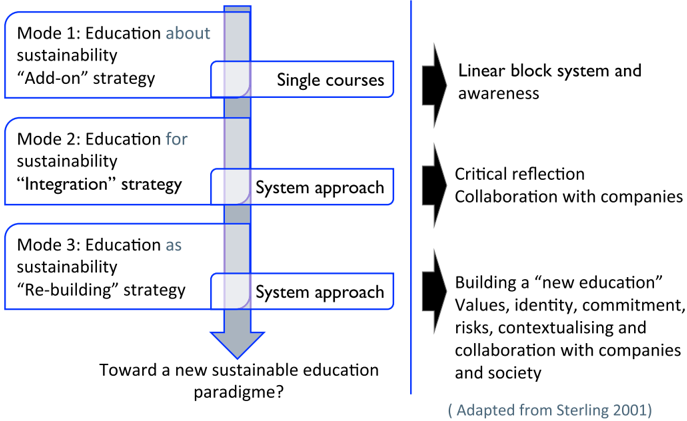
During the last 25 years, there have been many calls for new engineering competencies and a corresponding gradual change in both curriculum and pedagogy in engineering education. This has been a global trend, in the US, Europe, Australia and now emerging in the rest of the world. Basically, there have been two main types of societal challenges that many engineering institutions have responded to: the employability skills of graduates and the need for a sustainability approach to engineering. These are two very different challenges and societal needs; however, the ways engineering institutions have responded form a consistent pattern across many of the content aspects. No matter the specific character of change, three very different curriculum strategies seem to have evolved: an add-on strategy, an integration strategy or a re-building strategy; the latter involves substantial curriculum re-design. The add-on strategy and integration strategy are the ones most commonly used, whereas the re-building strategy is at an emerging stage in most engineering education communities. Most engineering schools find it very challenging to re-build an entire curriculum, so smaller changes are generally preferred. The purpose of this article is to conceptualise these institutional response strategies in a wider literature and present examples of curriculum change within both employability and sustainability. We will maintain that all these strategies are based on management decisions as well as academic faculty decisions; however the implications for using the various strategies are very different in terms of system change, role of disciplines, leader interventions and faculty development strategies. Furthermore, institutions might use all types of response strategies in different programs and in different semesters. The conceptual framework presented here can provide analytical anchors, hopefully creating more awareness of the complexity of systemic change.
Overview
The claims and statistics of this paper haven’t been checked yet.
Free: it reads the open-access text and checks the first 5 claims that cite a source we can check. Create a free account to check every claim.
Integrity signals
Registry
Cites
Statistics
Figures

Verification
Claims the paper makes
The claims and statistics of this paper haven’t been checked yet.
Free: it reads the open-access text and checks the first 5 claims that cite a source we can check. Create a free account to check every claim.
Claims other papers make about this one
Each is checked against this paper’s own text: does it say what the citing paper says it does?
The source backs part of the claim, not all of it — or backs it for a different population, condition or comparison.
In the citing paper
“However, in many civil and environmental engineering curricula, sustainability and ethics are still treated as supplementary topics rather than being systematically embedded in core technical courses.”
From Integrating Sustainability and Ethical Responsibility into Building Water Supply and Drainage Engineering Education: A CDIO-Based Curriculum Reform (2026) · cites this paper as [20]
Experimental — accuracy not yet measuredThe source backs part of the claim, not all of it — or backs it for a different population, condition or comparison.
In the citing paper
“While prior studies on EESD, CDIO-oriented curriculum reform, and project-based learning have reported positive outcomes in enhancing sustainability-related competencies [11,16,19,20,24], empirical evidence from disciplinespecific technical courses-particularly those directly related to public health and building safety-remains limited.”
From Integrating Sustainability and Ethical Responsibility into Building Water Supply and Drainage Engineering Education: A CDIO-Based Curriculum Reform (2026) · cites this paper as [20]
Experimental — accuracy not yet measuredThe source backs part of the claim, not all of it — or backs it for a different population, condition or comparison.
In the citing paper
“Globally, there are also increasing calls for curricula that focus on sustainability and the SDGs (Kolmos et al., 2016),”
From Global challenges, local responses: Exploring curriculum reform in South African engineering education (2025) · cites this paper as Kolmos et al., 2016
Experimental — accuracy not yet measuredThe cited source says what the claim attributes to it.
In the citing paper
“As Kolmos et al. (2016, p. 391) point out, engineering curriculum reform is a response to ' two main types of societal challenges … : the employability skills of graduates and the need for a sustainability approach to engineering. '”
From Global challenges, local responses: Exploring curriculum reform in South African engineering education (2025) · cites this paper as Kolmos et al., 2016
The cited source says what the claim attributes to it.
In the citing paper
“Employability is a recurring theme in global studies (Kolmos et al., 2016; Yates & Young, 2010).”
From Global challenges, local responses: Exploring curriculum reform in South African engineering education (2025) · cites this paper as Kolmos et al., 2016
Self-check
Percentages, sums and reported differences re-computed from the paper’s own numbers.
The self-check needs the paper’s full text.
Citations
Cites
(1994) · Journal of the American Dietetic Association · doi:10.1016/0002-8223(94)92216-0 · Cited by 45,910
The New Meaning of Educational Change
(2013) · Routledge eBooks · doi:10.4324/9780203609071 · Cited by 8,220 · cited 3×
“Within the framework of Fullan (2007a), de Graaff and Kolmos (2006) present a model for systemic change with four elements: (1) identify the core elements in the curriculum that have to undergo change and should be aligned, (2) identify the organisation and culture of the teaching unit, to address…”
BackgroundThe New Meaning of Educational Change
Fullan, M. (2001) · doi:10.4324/9780203986561 · Cited by 4,373
Leading change: why transformation efforts fail
Kotter, J. P. (2009) · IEEE Engineering Management Review · doi:10.1109/emr.2009.5235501 · Cited by 3,566 · cited 1×
“Kotter is often referred to as one of the core systemic theorists in the field (de Graaff and Kolmos 2006; Kotter 1995; Reidsema et al. 2013).”
BackgroundLeading in a Culture of Change
Fullan, M. J. (2001) · Cited by 3,489
Creating entrepreneurial universities : organizational pathways of transformation
Clark, B. R. (1998) · Cited by 2,867
(1980) · Cited by 2,480
Problem-Based Learning: An Approach to Medical Education
Engle, K. K. (1981) · The American Journal of Occupational Therapy · doi:10.5014/ajot.35.8.539b · Cited by 2,140
Sustainable Education: Re-Visioning Learning and Change. Schumacher Briefings.
Sterling, S. (2001) · Cited by 1,915
The Challenge of Problem-based Learning
Boud, D., & Feletti, G. (2013) · Routledge eBooks · doi:10.4324/9781315042039 · Cited by 1,754 · cited 2×
“No matter if the focus is on problem-based learning, (Barrows and Tamblyn 1980; Felletti and Boud 1997; Savin-Baden 2003), project-based learning (Edström and Kolmos 2014), or merging PBL models (Kolmos and Graaff 2014), the degree of implementation of PBL will depend on the degree of systemic…”
Background
Research works printed but not linked: 5
- 15. Dahlgren, M. A. (2002). Portraits of PBL: A cross-faculty comparison of students' experiences of problem- based learning. Linko ¨ping: Linko ¨pings universitet, Department of Behavioural Sciences.
- 16. de Graaff, E., & Kolmos, A. (2006). Management of change. Rotterdam: Sense Publishers.
- European Commission. (2009). Communiqué of the conference of European ministers responsible for higher education, Leuven and Louvain-la-Neuve, 28–29 April 2009. http://europa.eu/rapid/press-release_IP-09-675_en.htm . Accessed 6 February 2015.
- 38. Holgaard, J. E., de Graaff, E., & Kolmos, A. (2010). Sustainability in the practice, mindset and heart of engineering. Presented at the ESRSCP-EMSU Conference. http://vbn.aau.dk/da/publications/ sustainability-in-the-practise-mindset-and-heart-of-engineering(73d7bba8-f7b5-43ac-948b-49223159 267a).html. Accessed 15 October 2014.
- 61. Seidel, J., Hadgraft, R. G., & Eley, M. (1994). Student contractors bid for soils engineering jobs. Presented at the 6th Australasian Association for Engineering Education Conference, Sydney.
Cited by
Items 101–200 of 202
Wolf, P., Cormican, K. T., Frederiksen, M. H., Wilhøft, A., Ulus, H. E., Kunz, C., Çakır, Ö. A., Sarsar, F., & van Leeuwen, M. (2024) · Creativity and Innovation Management · doi:10.1111/caim.12599 · Cited by 5
Hattingh, T., & Inglis, H. M. (2024) · Research in Engineering Education Symposium (REES) · doi:10.52202/073963-0011 · Cited by 2
Integrating advanced computational skills into engineering education: A discipline‐based approach
Abell, J. A., Moreno‐Casas, P. A., & Recabarren, M. (2024) · Computer Applications in Engineering Education · doi:10.1002/cae.22784 · Cited by 2
“While comprehensive curriculum overhauls are challenging for most undergraduate schools, smaller, incremental changes within individual courses are more feasible [13].”
Student Reflections on a Summer School to achieve SDG 12: A Case Study
Beagon, Ú., McKennedy, J., Jani, R., Bowe, B. W., Morgan, M., & Henry, R. (2025) · SEFI Journal of Engineering Education Advancement · doi:10.62492/sefijeea.v2i1.24 · Cited by 2
Implementation of Education for Sustainable Development in Higher Education: Engineering Studies
Baqués, N. L., Ferrero, J. D., & Reyes, G. (2025) · Afinidad · doi:10.55815/431883 · Cited by 2
PBL, Social Progress and Sustainability
Guerra, A. O. P. D. C., Rodríguez, F. J., Kolmos, A., & Reyes, I. P. (2017) · BiblioBoard Library Catalog (Open Research Library) · Cited by 2
Self-citationRevolutionizing the Mechanical Engineering Undergraduate Curriculum
McNeilly, S., Pakala, K., & Plumlee, D. G. (2020) · ASEE Annual Conference & Exposition · doi:10.18260/1-2--35164 · Cited by 2
Which aspects of engineering degrees do graduates most value in their working lives?
Thomson, G. A. (2020) · Információs Társadalom · doi:10.22503/inftars.xx.2020.2.9 · Cited by 2
First-Year Engineering Program Curriculum ReDesign
Brooks, R. (2024) · ASEE Gulf Southwest Section Conference · doi:10.18260/1-2--36379 · Cited by 2
Homan, E. (2020) · Maynooth University ePrints and eTheses Archive (Maynooth University) · Cited by 5
Huang, T., Wang, T., Zhang, F., Hao, Y., Liang, L., Wang, X., Yao, M., & Yuan, C. (2026) · Sustainability · doi:10.3390/su18041933 · Cited by 1
Miller, S. J., & Higbee, S. (2020) · IEEE Frontiers in Education Conference (FIE) · doi:10.1109/fie44824.2020.9274092 · Cited by 1
“Still, programmatic changes that include an emphasis on design can be difficult to initiate, implement, and assess and often require a systematic method to realize change [6], [7].”
BackgroundEngineering 'STEAMs' Up Elementary Education: Impacts of the COVID-19 Pandemic (Fundamental)
Love, J. (2024) · ASEE Annual Conference & Exposition · doi:10.18260/1-2--47269 · Cited by 1
Digital Competence and Adaptability: Keys to Career Readiness in the Era of Artificial Intelligence
Ira Puspitadewi, S., & Umamy, S. H. (2024) · Jurnal Ekonomi Bisnis & Entrepreneurship · doi:10.55208/g028hy97 · Cited by 1
“Lastly, it offers insights into enhancing the competitiveness of the university's (Kolmos et al., 2016).”
Lü, C., Li, G., & Wu, J. (2024) · IEEE Frontiers in Education Conference (FIE) · doi:10.1109/fie61694.2024.10893021 · Cited by 1
“These topics are increasingly recognized as crucial components of a well-rounded engineering education that prepares graduates for the complexities of modern engineering challenges [18][19].”
Alonso, S. R. (2022) · HUMAN REVIEW International Humanities Review / Revista Internacional de Humanidades · doi:10.37819/revhuman.v12i1.1004 · Cited by 1
Skills in Engineering Education and Its Challenges to the Labour Market
Silva, P., García‐Holgado, A., & Felgueiras, C. (2025) · Lecture notes in educational technology · doi:10.1007/978-981-96-5658-5_100 · Cited by 1
Gardelle, L., Liu, J. C., & Fabri, K. (2025) · Higher Education Research & Development · doi:10.1080/07294360.2025.2514501 · Cited by 1
“This approach aligns with active pedagogies advocated by educational researchers worldwide (Kolmos et al., 2016) and has the potential to be transformative.”
Embedding Sustainability in Software Engineering Curriculum: A Case Study
Chitchyan, R., & Mahmoudi, N. (2026) · ACM/IEEE International Conference on Software Engineering: Companion Proceedings (ICSE-Companion) · doi:10.1145/3786580.3786981 · Cited by 1
“Re-building strategy is suggested as the most effective one, aiming to blend the disciplines and completely re-define the engineering curriculum [20].”
InfluentialWinkens, A.-K., Engelhardt, F., Lemke, C., Stöhr, C., & Leicht-Scholten, C. (2025) · European Journal of Engineering Education · doi:10.1080/03043797.2025.2573884 · Cited by 2
“These findings illustrate the relevance of the complex reciprocity between the individual level of educators and the institutional level of the higher education institution (, Cutler and Coso Strong 2023; Kolmos, Hadgraft, and Holgaard 2016).”
Appelhans, S., Thomas, R. L., Thomas, S., Thompson, M. S., & Cheville, A. (2025) · European Journal of Engineering Education · doi:10.1080/03043797.2025.2578321 · Cited by 1
“There are multiple strategies for integrating educational reforms such as convergence into engineering curricula that can be characterised as low to high integration (Kolmos, Hadgraft, and Holgaard 2016; Mulder 2006).”
Peters, A.-K., & Rosén, A. (2025) · European Journal of Engineering Education · doi:10.1080/03043797.2025.2575119 · Cited by 1
“Concerning the role of the educational developer, we find research suggesting that faculty development, education for teachers, needs to be prioritised to promote sustainability in higher education (Kolmos, Hadgraft, and Holgaard 2016; Mulà et al. 2017).”
Sustainability and patchwork transformations in engineering education
Cuevas-Garcia, C. (2025) · European Journal of Engineering Education · doi:10.1080/03043797.2025.2578704 · Cited by 1
“This requires ‘strong institutional support, often from the highest level of the university’ (Kolmos, Hadgraft, and Holgaard 2016, 396).”
InfluentialDemidova, N. N., Pimanova, N. A., Kiseleva, N. V., & Novik, I. R. (2026) · Veredas do Direito Direito Ambiental e Desenvolvimento Sustentável · doi:10.18623/rvd.v23.n4.4829 · Cited by 1
“…the content of engineering education to technological and social changes that lead to the generation of new knowledge and the adjustment of curricula (Kolmos et al ., 2016; Malmqvist et al ., 2022), changing educational practice programs in educational institutions (Capobianko & Rupp, 2014).”
Structural Shifts and Sustainable Futures: Transforming Higher Education for the Climate Century
Wood, D. M., Hegarty, S., Delaney, E. C., Cronin, N., Cross, A., Bowers, E. P., Clarke, D. L., Pesch, A. H., & Aqlan, F. (2026) · Sustainability · doi:10.3390/su18094349 · Cited by 1
Quizizz As a Game Based Interactive Learning Media in the Era of Independent Curriculum
Astuti, V. Y., Purnamasari, N., & Muslim, B. L. B. B. (2025) · Jurnal Teknologi Pendidikan · doi:10.47134/jtp.v3i2.2282 · Cited by 1
Sustainability and Science Education: Exploring Roles and Challenges
Skarstein, F., & Wolff, L.-A. (2026) · Environmental challenges and solutions · doi:10.1007/978-3-032-24408-6 · Cited by 1
Man, N. Y. T., ELMALI, Ş., Lommatzsch, A., & Tiemann, R. (2026) · Journal of Chemical Education · doi:10.1021/acs.jchemed.5c01713 · Cited by 1
Kolmos, A. (2026) · Springer eBooks · doi:10.1007/978-3-032-32540-2 · Cited by 2
Self-citationContent analysis in the training of engineers for the design of MOOCs
Palacios, M. S. R., & Silva, M. J. M. (2020) · IEEE Learning With MOOCS (LWMOOCS) · doi:10.1109/lwmoocs50143.2020.9234367 · Cited by 1
“In general, there are two approaches, one is to prepare engineering students for jobs in the current i ndustry and the other is the training of conscious individuals focused on analyzing engineering processes and their sustainability [15].”
Background“PBLing the unPBLable”: Exploring the Power of PBL Implementations for Organizational Learning
Scholkmann, A., & Thomassen, A. O. (2020) · Interdisciplinary Journal of Problem-based Learning · doi:10.14434/ijpbl.v14i2.31415 · Cited by 1
Alonso, S. R. (2022) · HUMAN REVIEW International Humanities Review / Revista Internacional de Humanidades · doi:10.37467/revhuman.v11.3914 · Cited by 1
“En nuestro caso, utilizaremos el modelo que Kolmos et al. (2015) definen como modelo Add-on strategy.”
BackgroundMagnell, M. (2022) · Philosophy of engineering and technology · doi:10.1007/978-3-031-11601-8_15 · Cited by 1
Chew, C. M., Teoh, H. C., Ng, L. Y., & Mah, S. K. (2023) · Journal of Computers in Education · doi:10.1007/s40692-023-00294-8 · Cited by 1
“It is important to ensure the employability skills of graduates are embedded in the project (Kolmos et al., 2016).”
Memarian, B. (2024) · ASEE Annual Conference & Exposition · doi:10.18260/1-2--43678 · Cited by 2
Smith, L., Hechter, J. E., Ebersöhn, L., Swartz, B., & Direito, I. (2025) · Proceedings from the International Research Symposium on Problem-Based Learning (IRSPBL) · doi:10.54337/irspbl-11107 · Cited by 1
Teaching Engineering Students About Cognitive Barriers During Design for Sustainable Infrastructure
McWhirter, N. (2017) · VTechWorks (Virginia Tech) · Cited by 1
Ibáñez, M. J., & Velíz, J. (2024) · SSRN Electronic Journal · doi:10.2139/ssrn.4823154 · Cited by 1
Vedhathiri, T. (2024) · Qeios · doi:10.32388/1vp5qw · Cited by 1
Soriano, S. M., Suz, A. L. A., Erro, A. M., Cruz-Mazo, F., & D’Amato, R. (2025) · Preprints.org · doi:10.20944/preprints202506.0973.v1 · Cited by 1
The Transformative Dimensions of Professional Curriculum Quality Enhancement
Hammer, S. J. (2019) · Springer eBooks · doi:10.1007/978-3-030-01084-3_10
Design of Emergency Vehicle Lighting Integrated in Fire Fighting Trucks
Alonso-García, M., Solís-Mellado, A., Gómez-Vázquez, C., Fernández-Rubio, M., de-Cózar-Macías, Ó. D., & Parra, E. B. B. (2020) · Lecture notes in mechanical engineering · doi:10.1007/978-3-030-41200-5_51
Challenges of Changing Engineering Education
Hasan, M., & Mahmood, E. J. (2019) · Engineering and Technology Journal · doi:10.30684/etj.37.4c.17
Entrepreneurs and Champions on the Frontiers of Engineering Education
Pluskwik, E., Frezza, S. T., & Morgan, J. (2020) · IEEE Frontiers in Education Conference (FIE) · doi:10.1109/fie44824.2020.9274212
Difference Makers: The Transition, Handoff and Sustainability of Innovative Programs
Pluskwik, E., Frezza, S. T., & Morgan, J. (2020) · IEEE Frontiers in Education Conference (FIE) · doi:10.1109/fie44824.2020.9273926
INTRODUCING OF FLEXIBLE APPROACHES TO TEACHING AND LEARNING IN AN ENGINEERING EDUCATION
Lutsenko, G. V. (2020) · Izdevniecība “Baltija Publishing” eBooks · doi:10.30525/978-9934-26-001-8-1-6
“Collis, B., & van der Wende, M. (2002).”
BackgroundOnyilo, I. R., Arsat, M., & Amin, N. F. M. (2021) · Asean Journal of Engineering Education · doi:10.11113/ajee2021.5n2.63
Helligsø, A. (2021) · Journal of Problem Based Learning in Higher Education · doi:10.5278/ojs.jpblhe.v9i1.7045
Pokholkov, Y. P., Muravlev, I., & Chervach, M. (2022) · Recent Contributions to Physics · doi:10.26577/rcph.2022.v83.i4.08
Cass, R. A. (2022) · Digital Repository Service (Northeastern University) · doi:10.17760/d20455960
Dias, S. M., Queiroz, K. I. P. D. M., & Dias, A. M. (2022) · Congresso Brasileiro de Automática · doi:10.20906/cba2022/3321
Brooks, R. (2024) · ASEE Annual Conference & Exposition · doi:10.18260/1-2--36994
“The curriculum in this case is regarded as a learning process where students have to identify problems and devise possible technical solutions to these problems while explicitly developing employability skills” [1].”
BackgroundMethodInfluentialInterdisziplinäre Kompetenzen in der Hochschulbildung für eine nachhaltige Entwicklung
Braßler, M. (2024) · Theorie und Praxis der Nachhaltigkeit · doi:10.1007/978-3-662-67740-7_12 · Cited by 1
Embedding Teamwork Skills in Mechanical Engineering Curriculum
Balawi, S., Weaver-Rosen, J. M., Tsenn, J., Mohiuddin, M. W., & Corleto, C. R. (2024) · ASEE Gulf Southwest Section Conference · doi:10.18260/1-2--45374
Dinh, T.-N. (2023) · theses.fr (ABES) · doi:10.70675/a8b29a66z3c9bz4d55zaf12z1a9b160bd5ae · Cited by 1
Jamison, C. S. E., Bakrania, S. D., Trkov, M., & Xue, W. (2024) · ASEE Annual Conference & Exposition · doi:10.18260/1-2--48284
Developing a Process for Software Engineering Curriculum Modernization
Marasco, E., Grozic, M., Pauchard, Y., & Moshirpour, M. (2024) · ASEE Annual Conference & Exposition · doi:10.18260/1-2--47152
From Pathological Bifurcations to Meaningful Planetary Change Agents
Tabas, B., Gardelle, L., Kövesi, K., & Beagon, Ú. (2025) · World sustainability series · doi:10.1007/978-3-031-80434-2_5
MANAGEMENT AND LEADERSHIP IN INTERDISCIPLINARY PROJECTS IN ENGINEERING EDUCATION
Routhe, H. W. (2024) · VBN Forskningsportal (Aalborg Universitet) · doi:10.54337/aau749592089
Mendoza, R., Dumloan, E., Baloro, E., Capaps, J. E., Carbonilla, P., & Maluya, R. (2025) · Psychology and Education A Multidisciplinary Journal · doi:10.70838/pemj.350101
The Role of Universities in Sustainable Transformation
Todorović, B. (2025) · FEB International Scientific Conference · doi:10.18690/um.epf.5.2025.25
Unzueta, S. C., Arriola, V. G., Murillo, E. L., & Reyes‐Villegas, E. (2025) · IEEE Global Engineering Education Conference (EDUCON) · doi:10.1109/educon62633.2025.11016610
“The Miravalle area comprised of sensors 1, 2, 3, 6, and 8 this zone is known for its traditional production of bricks as well as having multiple businesses of high emissions such as the Directorate of Public Cleaning, the Municipal slaughterhouse of Guadalajara and a cement production plant.”
How To Build Teams That Support Organizational Transformation
Sayyadi, M., & Provitera, M. J. (2025) · Muma Business Review · doi:10.28945/5584
dos Reis, J. C. G. (2025) · Lecture notes in networks and systems · doi:10.1007/978-3-032-00701-8_30
Strachan, S. M., Logan, L., Marshall, S., & Crichton-Allen, C. (2023) · Strathprints: The University of Strathclyde institutional repository (University of Strathclyde)
Bueno Terranova, C. E. (2020) · Icesi Digital Library (Icesi University)
Wijnia, P. (. (2024) · Research Repository (Delft University of Technology)
Soeiro, A., Bakker, N., Chakabarti, S., & Kretschmann, J. (2021) · Portuguese National Funding Agency for Science, Research and Technology (RCAAP Project by FCT) · Cited by 1
Instructionally industrially designed to become a reflective design engineer
Brosens, L. (2023) · Ghent University Academic Bibliography (Ghent University)
Interdisziplinarität in Forschung und Lehre gestalten: Bedingungen, Teamarbeit, Räume, Methoden
Braßler, M., Lerch, S., Brandstädter, S., & Verlag, W. B. (2025) · doi:10.3278/9783763978915
SHIH, Y.-H. (2025) · International Journal of Social Sciences and Management Review · doi:10.37602/ijrehc.2025.6623
“For example, collaborative community projects that link engineering and environmental sustainability can foster not only technical competence but also empathy and civic engagement (Kolmos, Hadgraft, & Holgaard, 2016).”
Tröster, P. M., Schön, J., & Albers, A. (2025) · International Conference on Industrial Engineering and Operations Management (IEOM) · doi:10.46254/wc02.20250147
Prasanna, S. G., Joshi, G. K., Baral, D., Verma, M., Kaushal, S. K., & Srinu, C. (2025) · International Conference on Artificial Intelligence and Knowledge Discovery in Concurrent Engineering (ICECONF) · doi:10.1109/iceconf65644.2025.11379648
Industry- Integrated Curriculum Model for New Age Skills: Insight of Industry Survey
Atitkar, D. M., & Swami, D. A. (2026) · International Journal of Research and Innovation in Social Science · doi:10.47772/ijriss.2026.10190023
Shange, L. N. L. (2024) · ResearchSpace (University of KwaZulu-Natal)
Perpignan, C. (2021) · theses.fr (ABES) · doi:10.70675/14deddb3zd982z416fzbbfbz6be6ce1dbd51 · Cited by 5
Interdisziplinarität in Forschung und Lehre gestalten. Bedingungen, Teamarbeit, Räume, Methoden
:null (2025) · Pedocs (German Institute for International Educational Research) · doi:10.25656/01:35191
Integrating Edge AI and Embedded Systems with Raspberry Pi into Computer Architecture
Gerousis, C., Krebs, J., & Quach, A. (2026) · Communications in computer and information science · doi:10.1007/978-3-032-22202-2_15
Joo, S. H. (2026) · Frontiers in Education · doi:10.3389/feduc.2026.1790898
Левицкая, И., & Дубровская, О. (2026) · Международный научно-исследовательский журнал · doi:10.60797/irj.2026.167.57
Experiential and Constructivist Learning in Structural Engineering: The Old Alton Bridge Module
Huang, Z. (2026) · Journal of Civil Engineering Education · doi:10.1061/jceecd.eieng-2406
Jaakkola, N. (2026) · Environmental challenges and solutions · doi:10.1007/978-3-032-24408-6_7
Bridging the skills gap for intelligent systems: Industry needs vs. engineering education
Srivastava, P., Shekhawat, K., -, H. S., Mamodiya, U., Choudhary, R. R., & Tekwani, K. (2026) · AIP conference proceedings · doi:10.1063/5.0327299
Rampasso, I. S., Quelhas, O. L. G., Sigahi, T. F. A. C., da Costa, S. R. R., Zotes, L. P., Araújo, R., & Anholon, R. (2026) · International Journal of Sustainable Engineering · doi:10.1080/19397038.2026.2696643
Nurulsari, N., Sumintono, B., & Hariri, H. (2026) · Education Sciences · doi:10.3390/educsci16071101
Creative Design Engineering Education for Human-Society-Environment Integrated Intelligent Systems
Erden, Z., & Erden, A. (2026) · Journal of Integrated Design and Process Science · doi:10.1177/10920617251405472 · Cited by 2
“The change process should be addressed in a holistic manner, not only with content updating but also with teaching methods, institutional culture and stakeholder participation (Kolmos et al., 2016).”
Sustainability integration in engineering education: A capability-based curriculum analysis
Rugbani, A. (2026) · International Journal of Mechanical Engineering Education · doi:10.1177/03064190261470949
Song, J. (2026) · Journal of Artificial Intelligence and Information · doi:10.66069/ojspub.1137260709
“The findings are consistent with studies showing that BIM enhances students' understanding of engineering information and that PBL promotes active learning, collaboration, and practical problem-solving [10].”
InfluentialDiaconu, M. G., & Salaj, A. T. (2026) · Systems · doi:10.3390/systems14080953
Vivekaandan, N., Rajeswari, K., Yuvraj Kanna, N., V, & Media, C. A. M. (2025) · International Conference on Computers in Education · doi:10.58459/icce.2025.5970
“Kolmos et al. (2016) emphasized that curricula should address authentic problems to foster systems thinking and collaboration, while Brereton et al. (2015) showed design challenges stimulate creativity and mirror professional practice.”
Kim, M., Oaxaca, G. S. C., Adaramola, A., Strong, A., Enuka, A., & Mendez-Sanders, G. A. A. (2026) · ASEE Annual Conference & Exposition · doi:10.18260/1-2--60381
Educational Change and Transformation
Kolmos, A. (2026) · Springer eBooks · doi:10.1007/978-3-032-32540-2_9
Self-citationSustainability in engineering education: an editorial and interpretive synthesis
Rosén, A., Lundqvist, U., & Mathebula, M. (2026) · European Journal of Engineering Education · doi:10.1080/03043797.2026.2703851
Alrizqi, M., & Godwin, A. (2026) · Journal of Engineering Education · doi:10.1002/jee.70081
Ingale, S. M. (2024) · Vidhyayana · doi:10.58213/kwhhmd84
Okereke, C. A., & Emeribeole, A. C. (2026) · African Journal of Social and Behavioural Sciences
Metadata
- Authors
- Kolmos, A., Hadgraft, R. G., & Holgaard, J. E.
- Affiliations
- Aalborg University (DK)
- Central Queensland University (AU)
- Corresponding author
- Kolmos, Anette
- Venue
- International Journal of Technology and Design Education
- Published
- 2015-06-18
- Volume
- 26
- Issue
- 3
- Pages
- 391-411
- ISSN
- 0957-7572 (ISSN-L)
- 1573-1804
- OpenAlex
- W1839564221
- Semantic Scholar
- 67038ce20f5a85b805f9cbc10ffadb63af8a8eba
- Cited by
- 171
- References
- 68
- Citations by year
- 2026: 21 · 2025: 31 · 2024: 27 · 2023: 10 · 2022: 21 · 2021: 8 · 2020: 28 · 2019: 12 · 2018: 4 · 2017: 7 · 2016: 2
- FWCI
- 6.95
- Type
- journal article
- Language
- en
- Open access
- hybrid
- doi.org
- Locations
- International Journal of Technology and Design Education (publishedVersion, cc-by)
- Acquire (CQUniversity) (submittedVersion, cc-by)
- Figshare (submittedVersion, cc-by)
- UTS ePRESS (University of Technology Sydney) (submittedVersion)
- VBN Forskningsportal (Aalborg Universitet) (submittedVersion, cc-by)
- Topics
- Social Sciences › Education › Engineering Education and Curriculum Development
- Social Sciences › Development › Engineering Education and Global Impact
- Social Sciences › Education › Engineering Education and Pedagogy
- Keywords
- curriculum change, engineering education, employability skills, sustainability in engineering, curriculum redesign, integration strategies, systemic change, faculty development, leadership interventions, engineering competencies
About these checks
Registry, retraction, Cites and statistics results are computed, not judged, with one exception: a printed reference that no index lists is read once by a model before it counts as a citation error. Claims are extracted by a model and kept only when their quote appears verbatim in the text; each cited source is then checked, with a model’s help, for whether it says what the claim relies on. Those verdicts can be wrong — read the claim’s quote and the cited source before relying on one.
Statistics and arithmetic are recomputed, not judged.
Confidence bands are shown only for fields calibrated on our annotated test set. None is calibrated yet, so no band is shown.
What counts as a claim ›How we measure confidence ›How we check this ›
Are you an author, or do you see a problem with this page? Request a review
Data sources
Bibliographic data: Semantic Scholar, OpenAlex, Crossref.
Contains information from the Semantic Scholar Academic Graph Datasets, made available under the ODC Attribution License (ODC-BY 1.0).
Semantic Scholar’s data is described in: Kinney, R., et al. (2023). The Semantic Scholar Open Data Platform. arXiv:2301.10140.
