

Response strategies for curriculum change in engineering
Open accessThe DOI matches its Crossref record; 66 of the 68 references it cites were found in a registry or an index.
Abstract
During the last 25 years, there have been many calls for new engineering competencies and a corresponding gradual change in both curriculum and pedagogy in engineering education. This has been a global trend, in the US, Europe, Australia and now emerging in the rest of the world. Basically, there have been two main types of societal challenges that many engineering institutions have responded to: the employability skills of graduates and the need for a sustainability approach to engineering. These are two very different challenges and societal needs; however, the ways engineering institutions have responded form a consistent pattern across many of the content aspects. No matter the specific character of change, three very different curriculum strategies seem to have evolved: an add-on strategy, an integration strategy or a re-building strategy; the latter involves substantial curriculum re-design. The add-on strategy and integration strategy are the ones most commonly used, whereas the re-building strategy is at an emerging stage in most engineering education communities. Most engineering schools find it very challenging to re-build an entire curriculum, so smaller changes are generally preferred. The purpose of this article is to conceptualise these institutional response strategies in a wider literature and present examples of curriculum change within both employability and sustainability. We will maintain that all these strategies are based on management decisions as well as academic faculty decisions; however the implications for using the various strategies are very different in terms of system change, role of disciplines, leader interventions and faculty development strategies. Furthermore, institutions might use all types of response strategies in different programs and in different semesters. The conceptual framework presented here can provide analytical anchors, hopefully creating more awareness of the complexity of systemic change.
Overview
The claims and statistics of this paper haven’t been checked yet.
Free: it reads the open-access text and checks the first 5 claims that cite a source we can check. Create a free account to check every claim.
Integrity signals
Registry
Cites
Statistics
Figures

Verification
Claims the paper makes
The claims and statistics of this paper haven’t been checked yet.
Free: it reads the open-access text and checks the first 5 claims that cite a source we can check. Create a free account to check every claim.
Claims other papers make about this one
Each is checked against this paper’s own text: does it say what the citing paper says it does?
The source backs part of the claim, not all of it — or backs it for a different population, condition or comparison.
In the citing paper
“However, in many civil and environmental engineering curricula, sustainability and ethics are still treated as supplementary topics rather than being systematically embedded in core technical courses.”
From Integrating Sustainability and Ethical Responsibility into Building Water Supply and Drainage Engineering Education: A CDIO-Based Curriculum Reform (2026) · cites this paper as [20]
Experimental — accuracy not yet measuredThe source backs part of the claim, not all of it — or backs it for a different population, condition or comparison.
In the citing paper
“While prior studies on EESD, CDIO-oriented curriculum reform, and project-based learning have reported positive outcomes in enhancing sustainability-related competencies [11,16,19,20,24], empirical evidence from disciplinespecific technical courses-particularly those directly related to public health and building safety-remains limited.”
From Integrating Sustainability and Ethical Responsibility into Building Water Supply and Drainage Engineering Education: A CDIO-Based Curriculum Reform (2026) · cites this paper as [20]
Experimental — accuracy not yet measuredThe source backs part of the claim, not all of it — or backs it for a different population, condition or comparison.
In the citing paper
“Globally, there are also increasing calls for curricula that focus on sustainability and the SDGs (Kolmos et al., 2016),”
From Global challenges, local responses: Exploring curriculum reform in South African engineering education (2025) · cites this paper as Kolmos et al., 2016
Experimental — accuracy not yet measuredThe cited source says what the claim attributes to it.
In the citing paper
“As Kolmos et al. (2016, p. 391) point out, engineering curriculum reform is a response to ' two main types of societal challenges … : the employability skills of graduates and the need for a sustainability approach to engineering. '”
From Global challenges, local responses: Exploring curriculum reform in South African engineering education (2025) · cites this paper as Kolmos et al., 2016
The cited source says what the claim attributes to it.
In the citing paper
“Employability is a recurring theme in global studies (Kolmos et al., 2016; Yates & Young, 2010).”
From Global challenges, local responses: Exploring curriculum reform in South African engineering education (2025) · cites this paper as Kolmos et al., 2016
Self-check
Percentages, sums and reported differences re-computed from the paper’s own numbers.
The self-check needs the paper’s full text.
Citations
Cites
(1994) · Journal of the American Dietetic Association · doi:10.1016/0002-8223(94)92216-0 · Cited by 45,910
The New Meaning of Educational Change
(2013) · Routledge eBooks · doi:10.4324/9780203609071 · Cited by 8,220 · cited 3×
“Within the framework of Fullan (2007a), de Graaff and Kolmos (2006) present a model for systemic change with four elements: (1) identify the core elements in the curriculum that have to undergo change and should be aligned, (2) identify the organisation and culture of the teaching unit, to address…”
BackgroundThe New Meaning of Educational Change
Fullan, M. (2001) · doi:10.4324/9780203986561 · Cited by 4,373
Leading change: why transformation efforts fail
Kotter, J. P. (2009) · IEEE Engineering Management Review · doi:10.1109/emr.2009.5235501 · Cited by 3,566 · cited 1×
“Kotter is often referred to as one of the core systemic theorists in the field (de Graaff and Kolmos 2006; Kotter 1995; Reidsema et al. 2013).”
BackgroundLeading in a Culture of Change
Fullan, M. J. (2001) · Cited by 3,489
Creating entrepreneurial universities : organizational pathways of transformation
Clark, B. R. (1998) · Cited by 2,867
(1980) · Cited by 2,480
Problem-Based Learning: An Approach to Medical Education
Engle, K. K. (1981) · The American Journal of Occupational Therapy · doi:10.5014/ajot.35.8.539b · Cited by 2,140
Sustainable Education: Re-Visioning Learning and Change. Schumacher Briefings.
Sterling, S. (2001) · Cited by 1,915
The Challenge of Problem-based Learning
Boud, D., & Feletti, G. (2013) · Routledge eBooks · doi:10.4324/9781315042039 · Cited by 1,754 · cited 2×
“No matter if the focus is on problem-based learning, (Barrows and Tamblyn 1980; Felletti and Boud 1997; Savin-Baden 2003), project-based learning (Edström and Kolmos 2014), or merging PBL models (Kolmos and Graaff 2014), the degree of implementation of PBL will depend on the degree of systemic…”
BackgroundSustainable education : re-visioning learning and change
Sterling, S. (2001) · Medical Entomology and Zoology · Cited by 1,118
Henderson, C., Beach, A., & Finkelstein, N. (2011) · Journal of Research in Science Teaching · doi:10.1002/tea.20439 · Cited by 1,055 · cited 3×
“Henderson et al. (2011) is one of the core references, in all articles except two, and forms the theoretical framework for the analysis of the work in several of the articles (Henderson et al. 2011).”
BackgroundInfluentialSocial learning towards a sustainable world: Principles, perspectives, and praxis
(2007) · Wageningen Academic Publishers eBooks · doi:10.3920/978-90-8686-594-9 · Cited by 566
Sustainability Education: Perspectives and Practice across Higher Education
Jones, P., Selby, D., & Sterling, S. (2010) · Medical Entomology and Zoology · Cited by 417
The Framework for Qualifications of the European Higher Education Area
Berg, M. (2005) · Cited by 365
Reflections on the changing nature of educational development
Gibbs, G. (2013) · International Journal for Academic Development · doi:10.1080/1360144x.2013.751691 · Cited by 335 · cited 5×
“Change in engineering education is a slow process, and making change is an emerging research area (Gibbs 2013).”
BackgroundMethodInfluentialManaging Sustainable Development
Carley, M., & Christie, I. (2017) · Routledge eBooks · doi:10.4324/9781315091525 · Cited by 329
Problem-Based and Project-Based Learning in Engineering Education: Merging Models
Kolmos, A., & de Graaff, E. (2014) · Cambridge Handbook of Engineering Education Research · doi:10.1017/cbo9781139013451.012 · Cited by 288 · cited 3×
“For a model of systemic change, the combination of the what (in which directions are we going), and the how (how to implement the changes) are important elements (de Graaff and Kolmos 2006; Kolmos and Graaff 2014).”
Self-citationA multilevel approach to building and leading learning organizations
Hannah, S. T., & Lester, P. B. (2009) · The Leadership Quarterly · doi:10.1016/j.leaqua.2008.11.003 · Cited by 285 · cited 5×
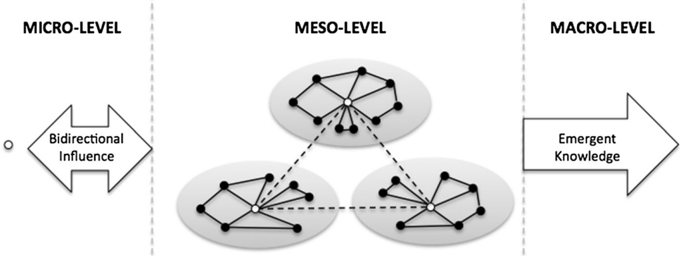
“Relating Gibbs (2013) to the model by Hannah and Lester (2009), there seems to be a trend to focus more on the meso or the institutional level; however it seems not to be present in the literature.”
BackgroundMethodInfluentialPBL and CDIO: complementary models for engineering education development
Edström, K., & Kolmos, A. (2014) · European Journal of Engineering Education · doi:10.1080/03043797.2014.895703 · Cited by 276 · cited 2×
“No matter if the focus is on problem-based learning, (Barrows and Tamblyn 1980; Felletti and Boud 1997; Savin-Baden 2003), project-based learning (Edström and Kolmos 2014), or merging PBL models (Kolmos and Graaff 2014), the degree of implementation of PBL will depend on the degree of systemic…”
BackgroundSelf-citationComplexity and Curriculum: A process approach to curriculum-making
Knight, P. T. (2001) · Teaching in Higher Education · doi:10.1080/13562510120061223 · Cited by 251 · cited 2×
“many places have included elements of both, to varying degrees; however, to expand their prominence in the curriculum, we believe that a process oriented approach to the remaking of a curriculum is required, involving external stakeholders (Knight 2001).”
BackgroundBarnett, R. (2010) · Routledge eBooks · doi:10.4324/9780203842485 · Cited by 250 · cited 3×
“The add-on strategy is in line with the basic philosophy of academic freedom within the university (Barnett 2010).”
BackgroundMethodResultFacilitating Problem-Based Learning
Savin‐Baden, M. (2003) · Cited by 235
Conceptualising Curriculum Change
Barnett, R., Parry, G., & Coate, K. (2001) · Teaching in Higher Education · doi:10.1080/13562510120078009 · Cited by 197 · cited 1×
“Education as sustainability will require both knowledge, skills and a higher emphasis on the development of each student’s identity (Barnett et al. 2001).”
BackgroundHybrid Learning: An Integrative Approach to Engineering Education
Jamison, A., Kolmos, A., & Holgaard, J. E. (2014) · Journal of Engineering Education · doi:10.1002/jee.20041 · Cited by 181 · cited 2×
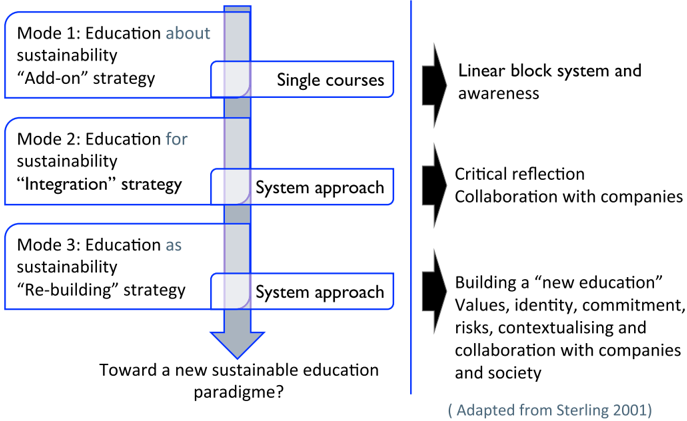
“Sterling’s three modes also correspond to the three modes developed by Jamison et al. (2014): the academic mode, the market-driven mode and the hybrid learning mode (Jamison et al. 2011, 2014).”
BackgroundMethodSelf-citationOrganizational Learning Is Essential to Achieving and Sustaining Change in Higher Education
Boyce, M. E. (2003) · Innovative Higher Education · doi:10.1023/b:ihie.0000006287.69207.00 · Cited by 174
Changing Engineering Education: Views of U.S. Faculty, Chairs, and Deans
Besterfield‐Sacre, M., Cox, M. F., Borrego, M., Beddoes, K., & Zhu, J. (2014) · Journal of Engineering Education · doi:10.1002/jee.20043 · Cited by 170 · cited 1×
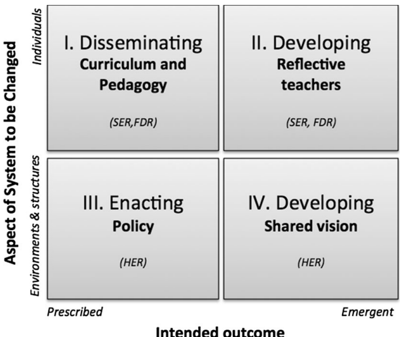
“…urgency and the creation of common vision and recent research presents results that shared vision is one of the lowest priorities among US faculties, although the shared vision supports the discussion of the what—in which directions engineering education should aim (Besterfield-Sacre et al. 2014).”
BackgroundLearning for sustainability in times of accelerating change
(2012) · Wageningen Academic Publishers eBooks · doi:10.3920/978-90-8686-757-8 · Cited by 157 · cited 1×
“There is an ongoing research conversation on combining the learning of sustainability with social learning, addressing the need for more complex and interdisciplinary knowledge and learning and as an element in facilitating emergence in the field (Wals 2007; Wals and Corcoran 2012).”
BackgroundEDUCATING ENGINEERS FOR THE 21ST CENTURY
King, J. E. (2009) · doi:10.1142/9789814261784_0001 · Cited by 152
Restructuring for caring and effective education : piecing the puzzle together
Villa, R. A., & Thousand, J. S. (2000) · Medical Entomology and Zoology · Cited by 151
Educating Engineers for the 21st Century: The Industry View
Spinks, N., Silburn, N., & Birchall, D. W. (2006) · Cited by 146
Issues and challenges in higher education leadership: Engaging for change
Drew, G. (2010) · The Australian Educational Researcher · doi:10.1007/bf03216930 · Cited by 122 · cited 2×
“Organisational change has become an important part of educational change involving sustained change in the long run (Boyce 2003; Drew 2010).”
BackgroundExploring what university teachers think about education for sustainability
Shephard, K., & Furnari, M. (2013) · Studies in Higher Education · doi:10.1080/03075079.2011.644784 · Cited by 111 · cited 3×
“Similar results are found by (Shephard and Furnari 2012) pointing out four different viewpoints among academic staff on education for sustainability of which only one viewpoint is in favor of integrating these elements into curriculum, and the resistance”
BackgroundResultInfluentialPractical pedagogy for embedding ESD in science, technology, engineering and mathematics curricula
Hopkinson, P., & James, P. (2010) · International Journal of Sustainability in Higher Education · doi:10.1108/14676371011077586 · Cited by 110 · cited 1×
“Reviewing the literature in the area of sustainability reveals mostly ‘‘the best practice perspective’’ (Fadeeva et al. 2010; Holmberg et al. 2012; Johnston 2013; Jones et al. 2010).”
BackgroundUnderstanding change in higher education as bricolage: how academics engage in curriculum change
Louvel, S. (2013) · Higher Education · doi:10.1007/s10734-013-9628-6 · Cited by 101 · cited 1×
“However, change is seldom based on such a comprehensive approach but much more based on small steps in the classroom (Louvel 2013).”
BackgroundOn Becoming a 21st Century Engineer
Sheppard, S., Pellegrino, J. W., & Olds, B. (2008) · Journal of Engineering Education · doi:10.1002/j.2168-9830.2008.tb00972.x · Cited by 93 · cited 2×
“Many of the best practice examples come from standalone courses that have been added into the curriculum, which is the most common strategy within engineering education (Sheppard et al. 2008).”
BackgroundHolmberg, J., Lundqvist, U., Svanström, M., & Arehag, M. (2012) · International Journal of Sustainability in Higher Education · doi:10.1108/14676371211242544 · Cited by 88 · cited 3×
“The result is that sustainability today is an explicit part of the curriculum (Holmberg et al. 2012).”
BackgroundLeading in a Culture of Change
Pope, M. L. (2019) · Journal of College Orientation Transition and Retention · doi:10.24926/jcotr.v10i1.2565 · Cited by 86
Crawley, E. F., Malmqvist, J., Östlund, S. Ö., Brodeur, D. R., & Edström, K. (2014) · Springer eBooks · doi:10.1007/978-3-319-05561-9_2 · Cited by 79 · cited 1×
“Many of the examples are a joint implementation of employability skills and sustainability and it is very rare that sustainability content has dominated the change by itself (Crawley et al. 2014).”
BackgroundFrom agents of change to partners in arms: the emerging academic developer role
Debowski, S. (2014) · The International Journal for Academic Development · doi:10.1080/1360144x.2013.862621 · Cited by 78 · cited 1×
“The role of an institutional change agent might have evolved further into a collaborative partnership with faculty and this involves a constant negotiation with academic staff (Debowski 2014).”
BackgroundCommitment to environmental sustainability in the UK student population
Cotton, D., & Alcock, I. (2012) · Studies in Higher Education · doi:10.1080/03075079.2011.627423 · Cited by 76 · cited 2×
“desirable; however, the university staff attitudes to integrate sustainability into the curriculum still have room for improvements (Cotton and Alcock 2012).”
BackgroundKolmos, A. (1990) · VBN Forskningsportal (Aalborg Universitet) · Cited by 69
Self-citationA Hybrid Imagination: Science and Technology in Cultural Perspective
Jamison, A. J., Botin, L., & Christensen, S. H. (2011) · Synthesis lectures on engineers, technology, and society · doi:10.2200/s00339ed1v01y201104ets016 · Cited by 66
Higher Education for Sustainability
(2012) · Routledge eBooks · doi:10.4324/9780203123041 · Cited by 63 · cited 3×
“depends on individual institutions (Johnston 2013).”
BackgroundManaging Sustainable Development Programmes: A Learning Approach to Change
Brulin, G., & Svensson, L. (2012) · Cited by 59
Facilitating Problem-Based Learning
Baden, M. S. (2003) · Cited by 57
Higher Education for Sustainability: Cases, Challenges, and Opportunities from across the Curriculum
DeVasher, R. B. (2013) · Rose-Hulman Scholar (Rose–Hulman Institute of Technology) · Cited by 50
The Complexities of Transforming Engineering Higher Education: Preparing for Next Steps
McKenna, A. F., Froyd, J. E., & Litzinger, T. (2014) · Journal of Engineering Education · doi:10.1002/jee.20039 · Cited by 47 · cited 1×
“JEE received 53 proposals for articles; however, only seven were invited for publication, as most of the articles described change in single courses (McKenna et al. 2014).”
BackgroundStrategic Leadership of Change in Higher Education
Marshall, S. (2007) · Routledge eBooks · doi:10.4324/9780203962855 · Cited by 45
Steering for Sustainability: Higher Education in England
Broadbent, J., Laughlin, R. C., & Alwani-Starr, G. (2010) · Public Management Review · doi:10.1080/14719037.2010.496257 · Cited by 36
Heterotopia: Alternative Pathways to Social Justice
Baillie, C. A., Kabo, J., & Reader, J. (2012) · UWA Profiles and Research Repository (University of Western Australia) · Cited by 35
Engineering students’ sustainability approaches
Haase, S. (2013) · European Journal of Engineering Education · doi:10.1080/03043797.2013.858103 · Cited by 27 · cited 1×
“Other studies indicate that the pressure for change has to come from the students more than faculty (Broadbent et al. 2010; Haase 2013a, b).”
BackgroundDavid, G. E. (2014) · ThreeJoy Associates, Inc eBooks · doi:10.4271/0986080004 · Cited by 26
Shaping Our World: Engineering Education for the 21st Century
Tryggvason, G., & Apelian, D. (2011) · Cited by 26
Stephan, K. D. (2005) · IEEE Technology and Society Magazine · doi:10.1109/mtas.2005.1442374 · Cited by 25
Gender-inclusive computer engineering education : Two attempts at curriculum change
Salminen‐Karlsson, M. (2002) · International journal of engineering education · Cited by 21
Managing Sustainable Development Programmes: A Learning Approach to Change
Brulin, G., & Svensson, L. (2016) · Routledge eBooks · doi:10.4324/9781315593647 · Cited by 16 · cited 2×
“This more complex approach is supported by (Brulin and Svensson 2012) describing two strategies for curriculum change: (1) a planning-steered (top-down) development model that is result-oriented and a one-way communication plan for managers, and (2) development-supportive strategy that is much more…”
BackgroundMethodChange strategies for educational transformation
Reidsema, C., Hadgraft, R. G., Cameron, I. T., & King, R. W. (2013) · Australasian journal of engineering education · doi:10.7158/d12-008.2013.19.2 · Cited by 15
Self-citationAn Engineering Dilemma: Sustainability in the Eyes of Future Technology Professionals
Haase, S. (2012) · Science and Engineering Ethics · doi:10.1007/s11948-012-9417-0 · Cited by 13 · cited 1×
“Other studies indicate that the pressure for change has to come from the students more than faculty (Broadbent et al. 2010; Haase 2013a, b).”
BackgroundDefining graduate capabilities for chemical engineers at RMIT
Hadgraft, R. G., & Muir, P. (2003) · RMIT Research Repository (RMIT University Library) · Cited by 12
Self-citationCivil And Infrastructure Engineering For Sustainability
Hadgraft, R. G., & Xie, Y. M. (2020) · IEEE Lasers and Electro-Optics Society Annual Meeting (LEOS) · doi:10.18260/1-2--13111 · Cited by 12 · cited 1×
“Another example is a civil engineering curriculum that was refocused around the issue of sustainable infrastructure, after consultation with industry partners (Hadgraft et al. 2004).”
BackgroundSelf-citationShaping Our World: Engineering Education for the 21st Century
(2011) · Wiley eBooks · doi:10.1002/9781118138267 · Cited by 9 · cited 1×
“The employability agenda is mostly skills and competence oriented whereas the sustainability agenda has been a mix between knowledge and societal values on the one side and skills and competencies on the other side (Clark et al. 2001; Tryggvason and Apelian 2011).”
Background100% PBL curriculum: Startup phase complete
Ulseth, R., & Johnson, B. (2014) · IEEE Frontiers in Education Conference (FIE) · doi:10.1109/fie.2014.7044288 · Cited by 7 · cited 2×
“However, this could easily be integrated as it is a question of which kind of requirements that students will identify (Ulseth and Johnson 2014).”
BackgroundAn Evaluation of the EWB Challenge - Implications for Future Curriculum Change
Jolly, L., Crosthwaite, C., & Kavanagh, L. (2010) · Cited by 6
Faculty Approaches to Working Life Issues in Engineering Curricula
Magnell, M., Geschwind, L., Gumaelius, L., & Kolmos, A. (2020) · ASEE Annual Conference & Exposition · doi:10.18260/1-2--20485 · Cited by 5 · cited 1×
“A recent study from the Royal Institute of Technology, Sweden, indicates that sustainability is regarded among the lowest ranked priorities of a number of engineering competencies (Magnell et al. 2014).”
BackgroundSelf-citationAdaptive Change in Higher Education
Schierenbeck, C. (2012) · Springer eBooks · doi:10.1007/978-3-658-00213-8_12 · Cited by 2 · cited 2×
“classroom level, resistance is an issue and not much change has happened (Schierenbeck 2013), although a recent study on faculty attitudes indicates that faculty are more positive towards individual change strategies rather than system and strategic change (BesterfieldSacre et al.”
Background
Research works printed but not linked: 5
- 15. Dahlgren, M. A. (2002). Portraits of PBL: A cross-faculty comparison of students' experiences of problem- based learning. Linko ¨ping: Linko ¨pings universitet, Department of Behavioural Sciences.
- 16. de Graaff, E., & Kolmos, A. (2006). Management of change. Rotterdam: Sense Publishers.
- European Commission. (2009). Communiqué of the conference of European ministers responsible for higher education, Leuven and Louvain-la-Neuve, 28–29 April 2009. http://europa.eu/rapid/press-release_IP-09-675_en.htm . Accessed 6 February 2015.
- 38. Holgaard, J. E., de Graaff, E., & Kolmos, A. (2010). Sustainability in the practice, mindset and heart of engineering. Presented at the ESRSCP-EMSU Conference. http://vbn.aau.dk/da/publications/ sustainability-in-the-practise-mindset-and-heart-of-engineering(73d7bba8-f7b5-43ac-948b-49223159 267a).html. Accessed 15 October 2014.
- 61. Seidel, J., Hadgraft, R. G., & Eley, M. (1994). Student contractors bid for soils engineering jobs. Presented at the 6th Australasian Association for Engineering Education Conference, Sydney.
Cited by
Brassler, M., & Dettmers, J. (2017) · Interdisciplinary Journal of Problem-Based Learning · doi:10.7771/1541-5015.1686 · Cited by 214
Integration of sustainability in engineering education: Why is PBL an answer?
Guerra, A. (2017) · International Journal of Sustainability in Higher Education · doi:10.1108/ijshe-02-2016-0022 · Cited by 177
Preparing engineering students for the challenges of the SDGs: what competences are required?
Beagon, Ú., Kövesi, K., Tabas, B., Nørgaard, B., Lehtinen, R., Bowe, B. W., Gillet, C., & Spliid, C. C. M. (2022) · European Journal of Engineering Education · doi:10.1080/03043797.2022.2033955 · Cited by 165
Holst, J., Singer‐Brodowski, M., Brock, A., & de Haan, G. (2024) · Sustainable Development · doi:10.1002/sd.2865 · Cited by 164
Engineering education and the development of competencies for sustainability
Quelhas, O. L. G., Lima, G. B. A., Ludolf, N. V.-E., Meiriño, M. J., Abreu, C., Anholon, R., Vieira Neto, J., & Rodrigues, L. S. G. (2019) · International Journal of Sustainability in Higher Education · doi:10.1108/ijshe-07-2018-0125 · Cited by 106
Metadata
- Authors
- Kolmos, A., Hadgraft, R. G., & Holgaard, J. E.
- Affiliations
- Aalborg University (DK)
- Central Queensland University (AU)
- Corresponding author
- Kolmos, Anette
- Venue
- International Journal of Technology and Design Education
- Published
- 2015-06-18
- Volume
- 26
- Issue
- 3
- Pages
- 391-411
- ISSN
- 0957-7572 (ISSN-L)
- 1573-1804
- OpenAlex
- W1839564221
- Semantic Scholar
- 67038ce20f5a85b805f9cbc10ffadb63af8a8eba
- Cited by
- 171
- References
- 68
- Citations by year
- 2026: 21 · 2025: 31 · 2024: 27 · 2023: 10 · 2022: 21 · 2021: 8 · 2020: 28 · 2019: 12 · 2018: 4 · 2017: 7 · 2016: 2
- FWCI
- 6.95
- Type
- journal article
- Language
- en
- Open access
- hybrid
- doi.org
- Locations
- International Journal of Technology and Design Education (publishedVersion, cc-by)
- Acquire (CQUniversity) (submittedVersion, cc-by)
- Figshare (submittedVersion, cc-by)
- UTS ePRESS (University of Technology Sydney) (submittedVersion)
- VBN Forskningsportal (Aalborg Universitet) (submittedVersion, cc-by)
- Topics
- Social Sciences › Education › Engineering Education and Curriculum Development
- Social Sciences › Development › Engineering Education and Global Impact
- Social Sciences › Education › Engineering Education and Pedagogy
- Keywords
- curriculum change, engineering education, employability skills, sustainability in engineering, curriculum redesign, integration strategies, systemic change, faculty development, leadership interventions, engineering competencies
About these checks
Registry, retraction, Cites and statistics results are computed, not judged, with one exception: a printed reference that no index lists is read once by a model before it counts as a citation error. Claims are extracted by a model and kept only when their quote appears verbatim in the text; each cited source is then checked, with a model’s help, for whether it says what the claim relies on. Those verdicts can be wrong — read the claim’s quote and the cited source before relying on one.
Statistics and arithmetic are recomputed, not judged.
Confidence bands are shown only for fields calibrated on our annotated test set. None is calibrated yet, so no band is shown.
What counts as a claim ›How we measure confidence ›How we check this ›
Are you an author, or do you see a problem with this page? Request a review
Data sources
Bibliographic data: Semantic Scholar, OpenAlex, Crossref.
Contains information from the Semantic Scholar Academic Graph Datasets, made available under the ODC Attribution License (ODC-BY 1.0).
Semantic Scholar’s data is described in: Kinney, R., et al. (2023). The Semantic Scholar Open Data Platform. arXiv:2301.10140.
