

The DOI matches its Crossref record; 22 of the 22 references it cites were found in a registry or an index.
The Construction and Validation of an Abridged Version of the Autism-Spectrum Quotient (AQ-Short)
Open accessAbstract
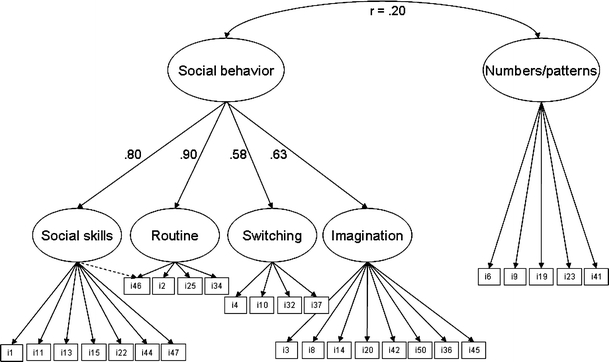
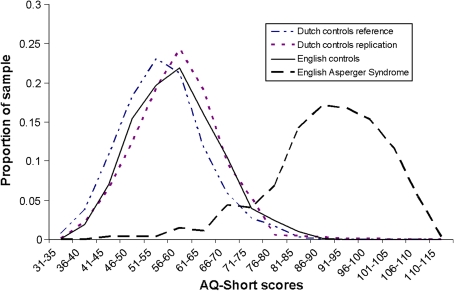
This study reports on the development and validation of an abridged version of the 50-item Autism-Spectrum Quotient (AQ), a self-report measure of autistic traits. We aimed to reduce the number of items whilst retaining high validity and a meaningful factor structure. The item reduction procedure was performed on data from 1,263 Dutch students and general population adults. The resulting 28-item AQ-Short was subsequently validated in 3 independent samples, both clinical and controls, from the Netherlands and the UK. The AQ-Short comprises two higher-order factors assessing 'social behavioral difficulties' and 'a fascination for numbers/patterns'. The clear factor structure of the AQ-Short and its high sensitivity and specificity make the AQ-Short a useful alternative to the full 50-item version.
Overview
The claims and statistics of this paper haven’t been checked yet.
Run the check — free, no account needed. It reads the open-access text and checks the sources it cites.
Integrity signals
Registry
Cites
Statistics
Figures
Verification
Claims the paper makes
The claims and statistics of this paper haven’t been checked yet.
Run the check — free, no account needed. It reads the open-access text and checks the sources it cites.
Claims other papers make about this one
Each is checked against this paper’s own text: does it say what the citing paper says it does?
The cited source doesn’t support the claim as written.
In the citing paper
“To verify the clinical diagnosis of ASD, we will use a cut-off ≥70 on the 28-item Short version of the AQ-28 [43, 44].”
From The effect of dialectical behaviour therapy in autism spectrum patients with suicidality and/or self-destructive behaviour (DIASS): Study protocol for a multicentre randomised controlled trial (2020) · cites this paper as [43]
Checked by a reasoning model — may be wrong.
Experimental — accuracy not yet measuredThe source backs part of the claim, not all of it — or backs it for a different population, condition or comparison.
In the citing paper
“A clinical cutoff score of > 65 has sensitivity of 0.97 and specificity of 0.82 for ASD (Hoekstra et al., 2011).”
From A mixed methods study of autistic adults' mental health therapy experiences (2023) · cites this paper as Hoekstra et al., 2011
Experimental — accuracy not yet measuredThe source backs part of the claim, not all of it — or backs it for a different population, condition or comparison.
In the citing paper
“The AQ-28 is scored between 28 and 72, and a cut-off score of 65 is the threshold, above which further assistance with seeking ASD diagnosis is recommended. The cut-off score has good sensitivity (0.97) and specificity (0.82). The AQ-28 also has good internal consistence (Cronbach’s alpha = 0.77–0.86).”
From Differences in anxieties and social networks in a group-matched sample of autistic and typically developing students transitioning to university (2020) · cites this paper as Hoekstra et al., 2011
Experimental — accuracy not yet measuredThe cited source says what the claim attributes to it.
In the citing paper
“Autism characteristics were assessed using the Autism Spectrum Quotient-Short (AQ-Short) (Hoekstra et al., 2011), which is an abridged 28-item version of the original 50-item AQ (Baron-Cohen et al., 2001), a continuous self-report measure of autism spectrum traits in adults.”
From A mixed methods study of autistic adults' mental health therapy experiences (2023) · cites this paper as Hoekstra et al., 2011
The cited source says what the claim attributes to it.
In the citing paper
“For TD students, the mean AQ-28 score was 64.54, which is somewhat higher than the previously reported control samples of 56–59.73 (Hoekstra et al., 2011).”
From Differences in anxieties and social networks in a group-matched sample of autistic and typically developing students transitioning to university (2020) · cites this paper as Hoekstra et al., 2011
The cited source says what the claim attributes to it.
In the citing paper
“The mean score on the Autism Quotient-28 (AQ-28) for the autistic students was 83.07, and with an exception of two students who scored 59 and 64, all students’ scores met the suggested clinical cut-off score of 65 (Hoekstra et al., 2011).”
From Differences in anxieties and social networks in a group-matched sample of autistic and typically developing students transitioning to university (2020) · cites this paper as Hoekstra et al., 2011
The cited source says what the claim attributes to it.
In the citing paper
“The AQ-Short is a reliable instrument for a quick assessment of quantitative autistic traits.”
Self-check
Percentages, sums and reported differences re-computed from the paper’s own numbers.
The self-check needs the paper’s full text.
Citations
Cites
Lord, C., Rutter, M., & Le Couteur, A. (1994) · Journal of Autism and Developmental Disorders · doi:10.1007/bf02172145 · Cited by 9,065
Schermelleh-Engel, K., Moosbrugger, H., & Müller, H. (2003) · Department of Psychology - University of Koblenz-Landau · doi:10.23668/psycharchives.12784 · Cited by 8,975
Lord, C., Risi, S., Lambrecht, L., Cook, E. H., Leventhal, B. L., DiLavore, P. C., Pickles, A., & Rutter, M. (2000) · Journal of Autism and Developmental Disorders · doi:10.1023/a:1005592401947 · Cited by 7,520
Baron-Cohen, S., Wheelwright, S., Skinner, R., Martin, J., & Clubley, E. (2001) · Journal of Autism and Developmental Disorders · doi:10.1023/a:1005653411471 · Cited by 6,450
Self-citationAutistic Traits in the General Population: A Twin Study
Constantino, J. N., & Todd, R. D. (2003) · Archives of General Psychiatry · doi:10.1001/archpsyc.60.5.524 · Cited by 1,317 · cited 2×
“Autism spectrum conditions (ASC; including autistic disorder, Asperger syndrome [AS] and pervasive developmental disorder not otherwise specified [PDD-NOS]) are now commonly conceptualized as dimensional, representing the extreme end of one or more continuously distributed traits in the general population ( Constantin…”
BackgroundWoodbury-Smith, M. R., Robinson, J., Wheelwright, S., & Baron-Cohen, S. (2005) · Journal of Autism and Developmental Disorders · doi:10.1007/s10803-005-3300-7 · Cited by 771
Self-citationHoekstra, R. A., Bartels, M., Cath, D. C., & Boomsma, D. I. (2008) · Journal of Autism and Developmental Disorders · doi:10.1007/s10803-008-0538-x · Cited by 651
Self-citationThe Autism Spectrum Quotient: Children’s Version (AQ-Child)
Bonnie Auyeung, B., Baron‐Cohen, S., Wheelwright, S. J., & Allison, C. L. (2007) · Journal of Autism and Developmental Disorders · doi:10.1007/s10803-007-0504-z · Cited by 650
Self-citationThe Autism-Spectrum Quotient (AQ)—Adolescent Version
Baron-Cohen, S., Hoekstra, R. A., Knickmeyer, R., & Wheelwright, S. (2006) · Journal of Autism and Developmental Disorders · doi:10.1007/s10803-006-0073-6 · Cited by 546
Self-citationHappé, F., & Ronald, A. (2008) · Neuropsychology Review · doi:10.1007/s11065-008-9076-8 · Cited by 498
Research works printed but not linked: 1
- Muthén, L. K., & Muthén, B. O. (2007). Mplus user’s guide (5th ed.). Los Angeles, CA: Muthén & Muthén.
Cited by
Sorted by citations
Items 301–400 of 506
Central Sensitivity Symptoms and Autistic Traits in Autistic and Non‐Autistic Adults
Grant, S., Norton, S., & Hoekstra, R. A. (2025) · Autism Research · doi:10.1002/aur.3297 · Cited by 8
Self-citationSummerill, J., Leedale, C., Thompson, D., Ingham, B., & Rutter, L. (2025) · Research in Autism · doi:10.1016/j.reia.2025.202557 · Cited by 6
Breiner, C. E., McQuaid, G. A., Wallace, G. L., & Zickgraf, H. F. (2025) · Autism Research · doi:10.1002/aur.70039 · Cited by 6
Holmefur, M., Roshanai, A. H., White, S., Janeslätt, G. K., Vimefall, E., & Lidström-Holmqvist, K. (2021) · Trials · doi:10.1186/s13063-021-05578-x · Cited by 6
Itoi, C., Ujiie, Y., Matsushima, K., Takahashi, K., & Ide, M. (2022) · Scientific Reports · doi:10.1038/s41598-022-25883-y · Cited by 8
Impact of animated objects on autistic and non-autistic users
Alzahrani, M. S., Uitdenbogerd, A. L., & Spichkova, M. (2022) · IEEE/ACM International Conference on Software Engineering: Software Engineering in Society (ICSE-SEIS) · doi:10.1145/3510458.3513007 · Cited by 6
Muniandy, M., Richdale, A. L., Arnold, S. R. C., Trollor, J. N., & Lawson, L. P. (2023) · Journal of Autism and Developmental Disorders · doi:10.1007/s10803-023-05953-4 · Cited by 8
Changing views: the effect of explicit perception-focus instructions on perspective-taking
Damen, D., van Amelsvoort, M., van der Wijst, P., & Krahmer, E. (2019) · Journal of Cognitive Psychology · doi:10.1080/20445911.2019.1606000 · Cited by 6
Krijnen, L., Greaves‐Lord, K., Mandy, W., Mataw, K. J., Hartog, P., & Begeer, S. (2023) · Journal of Autism and Developmental Disorders · doi:10.1007/s10803-023-06069-5 · Cited by 8
Measuring the Autistic Women’s Experience (AWE)
Groen, Y., Ebert, W. M., Dittner, F. M., Stapert, A. F., Henning, D., Greaves‐Lord, K., Davids, R. C. D., Castelein, S., Baron‐Cohen, S., Allison, C. L., et al. (2023) · International Journal of Environmental Research and Public Health · doi:10.3390/ijerph20247148 · Cited by 8
Self-citationMetacognition facilitates theory of mind through optimal weighting of trait inferences
Long, E. L., Catmur, C., Fleming, S. M., & Bird, G. (2024) · Cognition · doi:10.1016/j.cognition.2024.106042 · Cited by 5
Lisøy, R. S., Pfuhl, G., Sunde, H. F., & Biegler, R. (2022) · PLoS ONE · doi:10.1371/journal.pone.0275308 · Cited by 5
Chee, Z. J., Leung, Y., & de Vries, M. (2023) · Musicae Scientiae · doi:10.1177/10298649231167488 · Cited by 5
Smees, R., Simner, J., & Rinaldi, L. J. (2024) · The Journal of Creative Behavior · doi:10.1002/jocb.650 · Cited by 6
van den Helder, C., Plak, R. D., Meeter, M., & Begeer, S. (2024) · Journal of Autism and Developmental Disorders · doi:10.1007/s10803-024-06369-4 · Cited by 5
Love, A. M. A., Edwards, C., Dueber, D., Cai, R. Y., Grace, K., Toland, M. D., Lim, M. H., & Gibbs, V. (2025) · Autism in Adulthood · doi:10.1089/aut.2024.0258 · Cited by 5
A New Real-Life Test for Reciprocity in Autistic Adults: The Interactive Drawing Test
van Ommeren, T. B., Vreugdenhil, M., Koot, H. M., Spek, A. A., Scheeren, A. M., Jertberg, R., & Begeer, S. (2022) · Frontiers in Psychiatry · doi:10.3389/fpsyt.2022.842902 · Cited by 5
Exposure to Media on Perceptions of Violence as a Function of Trait Aggression and Athletic Status
Gross, C. D., & Mendoza, A. T. O. (2018) · Psi Chi Journal of Psychological Research · doi:10.24839/2325-7342.jn23.2.147 · Cited by 5
Raynal, P., Melioli, T., Goutaudier, N., & Chabrol, H. (2016) · European Review of Applied Psychology · doi:10.1016/j.erap.2016.05.004 · Cited by 5
Impacts of Co-Occurring ADHD Symptoms on Critical Markers of Outcome for Autistic AdultsPreprint
Yerys, B. E., McQuaid, G. A., Lee, N., & Wallace, G. L. (2021) · doi:10.31234/osf.io/zwjp7 · Cited by 5
Robles, M., Ramos-Grille, I., Amaia Hervas, G., Duran‐Tauleria, E., Galiano-Landeira, J., Wormwood, J. B., Falter‐Wagner, C. M., & Chanes, L. (2024) · International Journal of Clinical and Health Psychology · doi:10.1016/j.ijchp.2024.100440 · Cited by 6
Moore, H. L., Freeston, M. H., Rodgers, J., & Cassidy, S. (2024) · Journal of Autism and Developmental Disorders · doi:10.1007/s10803-024-06260-2 · Cited by 5
Hollocks, M. J., McQuaid, G. A., Lee, N., & Wallace, G. L. (2025) · Autism Research · doi:10.1002/aur.70061 · Cited by 4
Hansen, H. A., Norris, J. E., Bain, C. M., Ethridge, L. E., & Tardif, C. L. (2026) · Human Brain Mapping · doi:10.1002/hbm.70468 · Cited by 5
Ameli, S., Ghaderi, S., Lighvan, M. A., Davazdahemami, M. H., & Dadashzadeh, H. (2019) · Practice in Clinical Psychology · doi:10.32598/jpcp.7.4.303 · Cited by 5
Autism Characteristics and Self-Reported Health in Older Adulthood.
Lodi-Smith, J., Rodgers, J. D., Kozlowski, K., Khan, S., Luna, V. M., Long, C. J., Donnelly, J. P., Lopata, C., & Thomeer, M. (2021) · The journals of gerontology. Series B, Psychological sciences and social sciences · doi:10.1093/geronb/gbab136 · Cited by 4
Psychometric characteristics of the AQ-Adolescent in autistic and non-autistic adolescents
de Vries, M., Begeer, S., & Geurts, H. M. (2023) · Research in Autism · doi:10.1016/j.rasd.2023.102201 · Cited by 4
Hedley, D., Uljarević, M., Bury, S. M., Haschek, A., Richdale, A. L., Trollor, J. N., & Stokes, M. A. (2024) · Journal of Autism and Developmental Disorders · doi:10.1007/s10803-024-06489-x · Cited by 4
Poorer representation of minds underpins less accurate mental state inference for out-groups
Payne, B., Bird, G., & Catmur, C. (2024) · Scientific Reports · doi:10.1038/s41598-024-67311-3 · Cited by 4
From the Profound to the Mundane: Questionnaires as Emerging Technologies in Autism Genetics
Hollin, G. J. S. (2019) · Science Technology & Human Values · doi:10.1177/0162243919841691 · Cited by 4
Kajitani, K., Tsuchimoto, R., Nagano, J., & Nakao, T. (2019) · BioPsychoSocial Medicine · doi:10.1186/s13030-019-0156-1 · Cited by 4
Psychometric Evaluation of an Australian Version of the Vocational Index for Adults with Autism
Sahin, E., Bury, S. M., Flower, R. L., Lawson, L. P., Richdale, A. L., & Hedley, D. (2020) · Autism in Adulthood · doi:10.1089/aut.2019.0060 · Cited by 4
Khalesi, Z., Brook, C. A., Jetha, M. K., McNeely, H. E., Goldberg, J. O., & Schmidt, L. A. (2021) · Journal of Personality Assessment · doi:10.1080/00223891.2021.1895183 · Cited by 4
Smith, A. P., Garcha, J., & James, A. (2023) · Journal of Education Society and Behavioural Science · doi:10.9734/jesbs/2023/v36i71236 · Cited by 4
Love, A. M. A., Cai, R. Y., Edwards, C., & Gibbs, V. (2023) · Autism in Adulthood · doi:10.1089/aut.2023.0005 · Cited by 4
Which autistic traits are related to depressive symptoms in Japanese workers?
Suzuki, T., Miyaki, K., & Tsutsumi, A. (2020) · Industrial Health · doi:10.2486/indhealth.2019-0206 · Cited by 5
Introduction to the Special Issue on Open Science Practices: Badges of Honor
Rouse, S. V. (2018) · Psi Chi Journal of Psychological Research · doi:10.24839/2325-7342.jn23.2.94 · Cited by 5
Belief changes associated with psychedelic usePreprint
Nayak, S. M., Singh, M., Yaden, D. B., & Griffiths, R. R. (2022) · doi:10.31234/osf.io/rdzmy · Cited by 4
Familiarity versus Favorability: Exploring Formal Autism Terminology in Chinese Language DiscoursePreprint
Lao, U., Liang, F., Dai, J., Cao, W., Chen, Q., Zou, X., & Zhu, H. (2023) · doi:10.31219/osf.io/cp73f · Cited by 4
Inner experiences, mental health, and well‐being in autistic and non‐autistic adults
Mazurek, M. O., Pappagianopoulos, J. E., Brunt, S., Nevill, R. E. A., Menezes, M., Burroughs, C., Sadikova, E., Smith, J. V., & Howard, M. (2024) · Autism Research · doi:10.1002/aur.3273 · Cited by 3
Koivisto, M., & Toivanen, H. (2024) · Creativity Research Journal · doi:10.1080/10400419.2024.2438609 · Cited by 4
Georgiou, N., Delfabbro, P., Balzan, R. P., Caruana, N., & Young, R. L. (2026) · Cognitive Processing · doi:10.1007/s10339-025-01326-0 · Cited by 3
Self-reported autistic traits and psychosocial outcomes among university students in Malaysia
Low, H. M., Zainal, M. S., Pang, J. C., Ang, Y., & de Vries, M. (2023) · Autism · doi:10.1177/13623613231167501 · Cited by 9
Development of the Impact of Diagnosis Scale–Revised (IODS-R)
Arnold, S. R. C., Huang, Y., Lawson, L. P., Higgins, J. M., Hwang, Y. I., Richdale, A. L., & Trollor, J. N. (2023) · Assessment · doi:10.1177/10731911231196486 · Cited by 6
Academic learning challenges and links to vocational outcomes in young autistic adults
Grosman, H. E., Aragon-Guevara, D., McQuaid, G. A., Wallace, G. L., & Lee, N. (2024) · Autism · doi:10.1177/13623613241255774 · Cited by 4
Conspiracy mentality in autistic and non-autistic individuals
Roels, S. P., Begeer, S., Scheeren, A. M., & van Prooijen, J. (2024) · Cognitive Neuropsychiatry · doi:10.1080/13546805.2024.2399505 · Cited by 3
Fekih‐Romdhane, F., Sakr, F., Alhuwailah, A., Chaibi, L. S., Helmy, M. S., Shuwiekh, H. A. M., Boudouda, N. E., Zarrouq, B., Naser, A. Y., Jebreen, K., et al. (2025) · Journal of Public Health Research · doi:10.1177/22799036251377610 · Cited by 3
Chetcuti, L., Richdale, A. L., Haschek, A., Uljarević, M., & Lawson, L. P. (2022) · Journal of Autism and Developmental Disorders · doi:10.1007/s10803-021-05360-7 · Cited by 3
Psychosocial Outcomes in Autistic Children Before and During the COVID-19 Pandemic
Plak, R. D., Rippe, R. C. A., Merkelbach, I., & Begeer, S. (2023) · Journal of Autism and Developmental Disorders · doi:10.1007/s10803-023-06101-8 · Cited by 5
The three-factor structure of the Autism-Spectrum Quotient Japanese version in pregnant women
Zain, E., Fukui, N., Watanabe, Y., Hashijiri, K., Motegi, T., Ogawa, M., Egawa, J., Nishijima, K., & Someya, T. (2023) · Frontiers in Psychiatry · doi:10.3389/fpsyt.2023.1275043 · Cited by 3
Academic achievement of children with autistic symptoms compared to typically developing children
Sari, N. P., Luijk, M. P. C. M., Jansen, P. W., Prinzie, P., & van IJzendoorn, M. H. (2023) · European Journal of Psychology of Education · doi:10.1007/s10212-023-00758-6 · Cited by 6
First things first: An exploration of the effects of psychoeducation for older autistic adults
Lenders, M., Ouwens, M. A., Wilting, R. M. H. J., & Videler, A. C. (2024) · Autism · doi:10.1177/13623613231219745 · Cited by 3
Towards developing a “baby translator” - An exploration of how infant appetite cues are understood
Yu, S., Blundell-Birtill, P., Fildes, A., Tang, T., & Hetherington, M. M. (2025) · Appetite · doi:10.1016/j.appet.2025.107850 · Cited by 3
Assessing Adults with Normal Intelligence for ASD
Eriksson, J., Andersen, L. M. J., & Bejerot, S. (2013) · Springer eBooks · doi:10.1007/978-1-4614-4788-7_177 · Cited by 3
Role of Self-Compassion on College Students’ Social Self-Evaluations and Affect Across Two Domains
Saeed, Z., & Sonnentag, T. L. (2018) · Psi Chi Journal of Psychological Research · doi:10.24839/2325-7342.jn23.2.132 · Cited by 4
Disclosure of Diagnosis Increases Positivity of Social Responses to Autistic Individuals
Bolton, M. J., & Ault, L. K. (2018) · Psi Chi Journal of Psychological Research · doi:10.24839/2325-7342.jn23.2.110 · Cited by 4
Empathy in teaching staff across educational settings
Philips, A. (2020) · Psychology of Education Review · doi:10.53841/bpsper.2020.44.2.89 · Cited by 3
The effect of autism on information sampling during decision-making: An eye-tracking study
Farmer, G., Smith, P. L., Baron‐Cohen, S., & Skylark, W. J. (2021) · Judgment and Decision Making · doi:10.1017/s1930297500007762 · Cited by 4
Self-citationMcQuaid, G. A., Sadowski, L. Y., Lee, N., & Wallace, G. L. (2022) · doi:10.31234/osf.io/q375t · Cited by 3
Ebrahimi, A., Athar, M. E., Ashouri, A., & Karimi, S. (2022) · Bulletin of the Menninger Clinic · doi:10.1521/bumc.2022.86.3.204 · Cited by 2
Chow, C. K., & Lam, G. Y. H. (2025) · Qualitative Health Research · doi:10.1177/10497323251343773 · Cited by 2
Investigating OCD, ADHD, and Autistic Traits as Predictors of Maladaptive Daydreaming
Kowalczyk, A., Shah, P., Hargitai, L. D., & Leung, F. Y. N. (2025) · Neurodiversity · doi:10.1177/27546330251363392 · Cited by 2
Spanish Validation of the Autism Spectrum Quotient for Children (AQ-Child-SV)
Fernández-Álvarez, C. J., Yon-Hernández, J. A., Wojcik, D. Z., García, A. H., Bejarano‐Martín, Á., Villoria, E. D., de la Paz, M. P., & Canal‐Bedia, R. (2025) · Journal of Autism and Developmental Disorders · doi:10.1007/s10803-025-07068-4 · Cited by 4
Rahmati, Y., & Jarrold, C. (2026) · PLoS ONE · doi:10.1371/journal.pone.0339846 · Cited by 2
Barzykowski, K., Santangelo, V., Kvavilashvili, L., & Moulin, C. J. A. (2026) · Cortex; a journal devoted to the study of the nervous system and behavior · doi:10.1016/j.cortex.2026.08.017 · Cited by 1
Psychotic and autistic traits among magicians and their relationship with creative beliefs
Greengross, G., Silvia, P. J., & Crasson, S. J. (2023) · BJPsych Open · doi:10.1192/bjo.2023.609 · Cited by 2
A repeated cross‐sectional study of daily activities of autistic adults
Bury, S. M., Hedley, D., Uljarević, M., Stokes, M. A., & Begeer, S. (2024) · Autism Research · doi:10.1002/aur.3135 · Cited by 2
The role of emotional factors in face processing abilities in autism spectrum conditions
Baxter, N., & Hobson, H. (2024) · Research in Autism · doi:10.1016/j.rasd.2024.102400 · Cited by 2
Understanding banking experiences of autistic adults: an inquiry into inclusive banking
Cai, R. Y., Love, A. M. A., Haas, K., Gallagher, E., & Gibbs, V. (2024) · Advances in Autism · doi:10.1108/aia-08-2023-0052 · Cited by 2
McDonnell, C. G., Kaya, R. A., Andrzejewski, T. M., & Batista, S. G. (2024) · Journal of Autism and Developmental Disorders · doi:10.1007/s10803-024-06687-7 · Cited by 2
The effect of individual visual sensitivity on time perception
Růžičková, A., Jurkovičová, L., Páleník, J., Hutchison, K. A., Chmelík, J., Mitterová, K., & Juřík, V. (2025) · Scientific Reports · doi:10.1038/s41598-025-88778-8 · Cited by 2
Robayo, S., Velandia-Alarcón, C., García, Y., Skinta, M., & Muñoz-Martínez, A. (2025) · Clinical Case Studies · doi:10.1177/15346501251407940 · Cited by 1
Wojcik, D. Z., Villoria, E. D., Canal‐Bedia, R., Díez-Álamo, A. M., Yon-Hernández, J. A., & Fernández, Á. (2020) · Research in Autism · doi:10.1016/j.rasd.2020.101667 · Cited by 2
Robertson, N., Qureshi, A., & Monk, R. L. (2021) · Advances in Autism · doi:10.1108/aia-10-2020-0058 · Cited by 2
Participant Attentiveness to Consent Forms
Baker, D., & Chartier, C. R. (2018) · Psi Chi Journal of Psychological Research · doi:10.24839/2325-7342.jn23.2.141 · Cited by 4
Parental Attachment Predicting Emotions and Stress During Positive Life Events
Camden, A. A., & Hughes, J. L. (2018) · Psi Chi Journal of Psychological Research · doi:10.24839/2325-7342.jn23.2.119 · Cited by 4
Cassidy, S., Bradley, L., Cogger-Ward, H., & Rodgers, J. (2020) · Research Square · doi:10.21203/rs.3.rs-48455/v1 · Cited by 2
Loo, B. R. Y., Teo, T. J. Y., Liang, M. J., Leong, D.-J., Tan, D. W., Zhuang, S., Hull, L., Livingston, L. A., Mandy, W., Happe, F. G. E., et al. (2021) · doi:10.31219/osf.io/cg8ak · Cited by 2
Kreis, I. V., Zhang, L., Mittner, M., Syla, L., Lamm, C., & Pfuhl, G. (2020) · doi:10.31219/osf.io/nc2rx · Cited by 2
Rojas, J. A. (2023) · Advances in educational technologies and instructional design book series · doi:10.4018/978-1-6684-6868-5.ch003 · Cited by 1
Sari, N. P., Tsompanidis, A., Wahab, R. J., Gaillard, R., Aydin, E., Holt, R., Allison, C. L., Baron‐Cohen, S., van IJzendoorn, M. H., & Jansen, P. W. (2023) · Molecular Autism · doi:10.1186/s13229-023-00578-x · Cited by 1
Self-citationShao, M., Luo, S., Qian, H., Li, X., Wei, Z., Hong, M., Wang, J., Li, X., & Meng, J. (2024) · Heliyon · doi:10.1016/j.heliyon.2024.e26082 · Cited by 2
Fekih‐Romdhane, F., Chaibi, L. S., Alhuwailah, A., Sakr, F., Helmy, M. S., Shuwiekh, H. A. M., Boudouda, N. E., Zarrouq, B., Naser, A. Y., Jebreen, K., et al. (2025) · Scientific Reports · doi:10.1038/s41598-025-90597-w · Cited by 2
Investigating the stability of individual differences in face recognition behavior
Arrington, M. N., & Scherf, K. S. (2025) · Scientific Reports · doi:10.1038/s41598-025-90317-4 · Cited by 2
Reyes-Fournier, R. (2025) · International Journal of Research Publications · doi:10.47119/ijrp1001731520257891 · Cited by 1
Huntjens, A., Smit, F., van den Bosch, L. M. C., Kerkhof, A. J. F. M., Sizoo, B. B., & van der Gaag, M. (2025) · The European Journal of Health Economics · doi:10.1007/s10198-025-01794-3 · Cited by 1
Prosocial behavior in Large Language Models: Value alignment and affective mechanisms
Liu, H., Lei, Y., & Wu, Z. (2025) · Science China Technological Sciences · doi:10.1007/s11431-025-2977-0 · Cited by 3
Charalampopoulou, Μ., Ibrahim, A. T., Prime, H., Eddy, N., Panetta, L., Brown, H. M., Desai, S., Gray, K. M., Lai, M., Langdon, P. E., et al. (2025) · Autism · doi:10.1177/13623613251359196 · Cited by 2
Fiorenza, J., Calandra, D., Osello, A., & Lamberti, F. (2025) · Digital Applications in Archaeology and Cultural Heritage · doi:10.1016/j.daach.2025.e00471 · Cited by 1
McQuaid, G. A., Lee, N., & Wallace, G. L. (2025) · Personality Neuroscience · doi:10.1017/pen.2025.10006 · Cited by 1
Ip, I. N., Chiu, H. T., Ching, F. N. Y., Law, C.-K., Tang, E. H. L., Ng, C. S. F., & Wong, S. W. H. (2026) · Personality Neuroscience · doi:10.1017/pen.2025.10004 · Cited by 1
Support services for autistic adults: What helps and why?
Jonkman, K. M., Back, E., Scheeren, A. M., Begeer, S., & Staal, W. (2026) · Research in Autism · doi:10.1016/j.reia.2026.202929 · Cited by 1
van Asselt, A., Roke, Y., Begeer, S., & Scheeren, A. M. (2026) · Autism · doi:10.1177/13623613261446876 · Cited by 1
Song, W., McQuaid, G. A., Charlton, R. A., & Wallace, G. L. (2026) · Autism · doi:10.1177/13623613261446878 · Cited by 2
How Autism and Sex Influence Perspective-Taking in Pragmatic Inferences
Porrini, A. T., Goulston, J., Perovic, A., & Pouscoulous, N. (2026) · Journal of Autism and Developmental Disorders · doi:10.1007/s10803-026-07420-2 · Cited by 1
Empathy shortens perceived time in association with visual attention but not physiological measures
Golbabaei, S., Hosseinnezhad, M., Karami, Z., & Borhani, K. (2026) · Scientific Reports · doi:10.1038/s41598-026-75187-8 · Cited by 1
ESTUDO DE PREVALÊNCIA CARDIOVASCULAR EM CABO VERDE (ESTUDO PREVCARDIO.CV) - ILHA DO MAIO
COELHO, P. M. D. S. C., Rodrigues, F., & Adrião, L. L. D. S. (2021) · doi:10.22533/at.ed.5892117059 · Cited by 1
Tan, R., & Ashwin, C. (2023) · PLoS ONE · doi:10.1371/journal.pone.0291726 · Cited by 3
Temporal dynamics of normalization reweighting
Baker, D. H., Marinova, D., Aveyard, R., Hargreaves, L. J., Renton, A., Castellani, R., Hall, P., Harmens, M., Holroyd, G., Nicholson, B. L., et al. (2023) · Journal of Vision · doi:10.1167/jov.23.12.6 · Cited by 1
Tassone, A. U., Breitenfeldt, K. E., DeLucia, E. A., Albright, J., & McDonnell, C. G. (2024) · Autism in Adulthood · doi:10.1089/aut.2023.0119 · Cited by 2
Metadata
- Authors
- Hoekstra, R. A., Vinkhuyzen, A. A. E., Wheelwright, S., Bartels, M., Boomsma, D. I., Baron-Cohen, S., Posthuma, D., & van der Sluis, S.
- Affiliations
- The Open University (GB)
- Vrije Universiteit Amsterdam (NL)
- University of Cambridge (GB)
- Corresponding author
- Hoekstra, Rosa A.
- Venue
- Journal of Autism and Developmental Disorders
- Published
- 2010-08-10
- Volume
- 41
- Issue
- 5
- Pages
- 589-596
- ISSN
- 0162-3257 (ISSN-L)
- 1573-3432
- PMC
- PMC3076581
- OpenAlex
- W2130501331
- Cited by
- 506
- References
- 22
- Citations by year
- 2026: 42 · 2025: 45 · 2024: 47 · 2023: 66 · 2022: 59 · 2021: 70 · 2020: 34 · 2019: 33 · 2018: 27 · 2017: 22 · 2016: 14 · 2015: 16 · 2014: 6 · 2013: 16 · 2012: 5
- FWCI
- 4.64
- Type
- journal article
- Language
- en
- Open access
- hybrid
- doi.org
- Licence
- cc-by-nc
- Locations
- Journal of Autism and Developmental Disorders (publishedVersion, cc-by-nc)
- PubMed Central (publishedVersion, cc-by-nc)
- PubMed (publishedVersion)
- Research Portal (King's College London) (publishedVersion, other-oa)
- Amsterdam UMC (VU Amsterdam) - Institutional Repository (publishedVersion, other-oa)
- VU Research Portal (publishedVersion, other-oa)
- Open Research Online (The Open University) (acceptedVersion)
- Pure Amsterdam UMC (submittedVersion, other-oa)
- Digital Academic REpository of VU University Amsterdam (Vrije Universiteit Amsterdam) (submittedVersion)
- Data Archiving and Networked Services (DANS) (submittedVersion, other-oa)
- Funders
- National Institute for Health and Care Research
- Nederlandse Organisatie voor Wetenschappelijk Onderzoek (NWO/ SPI 56-464-14192, NWO 575-25-006, 56‐464‐14192, 451-08-025, VENI-451-08-025, Spi-56-464-14192, VIDI-016-065-318, 14192, 575-25-006)
- Medical Research Council
- Topics
- Life Sciences › Neuroscience › Cognitive Neuroscience › Autism Spectrum Disorder Research
- Social Sciences › Decision Sciences › Management Science and Operations Research › Psychometric Methodologies and Testing
- Social Sciences › Psychology › Experimental and Cognitive Psychology › Anxiety, Depression, Psychometrics, Treatment, Cognitive Processes
- Keywords
- Autism Spectrum Quotient, autistic traits, item reduction, self-report measures, factor structure, sensitivity and specificity, autism spectrum disorder
- MeSH terms
- Child, Child Development Disorders, Pervasive, Factor Analysis, Statistical, Humans, Psychometrics, Surveys and Questionnaires, Sensitivity and Specificity, Social Behavior, Reproducibility of Results, Young Adult, Self Report, Diagnostic Self Evaluation
About these checks
Registry, retraction, Cites and statistics results are computed, not judged, with one exception: a printed reference that no index lists is read once by a model before it counts as a citation error. Claims are extracted by a model and kept only when their quote appears verbatim in the text; each cited source is then checked, with a model’s help, for whether it says what the claim relies on. Those verdicts can be wrong — read the claim’s quote and the cited source before relying on one.
Statistics and arithmetic are recomputed, not judged.
Confidence bands are shown only for fields calibrated on our annotated test set. None is calibrated yet, so no band is shown.
What counts as a claim ›How we measure confidence ›How we check this ›
Are you an author, or do you see a problem with this page? Request a review
