

The DOI matches its Crossref record; 22 of the 22 references it cites were found in a registry or an index.
The Construction and Validation of an Abridged Version of the Autism-Spectrum Quotient (AQ-Short)
Open accessAbstract
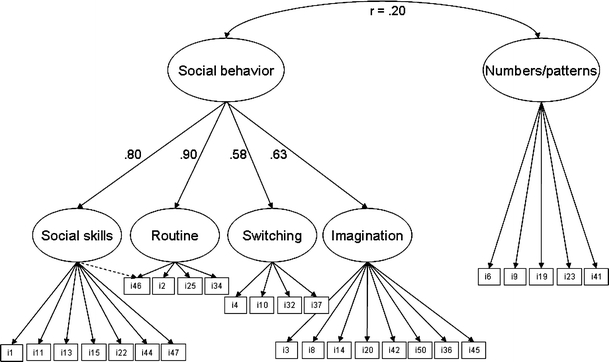
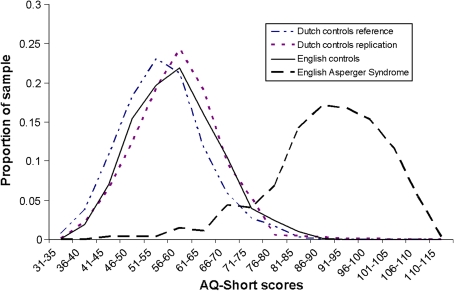
This study reports on the development and validation of an abridged version of the 50-item Autism-Spectrum Quotient (AQ), a self-report measure of autistic traits. We aimed to reduce the number of items whilst retaining high validity and a meaningful factor structure. The item reduction procedure was performed on data from 1,263 Dutch students and general population adults. The resulting 28-item AQ-Short was subsequently validated in 3 independent samples, both clinical and controls, from the Netherlands and the UK. The AQ-Short comprises two higher-order factors assessing 'social behavioral difficulties' and 'a fascination for numbers/patterns'. The clear factor structure of the AQ-Short and its high sensitivity and specificity make the AQ-Short a useful alternative to the full 50-item version.
Overview
The claims and statistics of this paper haven’t been checked yet.
Run the check — free, no account needed. It reads the open-access text and checks the sources it cites.
Integrity signals
Registry
Cites
Statistics
Figures
Verification
Claims the paper makes
The claims and statistics of this paper haven’t been checked yet.
Run the check — free, no account needed. It reads the open-access text and checks the sources it cites.
Claims other papers make about this one
Each is checked against this paper’s own text: does it say what the citing paper says it does?
The cited source doesn’t support the claim as written.
In the citing paper
“To verify the clinical diagnosis of ASD, we will use a cut-off ≥70 on the 28-item Short version of the AQ-28 [43, 44].”
From The effect of dialectical behaviour therapy in autism spectrum patients with suicidality and/or self-destructive behaviour (DIASS): Study protocol for a multicentre randomised controlled trial (2020) · cites this paper as [43]
Checked by a reasoning model — may be wrong.
Experimental — accuracy not yet measuredThe source backs part of the claim, not all of it — or backs it for a different population, condition or comparison.
In the citing paper
“A clinical cutoff score of > 65 has sensitivity of 0.97 and specificity of 0.82 for ASD (Hoekstra et al., 2011).”
From A mixed methods study of autistic adults' mental health therapy experiences (2023) · cites this paper as Hoekstra et al., 2011
Experimental — accuracy not yet measuredThe source backs part of the claim, not all of it — or backs it for a different population, condition or comparison.
In the citing paper
“The AQ-28 is scored between 28 and 72, and a cut-off score of 65 is the threshold, above which further assistance with seeking ASD diagnosis is recommended. The cut-off score has good sensitivity (0.97) and specificity (0.82). The AQ-28 also has good internal consistence (Cronbach’s alpha = 0.77–0.86).”
From Differences in anxieties and social networks in a group-matched sample of autistic and typically developing students transitioning to university (2020) · cites this paper as Hoekstra et al., 2011
Experimental — accuracy not yet measuredThe cited source says what the claim attributes to it.
In the citing paper
“Autism characteristics were assessed using the Autism Spectrum Quotient-Short (AQ-Short) (Hoekstra et al., 2011), which is an abridged 28-item version of the original 50-item AQ (Baron-Cohen et al., 2001), a continuous self-report measure of autism spectrum traits in adults.”
From A mixed methods study of autistic adults' mental health therapy experiences (2023) · cites this paper as Hoekstra et al., 2011
The cited source says what the claim attributes to it.
In the citing paper
“For TD students, the mean AQ-28 score was 64.54, which is somewhat higher than the previously reported control samples of 56–59.73 (Hoekstra et al., 2011).”
From Differences in anxieties and social networks in a group-matched sample of autistic and typically developing students transitioning to university (2020) · cites this paper as Hoekstra et al., 2011
The cited source says what the claim attributes to it.
In the citing paper
“The mean score on the Autism Quotient-28 (AQ-28) for the autistic students was 83.07, and with an exception of two students who scored 59 and 64, all students’ scores met the suggested clinical cut-off score of 65 (Hoekstra et al., 2011).”
From Differences in anxieties and social networks in a group-matched sample of autistic and typically developing students transitioning to university (2020) · cites this paper as Hoekstra et al., 2011
The cited source says what the claim attributes to it.
In the citing paper
“The AQ-Short is a reliable instrument for a quick assessment of quantitative autistic traits.”
Self-check
Percentages, sums and reported differences re-computed from the paper’s own numbers.
The self-check needs the paper’s full text.
Citations
Cites
Lord, C., Rutter, M., & Le Couteur, A. (1994) · Journal of Autism and Developmental Disorders · doi:10.1007/bf02172145 · Cited by 9,065
Schermelleh-Engel, K., Moosbrugger, H., & Müller, H. (2003) · Department of Psychology - University of Koblenz-Landau · doi:10.23668/psycharchives.12784 · Cited by 8,975
Lord, C., Risi, S., Lambrecht, L., Cook, E. H., Leventhal, B. L., DiLavore, P. C., Pickles, A., & Rutter, M. (2000) · Journal of Autism and Developmental Disorders · doi:10.1023/a:1005592401947 · Cited by 7,520
Baron-Cohen, S., Wheelwright, S., Skinner, R., Martin, J., & Clubley, E. (2001) · Journal of Autism and Developmental Disorders · doi:10.1023/a:1005653411471 · Cited by 6,450
Self-citationAutistic Traits in the General Population: A Twin Study
Constantino, J. N., & Todd, R. D. (2003) · Archives of General Psychiatry · doi:10.1001/archpsyc.60.5.524 · Cited by 1,317 · cited 2×
“Autism spectrum conditions (ASC; including autistic disorder, Asperger syndrome [AS] and pervasive developmental disorder not otherwise specified [PDD-NOS]) are now commonly conceptualized as dimensional, representing the extreme end of one or more continuously distributed traits in the general population ( Constantin…”
BackgroundWoodbury-Smith, M. R., Robinson, J., Wheelwright, S., & Baron-Cohen, S. (2005) · Journal of Autism and Developmental Disorders · doi:10.1007/s10803-005-3300-7 · Cited by 771
Self-citationHoekstra, R. A., Bartels, M., Cath, D. C., & Boomsma, D. I. (2008) · Journal of Autism and Developmental Disorders · doi:10.1007/s10803-008-0538-x · Cited by 651
Self-citationThe Autism Spectrum Quotient: Children’s Version (AQ-Child)
Bonnie Auyeung, B., Baron‐Cohen, S., Wheelwright, S. J., & Allison, C. L. (2007) · Journal of Autism and Developmental Disorders · doi:10.1007/s10803-007-0504-z · Cited by 650
Self-citationThe Autism-Spectrum Quotient (AQ)—Adolescent Version
Baron-Cohen, S., Hoekstra, R. A., Knickmeyer, R., & Wheelwright, S. (2006) · Journal of Autism and Developmental Disorders · doi:10.1007/s10803-006-0073-6 · Cited by 546
Self-citationHappé, F., & Ronald, A. (2008) · Neuropsychology Review · doi:10.1007/s11065-008-9076-8 · Cited by 498
Research works printed but not linked: 1
- Muthén, L. K., & Muthén, B. O. (2007). Mplus user’s guide (5th ed.). Los Angeles, CA: Muthén & Muthén.
Cited by
Sorted by citations
Items 101–200 of 506
Visual affects: Linking curiosity, Aha-Erlebnis, and memory through information gain
de Cruys, S. V., Damiano, C., Boddez, Y., Król, M. E., Goetschalckx, L., & Wagemans, J. P. (2021) · Cognition · doi:10.1016/j.cognition.2021.104698 · Cited by 50
Engelhardt, C. R., Mazurek, M. O., Hilgard, J., Rouder, J. N., & Bartholow, B. D. (2015) · Psychological Science · doi:10.1177/0956797615583038 · Cited by 55
O’Connor, C., Brassil, M., O’Sullivan, S., Seery, C., & Nearchou, F. (2021) · Journal of Mental Health · doi:10.1080/09638237.2021.1922653 · Cited by 54
Trait Autism is a Better Predictor of Empathy than Alexithymia
Shah, P., Livingston, L. A., Callan, M. J., & Player, L. (2019) · Journal of Autism and Developmental Disorders · doi:10.1007/s10803-019-04080-3 · Cited by 51
Alexithymia explains atypical spatiotemporal dynamics of eye gaze in autism
Cuve, H. C., Castiello, S., Shiferaw, B. A., Ichijo, E., Catmur, C., & Bird, G. (2021) · Cognition · doi:10.1016/j.cognition.2021.104710 · Cited by 51
Higgins, W. C., Ross, R. M., Langdon, R. A., & Polito, V. (2022) · Assessment · doi:10.1177/10731911221124342 · Cited by 56
The political, psychological, and social correlates of cryptocurrency ownership
Littrell, S., Klofstad, C., & Uscinski, J. E. (2024) · PLoS ONE · doi:10.1371/journal.pone.0305178 · Cited by 48
Lindeman, M., van Elk, M., Lipsanen, J. O., Marin, P., & Schjoedt, U. (2019) · International Journal for the Psychology of Religion · doi:10.1080/10508619.2019.1591140 · Cited by 50
Conspiracy theory beliefs, scientific reasoning and the analytical thinking paradox
Georgiou, N., Delfabbro, P., & Balzan, R. P. (2021) · Applied Cognitive Psychology · doi:10.1002/acp.3885 · Cited by 50
Scheeren, A. M., Buil, J. M., Howlin, P., Bartels, M., & Begeer, S. (2021) · Autism · doi:10.1177/13623613211027673 · Cited by 47
Self-citationHuang, Y., Trollor, J. N., Foley, K., & Arnold, S. R. C. (2023) · Autism in Adulthood · doi:10.1089/aut.2022.0066 · Cited by 61
Initial evidence that non-clinical autistic traits are associated with lower income
Skylark, W. J., & Baron‐Cohen, S. (2017) · Molecular Autism · doi:10.1186/s13229-017-0179-z · Cited by 45
Self-citationGrant, S., Norton, S., Weiland, R. F., Scheeren, A. M., Begeer, S., & Hoekstra, R. A. (2022) · Molecular Autism · doi:10.1186/s13229-022-00486-6 · Cited by 45
Self-citationMatlis, S., Boric, K., Chu, C. J., & Kramer, M. (2015) · BMC Neurology · doi:10.1186/s12883-015-0355-8 · Cited by 49
Belcher, H., Uglik‐Marucha, N., Vitoratou, S., Ford, R. M., & Morein‐Zamir, S. (2023) · BJPsych Open · doi:10.1192/bjo.2023.562 · Cited by 44
van Rentergem, J. A. A., Lever, A. G., & Geurts, H. M. (2019) · Autism · doi:10.1177/1362361319828361 · Cited by 44
I Should Have Known Better: Development of a Self-Report Measure of Gullibility
Teunisse, A. K., Case, T. I., Fitness, J., & Sweller, N. (2019) · Personality and Social Psychology Bulletin · doi:10.1177/0146167219858641 · Cited by 45
Factors associated with age at autism diagnosis in a community sample of Australian adults
Huang, Y., Arnold, S. R. C., Foley, K., Lawson, L. P., Richdale, A. L., & Trollor, J. N. (2021) · Autism Research · doi:10.1002/aur.2610 · Cited by 45
The Dutch Sensory Perception Quotient-Short in adults with and without autism
Weiland, R. F., Polderman, T. J. C., Hoekstra, R. A., Smit, D. J. A., & Begeer, S. (2020) · Autism · doi:10.1177/1362361320942085 · Cited by 43
Self-citationGibbs, V., Hudson, J. L., Hwang, Y. I., Arnold, S. R. C., Trollor, J. N., & Pellicano, E. (2021) · Research in Autism · doi:10.1016/j.rasd.2021.101866 · Cited by 52
Gibbs, V., Hudson, J. L., & Pellicano, E. (2022) · Journal of Autism and Developmental Disorders · doi:10.1007/s10803-022-05647-3 · Cited by 55
Screening tools for autism spectrum disorders
Sappok, T., Heinrich, M., & Underwood, L. (2015) · Advances in Autism · doi:10.1108/aia-03-2015-0001 · Cited by 44
Hargitai, L. D., Livingston, L. A., Waldren, L. H., Robinson, R., Jarrold, C., & Shah, P. (2023) · Scientific Reports · doi:10.1038/s41598-022-26350-4 · Cited by 48
Lei, J., Leigh, E., Charman, T., Russell, A., & Hollocks, M. J. (2023) · Journal of Child Psychology and Psychiatry · doi:10.1111/jcpp.13884 · Cited by 40
Lewton, M., Ashwin, C., & Brosnan, M. (2018) · Autism · doi:10.1177/1362361318808779 · Cited by 45
Autistic Adults’ Experiences of Diagnosis Disclosure
Huang, Y., Hwang, Y., Arnold, S. R. C., Lawson, L., Richdale, A., & Trollor, J. (2022) · Journal of Autism and Developmental Disorders · doi:10.1007/s10803-021-05384-z · Cited by 35
A transdiagnostic approach to neurodiversity in a representative population sample: The N+ 4 model
Apperly, I. A., Lee, R., van der Kleij, S. W., & Devine, R. T. (2024) · JCPP Advances · doi:10.1002/jcv2.12219 · Cited by 37
Self‐reported cognitive decline among middle and older age autistic adults
Klein, C. B., McQuaid, G. A., Charlton, R. A., Klinger, L. G., & Wallace, G. L. (2022) · Autism Research · doi:10.1002/aur.2877 · Cited by 37
Murray, A. L., McKenzie, K., Kuenssberg, R., & Booth, T. (2015) · Assessment · doi:10.1177/1073191115611230 · Cited by 37
Associations between compulsive internet use and the autism spectrum
Shane‐Simpson, C., Brooks, P. J., Obeid, R., Denton, E.-G. D., & Gillespie‐Lynch, K. (2016) · Research in Autism · doi:10.1016/j.rasd.2015.12.005 · Cited by 40
The Friendship Questionnaire, autism, and gender differences: a study revisited
Sedgewick, F., Leppänen, J., & Tchanturia, K. (2019) · Molecular Autism · doi:10.1186/s13229-019-0295-z · Cited by 42
Pelton, M., Crawford, H., Robertson, A., Rodgers, J., Baron‐Cohen, S., & Cassidy, S. (2020) · Autism in Adulthood · doi:10.1089/aut.2019.0055 · Cited by 37
Self-citationKuenssberg, R., Murray, A. L., Booth, T., & McKenzie, K. (2012) · Autism · doi:10.1177/1362361312467708 · Cited by 37
Autistic adult outcomes on weight and body mass index: a large-scale online study
Sedgewick, F., Leppänen, J., & Tchanturia, K. (2019) · Eating and Weight Disorders - Studies on Anorexia Bulimia and Obesity · doi:10.1007/s40519-019-00695-8 · Cited by 36
Horwitz, E., Schoevers, R. A., Ketelaars, C. E. J., Kan, C. C., van Lammeren, A. M. D. N., Meesters, Y., Spek, A. A., Wouters, S., Teunisse, J., Cuppen, L., et al. (2016) · Research in Autism · doi:10.1016/j.rasd.2016.01.003 · Cited by 35
Muniandy, M., Richdale, A. L., Arnold, S. R. C., Trollor, J. N., & Lawson, L. P. (2021) · Autism Research · doi:10.1002/aur.2564 · Cited by 44
The broad autism phenotype: Implications for empathy and friendships in emerging adults
Jamil, R., Gragg, M. N., & DePape, A.-M. R. (2017) · Personality and Individual Differences · doi:10.1016/j.paid.2017.02.020 · Cited by 35
Sun, X., Allison, C. L., Bonnie Auyeung, B., Zhang, Z., Matthews, F. E., Baron‐Cohen, S., & Brayne, C. (2015) · Autism · doi:10.1177/1362361314556785 · Cited by 33
Self-citationKuzminskaite, E., Begeer, S., Hoekstra, R. A., & Grove, R. (2020) · Autism · doi:10.1177/1362361320934218 · Cited by 33
Self-citationAutistic and schizotypal traits and global functioning in bipolar I disorder
Abu-Akel, A. M., Clark, J., Perry, A., Wood, S. J., Forty, L., Craddock, N. J., Jones, I. R., Gordon‐Smith, K., & Jones, L. A. (2016) · Journal of Affective Disorders · doi:10.1016/j.jad.2016.09.059 · Cited by 34
A mixed methods study of autistic adults' mental health therapy experiences
Mazurek, M. O., Pappagianopoulos, J., Brunt, S., Sadikova, E., Nevill, R., Menezes, M., & Harkins, C. (2023) · Clinical Psychology & Psychotherapy · doi:10.1002/cpp.2835 · Cited by 33
McQuaid, G. A., Gendy, J., Lee, N., & Wallace, G. L. (2022) · Autism in Adulthood · doi:10.1089/aut.2021.0088 · Cited by 39
Pelton, M., Crawford, H., Bul, K., Robertson, A., Adams, J., Beurs, D. P. D., Rodgers, J., Baron‐Cohen, S., & Cassidy, S. (2023) · Suicide and Life-Threatening Behavior · doi:10.1111/sltb.12954 · Cited by 36
Self-citationLei, J., Brosnan, M., Ashwin, C., & Russell, A. (2020) · Journal of Autism and Developmental Disorders · doi:10.1007/s10803-020-04391-w · Cited by 34
Choose your Own Adventure: Pathways to Adulthood Autism Diagnosis in Australia
Huang, Y., Arnold, S. R. C., Foley, K., & Trollor, J. N. (2021) · Journal of Autism and Developmental Disorders · doi:10.1007/s10803-021-05169-4 · Cited by 30
Cai, R. Y., Richdale, A. L., Foley, K., Trollor, J. N., & Uljarević, M. (2017) · Research in Autism · doi:10.1016/j.rasd.2017.10.002 · Cited by 36
Arnold, S. R. C., Huang, Y., Hwang, Y. I., Richdale, A. L., Trollor, J. N., & Lawson, L. P. (2020) · Autism in Adulthood · doi:10.1089/aut.2019.0059 · Cited by 31
Development and validation of the Four-Item Mentalising Index.
Clutterbuck, R. A., Callan, M. J., Taylor, E., Livingston, L. A., & Shah, P. (2021) · Psychological Assessment · doi:10.1037/pas0001004 · Cited by 35
Autonomic dysfunction in autism: the roles of anxiety, depression, and stress
Taylor, E. C., Livingston, L. A., Callan, M. J., Ashwin, C., & Shah, P. (2021) · Autism · doi:10.1177/1362361320985658 · Cited by 30
Magnetoencephalography decoding reveals structural differences within integrative decision processes
Eldar, E., Bae, G. J., Kurth-Nelson, Z. L., Dayan, P., & Dolan, R. J. (2018) · Nature Human Behaviour · doi:10.1038/s41562-018-0423-3 · Cited by 30
Cvejic, R. C., Arnold, S. R. C., Foley, K., & Trollor, J. N. (2018) · BJPsych Open · doi:10.1192/bjo.2018.64 · Cited by 30
Cai, R. Y., Gibbs, V., Love, A. M. A., Robinson, A., Fung, L. K., & Brown, L. (2022) · Journal of Autism and Developmental Disorders · doi:10.1007/s10803-022-05668-y · Cited by 29
Intellectually able adults with autism spectrum disorder show typical resting-state EEG activity
Li, Q., Weiland, R. F., Konvalinka, I., Mansvelder, H. D., Andersen, T., Smit, D. J. A., Begeer, S., & Linkenkaer‐Hansen, K. (2022) · Scientific Reports · doi:10.1038/s41598-022-22597-z · Cited by 27
Unpacking the overlap between Autism and ADHD in adults: A multi-method approach
Waldren, L. H., Leung, F. Y. N., Hargitai, L. D., Burgoyne, A. P., Liceralde, V. R. T., Livingston, L. A., & Shah, P. (2024) · Cortex · doi:10.1016/j.cortex.2023.12.016 · Cited by 39
Suzuki, T., Miyaki, K., Eguchi, H., & Tsutsumi, A. (2017) · Autism · doi:10.1177/1362361317716605 · Cited by 28
Aging Well on the Autism Spectrum: An Examination of the Dominant Model of Successful Aging
Hwang, Y. I., Foley, K., & Trollor, J. N. (2018) · Journal of Autism and Developmental Disorders · doi:10.1007/s10803-018-3596-8 · Cited by 33
Sedgewick, F., Leppänen, J., Goh, F., Hayward, H., Happe, F. G. E., & Tchanturia, K. (2019) · Frontiers in Psychiatry · doi:10.3389/fpsyt.2019.00318 · Cited by 28
Abu-Akel, A. M., Webb, M. E., de Montpellier, E., Bentivegni, S. V., Luechinger, L., Ishii, A., & Möhr, C. (2020) · Thinking Skills and Creativity · doi:10.1016/j.tsc.2020.100656 · Cited by 30
Lee, N., McQuaid, G. A., Grosman, H. E., Jayaram, S., & Wallace, G. L. (2022) · Journal of Autism and Developmental Disorders · doi:10.1007/s10803-022-05804-8 · Cited by 41
Bury, S. M., Haschek, A., Wenzel, M., Spoor, J. R., & Hedley, D. (2022) · Journal of Autism and Developmental Disorders · doi:10.1007/s10803-022-05823-5 · Cited by 37
Lei, J., & Russell, A. (2020) · Journal of Autism and Developmental Disorders · doi:10.1007/s10803-020-04657-3 · Cited by 35
Predictors of the Quality of Life of Informal Carers of Adults on the Autism Spectrum
Sonido, M. T., Hwang, Y. I., Srasuebkul, P., Trollor, J. N., & Arnold, S. R. C. (2021) · Journal of Autism and Developmental Disorders · doi:10.1007/s10803-021-05178-3 · Cited by 27
Do autistic traits predict pro-environmental attitudes and behaviors, and climate change belief?
Taylor, E., Livingston, L. A., Callan, M. J., Hanel, P. H. P., & Shah, P. (2021) · Journal of Environmental Psychology · doi:10.1016/j.jenvp.2021.101648 · Cited by 34
Kallitsounaki, A., & Williams, D. M. (2022) · Archives of Sexual Behavior · doi:10.1007/s10508-022-02386-5 · Cited by 34
Posserud, M.-B. R., Breivik, K., Gillberg, C., & Lundervold, A. J. (2013) · Research in Developmental Disabilities · doi:10.1016/j.ridd.2013.09.032 · Cited by 34
Bemmouna, D., Lagzouli, A., & Weiner, L. (2023) · Molecular Autism · doi:10.1186/s13229-023-00580-3 · Cited by 27
Measuring and validating autistic burnout
Mantzalas, J., Richdale, A. L., Li, X., & Dissanayake, C. (2024) · Autism Research · doi:10.1002/aur.3129 · Cited by 32
van Passel, B., Danner, U. N., Dingemans, A. E., van Furth, E. F., Sternheim, L. C., Elburg, A. A. V., van Minnen, A., van den Hout, M., Hendriks, G., & Cath, D. C. (2016) · BMC Psychiatry · doi:10.1186/s12888-016-1109-x · Cited by 29
The Inter-Relationship of Emotion Regulation, Self-Compassion, and Mental Health in Autistic Adults
Cai, R. Y., Love, A., Robinson, A., & Gibbs, V. (2023) · Autism in Adulthood · doi:10.1089/aut.2022.0068 · Cited by 25
Barriers to healthcare for Australian autistic adults
Arnold, S. R. C., Bruce, G., Weise, J. C., Mills, C., Trollor, J. N., & Coxon, K. (2023) · Autism · doi:10.1177/13623613231168444 · Cited by 27
Lewis, G. J., Shakeshaft, N. G., & Plomin, R. J. (2018) · Journal of Autism and Developmental Disorders · doi:10.1007/s10803-018-3539-4 · Cited by 27
Lugo‐Marín, J., Villoria, E. D., Magán‐Maganto, M., Pérez‐Méndez, L., Alviani, M., de la Fuente‐Portero, J. A., & Canal‐Bedia, R. (2019) · Journal of Autism and Developmental Disorders · doi:10.1007/s10803-019-04127-5 · Cited by 33
O’Connor, C., Burke, J., & Rooney, B. (2019) · Journal of Autism and Developmental Disorders · doi:10.1007/s10803-019-04239-y · Cited by 25
Gisbert, L., Lugo‐Marín, J., Setién-Ramos, I., Ibañez-Jiménez, P., Romero, O., Jurado, M. J., Ballester, P., Cruella, A. E., Villoria, E. D., Canal‐Bedia, R., et al. (2021) · Sleep Medicine · doi:10.1016/j.sleep.2021.04.022 · Cited by 30
Associations between coping strategies and mental health outcomes in autistic adults
Muniandy, M., Richdale, A. L., Arnold, S. R. C., Trollor, J. N., & Lawson, L. P. (2022) · Autism Research · doi:10.1002/aur.2694 · Cited by 32
McKenzie, K., Murray, A. L., Wilkinson, A., Murray, G. C., Metcalfe, D., O’Donnell, M., & McCarty, K. (2017) · Personality and Individual Differences · doi:10.1016/j.paid.2017.08.007 · Cited by 26
Cai, R. Y., Richdale, A. L., Dissanayake, C., & Uljarević, M. (2019) · Journal of Autism and Developmental Disorders · doi:10.1007/s10803-019-03934-0 · Cited by 26
Autistic adults’ experiences of financial wellbeing: Part II
Pellicano, E., Hall, G., & Ying Cai, R. (2024) · Autism · doi:10.1177/13623613231191594 · Cited by 24
Evaluating the latent structure of the non-social domain of autism in autistic adults
Grove, R., Begeer, S., Scheeren, A. M., Weiland, R. F., & Hoekstra, R. A. (2021) · Molecular Autism · doi:10.1186/s13229-020-00401-x · Cited by 24
Self-citationPositive Disability Identity Predicts Sense of Belonging in Emerging Adults With a Disability
Raver, A., Murchake, H., & Chalk, H. M. (2018) · Psi Chi Journal of Psychological Research · doi:10.24839/2325-7342.jn23.2.157 · Cited by 31
Predicting the financial wellbeing of autistic adults: Part I
Cai, R. Y., Hall, G., & Pellicano, E. (2023) · Autism · doi:10.1177/13623613231196085 · Cited by 25
Poly‐victimization of autistic adults: An investigation of individual‐level correlates
Gibbs, V., Hudson, J. L., & Pellicano, E. (2023) · Autism Research · doi:10.1002/aur.3031 · Cited by 27
Occurrence and predictors of lifetime suicidality and suicidal ideation in autistic adults
van Bentum, J. S., Sijbrandij, M., Huibers, M. J. H., & Begeer, S. (2024) · Autism · doi:10.1177/13623613231225901 · Cited by 24
Wu, Y., Zhang, Y., Ou, J., Hu, Y., & Zilioli, S. (2020) · Proceedings of the Royal Society B Biological Sciences · doi:10.1098/rspb.2020.0976 · Cited by 22
Flower, R. L., Richdale, A. L., & Lawson, L. P. (2020) · Journal of Autism and Developmental Disorders · doi:10.1007/s10803-020-04600-6 · Cited by 22
Lindeman, M., Koirikivi, I., & Lipsanen, J. O. (2016) · European Journal of Psychological Assessment · doi:10.1027/1015-5759/a000353 · Cited by 22
Autism sensory dysfunction in an evolutionarily conserved system
Vilidaitė, G., Norcia, A. M., West, R. J. H., Elliott, C. J. H., Pei, F., Wade, A. R., & Baker, D. H. (2018) · Proceedings of the Royal Society B Biological Sciences · doi:10.1098/rspb.2018.2255 · Cited by 19
Are Autism Spectrum Disorder and Asexuality Connected?
Attanasio, M., Masedu, F., Quattrini, F., Pino, M. C., Vagnetti, R., Valenti, M., & Mazza, M. (2021) · Archives of Sexual Behavior · doi:10.1007/s10508-021-02177-4 · Cited by 27
Sari, N. P., Luijk, M. P. C. M., Prinzie, P., van IJzendoorn, M. H., & Jansen, P. W. (2021) · Child and Adolescent Psychiatry and Mental Health · doi:10.1186/s13034-021-00421-2 · Cited by 21
Autism Characteristics in Older Adults with Depressive Disorders
Geurts, H. M., Stek, M. L., & Comijs, H. C. (2015) · American Journal of Geriatric Psychiatry · doi:10.1016/j.jagp.2015.08.003 · Cited by 23
Tonge, N., Rodebaugh, T. L., Fernandez, K. C., & Lim, M. H. (2015) · Journal of Anxiety Disorders · doi:10.1016/j.janxdis.2015.12.005 · Cited by 21
The Measurement of Adult Pathological Demand Avoidance Traits
Egan, V., Linenberg, O., & O’Nions, E. (2018) · Journal of Autism and Developmental Disorders · doi:10.1007/s10803-018-3722-7 · Cited by 21
Bishop, L., Charlton, R. A., McLean, K. J., McQuaid, G. A., Lee, N., & Wallace, G. L. (2022) · Autism Research · doi:10.1002/aur.2872 · Cited by 20
Using Experience Sampling Methodology to Capture Disclosure Opportunities for Autistic Adults
Love, A. M. A., Edwards, C., Cai, R. Y., & Gibbs, V. (2023) · Autism in Adulthood · doi:10.1089/aut.2022.0090 · Cited by 20
Kreis, I. V., Zhang, L., Mittner, M., Syla, L., Lamm, C., & Pfuhl, G. (2023) · Cognitive Affective & Behavioral Neuroscience · doi:10.3758/s13415-023-01088-2 · Cited by 20
McQuaid, G. A., Sadowski, L. Y., Lee, N., & Wallace, G. L. (2023) · Autism in Adulthood · doi:10.1089/aut.2022.0121 · Cited by 25
Yerys, B. E., McQuaid, G. A., Lee, N. R., & Wallace, G. L. (2022) · Autism · doi:10.1177/13623613221112198 · Cited by 21
Shalev, I., Eran, A., & Uzefovsky, F. (2023) · Frontiers in Psychology · doi:10.3389/fpsyg.2023.1153447 · Cited by 21
Loo, B. R. Y., Teo, T. J. Y., Liang, M. J., Leong, D.-J., Tan, D. W., Zhuang, S., Hull, L., Livingston, L. A., Mandy, W., Happe, F. G. E., et al. (2023) · Autism · doi:10.1177/13623613231180075 · Cited by 25
Scherff, A. D., Taylor, M. J., Eley, T. C., Happe, F. G. E., Charman, T., & Ronald, A. (2013) · Research on Child and Adolescent Psychopathology · doi:10.1007/s10802-013-9796-y · Cited by 19
Metadata
- Authors
- Hoekstra, R. A., Vinkhuyzen, A. A. E., Wheelwright, S., Bartels, M., Boomsma, D. I., Baron-Cohen, S., Posthuma, D., & van der Sluis, S.
- Affiliations
- The Open University (GB)
- Vrije Universiteit Amsterdam (NL)
- University of Cambridge (GB)
- Corresponding author
- Hoekstra, Rosa A.
- Venue
- Journal of Autism and Developmental Disorders
- Published
- 2010-08-10
- Volume
- 41
- Issue
- 5
- Pages
- 589-596
- ISSN
- 0162-3257 (ISSN-L)
- 1573-3432
- PMC
- PMC3076581
- OpenAlex
- W2130501331
- Cited by
- 506
- References
- 22
- Citations by year
- 2026: 42 · 2025: 45 · 2024: 47 · 2023: 66 · 2022: 59 · 2021: 70 · 2020: 34 · 2019: 33 · 2018: 27 · 2017: 22 · 2016: 14 · 2015: 16 · 2014: 6 · 2013: 16 · 2012: 5
- FWCI
- 4.64
- Type
- journal article
- Language
- en
- Open access
- hybrid
- doi.org
- Licence
- cc-by-nc
- Locations
- Journal of Autism and Developmental Disorders (publishedVersion, cc-by-nc)
- PubMed Central (publishedVersion, cc-by-nc)
- PubMed (publishedVersion)
- Research Portal (King's College London) (publishedVersion, other-oa)
- Amsterdam UMC (VU Amsterdam) - Institutional Repository (publishedVersion, other-oa)
- VU Research Portal (publishedVersion, other-oa)
- Open Research Online (The Open University) (acceptedVersion)
- Pure Amsterdam UMC (submittedVersion, other-oa)
- Digital Academic REpository of VU University Amsterdam (Vrije Universiteit Amsterdam) (submittedVersion)
- Data Archiving and Networked Services (DANS) (submittedVersion, other-oa)
- Funders
- National Institute for Health and Care Research
- Nederlandse Organisatie voor Wetenschappelijk Onderzoek (NWO/ SPI 56-464-14192, NWO 575-25-006, 56‐464‐14192, 451-08-025, VENI-451-08-025, Spi-56-464-14192, VIDI-016-065-318, 14192, 575-25-006)
- Medical Research Council
- Topics
- Life Sciences › Neuroscience › Cognitive Neuroscience › Autism Spectrum Disorder Research
- Social Sciences › Decision Sciences › Management Science and Operations Research › Psychometric Methodologies and Testing
- Social Sciences › Psychology › Experimental and Cognitive Psychology › Anxiety, Depression, Psychometrics, Treatment, Cognitive Processes
- Keywords
- Autism Spectrum Quotient, autistic traits, item reduction, self-report measures, factor structure, sensitivity and specificity, autism spectrum disorder
- MeSH terms
- Child, Child Development Disorders, Pervasive, Factor Analysis, Statistical, Humans, Psychometrics, Surveys and Questionnaires, Sensitivity and Specificity, Social Behavior, Reproducibility of Results, Young Adult, Self Report, Diagnostic Self Evaluation
About these checks
Registry, retraction, Cites and statistics results are computed, not judged, with one exception: a printed reference that no index lists is read once by a model before it counts as a citation error. Claims are extracted by a model and kept only when their quote appears verbatim in the text; each cited source is then checked, with a model’s help, for whether it says what the claim relies on. Those verdicts can be wrong — read the claim’s quote and the cited source before relying on one.
Statistics and arithmetic are recomputed, not judged.
Confidence bands are shown only for fields calibrated on our annotated test set. None is calibrated yet, so no band is shown.
What counts as a claim ›How we measure confidence ›How we check this ›
Are you an author, or do you see a problem with this page? Request a review
