

The DOI matches its Crossref record; 22 of the 22 references it cites were found in a registry or an index.
The Construction and Validation of an Abridged Version of the Autism-Spectrum Quotient (AQ-Short)
Open accessAbstract
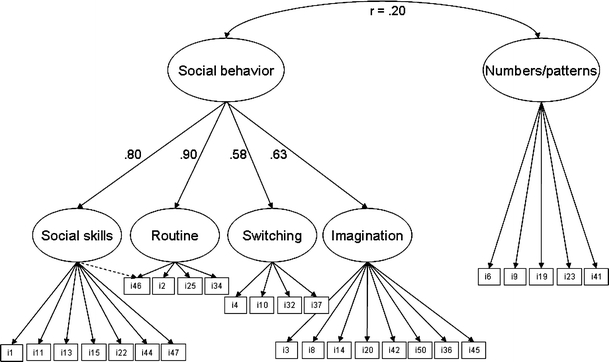
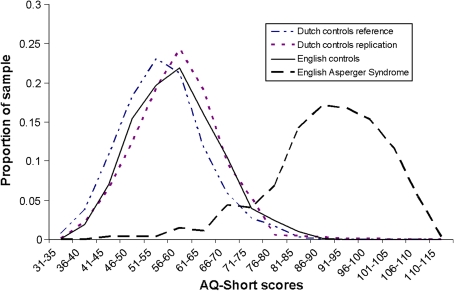
This study reports on the development and validation of an abridged version of the 50-item Autism-Spectrum Quotient (AQ), a self-report measure of autistic traits. We aimed to reduce the number of items whilst retaining high validity and a meaningful factor structure. The item reduction procedure was performed on data from 1,263 Dutch students and general population adults. The resulting 28-item AQ-Short was subsequently validated in 3 independent samples, both clinical and controls, from the Netherlands and the UK. The AQ-Short comprises two higher-order factors assessing 'social behavioral difficulties' and 'a fascination for numbers/patterns'. The clear factor structure of the AQ-Short and its high sensitivity and specificity make the AQ-Short a useful alternative to the full 50-item version.
Overview
The claims and statistics of this paper haven’t been checked yet.
Run the check — free, no account needed. It reads the open-access text and checks the sources it cites.
Integrity signals
Registry
Cites
Statistics
Figures
Verification
Claims the paper makes
The claims and statistics of this paper haven’t been checked yet.
Run the check — free, no account needed. It reads the open-access text and checks the sources it cites.
Claims other papers make about this one
Each is checked against this paper’s own text: does it say what the citing paper says it does?
The cited source doesn’t support the claim as written.
In the citing paper
“To verify the clinical diagnosis of ASD, we will use a cut-off ≥70 on the 28-item Short version of the AQ-28 [43, 44].”
From The effect of dialectical behaviour therapy in autism spectrum patients with suicidality and/or self-destructive behaviour (DIASS): Study protocol for a multicentre randomised controlled trial (2020) · cites this paper as [43]
Checked by a reasoning model — may be wrong.
Experimental — accuracy not yet measuredThe source backs part of the claim, not all of it — or backs it for a different population, condition or comparison.
In the citing paper
“A clinical cutoff score of > 65 has sensitivity of 0.97 and specificity of 0.82 for ASD (Hoekstra et al., 2011).”
From A mixed methods study of autistic adults' mental health therapy experiences (2023) · cites this paper as Hoekstra et al., 2011
Experimental — accuracy not yet measuredThe source backs part of the claim, not all of it — or backs it for a different population, condition or comparison.
In the citing paper
“The AQ-28 is scored between 28 and 72, and a cut-off score of 65 is the threshold, above which further assistance with seeking ASD diagnosis is recommended. The cut-off score has good sensitivity (0.97) and specificity (0.82). The AQ-28 also has good internal consistence (Cronbach’s alpha = 0.77–0.86).”
From Differences in anxieties and social networks in a group-matched sample of autistic and typically developing students transitioning to university (2020) · cites this paper as Hoekstra et al., 2011
Experimental — accuracy not yet measuredThe cited source says what the claim attributes to it.
In the citing paper
“Autism characteristics were assessed using the Autism Spectrum Quotient-Short (AQ-Short) (Hoekstra et al., 2011), which is an abridged 28-item version of the original 50-item AQ (Baron-Cohen et al., 2001), a continuous self-report measure of autism spectrum traits in adults.”
From A mixed methods study of autistic adults' mental health therapy experiences (2023) · cites this paper as Hoekstra et al., 2011
The cited source says what the claim attributes to it.
In the citing paper
“For TD students, the mean AQ-28 score was 64.54, which is somewhat higher than the previously reported control samples of 56–59.73 (Hoekstra et al., 2011).”
From Differences in anxieties and social networks in a group-matched sample of autistic and typically developing students transitioning to university (2020) · cites this paper as Hoekstra et al., 2011
The cited source says what the claim attributes to it.
In the citing paper
“The mean score on the Autism Quotient-28 (AQ-28) for the autistic students was 83.07, and with an exception of two students who scored 59 and 64, all students’ scores met the suggested clinical cut-off score of 65 (Hoekstra et al., 2011).”
From Differences in anxieties and social networks in a group-matched sample of autistic and typically developing students transitioning to university (2020) · cites this paper as Hoekstra et al., 2011
The cited source says what the claim attributes to it.
In the citing paper
“The AQ-Short is a reliable instrument for a quick assessment of quantitative autistic traits.”
Self-check
Percentages, sums and reported differences re-computed from the paper’s own numbers.
The self-check needs the paper’s full text.
Citations
Cites
Lord, C., Rutter, M., & Le Couteur, A. (1994) · Journal of Autism and Developmental Disorders · doi:10.1007/bf02172145 · Cited by 9,065
Schermelleh-Engel, K., Moosbrugger, H., & Müller, H. (2003) · Department of Psychology - University of Koblenz-Landau · doi:10.23668/psycharchives.12784 · Cited by 8,975
Lord, C., Risi, S., Lambrecht, L., Cook, E. H., Leventhal, B. L., DiLavore, P. C., Pickles, A., & Rutter, M. (2000) · Journal of Autism and Developmental Disorders · doi:10.1023/a:1005592401947 · Cited by 7,520
Baron-Cohen, S., Wheelwright, S., Skinner, R., Martin, J., & Clubley, E. (2001) · Journal of Autism and Developmental Disorders · doi:10.1023/a:1005653411471 · Cited by 6,450
Self-citationAutistic Traits in the General Population: A Twin Study
Constantino, J. N., & Todd, R. D. (2003) · Archives of General Psychiatry · doi:10.1001/archpsyc.60.5.524 · Cited by 1,317 · cited 2×
“Autism spectrum conditions (ASC; including autistic disorder, Asperger syndrome [AS] and pervasive developmental disorder not otherwise specified [PDD-NOS]) are now commonly conceptualized as dimensional, representing the extreme end of one or more continuously distributed traits in the general population ( Constantin…”
BackgroundWoodbury-Smith, M. R., Robinson, J., Wheelwright, S., & Baron-Cohen, S. (2005) · Journal of Autism and Developmental Disorders · doi:10.1007/s10803-005-3300-7 · Cited by 771
Self-citationHoekstra, R. A., Bartels, M., Cath, D. C., & Boomsma, D. I. (2008) · Journal of Autism and Developmental Disorders · doi:10.1007/s10803-008-0538-x · Cited by 651
Self-citationThe Autism Spectrum Quotient: Children’s Version (AQ-Child)
Bonnie Auyeung, B., Baron‐Cohen, S., Wheelwright, S. J., & Allison, C. L. (2007) · Journal of Autism and Developmental Disorders · doi:10.1007/s10803-007-0504-z · Cited by 650
Self-citationThe Autism-Spectrum Quotient (AQ)—Adolescent Version
Baron-Cohen, S., Hoekstra, R. A., Knickmeyer, R., & Wheelwright, S. (2006) · Journal of Autism and Developmental Disorders · doi:10.1007/s10803-006-0073-6 · Cited by 546
Self-citationHappé, F., & Ronald, A. (2008) · Neuropsychology Review · doi:10.1007/s11065-008-9076-8 · Cited by 498
Research works printed but not linked: 1
- Muthén, L. K., & Muthén, B. O. (2007). Mplus user’s guide (5th ed.). Los Angeles, CA: Muthén & Muthén.
Cited by
Sorted by citations
The Generation R Study: design and cohort update 2017
Kooijman, M. N., Kruithof, C. J., van Duijn, C. M., Duijts, L., Franco, O. H., van IJzendoorn, M. H., de Jongste, J. C., Klaver, C. C. W., van der Lugt, A., Mackenbach, J. P., et al. (2016) · European Journal of Epidemiology · doi:10.1007/s10654-016-0224-9 · Cited by 1,238
The Generation R Study: design and cohort update 2010
Jaddoe, V. W. V., van Duijn, C. M., van der Heijden, A. J., Mackenbach, J. P., Moll, H. A., Steegers, E. A. P., Tiemeier, H., Uitterlinden, A. G., Verhulst, F. C., & Hofman, A. (2010) · European Journal of Epidemiology · doi:10.1007/s10654-010-9516-7 · Cited by 1,027
The Generation R Study: Design and cohort update 2012
Jaddoe, V. W. V., van Duijn, C. M., Franco, O. H., van der Heijden, A. J., van IIzendoorn, M. H., de Jongste, J. C., van der Lugt, A., Mackenbach, J. P., Moll, H. A., Raat, H., et al. (2012) · European Journal of Epidemiology · doi:10.1007/s10654-012-9735-1 · Cited by 546
Bury, S. M., Jellett, R., Spoor, J. R., & Hedley, D. (2023) · Journal of Autism and Developmental Disorders · doi:10.1007/s10803-020-04425-3 · Cited by 452
Loneliness, friendship, and well-being in adults with autism spectrum disorders
Mazurek, M. O. (2014) · Autism · doi:10.1177/1362361312474121 · Cited by 401
Cassidy, S., Gould, K., Townsend, E., Pelton, M., Robertson, A., & Rodgers, J. (2019) · Journal of Autism and Developmental Disorders · doi:10.1007/s10803-019-04323-3 · Cited by 372
Kahane, G., Everett, J. A. C., Earp, B. D., Farias, M., & Savulescu, J. (2014) · Cognition · doi:10.1016/j.cognition.2014.10.005 · Cited by 351
Dewinter, J., De Graaf, H., & Begeer, S. (2017) · Journal of Autism and Developmental Disorders · doi:10.1007/s10803-017-3199-9 · Cited by 281
Distinct Subtypes of Apathy Revealed by the Apathy Motivation Index
Ang, Y., Lockwood, P. L., Apps, M. A. J., Muhammed, K., & Masud Husain, B. (2017) · PLoS ONE · doi:10.1371/journal.pone.0169938 · Cited by 256
Risk and protective factors underlying depression and suicidal ideation in Autism Spectrum Disorder
Hedley, D., Uljarević, M., Foley, K.-R., Richdale, A., & Trollor, J. (2018) · Depression and Anxiety · doi:10.1002/da.22759 · Cited by 246
Eriksson, J., Andersen, L. M. J., & Bejerot, S. (2013) · Molecular Autism · doi:10.1186/2040-2392-4-49 · Cited by 232
Buijsman, R., Begeer, S., & Scheeren, A. M. (2022) · Autism · doi:10.1177/13623613221117914 · Cited by 245
The Amsterdam Resting-State Questionnaire reveals multiple phenotypes of resting-state cognition
Diaz, B. A., Van Der Sluis, S., Moens, S., Benjamins, J. S., Migliorati, F., Stoffers, D., Den Braber, A., Poil, S.-S., Hardstone, R., Van't Ent, D., et al. (2013) · Frontiers in Human Neuroscience · doi:10.3389/fnhum.2013.00446 · Cited by 194
Self-citationLoneliness in autistic adults: A systematic review
Umagami, K., Remington, A., Lloyd‐Evans, B., Davies, J., & Crane, L. (2022) · Autism · doi:10.1177/13623613221077721 · Cited by 218
Systematic Review of Suicide in Autism Spectrum Disorder: Current Trends and Implications
Hedley, D., & Uljarević, M. (2018) · Current Developmental Disorders Reports · doi:10.1007/s40474-018-0133-6 · Cited by 176
Paediatric population neuroimaging and the Generation R Study: the second wave
White, T. J. H., Muetzel, R. L., Marroun, H. E., Blanken, L. M. E., Jansen, P. R., Bolhuis, K., Kocevska, D., Mous, S. E., Mulder, R. H., Jaddoe, V. W. V., et al. (2017) · European Journal of Epidemiology · doi:10.1007/s10654-017-0319-y · Cited by 178
Brief Report: An Evaluation of the AQ-10 as a Brief Screening Instrument for ASD in Adults
Booth, T., Murray, A. L., McKenzie, K., Kuenssberg, R., O’Donnell, M., & Burnett, H. G. (2013) · Journal of Autism and Developmental Disorders · doi:10.1007/s10803-013-1844-5 · Cited by 169
Strunz, S., Schermuck, C., Ballerstein, S., Ahlers, C. J., Dziobek, I., & Roepke, S. (2016) · Journal of Clinical Psychology · doi:10.1002/jclp.22319 · Cited by 191
Anxiety and Depression from Adolescence to Old Age in Autism Spectrum Disorder
Uljarević, M., Hedley, D., Foley, K., Magiati, I., Cai, R. Y., Dissanayake, C., Richdale, A. L., & Trollor, J. N. (2019) · Journal of Autism and Developmental Disorders · doi:10.1007/s10803-019-04084-z · Cited by 181
MYmind : Mindfulness training for Youngsters with autism spectrum disorders and their parents
de Bruin, E. I., Blom, R., Smit, F. M., van Steensel, F. J. A., & Bögels, S. M. (2014) · Autism · doi:10.1177/1362361314553279 · Cited by 197
Hedley, D., Uljarević, M., Wilmot, M., Richdale, A., & Dissanayake, C. (2018) · Research in Autism Spectrum Disorders · doi:10.1016/j.rasd.2017.11.003 · Cited by 154
Higgins, J. M., Arnold, S. R. C., Weise, J. C., Pellicano, E., & Trollor, J. N. (2021) · Autism · doi:10.1177/13623613211019858 · Cited by 161
McQuaid, G. A., Lee, N., & Wallace, G. L. (2021) · Autism · doi:10.1177/13623613211042131 · Cited by 217
Hwang, Y. I. (., Arnold, S., Srasuebkul, P., & Trollor, J. (2020) · Autism · doi:10.1177/1362361319868907 · Cited by 141
“Participants for this study included 214 autistic adults from the ALSAA who self-reported a clinical diagnosis of ASD with a score over 65 on the Autism-Spectrum Quotient-Short (AQ-short; Hoekstra et al., 2011) and 146 non-autistic adults.”
MethodHedley, D., Uljarević, M., Wilmot, M., Richdale, A. L., & Dissanayake, C. (2017) · Journal of Autism and Developmental Disorders · doi:10.1007/s10803-017-3274-2 · Cited by 152
Lawson, L. P., Richdale, A. L., Haschek, A., Flower, R. L., Vartuli, J., Arnold, S. R., & Trollor, J. N. (2020) · Autism · doi:10.1177/1362361320908107 · Cited by 138
Oomen, D., Nijhof, A. D., & Wiersema, J. R. (2021) · Molecular Autism · doi:10.1186/s13229-021-00424-y · Cited by 136
The brains of high functioning autistic individuals do not synchronize with those of others
Salmi, J., Roine, U., Glerean, E., Lahnakoski, J. M., Wendt, T. N., Tani, P., Leppämäki, S., Nummenmaa, L., Jääskeläinen, I. P., Carlson, S., et al. (2013) · NeuroImage Clinical · doi:10.1016/j.nicl.2013.10.011 · Cited by 148
Lundqvist, L., & Lindner, H. Y. N. (2017) · Journal of Autism and Developmental Disorders · doi:10.1007/s10803-017-3128-y · Cited by 148
Kentrou, V., de Veld, D. M., Mataw, K. J., & Begeer, S. (2019) · Autism · doi:10.1177/1362361318785171 · Cited by 133
The co-occurrence of autistic and ADHD dimensions in adults: an etiological study in 17 770 twins
Polderman, T. J. C., Hoekstra, R. A., Posthuma, D., & Larsson, H. (2014) · Translational Psychiatry · doi:10.1038/tp.2014.84 · Cited by 136
Self-citationStevenson, J. L., & Hart, K. R. (2017) · Journal of Autism and Developmental Disorders · doi:10.1007/s10803-017-3109-1 · Cited by 130
Banerjee, K., & Bloom, P. (2014) · Cognition · doi:10.1016/j.cognition.2014.06.017 · Cited by 129
Walsh, R. J., Krabbendam, L., Dewinter, J., & Begeer, S. (2018) · Journal of Autism and Developmental Disorders · doi:10.1007/s10803-018-3702-y · Cited by 142
Participant carelessness and fraud: Consequences for clinical research and potential solutions.
Chandler, J., Sisso, I., & Shapiro, D. N. (2019) · Journal of Abnormal Psychology · doi:10.1037/abn0000479 · Cited by 124
Zhang, L., Sun, Y., Chen, F., Wu, D., Tang, J., Han, X.-P., Ye, J., & Wang, K. (2016) · BMC Psychiatry · doi:10.1186/s12888-016-0915-5 · Cited by 132
Loneliness in Adults on the Autism Spectrum
Ee, D., Hwang, Y. I., Reppermund, S., Srasuebkul, P., Trollor, J. N., Foley, K., & Arnold, S. R. C. (2019) · Autism in Adulthood · doi:10.1089/aut.2018.0038 · Cited by 123
Cai, R. Y., Richdale, A. L., Dissanayake, C., & Uljarević, M. (2018) · Journal of Autism and Developmental Disorders · doi:10.1007/s10803-017-3318-7 · Cited by 107
Brosnan, M., Chapman, E., & Ashwin, C. (2013) · Journal of Autism and Developmental Disorders · doi:10.1007/s10803-013-1897-5 · Cited by 108
Arnold, S. R. C., Uljarević, M., Hwang, Y. I., Richdale, A. L., Trollor, J. N., & Lawson, L. P. (2019) · Journal of Autism and Developmental Disorders · doi:10.1007/s10803-019-03947-9 · Cited by 101
Aldridge, Z., Patel, S., Guo, B., Nixon, E., Bouman, W. P., Witcomb, G. L., & Arcelus, J. (2020) · Andrology · doi:10.1111/andr.12884 · Cited by 106
Dijk, H. M. H., van de Schoot, R., Rijkeboer, M. M., Mathews, C. A., & Cath, D. C. (2016) · Psychiatry Research · doi:10.1016/j.psychres.2016.01.051 · Cited by 107
Pelton, M., Crawford, H., Robertson, A., Rodgers, J., Baron‐Cohen, S., & Cassidy, S. (2020) · Journal of Autism and Developmental Disorders · doi:10.1007/s10803-020-04393-8 · Cited by 119
Self-citationMichelini, G., Carlisi, C. O., Eaton, N. R., Elison, J. T., Haltigan, J. D., Kotov, R., Krueger, R. F., Latzman, R. D., Li, J. J., Levin-Aspenson, H. F., et al. (2024) · World Psychiatry · doi:10.1002/wps.21225 · Cited by 109
Baghdadli, A., Russet, F., & Mottron, L. (2017) · European Psychiatry · doi:10.1016/j.eurpsy.2017.04.009 · Cited by 109
School participation of autistic youths: The influence of youth, family and school factors
Li, B., Heyne, D. A., Scheeren, A. M., Blijd-Hoogewys, E. M. A., & Rieffe, C. J. (2024) · Autism · doi:10.1177/13623613231225490 · Cited by 93
Belief changes associated with psychedelic use
Nayak, S. M., Singh, M., Yaden, D. B., & Griffiths, R. R. (2022) · Journal of Psychopharmacology · doi:10.1177/02698811221131989 · Cited by 96
Gender differences in mental health prevalence in autism
Sedgewick, F., Leppänen, J., & Tchanturia, K. (2020) · Advances in Autism · doi:10.1108/aia-01-2020-0007 · Cited by 108
Roestorf, A., Bowler, D. M., Deserno, M. K., Howlin, P., Klinger, L., McConachie, H., Parr, J. R., Powell, P., Van Heijst, B. F. C., & Geurts, H. M. (2019) · Research in Autism Spectrum Disorders · doi:10.1016/j.rasd.2018.08.007 · Cited by 87
Autistic traits in adults who have attempted suicide
Richards, G., Kenny, R., Griffiths, S., Allison, C. L., Mosse, D., Holt, R., O’Connor, R. C., Cassidy, S., & Baron‐Cohen, S. (2019) · Molecular Autism · doi:10.1186/s13229-019-0274-4 · Cited by 89
Self-citationUnderstanding language preference: Autism knowledge, experience of stigma and autism identity
Bury, S., Jellett, R., Haschek, A., Wenzel, M., Hedley, D., & Spoor, J. (2022) · Autism · doi:10.1177/13623613221142383 · Cited by 74
Uljarević, M., Richdale, A. L., McConachie, H., Hedley, D., Cai, R. Y., Merrick, H., Parr, J. R., & Le Couteur, A. (2018) · Autism Research · doi:10.1002/aur.1872 · Cited by 85
People With Autism Spectrum Conditions Make More Consistent Decisions
Farmer, G., Baron‐Cohen, S., & Skylark, W. J. (2017) · Psychological Science · doi:10.1177/0956797617694867 · Cited by 91
Self-citationKanne, S. M., Wang, J., & Christ, S. E. (2011) · Journal of Autism and Developmental Disorders · doi:10.1007/s10803-011-1308-8 · Cited by 83
Nishiyama, T., Suzuki, M., Adachi, K., Sumi, S., Okada, K., Kishino, H., Sakai, S., Kamio, Y., Kojima, M., Suzuki, S., et al. (2013) · Journal of Autism and Developmental Disorders · doi:10.1007/s10803-013-2020-7 · Cited by 83
Cassidy, S., Bradley, L., Cogger-Ward, H., & Rodgers, J. (2021) · Molecular Autism · doi:10.1186/s13229-021-00449-3 · Cited by 84
English, M. C. W., Gignac, G. E., Visser, T. A. W., Whitehouse, A., & Maybery, M. T. (2019) · Autism Research · doi:10.1002/aur.2198 · Cited by 91
Does mindfulness meditation increase empathy? An experiment
Ridderinkhof, A., de Bruin, E. I., Brummelman, E., & Bögels, S. M. (2017) · Self and Identity · doi:10.1080/15298868.2016.1269667 · Cited by 87
Religious Cognition and Behaviour in Autism: The Role of Mentalizing
Reddish, P., Tok, P., & Kundt, R. (2015) · International Journal for the Psychology of Religion · doi:10.1080/10508619.2014.1003518 · Cited by 86
Sizoo, B. B., Horwitz, E., Teunisse, J., Kan, C., Vissers, C., Forceville, E., Van Voorst, A., & Geurts, H. (2015) · Autism · doi:10.1177/1362361315589869 · Cited by 77
Uljarević, M., Richdale, A. L., Evans, D. W., Cai, R. Y., & Leekam, S. (2017) · Molecular Autism · doi:10.1186/s13229-017-0158-4 · Cited by 89
Brosnan, M., & Mills, E. A. (2015) · Autism · doi:10.1177/1362361315586721 · Cited by 76
Hedley, D., Uljarević, M., Bury, S. M., & Dissanayake, C. (2019) · Autism Research · doi:10.1002/aur.2064 · Cited by 84
Social support and links to quality of life among middle-aged and older autistic adults
Charlton, R. A., McQuaid, G. A., & Wallace, G. L. (2022) · Autism · doi:10.1177/13623613221081917 · Cited by 75
Hymas, R., Badcock, J. C., & Milne, E. (2022) · Review Journal of Autism and Developmental Disorders · doi:10.1007/s40489-022-00330-w · Cited by 81
Perceived misdiagnosis of psychiatric conditions in autistic adults
Kentrou, V., Livingston, L. A., Grove, R., Hoekstra, R. A., & Begeer, S. (2024) · EClinicalMedicine · doi:10.1016/j.eclinm.2024.102586 · Cited by 94
Self-citationDiverse Cognitive Profiles of Religious Believers and Nonbelievers
Lindeman, M., & Lipsanen, J. O. (2016) · International Journal for the Psychology of Religion · doi:10.1080/10508619.2015.1091695 · Cited by 78
Lundin, A., Kosidou, K., & Dalman, C. (2018) · Journal of Autism and Developmental Disorders · doi:10.1007/s10803-018-3749-9 · Cited by 80
Emotion regulation in autism: reappraisal and suppression interactions
Cai, R. Y., Richdale, A. L., Dissanayake, C., Trollor, J., & Uljarević, M. (2019) · Autism · doi:10.1177/1362361318774558 · Cited by 71
Mediators of the Link Between Autistic Traits and Relationship Satisfaction in a Non-Clinical Sample
Pollmann, M. M. H., Finkenauer, C., & Begeer, S. (2009) · Journal of Autism and Developmental Disorders · doi:10.1007/s10803-009-0888-z · Cited by 73
Measuring Empathizing and Systemizing with a Large US Sample
Wright, D. B., & Skagerberg, E. M. (2012) · PLoS ONE · doi:10.1371/journal.pone.0031661 · Cited by 72
Murray, A. L., Booth, T., McKenzie, K., Kuenssberg, R., & O’Donnell, M. (2013) · Journal of Autism and Developmental Disorders · doi:10.1007/s10803-013-1851-6 · Cited by 70
Finkenauer, C., Pollmann, M. M. H., Begeer, S., & Kerkhof, P. (2012) · Journal of Autism and Developmental Disorders · doi:10.1007/s10803-012-1465-4 · Cited by 71
Sleep Quality in Autism from Adolescence to Old Age
Jovevska, S., Richdale, A. L., Lawson, L. P., Uljarević, M., Arnold, S. R. C., & Trollor, J. N. (2020) · Autism in Adulthood · doi:10.1089/aut.2019.0034 · Cited by 63
Costa, A. P., Loor, C., & Steffgen, G. (2020) · Journal of Autism and Developmental Disorders · doi:10.1007/s10803-020-04433-3 · Cited by 62
Autistic Traits in Treatment-Seeking Transgender Adults
Nobili, A., Glazebrook, C., Bouman, W. P., Glidden, D., Baron‐Cohen, S., Allison, C. L., Smith, P. L., & Arcelus, J. (2018) · Journal of Autism and Developmental Disorders · doi:10.1007/s10803-018-3557-2 · Cited by 60
Self-citationAttentional switching forms a genetic link between attention problems and autistic traits in adults
Polderman, T. J. C., Hoekstra, R. A., Vinkhuyzen, A. A. E., Sullivan, P. F., van der Sluis, S., & Posthuma, D. (2012) · Psychological Medicine · doi:10.1017/s0033291712002863 · Cited by 65
Self-citationLeisure participation and satisfaction in autistic adults and neurotypical adults
Stacey, T.-L., Froude, E., Trollor, J. N., & Foley, K. (2018) · Autism · doi:10.1177/1362361318791275 · Cited by 69
Confirming the nature of autistic burnout
Arnold, S. R. C., Higgins, J. M., Weise, J., Desai, A., Pellicano, E., & Trollor, J. (2023) · Autism · doi:10.1177/13623613221147410 · Cited by 48
Cohort profile: the Australian Longitudinal Study of Adults with Autism (ALSAA)
Arnold, S. R. C., Foley, K., Hwang, Y. I., Richdale, A. L., Uljarević, M., Lawson, L. P., Cai, R. Y., Falkmer, T., Falkmer, M., Lennox, N., et al. (2019) · BMJ Open · doi:10.1136/bmjopen-2019-030798 · Cited by 61
Autism and depression are connected: A report of two complimentary network studies
van Heijst, B. F., Deserno, M. K., Rhebergen, D., & Geurts, H. M. (2020) · Autism · doi:10.1177/1362361319872373 · Cited by 57
Sleep, Sensory Integration/Processing, and Autism: A Scoping Review
Lane, S. J., Leão, M. A., & Spielmann, V. (2022) · Frontiers in Psychology · doi:10.3389/fpsyg.2022.877527 · Cited by 74
Exploring sex differences in autistic traits: A factor analytic study of adults with autism
Grove, R., Hoekstra, R., Wierda, M., & Begeer, S. (2017) · Autism · doi:10.1177/1362361316667283 · Cited by 54
Self-citationEmotion recognition ability: Evidence for a supramodal factor and its links to social cognition.
Connolly, H. L., Lefevre, C., Young, A., & Lewis, G. J. (2020) · Cognition · doi:10.1016/j.cognition.2019.104166 · Cited by 52
Murray, A. L., Booth, T., McKenzie, K., & Kuenssberg, R. (2015) · Psychological Assessment · doi:10.1037/pas0000215 · Cited by 56
Variable Emergence of Autism Spectrum Disorder Symptoms From Childhood to Early Adulthood
Riglin, L., Wootton, R. E., Thapar, A. K., Livingston, L. A., Langley, K., Collishaw, S., Tagg, J., Smith, G. D., Stergiakouli, E., Tilling, K. M., et al. (2021) · American Journal of Psychiatry · doi:10.1176/appi.ajp.2020.20071119 · Cited by 57
Employment profiles of autistic adults in Australia
Harvery, M., Froude, E., Foley, K., Trollor, J. N., & Arnold, S. R. C. (2021) · Autism Research · doi:10.1002/aur.2588 · Cited by 62
Hyperfocus or flow? Attentional strengths in autism spectrum disorder
Dupuis, A., Mudiyanselage, P. K., Burton, C. L., Arnold, P. D., Crosbie, J., & Schachar, R. J. (2022) · Frontiers in Psychiatry · doi:10.3389/fpsyt.2022.886692 · Cited by 56
Cai, R. Y., Richdale, A. L., Dissanayake, C., & Uljarević, M. (2018) · International Journal of Psychophysiology · doi:10.1016/j.ijpsycho.2018.12.010 · Cited by 55
Stability of co-occurring psychiatric diagnoses in autistic men and women
Kentrou, V., Oostervink, M., Scheeren, A. M., & Begeer, S. (2021) · Research in Autism · doi:10.1016/j.rasd.2021.101736 · Cited by 62
Riddiford, J. A., Enticott, P. G., Lavale, A., & Gurvich, C. (2022) · Autism Research · doi:10.1002/aur.2729 · Cited by 65
Towards the measurement of autistic burnout
Arnold, S. R. C., Higgins, J. M., Weise, J. C., Desai, A., Pellicano, E., & Trollor, J. N. (2023) · Autism · doi:10.1177/13623613221147401 · Cited by 64
Autism spectrum disorder and sexual offending: Responsivity in forensic interventions
Higgs, T., & Carter, A. J. (2015) · Aggression and Violent Behavior · doi:10.1016/j.avb.2015.04.003 · Cited by 58
Armstrong, K., & Iarocci, G. (2013) · Journal of Autism and Developmental Disorders · doi:10.1007/s10803-013-1769-z · Cited by 58
Hohn, V. D., de Veld, D. M. J., Mataw, K. J. S., van Someren, E. J. W., & Begeer, S. (2019) · Journal of Autism and Developmental Disorders · doi:10.1007/s10803-019-03891-8 · Cited by 52
McQuaid, G. A., Weiss, C. H. H., Said, A. J., Pelphrey, K. A., Lee, N., & Wallace, G. L. (2022) · Autism Research · doi:10.1002/aur.2779 · Cited by 51
Employment profiles of autistic people: An 8-year longitudinal study
Bury, S. M., Hedley, D., Uljarević, M., Li, X., Stokes, M. A., & Begeer, S. (2024) · Autism · doi:10.1177/13623613231225798 · Cited by 52
Career progression for autistic people: A scoping review
Davies, J., Romualdez, A. M., Pellicano, E., & Remington, A. (2024) · Autism · doi:10.1177/13623613241236110 · Cited by 52
The empathy impulse: A multinomial model of intentional and unintentional empathy for pain.
Cameron, C. D., Spring, V. L., & Todd, A. R. (2017) · Emotion · doi:10.1037/emo0000266 · Cited by 52
Huntjens, A., van den Bosch, L. M. C. W., Sizoo, B., Kerkhof, A., Huibers, M. J. H., & van der Gaag, M. (2020) · BMC Psychiatry · doi:10.1186/s12888-020-02531-1 · Cited by 50
Metadata
- Authors
- Hoekstra, R. A., Vinkhuyzen, A. A. E., Wheelwright, S., Bartels, M., Boomsma, D. I., Baron-Cohen, S., Posthuma, D., & van der Sluis, S.
- Affiliations
- The Open University (GB)
- Vrije Universiteit Amsterdam (NL)
- University of Cambridge (GB)
- Corresponding author
- Hoekstra, Rosa A.
- Venue
- Journal of Autism and Developmental Disorders
- Published
- 2010-08-10
- Volume
- 41
- Issue
- 5
- Pages
- 589-596
- ISSN
- 0162-3257 (ISSN-L)
- 1573-3432
- PMC
- PMC3076581
- OpenAlex
- W2130501331
- Cited by
- 506
- References
- 22
- Citations by year
- 2026: 42 · 2025: 45 · 2024: 47 · 2023: 66 · 2022: 59 · 2021: 70 · 2020: 34 · 2019: 33 · 2018: 27 · 2017: 22 · 2016: 14 · 2015: 16 · 2014: 6 · 2013: 16 · 2012: 5
- FWCI
- 4.64
- Type
- journal article
- Language
- en
- Open access
- hybrid
- doi.org
- Licence
- cc-by-nc
- Locations
- Journal of Autism and Developmental Disorders (publishedVersion, cc-by-nc)
- PubMed Central (publishedVersion, cc-by-nc)
- PubMed (publishedVersion)
- Research Portal (King's College London) (publishedVersion, other-oa)
- Amsterdam UMC (VU Amsterdam) - Institutional Repository (publishedVersion, other-oa)
- VU Research Portal (publishedVersion, other-oa)
- Open Research Online (The Open University) (acceptedVersion)
- Pure Amsterdam UMC (submittedVersion, other-oa)
- Digital Academic REpository of VU University Amsterdam (Vrije Universiteit Amsterdam) (submittedVersion)
- Data Archiving and Networked Services (DANS) (submittedVersion, other-oa)
- Funders
- National Institute for Health and Care Research
- Nederlandse Organisatie voor Wetenschappelijk Onderzoek (NWO/ SPI 56-464-14192, NWO 575-25-006, 56‐464‐14192, 451-08-025, VENI-451-08-025, Spi-56-464-14192, VIDI-016-065-318, 14192, 575-25-006)
- Medical Research Council
- Topics
- Life Sciences › Neuroscience › Cognitive Neuroscience › Autism Spectrum Disorder Research
- Social Sciences › Decision Sciences › Management Science and Operations Research › Psychometric Methodologies and Testing
- Social Sciences › Psychology › Experimental and Cognitive Psychology › Anxiety, Depression, Psychometrics, Treatment, Cognitive Processes
- Keywords
- Autism Spectrum Quotient, autistic traits, item reduction, self-report measures, factor structure, sensitivity and specificity, autism spectrum disorder
- MeSH terms
- Child, Child Development Disorders, Pervasive, Factor Analysis, Statistical, Humans, Psychometrics, Surveys and Questionnaires, Sensitivity and Specificity, Social Behavior, Reproducibility of Results, Young Adult, Self Report, Diagnostic Self Evaluation
About these checks
Registry, retraction, Cites and statistics results are computed, not judged, with one exception: a printed reference that no index lists is read once by a model before it counts as a citation error. Claims are extracted by a model and kept only when their quote appears verbatim in the text; each cited source is then checked, with a model’s help, for whether it says what the claim relies on. Those verdicts can be wrong — read the claim’s quote and the cited source before relying on one.
Statistics and arithmetic are recomputed, not judged.
Confidence bands are shown only for fields calibrated on our annotated test set. None is calibrated yet, so no band is shown.
What counts as a claim ›How we measure confidence ›How we check this ›
Are you an author, or do you see a problem with this page? Request a review
